
Life, 1921-03-24 · page 25 of 34
Life — March 24, 1921 — page 25: what you’re looking at
What you’re looking at
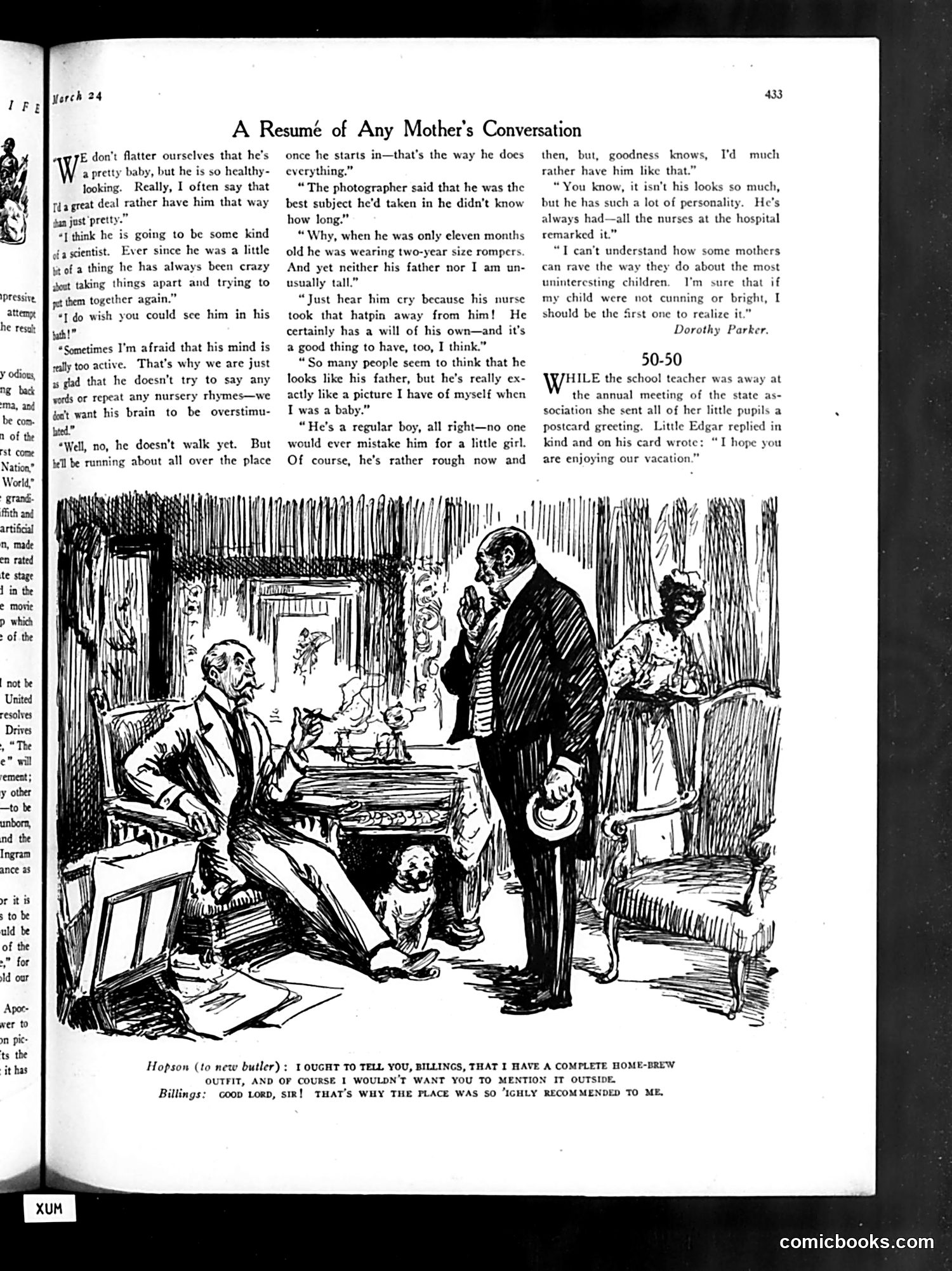
This is a satirical piece by Dorothy Parker mocking mothers who obsessively brag about their babies. The text presents a monologue of a self-deluded mother making contradictory claims: her child is healthy (not pretty), intellectually gifted yet needing brain rest, won't walk but will run everywhere, resembles her not the father, has exceptional personality, and is perfectly behaved despite being "rough." The humor lies in Parker's exposure of maternal vanity and the clichéd, often absurd praise mothers heap on unremarkable children. The piece ridicules how mothers convince themselves their ordinary babies are exceptional through selective perception. The accompanying cartoon and "50-50" joke (child assumes teacher's vacation is shared with students) are lighter, unrelated humor pieces. The bottom cartoon references Prohibition-era home brewing, a topical concern when alcohol was illegal.
📄 Transcribed text from this page (OCR, searchable)
Machine-transcribed from the original scan — historical spelling and the odd misread are preserved.
TF IPressive, attemy, he result y odious, | not be United resolves of it is s to be uld be of the verch 24 A Resume of Any Mother's Conversation E don’t flatter ourselves that he’s apretty baby, but he is so healthy- looking. Really, I often say that [da great deal rather have him that way an just pret “[ think he is going to be some kind ejascentist. Ever since he was a little tof a thing he has always been crazy goat taking things apart and trying to pt them together again.” *I do wish you could sce him in his ath!” “Sometimes I'm afraid that his mind is rally too active. That's why we are just 3s lad that he doesn’t try to say any words or repeat any nursery rhymes—we fect want his brain to be overstimu- bed” “Well, no, he doesn’t walk yet. But tell be running about all over the place once he starts in—that’s the way he does everything.” “The photographer said that he was the best subject he'd taken in he didn’t know how long.” “Why, when he was only eleven months old he was wearing two-year size rompers And yet neither his father nor I am un- usually tall.” “Just hear him cry because his nurse took that hatpin away from him! He certainly has a will of his own—and it's a good thing to have, too, I think.” “So many people seem to think that he looks like his father, but he's really ex- actly like a picture I have of myself when I was a baby.” “He's a regular boy, all right—no one would ever mistake him for a little girl. Of course, he’s rather rough now and i 4 then, but, goodness knows, I'd much rather have him like that.” “You know, it isn't his looks so much, but he has such a lot of personality. He's always had—all the nurses at the hospital remarked it.” “T can't understand how some mothers can rave the way they do about the most uninteresting children. I'm sure that if my child were not cunning or bright, I should be the first one to realize it.” Dorothy Parker. 50-50 HILE the school teacher was away at the annual meeting of the state as- sociation she sent all of her little pupils a postcard greeting. Little Edgar replied in kind and on his card wrote: “I hope you are enjoying our vacation.” (NV at Hall oN Hopson (to new butler) : 1 OUGHT TO TELL YOU, BILLINGS, THAT I HAVE A COMPLETE HOME-BREW OUTFIT, AND OF COURSE I WOULDN'T WANT YOU TO MENTION IT OUTSIDE. Billings: coop Lorp, sir! THAT'S WHY THE PLACE WAS SO ’IGHLY RECOMMENDED TO ME. comicbooks.com