
Life, 1921-03-24 · page 17 of 34
Life — March 24, 1921 — page 17: what you’re looking at
What you’re looking at
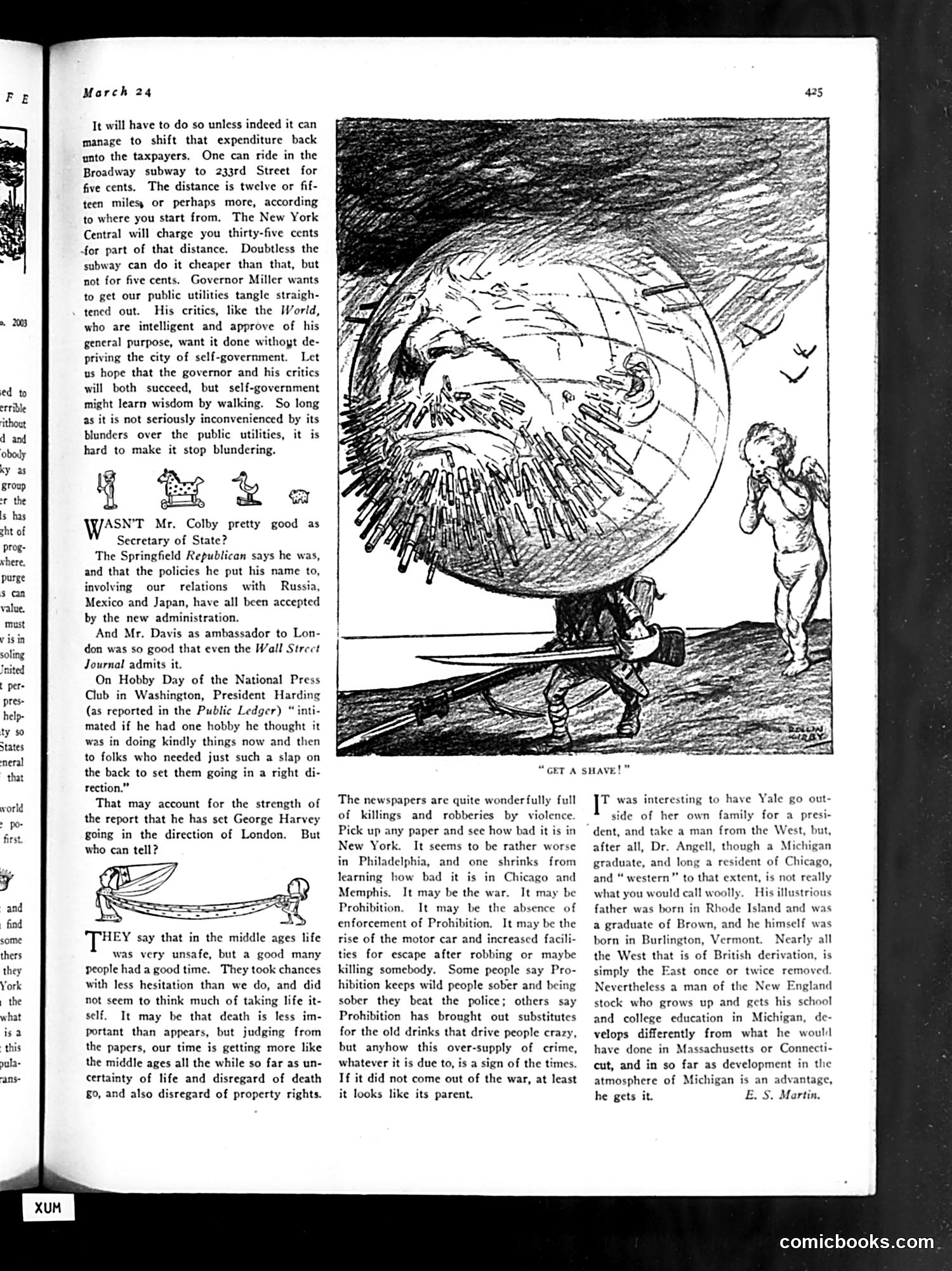
This page contains political commentary and satire typical of Life's early 1920s editorial content. **Main Cartoon ("Get a Shave!"):** A cherub or cupid figure appears to be shaving or trimming a large, bearded male head. The cartoon likely satirizes a political or public figure, though the specific identity isn't definitively clear from the image alone. **Text Commentary:** The page discusses several topics: 1. **Governor Miller's utilities reform** in New York, criticizing the contradiction between five-cent subway fares and higher railroad charges 2. **Secretary of State Colby and Ambassador Davis** — praised for continuing policies from the previous administration regarding Russia, Mexico, and Japan 3. **President Harding's "hobby"** — sarcastically noting his supposed kindness to people, with veiled criticism about appointment of George Harvey as ambassador to London 4. **Crime and Prohibition** — extensive discussion of rising violence and robberies, debating whether Prohibition, the war, or motor vehicles caused increased lawlessness 5. **Yale's new president** — Dr. Angell, praised as bringing Western perspective despite Eastern family roots The overall tone is sophisticated political mockery aimed at early Harding administration policies.
📄 Transcribed text from this page (OCR, searchable)
Machine-transcribed from the original scan — historical spelling and the odd misread are preserved.
ed to errible d and oboly KY 2s group or the Is has ght of prog vhere, purge scan value. must y is in soling Jnited t pers pres- help- ty $0 States neral that world March 24 It will have to do so unless indeed it can manage to shift that expenditure back unto the taxpayers. One can ride in the Broadway subway to 233rd Street for five cents. The distance is twelve or fif- teen milesy or perhaps more, according to where you start from. The New York Central will charge you thirty-five cents -for part of that distance. Doubtless the subway can do it cheaper than that, but not for five cents. Governor Miller wants to get our public utilities tangle straigh- tened out. His critics, like the World, who are intelligent and approve of his general purpose, want it done withoyt de- priving the city of self-government. Let us hope that the governor and his critics will both succeed, but self-government might learn wisdom by walking. So long as it is not seriously inconvenienced by its blunders over the public utilities, it is hard to make it stop blundering. { & be 'ASN’T Mr. Colby pretty good as Secretary of State? The Springfield Republican says he was, and that the policies he put his name to, involving our relations with Russia, Mexico and Japan, have all been accepted by the new administration. And Mr. Davis as ambassador to Lon- don was so good that even the Wall Strect Journal admits it. On Hobby Day of the National Press Club in Washington, President Harding (as reported in the Public Ledger) “ inti- mated if he had one hobby he thought it was in doing kindly things now and then to folks who needed just such a slap on the back to set them going in a right di- rection.” That may account for the strength of the report that he has set George Harvey going in the direction of London. But who can tell? was very unsafe, but a good many people had a good time. They took chances with less hesitation than we do, and did not seem to think much of taking life it- self. It may be that death is less im- portant than appears, but judging from the papers, our time is getting more like the middle ages all the while so far as un- certainty of life and disregard of death g0, and also disregard of property rights. “GET A sHAvE!” The newspapers are quite wonderfully full of killings and robberies by violence. Pick up any paper and see how bad it is in New York. It seems to be rather worse in Philadelphia, and one shrinks from learning how bad it is in Chicago and Memphis. It may be the war. It may be Prohibition. It may be the absence of enforcement of Prohibition. It may be the rise of the motor car and increased facili- ties for escape after robbing or maybe killing somebody. Some people say Pro- hibition keeps wild people sober and being sober they beat the police; others say Prohibition has brought out substitutes for the old drinks that drive people crazy, but anyhow this over-supply of crime, whatever it is due to, is a sign of the times. If it did not come out of the war, at least it looks like its parent. T was interesting to have Yale go out- side of her own family for a presi- dent, and take a man from the West, but, after all, Dr. Angell, though a Michigan graduate, and long a resident of Chicago, and “ western” to that extent, is not really what you would call woolly. His illustrious father was born in Rhode Island and was a graduate of Brown, and he himself was born in Burlington, Vermont. Nearly all the West that is of British deri simply the East once or twice removed. Nevertheless a man of the New England stock who grows up and gets his school and college education in Michigan, de- velops differently from what he would have done in Massachusetts or Connecti- cut, and in so far as development in the atmosphere of Michigan is an advantage, he gets it. E. S. Martin. comicbooks.com