
Life, 1921-03-24 · page 16 of 34
Life — March 24, 1921 — page 16: what you’re looking at
What you’re looking at
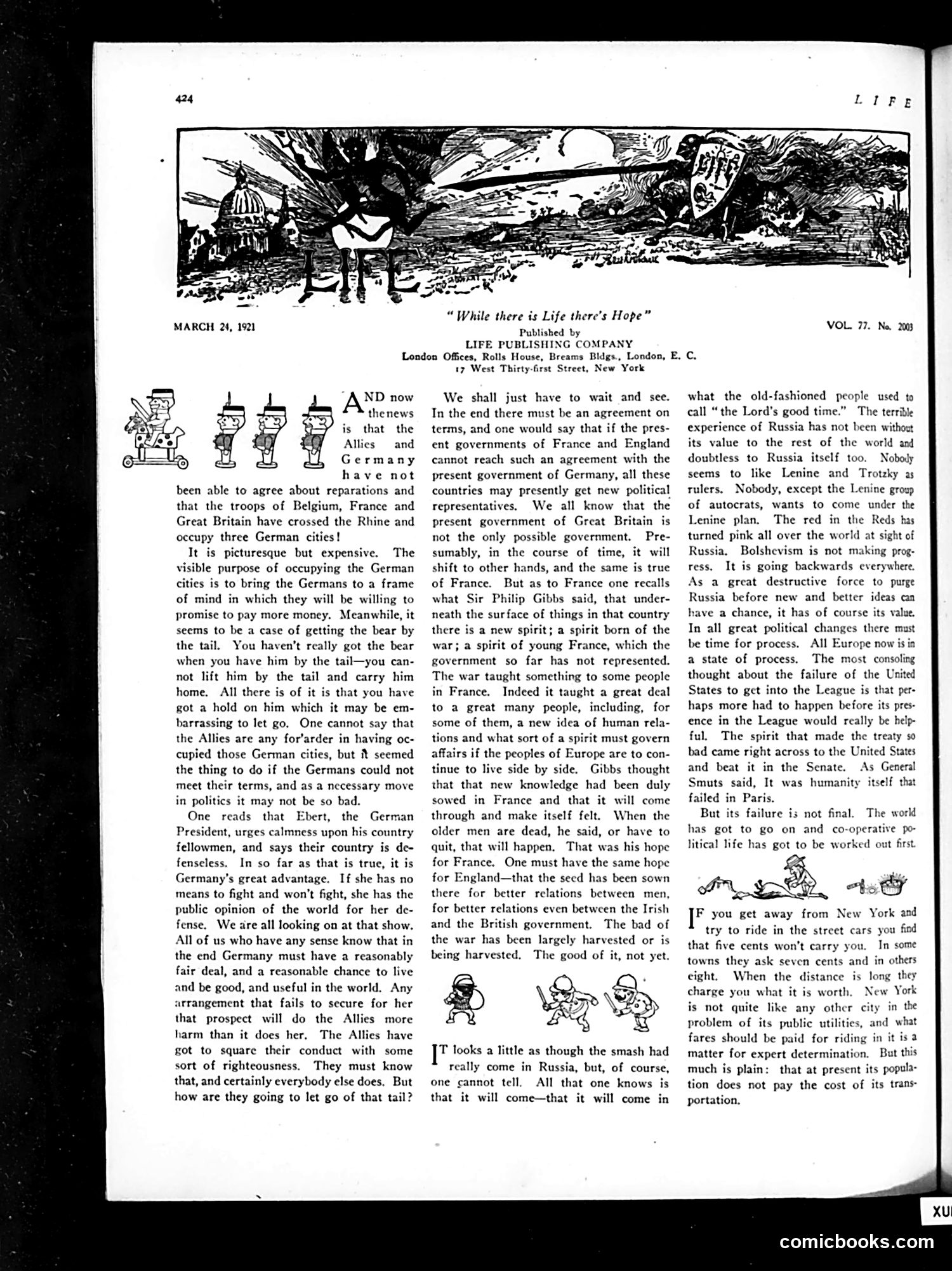
The main cartoon depicts **four figures in military/diplomatic dress** representing the Allied powers (the four soldiers with helmets at top left appear to represent Britain, France, America, and Germany in the context of post-WWI negotiations). The article discusses **post-war reparations and German occupation** by Allied troops. It references debates over whether Germany can afford reparations, mentions **Lenin, Trotsky, and Bolshevism** as threats to European stability, and criticizes the failed League of Nations treaty ratification in the U.S. Senate. The satirical point: The Allies occupied German cities but cannot agree on fair terms; meanwhile, political instability spreads across Europe. The cartoon suggests the occupying powers are squabbling children rather than serious negotiators addressing continental crises. A separate joke about NYC streetcar fares appears at bottom.
📄 Transcribed text from this page (OCR, searchable)
Machine-transcribed from the original scan — historical spelling and the odd misread are preserved.
MARCH 24, 1921 “While there is Life there’s Hope” Published by LIFE PUBLISHING COMPANY London Offices, Rolls House, Breams Bldgs, London, VD now thenews is that the Allies and Germany have not been able to agree about reparations and that the troops of Belgium, France and Great Britain have crossed the Rhine and occupy three German cities! It is picturesque but expensive. The visible purpose of occupying the German cities is to bring the Germans to a frame of mind in which they will be willing to promise to pay more money. Meanwhile, it seems to be a case of getting the bear by the tail. You haven't really got the bear when you have him by the tail—you can- not lift him by the tail and carry him home. All there is of it is that you have got a hold on him which it may be em- barrassing to let go, One cannot say that the Allies are any for’arder in having oc- cupied those German cities, but it seemed the thing to do if the Germans could not meet their terms, and as a necessary move in politics it may not be so bad. One reads that Ebert, the German President, urges calmness upon his country fellowmen, and says their country is de- fenseless, In so far as that is true, it is Germany's great advantage. If she has no means to fight and won't fight, she has the public opinion of the world for her de- fense. We are all looking on at that show. All of us who have any sense know that in the end Germany must have a reasonably fair deal, and a reasonable chance to live and be good, and useful in the world. Any arrangement that fails to secure for her that prospect will do the Allies more harm than it does her, The Allies have got to square their conduct with some sort of righteousness. They must know that, and certainly everybody else does, But how are they going to let go of that tail? 17 West Thirty-first Street, New York We shall just have to wait and see. In the end there must be an agreement on terms, and one would say that if the pres- ent governments of France and England cannot reach such an agreement with the present government of Germany, all these countries may presently get new political representatives, We all know that the present government of Great Britain is not the only possible government. Pre- sumably, in the course of time, it will shift to other hands, and the same is true of France. But as to France one recalls what Sir Philip Gibbs said, that under- neath the surface of things in that country there is a new spirit; a spirit born of the war; a spirit of young France, which the government so far has not represented. The war taught something to some people in France. Indeed it taught a great deal to a great many people, including, for some of them, a new idea of human rela- tions and what sort of a spirit must govern affairs if the peoples of Europe are to con- tinue to live side by side. Gibbs thought that that new knowledge had been duly sowed in France and that it will come through and make itself felt. When the older men are dead, he said, or have to quit, that will happen, That was his hope for France. One must have the same hope for England—that the seed has been sown there for better relations between for better relations even between the Irish and the British government. The bad of the war has been largely harvested or is being harvested, The good of it, not yet. > B i looks a little as though the smash had really come in Russia, but, of course, one cannot tell. All that one knows is that it will come—that it will come in men, VOL. 77. No. 203 E.C. what the old-fashioned people used to call “the Lord's good time.” The terrible experience of Russia has not been withost its value to the rest of the world and doubtless to Russia itself too. Nobody seems to like Lenine and Trotzky as rulers. Nobody, except the Lenine group of autocrats, wants to come under the Lenine plan, The red in the Reds has turned pink all over the world a ht of Russia. Bolshevism is not making prog- ress. It is going backwards everywhere. As a great destructive force to purge Russia before new and better ideas can have a chance, it has of course its value, In all great political changes there must be time for process. All Europe now is in a state of process. The most consoling thought about the failure of the United States to get into the League is that per- haps more had to happen before its pres- ence in the League would really be help- ful. The spirit that made the treaty so bad came right across to the United States and beat it in the Senate. As General Smuts said, It was humanity itself that failed in Paris. But its failure is not final. The world has got to go on and co-operative po- litical life has got to be worked out first. Py Oh tty IF you get away from New York and try to ride in the street cars you find In some that five cents won't carry you. towns they ask seven cents and in others cight. When the distance is long they charge you what it is worth, New York is not quite like any other city in the problem of its public utilities, and what fares should be paid for riding in it is 2 matter for expert determination. But this much is plain: that at present its popula- tion does not pay the cost of its trans- portation, comicbooks.com