
A complete issue · 44 pages · 1920
Life — December 23, 1920
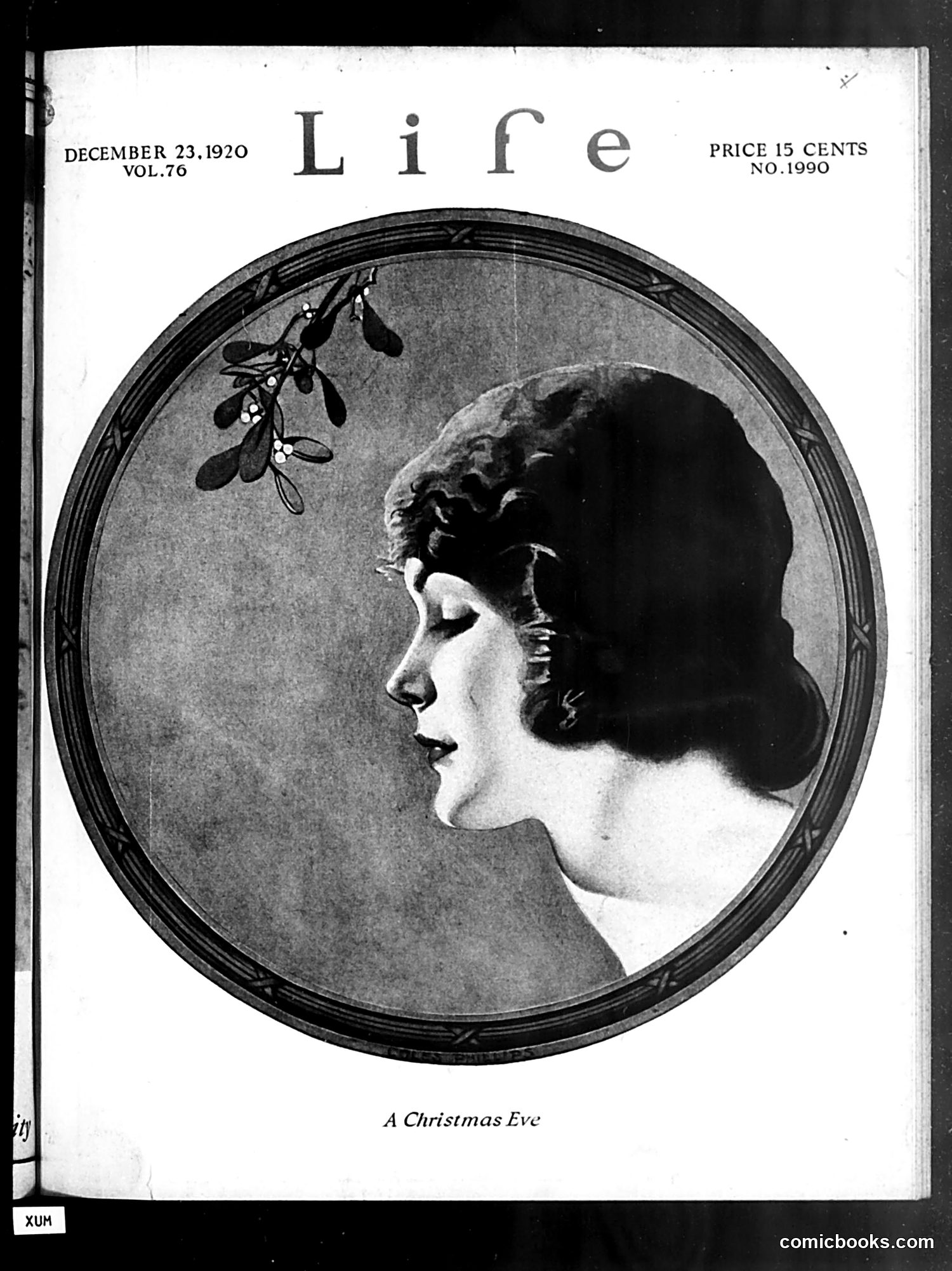
This cover features a profile portrait of a woman in an oval frame with mistletoe above, titled "A Christmas Eve." The image appears to be a sentimental, non-satirical holiday illustration rather than political satire. The classical oval framing and romantic mistletoe detail suggest this is a romanticized portrait—possibly of an actress, society figure, or idealized woman meant to evoke Christmas sentiment. The styling and composition are typical of Life's cover art from this era, which often blended humor with genteel aesthetics. Without additional context or caption text identifying the specific subject, the exact satirical intent (if any) remains unclear. This appears primarily decorative rather than directly satirical.
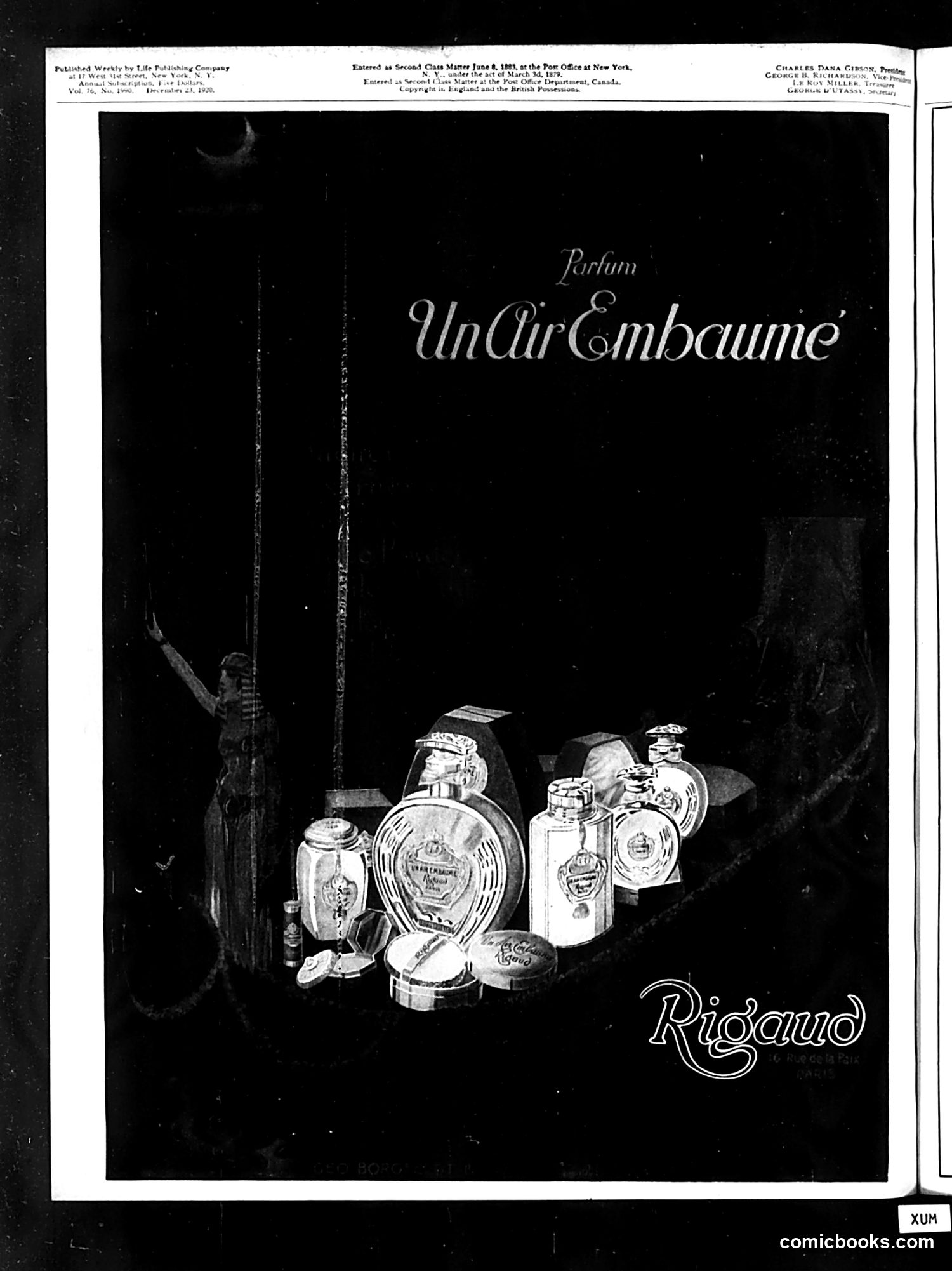
This page is primarily an **advertisement for Rigaud perfume**, not political satire. The image shows various Rigaud fragrance bottles and containers arranged dramatically against a dark background, with the French text "Parfum Un Clair Embaumé" (describing a clear, fragrant perfume) at the top and the brand name "Rigaud" at the bottom. The aesthetic is typical of 1920s luxury advertising—using theatrical lighting and artistic composition to convey elegance and sophistication. The figures visible on the left appear to be decorative Egyptian or orientalist statuary, reflecting Art Deco design trends popular during this era. This is purely commercial content, not editorial commentary or political cartoon.
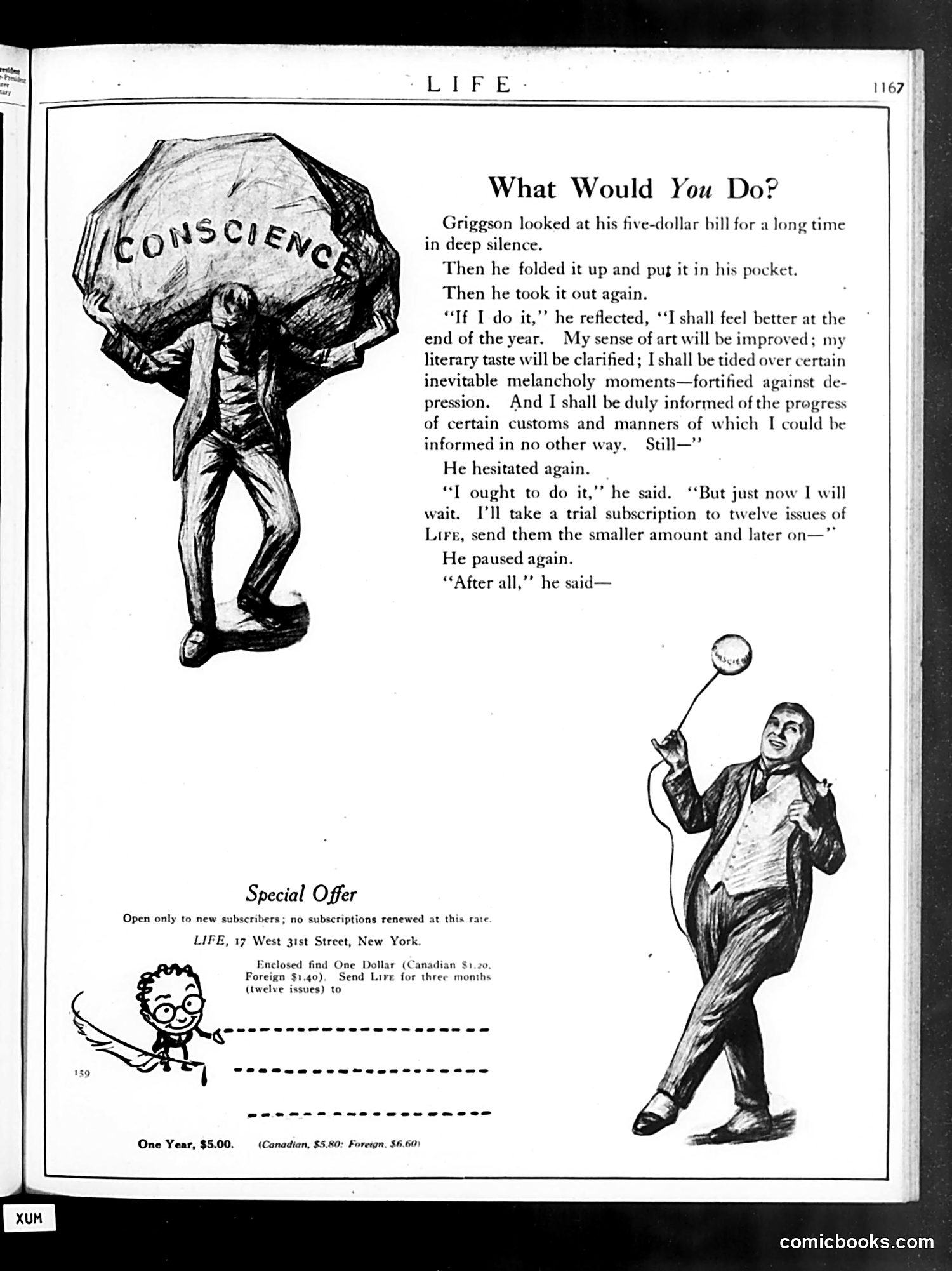
This page is primarily a **subscription advertisement** for *Life* magazine itself, using humor to persuade readers to subscribe. **The Satire:** A character named Griggson deliberates over spending $5 on a *Life* subscription. His internal monologue humorously lists self-improvement justifications—improved artistic sense, literary taste, and social awareness—before he ultimately decides to take a cheaper trial subscription instead of committing fully. **The Joke:** The visual metaphor shows a figure literally struggling under the weight of "CONSCIENCE," representing the internal conflict between wanting self-improvement and financial caution. The accompanying figure with the balloon represents the lighter relief a trial subscription offers. **The Point:** This satirizes readers' rationalization of their purchasing decisions, while gently mocking penny-pinching hesitation about cultural refinement—a common concern during this era.
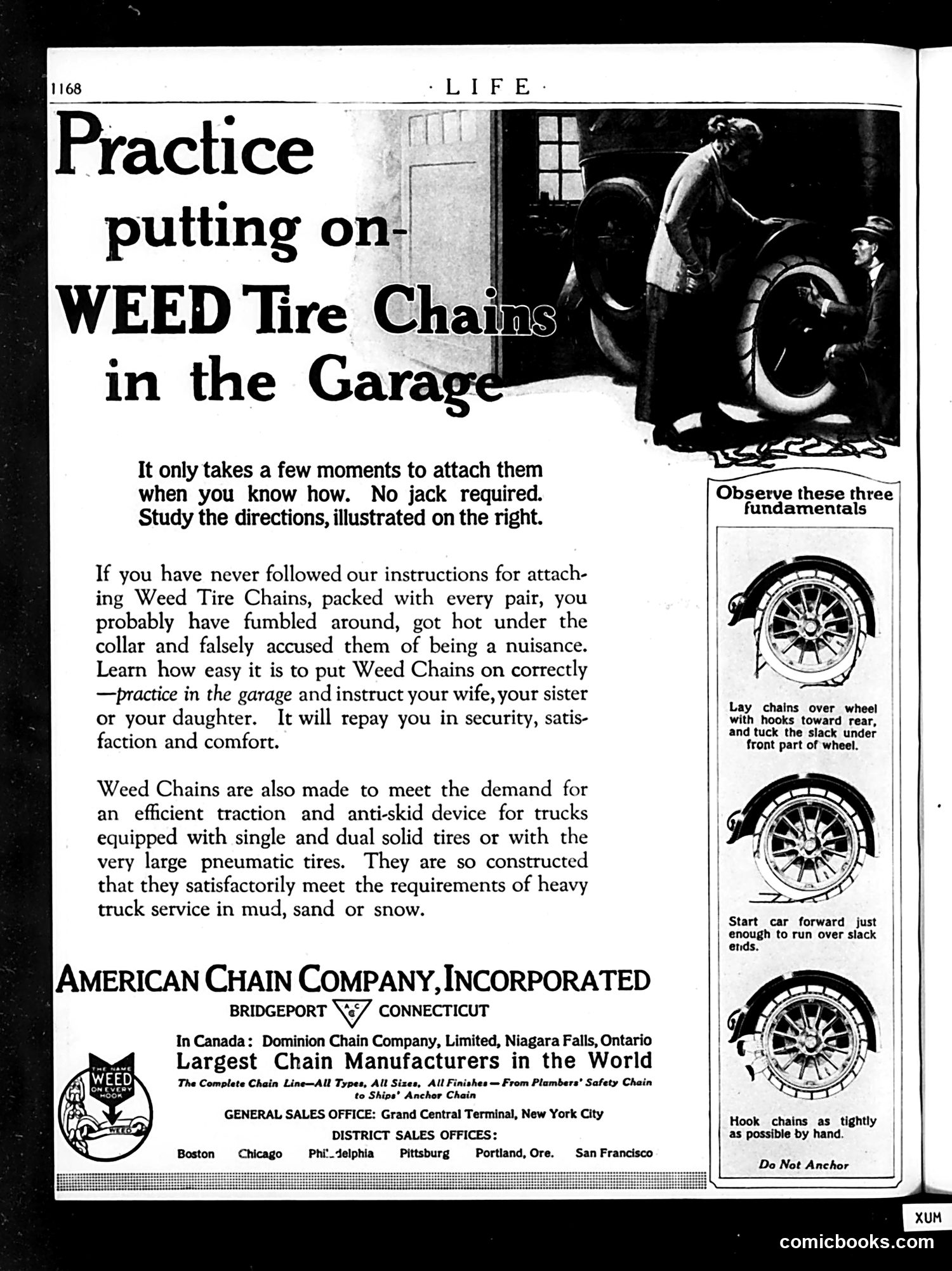
This is **not satirical content** — it's a straightforward advertisement for Weed Tire Chains, manufactured by American Chain Company of Bridgeport, Connecticut. The page shows a practical instructional ad for winter driving safety equipment. The photo depicts a man installing chains on a car tire in a garage, while the text promises the process is quick and easy with proper instructions. The three diagrams on the right illustrate correct installation steps. The ad appeals to car owners (including women drivers, explicitly mentioned) by emphasizing that chains prevent skidding and provide traction in snow and mud. This reflects early-to-mid 20th century winter driving conditions before widespread road treatment. There is no political satire or caricature — this is genuine product marketing.
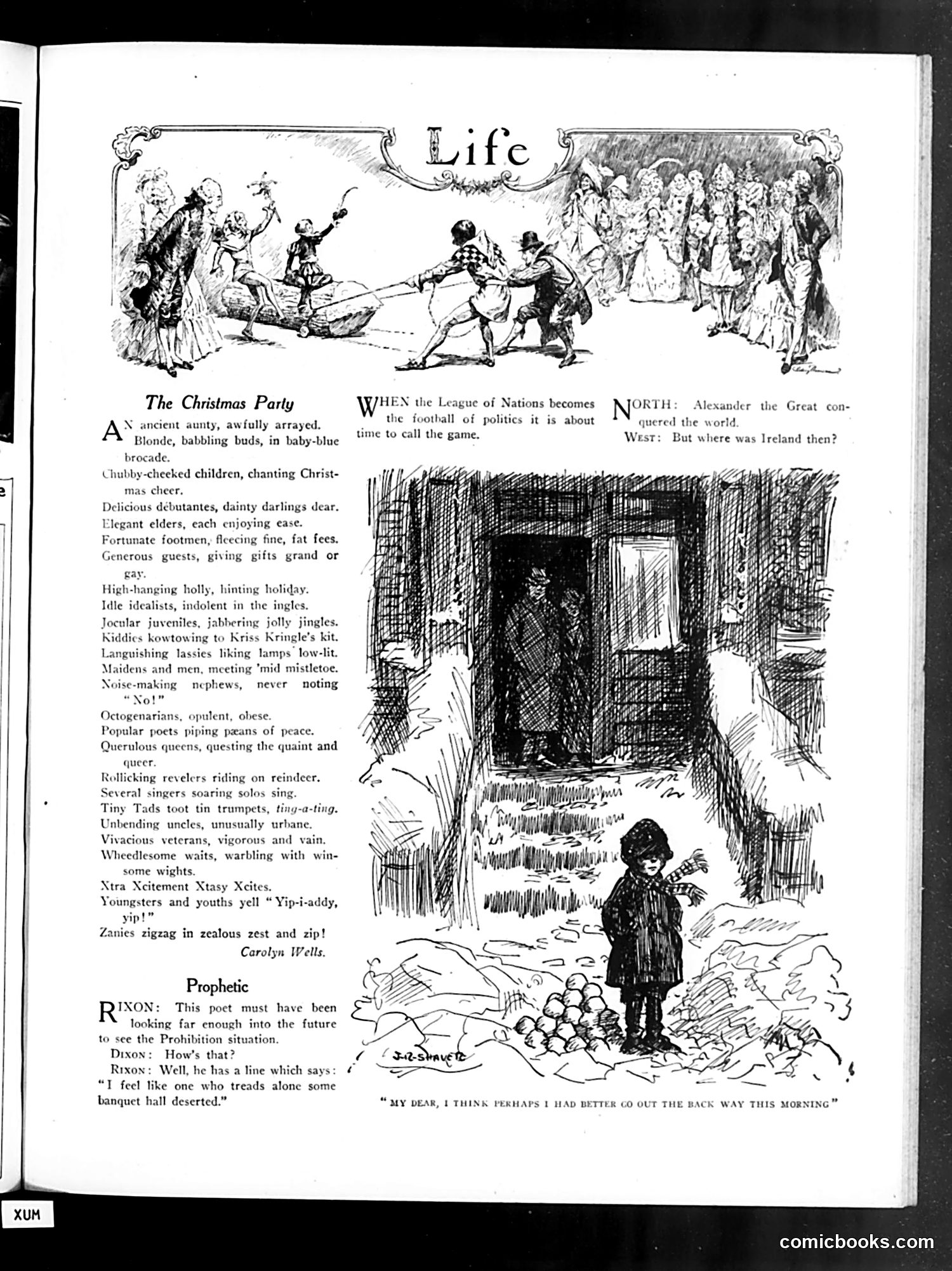
This page contains two satirical pieces from *Life* magazine (circa early 20th century): **"The Christmas Party"** (top): A poem by Carolyn Wells humorously cataloging the chaos of a Victorian-era Christmas gathering—noisy children, drunk relatives, amateur singers, and general pandemonium. The satire mocks the idealized "perfect Christmas" by listing its actual messy realities. **"Prophetic"** (bottom): A dialogue between characters named Rixon and Dixon discussing poetry and the League of Nations becoming "the football of politics." The joke appears to criticize how international diplomacy gets trivialized into partisan games. A separate illustration shows a child outside in winter, captioned about wishing they'd gone "out the back way this morning"—likely satirizing family gathering chaos. Both pieces satirize contemporary social institutions through humorous exaggeration.
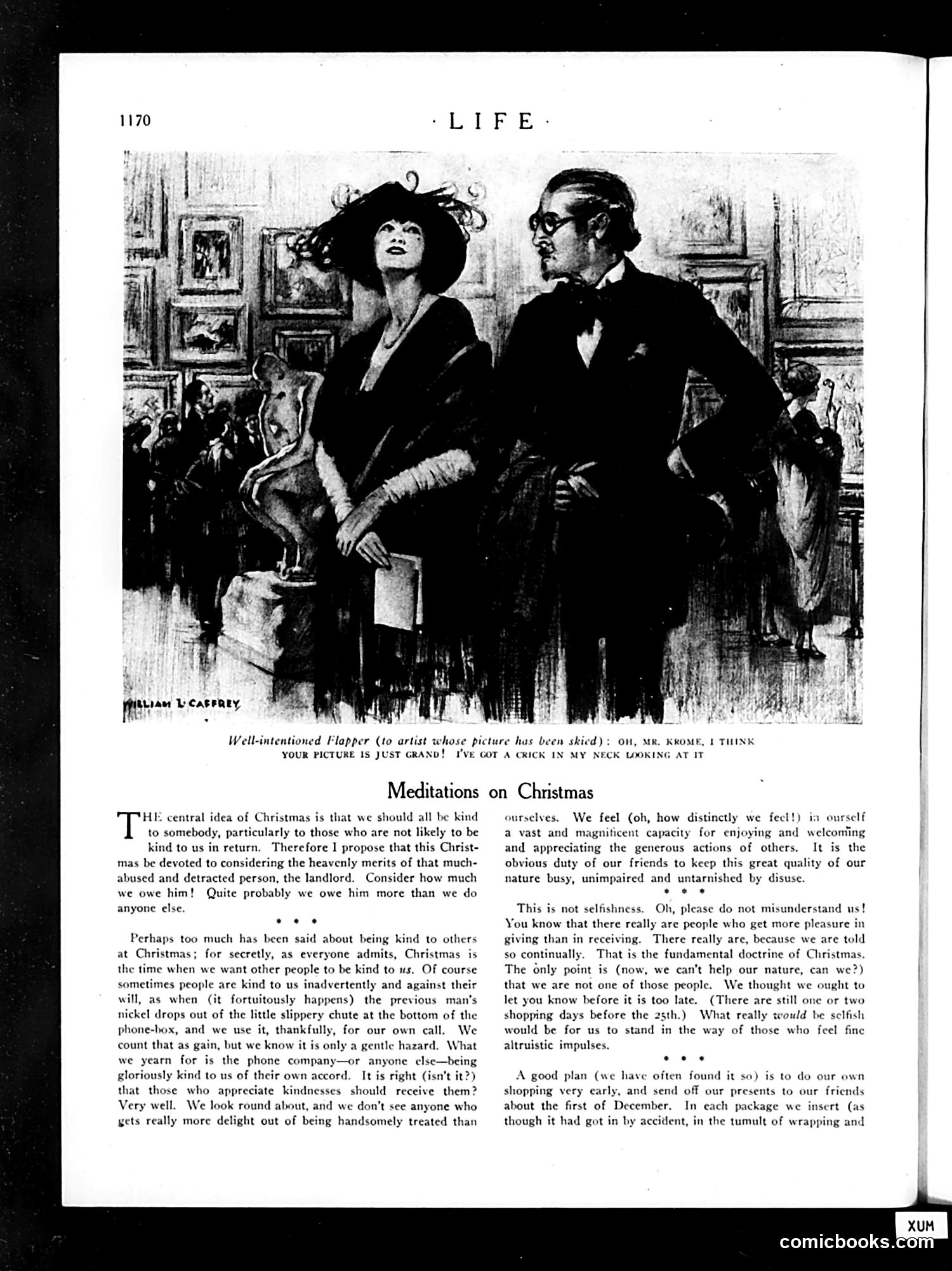
This page contains a satirical cartoon by William L. Caffrey depicting a social scene at what appears to be an art gallery or exhibition. The caption shows a "well-intentioned Flapper" complimenting a male artist, saying his picture is "just grand" while admitting she has "a crick in my neck looking at it." The joke satirizes 1920s "Flapper" culture—young women adopting modern, sometimes superficial attitudes. Here, the woman is praising artwork she physically cannot properly view, suggesting she's being polite rather than genuinely appreciating art. This reflects contemporary satire about Flappers as fashionable but not intellectually engaged. The accompanying essay, "Meditations on Christmas," discusses kindness and generosity during the holiday season, advocating for authentic rather than performative charity—thematically aligned with the cartoon's critique of empty compliments.
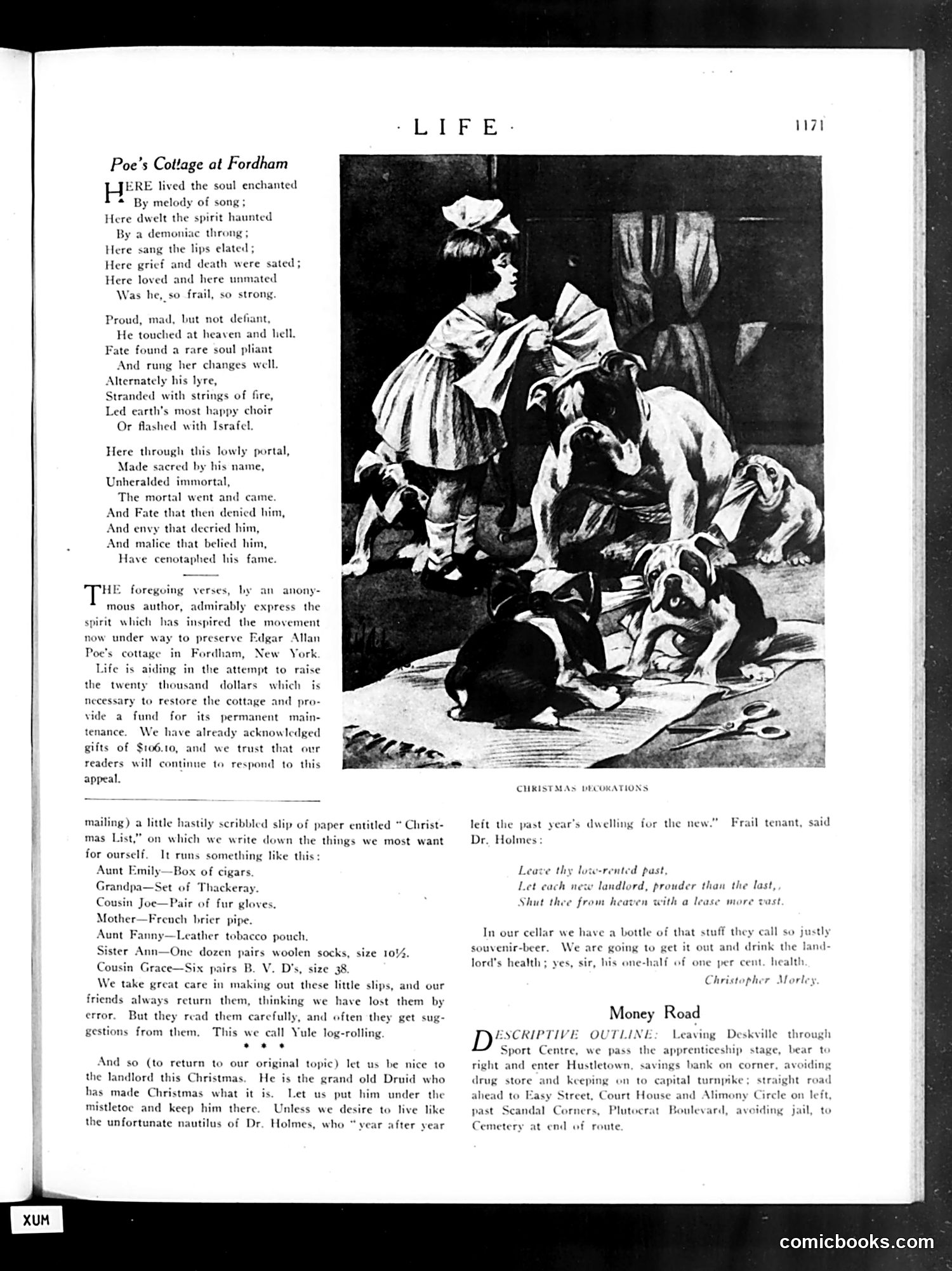
This page features **"Poe's Cottage at Fordham,"** an illustrated article about preserving Edgar Allan Poe's former home in New York. The accompanying engraving depicts a domestic scene with a woman and children near dogs, likely representing the cottage's historical significance. The text explains a fundraising effort to restore the cottage, already receiving donations ($106.10 mentioned), and describes a "Christmas List" tradition where readers suggest gifts for an impoverished elderly resident ("Dr. Holmes"). The satire appears gentle: readers are asked to contribute modest items (cigars, socks, tobacco pouches) for this unfortunate tenant, framing charity as a quaint Victorian custom rather than addressing systemic poverty directly. The page concludes with an unrelated travel piece, "Money Road."
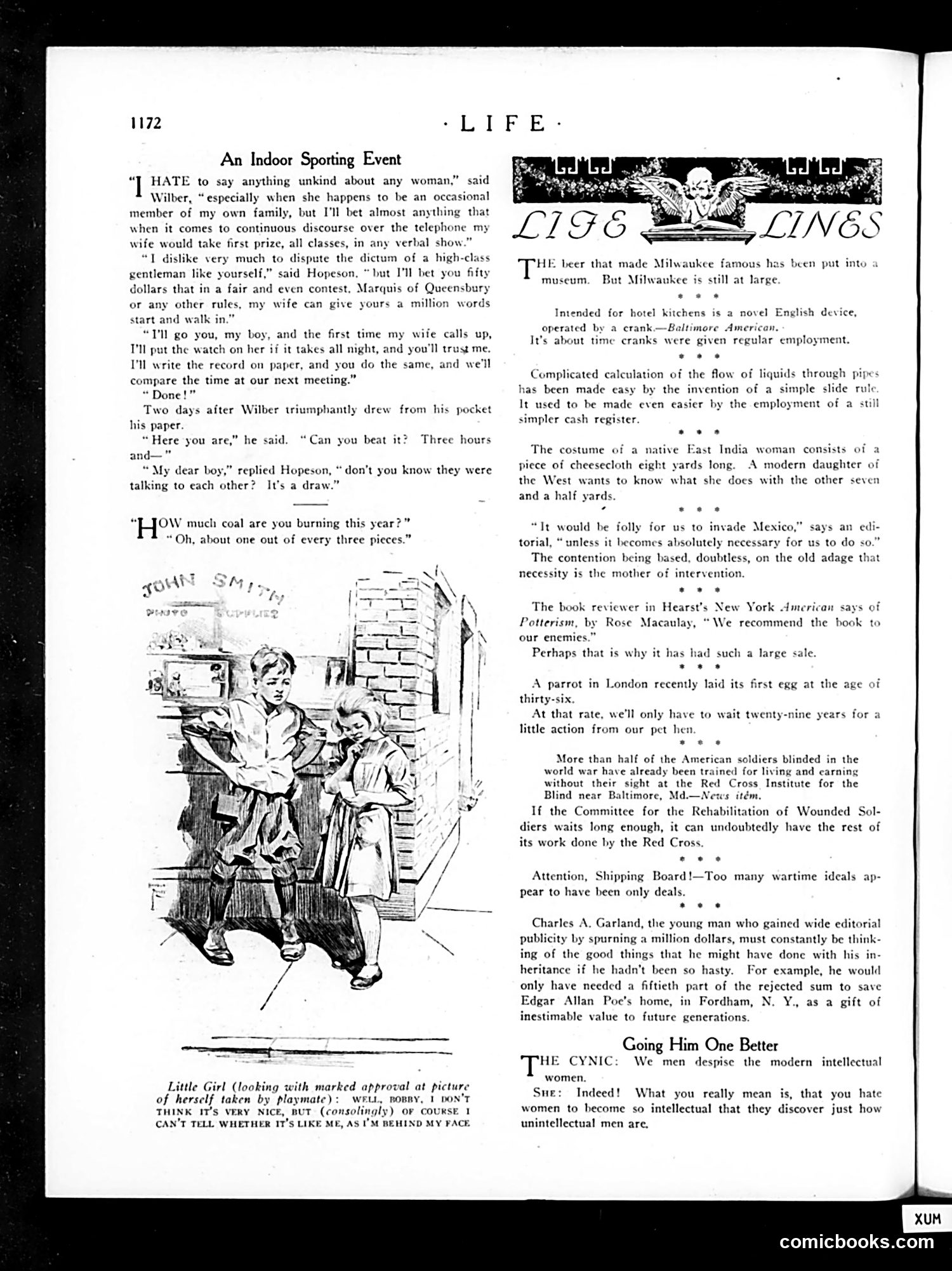
This page contains satirical commentary and a domestic humor cartoon. The main illustration shows a mother with two children looking at a picture, with the caption mocking the children's politeness about an unflattering portrait: they won't admit it looks bad "as I behind my face." The "Libeings" section offers brief satirical observations on contemporary topics: Milwaukee's beer industry, hotel plumbing innovations, women's clothing measurements, potential invasion of Mexico, a book reviewer's backhanded compliment about *Pottierism*, a parrot's slow egg-laying, wounded WWI soldiers receiving Red Cross care, and Charles A. Garland's charitable inheritance decisions. The final dialogue ("Going Him One Better") satirizes intellectual pretension, with a cynic claiming men resent women becoming intellectual, and a woman retorting that men hate discovering their own lack of intellect. The humor relies on domestic situations and social commentary typical of 1920s American satire.
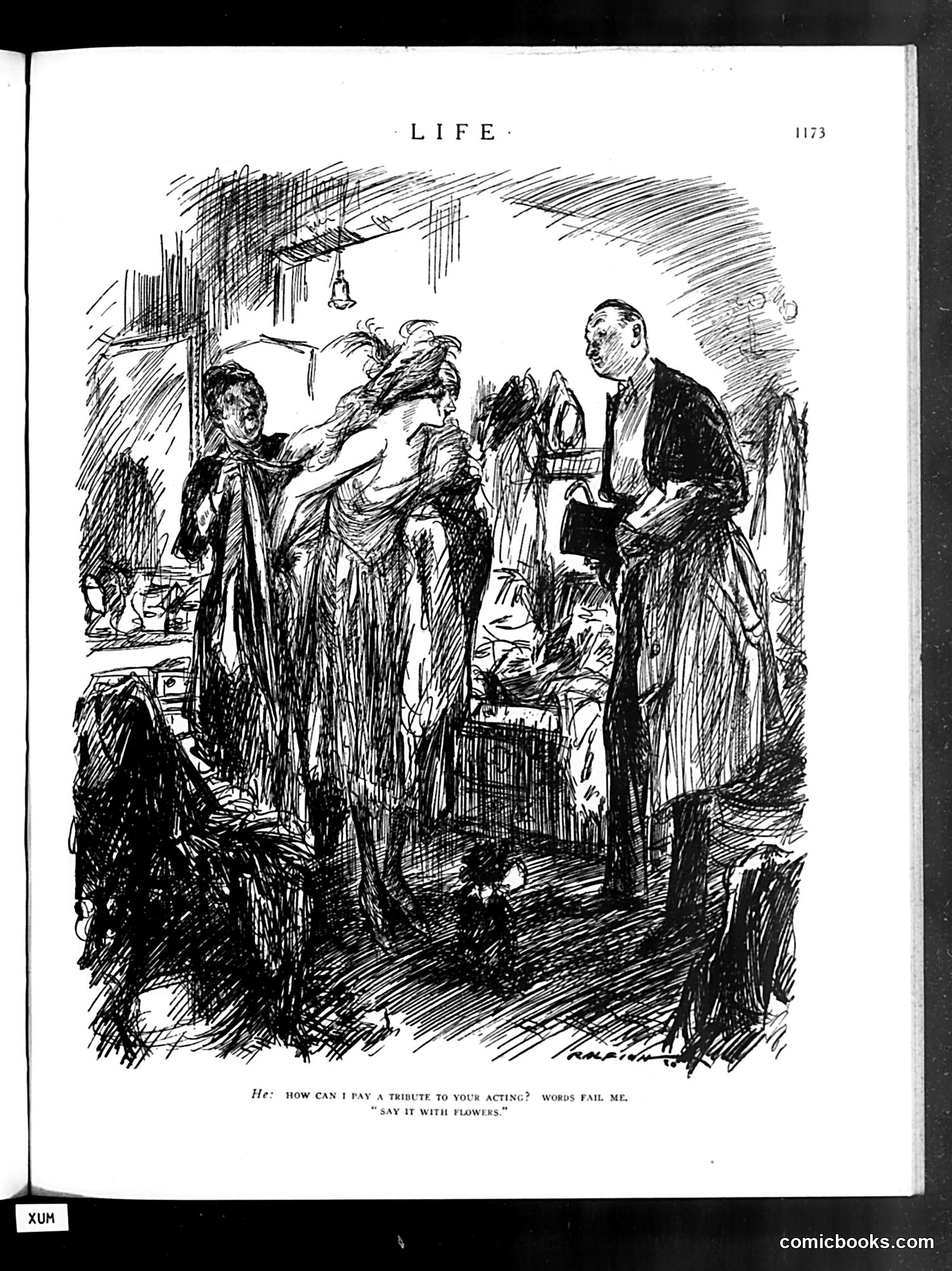
This is a theatrical satire from *Life* magazine (page 1173). The cartoon depicts a backstage scene where a man in formal attire (right) approaches a woman actress who has just performed. He says: "How can I pay a tribute to your acting? Words fail me. 'Say it with flowers.'" The joke satirizes the phrase "say it with flowers"—a popular advertising slogan of the early 20th century promoting flowers as gifts. Here, the man suggests using flowers instead of offering genuine theatrical praise, implying either that: 1. Her acting was poor and flowers are easier than honest compliments, or 2. The phrase has become such a cliché that it substitutes for authentic appreciation The cartoon mocks both theatrical pretension and the commercialization of sentiment through mass-marketing slogans.
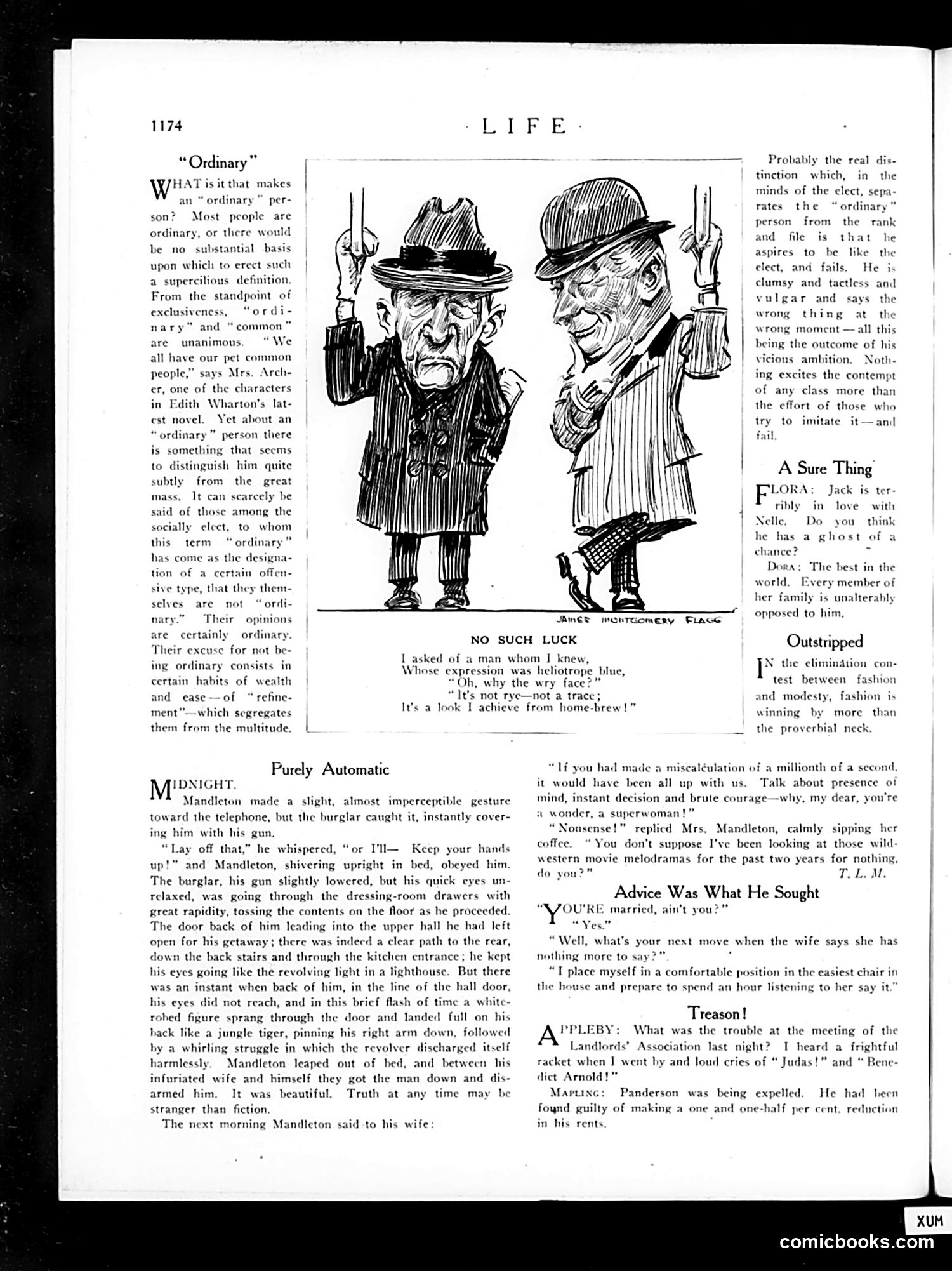
The cartoon titled "NO SUCH LUCK" by James Montgomery Flagg depicts two men in conversation. One asks a third party about a man whose "eyes were pools of blue" but who is "wry faced." The questioner notes: "It's not a case of luck; It's a look I achieve from home-brew!" This is a Prohibition-era joke. The cartoon satirizes homemade alcohol production during Prohibition (1920-1933). The "wry face" results from drinking poorly-made homebrew liquor—the implication being that bad homemade alcohol causes physical distortion or grimacing. The joke's humor lies in the man's deliberate, ironic claim that his unpleasant facial expression is self-inflicted through his own brewing efforts, rather than natural misfortune.
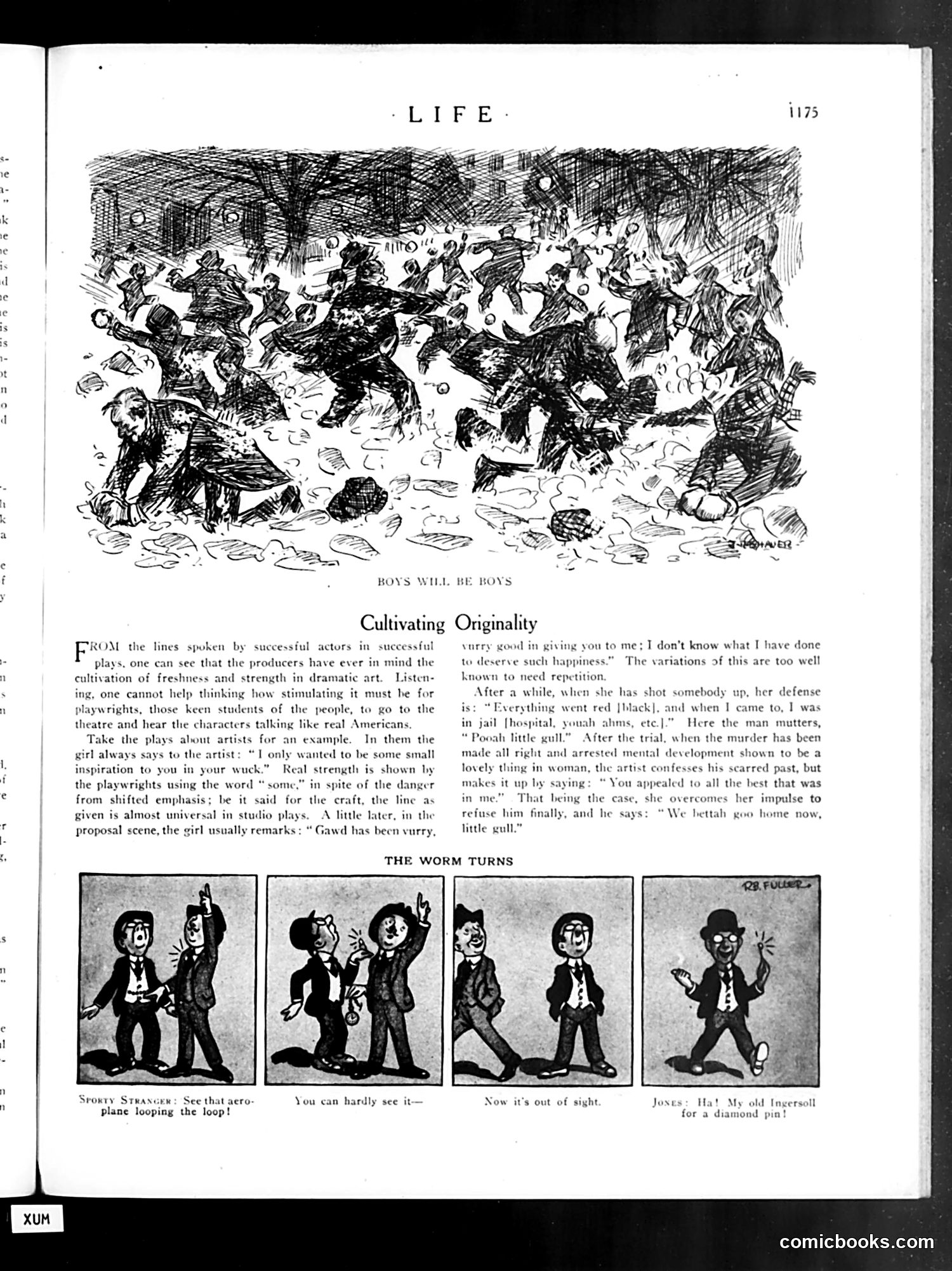
**Main Article: "Cultivating Originality"** This essay discusses how dramatic arts students and playwrights should develop freshness and strength through observation rather than imitation. It critiques the tendency to use the word "some" in plays and argues that artists must find their own voice. **"The Worm Turns" Comic Strip** A four-panel sequence showing two men in formal attire. The humor appears to play on a reversal of power dynamics: the first man shows off an airplane loop; the second man watches; in the third panel he's out of sight; in the final panel, he's exuberantly celebrating, claiming credit ("My old Ingersoll for a diamond pin!"). The joke suggests the initially confident man has been outwitted or upstaged by his companion—hence "the worm turns" (the meek person finally gets revenge).
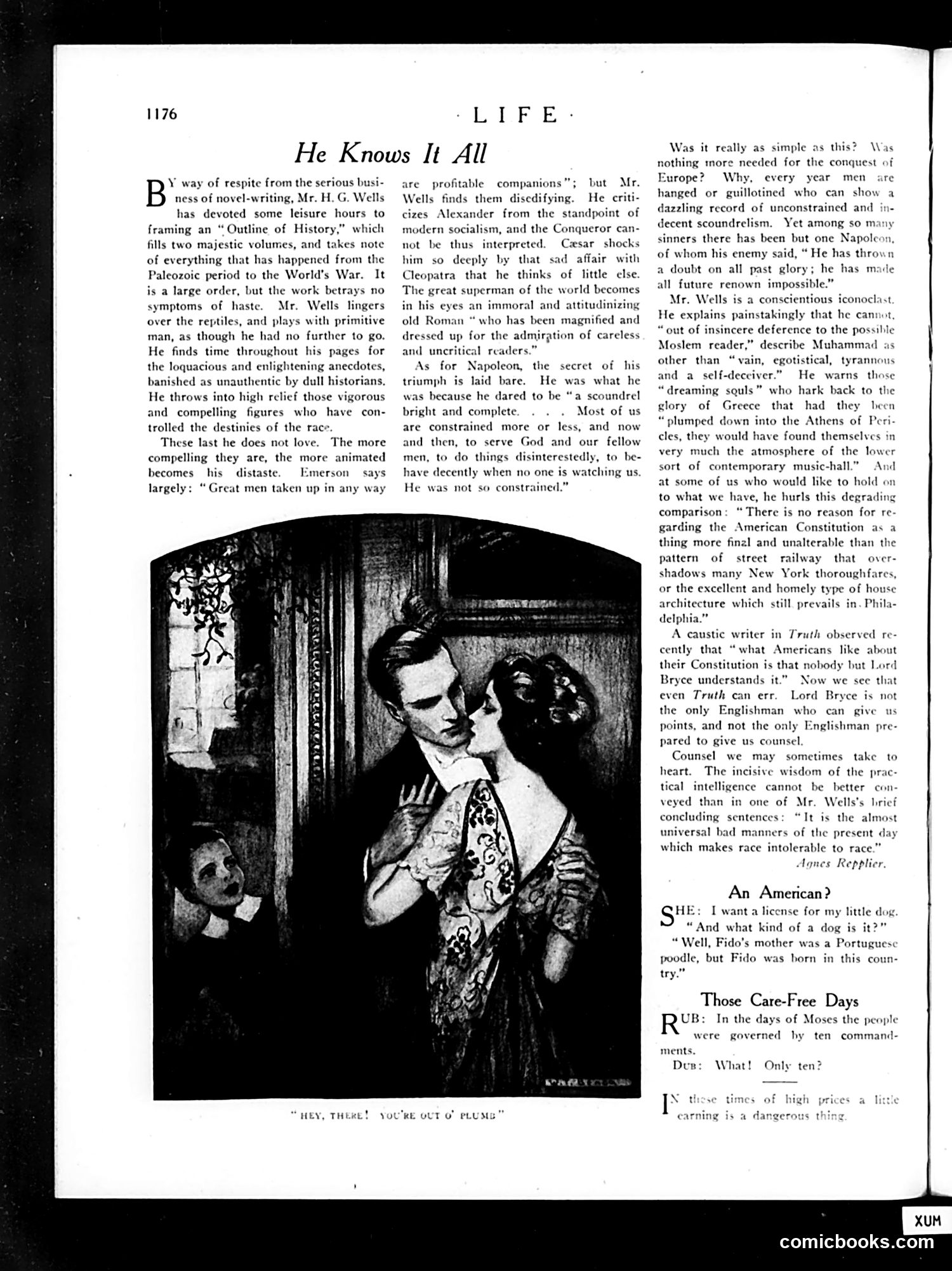
This page reviews H.G. Wells's writing, particularly his historical outlines and social criticism. The article praises Wells's ability to debunk "serious business" while critiquing his dismissiveness toward other intellectuals—notably Alexander the Great, Napoleon, and Muhammad. The illustration labeled "HEY, THERE! YOU'RE OUT OF PLUMS" appears to satirize Wells himself as a somewhat pompous figure, likely mocking his tendency to pronounce sweeping judgments on history and civilization. The subsequent brief dialogues ("An American?" and "Those Care-Free Days") continue the satirical tone, poking fun at contemporary attitudes and pretensions. The overall message seems to be that while Wells offers valuable insights, his all-knowing persona deserves gentle ridicule.
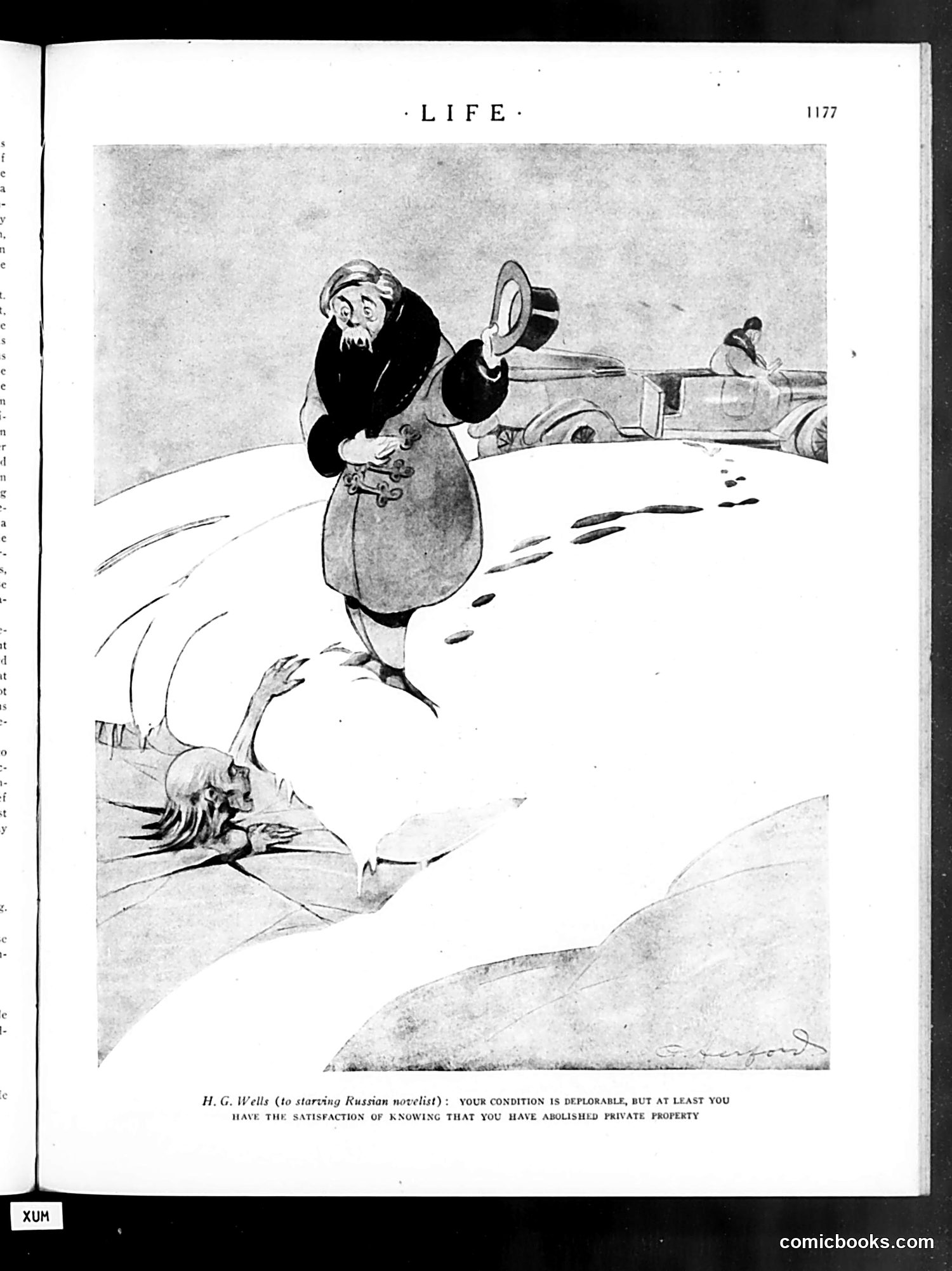
This cartoon from *Life* magazine satirizes H.G. Wells, the famous science fiction novelist. The caption attributes a quote to Wells addressing a "Russian novelist," saying: "Your condition is deplorable, but at least you have the satisfaction of knowing that you have abolished private property." The image shows a bearded figure (Wells) in winter clothing, appearing to gesture mockingly at a disheveled, impoverished person in the snow. In the background, an automobile suggests wealth and capitalist luxury. The satire critiques Wells's apparent hypocrisy—he advocated socialist ideals and the abolition of private property while enjoying the material comforts of capitalism himself. The cartoon suggests he was offering cold comfort to the suffering poor, praising their sacrifice of private property while he retained his own wealth and privilege.
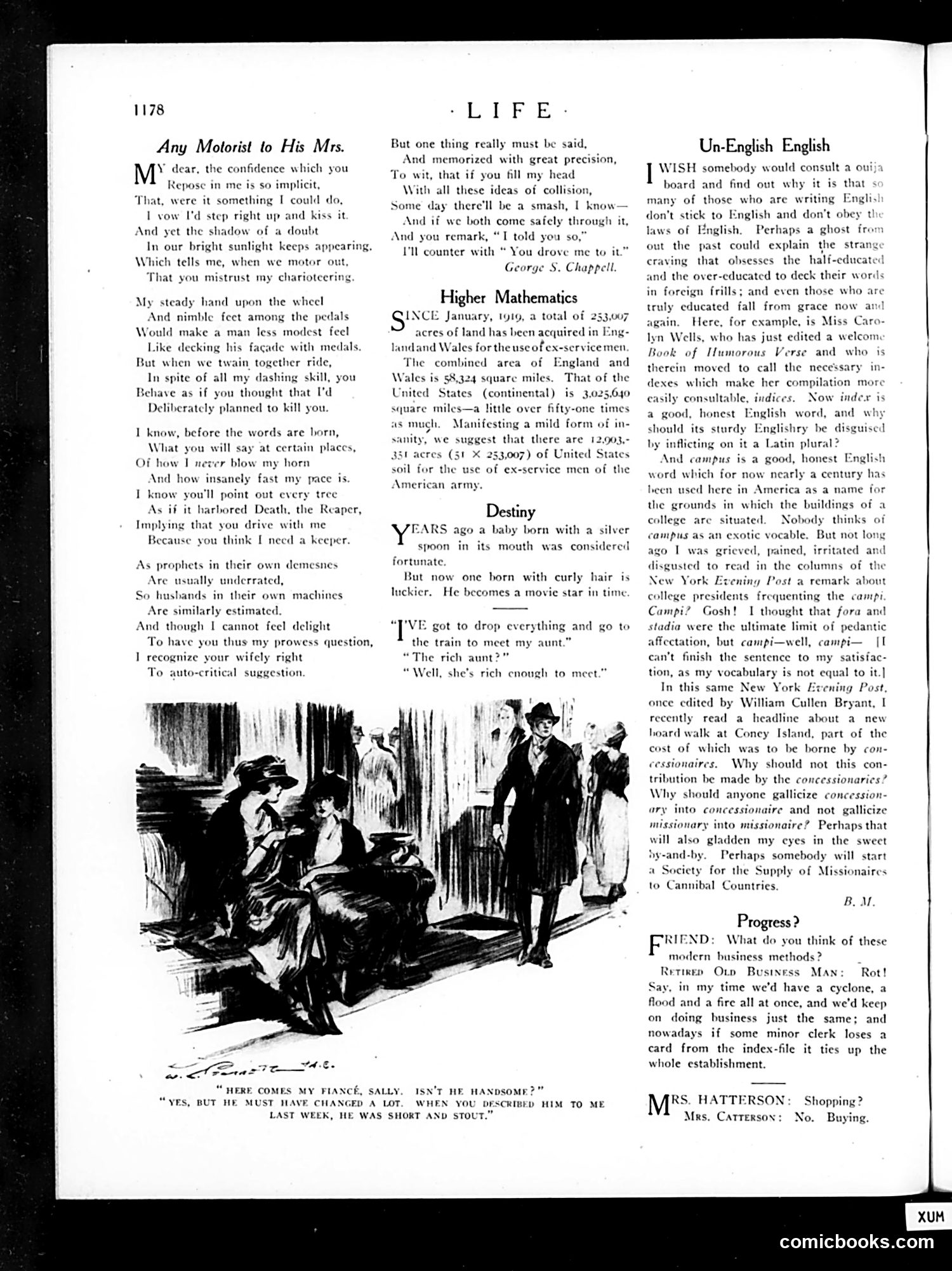
This page contains several short satirical pieces rather than a single cartoon. The main illustration shows a street scene with well-dressed figures and appears to accompany a caption about someone's appearance changing—"HERE COMES MY DEAR OLD HANDSOME?" with text noting "YES, BUT HE MUST HAVE CHANGED A LOT. WHEN YOU DESCRIBED HIM TO ME LAST WEEK, HE WAS SHORT AND STOUT." The humor suggests a wife's exaggerated description of her husband to friends versus his actual appearance—a common domestic satire trope. The page also includes poetry, a "Higher Mathematics" section with statistics about ex-servicemen's land, and a brief dialogue exchange titled "Progress?" mocking outdated business methods. Overall, this represents typical early 20th-century satirical magazine content mixing domestic humor, social commentary, and light wordplay.
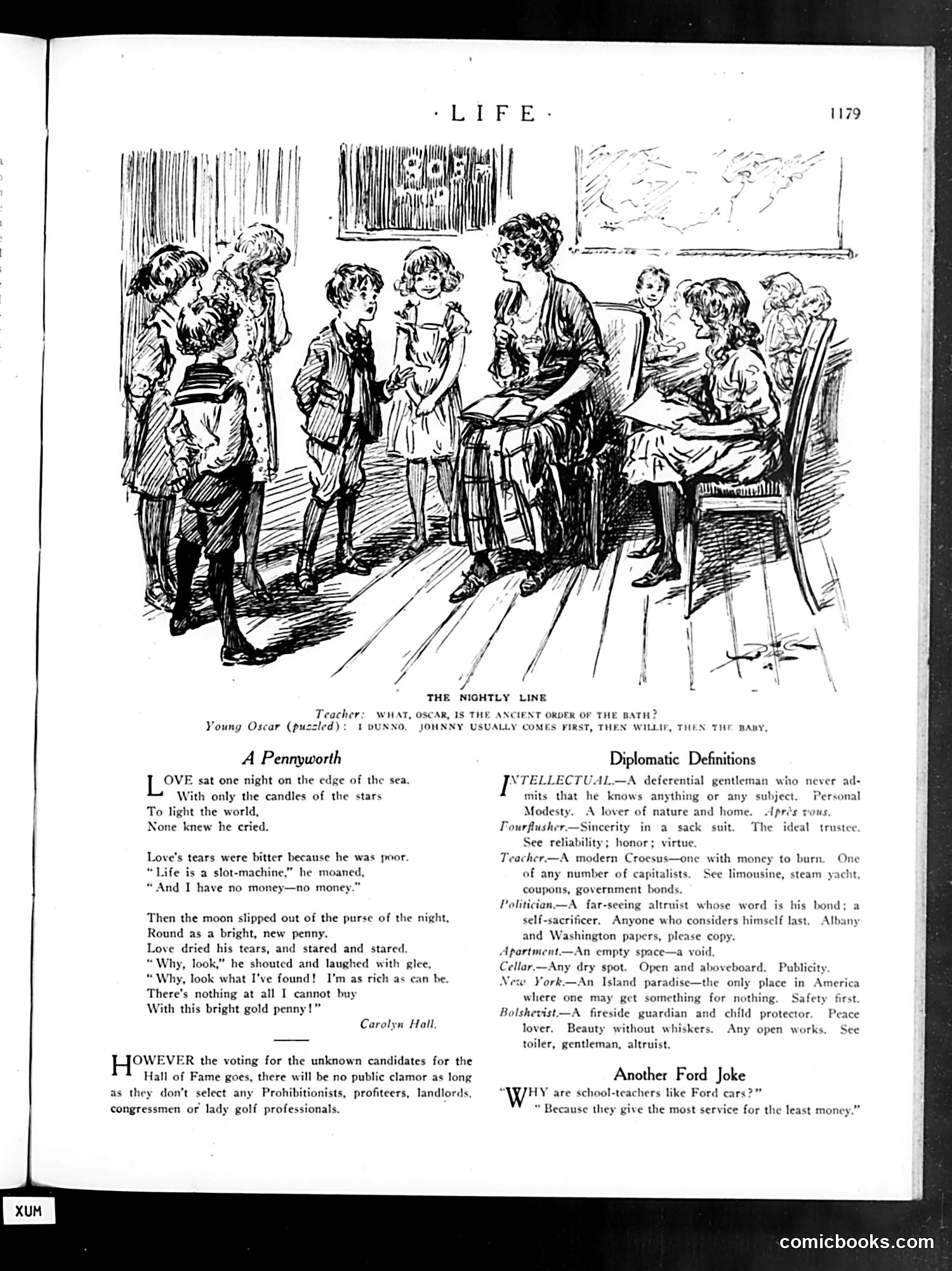
**Main Cartoon: "The Nightly Line"** Shows a schoolteacher conducting children in what appears to be a recitation or lesson. The caption presents a joke about bath time ordering: "What, Oscar, is the ancient order of the bath?" Young Oscar answers with a sequence of children's names (Johnny, Willie, the baby), misunderstanding "order of the bath" as a literal sequence rather than a historical reference. This is a simple pun—playing on the double meaning of "order" (historical ranks vs. bathing sequence). It's gentle children-based humor typical of Life's satirical style. **Other Content:** The page includes poetry ("A Pennyworth" by Carolyn Hall), satirical definitions mocking social types (intellectuals, teachers, politicians), and a Ford automobile joke. The overall tone reflects early 20th-century genteel American satire.
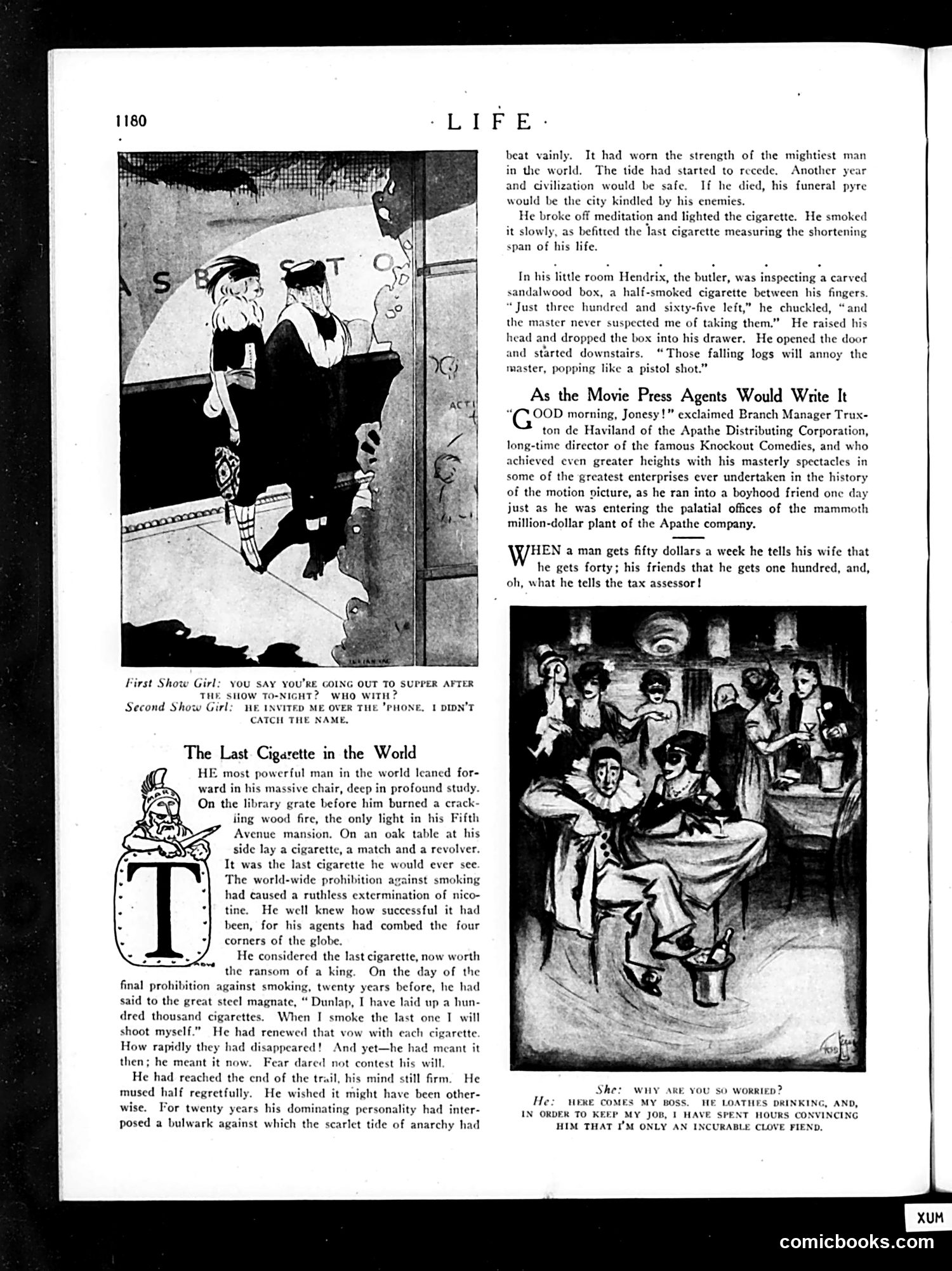
This page contains three separate humorous pieces: 1. **Top cartoon**: Shows two show girls gossiping outside a theater. The joke plays on social class and discretion—one girl went to supper with someone she wouldn't name, while the other assumes it was a wealthy suitor. The humor derives from the implication of secretive romantic encounters. 2. **"The Last Cigarette in the World"**: A satirical story about a wealthy man hoarding the final cigarette after global smoking prohibition. The piece mocks both excessive wealth and the futility of resisting sweeping social laws. It suggests that even the richest cannot escape civilizational change. 3. **Bottom photograph/caption**: Appears to show a workplace scene with a humorous caption about keeping one's boss unaware of social activities. The page reflects early-20th-century anxieties about prohibition and class distinctions.
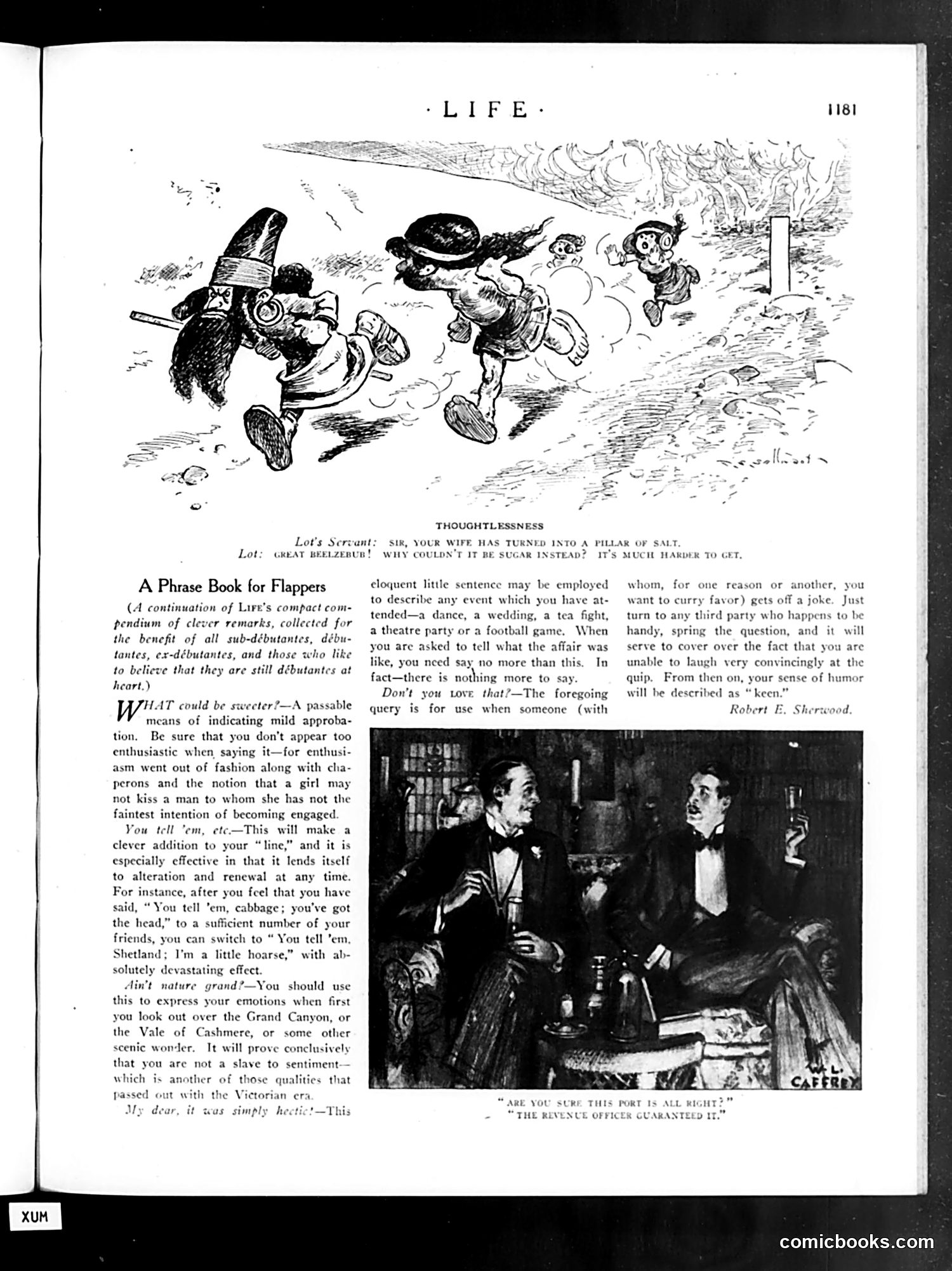
This page from *Life* magazine contains two distinct elements: **"A Phrase Book for Flappers"** is a humorous guide to slang and affected speech patterns used by "flappers"—young women of the 1920s known for rejecting Victorian propriety. The article mocks their pretentious, repetitive phrases like "You tell 'em," "ain't nature grand?" and "simply hectic!" by suggesting these expressions are fashionable but hollow substitutes for genuine conversation. **The cartoons** illustrate this theme of superficial behavior. The top cartoon labeled "Thoughtlessness" shows people engaged in exaggerated, foolish antics, while the lower photograph-style cartoon depicts two men in what appears to be a revenue/tax office scene, with the caption joking about a man's wife turning into a "pillar of salt" (a biblical reference)—the humor suggesting marital discord or the woman's silent disapproval. Together, the page satirizes 1920s youth culture's embrace of empty fashionable speech over genuine emotion or substance.
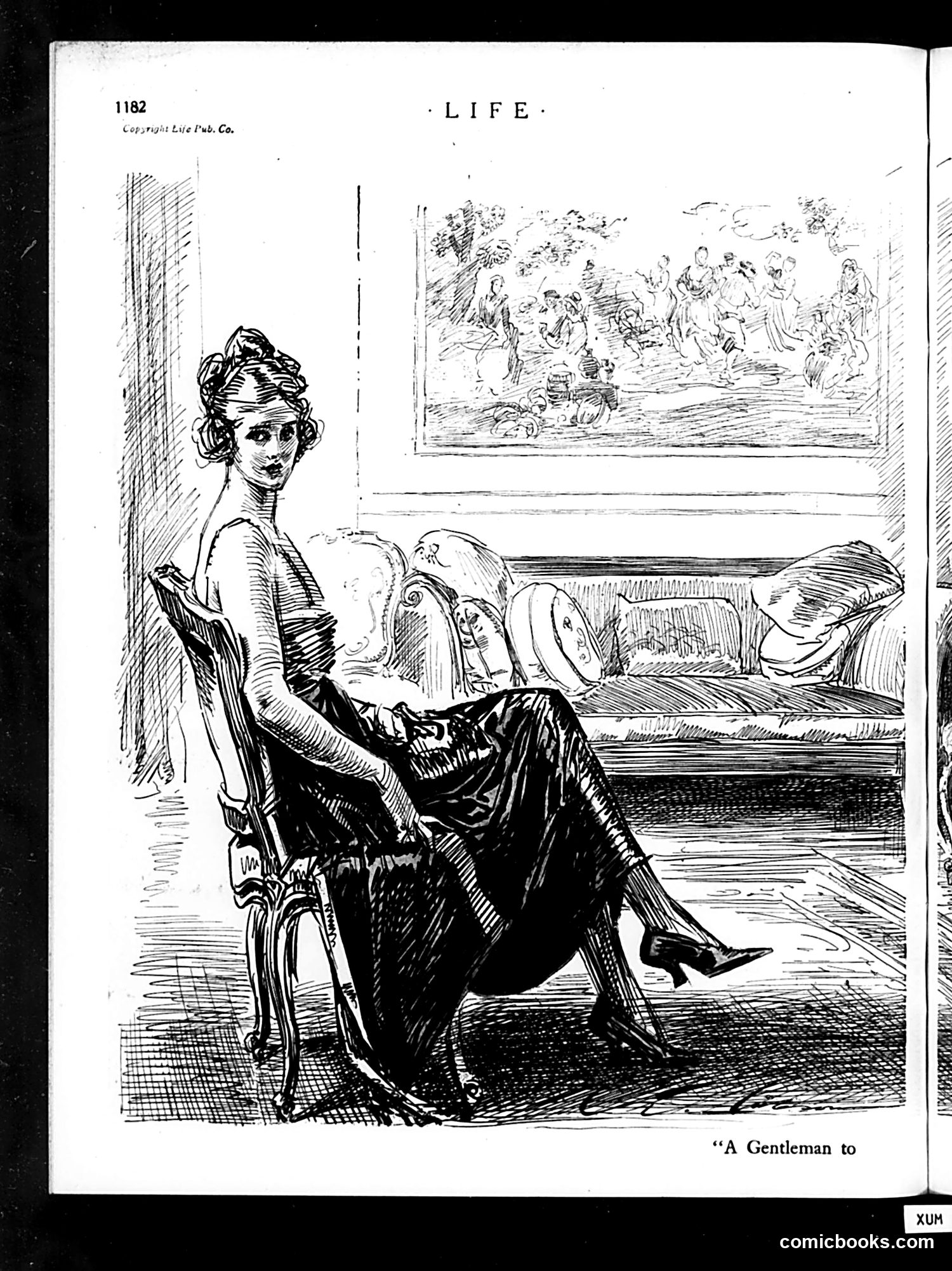
This is a satirical illustration from *Life* magazine showing a well-dressed woman reclining on a sofa in an elegant interior, gazing toward a framed scene of people bathing or swimming outdoors. The incomplete caption "A Gentleman to" suggests ironic commentary—likely about courtship, romance, or social expectations. The satire appears to target either: feminine leisure and idle daydreaming, the contrast between constrained indoor propriety and natural freedom, or romantic fantasies versus reality. The woman's composed pose and the pastoral scene she's viewing suggest commentary on idealized notions of romance or escape from social conventions. Without the complete caption or publication date visible, the specific target remains somewhat unclear, though the style suggests early-to-mid 20th century social satire typical of *Life* magazine's content.
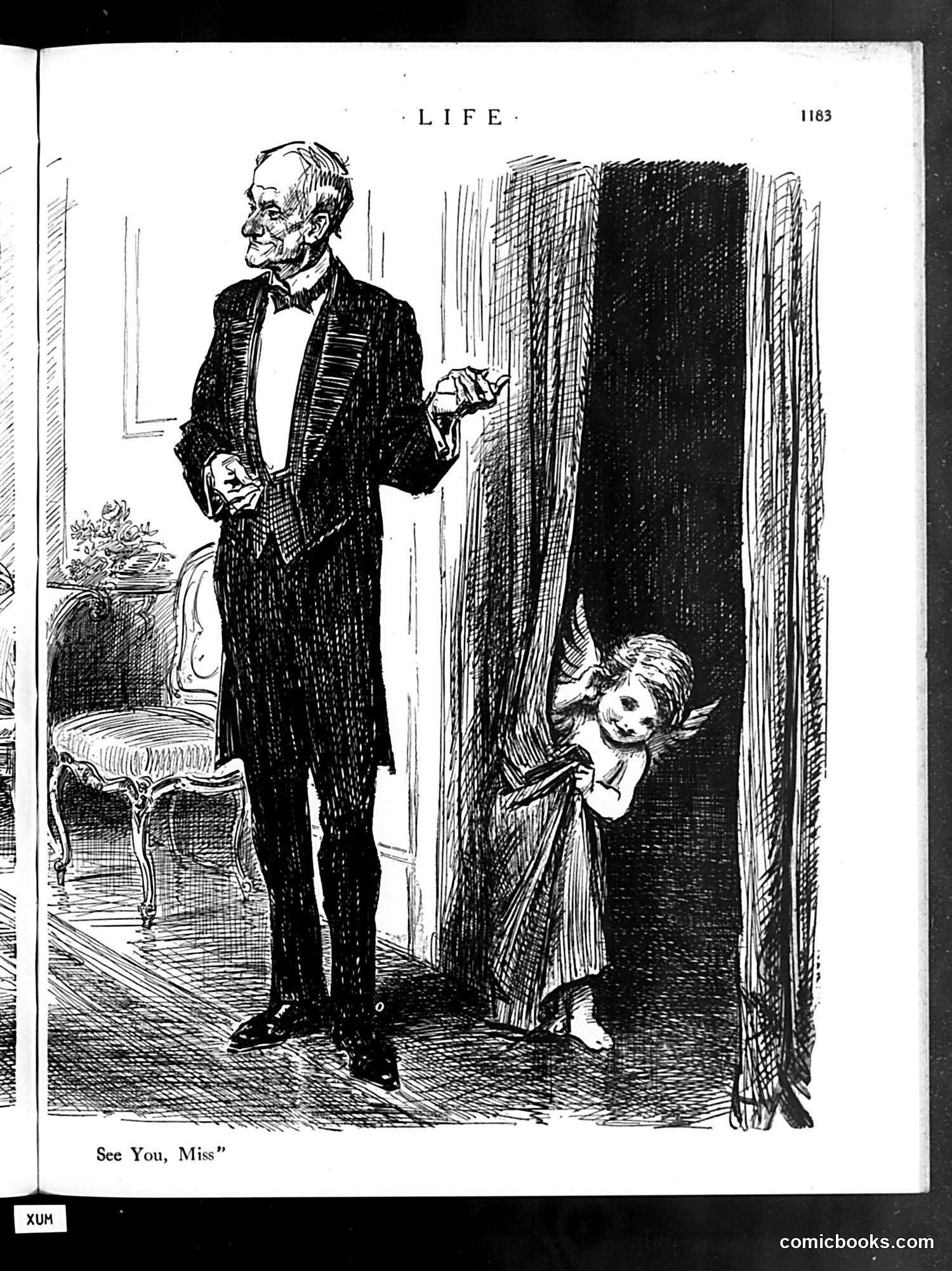
This sketch depicts a well-dressed gentleman in formal evening wear (tuxedo with bow tie) standing in a doorway, bidding farewell to a young woman or girl who peers out from behind heavy curtains. The caption "See You, Miss" suggests a departure scene. The satire likely comments on courtship, social etiquette, or relationship dynamics of the era. The man's formal attire and composed demeanor contrast with the woman's partially-hidden, almost shy positioning, perhaps mocking Victorian-era social conventions around male-female interactions or the formality of calling. The gentleman appears to be the pursuer, while the woman maintains a modest distance—possibly satirizing the elaborate social rituals of proper society courtship during this period.
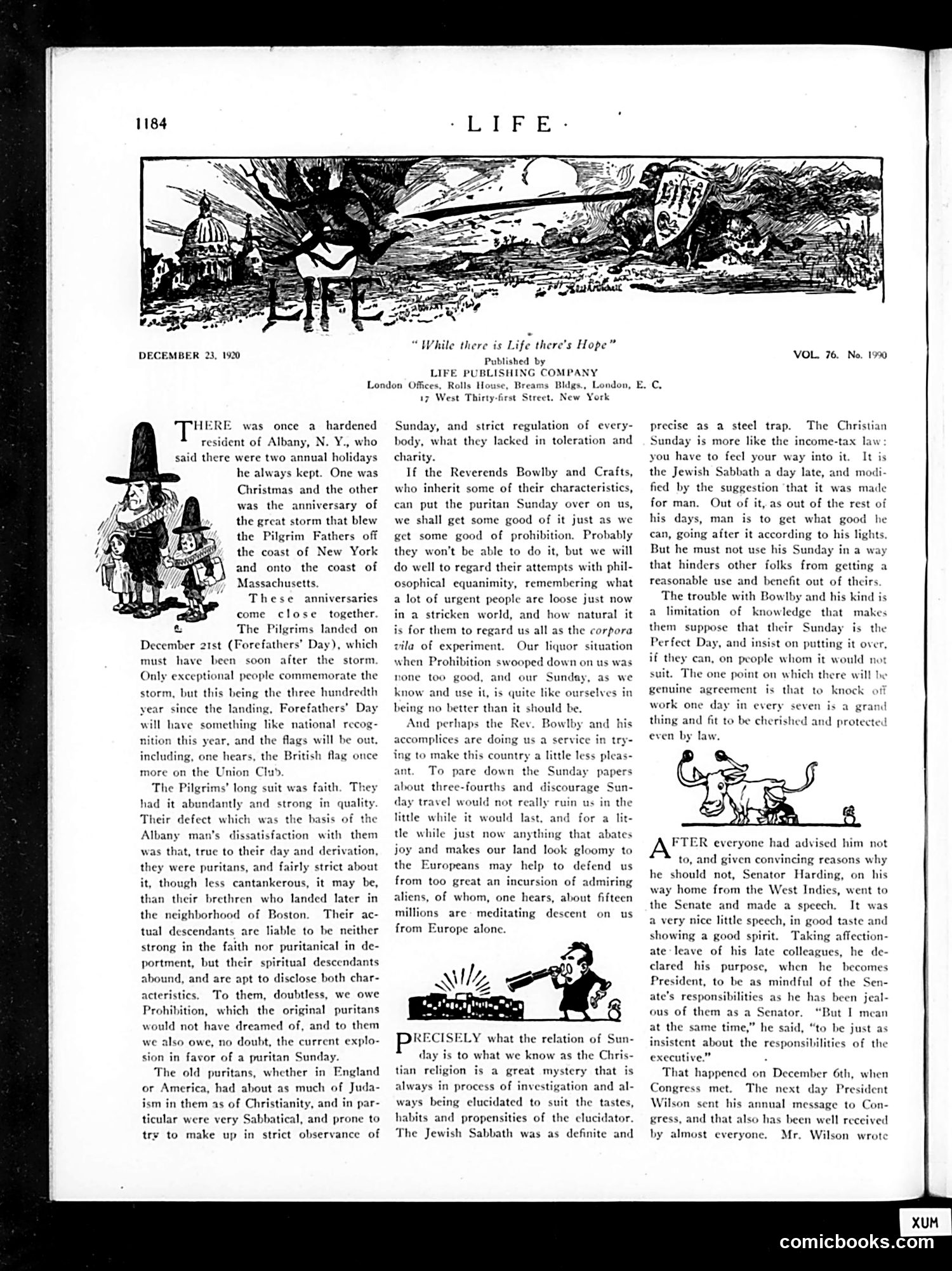
This page discusses the tension between Puritan-descended Americans and modern Sunday observance. The author references **Reverends Bowlby and Crafts**, apparently religious figures advocating stricter Sunday regulations (likely connected to Prohibition-era moral reform movements). The satire targets **spiritual descendants of the Pilgrims**—modern Prohibitionists and religious reformers who, the author argues, are attempting to impose rigid "puritan Sundays" on the country. The piece notes the irony that original Puritans never imagined Prohibition itself, yet their modern heirs created it. The cartoon imagery (showing Pilgrims) reinforces this historical comparison. The author's point: while the original Puritans were strict, current attempts to regulate American life through Sunday restrictions are heavy-handed and poorly-timed, especially given post-WWI social upheaval. The piece satirizes both the reformers' rigidity and their claim moral authority through historical lineage, arguing their restrictions will ultimately fail against public resistance.
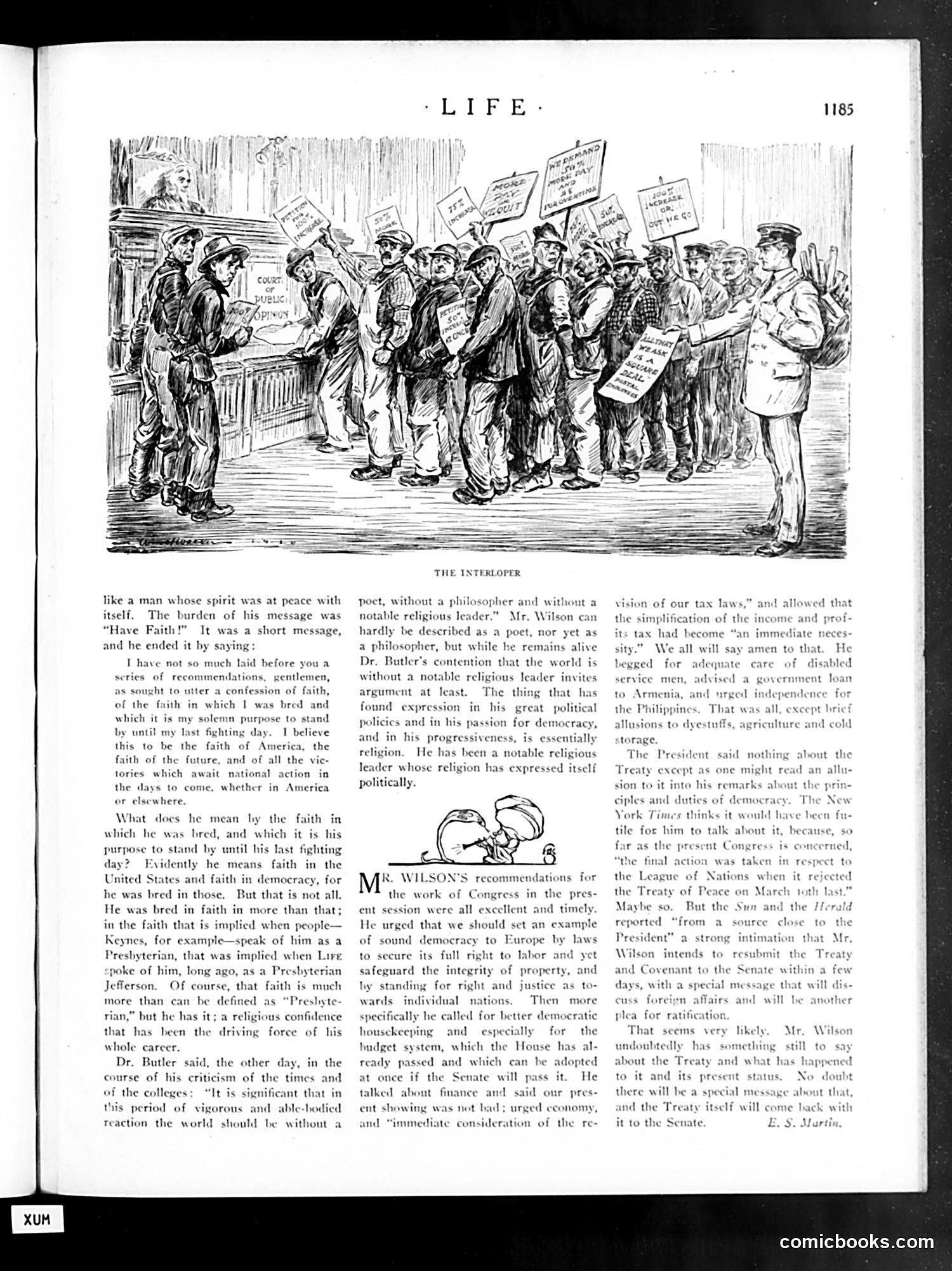
This page satirizes President Wilson's recent address to Congress. The cartoon depicts a crowd of men holding protest signs confronting what appears to be an official or military figure—"the interloper" of the title. The accompanying text discusses Wilson's speech emphasizing "faith" in democracy and America's future. The satire critiques that while Wilson spoke eloquently about ideals, he notably avoided discussing the **League of Nations and the Treaty of Peace**—major political issues of the moment (appearing to be 1919, post-WWI). The cartoon's "interloper" likely represents Wilson or his administration inserting themselves into Congress's work while avoiding accountability on the Treaty question. The protest signs suggest public/congressional pressure on unaddressed issues. The joke: Wilson preaches faith and democracy while sidestepping the era's most contentious foreign policy debate. Critics (represented by the crowd) see his rhetoric as evasive deflection rather than genuine leadership.
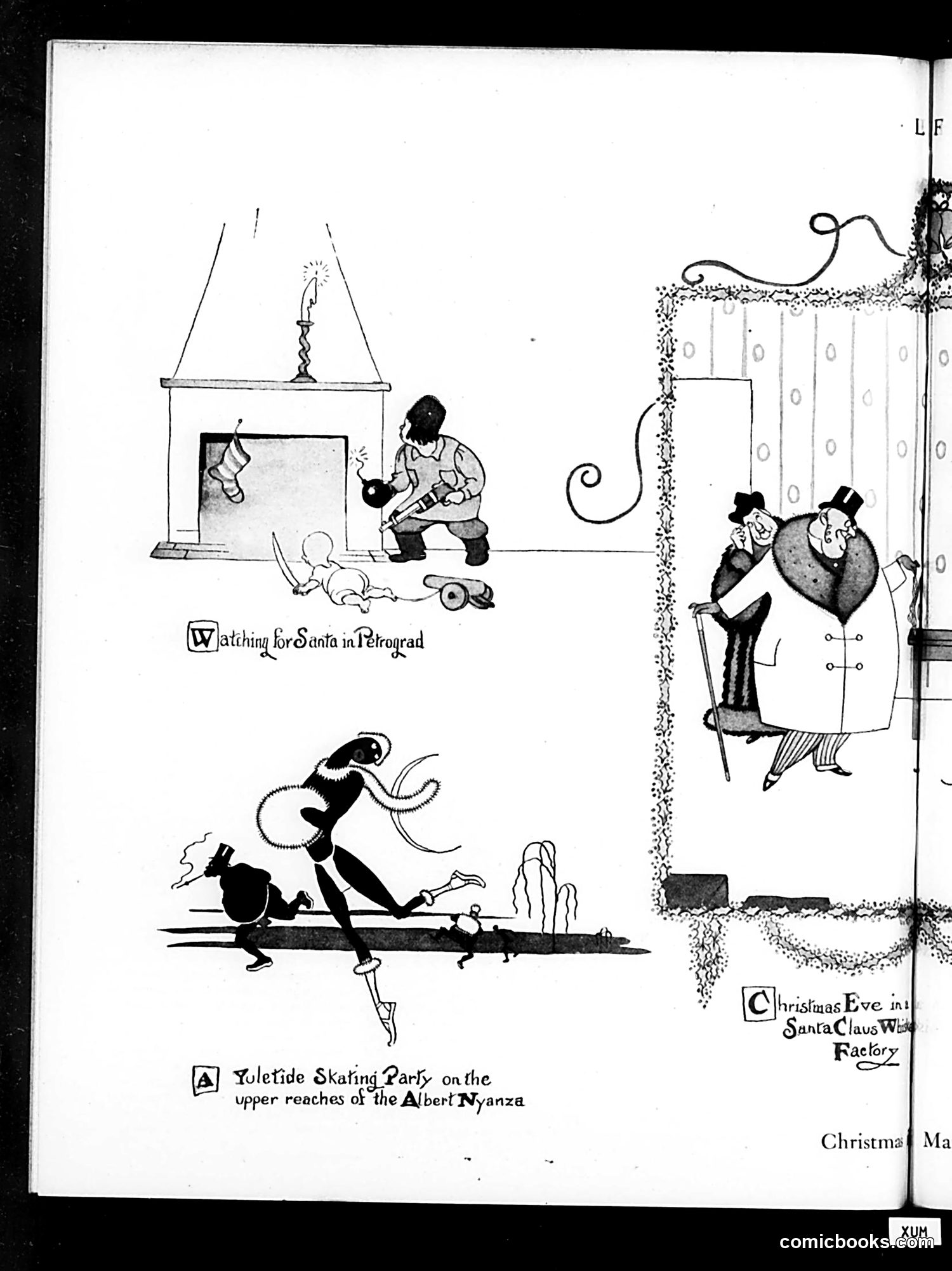
This page contains three Christmas-themed satirical illustrations from *Life* magazine: **(A) "Yuletide Skating Party on the upper reaches of the Albert Nyanza"** depicts figures ice-skating on an African river (the Albert Nyanza, now Lake Albert), with exaggerated caricatures in a comedic style typical of early 20th-century satire. **(B) "Watching for Santa in Petrograd"** shows someone observing through a window, likely satirizing Russian Christmas customs or Cold War-era anxieties (Petrograd was the Soviet name for Leningrad). **(C) "Christmas Eve in Santa Claus Workshop Factory"** illustrates the commercialized, industrialized production of Christmas gifts—depicting what appears to be workers in a factory rather than Santa's workshop, satirizing Christmas consumerism and mass manufacturing. The overall theme satirizes Christmas celebrations across different cultures and economic contexts.
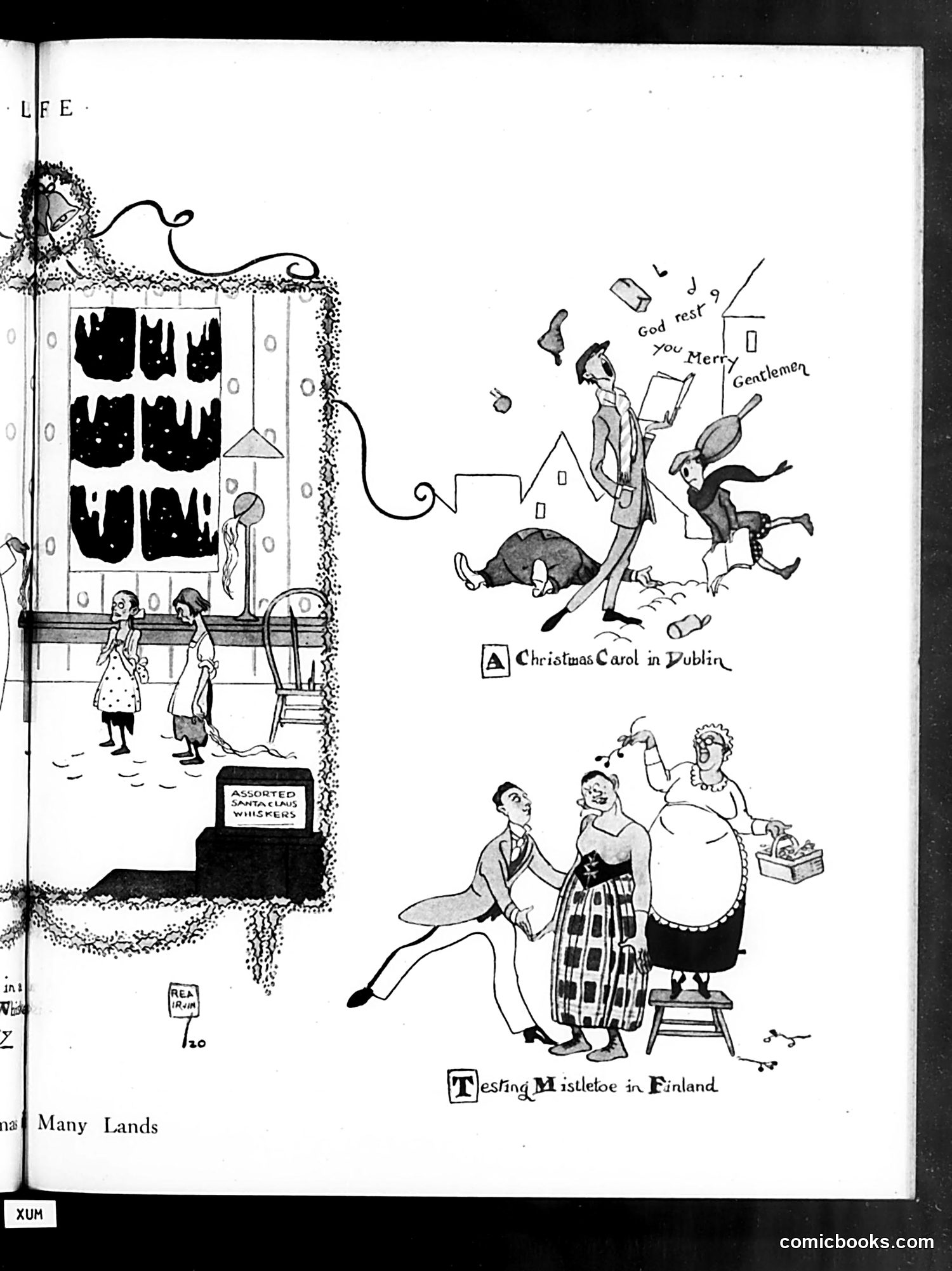
This page from *Life* magazine presents two humorous vignettes about Christmas customs in different lands, illustrating cultural differences through satire. **"A Christmas Carol in Dublin"** depicts Irish Christmas caroling, showing figures singing outside a shop window while a man tosses money from above—satirizing the stereotype of Irish generosity or perhaps the commercialization of holiday traditions. **"Testing Mistletoe in Finland"** shows figures gathered around mistletoe, apparently testing its romantic properties—likely mocking Finnish customs or the universal excuse mistletoe provides for kissing during holidays. The left panel shows a festive shop window display, establishing the holiday setting. Together, these sketches use exaggeration and cultural stereotypes as humor, inviting readers to laugh at how different nations celebrate Christmas.
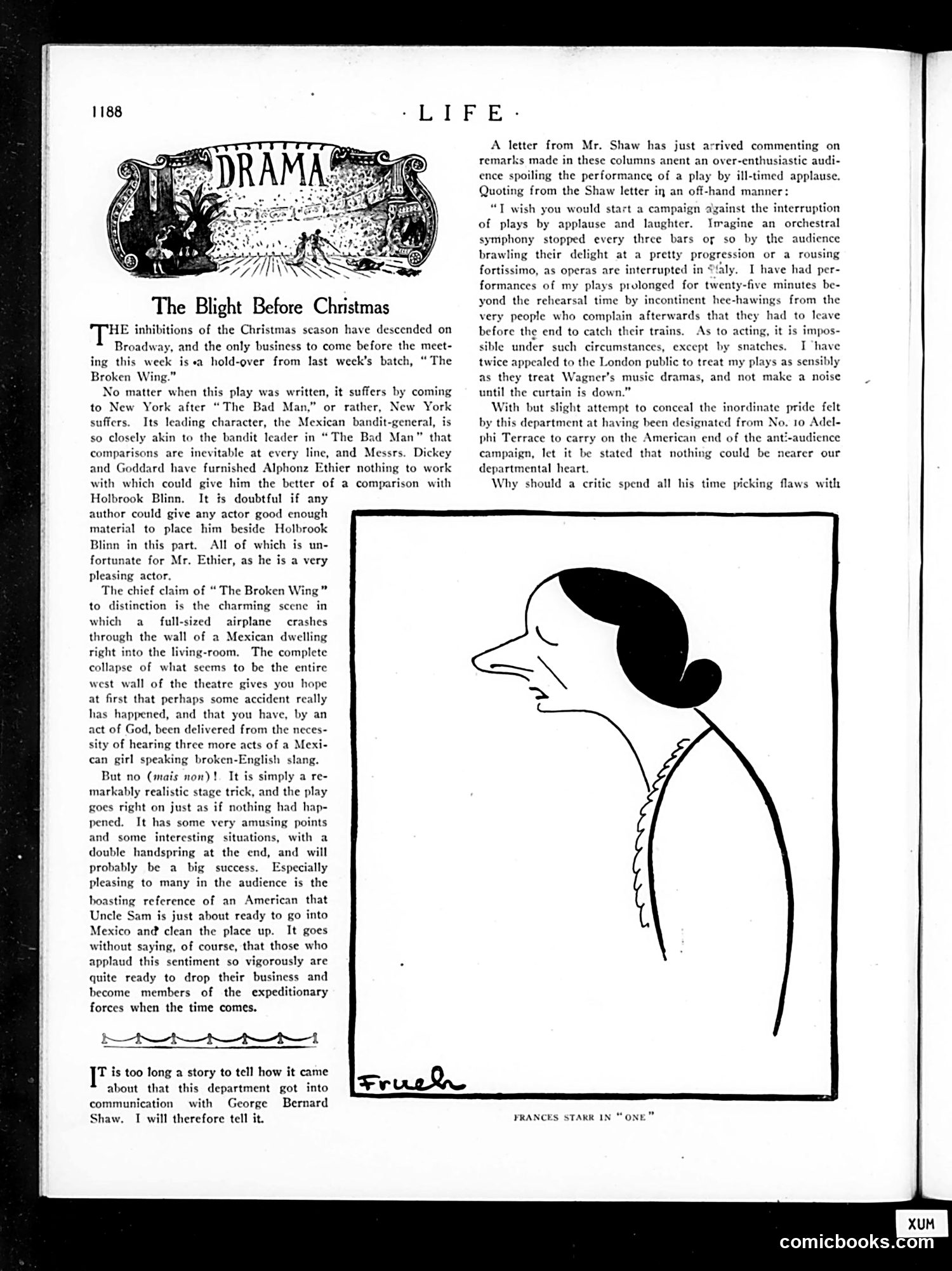
This page reviews Broadway plays during the Christmas season. The main critique targets *"The Broken Wing,"* a play featuring a Mexican bandit-general character that critics found derivative of the recently-staged *"The Bad Man."* The review mocks the play's central gimmick—a full-sized airplane crashing through a Mexican dwelling's wall—as a hollow spectacle that doesn't justify sitting through three acts of "a Mexican girl speaking broken-English slang." The satire extends to American jingoism: the review notes that audiences enthusiastically applaud a character's boast about the U.S. being "ready to go into Mexico and clean the place up," sarcastically observing these same vocal patriots wouldn't actually enlist if war came. A sidebar features correspondence with George Bernard Shaw condemning audience applause interrupting performances, comparing it to stopping an orchestra mid-symphony. The illustration shows Frances Starr in the play *"One"* (credited at bottom).
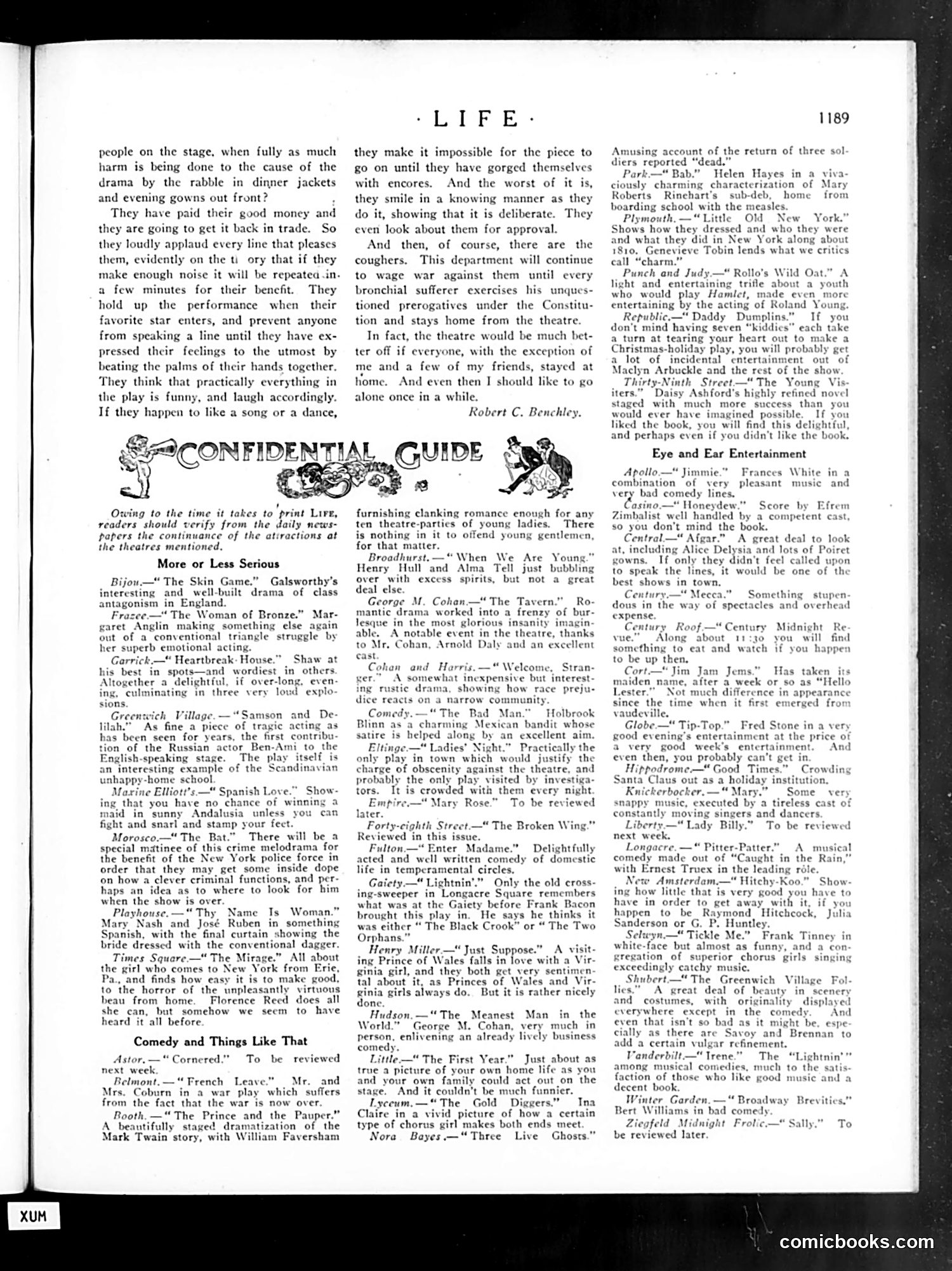
This page from *Life* magazine contains theater reviews and commentary, not political cartoons. The decorative "Confidential Guide" header with illustrated figures is purely ornamental. The main content is Robert C. Benchley's satirical essay criticizing theater audiences. Benchley mocks affluent theatergoers ("dinner jackets and evening gowns") who pay for tickets, then deliberately disrupt performances by loudly applauding favorite moments to force repetition, laughing excessively at everything, and demanding encores. He also targets chronic coughers who won't stay home when sick. The humor is social satire: Benchley portrays audience members as self-centered hecklers who mistake their paid admission as entitling them to control the show. He concludes by sardonically suggesting everyone stay home except himself and "a few of my friends"—a classic Benchley-style misanthropic punchline. The remaining reviews briefly assess current Broadway productions with similar wit.
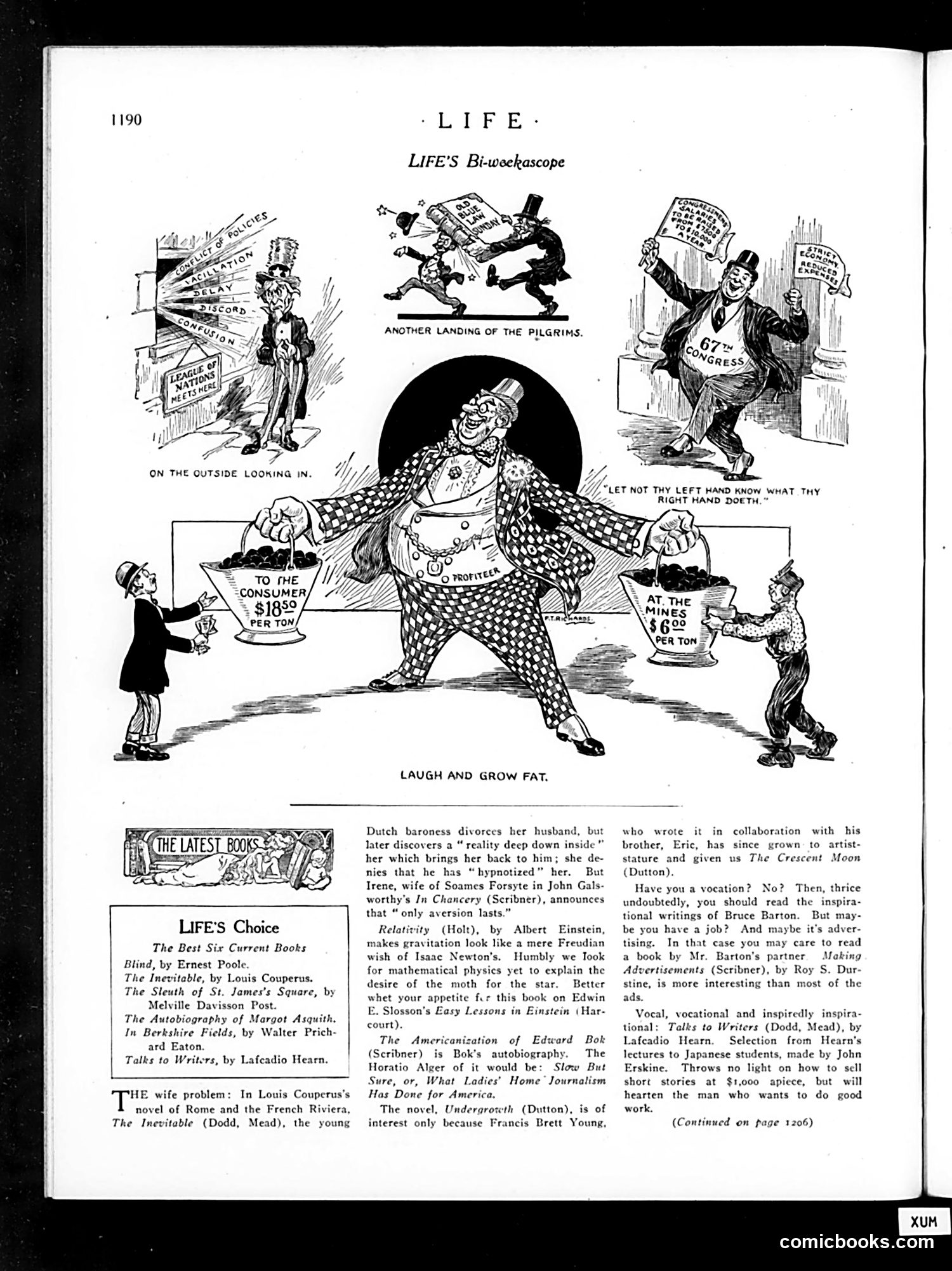
This page features "Life's Bi-weekascope," a satirical cartoon mocking profiteering and hypocrisy during what appears to be the World War I era. The central figure is a fat plutocrat/profiteer wearing a checkered suit, positioned between two figures labeled "To the Consumer $1.99 per ton" (left) and "At the Mines $6.03 per ton" (right)—illustrating price-gouging middlemen exploiting both consumers and miners. The phrase "Laugh and Grow Fat" emphasizes the moral commentary: the profiteer grows wealthy while others suffer. Surrounding vignettes mock related hypocrisies: politicians claiming patriotism, religious hypocrisy ("Let not thy left hand know what thy right hand doeth"), and false piety during wartime profiteering. The cartoon critiques war profiteers and corporate exploitation—common satirical targets in American magazines during WWI, when such behavior drew public outrage and moral condemnation.
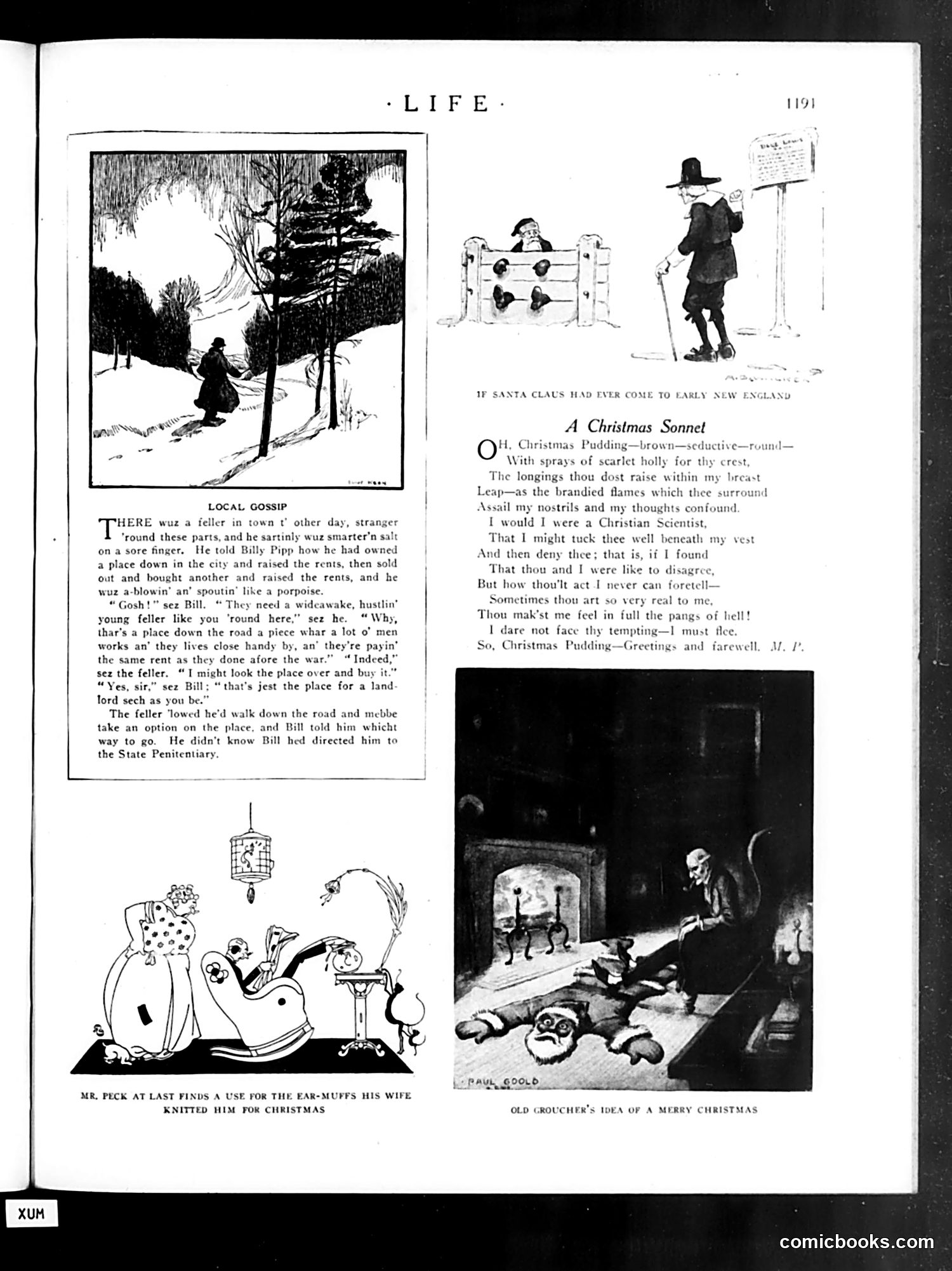
This page contains three Christmas-themed satirical pieces typical of early 20th-century Life magazine humor: **"Local Gossip"**: A tall tale about a con man who sells city property at inflated rents, then tricks a gullible stranger into buying land—which turns out to be the State Penitentiary. The joke plays on rural/urban stereotypes and warns against get-rich-quick schemes. **"A Christmas Sonnet"**: Mock-serious poetry about struggling with temptation from Christmas pudding, treating the dessert as an irresistible moral test. The humor lies in treating food with overwrought dramatic language. **The cartoons** depict domestic absurdities: a man finally finding practical use for useless ear-muffs his wife knitted, and an old man's "merry Christmas" imagined as sitting alone by a fireplace. The overall tone is gentle satire of American life, with recurring themes of marital comedy, consumer folly, and rural simplicity versus urban cunning—characteristic of Life's early satirical voice.
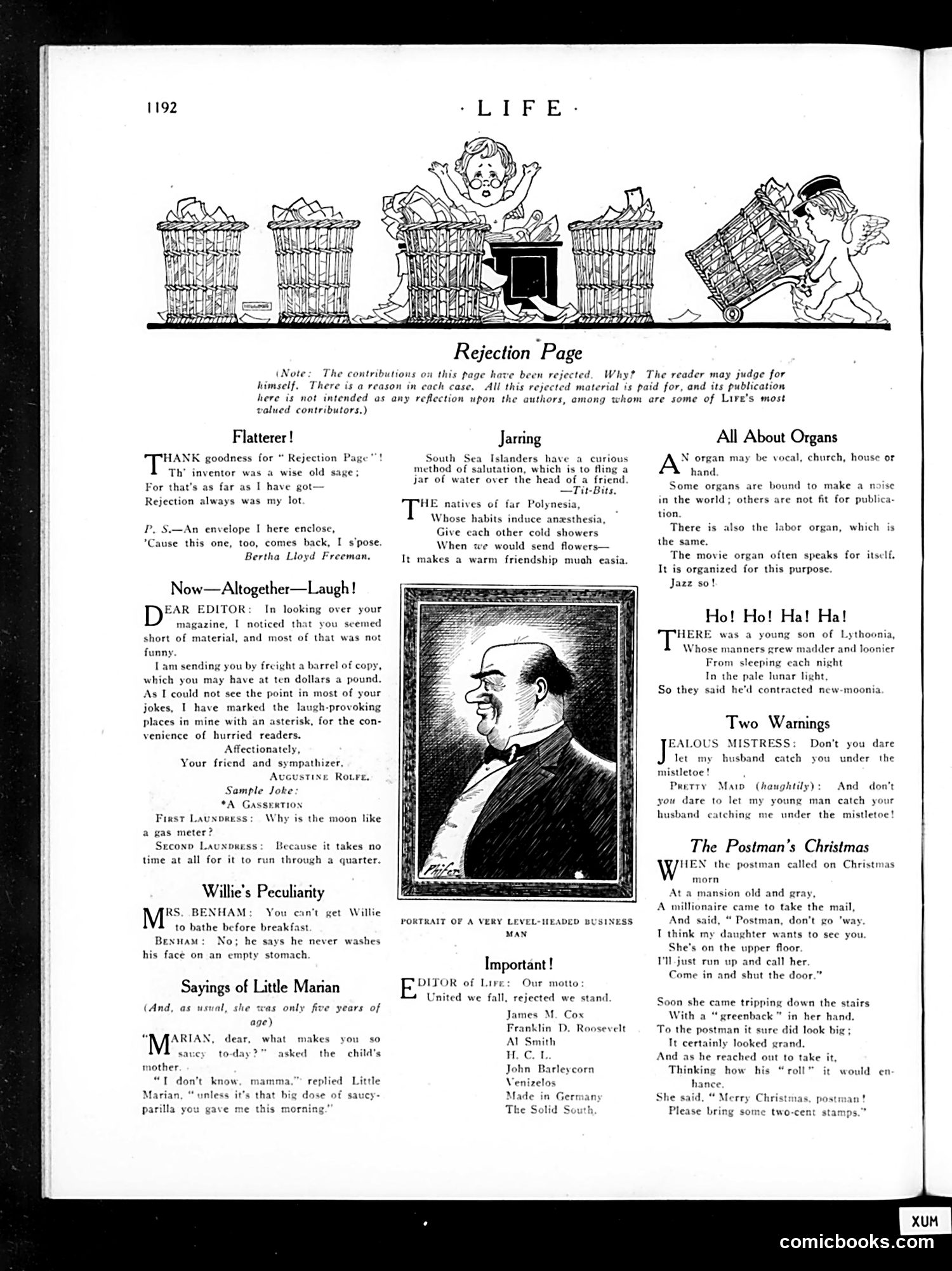
This is a **rejection page** — a deliberate self-parody where *Life* magazine publishes submitted material they deliberately rejected, with editors' explanations. The page functions as satire on amateur writers and their submissions. **Key content:** The **portrait** shows a "level-headed business man," likely satirizing a typical contributor — probably someone with conventional thinking who submits unfunny jokes. **The humor targets:** - Amateur poets and joke-writers submitting poor material - Predictable puns ("Why is the moon like a gas meter?") - Saccharine children's dialogue ("Little Marian") - Heavy-handed verse about South Sea customs **The "Important!" section** lists political figures (Cox, FDR, Al Smith, Barleycorn) as "editors" — suggesting *Life's* editorial staff includes everybody from competing political camps, a jab at editorial confusion. The page itself is the joke: by publishing rejected material with why it failed, *Life* mocks both submission quality and generously compensates rejected writers ("paid for"), maintaining goodwill with contributors while entertaining readers with the material's badness.
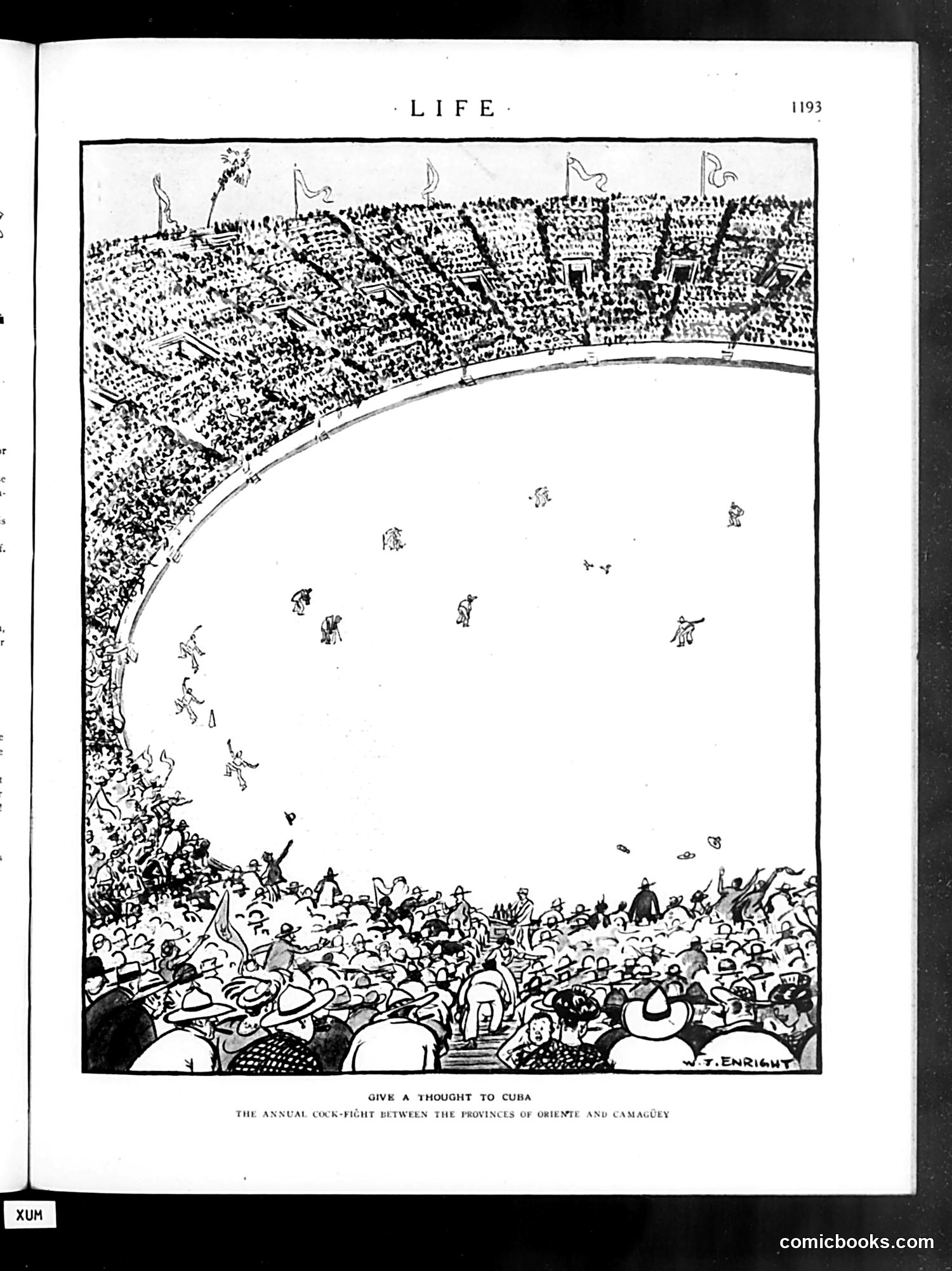
This satirical cartoon, illustrated by J. Enright, depicts a massive arena packed with spectators watching a cockfight. The image uses cockfighting as a metaphor for conflict between Cuba's Oriente and Camaguey provinces. The satire appears to mock Cuban politics or regional rivalries by comparing them to a primitive, brutal spectacle. The enormous crowds suggest these provincial disputes draw public attention similar to blood sports. By portraying serious political/social matters as mere entertainment—a cockfight—the cartoon criticizes either the triviality of the conflict or the Cuban public's fascination with regional disputes. The title's plea to "give a thought to Cuba" suggests the artist views these provincial quarrels as distracting from more serious national concerns, inviting readers to consider what Cuba might accomplish if not consumed by internal rivalry.
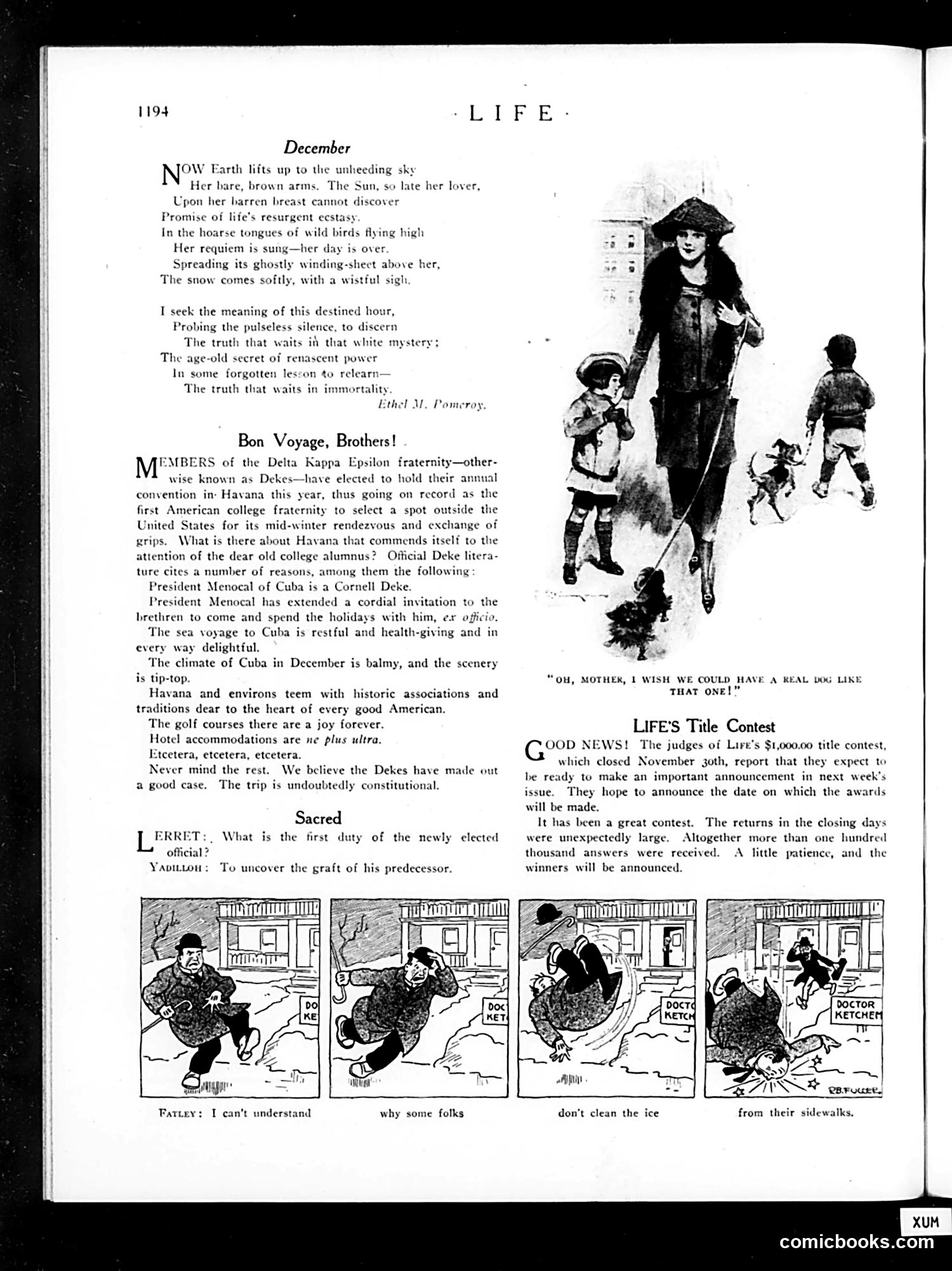
This page contains several distinct pieces of satire: **"Bon Voyage, Brothers!"** mocks Delta Kappa Epsilon fraternity's decision to hold their convention in Havana, Cuba. The piece sarcastically catalogs their justifications—including that Cuban President Menocal is a Cornell alumnus and the golf courses are excellent—while the real implication is transparent: wealthy college men seeking tropical leisure under a thin veneer of fraternal legitimacy. The casual reference to the trip being "undoubtedly constitutional" suggests some contemporary controversy about the trip's propriety. **The four-panel comic strip** (artist unclear) depicts someone repeatedly slipping on ice while others apparently avoid the problem by not clearing sidewalks—a commentary on negligent winter maintenance and public safety hazards. **"Sacred"** is a brief joke: a newly elected official's first duty is uncovering his predecessor's graft/corruption, reflecting widespread Progressive Era concerns about municipal and political corruption. The page also includes poetry and advertisement for Life's title contest ($1,000 prize).
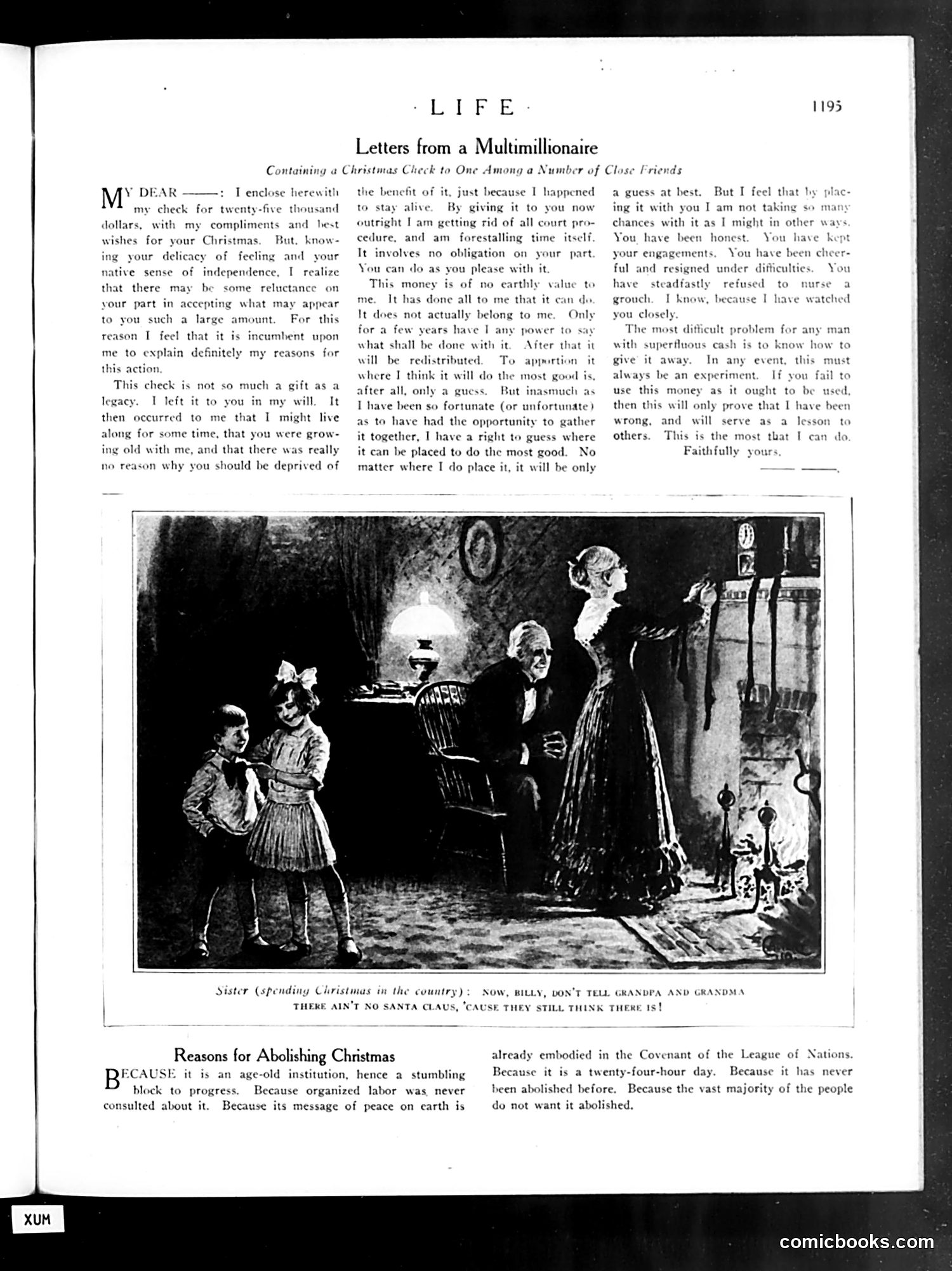
This page contains satirical commentary on wealth distribution and Christmas traditions circa early 20th century. **The Letter:** A wealthy donor explains giving $25,000 to a friend, framing it as neither pure gift nor obligation. The satire targets the multimillionaire's self-justification—he's uncertain whether his money will do "good," admits his choice is "only a guess," yet presents himself as thoughtfully philanthropic. The humor lies in the donor's verbose rationalization for what is essentially an arbitrary act of wealth dispersal. **The Cartoon:** A sister tells her brother Billy not to reveal Santa's non-existence to their grandparents, who still believe. It's gentle satire about generational pretense and the value of maintaining comforting illusions. **"Reasons for Abolishing Christmas":** A satirical list offering absurd justifications (it's old-fashioned, labor wasn't consulted, it's 24 hours long) while the actual reason—most people don't want it abolished—undermines the premise. This mocks progressive reformers proposing radical changes contrary to public opinion.
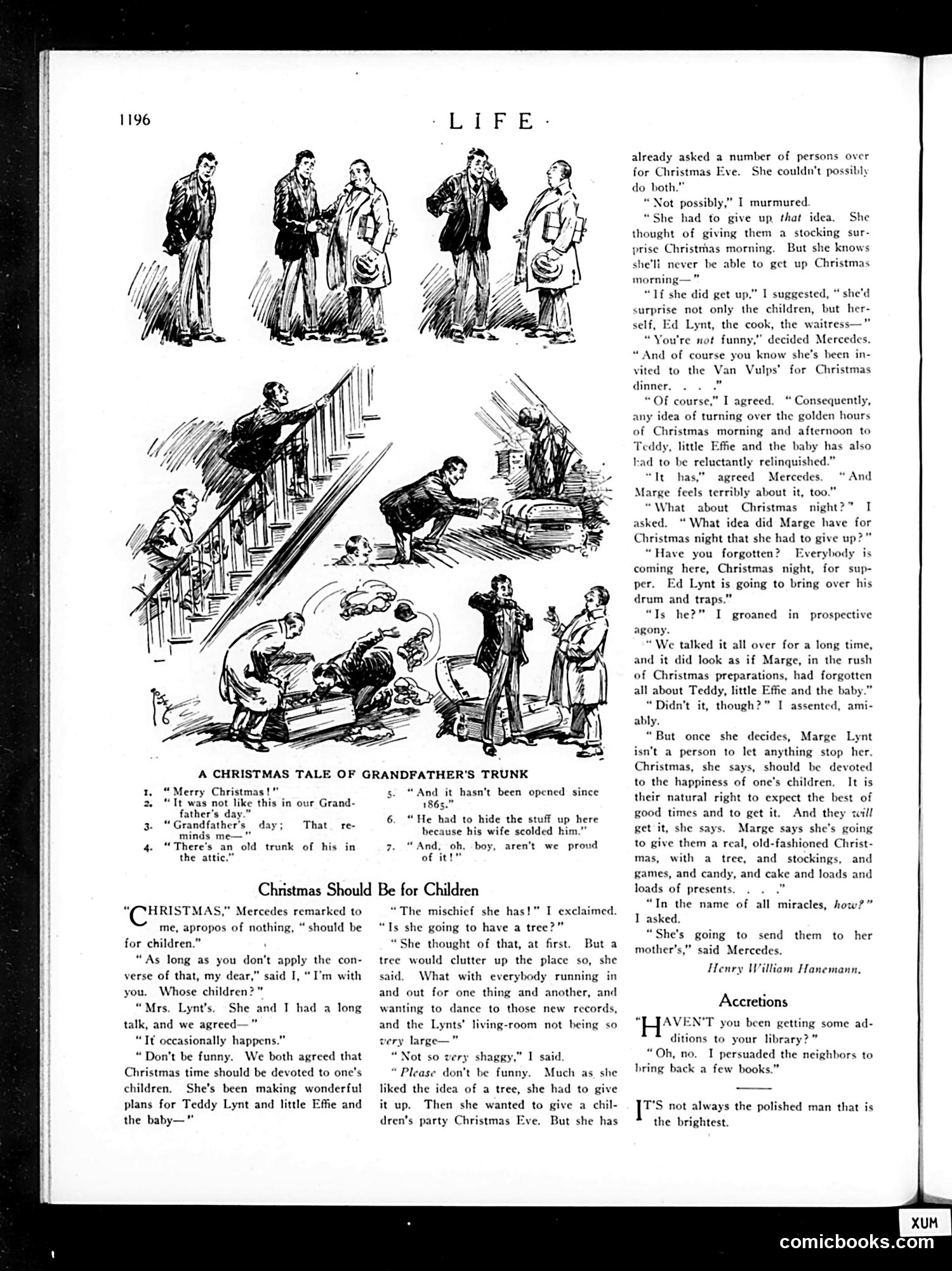
This page contains two satirical pieces from *Life* magazine about Christmas hypocrisy among the upper-middle class. **"A Christmas Tale of Grandfather's Trunk"** mocks nostalgia for simpler times. The accompanying illustrations show family members discovering an old trunk from 1865 (just after the Civil War), which the grandfather had hidden from his scolding wife. The joke: modern people romanticize the past while ignoring that even "Grandfather's day" involved the same domestic friction and material concerns. **"Christmas Should Be for Children"** is sharper satire. Mercedes and her friend discuss how Mrs. Marge Lynt claims Christmas "should be for children"—yet Marge has committed to adult social obligations: a dinner party at the Van Vulps', a supper with Ed Lynt's drum performances. She's canceled the children's tree, the stocking surprise, the children's party. The punchline: to actually give her children a "real, old-fashioned Christmas," she's sending them to their grandmother's house—thus removing them entirely so adults can enjoy the holiday undisturbed. The satire targets sanctimonious parenting rhetoric that masks adult selfishness.
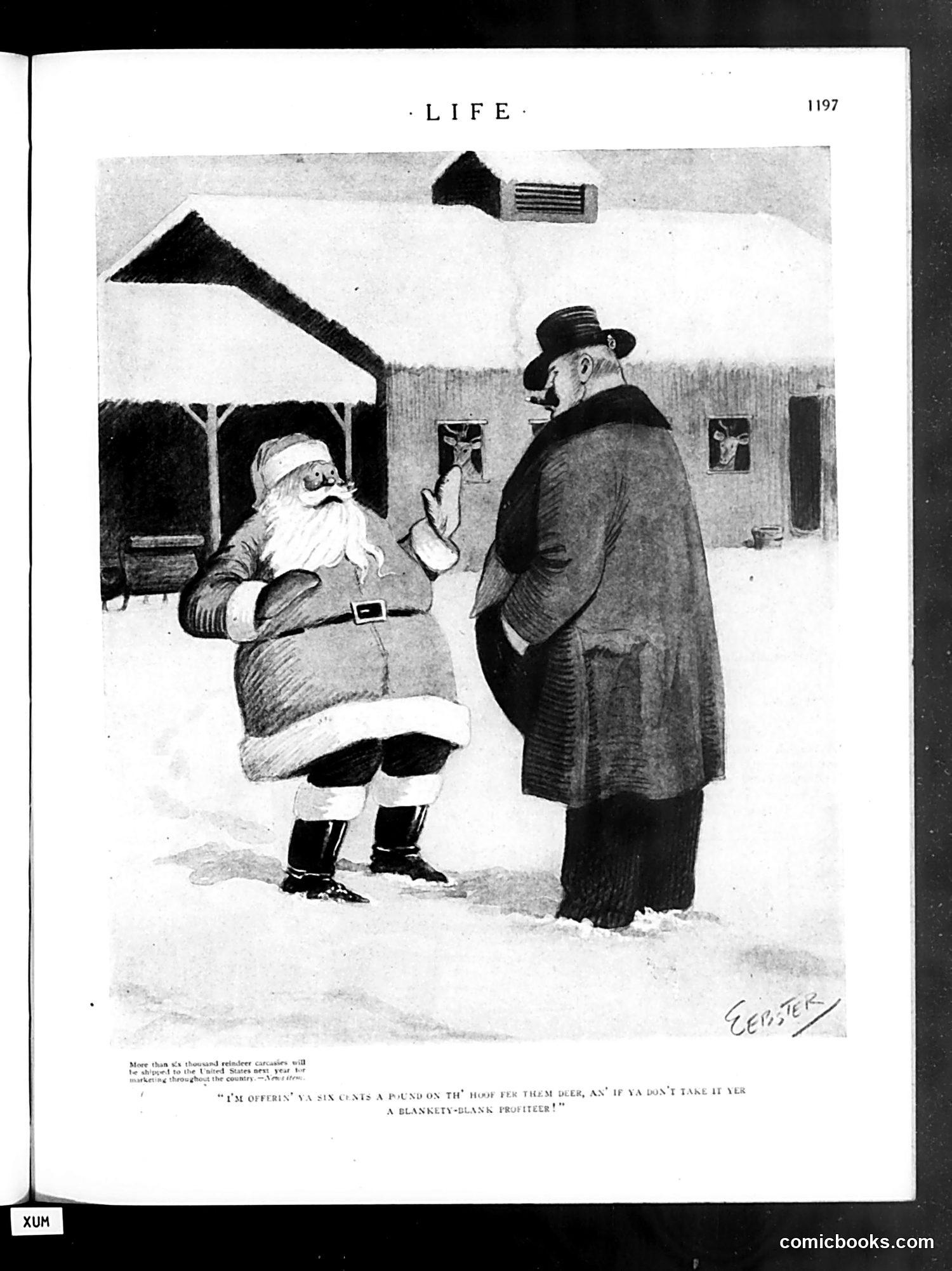
This is a satirical cartoon criticizing wartime profiteering. Santa Claus (representing traditional American values and generosity) confronts a man in a top hat and overcoat (depicted as a profiteer or war contractor). Santa offers "six cents a pound on th' hoof" for hogs—an extremely low price—while sarcastically suggesting the profiteer wouldn't accept it "as a blanketty-blank profiteer." The cartoon attacks those exploiting food shortages during wartime (likely WWI era, given *Life* magazine's publication period) by charging excessive prices. Santa's presence emphasizes the moral outrage: even Santa won't tolerate such greed during the Christmas season. The satire suggests these profiteers are un-American and lacking in holiday spirit or patriotic sacrifice.
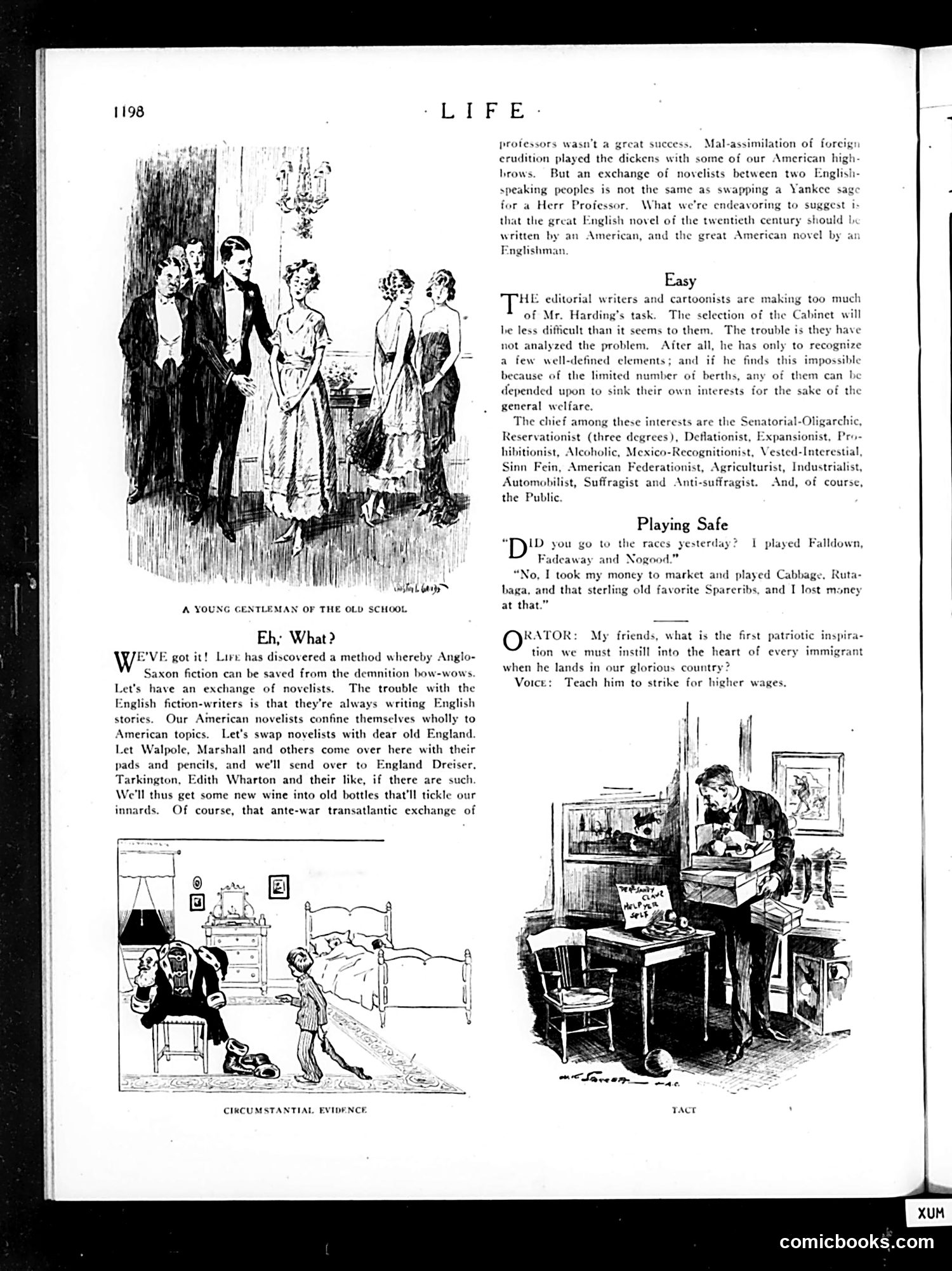
This page contains three satirical pieces from Life magazine (appears to be post-WWI era, referencing President Harding's Cabinet selection). **"Eh, What?"** mocks the idea of exchanging novelists between America and England. The author sarcastically proposes swapping American writers (Dreiser, Tarkington, Wharton) with English ones (Walpole, Marshall) to revitalize "old" English fiction. The satire targets both nations' literary insularity and suggests Americans should write the great 20th-century English novel—a jab at perceived American cultural inferiority. **"Easy"** ridicules political commentary about Harding's Cabinet choices, listing competing interest groups (Senatorial oligarchs, Prohibitionists, labor advocates, etc.) as if they're simple "elements" to balance—mocking the naive assumption these factions will selflessly compromise. **"Playing Safe"** uses horse-racing metaphors to satirize cautious betting, comparing it to vegetable names. The final "Tact" cartoon shows an orator promoting patriotism while a voice interrupts: "Teach him to strike for higher wages"—satirizing the contradiction between nationalist rhetoric and labor radicalism post-war.
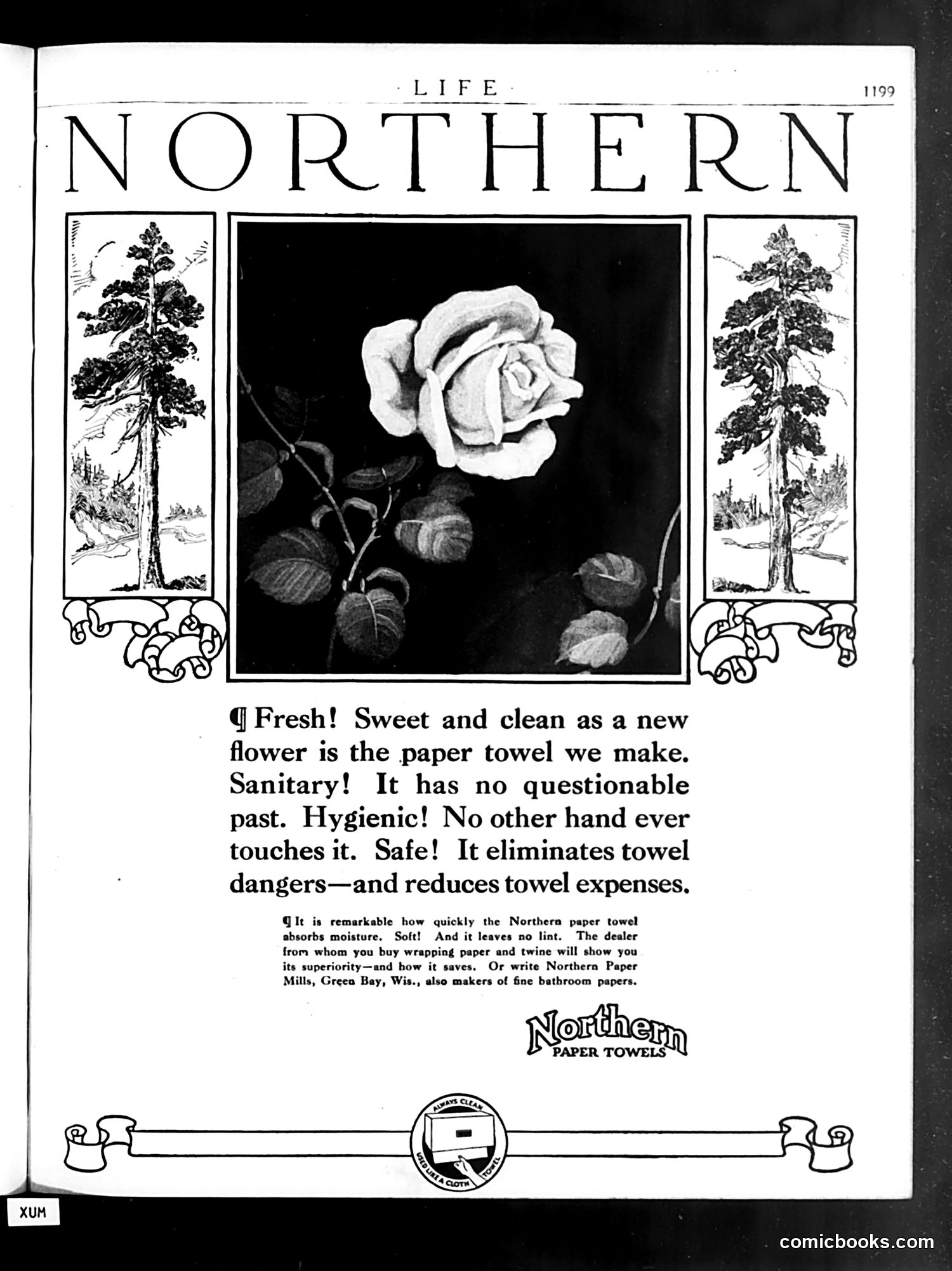
This is primarily a **product advertisement**, not political satire. Northern Paper Towels markets their paper towels using early 20th-century advertising rhetoric emphasizing hygiene and sanitation—concerns that were culturally prominent during this era. The ad's central claim is that paper towels are superior to cloth towels because they're disposable and "hygienic"—no hand ever touches them after manufacturing, eliminating cross-contamination. The rose imagery symbolizes cleanliness and freshness. The decorative pine trees flanking the rose suggest natural purity. Language like "no questionable past" and emphasis on safety reflect the era's growing anxiety about germs and bacterial transmission, likely influenced by early 20th-century public health campaigns. This represents the commercialization of hygiene concerns to drive consumer adoption of disposable paper products—a successful marketing strategy that fundamentally changed household practices.
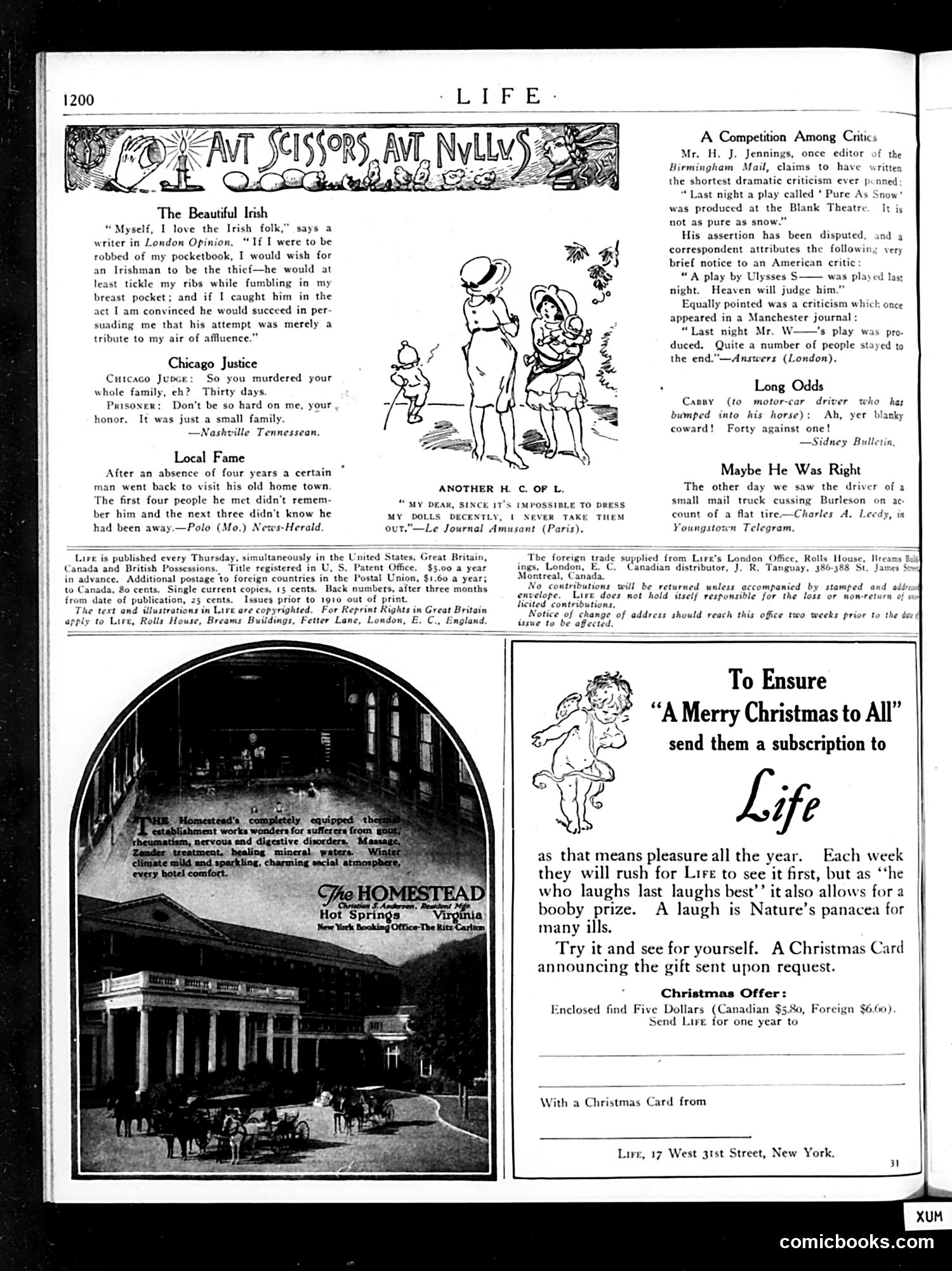
This page from *Life* magazine features several short humorous pieces mocking dramatic criticism and everyday absurdities: **"A Competition Among Critics"** satirizes the brevity of theatrical reviews, presenting increasingly terse (and dismissive) critiques of a play called "Pure As Snow." The joke is that critics are trying to out-do each other with ever-shorter, snarkier notices—culminating in an American critic's brutal one-liner: "A play by Ulysses S— was played last night. Heaven will judge him." **"Chicago Justice"** and **"Local Fame"** are brief comedy bits about a murderer receiving a light sentence and a man returning home unremembered—standard vaudeville humor of the era. **"Long Odds"** appears to reference a motor-car accident, likely mocking the prevalence of automobile incidents. The page also contains a *Homestead Hotel* advertisement and a subscription offer for *Life* itself as a Christmas gift—emphasizing that laughter provides health benefits ("Nature's panacea for many ills"). The overall tone is light, satirical commentary on contemporary life rather than political satire.
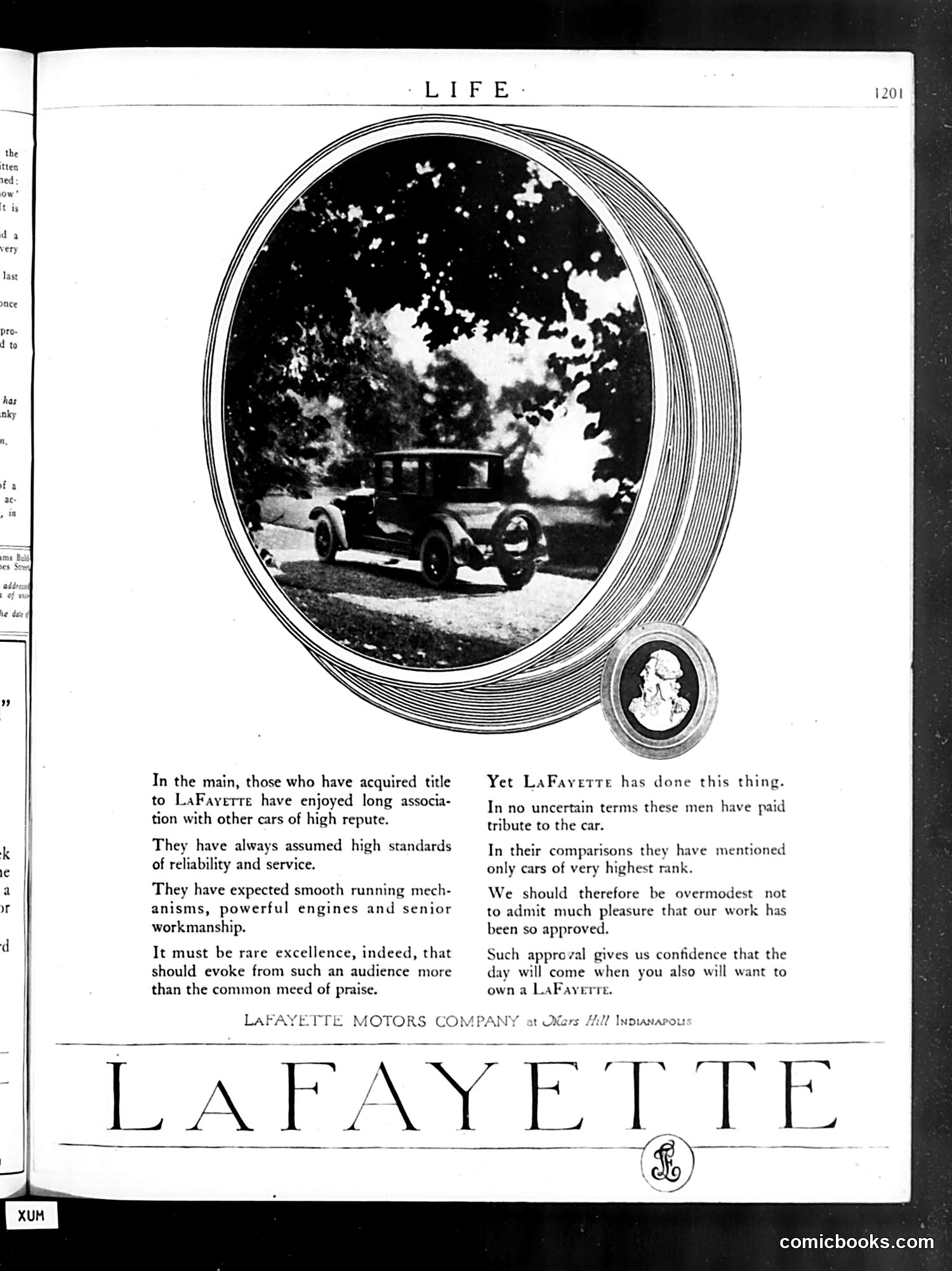
This is primarily a **car advertisement**, not a political cartoon. The page promotes Lafayette automobiles manufactured in Indianapolis. The ad argues that Lafayette owners are typically wealthy, discerning people with refined taste who compare cars only to other "high repute" vehicles. The accompanying photograph shows a Lafayette automobile parked on a tree-lined road. The advertisement's strategy is aspirational: it claims Lafayette has earned praise even from this elite, hard-to-impress audience—suggesting that owning one signals refined judgment. The implied message to readers is that purchasing a Lafayette will associate them with this distinguished ownership class. There is **no satire or political content** here—this is straightforward luxury car marketing from the early automobile era, appealing to status-conscious consumers.
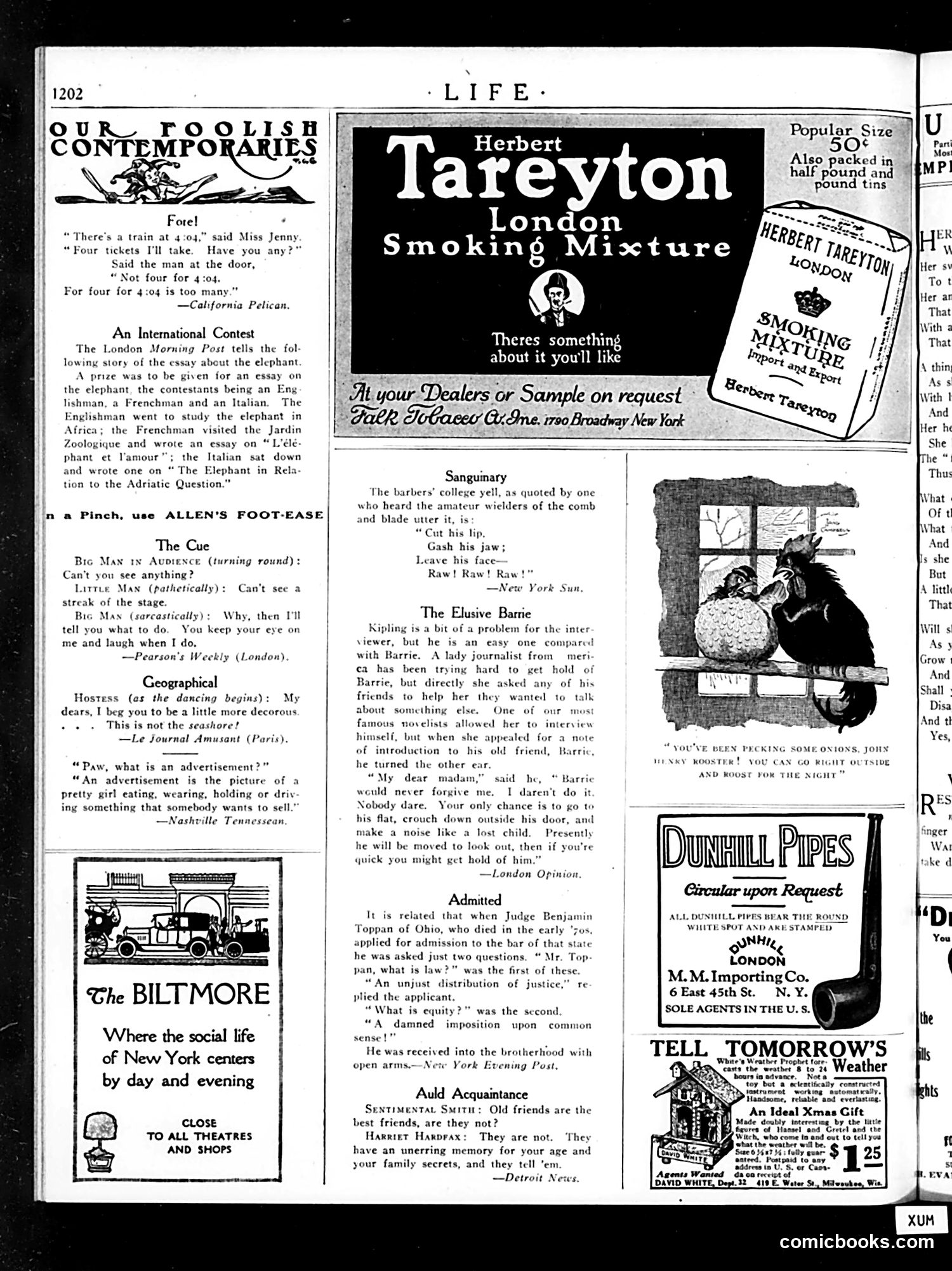
This page from *Life* magazine contains primarily **humorous anecdotes and wordplay** rather than political cartoons. The main joke sections mock bureaucratic absurdity and professional pretension: - **"Fore!"** is a tongue-twister joke about train tickets and the number 4:04 - **"An International Contest"** satirizes national stereotypes: an Englishman, Frenchman, and Italian each write essays on elephants reflecting their cultures' obsessions (the Italian absurdly relating it to the "Adriatic Question") - **"The Elusive Barrie"** mocks the difficulty of interviewing author J.M. Barrie - **"Admitted"** presents a sardonic anecdote where an Ohio judge defines law as "unjust distribution of justice"—suggesting the legal system is inherently corrupt, yet he's admitted to the bar anyway The page is largely **advertising** (Herbert Tareyton tobacco, Dunhill Pipes, the Biltmore hotel) mixed with reprinted jokes from various newspapers and magazines. There are no identifiable political figures or current events commentary—just period humor about human foibles and professional pomposity.
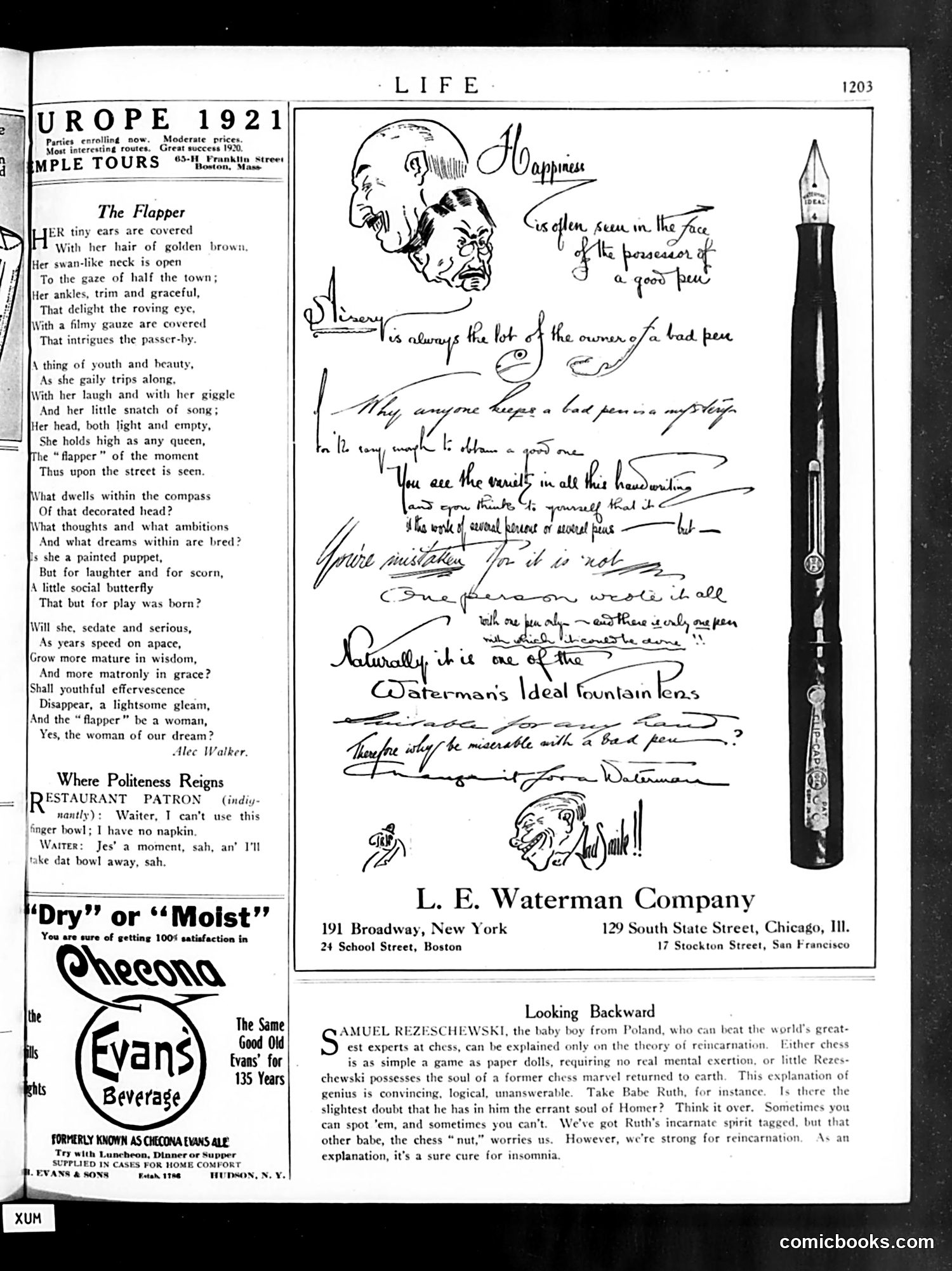
**"The Flapper" Poem**: This satirical verse mocks the 1920s "flapper"—a young woman with bobbed hair, visible ankles, and carefree demeanor that shocked conservatives. The poem questions whether these modern girls are empty-headed "painted puppets" or will mature into respectable women, reflecting widespread anxiety about changing female social roles and morality during the post-WWI era. **"Where Politeness Reigns" Cartoon**: A brief joke about restaurant etiquette. A patron complains he cannot use a finger bowl without a napkin; the waiter offers to remove the bowl. The humor lies in the miscommunication and the waiter's casual dismissal of proper dining protocol—likely satirizing either declining service standards or the mixing of social classes. **"Looking Backward" Column**: Humorously applies reincarnation theory to explain genius, using chess prodigy Samuel Rezeschewski and baseball star Babe Ruth as examples. The satirical point appears to be that reincarnation is a more convincing explanation for exceptional talent than actual skill development.
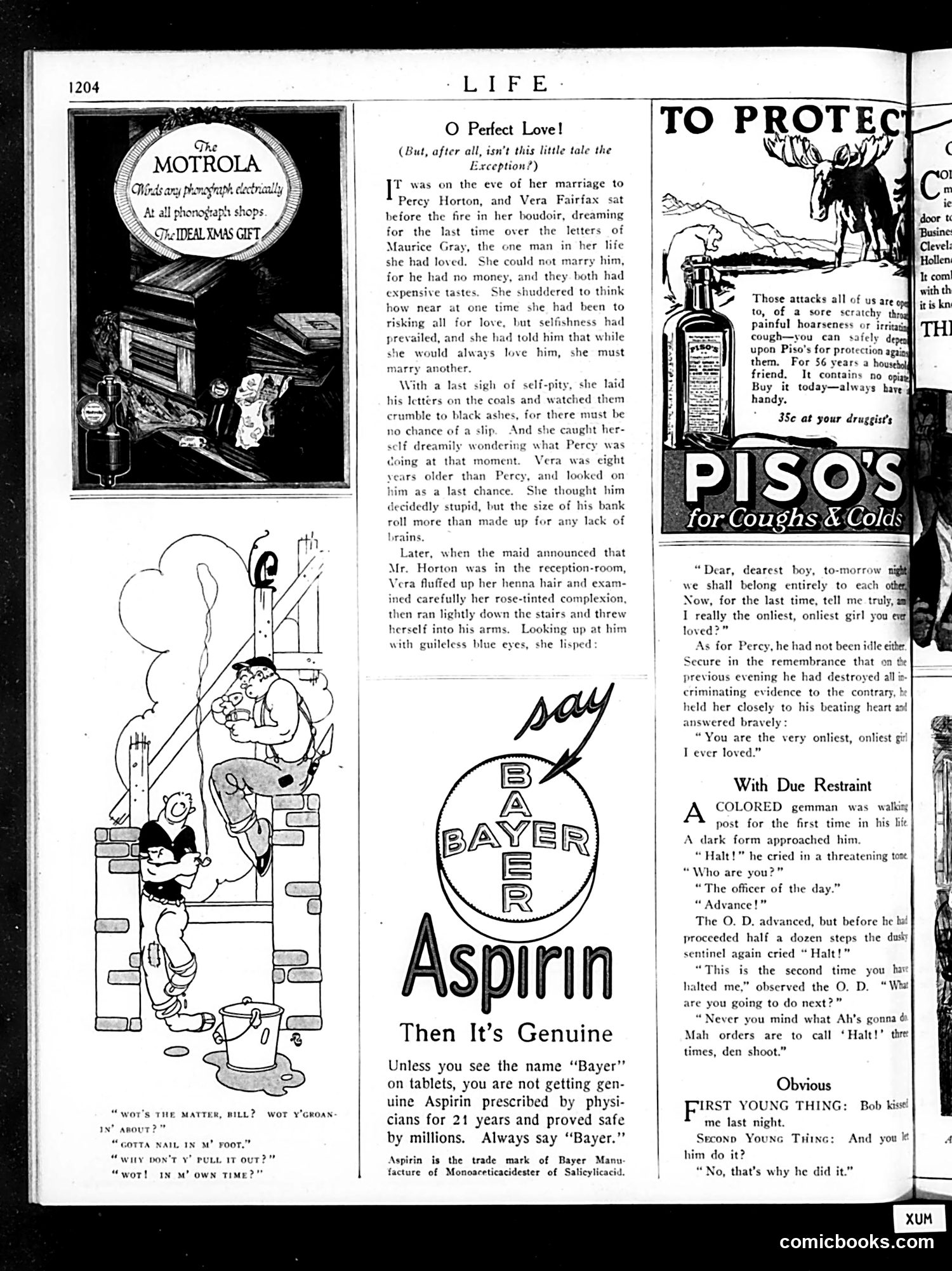
This Life magazine page contains three distinct humorous pieces targeting early 1920s social attitudes: **"O Perfect Love!"** is a satirical short story about Vera Fairfax, who burns love letters from a poor man (Maurice Gray) before marrying the wealthy but "decidedly stupid" Percy Horton. The satire mocks women who choose financial security over genuine affection, and men who accept obvious lies—both swear undying love while harboring secret doubts and past attachments. **The cartoon** ("Wor's the matter, Bill?") depicts working-class men discussing a nail in a foot, using dialect humor typical of the era's vaudeville comedy. **"With Due Restraint"** satirizes racial stereotypes, portraying a Black soldier using exaggerated dialect while performing guard duty with comedic incompetence—reflecting the period's offensive entertainment conventions. The advertisements for Motrola phonographs, Piso's cough syrup, and Bayer Aspirin are standard contemporary marketing, with Aspirin emphasizing its trademark authenticity against generic competitors.
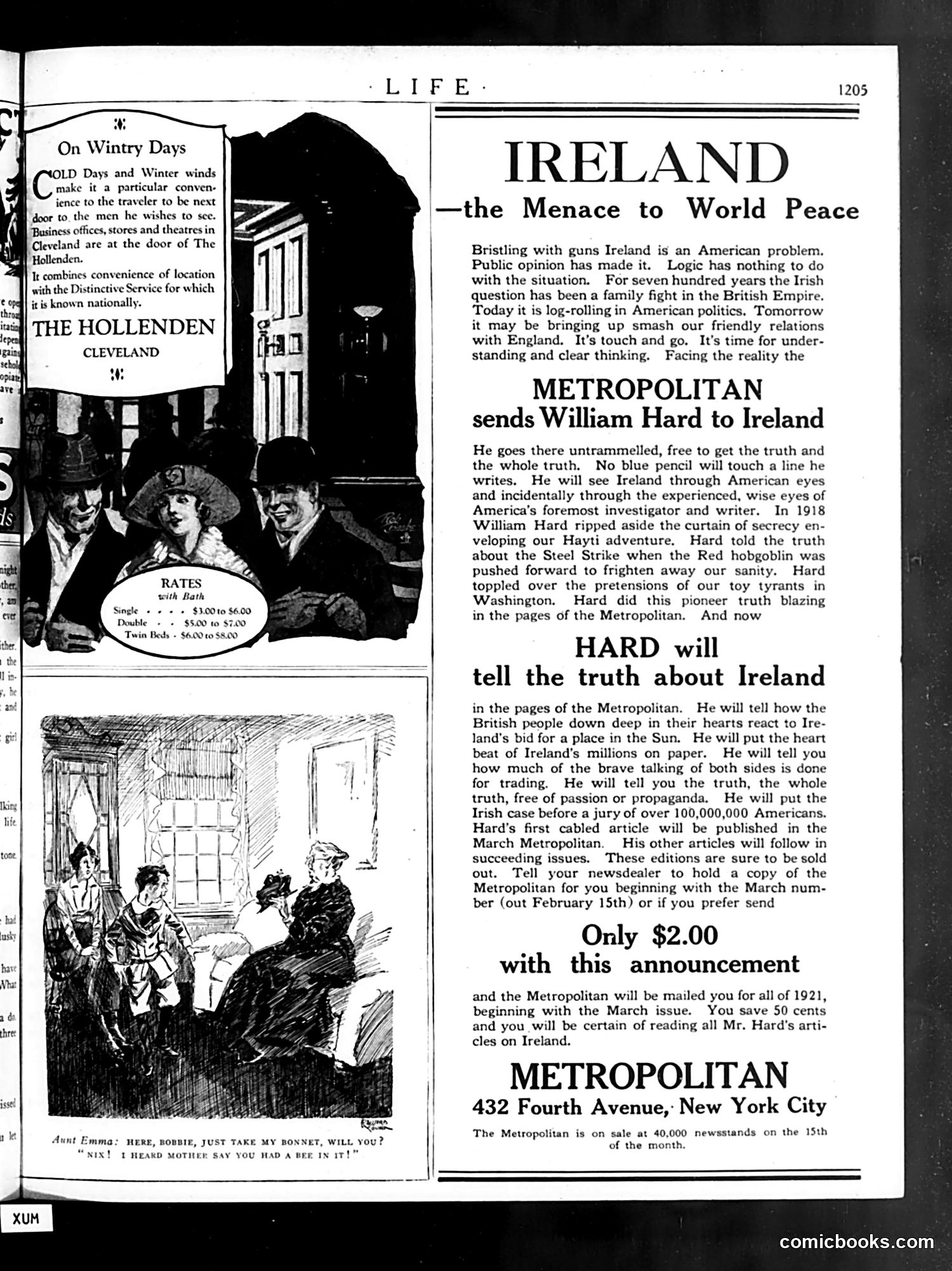
This page combines hotel advertising with a major editorial promotion. The right side is a full-page advertisement for *Metropolitan* magazine, announcing journalist William Hard's investigative series on Ireland—a then-urgent American political issue. **The Context:** In 1921, Irish independence from Britain was a flashpoint in American politics. Irish-Americans formed a significant voting bloc, and the Irish War of Independence (1919-1921) generated passionate public debate. **The Pitch:** *Metropolitan* positions Hard as an fearless truth-teller who previously exposed secrets about Haiti and steel strikes. The ad frames his Ireland reporting as essential reading for Americans forming opinions on this contentious foreign issue. **The Small Cartoon:** The bottom illustration ("Aunt Emma") is an unrelated domestic joke about a gossipy character—typical filler humor for the era. **The Left Side:** The Hollenden hotel advertisement exploits winter travel convenience, standard commercial content for the magazine.
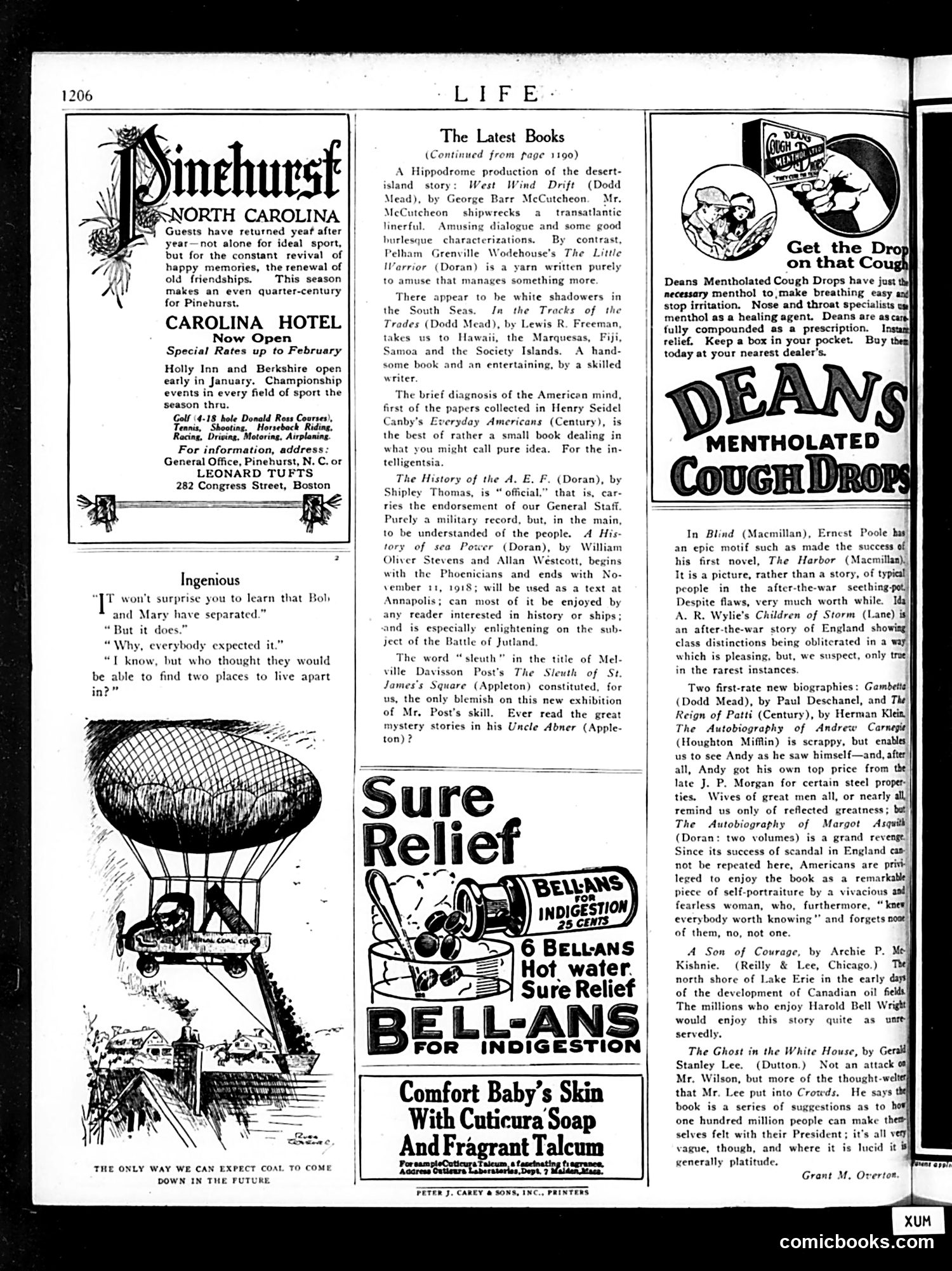
This single-panel cartoon depicts a hot air balloon descending toward ground level, satirizing post-World War I coal price inflation in America. The joke plays on the phrase "come down" — literally showing coal arriving via hot air balloon (an absurdly impractical method) as commentary on how **unrealistic it is to expect coal prices to decrease naturally**. The cartoon reflects genuine economic anxieties of the early 1920s, when coal shortages and rising prices were serious public concerns. By suggesting only a fantastical airship delivery could lower costs, the cartoonist implies that government intervention or other dramatic measures—not market forces—would be needed to address the crisis. The accompanying dialogue about a couple affording separate residences plays on similar post-war housing and cost-of-living concerns affecting ordinary Americans.
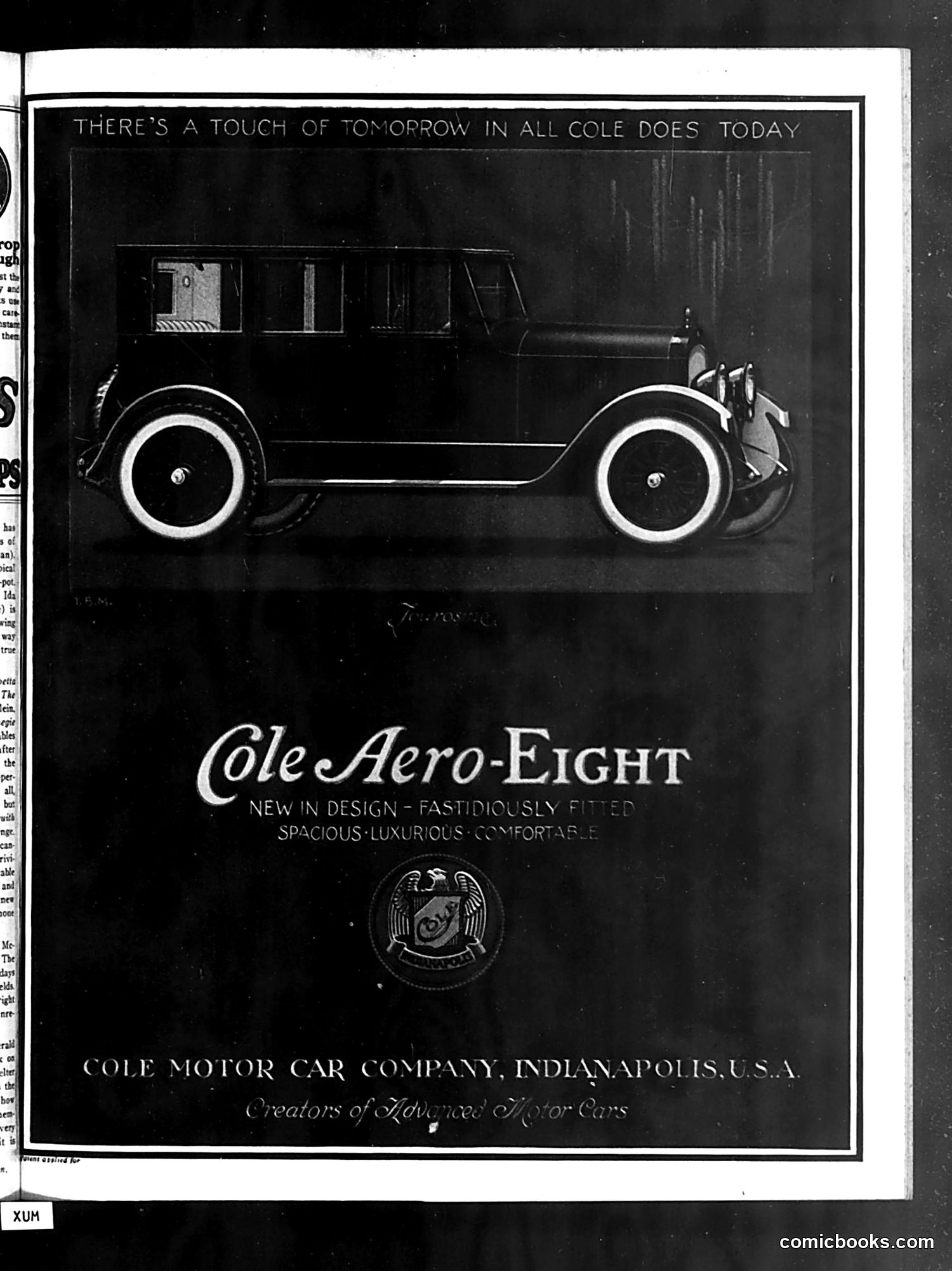
This is a full-page advertisement, not a political cartoon. It promotes the Cole Aero-Eight automobile, manufactured by the Cole Motor Car Company in Indianapolis. The ad features a side-view illustration of a sleek, closed sedan with prominent white-wall tires against a dark background. The tagline "There's a touch of tomorrow in all Cole does today" emphasizes the vehicle's modern, forward-thinking design. The text highlights the car as "new in design" and "fastidiously fitted," appealing to affluent buyers seeking luxury and spaciousness. This appears to be from the early automotive era when such vehicles represented technological advancement and aspirational middle-to-upper-class status.
This is primarily a **Postum cereal advertisement**, not political satire. The page features a large circular emblem reading "HEALTH FIRST" surrounding the message "Drink POSTUM — 'There's a Reason.'" Postum was a caffeine-free cereal beverage marketed as a healthier alternative to coffee. The "There's a Reason" slogan was the company's actual advertising catchphrase of the era, implying health benefits from avoiding caffeine. The 1916 copyright date and product images (instant Postum beverage boxes) frame the advertisement. This represents early 20th-century consumer marketing emphasizing wellness — a common sales pitch when caffeine's effects were debated. The page contains no political commentary or satire; it's straightforward product promotion.