
Life, 1920-12-23 · page 24 of 44
Life — December 23, 1920 — page 24: what you’re looking at
What you’re looking at
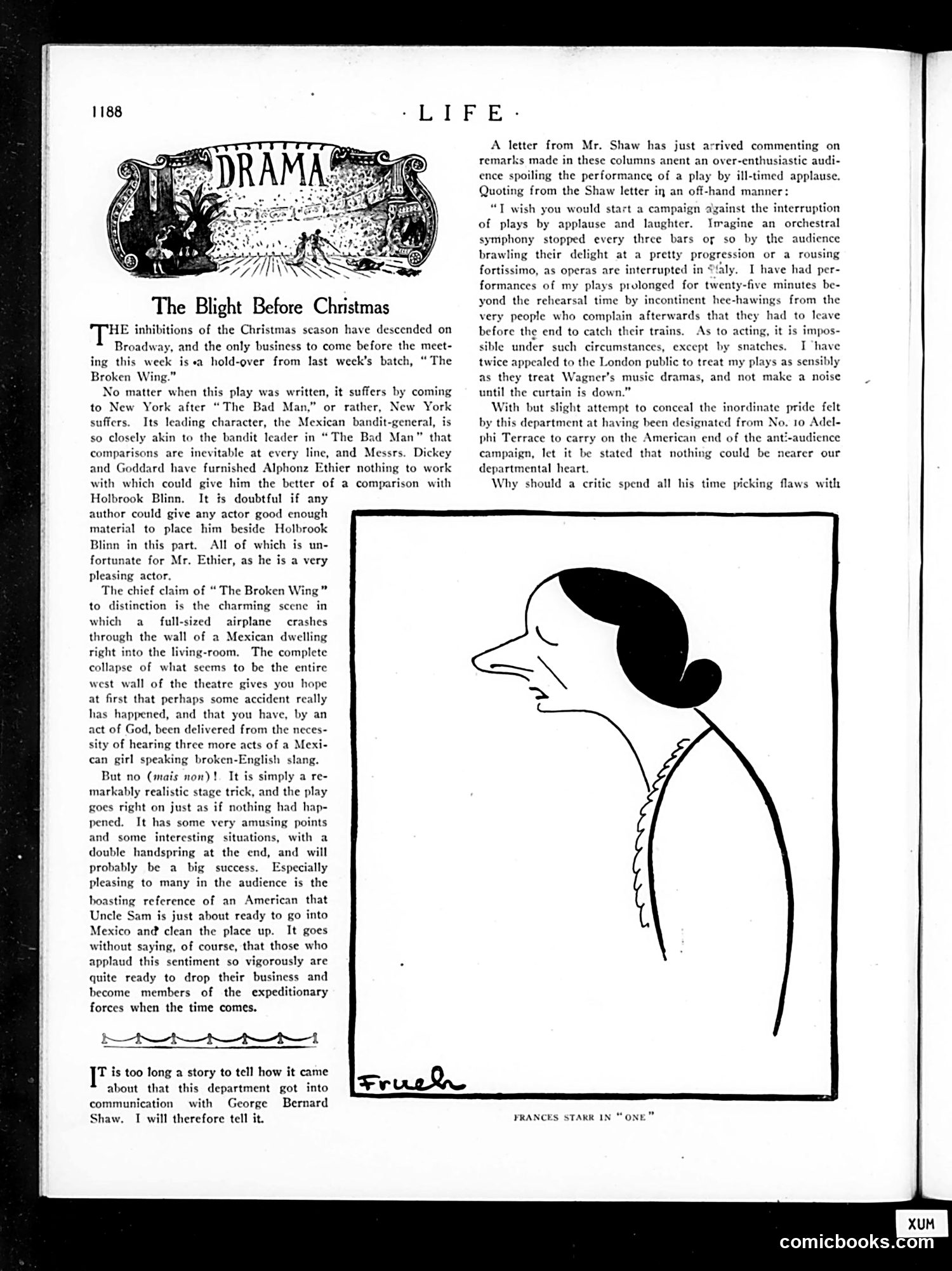
This page reviews Broadway plays during the Christmas season. The main critique targets *"The Broken Wing,"* a play featuring a Mexican bandit-general character that critics found derivative of the recently-staged *"The Bad Man."* The review mocks the play's central gimmick—a full-sized airplane crashing through a Mexican dwelling's wall—as a hollow spectacle that doesn't justify sitting through three acts of "a Mexican girl speaking broken-English slang." The satire extends to American jingoism: the review notes that audiences enthusiastically applaud a character's boast about the U.S. being "ready to go into Mexico and clean the place up," sarcastically observing these same vocal patriots wouldn't actually enlist if war came. A sidebar features correspondence with George Bernard Shaw condemning audience applause interrupting performances, comparing it to stopping an orchestra mid-symphony. The illustration shows Frances Starr in the play *"One"* (credited at bottom).
📄 Transcribed text from this page (OCR, searchable)
Machine-transcribed from the original scan — historical spelling and the odd misread are preserved.
-LIFE- The Blight Before Christmas 'HE inhibitions of the Christmas scason have descended on and the only business to come before the meet- he Broadway, ing this week is +a hold-over from last week's batch, “ Broken Wing.” No matter when this play was written, it suffers by coming to New York after “The Bad Man,” or rather, New York suffers. Its leading character, the Mexican bandit-general, is so closely akin to the bandit leader in “The Bad Man” that comparisons are inevitable at every line, and Messrs. Dickey and Goddard have furnished Alphonz Ethier nothing to work with which could give him the better of a comparison with Holbrook Blinn. It is doubtful if any author could give any actor good enough material to place him beside Holbrook Blinn in this part. All of which is un- fortunate for Mr. Ethier, as he is a very pleasing actor. The chief claim of “ The Broken Wing” to distinction is the charming scene in which a full-sized airplane crashes through the wall of a Mexican dwelling right into the living-room. The complete collapse of what seems to be the entire west wall of the theatre gives you hope at first that perhaps some accident really has happened, and that you have, by an act of God, been delivered from the neces- sity of hearing three more acts of a Mexi- can girl speaking broken-English slang. But no (mais non)! It is simply a re- markably realistic stage trick, and the play goes right on just as if nothing had hap- pened. It has some very amusing points and some interesting situations, with a double handspring at the end, and will probably be a big success. Especially pleasing to many in the audience is the boasting reference of an American that Uncle Sam is just about ready to go into Mexico an@ clean the place up. It goes without saying, of course, that those who applaud this sentiment so vigorously are quite ready to drop their business and become members of the expeditionary forces when the time comes. Lea a Ss r is too long a story to tell how it came about that this department got into communication with George Bernard Shaw. I will therefore tell it. FruseW A letter from Mr. Shaw has just arrived commenting on remarks made in these columns anent an over-enthusiastic audi- ence spoiling the performance of a play by ill-timed applause. Quoting from the Shaw letter in an off-hand manner: “T wish you would start a campaign against the interruption of plays by applause and laughter. Imagine an orchestral symphony stopped every three bars of so by the audience brawling their delight at a pretty progression or a rousing fortissimo, as operas are interrupted in “aly. I have had per- formances of my plays prolonged for twenty-five minutes be- yond the rehearsal time by incontinent hee-hawings from the very people who complain afterwards that they had to leave before the end to catch their trains. As to acting, it is impos- sible under such circumstances, except by snatches. I have twice appealed to the London public to treat my plays as sensibly as they treat Wagner's music dramas, and not make a noise until the curtain is down.” With but slight attempt to conceal the inordinate pride felt by this department at having been designated from No. 10 Adel- phi Terrace to carry on the American end of the anti-audience campaign, let it be stated that nothing could be nearer our departmental heart. Why should a critic spend all his time picking flaws with FRANCES STARR IN “ONE comicbooks.com