
Life, 1920-12-23 · page 12 of 44
Life — December 23, 1920 — page 12: what you’re looking at
What you’re looking at
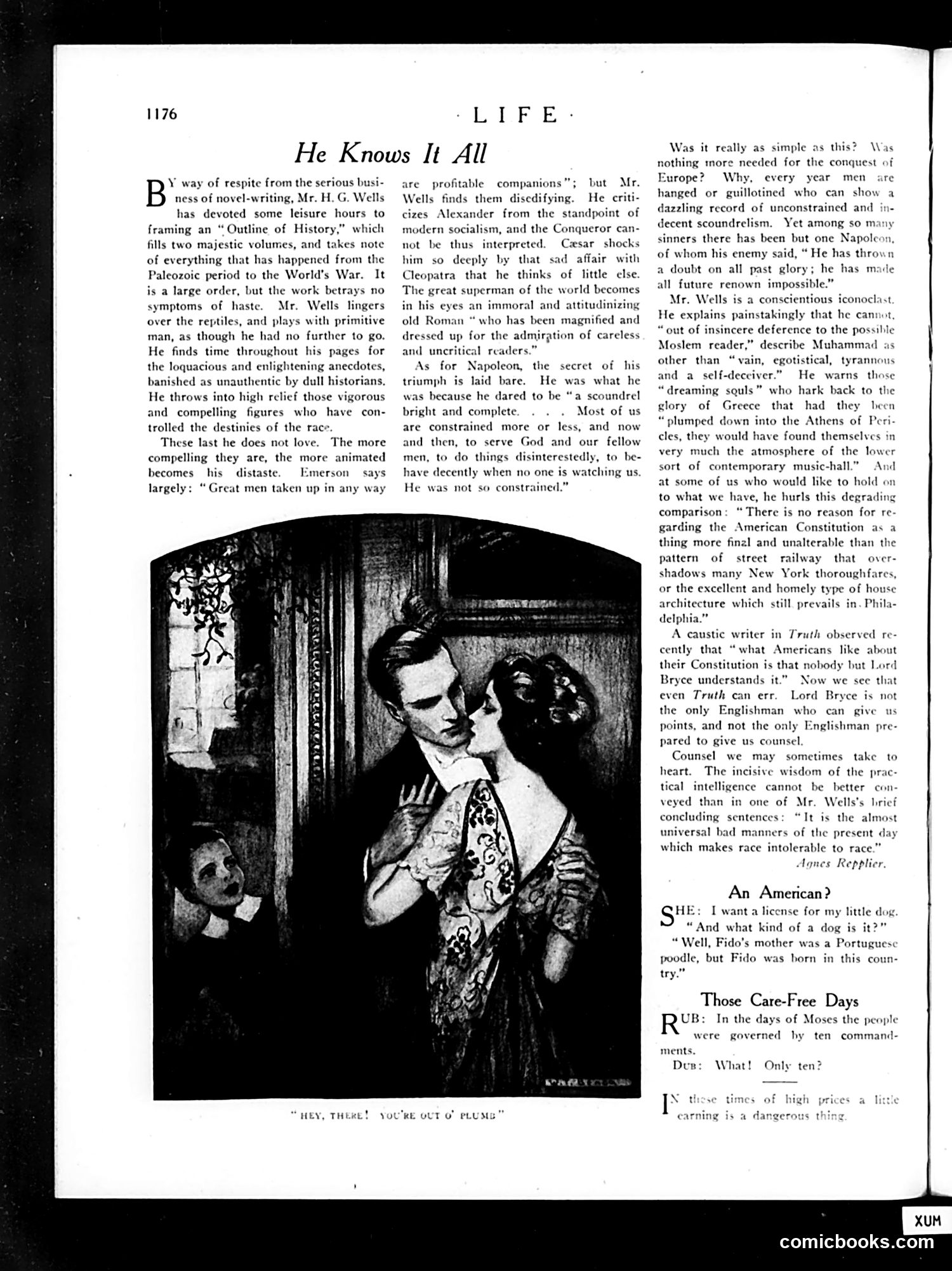
This page reviews H.G. Wells's writing, particularly his historical outlines and social criticism. The article praises Wells's ability to debunk "serious business" while critiquing his dismissiveness toward other intellectuals—notably Alexander the Great, Napoleon, and Muhammad. The illustration labeled "HEY, THERE! YOU'RE OUT OF PLUMS" appears to satirize Wells himself as a somewhat pompous figure, likely mocking his tendency to pronounce sweeping judgments on history and civilization. The subsequent brief dialogues ("An American?" and "Those Care-Free Days") continue the satirical tone, poking fun at contemporary attitudes and pretensions. The overall message seems to be that while Wells offers valuable insights, his all-knowing persona deserves gentle ridicule.
📄 Transcribed text from this page (OCR, searchable)
Machine-transcribed from the original scan — historical spelling and the odd misread are preserved.
“LIFE: He Knows It All Y way of respite from the serious busi- B ness of novel-writing, Mr. H. G. Wells has devoted some leisure hours to framing an “Outline of History,” which fills two majestic volumes, and takes note of everything that has happened from the Paleozoic period to the World's War. It is a large order, but the work betrays no symptoms of haste. Mr. Wells lingers over the reptiles, and plays with primitive man, as though he had no further to go. He finds time throughout his pages for the loquacious and enlightening anecdotes, banished as unauthentic by dull historians, He throws into high relief those vigorous and compelling figures who have con- trolled the destinies of the ra These last he does not love. The more compelling they are, the more animated becomes his distaste. largely: “Great men taken up in any way Emerson says “HEY, THER! are profitable companions”; but Mr. Wells finds them disedifying. He criti- cizes Alexander from the standpoint of modern socialism, and the Conqueror can- not be thus interpreted. Czsar him so deeply by that sad affair with Cleopatra that he thinks of little else. shocks The great superman of the world becomes in his eyes an immoral and attitudinizing old Roman “who has been magnified and dressed up for the admiration of careless and uncritical readers,” As for Napoleon, th triumph is laid bare. He was what he was because he dared to be “a scoundrel bright and complete. Most of us are constrained more or less, and and then, to serve God and our fellow men, to do things disinterestedly, to be- have decently when no one is watching us. secret of his now He was not so constrained YOU'RE OUT O” PLUM it really as simple as this? W nothing more needed for the conquest of Europe? Why, every hanged or guillotined who can show year men dazzling record of unconstrained and decent scoundrelism. Yet among so ma: sinners there has been but one Napolc of whom his enemy said, “ He has throy a doubt on all past glory; he has made all future renown impossible.” Mr. Wells is a conscientious iconoclast He explains painstakin, that he cannot “out of insincere deference to the possible Moslem reader,” describe Muhammad « other than “vain, egotistical, tyrannous and a self-deceiver.” He warns those “dreaming squls” who hark back to the glory of that had they been “plumped down into the Athens of Peri- cles, they would have found themselves in very much the atmosphere of the lower sort of contemporary music-hall.” And Greece at some of us who would like to hold on to what we have, he hurls this degrading comparison: “There is no reason for re garding the American Constitution as thing more final and unalterable than th pattern of that shadows many New York thoroughfares, or the excellent and homely type of house architecture which still prevails in. Phila- delphia.” A caustic writer in cently that “what Americans like about their Constitution is that nobody but Lord Bryce understands it.” even Truth can err. Lord Bryce is not the only Englishman who can give us points, and not the only Englishman pre- pared to give us counsel. Counsel heart. tical street railway over- Truth observed re- low we see that we may take to The incisive wisdom of the prac intelligence sometimes better con- veyed than in one of Mr. Wells's brief concluding sentences: “It is the almost universal bad manners of the present day which makes race intolerable to race.” Agnes Repplier. An American? GPE: T want a license for my Hittle dox. “And what kind of a dog is it?” “Well, Fido’s mother was a Portuguese cannot be poodle, but Fido was born in this coun- try Those Care-Free Days UB: In the days of Moses the people were governed by ten command- ments. Des: What! Only ten? XUM comicbooks.com