
Life, 1920-12-23 · page 26 of 44
Life — December 23, 1920 — page 26: what you’re looking at
What you’re looking at
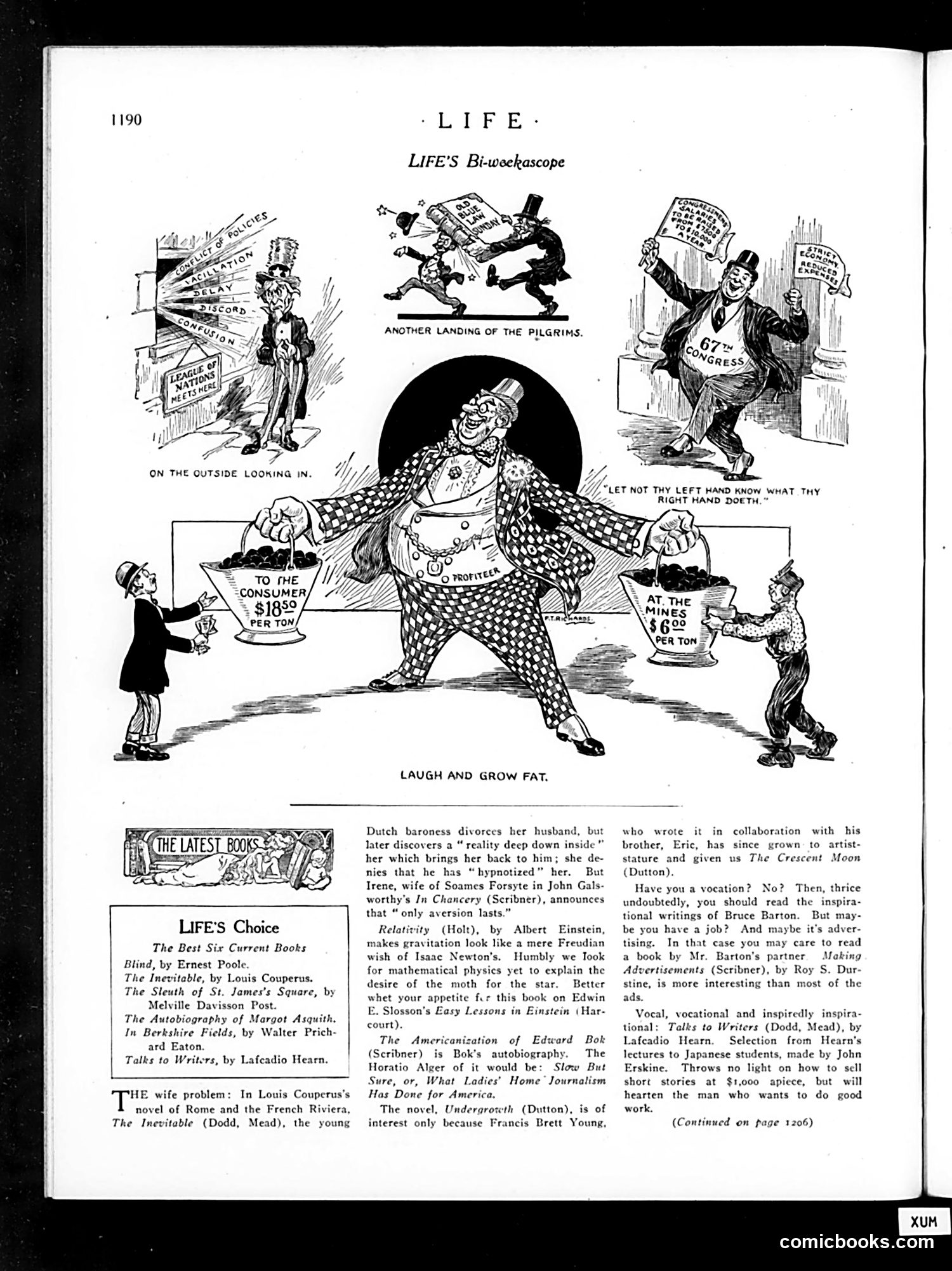
This page features "Life's Bi-weekascope," a satirical cartoon mocking profiteering and hypocrisy during what appears to be the World War I era. The central figure is a fat plutocrat/profiteer wearing a checkered suit, positioned between two figures labeled "To the Consumer $1.99 per ton" (left) and "At the Mines $6.03 per ton" (right)—illustrating price-gouging middlemen exploiting both consumers and miners. The phrase "Laugh and Grow Fat" emphasizes the moral commentary: the profiteer grows wealthy while others suffer. Surrounding vignettes mock related hypocrisies: politicians claiming patriotism, religious hypocrisy ("Let not thy left hand know what thy right hand doeth"), and false piety during wartime profiteering. The cartoon critiques war profiteers and corporate exploitation—common satirical targets in American magazines during WWI, when such behavior drew public outrage and moral condemnation.
📄 Transcribed text from this page (OCR, searchable)
Machine-transcribed from the original scan — historical spelling and the odd misread are preserved.
x ESS = Sie 2 Seu Ay a ee x SOW pet us, - Son “LIFE. LIFE'S Bi-weekascope “LET NOT THY LEFT HAND KNOW WHAT THY LAUGH AND GROW FAT. ne LIFE’S Choice The Best Six Current Books Blind, by Ernest Poole. The Inevitable, by Louis Couperus. The Sleuth of St. James's Square, by Melville Davisson Post. The Autobiography of Margot Asquith. In Berkshire Fields, by Walter Prich- ard Eaton. Talks to Writers, by Lafcadio Hearn. HE wife problem: In Louis Couperus’s novel of Rome and the French Riviera, The Inevitable (Dodd, Mead), the young Dutch baroness divorces her husband, but later discovers a “ reality deep down inside” her which brings her back to him; she de- nies that he has “hypnotized” her. But Irene, wife of Soames Forsyte in John Gals- worthy’s In Chancery (Scribner), announces that “only aversion lasts.” Relativity (Holt), by Albert Einstein, makes gravitation look like a mere Freudian wish of Isaac Newton's, Humbly we Took for mathematical physics yet to explain the desire of the moth for the star. Better whet your appetite fer this book on Edwin =. Slosson’s Easy Lessons in Einstein (Har- court), The Americanization of Edward Bok (Scribner) is Bok’s autobiography. The Horatio Alger of it would be: Slow But Sure, or, What Ladies’ Home’ Journalism Has Done for America. The novel, Undergrowth (Dutton), is of interest only because Francis Brett Young, RIGHT HAND DOETH.” who wrote it in collaboration with his brother, Eric, has since grown to artist- stature and given us The Crescent Moon (Dutton). Have you a vocation? No? Then, thrice undoubtedly, you should read the inspira- tional writings of Bruce Barton. But may- be you have a job? And maybe it’s adver- tising. In that case you may care to read a book by Mr. Barton’s partner Making rtisements (Scribner), by Roy S. Dur- 3 more interesting than most of the Vocal, vocational and inspiredly inspira- tional: Talks to Writers (Dodd, Mead), by Lafeadio Hearn. Selection from Hearn’s lectures to Japanese students, made by John Erskine. Throws no light on how to sell short stories at $1,000 apiece, but will hearten the man who wants to do good work. (Continued on page 1206) comicbooks.com