
Life, 1920-12-23 · page 25 of 44
Life — December 23, 1920 — page 25: what you’re looking at
What you’re looking at
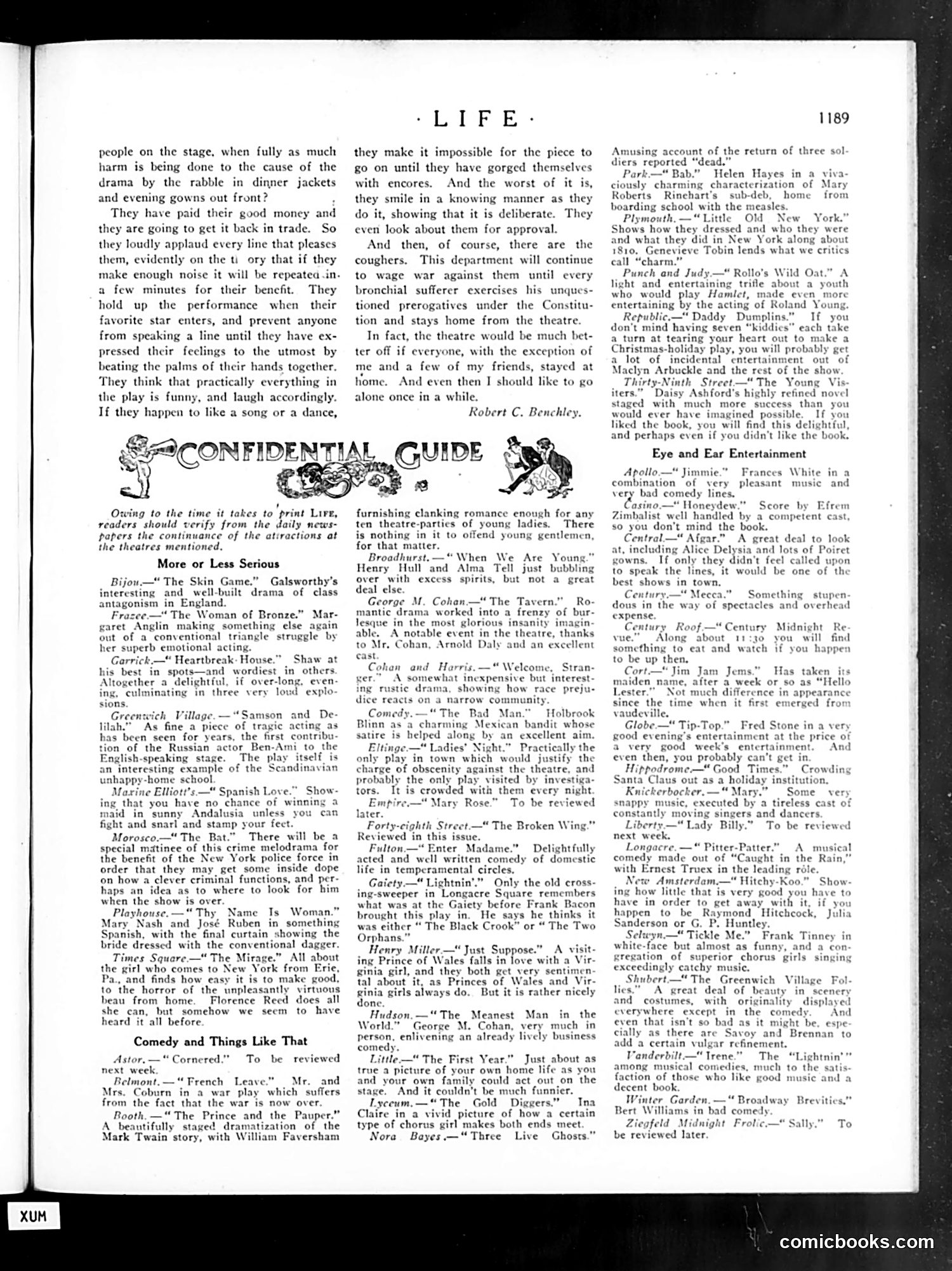
This page from *Life* magazine contains theater reviews and commentary, not political cartoons. The decorative "Confidential Guide" header with illustrated figures is purely ornamental. The main content is Robert C. Benchley's satirical essay criticizing theater audiences. Benchley mocks affluent theatergoers ("dinner jackets and evening gowns") who pay for tickets, then deliberately disrupt performances by loudly applauding favorite moments to force repetition, laughing excessively at everything, and demanding encores. He also targets chronic coughers who won't stay home when sick. The humor is social satire: Benchley portrays audience members as self-centered hecklers who mistake their paid admission as entitling them to control the show. He concludes by sardonically suggesting everyone stay home except himself and "a few of my friends"—a classic Benchley-style misanthropic punchline. The remaining reviews briefly assess current Broadway productions with similar wit.
📄 Transcribed text from this page (OCR, searchable)
Machine-transcribed from the original scan — historical spelling and the odd misread are preserved.
people on the stage, when fully as much harm is being done to the cause of the drama by the rabble in dinner jackets and evening gowns out front? They have paid their good money and they are going to get it back in trade. So they loudly applaud every line that pleases them, evidently on the ti ory that if they make enough noise it will be repeated .in- a few minutes for their benefit. They hold up the performance when their favorite star enters, and prevent anyone from speaking a line until they have ex- pressed their feelings to the utmost by beating the palms of their hands together. They think that practically everything in the play is funny, and laugh accordingly. If they happen to like a song or a dance, Owing to the time it takes to print Livi readers should verify from the daily news- papers the continuance of the atiractions at the theatres mentioned. More or Less Serious Bijou.—"“ The Skin Game.” Galsworthy’s interesting and_ well-built drama of class antagonism in England. F ¢.—‘ The Woman of Bronze.” Mar- garet Anglin making something else again out of a conventional triangle struggle by her superb emotional acting. Garrick.—“ Heartbreak: House.” Shaw at his best in spots—and wordiest in others. Altogether a delightful, if over-long, even ing, culminating in three very loud explo sions. Greenwich Village. —“Samson and De- lilah.” As fine a piece of tragic acting as has been seen for years, the first contribu tion of the Russian or Ben-Ami to the English-speaking stag The play itself, is an interesting example of the Scandinavian unhappy-home school Maxine Elliott's —" Spanish Love.” Show- ing that you have no chance of winning a maid in sunny Andalusia unless you can fight and snarl and stamp your feet. Morosco.—" The Bai There will be a special matinee of this crime melodrama for the benefit of the New York police force in order that they may get some inside dope on how a clever criminal functions, and per- haps an idea as to where to look for him when the show is over. Playhouse. —“ Thy Name Is Woman.” Mary Nash and José Ruben in something Spanish, with the final curtain showing the bride dressed with the conventional dagger. Times Square —* The Mirage.” All about the girl who comes to New York from Erie, Pa., and finds how easy it is to make good, to the horror of the unpleasantly virtuous beau from home. Florence Reed does all she can, but somehow we seem to have heard it all before. Comedy and Things Like That Astor, —“ Cornered,’ To be reviewed next week. Belmont. —“ French Leave.” Mr. and Mrs. Coburn in a war play which suffers from the fact that the war is now over. Rooth.—“ The Prince and the Pauper.” A beautifully staged dramatization of the Mark Twain story, with William Faversham LIFE they make it impossible for the piece to go on until they have gorged themselve with encores. And the worst of it is, they smile in a knowing manner as they do it, showing that it is deliberate. They even look about them for approval. And then, of course, coughers. This department will continue to wage war against them until bronchial sufferer exercises his tioned prerogatives under the Constitu- tion and stays home from the theatre. In fact, the theatre would be much bet- ter off if everyone, with the exception of me and a few of my friends, stayed at And even then I should like to go alone once in a while. Robert C. Benchley. there are the every unques- home. furnishing clanking romance enough for any ten theatre-parties of young ladies. There is nothing in it to offend young gentlemen, for that matter, Broadhurst, —* When We Are Young Henry Hull and Alma Tell just bubbling over with excess spirits, not a great deal else. corge M. Cohan.— The Tavern.” Ro- mantic drama worked into a frenzy of bur- lesque in the most glorious insanity imagin able. A notable event in the theatre, thanks to Mr. Cohan, Arnold Daly and an excellent cast Cohan and Harris. —“ Welcom: ger.” A somewhat inexpensive bi ing rustic drama, showing how race dice reacts on a narrow community Comedy.—“ The Bad Man.” Holbrook Blinn asa charming Mexican bandit whose satire is helped along by an excellent aim. Eltinge—" Ladies’ Practically the only play in town which would justify. the charge of obscenity against the theatre, and probably the only play. visited by investiga- tors. It is crowded with them every night. Empire-—" Mary Rose.” To be reviewed later. Forty-cighth Street— Reviewed in this issue. Fulton —“ Enter Madame.” Delightfully acted and well written comedy of domestic life in temperamental circles. Gaicty—" Lightnin’.” Only the old cross- ing-sweeper in Longacre Square remembers what was at the Gaiety before Frank Bacon brought this play in. He says he thinks it was either “ The Black Crook” or “ The Two Orphans.” Henry Miller —‘ Just Suppose.” A visi ing Prince of Wales falls in love with a Vir- a girl, and they both get very sentimen tal about it, as Princes of Wales and Vir- ginia girls always do. But it is rather nicely done. Hudson.—“ The Meanest Man in. the World.” George M. Cohan, very much in person, enlivening an already lively business comedy. ittle—" The First Year.” Just about as true a picture of your own homie life as you and your own family could act out on the stage. And it couldn't be much funnier. Lyceum.—“ The Gold Diggers.” Ina Claire in a vivid picture of how a certain type of chorus girl makes both ends meet Nora Bayes.—“Three Live Ghos Stran- interest preju- The Broken Wing.” 1189 Amusing account of the return of three sol. diers reported “dead.” Park.—" Bab.” Helen Hayes in a ciously charming characterization of Roberts Rinehart’s sub-deb, home boarding school with the measles Plymouth. —“ Little Old New York.” Shows how they dressed and who they were and what they did in New York along about 1810. Genevieve Tobin lends what we critics call “charm.” Punch and Judy.—" Rollo’s Wild Oat.” A light and entertaining trifle about a youth who would play Hamlct, made even more entertaining by the acting of Roland Young. Republic.—" Daddy Dumplins.” If you don't mind having seven “kiddies” each take a turn at tearing your heart out to make a Christmas-holiday play, you will probably get a lot of incidental entertainment out of Maclyn Arbuckle and the rest of the show Thirty-Ninth Street—"“ The Young Vis. iters.” “Daisy Ashford's highly refined novel staged with much more success than you would ever have imagined possible. If you liked the book, you will find this delightful, and perhaps even if you didn't like the t viva Mary from Eye and Ear Entertainment Apollo.—" Jimmie.” combination of very very bad comedy lines. ‘asino.—" Honeydew.” Score by Efrem Zimbalist well handled by a competent cast so you don’t mind the book. Central—* Afgar.” A great d at, including Alice Delysia and 1 gowns. If only they didn't feel called upon to speak the lines, it would be one of the best shows in town, Century,—" Mecca.” Something dous in the way of spectacles and ov expense. Century Roof—“ Century Midnight Re Along abc tt:3o you will fi something to eat and watch if you t to be up then, Jim Jam Frances Wh ina pleasant. music and Jems.” Has tak maiden 1 ter a week or so as “Hello Lester.” much difference in appearance since the time when it first emerged fron vaudeville. Globe-—" Tip-Top.” | Fred Stone in a very good evening's entertainment at the price of a very good week's entertainment. And even then, you probably can’t get in _ Hippodrome— Good Times.” Crowding nta Claus out as a holiday inst Knickerbocker. —“ Mary. very snappy music, executed by a tireless cast antly moving singers and dancers iberty —“ Lady Billy.” To be reviewed next week. Longacre. —“ Pitter-Patter.”. A musical comedy made out of “Caught in the Rain,” with Ernest Truex in the leading rdle. New Amsterdam.—" Hitchy-Koo.” Show ing how little that is very good you have to have in order to get away with it, if you happen to be Raymond. Hitchcock, Ju Sanderson or G. P. Huntle 1.—" Tickle Me.” Frank Tinney in face but almost as funny, and a con gregation of superior chorus girls singing exceedingly catchy music. Shubert—" The Greenwic h Village Fol- A great lies.” deal of bi in scenery and costumes, with origina displayed everywhere except in the c dy And even that isn’t so bad as it might be. espe cially as there are Savoy and Brennan to add a certain vulgar refinement. Vanderbilt—" Irene.” The “Lightnin’” nong musical comedies, much to the sa tion of those who like good music and decent book. Winter Garden. —“ Broadway Bert Williams in bad comedy Ziegfeld Midnight Frotie.—* $ be reviewed later. Brevities.” comicbooks.com