
Life, 1920-12-23 · page 32 of 44
Life — December 23, 1920 — page 32: what you’re looking at
What you’re looking at
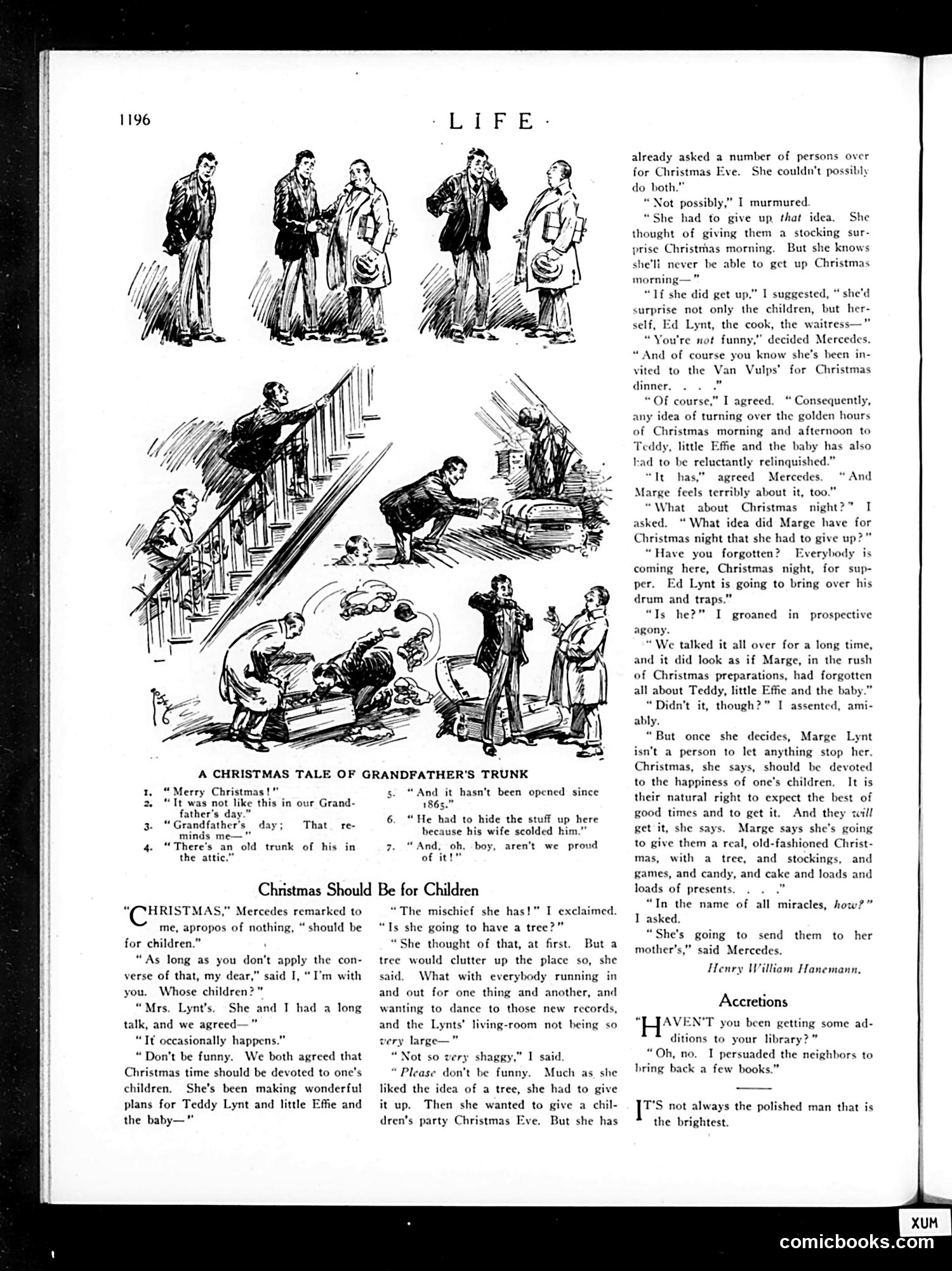
This page contains two satirical pieces from *Life* magazine about Christmas hypocrisy among the upper-middle class. **"A Christmas Tale of Grandfather's Trunk"** mocks nostalgia for simpler times. The accompanying illustrations show family members discovering an old trunk from 1865 (just after the Civil War), which the grandfather had hidden from his scolding wife. The joke: modern people romanticize the past while ignoring that even "Grandfather's day" involved the same domestic friction and material concerns. **"Christmas Should Be for Children"** is sharper satire. Mercedes and her friend discuss how Mrs. Marge Lynt claims Christmas "should be for children"—yet Marge has committed to adult social obligations: a dinner party at the Van Vulps', a supper with Ed Lynt's drum performances. She's canceled the children's tree, the stocking surprise, the children's party. The punchline: to actually give her children a "real, old-fashioned Christmas," she's sending them to their grandmother's house—thus removing them entirely so adults can enjoy the holiday undisturbed. The satire targets sanctimonious parenting rhetoric that masks adult selfishness.
📄 Transcribed text from this page (OCR, searchable)
Machine-transcribed from the original scan — historical spelling and the odd misread are preserved.
A CHRISTMAS TALE OF GRANDFATHER'S TRUNK “Merry Christmas!" “Tt was not like this in our Grand- father’s day.” “ Grandfather's minds me—" “ There's old trunk of his in the attic. day; That. re- s. “And it hasn't been opened since 1865.” “He had to hide the stuff up here because his wife scolded him.” “And, oh, boy, of it aren't we proud Christmas Should Be for Children “CHRISTMA Mercedes remarked to me, apropos of nothing, “ should be for children.” ‘ “As long as you don't apply the con- verse of that, my dear,” said I, “I'm with you. Whose children?” “Mrs. Lynt’s. She and I had a long talk, and we agreed—" “Tt occasionally happens. “Don't be funny. We both agreed that Christmas time should be devoted to one’s children. She's been making wonderful plans for Teddy Lynt and little Effie and the baby—" “The mischief she has!” I exclaimed. “Is she going to have a tree?” “She thought of that, at first. But a tree would clutter up the place so, she said. What with everybody running in and out for one thing and another, and wanting to dance to those new records, and the Lynts’ living-room not being so very large— “Not so very shaggy,” I said Much as she liked the idea of a tree, she had to give it up. Then she wanted to give a chil- dren’s party Christmas Eve. But she has “Please don’t be funny. already asked a number of persons over for Christmas Eve. She couldn't possibly do both.” “Not possibly,” I murmured. “She had to give up that idea, She thought of ing them a stocking sur- prise Christmas morning. But she knows she'll never be able to get up Christmas morning—" “If she did get up,” I suggested, “ she'd surprise not only the children, but her- self, Ed Lynt, the cook, the waitress—" “You're not funny,” decided Mercedes. “And of course you know she’s been in- vited to the Van Vulps’ for Christmas dinner. = “ Of course,” I agreed. “ Consequently, lea of turning over the golden hours Christmas morning and afternoon to Teddy, little Effie and the baby has also had to be reluctantly relinquished.” “It has,” agreed Mercedes, Marge feels terribly about it, too. “What about Christmas night?” I asked. “ What idea did Marge have for Christmas night that she had to give up?” “Have you forgotten? Everybody is coming here, Christmas night, for sup- per. Ed Lynt is going to bring over his drum and traps.” “Ts agony. “We talked it all over for a long time, and it did look as if Marge, in the rush of Christmas preparations, had forgotten all about Teddy, little Effie and the baby.” “Didn't it, though?” I assented, ami- ably. “But once she decides, Marge Lynt isn't a person to let anything stop her. Christmas, she says, should be devoted to the happiness of one’s children. It is their natural right to expect the best of good times and to get it. And they will get it, she says. Marge says she’s going to give them a real, old-fashioned Christ- mas, with a tree, and stockings, and games, and candy, and cake and loads and loads of presents. . he?” I groaned in prospective “In the name of all miracles, how?” I asked. “She's going to mother’s,” send said Mercedes. them to her Henry William Hanemann, Accretions ‘H Vv you been getting some ad- ditions to your library?” “Oh, no. I persuaded the neighbors to bring back a few books.” T’S not always the polished man that is the brightest. comicbooks.com