
Life, 1920-12-23 · page 17 of 44
Life — December 23, 1920 — page 17: what you’re looking at
What you’re looking at
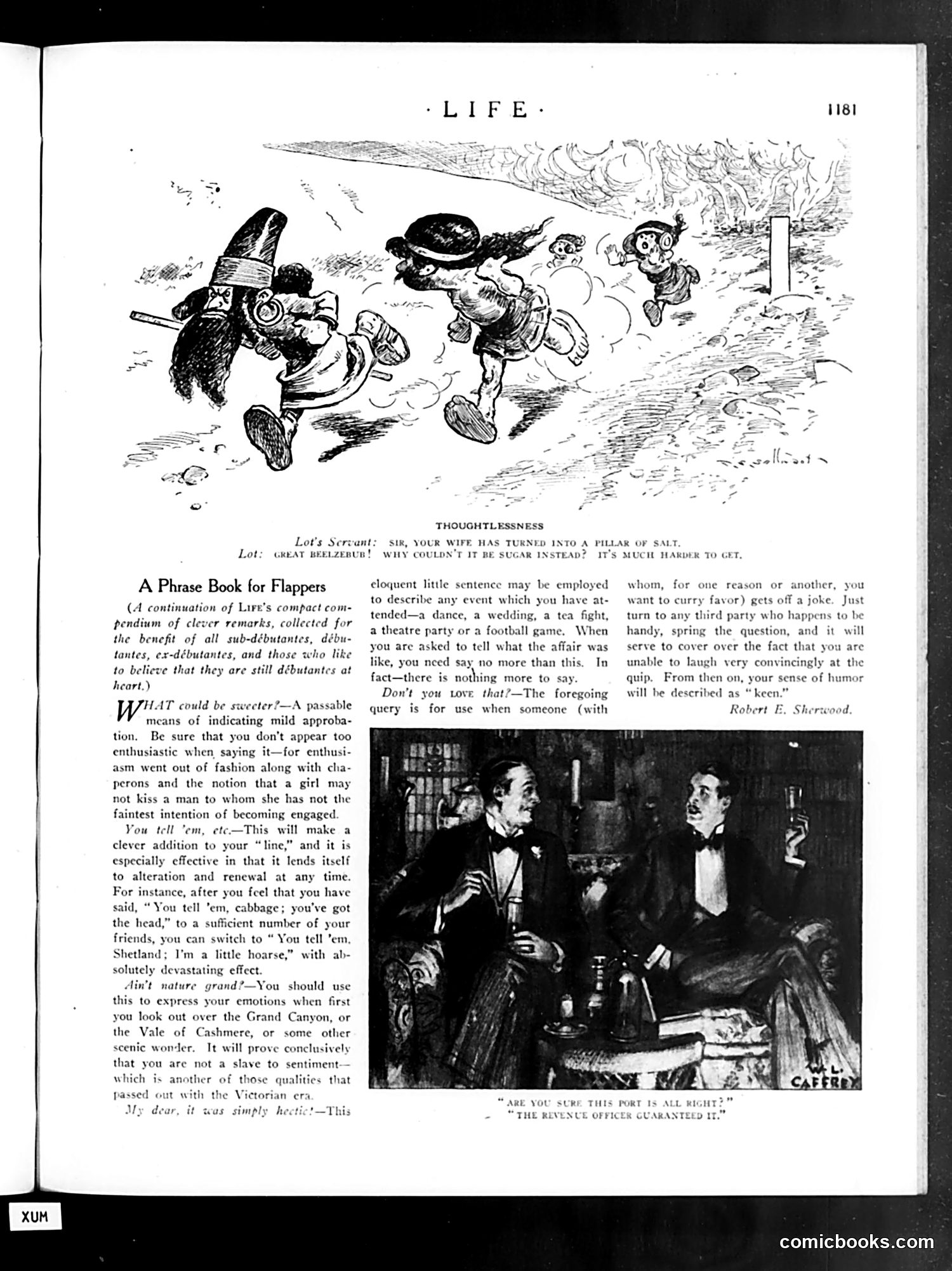
This page from *Life* magazine contains two distinct elements: **"A Phrase Book for Flappers"** is a humorous guide to slang and affected speech patterns used by "flappers"—young women of the 1920s known for rejecting Victorian propriety. The article mocks their pretentious, repetitive phrases like "You tell 'em," "ain't nature grand?" and "simply hectic!" by suggesting these expressions are fashionable but hollow substitutes for genuine conversation. **The cartoons** illustrate this theme of superficial behavior. The top cartoon labeled "Thoughtlessness" shows people engaged in exaggerated, foolish antics, while the lower photograph-style cartoon depicts two men in what appears to be a revenue/tax office scene, with the caption joking about a man's wife turning into a "pillar of salt" (a biblical reference)—the humor suggesting marital discord or the woman's silent disapproval. Together, the page satirizes 1920s youth culture's embrace of empty fashionable speech over genuine emotion or substance.
📄 Transcribed text from this page (OCR, searchable)
Machine-transcribed from the original scan — historical spelling and the odd misread are preserved.
Lot's Servant: GREAT BEELZEBUB! Lot A Phrase Book for Flappers (A continuation of Lire’s compact com- pendium of clever remarks, collected for the benefit of all sub-débutantes, débu- tantes, ex-débutantes, and those who like to believe that they are still débutantes at heart.) HAT could be —A passable means of indicating mild approba- tion, Be sure that you don’t appear too enthusiastic when, saying it—for enthusi- asm went out of fashion along with cha- perons and the notion that a girl may not kiss a man to whom she has not the faintest intention of becoming engaged. You tell ’em, etc-—This will make a clever addition to your “line,” and it is especially effective in that it lends itself to alteration and renewal at any time. For instance, after you feel that you have said, “You tell ’em, cabbage; you've got the head,” to a sufficient number of your friends, you can switch to “ You tell 'em, Shetland; I'm a little hoarse,” with ab- solutely devastating effect. Ain't nature grand?—You should use this to express your emotions when first you look out over the Grand Canyon, or the Vale of Cashmere, or some other scenic wonder. It will prove conclusively that you are not a slave to sentiment— which is another of those qualities that Passed out with the Victorian era My dear, it was simply hectic! —This THOUGHTLESSNESS SIR, YOUR WIFE eloquent little sentence may be employed to describe any event which you have at- tended—a dance, a wedding, a tea fight, a theatre party or a football game. When you are asked to tell what the affair was like, you need say no more than this. In fact—there is nothing more to say. Don't you Love that?—The foregoing query is for use when someone (with “ARE YOU SUR “THE REVENUE THIS OFFICER HAS TURNED INTO A PILLAR OF SALT WHY COULDN'T IT BE SUGAR INSTEAD? 11's MUCIL HARDER TO GET, whom, for one reason or another, you Just ppens to be want to curry favor) gets off a joke turn to any third party who | handy, spring the question, and it will serve to cover over the fact that you are unable to laugh very convincingly at the quip. From then on, your sense of humor will be described as “keen.” Robert E. Sherwood. PORT IS ALL Rt GUARANTEED comicbooks.com