
A complete issue · 45 pages · 1920
Life — December 16, 1920
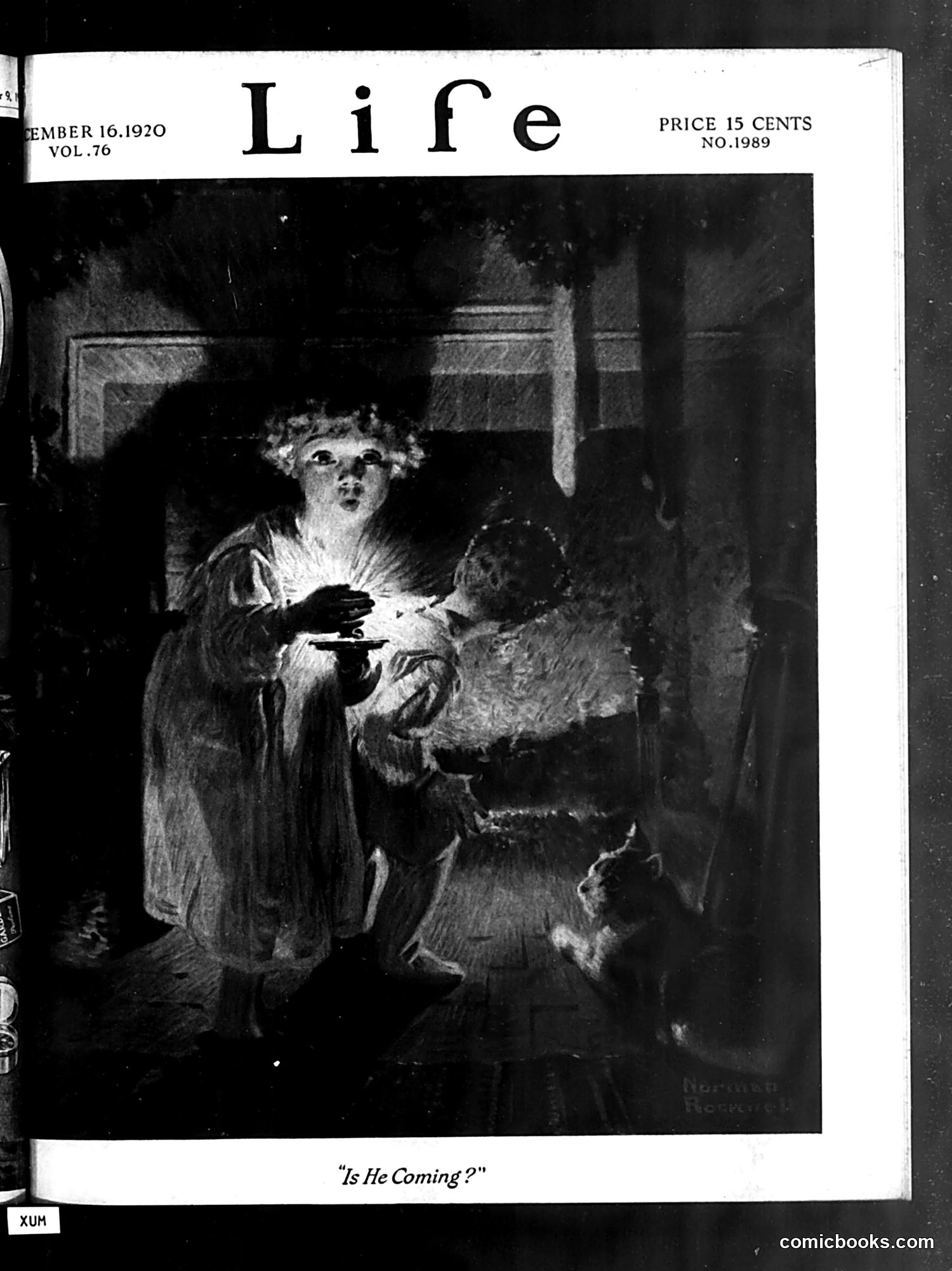
**Title: "Is He Coming?"** This cover illustration depicts a woman in classical Greek or Roman dress holding a lamp (evoking Diogenes' search for an honest man), gazing upward with anxious expression. She appears to be waiting or searching for someone. The context likely relates to the 1920 U.S. presidential election or post-election period. The caption's questioning tone—"Is He Coming?"—suggests satirical commentary on anticipated political leadership or a promised figure who may or may not arrive. Without additional text identifying the specific figure or event referenced, the precise satirical target remains unclear, though the classical imagery suggests commentary on searching for virtuous or competent leadership during this transitional post-WWI period.
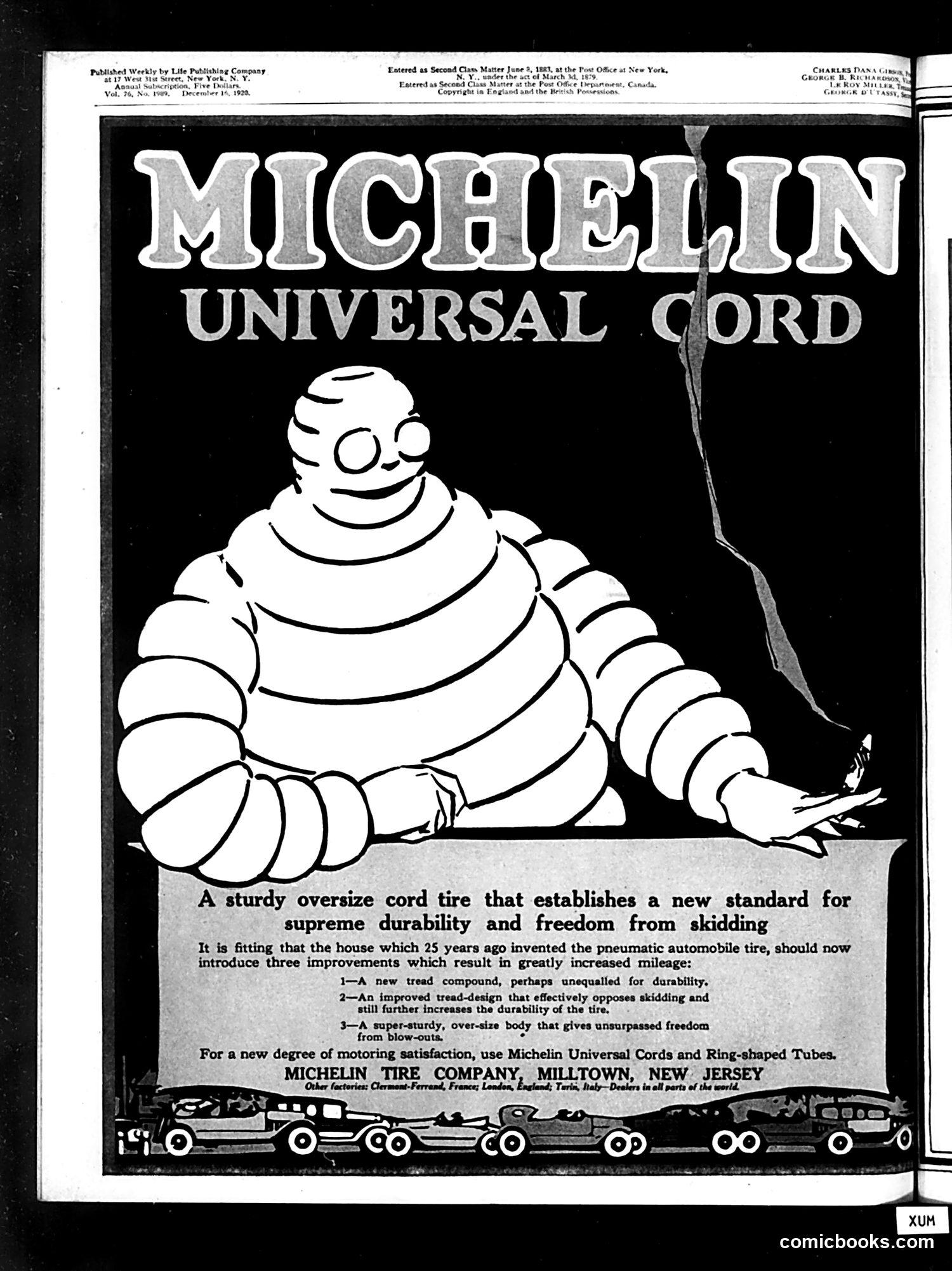
This page is **primarily an advertisement** for Michelin Universal Cord tires, not political satire. The central image depicts the Michelin Man (Bibendum), the company's mascot—a rotund, segmented character made of tire treads. The advertisement emphasizes three product improvements: a new tread compound for durability, improved tread design to prevent skidding, and an oversized body resisting blow-outs. The copy positions these as innovations establishing "a new standard for supreme durability." The small vehicles illustrated at the bottom represent the tire's versatility across different transportation types. This appears in *Life* magazine's paid advertising section rather than editorial content, making it a commercial message rather than commentary or satire.
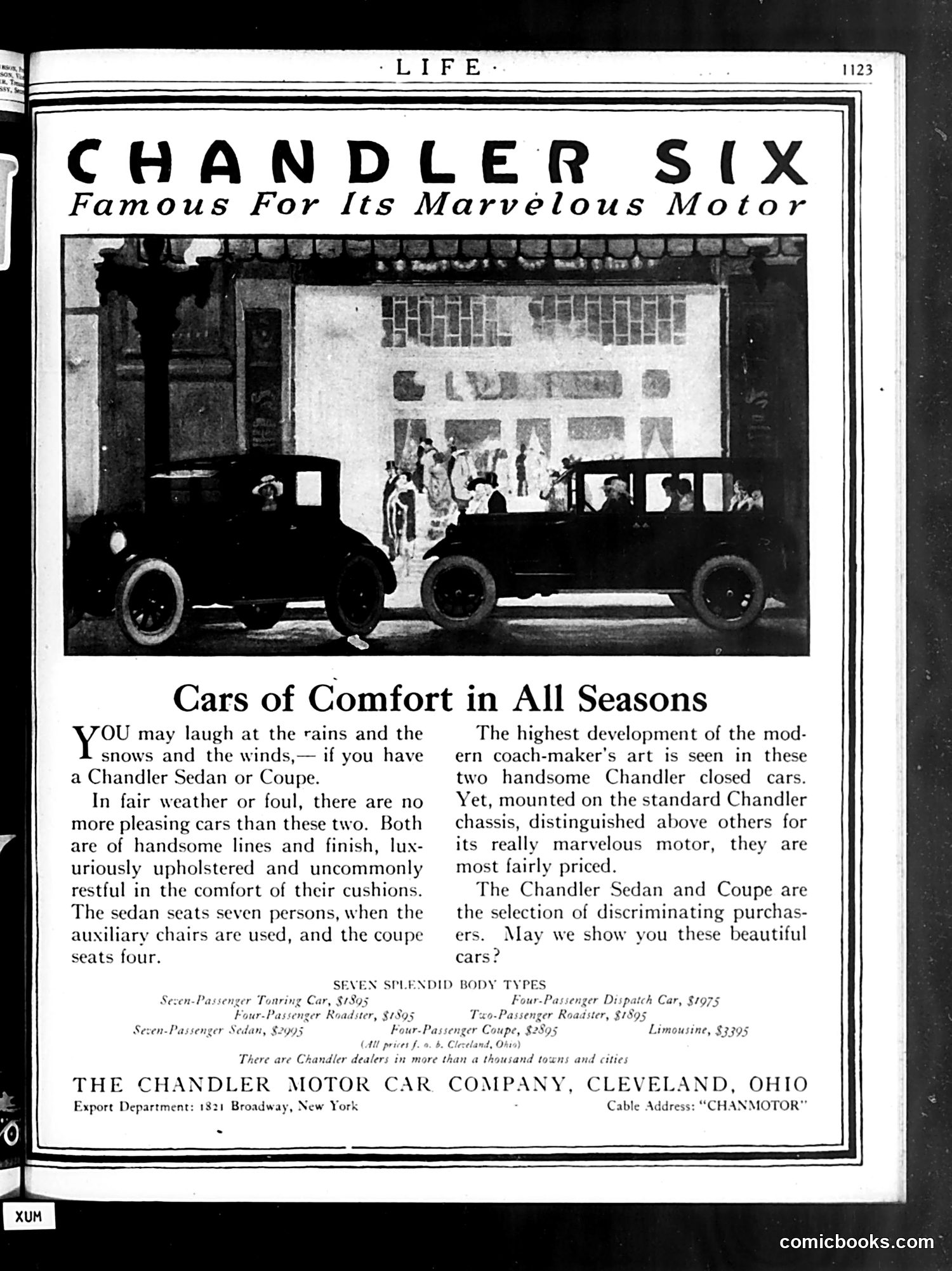
This is **not a cartoon or satire page** — it's a straightforward **advertisement for Chandler automobiles** from the early 1920s. The image shows two Chandler vehicles parked in front of what appears to be a storefront or showroom, with pedestrians visible. The ad emphasizes the Chandler Six's "marvelous motor" and promotes two body styles: a seven-passenger sedan and four-passenger coupe, both praised for comfort and handsome design. The text targets "discriminating purchasers" and lists various models with prices ranging from $1,595 to $2,895. The Chandler Motor Car Company, based in Cleveland, Ohio, was a real automobile manufacturer of that era competing in the mid-range market. This represents typical automotive advertising from Life magazine's early 20th-century period.
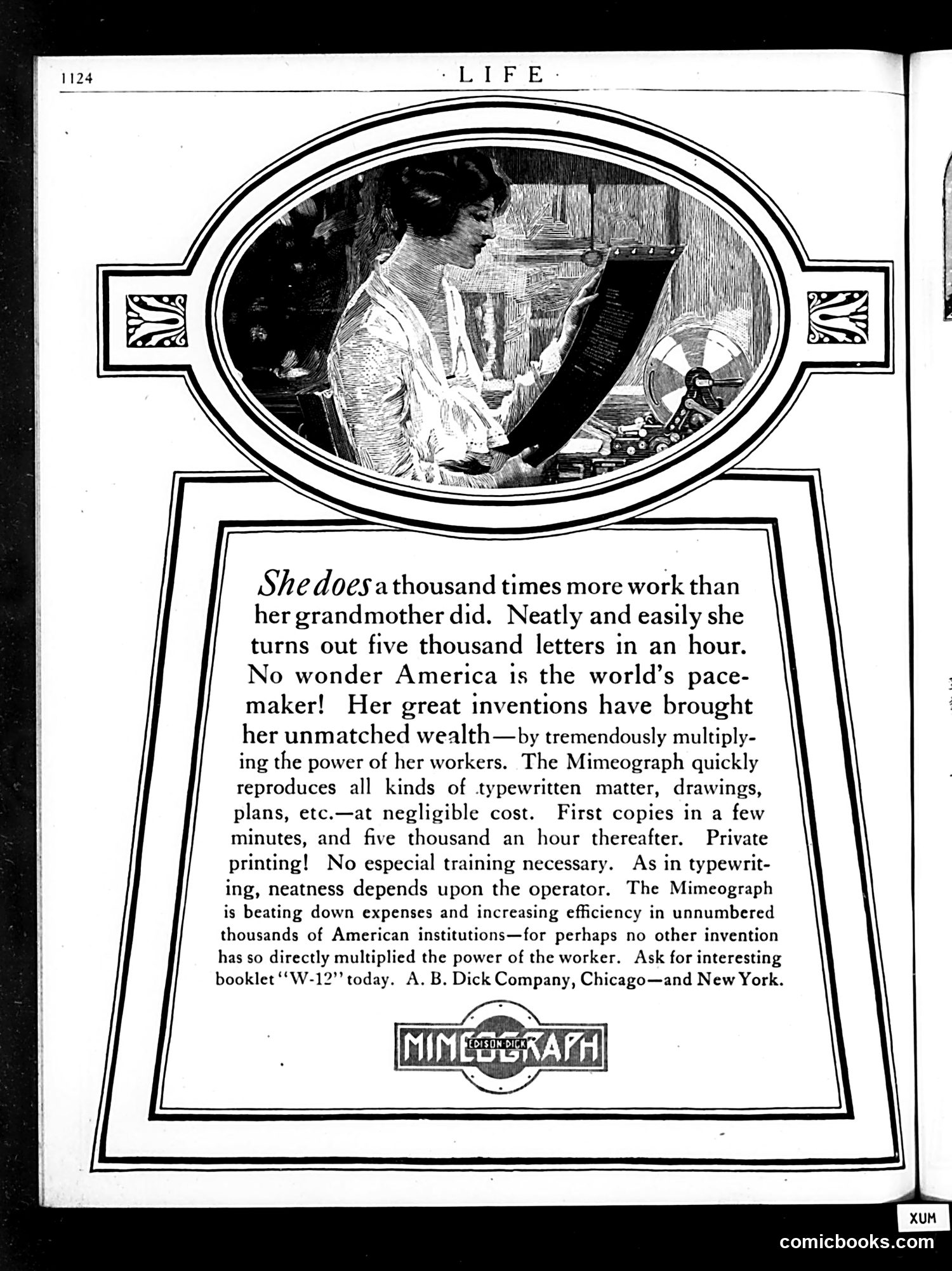
This is **advertising, not satire**. The page promotes the Mimeograph machine by A.B. Dick Company of Chicago and New York. The ad compares modern American productivity to the past, claiming a woman operator "does a thousand times more work than her grandmother did," producing 5,000 letters per hour. The image shows a woman at a mimeograph machine in an office setting. The ad celebrates this as evidence of American industrial progress and efficiency, arguing the mimeograph "multiplied the power of the worker" across American institutions. It emphasizes the machine requires "no special training" and produces copies "at negligible cost." The underlying message conflates technological advancement with national superiority—a common early 20th-century advertising strategy linking consumer products to American exceptionalism and modernity.
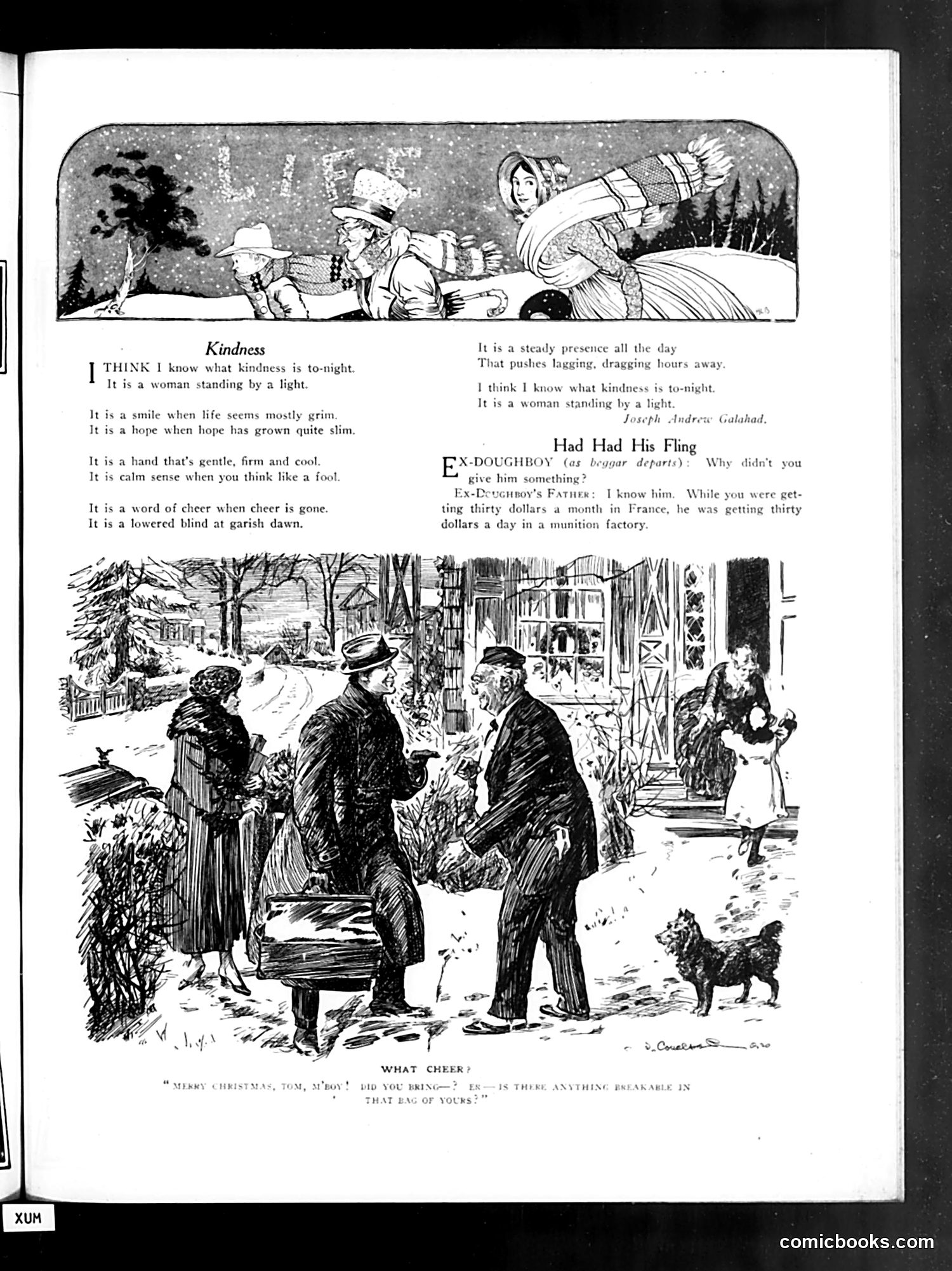
The page contains two distinct pieces: **"Kindness"** (top): A sentimental poem by Joseph Addison Galahad about recognizing kindness in everyday acts—a woman's steadying presence, gentle hands, words of cheer. This reflects early 20th-century moralistic content common to *Life* magazine. **"Had Had His Fling"** (bottom): A cartoon dialogue between an Ex-Doughboy and his father. The son, returning from WWI service in France where he earned $30/month in a munitions factory, is asked why he didn't bring something home. The humor targets post-war economic disappointment—soldiers returning to meager civilian prospects after military service. The Christmas scene emphasizes the contrast between wartime sacrifice and peacetime hardship, satirizing both the father's expectations and the son's deflated circumstances.
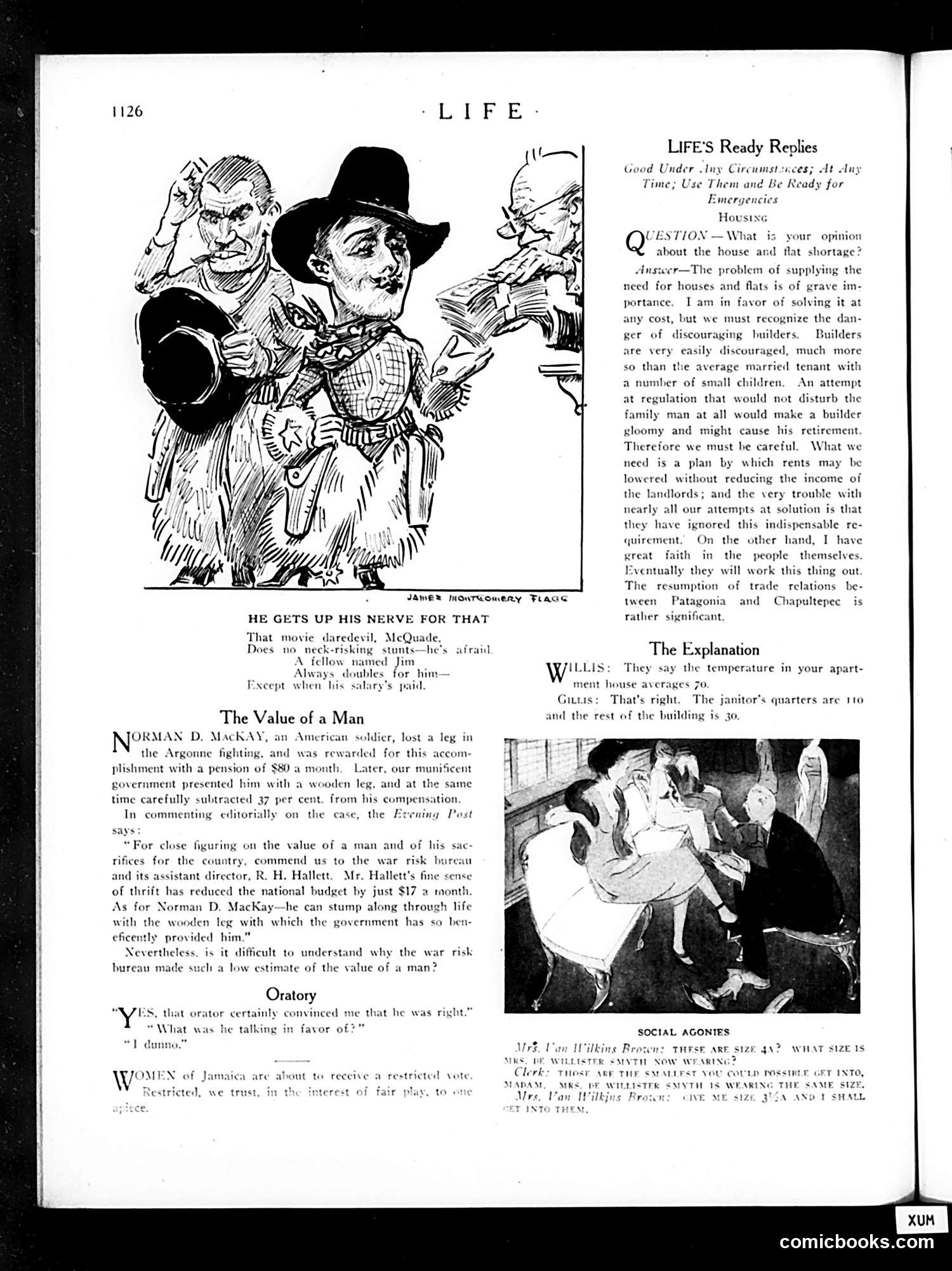
**Main Cartoon: "He Gets Up His Nerve for That"** Artist James Montgomery Flagg depicts three caricatured figures, likely representing politicians or public figures, in an exaggerated discussion about a movie stunt performer named Jim. The caption suggests Jim performs dangerous stunts without hesitation, contrasting with the timidity of the figures discussing him. This appears to satirize political cowardice—mocking public figures who lack the courage that ordinary citizens possess. **Supporting Articles:** The page includes commentary on housing shortages and the value placed on human life (referencing a soldier's compensation). A separate item addresses voting rights restrictions for women in Jamaica, treating the topic with satirical indignation about fairness. The satire targets institutional timidity and political inequity common to the early 20th century.
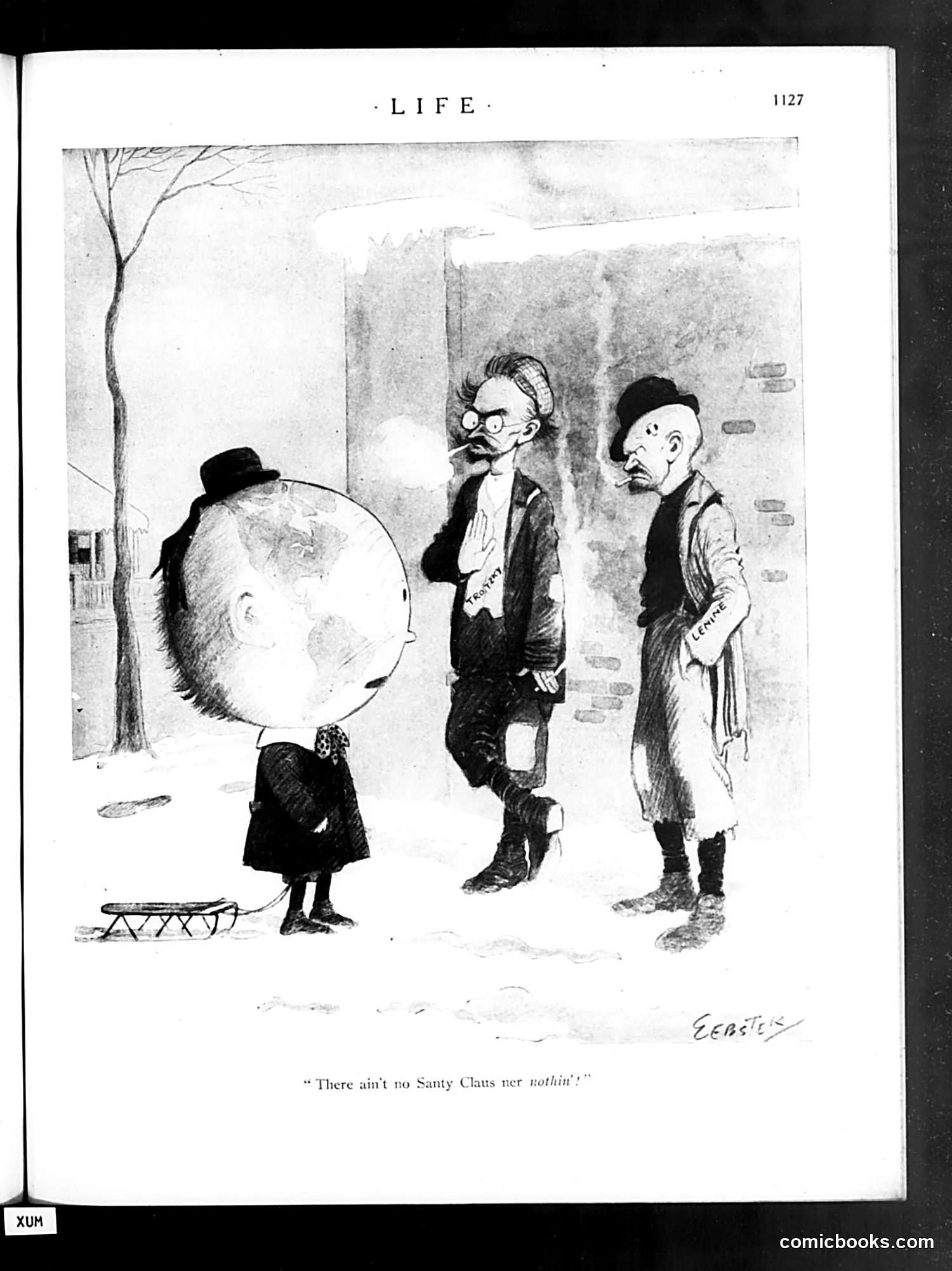
This cartoon depicts a disillusioned child holding a large globe, confronted by two adult men in winter clothing. The child's statement — a cynical rejection of Santa Claus — reflects early 20th-century anxieties about lost innocence. The globe the child carries suggests geographical or worldly knowledge, implying the "truth" that has destroyed childhood wonder. The two men appear to represent adult reality or authority figures delivering harsh truths. The satire likely critiques how modern industrial society strips away childhood illusions, or comments on how adults burden children with worldly concerns. The exaggerated caricatures and the child's crude dialect emphasize the clash between innocent youth and hard reality — a common theme in *Life* magazine's social commentary during this period.
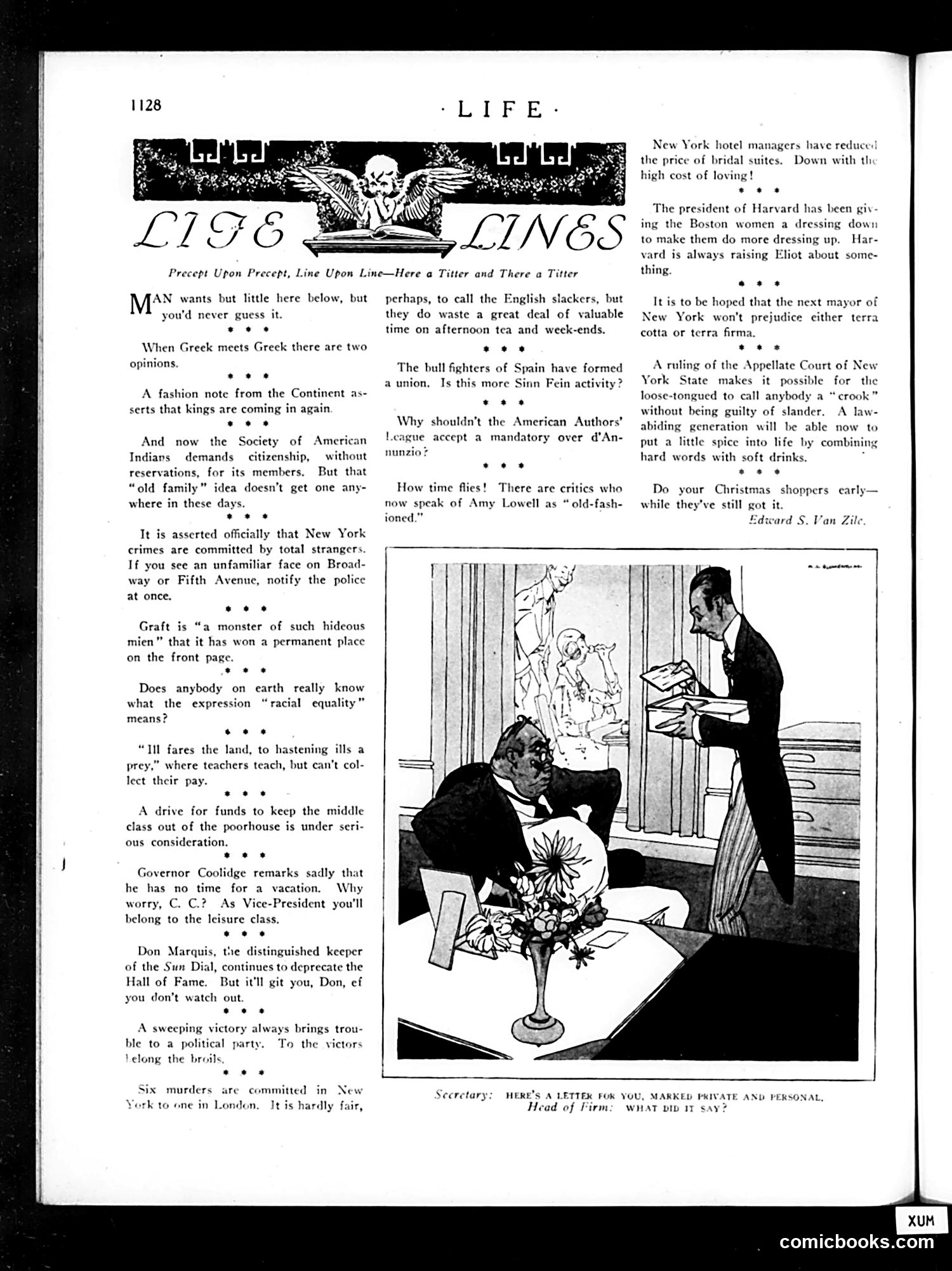
This page contains satirical commentary rather than a cartoon. The "Life-ings" column presents brief, witty observations on contemporary social and political topics. Key references include: - **New York hotel pricing**: Satire about reduced bridal suite costs reflecting economic conditions - **Harvard's president addressing Boston women**: Social commentary on women's fashion and the university's influence - **American Authors' League and Annunzio**: Unclear reference, likely concerning copyright or literary policy - **Amy Lowell**: Dated reference to the poet being called "old-fashioned" - **Governor Coolidge**: Mentioned regarding lack of vacation time (likely Calvin Coolidge) - **New York crime**: Six murders committed, comparing New York unfavorably to London The accompanying illustration shows a secretary delivering a marked "private and personal" letter to her boss, humorously suggesting workplace intrigue or personal matters interrupting business.
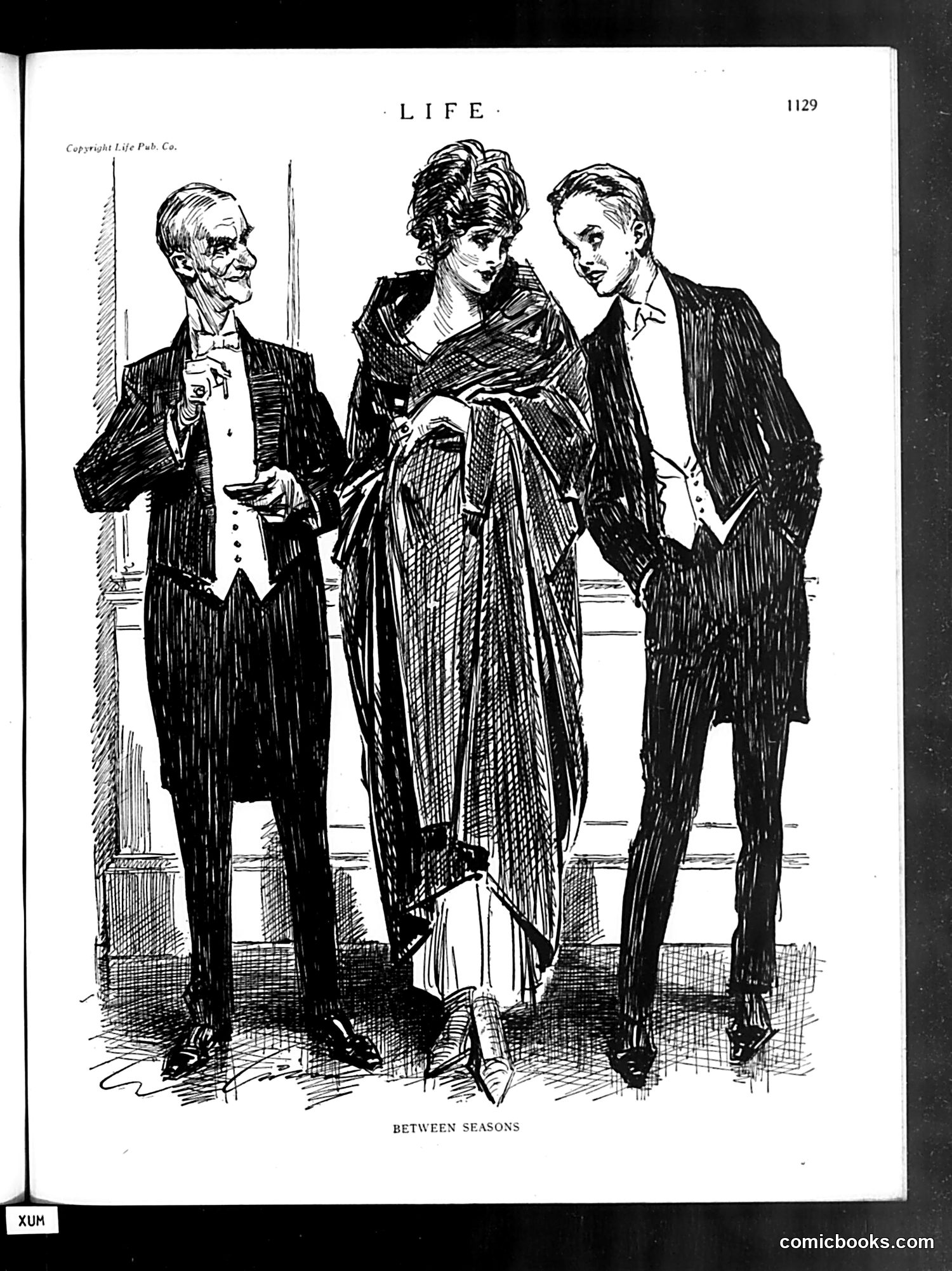
This Life magazine illustration depicts three fashionably dressed figures in formal evening wear, captioned "Between Seasons." The satire appears to target upper-class social behavior during the transition between social seasons (likely spring to summer, or summer to fall in the early 20th century). The composition shows two men in tuxedos flanking a woman in an elaborate wrap or shawl, suggesting idle socialites with nothing particular to do during off-season periods. The joke likely mocks the leisure class's dependence on the structured social calendar—their lack of productive activity when formal social events aren't scheduled. The illustration's style and Life magazine's satirical tradition suggest this critiques the emptiness or superficiality of high-society life during these transitional periods.
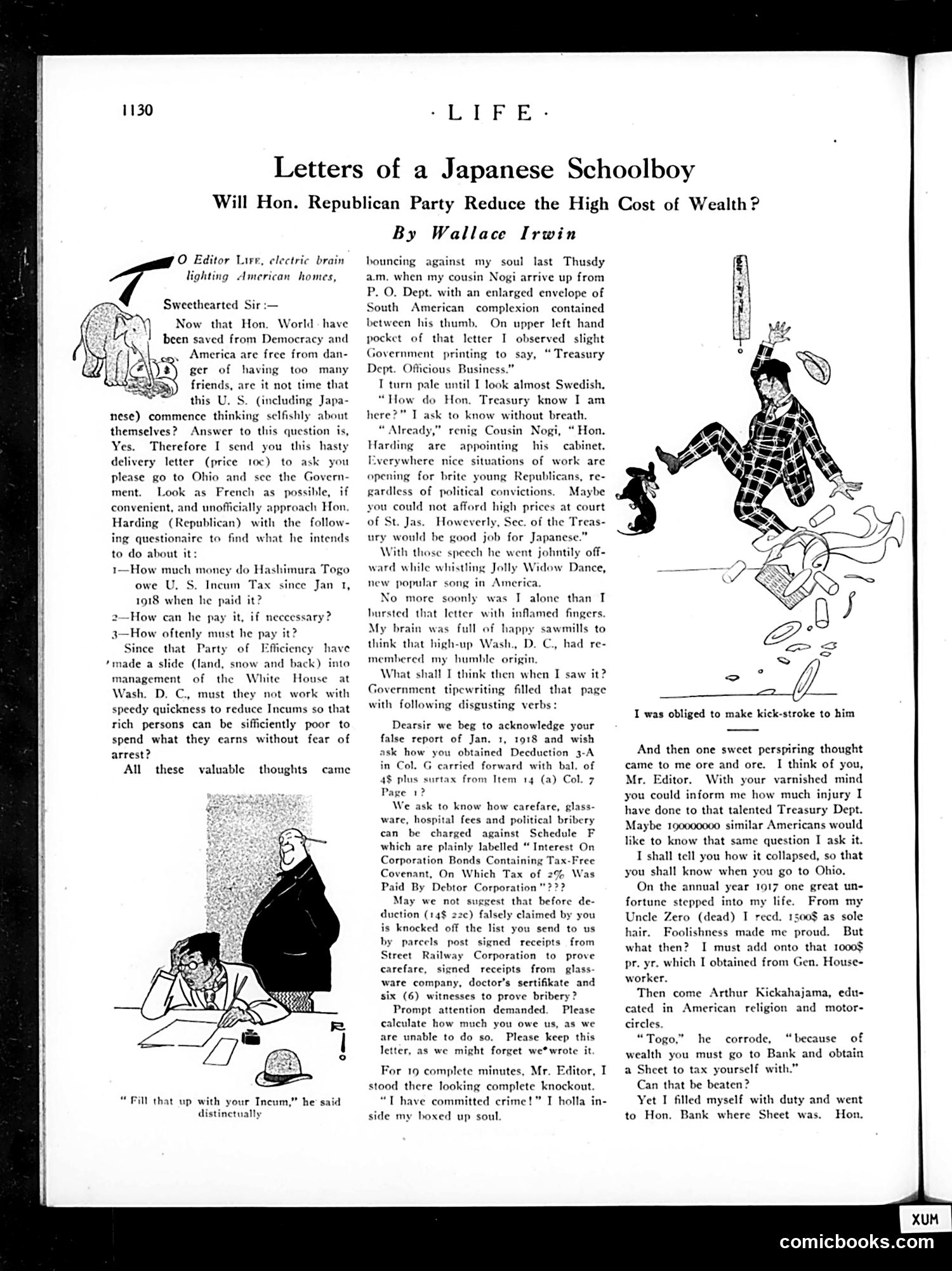
This is a satirical letter column by Wallace Irwin mocking American government inefficiency through the eyes of a fictional Japanese observer. The writer poses as a naive Japanese schoolboy writing to Hon. Harding (likely President Warren G. Harding) with questions about U.S. Treasury spending and tax collection. The satire criticizes Republican Party promises to reduce government waste and high costs. The letter includes absurdist details—government receipts mixed with glass-ware company documents and doctor's certificates allegedly proving "bribery"—to mock bureaucratic incompetence and corruption. The accompanying cartoons show the Japanese character in exaggerated poses, emphasizing the "outsider perspective" device used to critique American political and fiscal mismanagement. The humor relies on contrasting naive questioning with obvious governmental dysfunction.
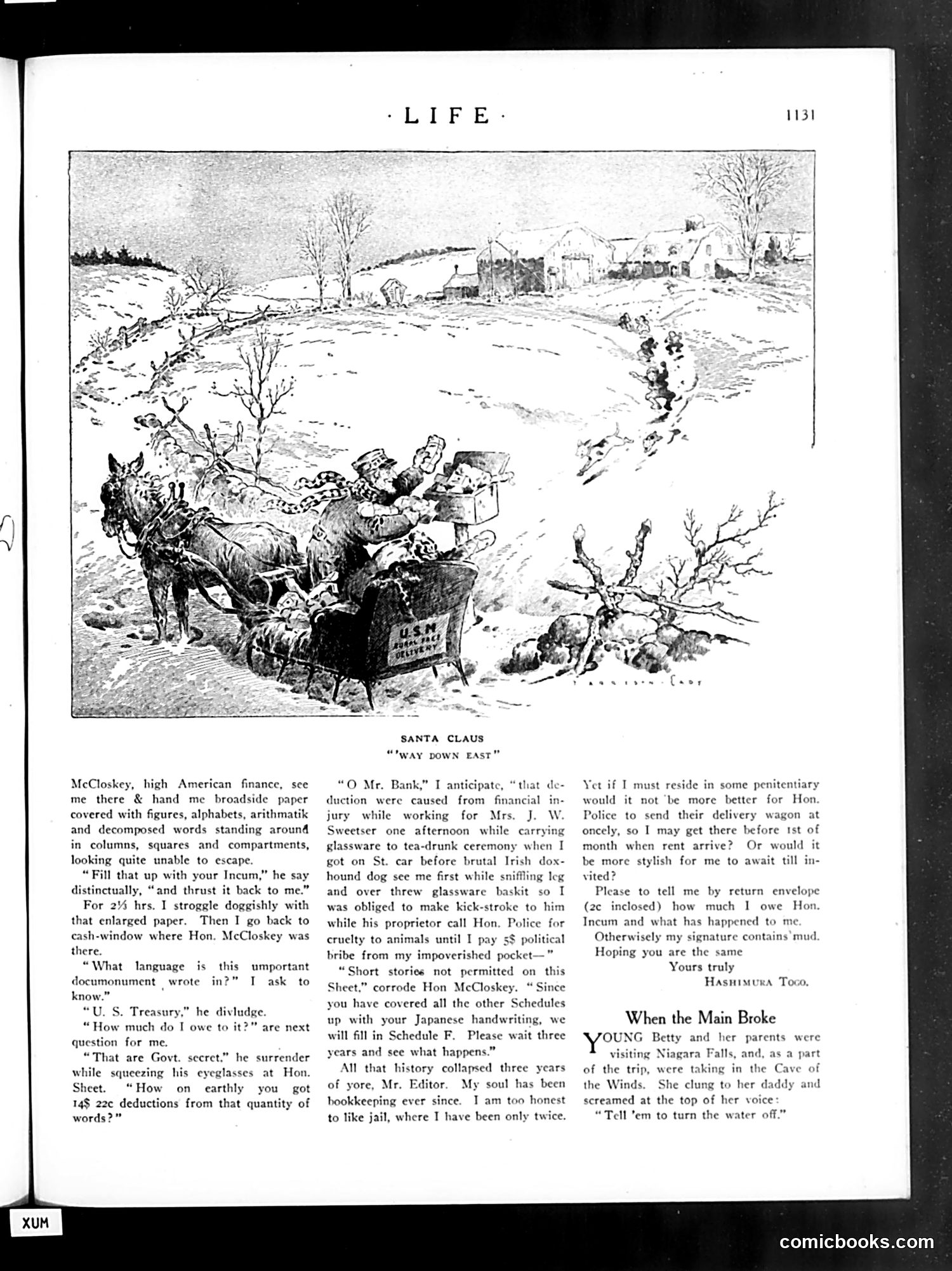
This page contains two distinct pieces. The main illustration, "Santa Claus 'Way Down East,'" is a satirical cartoon depicting a figure driving a sleigh labeled "U.S. Mail Delivery" pulled by a donkey. The image mocks the delivery of mail—particularly suggesting corrupt or problematic postal service in rural America. Below is a humorous letter from someone (signed Hashimura Togo) complaining to Hon. McCloskey about financial troubles while working for Mrs. J.W. Seavey. The writer sarcastically anticipates being arrested for debt and requests Hon. Incum explain his obligations. The second story, "When the Main Broke," begins a narrative about young Betty visiting Niagara Falls. The satire targets government inefficiency and financial hardship during this period.
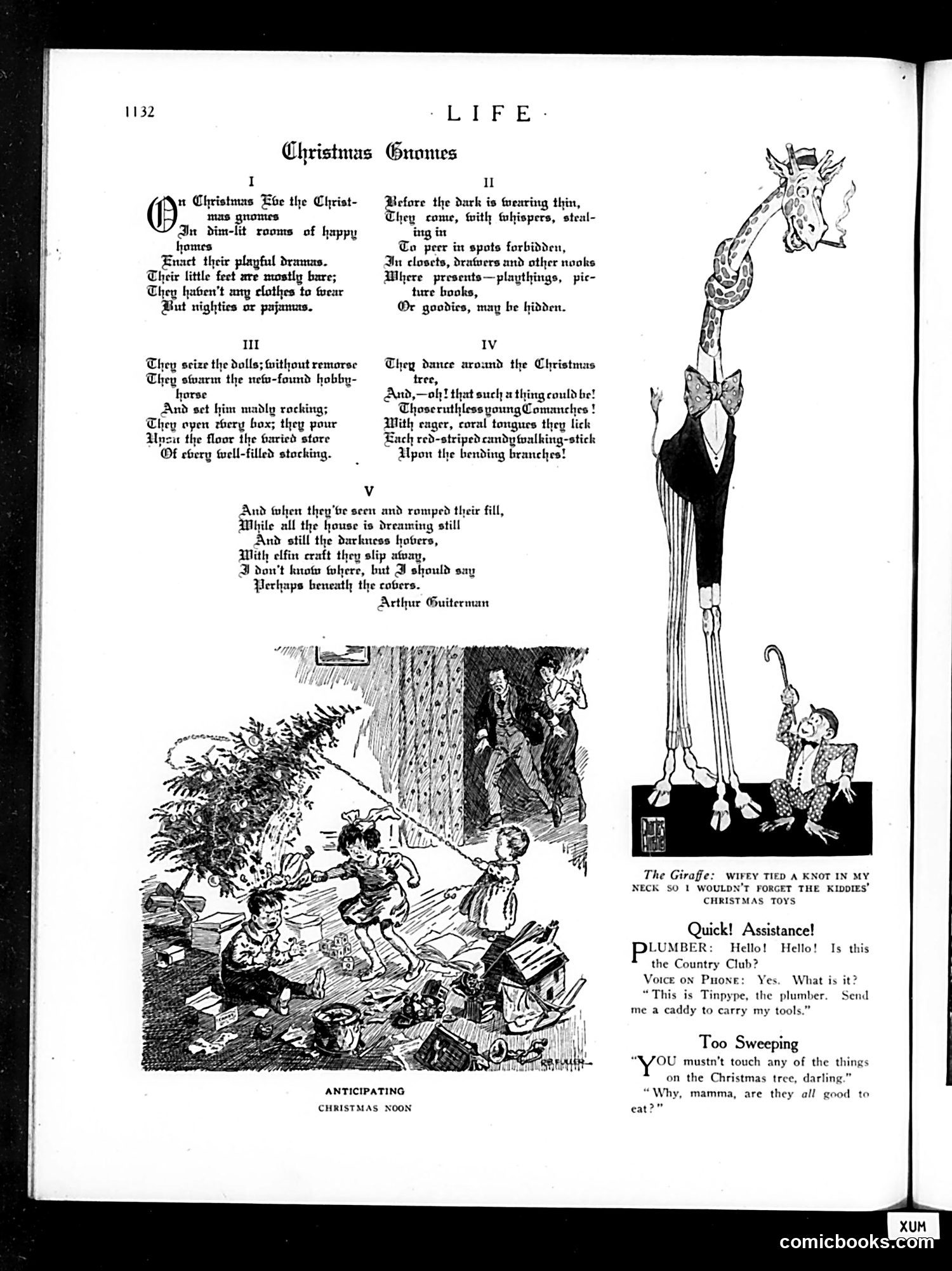
This page from *Life* magazine presents a lighthearted Christmas poem by Arthur Gutterman divided into five numbered sections, accompanied by whimsical illustrations. The content depicts gnomes celebrating Christmas in domestic settings—opening presents, dancing around a tree, and enjoying holiday festivities. The accompanying drawings show children and fantastical creatures in Victorian-era Christmas scenes. Below the poem are three separate comedic sketches: "Anticipating Christmas Noon" (children around a tree), "The Giraffe" (a visual pun about a toy giraffe), and two brief comic dialogues—"Quick! Assistance!" (about a plumber) and "Too Sweeping" (about Christmas tree decorations). These are gentle, family-oriented humor pieces typical of *Life*'s approach to holiday entertainment, with no apparent political content or social satire.
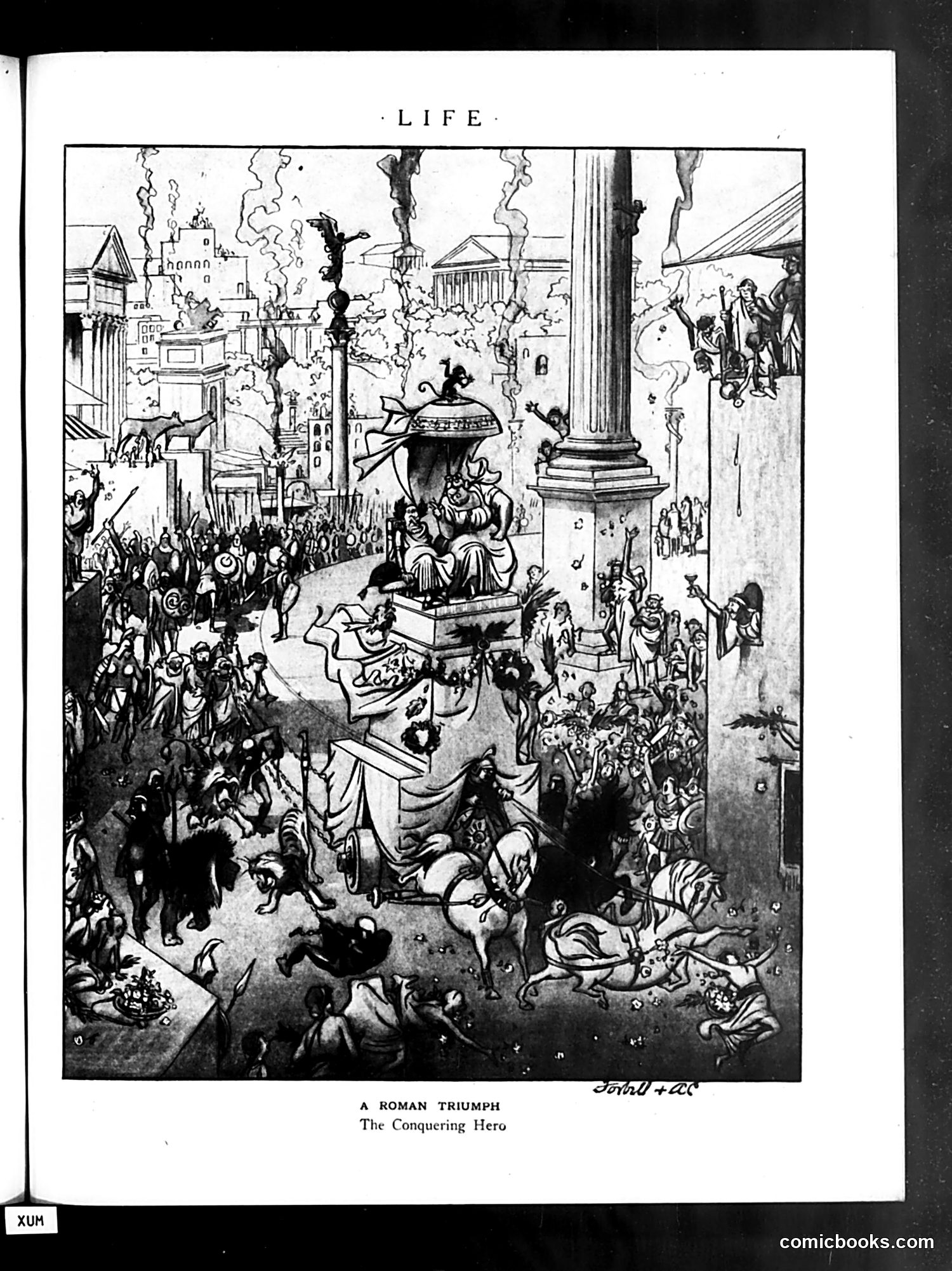
This is a satirical illustration titled "A Roman Triumph: The Conquering Hero" from Life magazine. The image depicts a grand classical Roman scene with massive architecture, crowds, and a central triumphant figure on an elevated platform. The satire appears to mock the glorification of military conquest and imperial power through exaggerated classical imagery. The crowded masses, ornate buildings, and ceremonial grandeur suggest commentary on how societies celebrate military leaders. Without additional context about the publication date, the specific hero referenced remains unclear, though the satire targets the romanticization of conquest and the spectacle surrounding military victory. The classical Roman setting allows the artist to critique contemporary militarism through historical analogy.
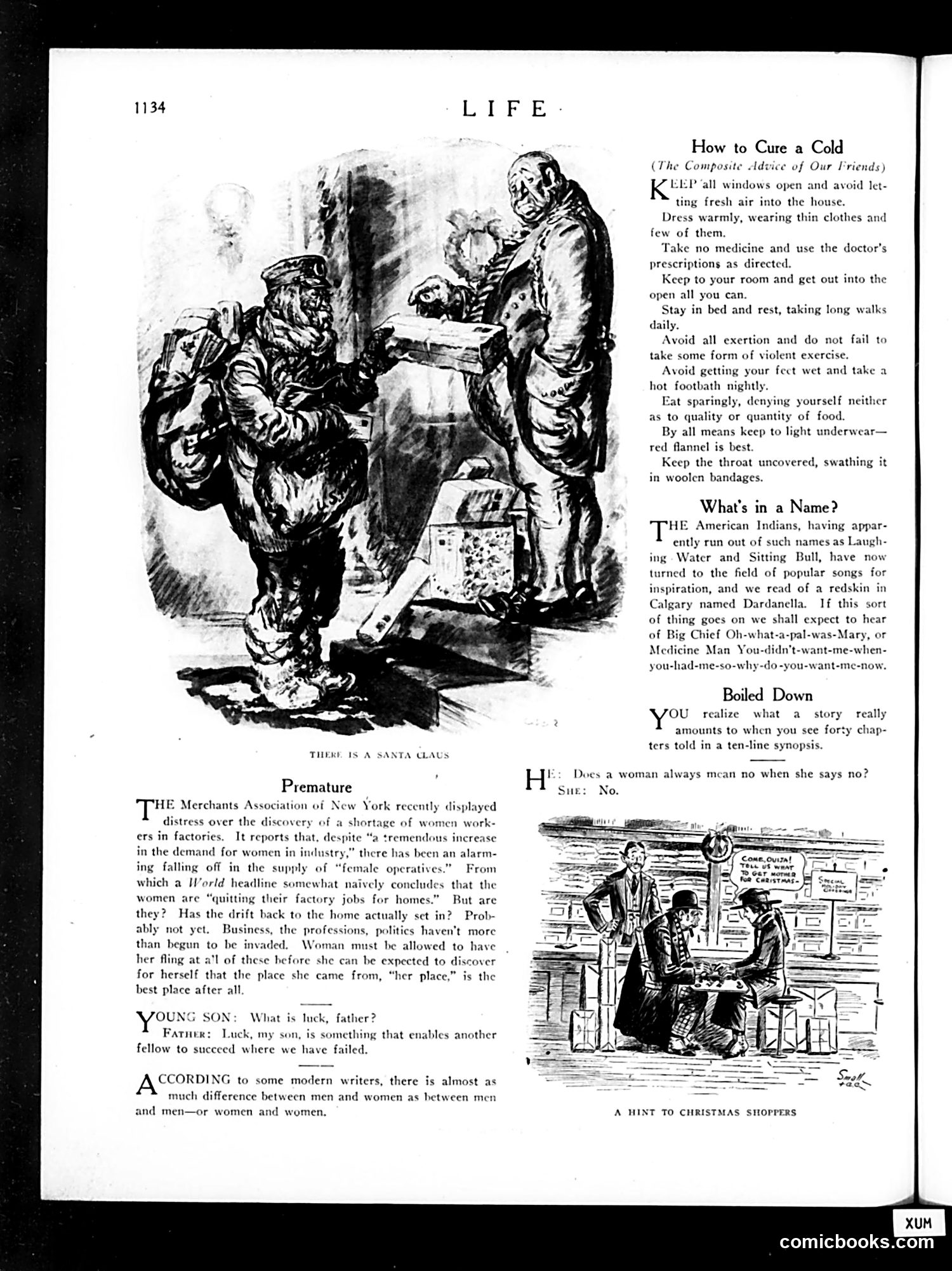
This page contains several satirical pieces: **"There is a Santa Claus"** (main illustration): A caricatured figure appears to be delivering goods/charity, likely referencing wartime or Depression-era relief efforts with dark humor. **"Premature"**: Critiques the Merchants Association of New York's alarm over women leaving factory jobs. The satire argues women shouldn't be expected to remain in "her place" in the workforce—they deserve the same career freedom as men to find better opportunities. **"Boiled Down"** and **"He: Does a woman always mean no when she says no?"**: Brief humorous exchanges about gender relations and communication. **"A Hint to Christmas Shoppers"**: A cartoon showing crowded shopping conditions with sardonic commentary on holiday retail. The overall theme satirizes gender roles, wartime economics, and consumer culture expectations.
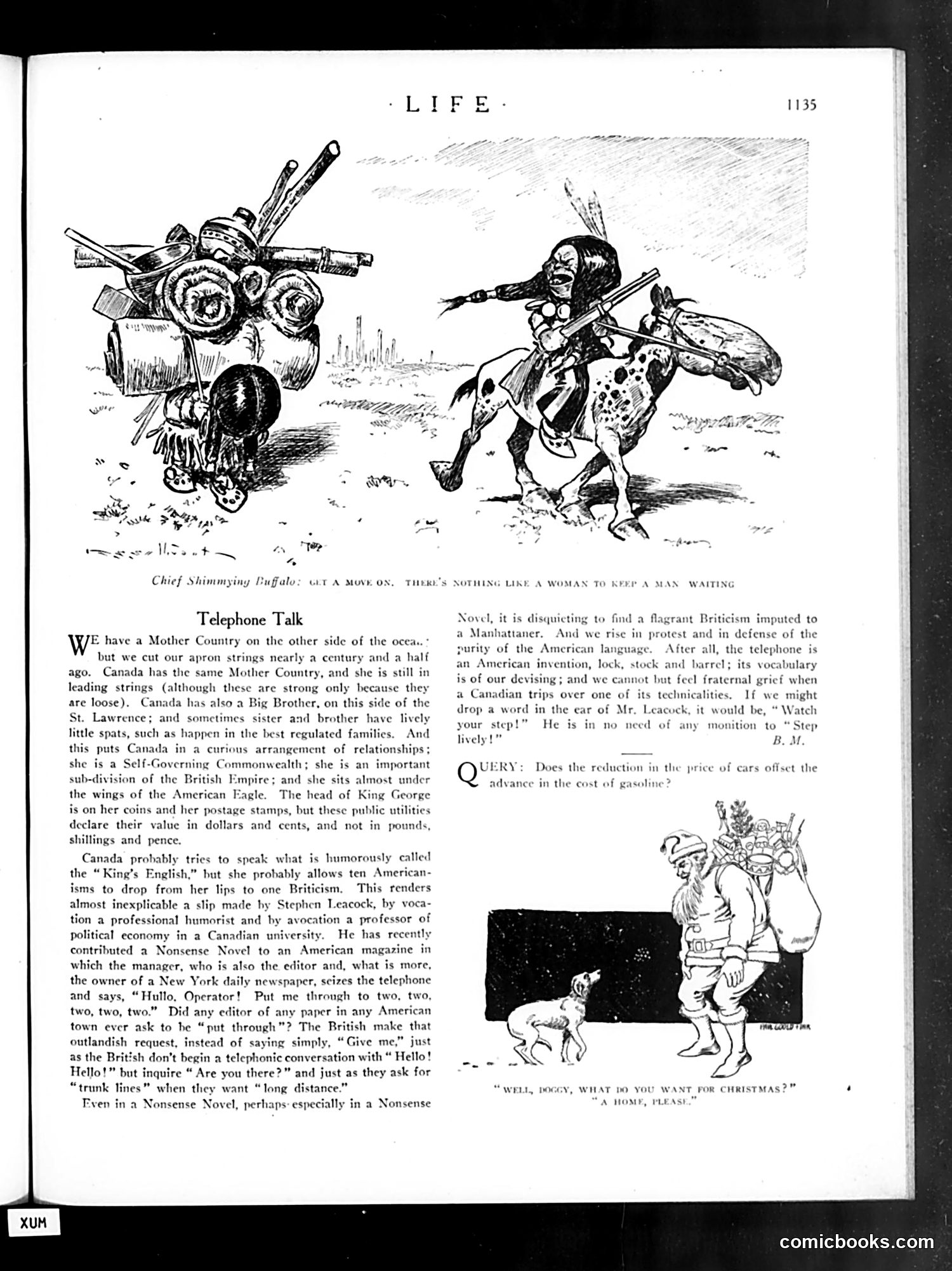
The top cartoon depicts a Native American chief on horseback fleeing from what appears to be military weaponry or industrial machinery in the background—likely satirizing the historical displacement of Indigenous peoples by American technological progress and westward expansion. The main article, "Telephone Talk," humorously critiques Canadian linguistic and cultural differences from Americans. The author mock-complains about Canadians' British English expressions and their formality on telephones (saying "Hello!" repeatedly rather than getting to business). The piece presents this as quaint colonial affectation, embodying American satirical superiority toward their northern neighbor's British cultural ties. The lower cartoon shows civilians discussing Christmas gifts, with the caption "Well, Ducky, What Do You Want for Christmas? 'At Home, Please'"—apparently commenting on wartime separation or economic hardship.
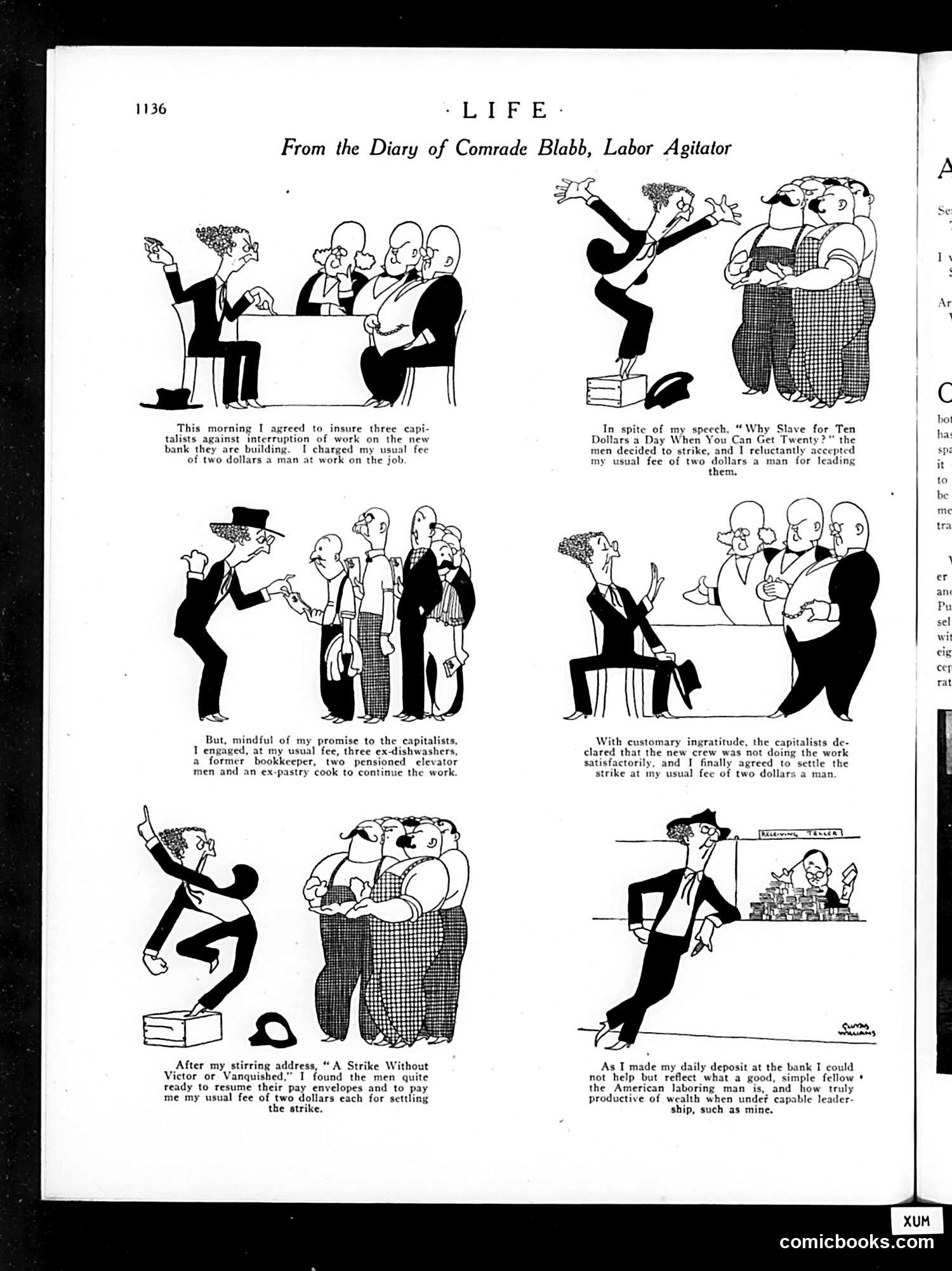
This is a satirical comic strip mocking labor activism and union organizing. The protagonist, "Comrade Blabb," is a labor agitator who claims ideological commitment to workers' strikes but consistently accepts capitalist bribes—charging two dollars per worker to negotiate settlements. The satire targets the hypocrisy of corrupt union leaders: Blabb gives fiery speeches about labor solidarity ("A Strike Without Victory or Vanquished") while privately selling out strikers to capitalists who hire scabs (replacement workers). He profits personally from both sides—collecting strike fees from workers while accepting payoffs to end strikes. The cartoon criticizes how labor leaders could exploit workers' genuine grievances for personal gain, portraying Blabb as self-serving rather than principled.
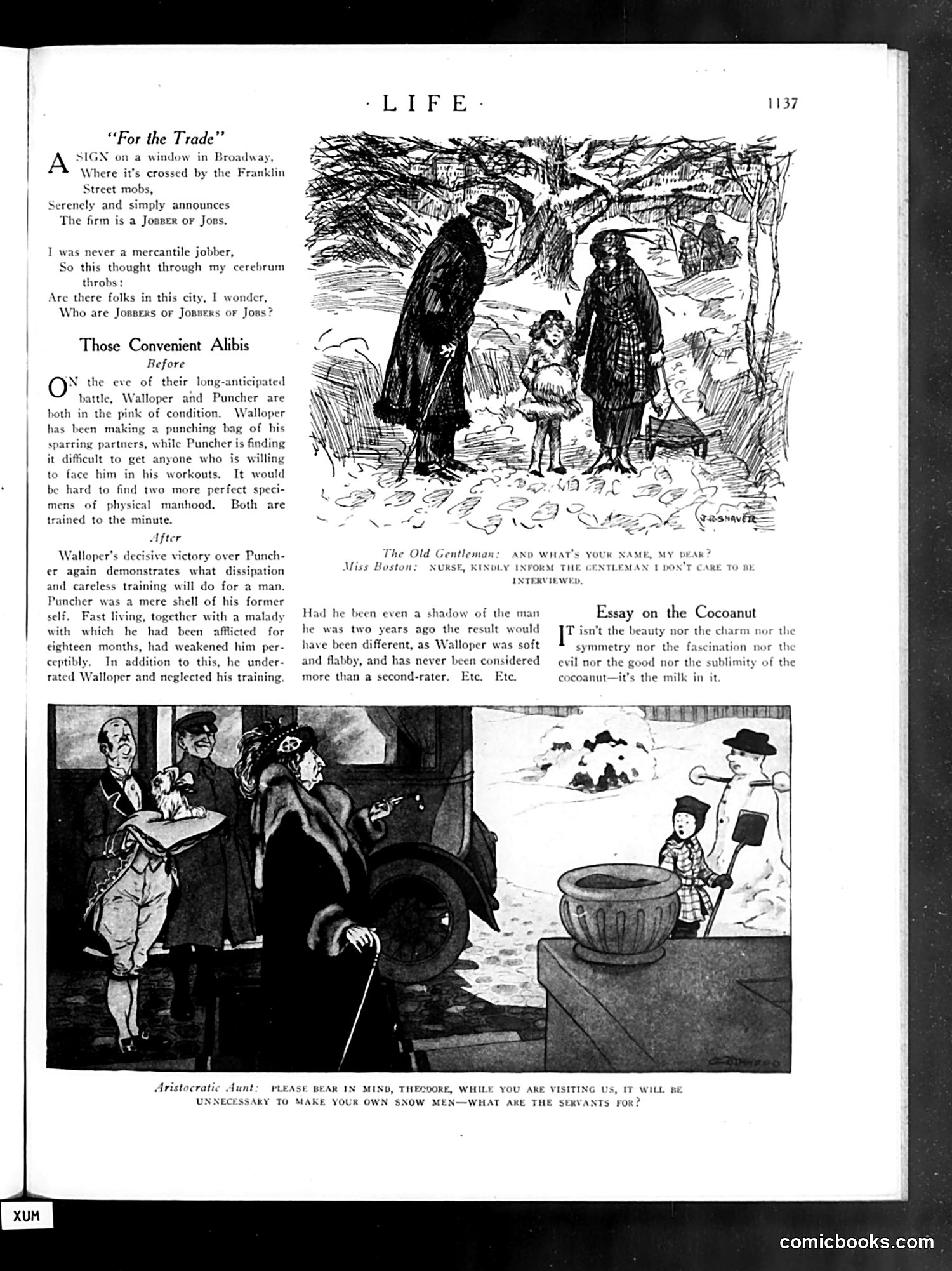
This page contains three satirical pieces from an early 20th-century American humor magazine: **"For the Trade"**: A poem mocking the prevalence of similar surnames (Jobsen/Jobs) among New York's business community, likely referencing immigrant merchants of Scandinavian or Jewish descent. **"Those Convenient Alibis"**: A boxing narrative contrasting two fighters before and after a match. The "After" section sarcastically notes that Walloper's victory over Puncher demonstrates how dissipation and poor training (implied: fast living and illness) devastate physical performance, while Walloper remains mediocre despite winning. **Bottom cartoons**: Two comic vignettes—one showing a wealthy woman dismissing an elderly gentleman's attempt at social interaction, and another depicting an aristocratic aunt instructing a child that servants, not children, should build snowmen, mocking upper-class pretension and servant-dependent household management. The humor targets social pretension, immigrant stereotypes, and class-based assumptions typical of early 1900s American satire.
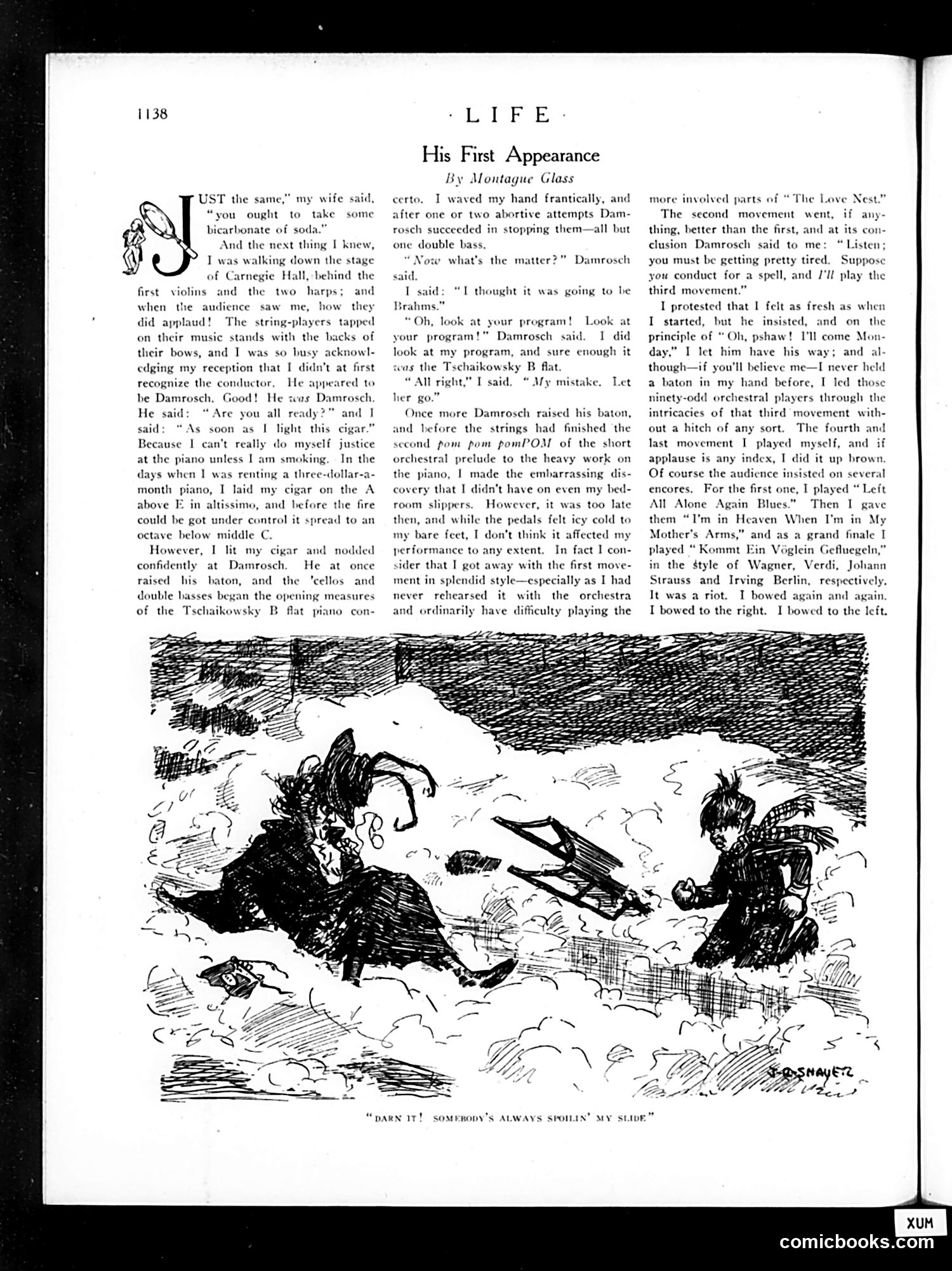
This humorous short story describes a narrator's chaotic Carnegie Hall debut as a piano soloist with conductor Leopold Damrosch. The accompanying illustration shows someone sledding—a visual pun on the narrator's final line about someone "spoiling my slide." The satire targets social pretension and artistic mishaps: the narrator is unprepared (lacking slippers, confused about the program), yet remains obliviously confident. Damrosch represents the dignified maestro dealing with incompetence. The joke hinges on the narrator's self-delusion—he believes his bumbling performance was a triumph, citing audience applause that likely resulted from novelty or amusement rather than genuine musical merit. The story mocks concert-hall pretension and the gap between self-perception and reality, typical of *Life* magazine's early-20th-century satirical approach to cultural institutions.
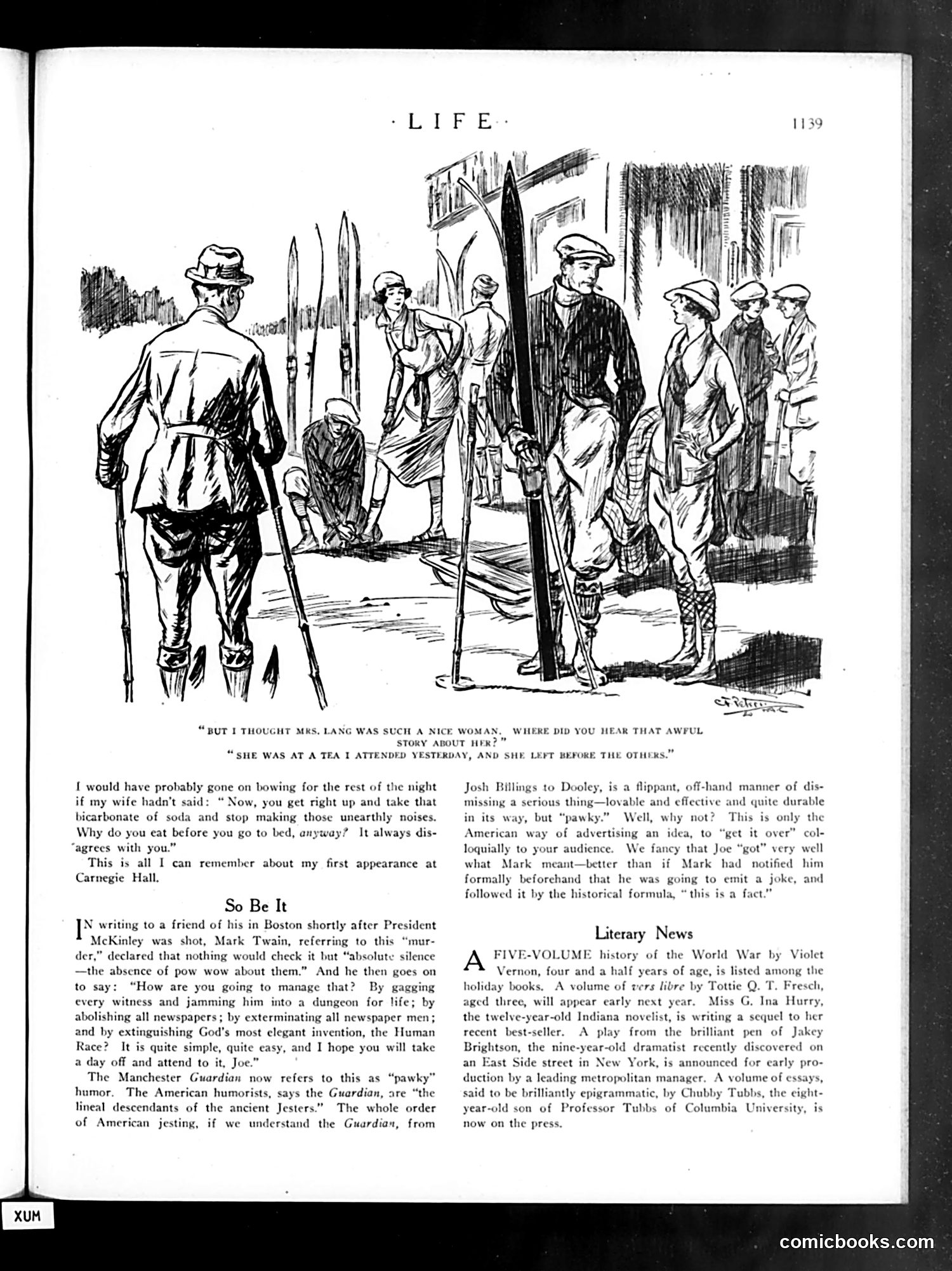
The top cartoon satirizes social gossip and rumor-mongering. A woman's reputation is damaged by mere absence—she left a tea party early, and this alone becomes "an awful story" circulating among society women. The joke exposes how flimsy the basis for scandal can be, and how women's social standing depends on arbitrary, trivial behaviors observed at social gatherings. The page's main text discusses Mark Twain's dark humor about President McKinley's assassination, contrasting American and British views of comedy. Twain advocated "absolute silence" about the murder—a deliberately absurd exaggeration meant to mock those demanding censorship of political discussion. The *Manchester Guardian* labels this distinctly American style "pawky" (slyly humorous) humor: colloquial, indirect, dismissive of serious matters through flippant wit rather than formal pronouncement. The "Literary News" section appears to be satirical filler, humorously announcing books by improbably young authors (a three-year-old poet, nine-year-old dramatist), likely mocking literary publishing trends.
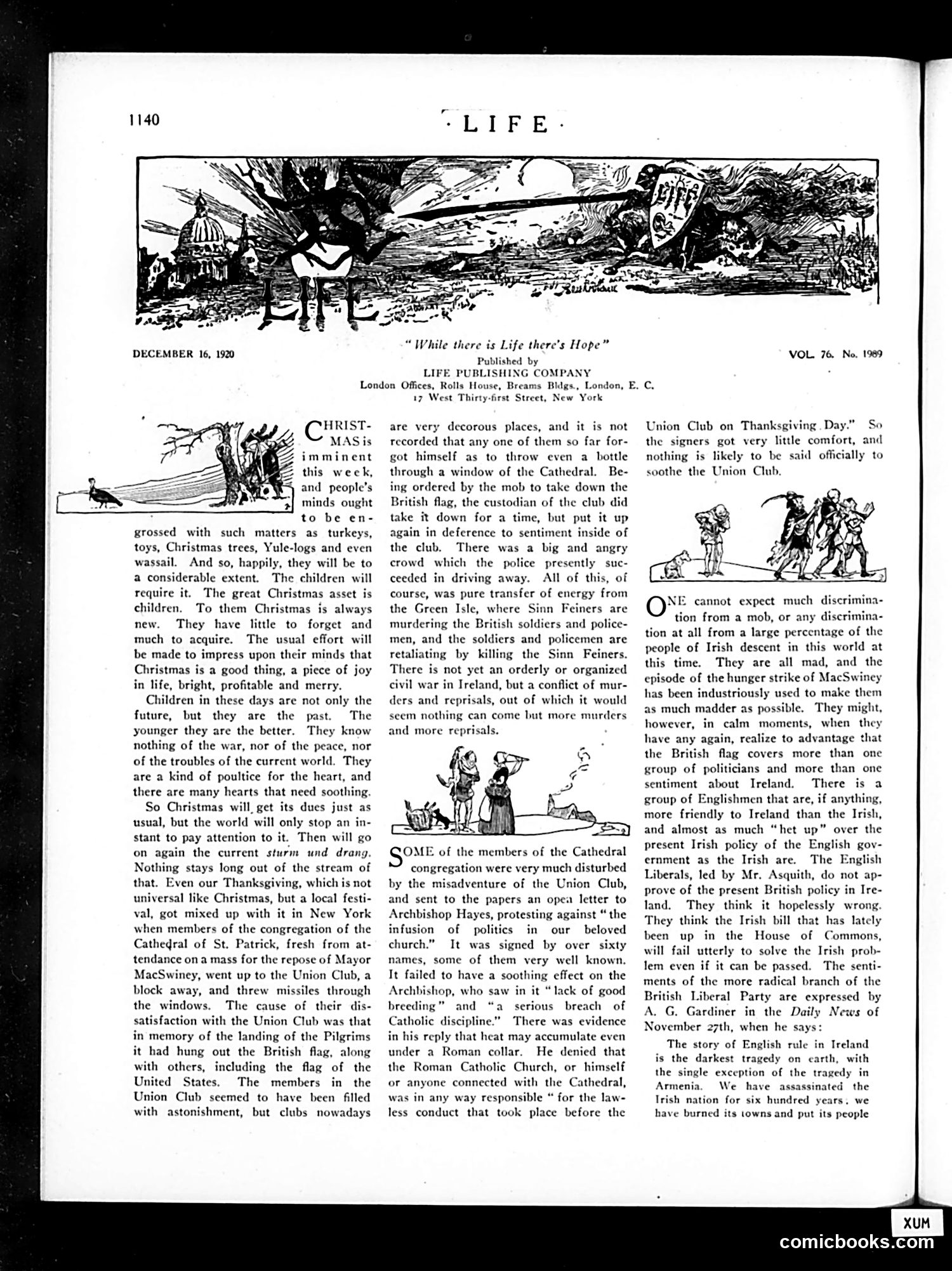
This article discusses the aftermath of a Thanksgiving Day incident at the Union Club in Manhattan, where Irish nationalists threw rocks through windows in protest of a British flag display. The immediate context: Mayor MacSwiney's recent death during a hunger strike in British custody had inflamed Irish-American sentiment. The piece references the Irish War of Independence (1919-1921), mentioning "Sinn Feiners" (Irish republican rebels) engaged in a cycle of "murders and reprisals" against British soldiers and police. The author presents this violence as spreading to America through Irish-descended Catholics, who object to British symbols even in private clubs. Archbishop Hayes's dismissive response—blaming "lack of good breeding" rather than addressing political grievances—frustrated the protesters. The article illustrates the tension between Irish-American nationalist fervor and American institutions' neutrality, showing how international conflicts were actively dividing American communities in 1920.
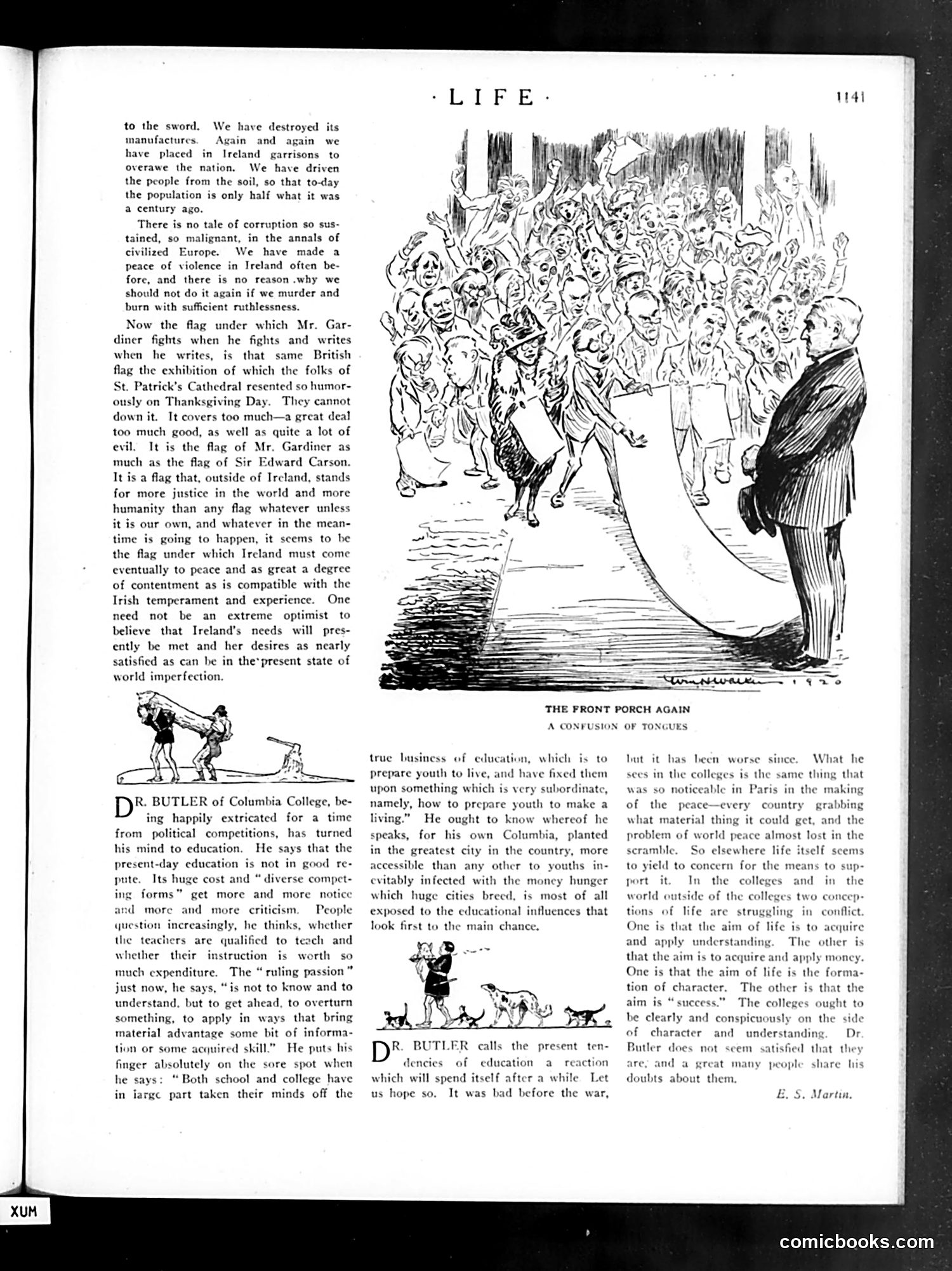
This page critiques Irish nationalism and education during the early 20th century. The main cartoon depicts a man (likely representing a British official or unionist) addressing a crowd of Irish people with raised fists and animated expressions—suggesting nationalist fervor or protest. The text discusses Irish independence, referencing Mr. Gardiner and Sir Edward Carson (likely figures in the Home Rule debate), and criticizes British colonial policy's devastation of Ireland. It condemns the contradiction of fighting under the British flag while Irish nationalism grows. The secondary article by Dr. Butler of Columbia College critiques American education, arguing that schools prioritize teaching students "how to make a living" over "how to live"—focusing on material gain rather than character formation. This reflects broader early-20th-century anxiety about education's purpose amid rapid industrialization and social change.
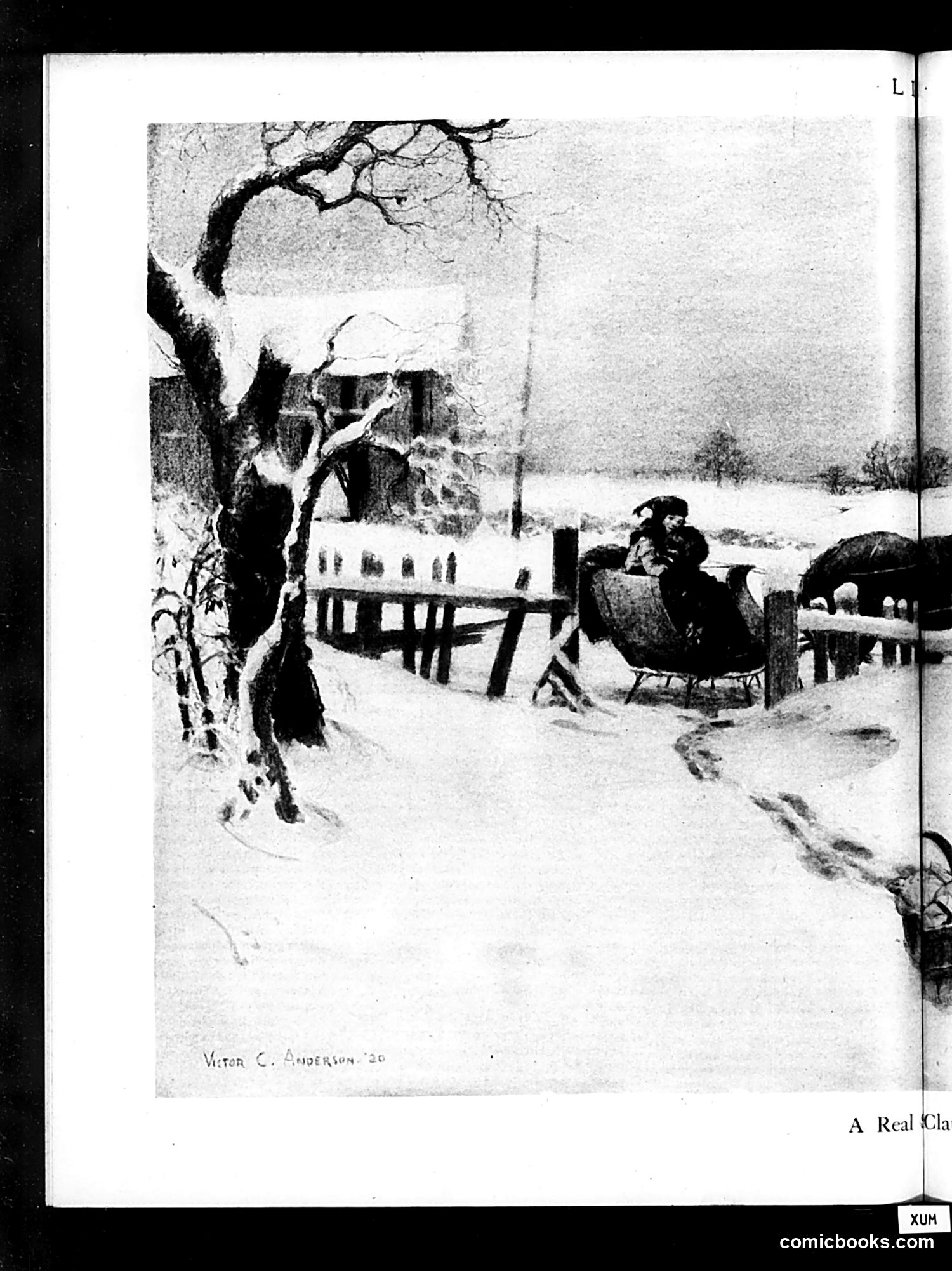
This appears to be a page from *Life* magazine featuring a winter scene photograph credited to Victor C. Anderson ('26). The image shows a snowy landscape with a bare tree in the foreground, a house or cottage in the middle distance, and figures with what appears to be a sleigh on the right side. The visible text reads "A Real Cla[ssic]" (cut off), suggesting this may be part of a caption or heading, though the complete context is unclear from this fragment. Without the full OCR text or complete caption, I cannot definitively identify the specific satire, political reference, or joke intended. The image itself appears to be a straightforward winter landscape photograph rather than a political cartoon. More context from the surrounding page would be needed for accurate interpretation.
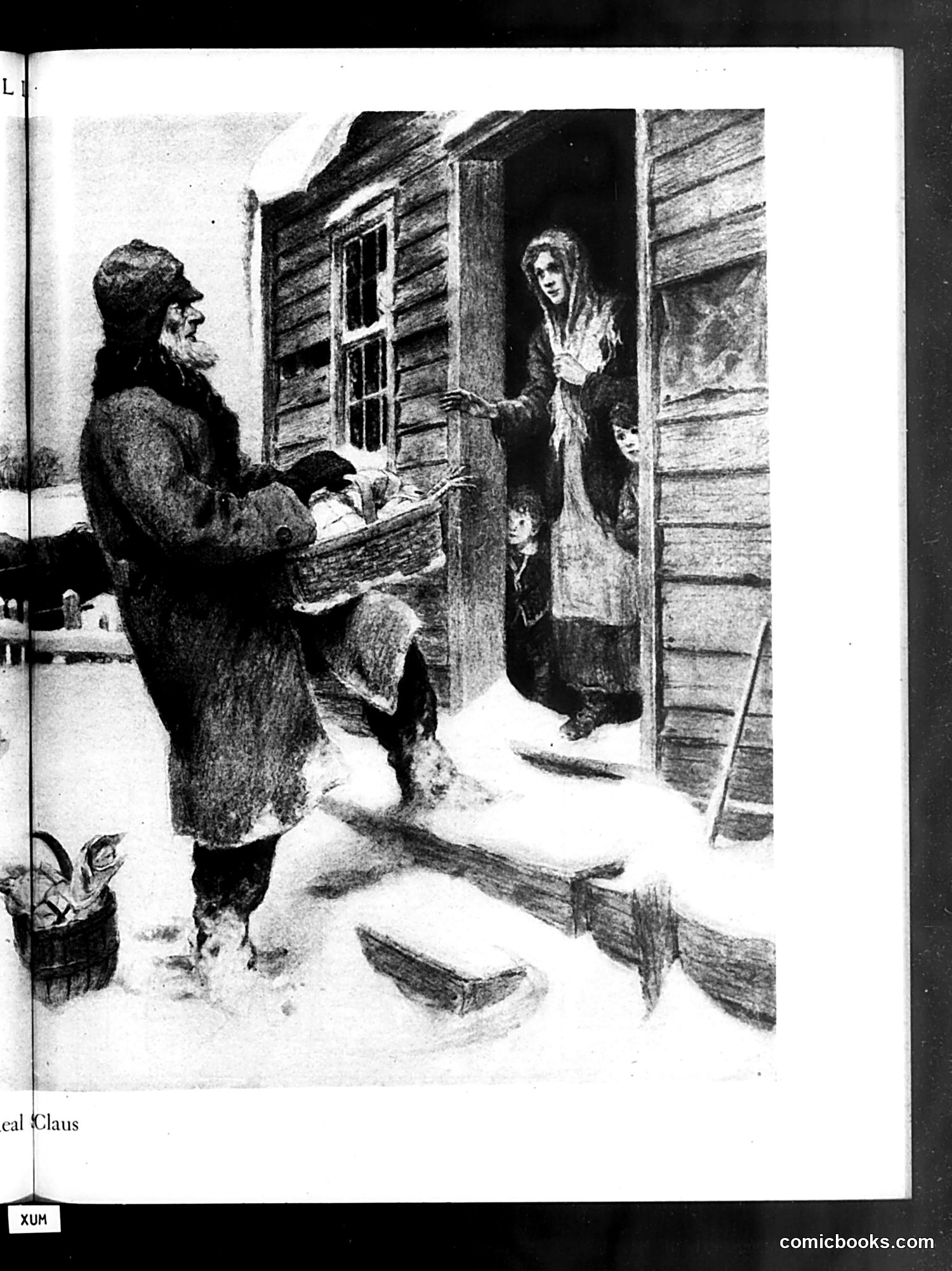
This appears to be a satirical illustration titled "Real Claus" (visible at bottom), presenting a dark social commentary on poverty and charity during what seems to be a winter season. The image depicts an old man—dressed as Santa Claus or representing charitable gift-giving—distributing items to a woman and child at the doorway of a modest wooden house in snowy conditions. The satire likely critiques the inadequacy of seasonal charity or holiday generosity as a response to systemic poverty. The caption "Real Claus" suggests irony: the figure represents authentic charity or the "real" spirit of Christmas, contrasted with commercial or superficial holiday traditions. The scene emphasizes economic hardship and the desperation of the poor during winter, questioning whether token charitable acts truly address fundamental social problems.
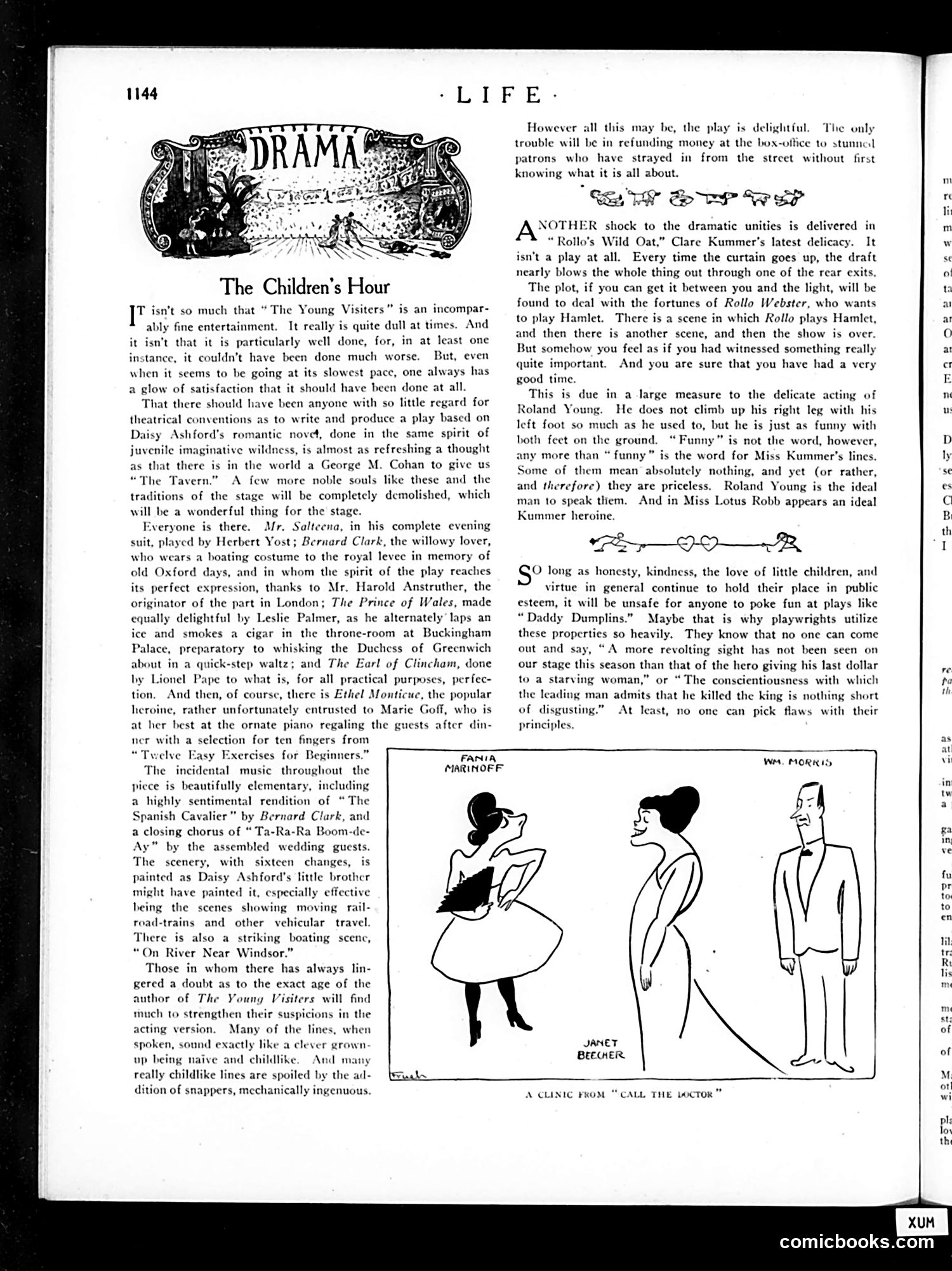
This page reviews three theatrical productions. The main cartoon at bottom, titled "A Clinic from 'Call the Doctor,'" depicts three characters—identified as Pania Markhoff, Janet Beecher, and W.H. Pickris—in what appears to be a comedic scene, likely illustrating a humorous moment from the play being discussed. The text reviews "The Children's Hour" (a stage adaptation of Daisy Ashford's novel "The Young Visitors"), "Rollo's Wild Oat" by Clare Kummer, and "Daddy Dumplins." The reviews praise the delightful absurdity of these productions—their departure from theatrical conventions and their ability to entertain despite (or because of) their illogical plots. The satire targets both the plays' deliberate nonsense and the public's hunger for wholesome entertainment featuring "honesty, kindness, the love of little children." The cartoon illustrates theatrical comedy style of the era, showing exaggerated character types typical of stage farce.
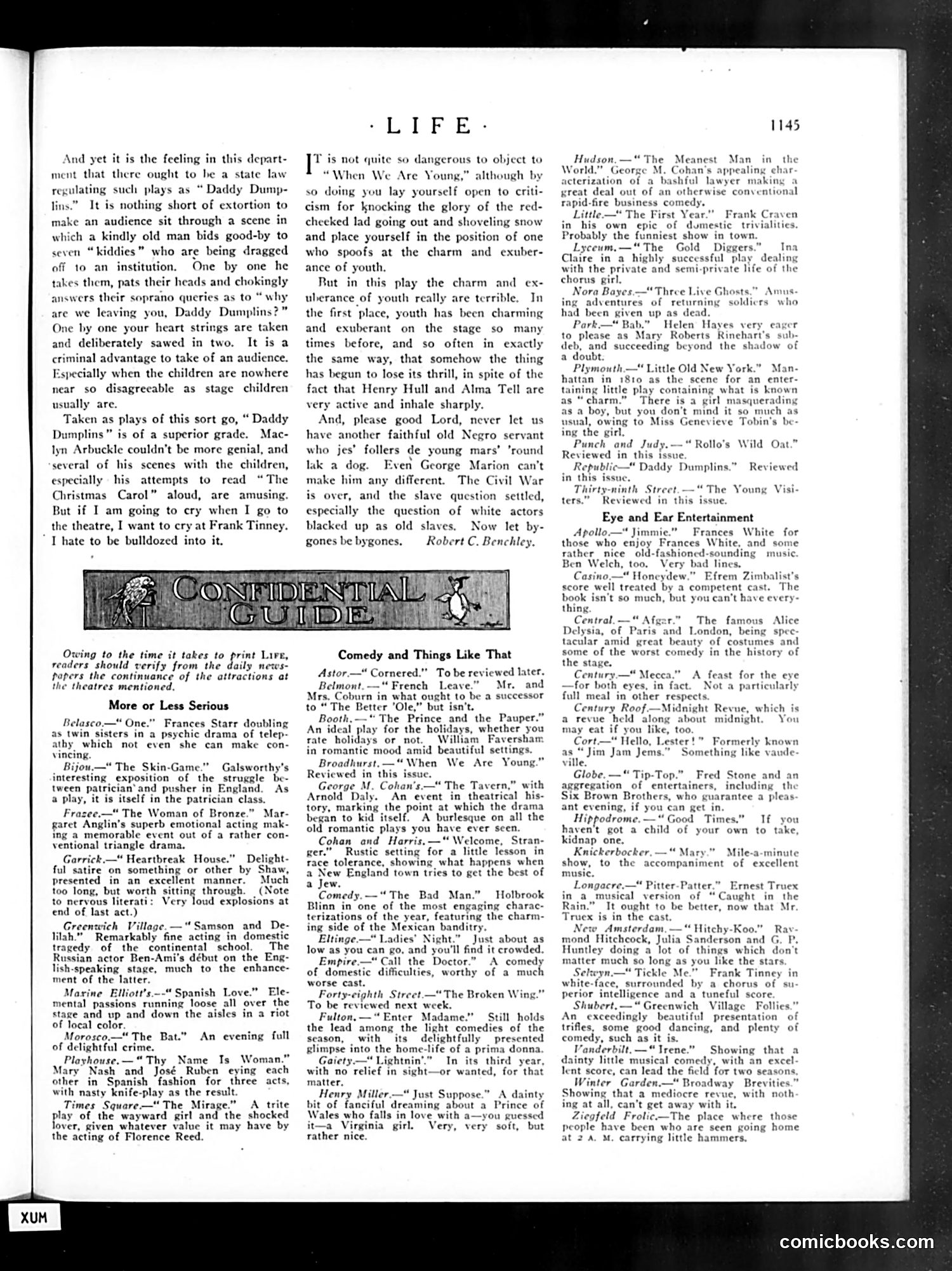
This page contains theater reviews rather than political cartoons. The critic discusses Broadway productions with characteristic early 20th-century sensibility. The main satirical target is the play "Daddy Dumplins," which the reviewer attacks for emotional manipulation—deliberately extracting tears from audiences through scenes of children being separated from their adoptive father. The critic calls this "extortion" and "criminal advantage," arguing that if audiences must cry at theater, they should do so at performer Frank Tinney's comedy rather than be "bulldozed into it." The review praises actor Maclyn Arbuckle's performance despite the play's manipulative structure. The page also lists brief reviews of other Broadway productions, mostly praising technical performances (Margaret Anglin, Ben-Ami) while criticizing tired dramatic conventions—particularly the repeated use of faithful elderly Black servants in plays, which the critic sarcastically notes should end now that "the Civil War is over, and the slave question settled."
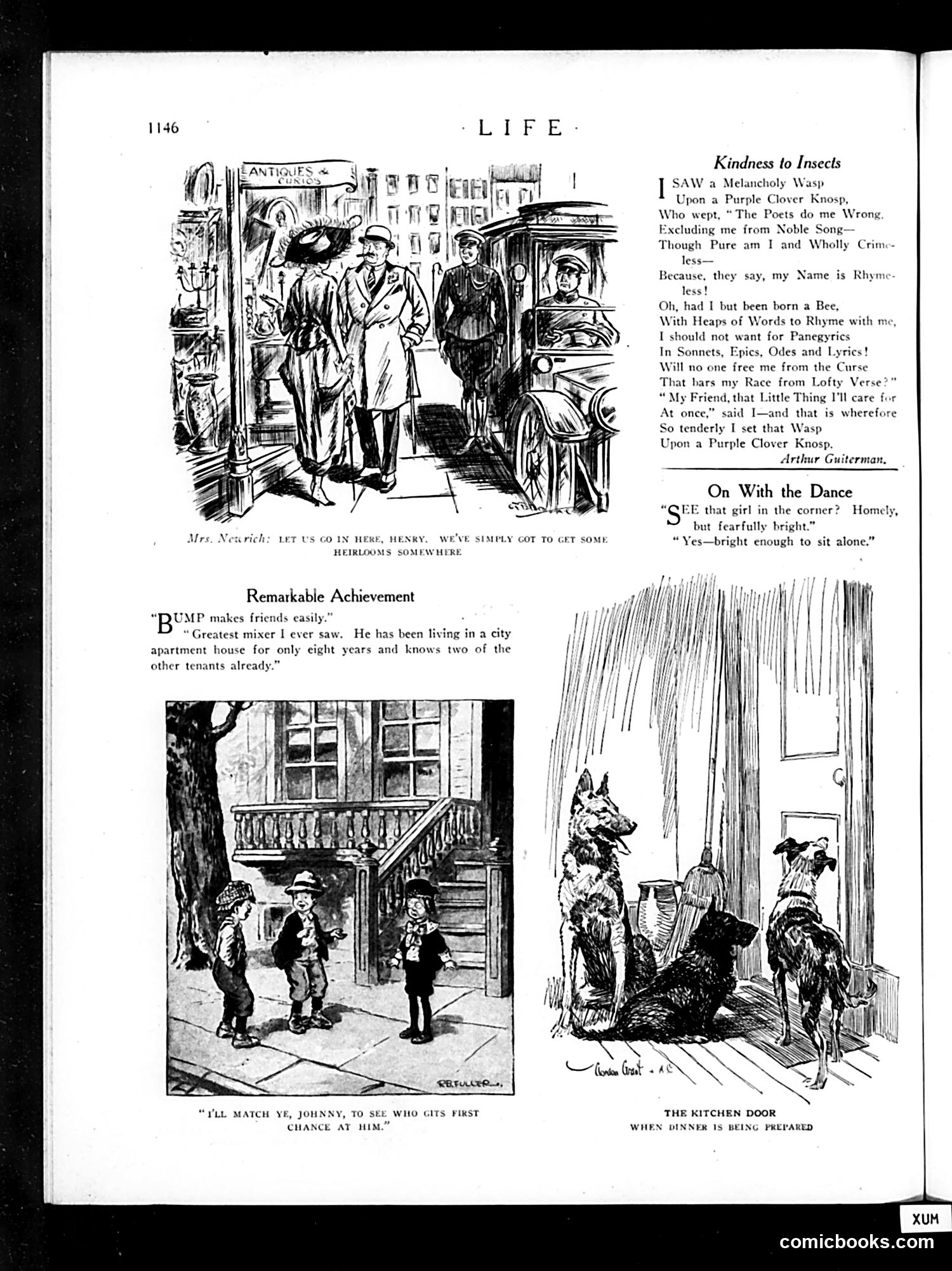
This page contains three distinct pieces of satirical content: **"Kindness to Insects"** - A poem by Arthur Guiterman presenting a whimsical complaint from a melancholy wasp excluded from poetic celebration because insects lack good rhyming names. The satire gently mocks Romantic-era poetry's conventions. **"Remarkable Achievement"** - A brief joke about a character named "Bump" who, despite living eight years in an apartment building, knows only two other tenants. This satirizes urban anonymity and the difficulty of forming connections in crowded city living—a then-modern social commentary. **"On With the Dance"** - A caption joke about a homely but bright girl sitting alone at a dance, suggesting superficiality in social circles. The cartoon shows newly wealthy people ("Newrich") seeking to acquire heirloom antiques for social status, mocking nouveau-riche pretension. The lower illustrations humorously depict dogs' interest in kitchen dinner preparations, serving as gentle domestic humor. The overall tone is light social satire typical of early 20th-century Life magazine.
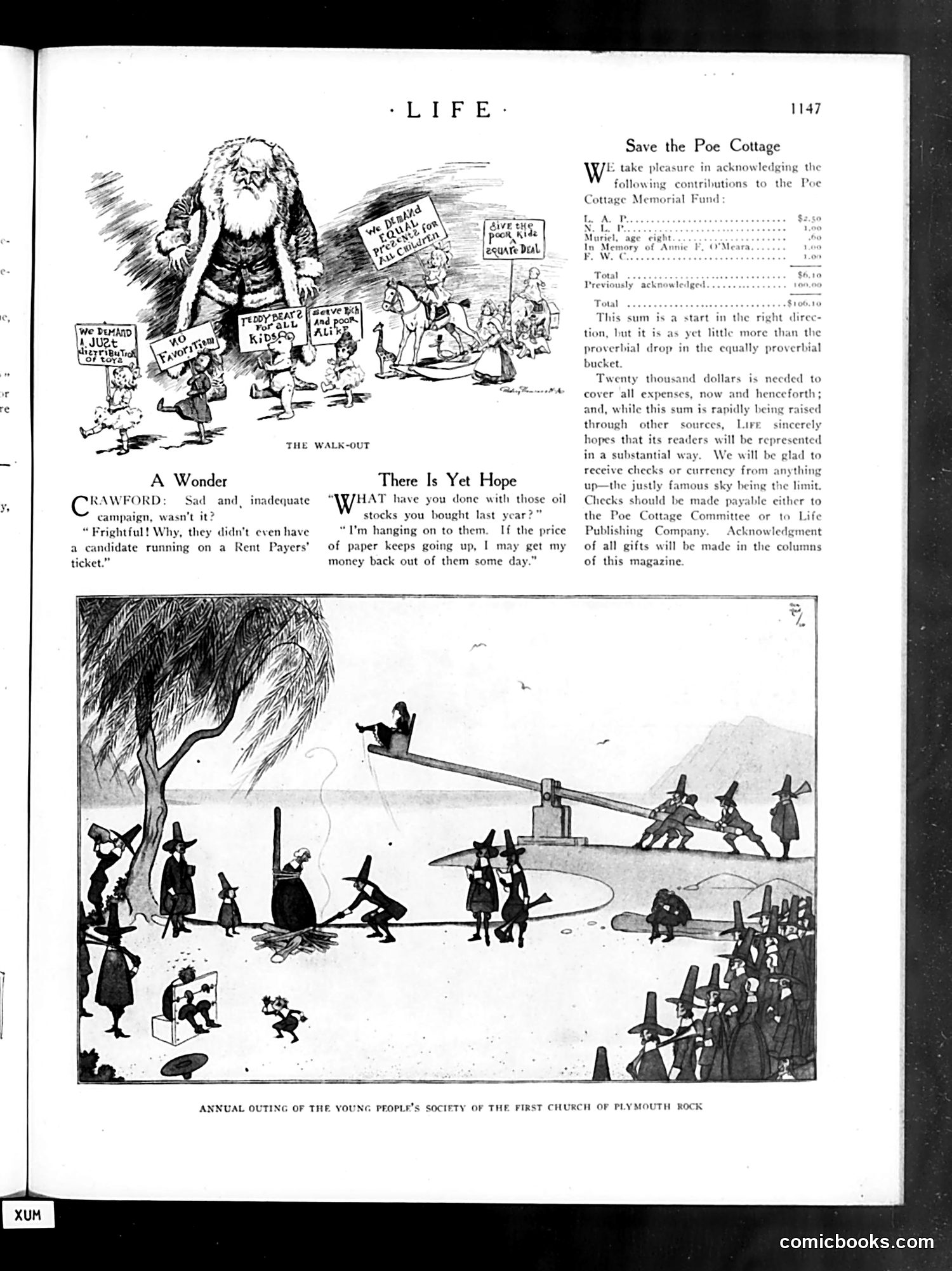
This Life magazine page contains three satirical pieces about 1920s American concerns: **"The Walk-Out"** (top cartoon): Depicts Santa Claus leading children in a strike, with signs reading "We demand," "Teddy bears," and "Stockings"—mocking labor strikes of the era by showing even children demanding goods. **"A Wonder" and "There Is Yet Hope"**: Two brief jokes. The first ridicules a failed political campaign lacking even a "Rent Payers' Party" candidate. The second jokes darkly about stock market losses: someone holding worthless oil stocks hopes paper prices will rise so they can recoup losses—a cynical reference to 1920s financial speculation and market volatility. **"Save the Poe Cottage"**: A fundraising appeal for Edgar Allan Poe's cottage, listing small donations already received and requesting $20,000 total—reflecting era-typical patronage of American literary landmarks. **Bottom illustration**: A humorous scene of a church youth group's outing, apparently featuring a see-saw or carnival activity, likely satirizing earnest small-town religious organizations.
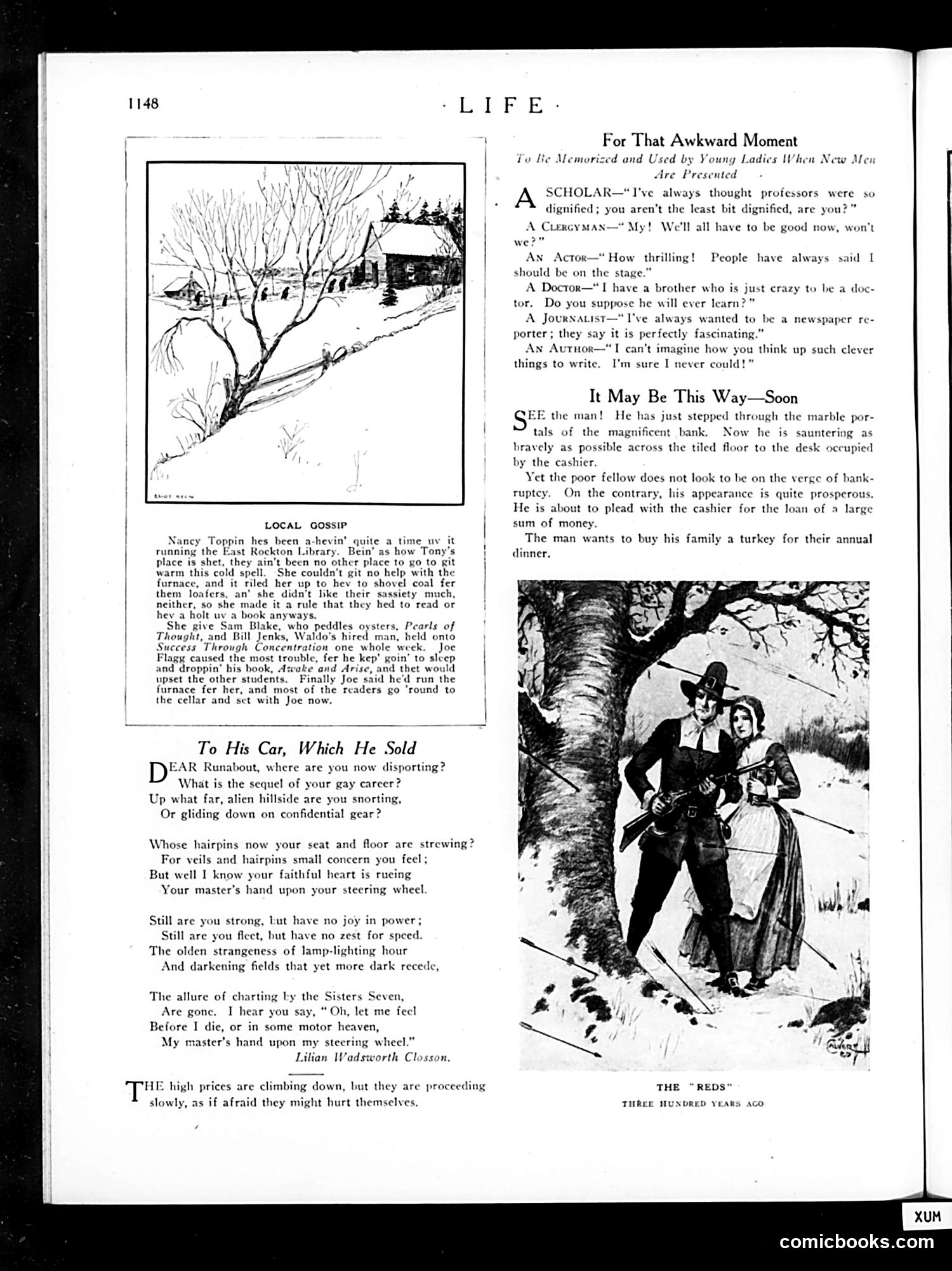
## "For That Awkward Moment" This satirical advice column offers young women canned compliments to flatter various professional men they meet socially. The humor lies in the transparently insincere nature of each line—a scholar who isn't dignified, a clergyman being teased about morality, an actor fishing for stage validation. The satire mocks both the shallow social conventions requiring women to praise men and the vanity of these professions. ## "It May Be This Way—Soon" A brief story about a prosperous-looking man entering a bank to request a large loan—for a turkey dinner. The satire appears to critique either post-war economic precarity (appearing successful while financially struggling) or the absurdity of taking bank loans for frivolous purchases. ## "Local Gossip" & "To His Car" Small-town gossip about a librarian, and a sentimental (mocking?) poem about a sold automobile, addressing it as a lost companion. The page reflects 1920s social humor about class, gender roles, and American consumer culture.
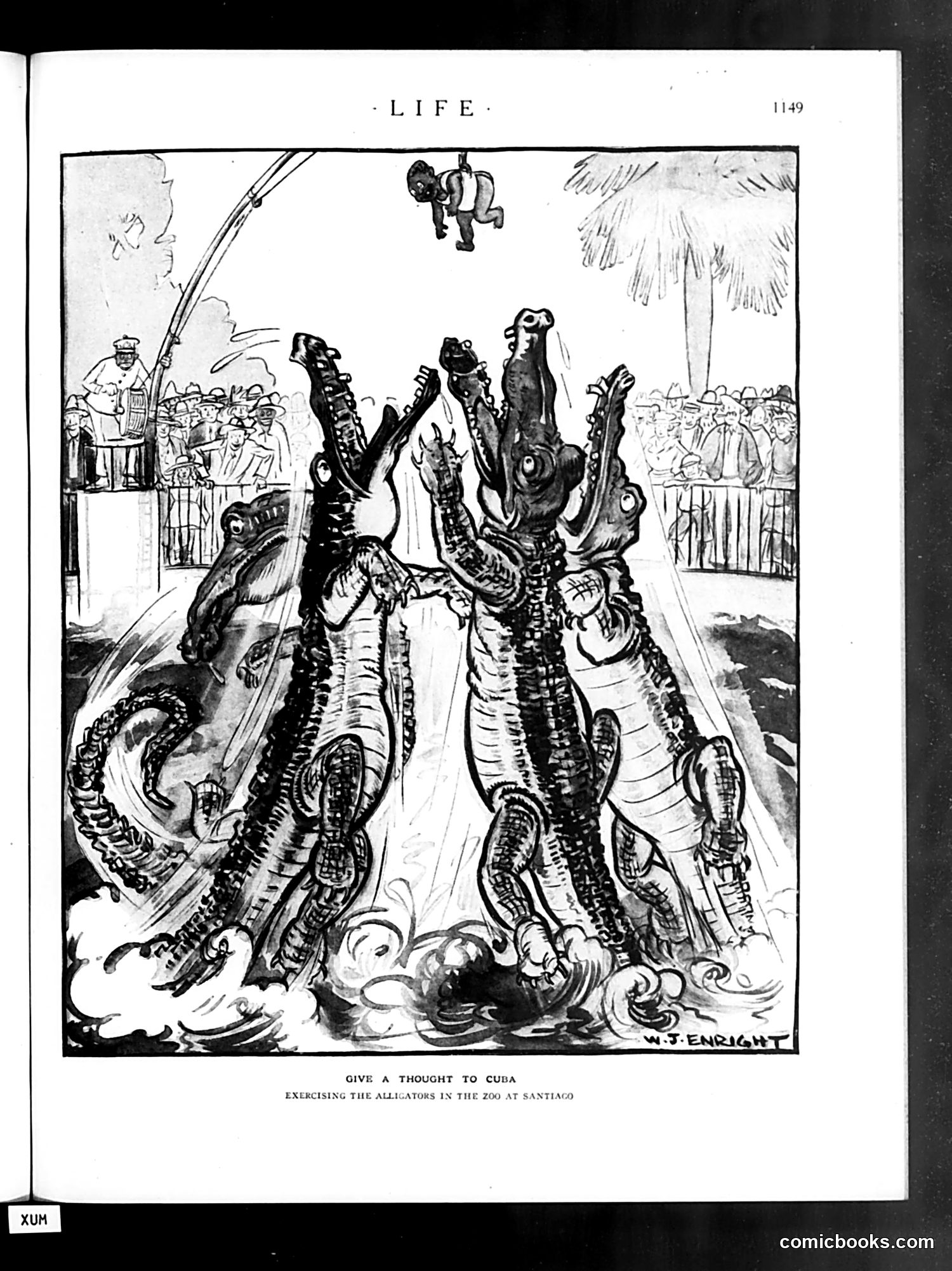
This satirical cartoon depicts a multi-headed beast labeled as alligators being "exercised" at a zoo in Santiago, Cuba. The creatures have human faces and gesticulate wildly with their limbs raised. Spectators observe from behind barriers. The cartoon appears to mock Cuban political leadership or military figures of the period—the "alligators" represent dangerous, chaotic politicians or strongmen requiring containment like zoo animals. The satire suggests these leaders are primitive, bestial, and require management by observers (likely American interests). The specific historical context—which Cuban figures or period this references—isn't entirely clear from the visible information, though Cuba's turbulent political history and American intervention were frequent Life magazine subjects. The dehumanizing caricature reflects early-twentieth-century satirical conventions that are now recognized as offensive.
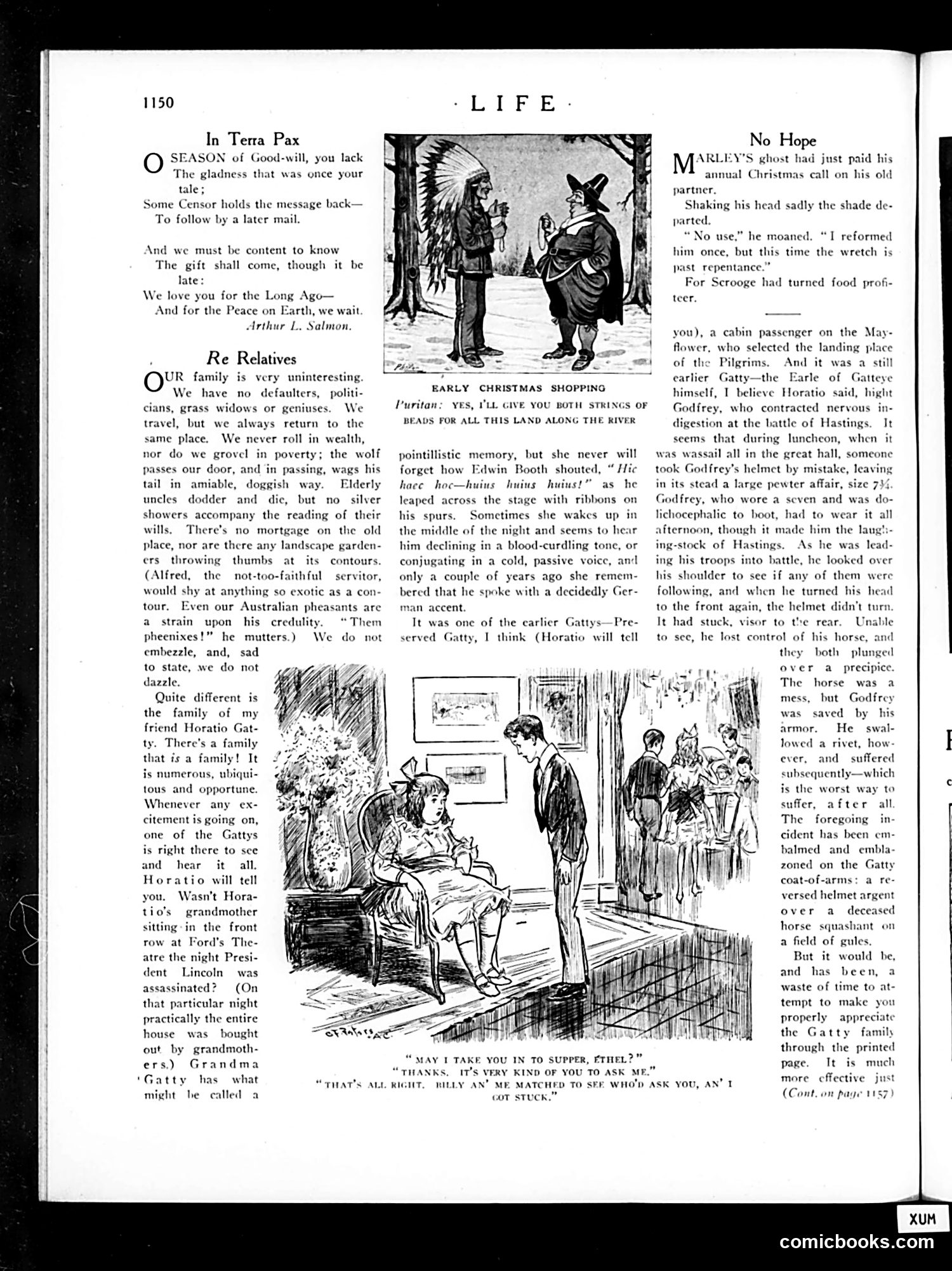
This page contains three distinct pieces of satirical content: **"In Terra Pax"** — A poem commenting on wartime censorship, lamenting that Christmas messages are being held back by censors, with only delayed mail permitted. **"Re Relatives"** — Humorous essay contrasting the author's boring, respectable family with his friend Horatio Gatty's theatrically dramatic lineage. The satire targets both pretentious family histories and people who embellish ancestors' importance. The Gatty family supposedly includes Lincoln's assassination witness and someone at the Battle of Hastings—obvious exaggerations. **"No Hope"** — A brief cartoon showing Marley's ghost visiting Scrooge, finding him now a "food profiteer" (wartime price gouger). The joke plays on Dickens' *A Christmas Carol*, suggesting even supernatural redemption cannot reform wartime black-market profiteers—a contemporary reference to food rationing/price controls during WWI or WWII. The cartoons mock both pretension and wartime moral failures.
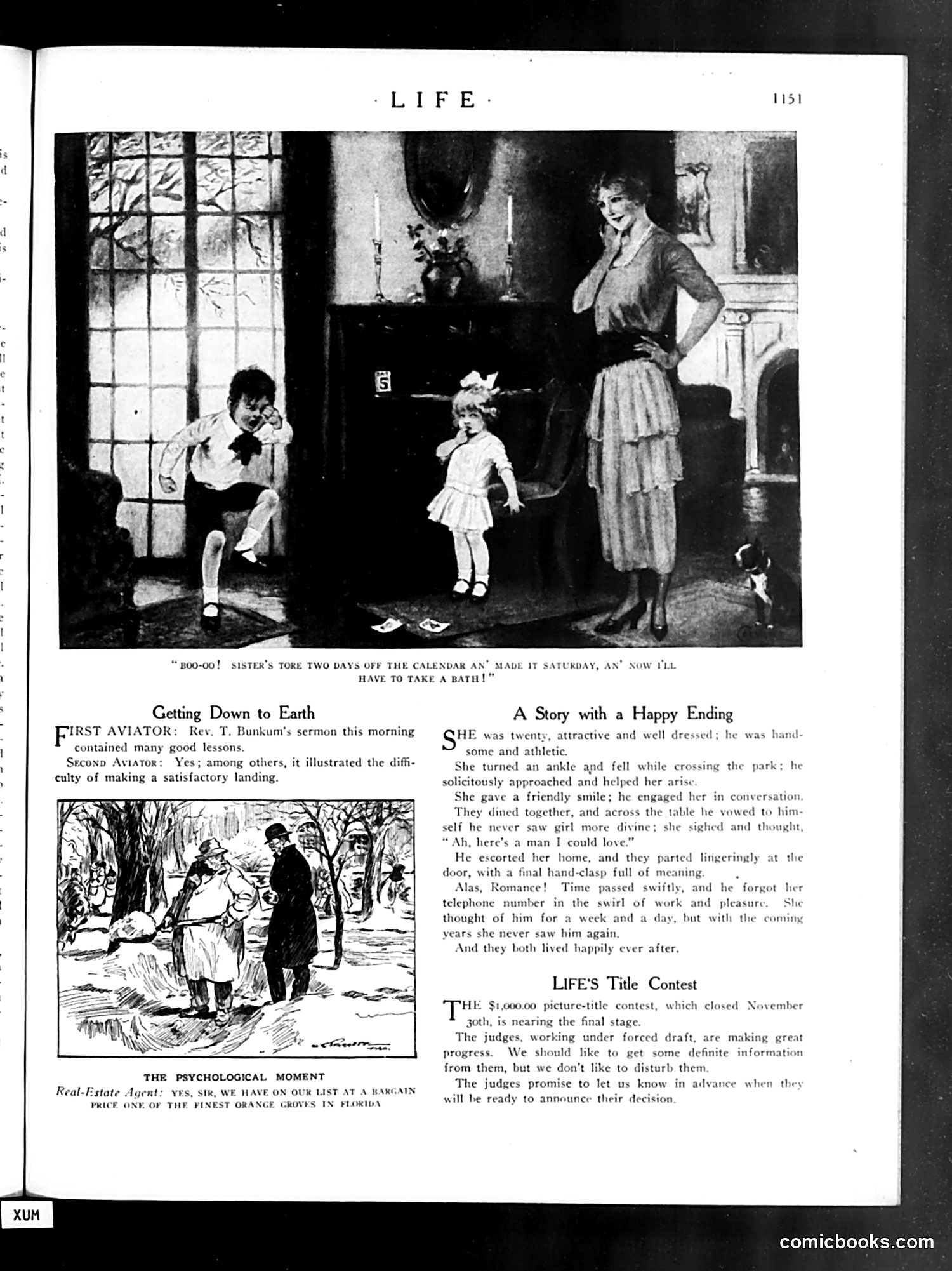
This page contains three separate humorous pieces typical of early 20th-century Life magazine: 1. **Top cartoon**: A domestic scene where a child complains about being forced to bathe because his sister manipulated the calendar. The humor lies in childhood resistance to hygiene. 2. **"Getting Down to Earth"**: Two brief jokes about aviators—one comparing a clergyman's sermon to difficult airplane landings (implying the sermon was hard to follow), the other about a real-estate agent's pitch about Florida orange groves. These mock both religious oratory and land-sales hype. 3. **"A Story with a Happy Ending"**: A satirical romance where two people meet, fall in love briefly, but then forget each other due to life's distractions. The ironic title mocks sentimental romance stories by showing love's impermanence. 4. **"LIFE's Title Contest"**: A meta-joke about the magazine's own picture-title competition, humorously noting the judges are slow while asking readers not to rush them. The overall tone is gently satirical about American life, romance, and commercialism.
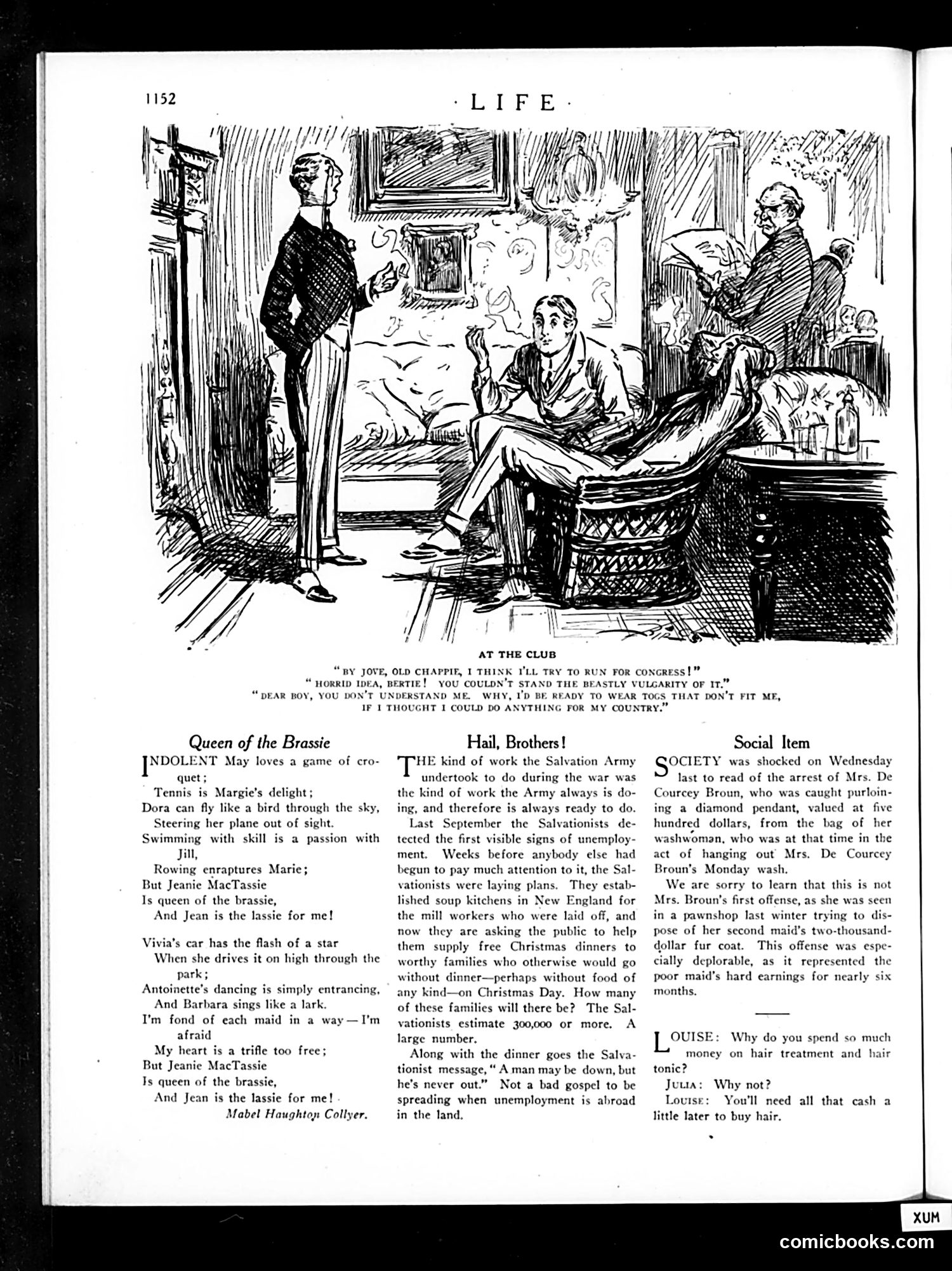
**The Main Cartoon ("At the Club"):** Two wealthy clubmen discuss one considering running for Congress. The joke mocks upper-class snobbery—the friend warns that politics involves "beastly vulgarity" and ill-fitting clothes, yet the would-be candidate claims he'd endure these indignities for his country. The satire targets the aristocratic attitude that public service is beneath gentlemen, while simultaneously suggesting such men are disconnected from ordinary concerns. **"Queen of the Brassie":** A light romantic song celebrating a woman named Jeanie MacTassie, who excels at golf (a "brassie" is a golf club). The poem contrasts her athletic prowess with other fashionable women's accomplishments. **"Hail, Brothers!"** and **"Social Item":** Contrasting pieces—one praising the Salvation Army's Depression-era charity work and message that "a man may be down, but he's never out"; the other satirizing wealthy women's moral bankruptcy through the story of Mrs. De Courcey Broun stealing from her washwoman and maid.
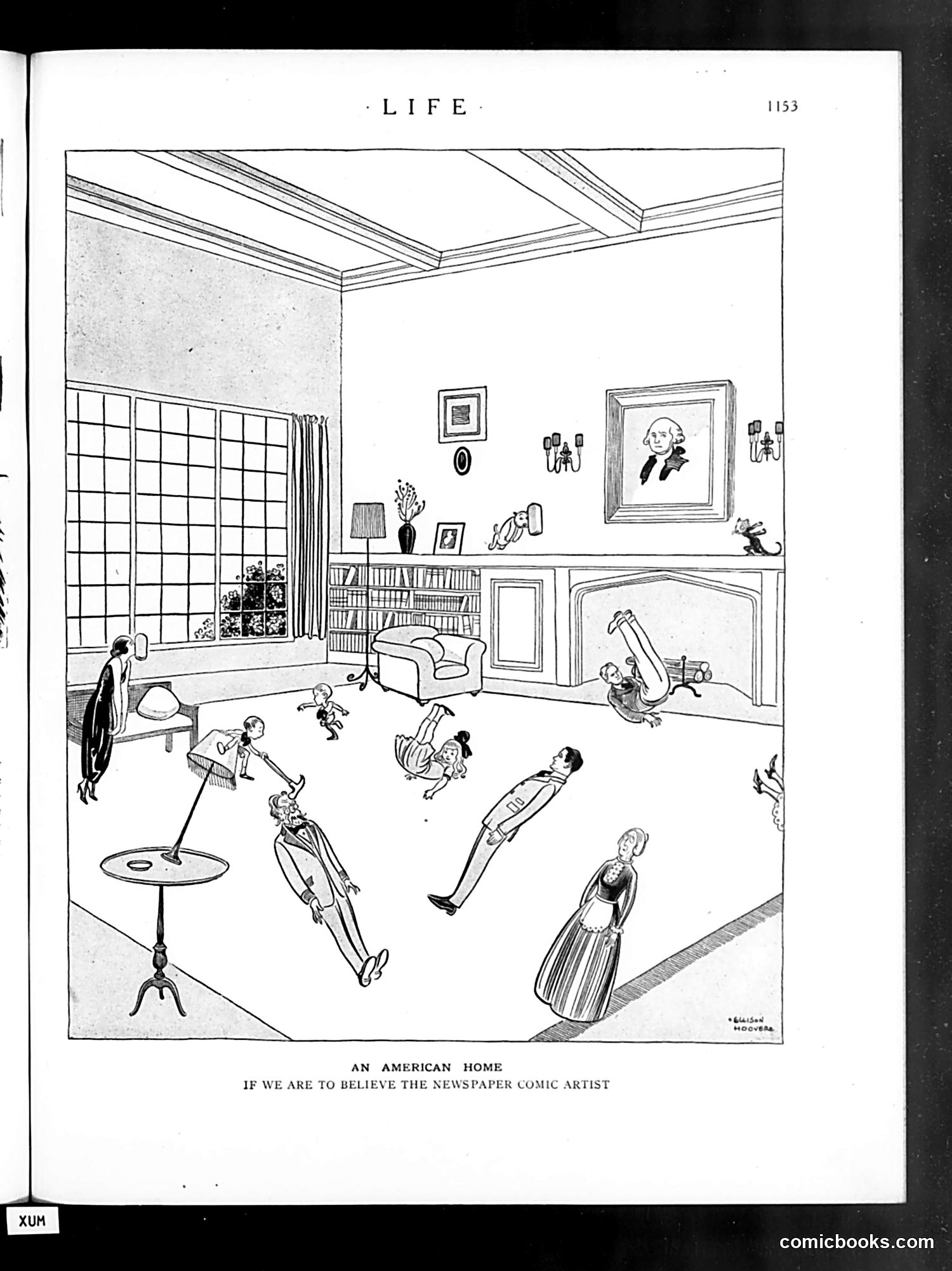
This satirical cartoon depicts an idealized American home in chaotic disarray. Adults and children are scattered across the floor in exaggerated, impossible poses—lying flat, contorted, or suspended mid-air—while engaging in leisure activities like exercising, playing, and relaxing. The caption critiques newspaper comic artists for their fantastical depictions of domestic life. The satire suggests that comics portray American homes and family behavior in wildly unrealistic, physically impossible ways. The artist is mocking how comic strips present idealized or absurd versions of everyday American domestic existence that bear no resemblance to actual homes and family life. It's commentary on the gap between comic strip fantasy and reality.
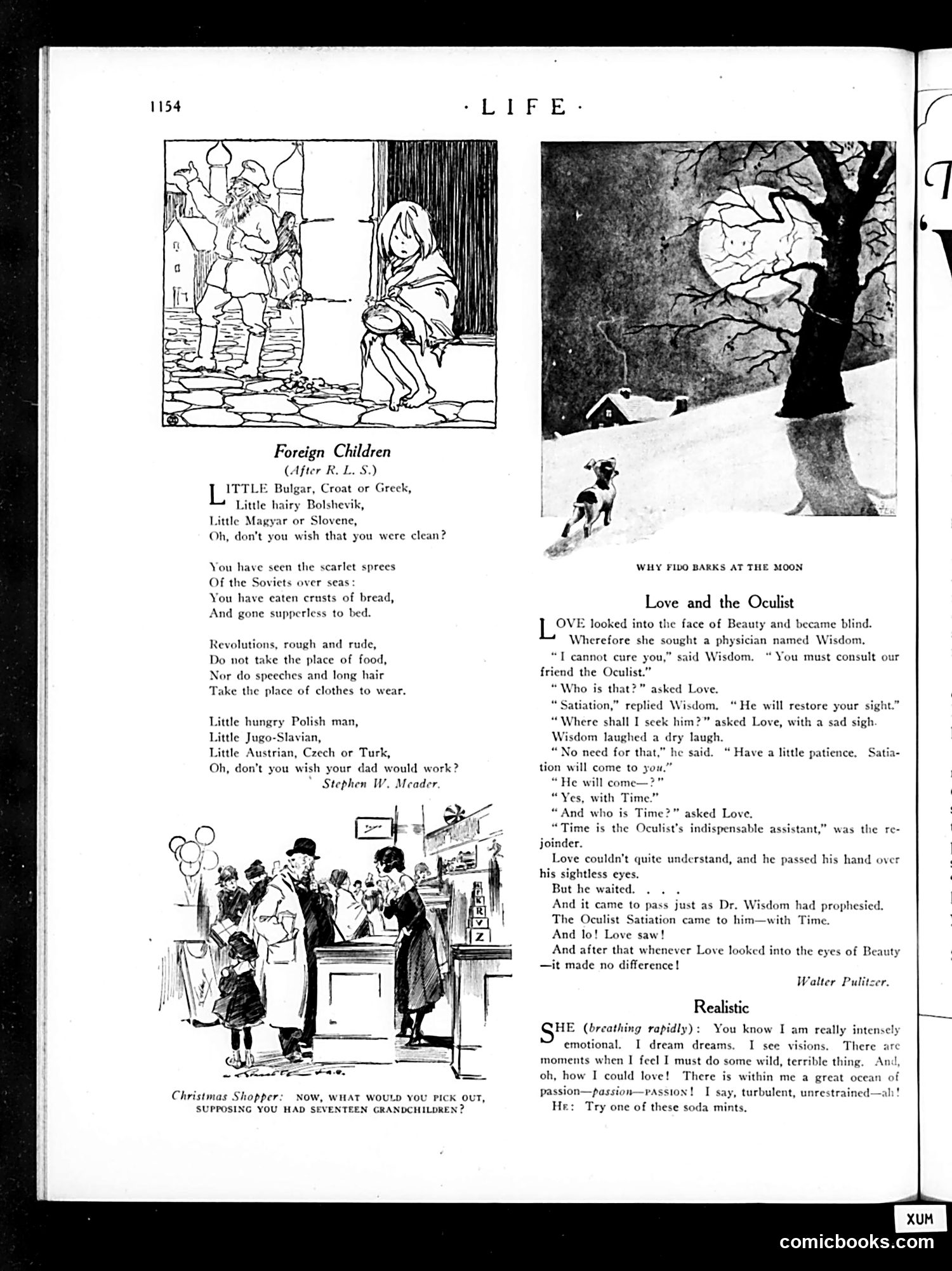
This page contains three distinct pieces of satirical content: **"Foreign Children"** is a poem (after Robert Louis Stevenson) mocking Eastern European peoples—Bulgars, Croats, Greeks, Poles, Yugoslavs, Austrians, Czechs, and Turks—as dirty, hungry, and politically unstable. It associates them with Bolshevism and suggests their poverty stems from revolution rather than practical concerns. This reflects post-WWI American xenophobia toward Eastern Europeans and anti-communist sentiment. **"Love and the Oculist"** is an allegorical fable suggesting that romantic love fades with time and satiation—a cynical commentary on marriage and passion. **"Realistic"** satirizes an overly dramatic woman's performative emotionalism by having a practical man suggest soda mints as a cure, deflating her theatrical passion. The Christmas Shopper cartoon appears to show crowded holiday shopping, likely satirizing consumer excess. The page reflects early 20th-century Life magazine's focus on social commentary and gentle mockery of human behavior and contemporary anxieties.
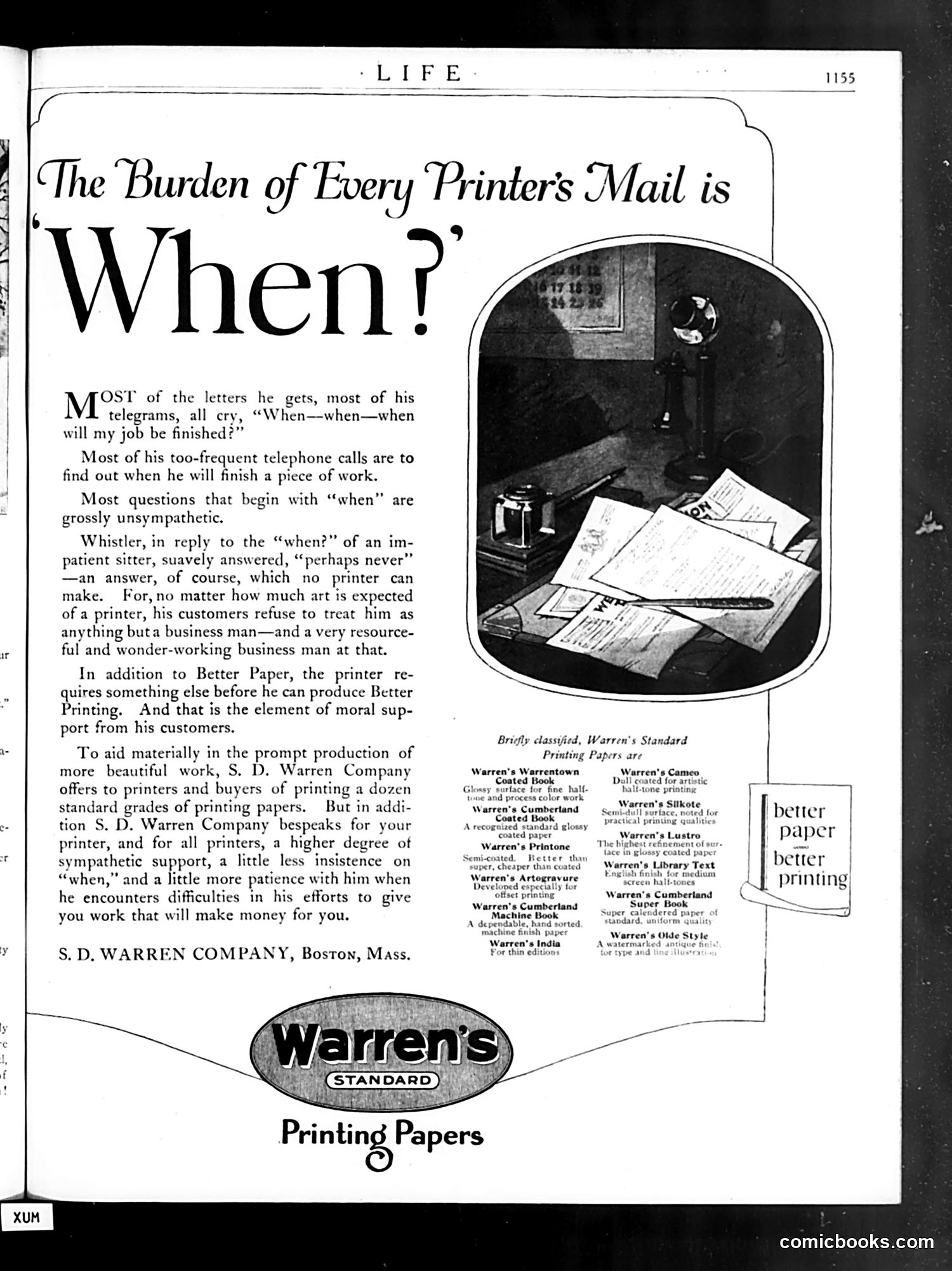
This is primarily a **print advertisement**, not a political cartoon. It's a 1920s-era ad for Warren's Standard Printing Papers, disguised as social commentary. The "joke" targets the universal frustration of commercial printers: customers constantly asking "When will my job be finished?" The text references James McNeill Whistler (the famous artist) who allegedly told an impatient patron "perhaps never"—implying printers face impossible demands for both artistic quality and speed. The advertisement's actual pitch: printers need not just better paper (Warren's products) but also customer patience and "moral support." The ad argues that treating printers as artists rather than mere "business men" will result in better work. The photograph shows a printer's desk with papers and tools, illustrating the cluttered reality of print production. This reflects early 20th-century anxieties about industrial labor, quality control, and the tension between art and commerce in printing trades.
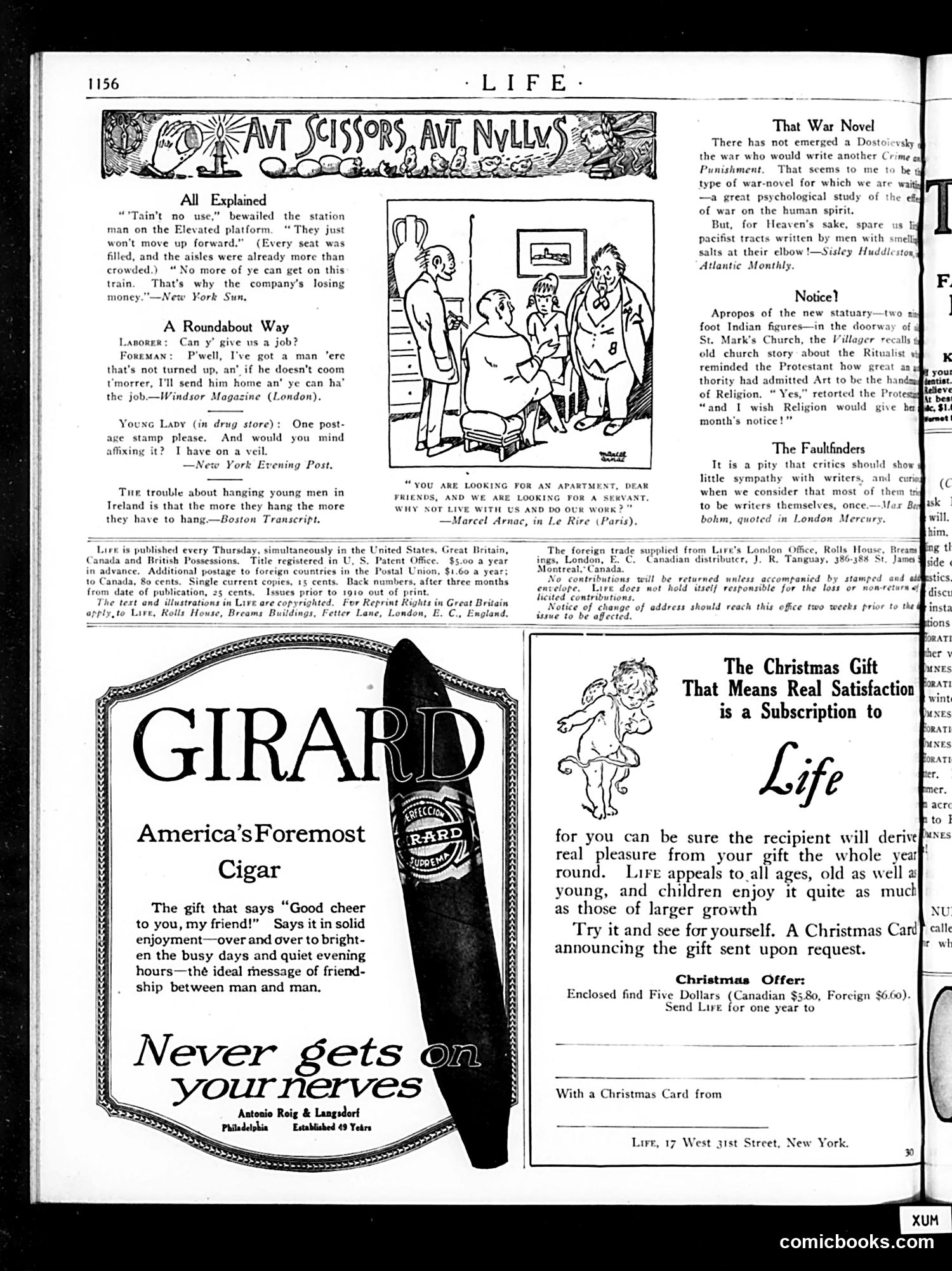
This page from *Life* magazine contains satirical short jokes and advertisements typical of early 20th-century humor. ## The Cartoons/Jokes: **"All Explained"** and **"A Roundabout Way"** are brief workplace humor pieces with no specific political figures—just generic critiques of bureaucracy and labor practices common to the era. **"The Faultfinders"** cartoon (center) depicts a couple offering lodging to apartment-seekers, asking "why not live with us and do our work?" This satirizes exploitative housing arrangements where landlords expected tenants to perform labor in exchange for reduced rent—a common working-class grievance of the period. The short text snippets below mock Irish hanging practices, pacifist war literature, and overzealous art critics—typical *Life* magazine social commentary without reference to specific contemporary figures. ## Advertisements: The Girard cigar ad and Life magazine subscription offer are standard period advertising emphasizing leisure and gift-giving. **Overall:** This is primarily an **advertising-heavy page** with generic satirical humor targeting common social frustrations rather than specific political events or individuals.
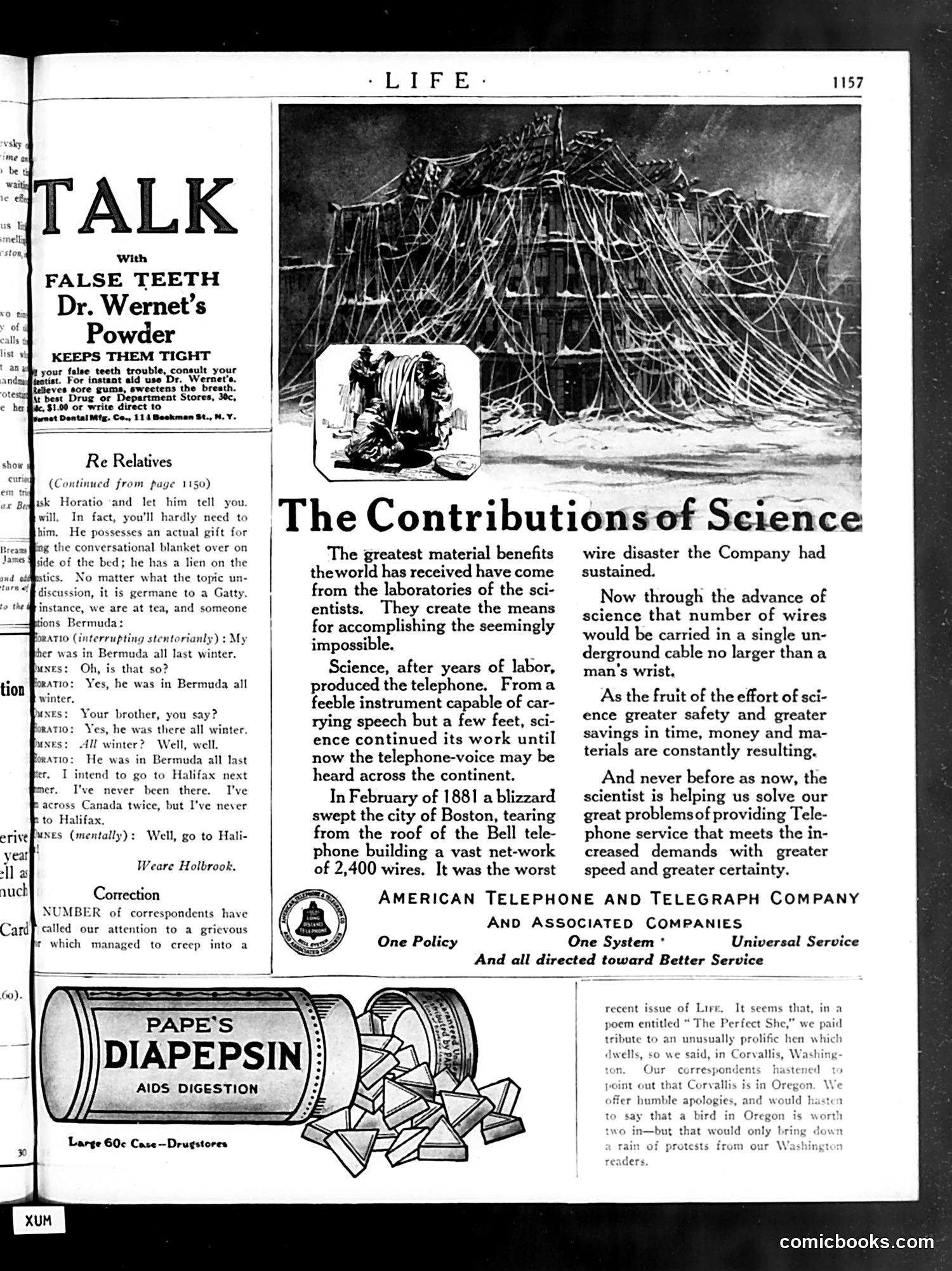
This page is primarily **advertising and corporate content**, not political satire. **The main content** is a lengthy advertisement by American Telephone & Telegraph Company celebrating scientific progress. It uses a dramatic image of a tent-like structure (likely damaged telephone infrastructure) to illustrate a 1881 Boston blizzard that destroyed 2,400 telephone wires. The ad argues that modern science has solved such problems—those same wires could now fit in a single underground cable "no larger than a man's wrist." **Side content includes:** - A brief fictional dialogue about relatives discussing Bermuda (social comedy about tedious conversational habits) - A "Correction" section addressing an error in a previous poem about "The Perfect She" - Advertisements for Dr. Wernet's false teeth powder and Pape's Diapepsin (digestive aid) The page reflects early 20th-century American optimism about technological progress and corporate responsibility, wrapped in consumerist advertising typical of Life magazine's revenue model.
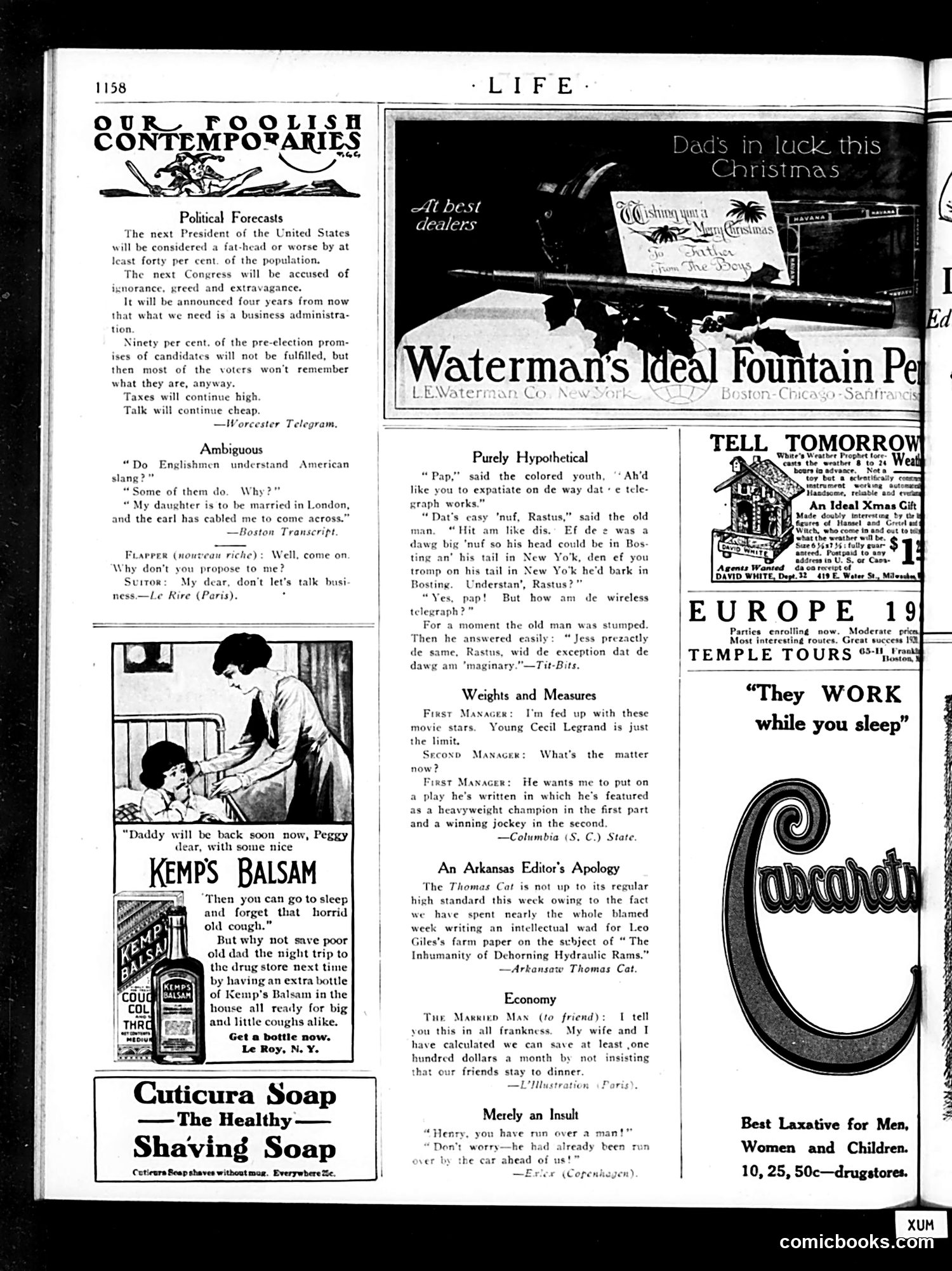
This page from *Life* magazine consists primarily of **satirical commentary and jokes** rather than political cartoons. ## Key Content: **"Political Forecasts"** mockingly predicts that the next U.S. President will be criticized by 40% of the population, Congress will face accusations of greed and incompetence, campaign promises will go unfulfilled, and taxes will remain high. This is cynical commentary on American electoral politics—suggesting that regardless of who wins, disappointment and partisan criticism are inevitable. **Other sections** include brief, genteel humor about: - Anglo-American cultural misunderstandings - A "colored youth" dialect joke about explaining wireless telegraphy (typical period racial stereotyping) - Movie star complaints and marital economics The page is dominated by **period advertisements** (Kemp's Balsam cough medicine, Cuticura Soap, and other products), which was standard for *Life* magazine's business model. The satire targets predictable political cycles and public cynicism rather than specific figures or events.
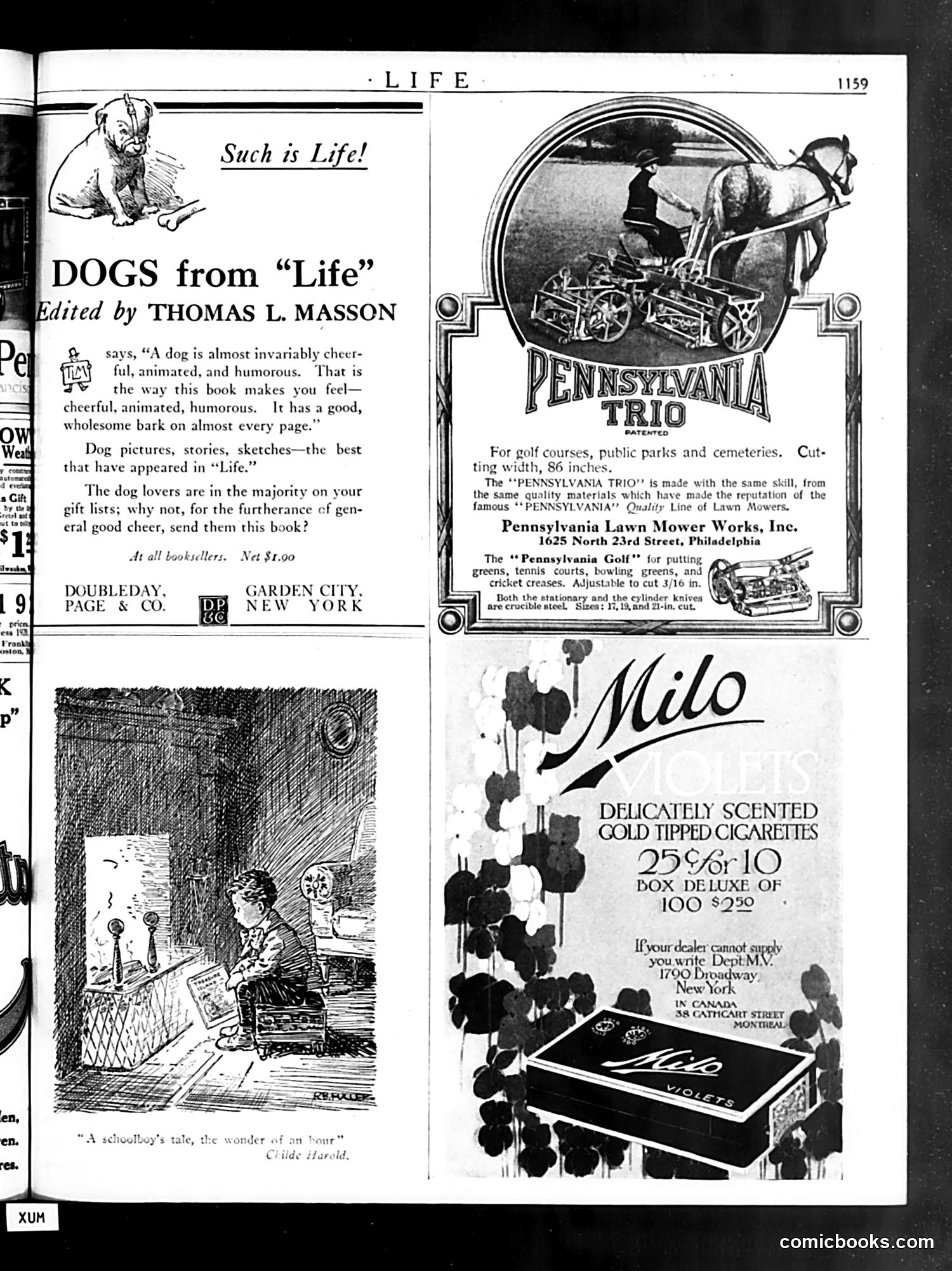
This page is primarily **advertising and promotional content**, not satirical cartoons. The main features are: 1. **"Dogs from Life" book advertisement** (left): Promotes a collection of dog-themed content from Life magazine, edited by Thomas L. Masson. The pitch emphasizes dogs as inherently cheerful subjects suitable for gift-giving. 2. **Pennsylvania Trio lawn mower ad** (top right): Markets a horse-drawn grass-cutting machine for golf courses, parks, and cemeteries—practical industrial equipment typical of early 20th-century advertising. 3. **Milo cigarettes ad** (bottom right): Promotes "delicately scented gold-tipped cigarettes" at 25¢ for 10 or $2.50 per box of 100—standard luxury tobacco advertising of the era. 4. **Illustration** (lower left): A sketch captioned "A schoolboy's tale; the wonder of an hour," appears to be sample content from the dog book. The page reflects commercial Life magazine content and early-1900s consumer products rather than political satire.
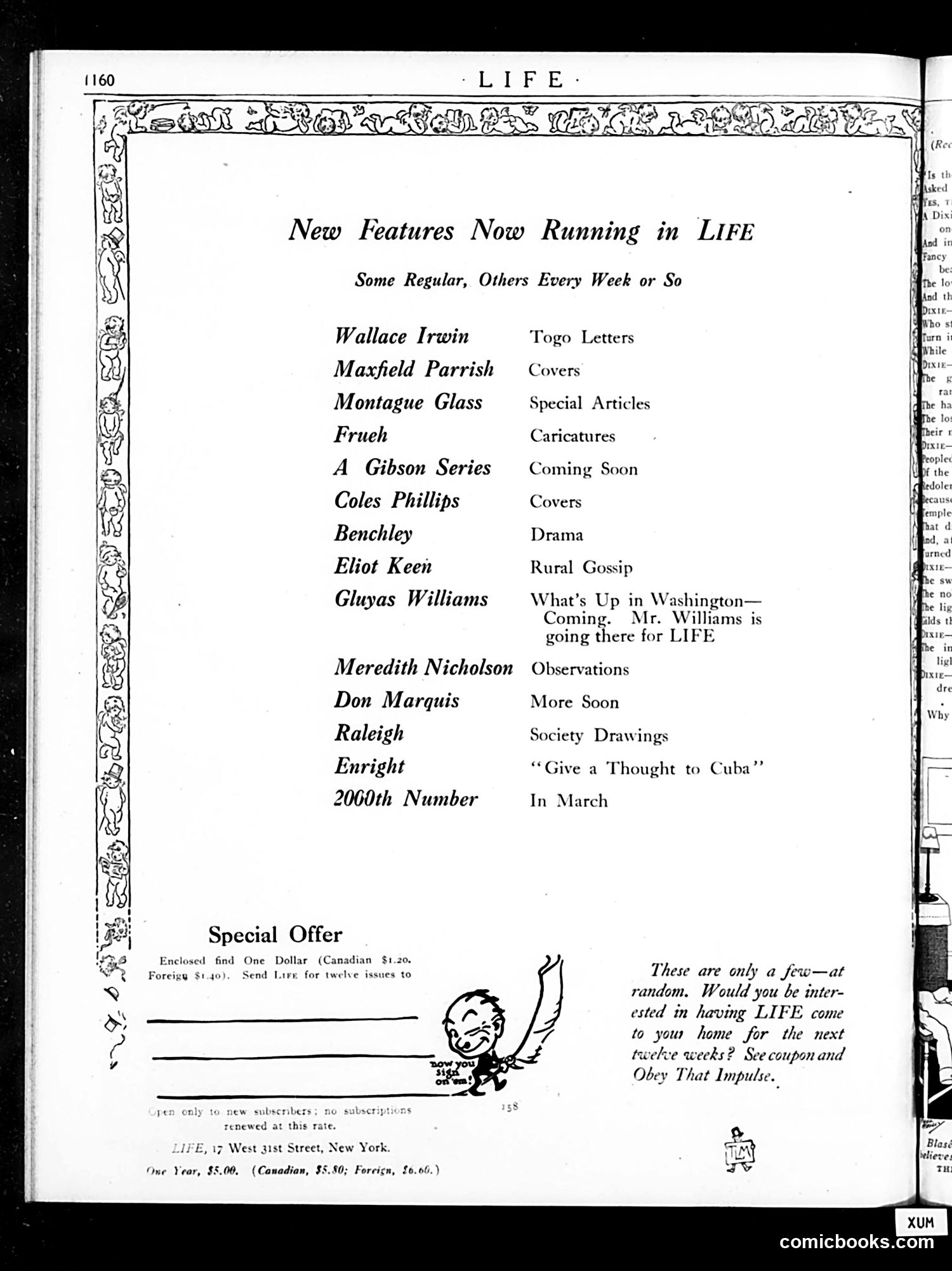
This is primarily a **promotional page** announcing new content and features coming to *Life* magazine. Rather than containing political cartoons, it's an advertisement showcasing the magazine's contributors and upcoming series. Key elements include: **Notable contributors listed**: Wallace Irwin (humor columnist), Maxfield Parrish (cover artist), Frueh (caricaturist), and Don Marquis (humorist) — all prominent early-20th-century writers and artists. **Content highlights**: "Togo Letters," rural gossip columns, Washington observations, and society drawings reflect *Life's* mix of humor, social commentary, and cultural coverage. **The small cartoon**: Shows an excited figure, likely representing the magazine's appeal or an impulse to subscribe. **"Give a Thought to Cuba"** by Enright suggests the magazine addressed contemporary foreign policy issues, though details are unclear. The subscription offer ($1 for twelve issues) and tagline "Obey That Impulse" use period advertising language to encourage readers to subscribe.
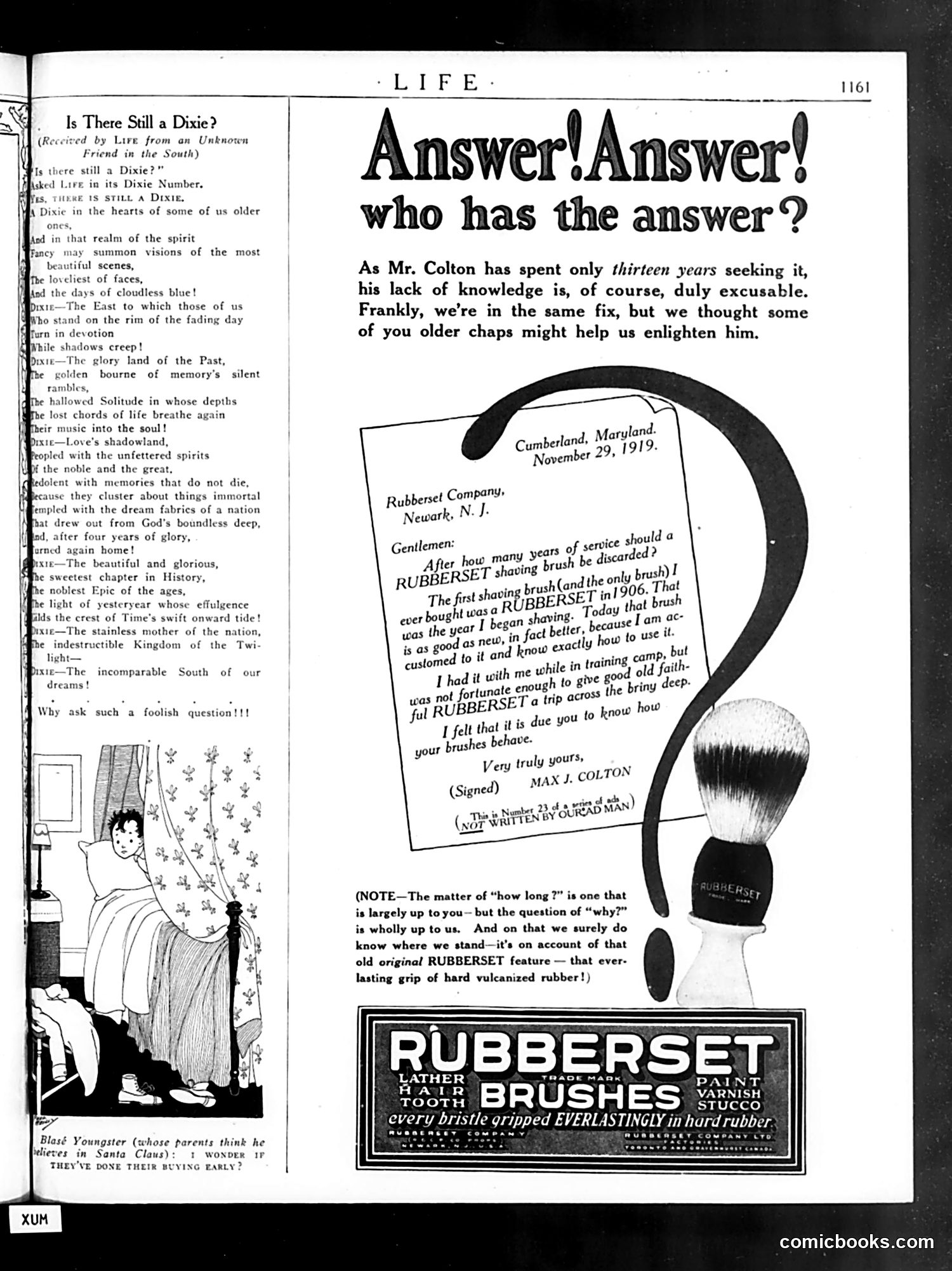
This page contains two distinct elements: **Left side:** A sentimental poem titled "Is There Still a Dixie?" celebrating the American South in nostalgic, romanticized language—evoking "the glory land of the Past" and "memories that do not die." This appears to be genuine nostalgic verse, possibly sent to Life magazine by a Southern reader. **Right side:** An advertisement for Rubberset brushes disguised as reader correspondence. A man named Max J. Colton writes to the company claiming he's spent thirteen years trying to determine how long a Rubberset brush lasts. The magazine's note beneath admits this is promotional material, joking that while "how long?" is the customer's question, "why?" is Life's—and they answer: because Rubberset brushes have superior vulcanized rubber grips. The satire is gentle: Life is mocking both the overwrought sentimentality of Southern nostalgia *and* advertising's attempt to masquerade as authentic reader mail. The juxtaposition highlights early 20th-century marketing tactics and regional romanticism.
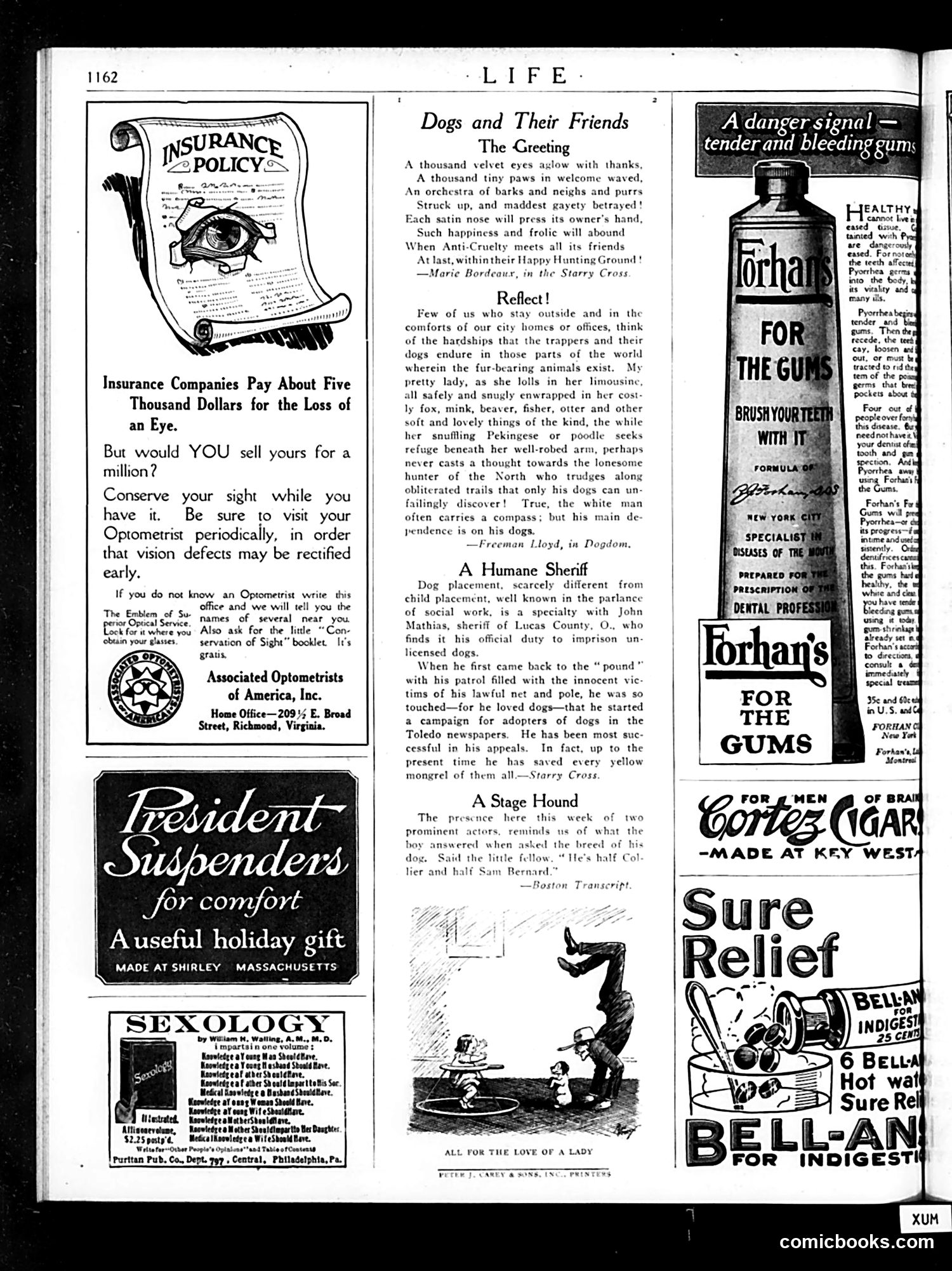
This page mixes **public service advocacy with period advertisements**. The main content includes: **"Dogs and Their Friends"** — sentimental poetry and prose celebrating dogs' loyalty and usefulness, particularly highlighting a sheriff (John Mathias of Lucas County, Ohio) who rescues impounded dogs by finding them adoptive homes through newspaper campaigns. The piece reflects early 20th-century sentimentality about animal welfare. **Social commentary** appears in "Reflect!" — contrasting wealthy urban women in furs and limousines with Northern trappers and sled dogs enduring harsh conditions, implying hypocrisy about animal suffering. **The cartoon** ("All for the Love of a Lady") shows a stage hound, referencing visiting stage actresses and their dog breeds—a light celebrity culture joke. **Advertisements** occupy significant space: optometry services, tooth/gum products (Forhan's), cigars, and patent medicines—typical period advertising claiming health benefits. The page reflects **1910s-1920s concerns**: animal welfare activism, celebrity culture, and aggressive patent medicine marketing before FDA regulation.
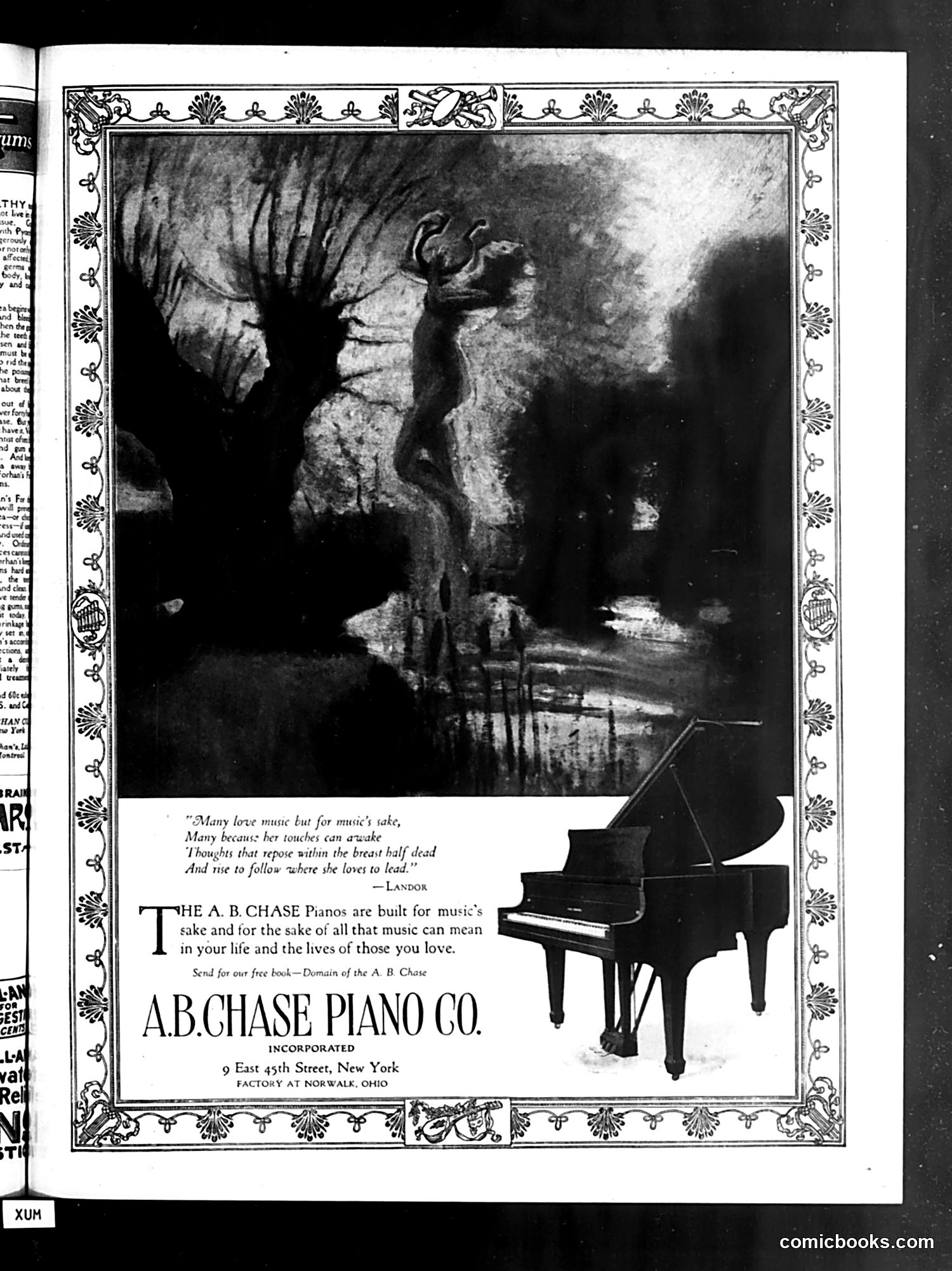
This is primarily a **piano company advertisement**, not a political cartoon. The page features a romantic, atmospheric illustration of a woman at a piano with a man gazing at her, meant to evoke emotional connection and artistic refinement. The ad uses a Landor poetry quote about music's power to awaken deep feelings and inspire devotion. The marketing message associates A.B. Chase pianos with emotional intimacy, suggesting that owning their instrument will enrich personal relationships and "music's sake." This reflects early 20th-century advertising that marketed luxury goods through sentimentality and aspiration rather than technical specifications. The elegant border design and artistic imagery were typical of *Life* magazine's upscale advertising content aimed at middle and upper-class readers.
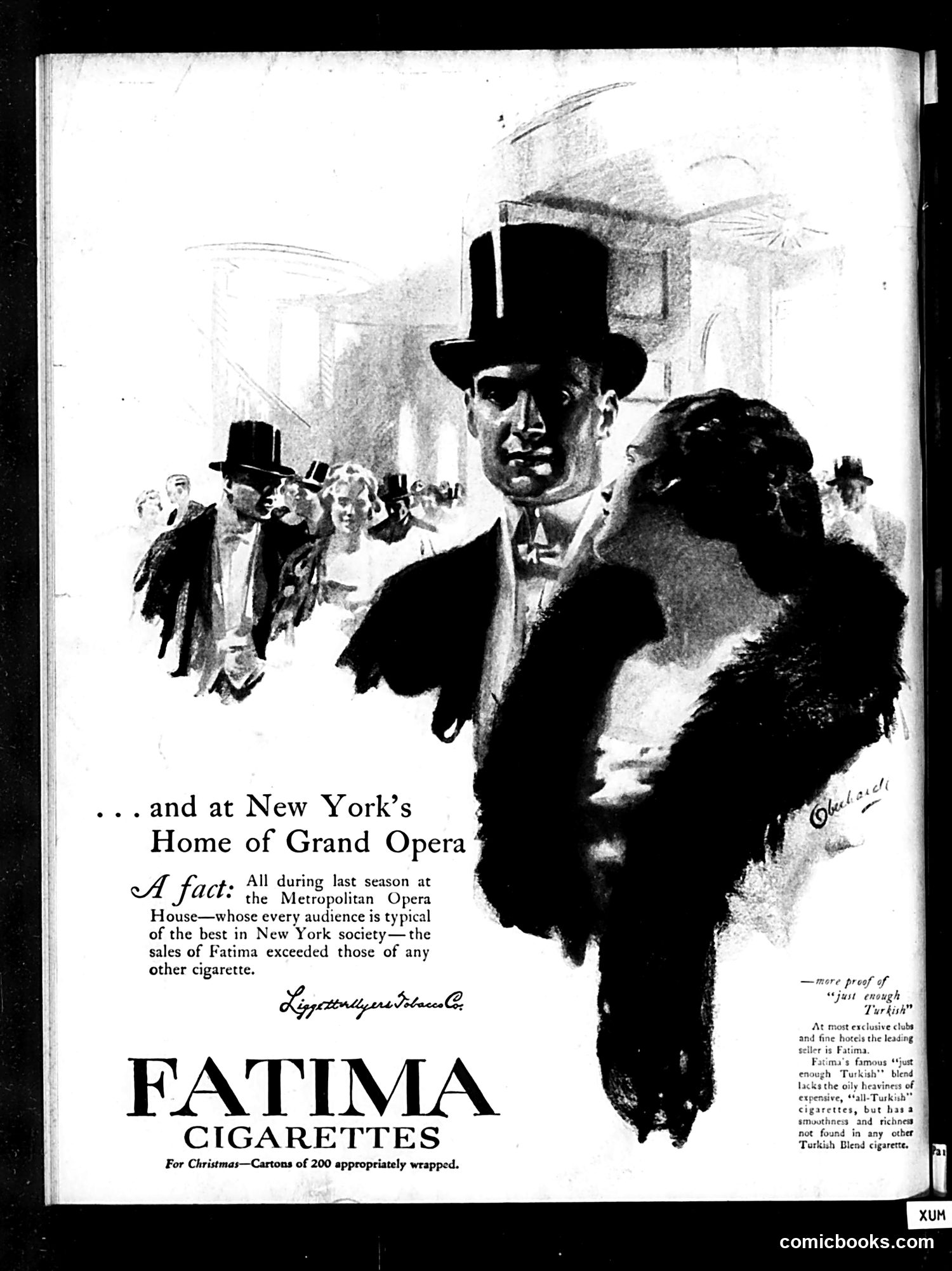
This is primarily a **cigarette advertisement**, not political satire. The image shows well-dressed opera-goers in top hats and formal attire outside New York's Metropolitan Opera House, establishing an association between Fatima cigarettes and high society. The "joke" or selling point: the ad claims that during the previous opera season, Fatima cigarettes outsold all competitors among the Metropolitan Opera's elite audiences. This attempts to position the brand as the cigarette of choice for wealthy, cultured New Yorkers. The text emphasizes Fatima's "Turkish blend," marketing it as superior to other Turkish cigarettes for its richness and lack of "oily heaviness." **Historical context**: This represents early 20th-century advertising strategy—using class association and aspirational imagery to sell products. There is no political commentary; the opera setting simply signals sophistication and wealth to potential buyers.
I can see this is a page from Life magazine, but the image is almost entirely black or blank, making it impossible to discern any cartoon content, caricatures, text, or satirical elements. The only visible elements are: - A white margin on the left side with some partially visible text fragments - A watermark reading "comicbooks.com" at the bottom right - Reference number "XUM" at the bottom left Without being able to see the actual cartoon or readable text content, I cannot identify the figures, political references, or explain the satire as requested. The page would need to be reproduced with better clarity or contrast to analyze its historical and satirical meaning.