
Life, 1920-12-16 · page 18 of 45
Life — December 16, 1920 — page 18: what you’re looking at
What you’re looking at
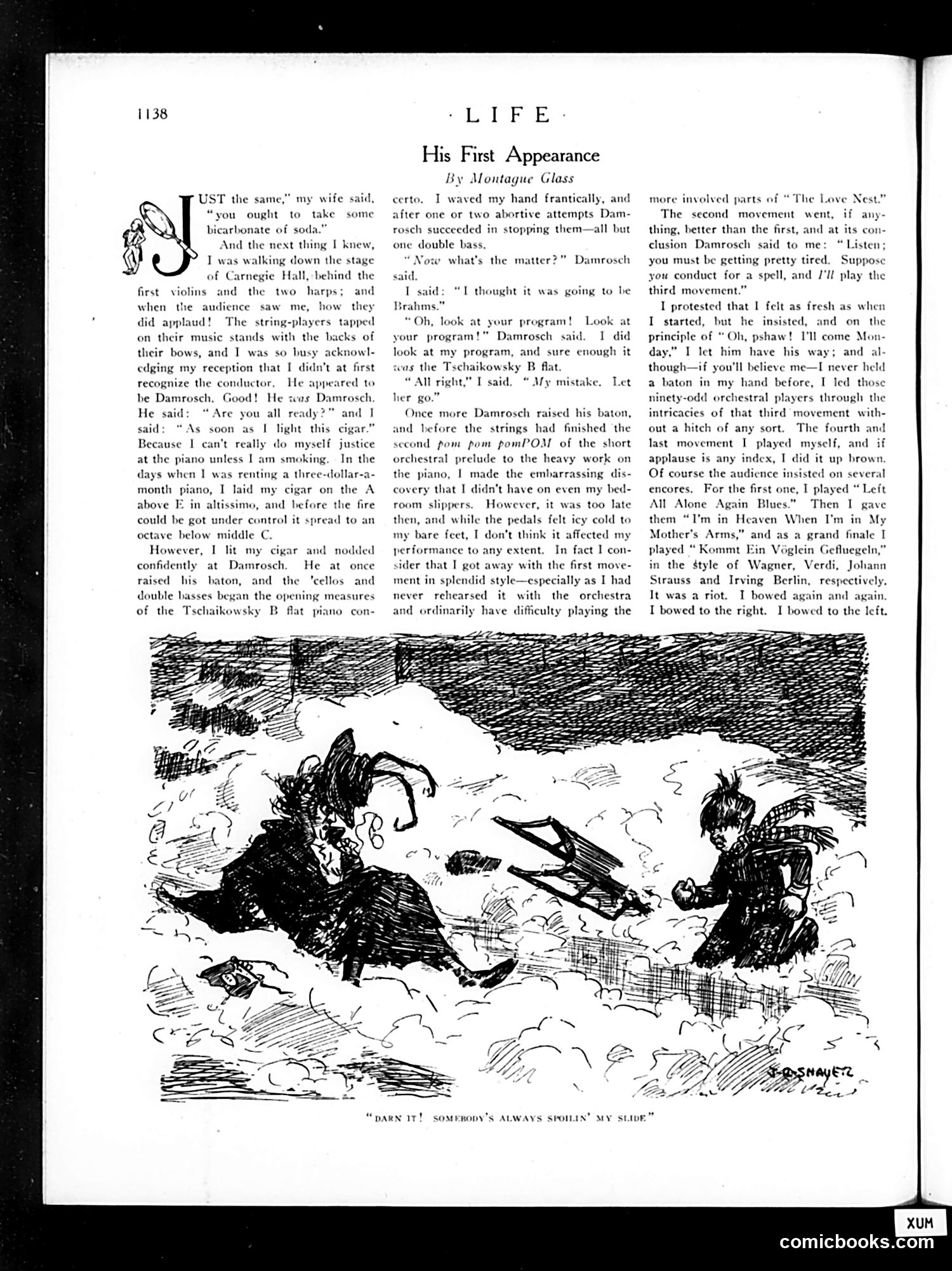
This humorous short story describes a narrator's chaotic Carnegie Hall debut as a piano soloist with conductor Leopold Damrosch. The accompanying illustration shows someone sledding—a visual pun on the narrator's final line about someone "spoiling my slide." The satire targets social pretension and artistic mishaps: the narrator is unprepared (lacking slippers, confused about the program), yet remains obliviously confident. Damrosch represents the dignified maestro dealing with incompetence. The joke hinges on the narrator's self-delusion—he believes his bumbling performance was a triumph, citing audience applause that likely resulted from novelty or amusement rather than genuine musical merit. The story mocks concert-hall pretension and the gap between self-perception and reality, typical of *Life* magazine's early-20th-century satirical approach to cultural institutions.
📄 Transcribed text from this page (OCR, searchable)
Machine-transcribed from the original scan — historical spelling and the odd misread are preserved.
UST the sam “you my wife said, take bicarbonate of soda.” And the next thing I knew, ought — te some I was walking down the stage of Carnegie Hall, behind the and they first violins and the two harps; udience saw when the me, how did applaud! The string-players tapped on their music stands with the backs of their bows, and I was so busy acknowl- cdging my reception that I didn’t at first recognize the conductor, be Damrosch, Good! He was Damrosch He said: and J “As light this cigar.” Because I can't really do myself justice at the piano unless | am smoking, In the days when 1 was renting a three-dollar-a- month piano, I laid my cigar on the A above E nd before the fire He appeared to “Are you all ready said soon as I in altissimo, could be got under control it spread to an octave below middle C. However, I lit my confidently at Damrosch. He at and the cigar and nodded once raised his baton, ‘cellos and double basses began the opening mi of the Tschaikowsky B ures at piano con- “DaRN It! “LIFE His First Appearance By Montague Glass certo. I waved my hand frantically, and after one or two abortive attempts Dam- rosch succeeded in stopping them—all but one double bass, “Now what's the matter?” Damrosch said: “I thought it was going to be alms.” Oh, look at your progra Look at your program!” Damrosch said. I did look at my program, and sure enough it was the Tschaikowsky B flat “All right,” Is her go.” “My mistake. Let Once more Damrosch raised his baton, and before the strings had finished the second pom pom pomPOM of the short orchestral prelude to the heavy work on the piano, | made the embarrassing dis- covery that I didn’t have on even my bed- room slippers. However, it was too late and while the pedals felt icy are feet, I don’t think it aff performance to any extent. In fact I con- sider that I got away with the first move- ment in splendid style—especially as I had rehearsed it with the orchestra and ordinarily have difficulty playing the cold to ed my never The Love Nest movement more involved parts of The thing, better than the first, and at its co! clusion Damrosch said to me: “ Listen; you must be getting pretty tired. Suppose you conduct for a spell, and /’ll play the third movement.” second went, if ai I protested that I felt as fresh as when I started, but he principle of “Oh, pshaw! I'll come Mon- day,” I let him have his way; and al- though—if you'll believe me—I never held a baton in my hand before, I led those ninety-odd orchestral players through the insisted, and on the intricacies of that third movement with- out a hitch of any sort. The fourth ar last movement I played myself, and if applause is any index, I did it up brown. Of course the audience insisted on several encores, For the first one, I played “Left All Alone Again Blues.” hen I gave them “I'm in Heaven When I'm in My Mother's Arms,” played “ Kommt Ein Véglein Gefluegeln,” in the style of Wagner, Verdi, Johann Strauss and Irving Berlin, respecti It was a riot. I bowed again and 3 I bowed to the right. I bowed to the le and as a grand finale I SOMEBODY'S ALWAYS SPOILIN’ MY SLIDE" comicbooks.com