
Life, 1920-12-16 · page 19 of 45
Life — December 16, 1920 — page 19: what you’re looking at
What you’re looking at
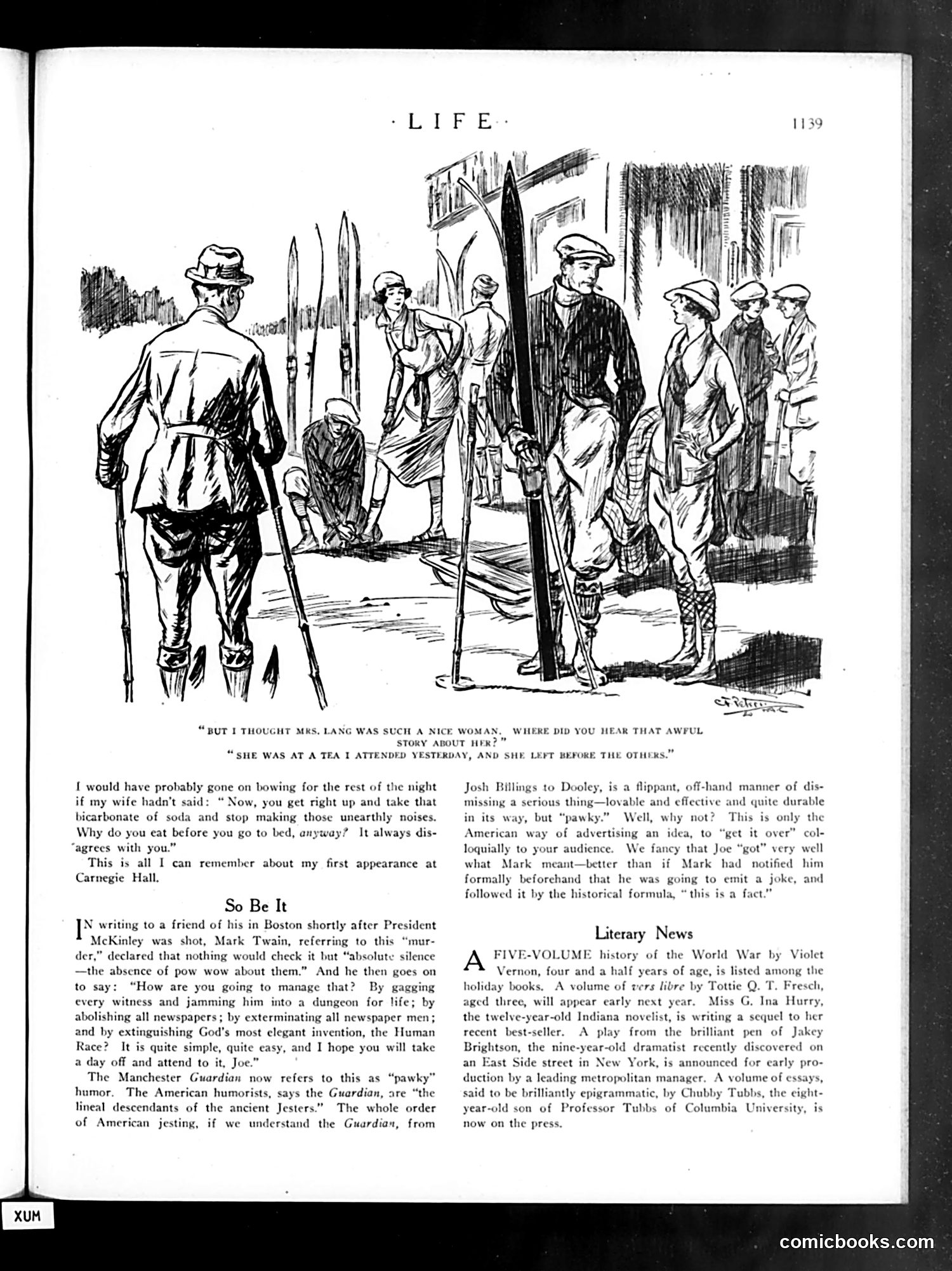
The top cartoon satirizes social gossip and rumor-mongering. A woman's reputation is damaged by mere absence—she left a tea party early, and this alone becomes "an awful story" circulating among society women. The joke exposes how flimsy the basis for scandal can be, and how women's social standing depends on arbitrary, trivial behaviors observed at social gatherings. The page's main text discusses Mark Twain's dark humor about President McKinley's assassination, contrasting American and British views of comedy. Twain advocated "absolute silence" about the murder—a deliberately absurd exaggeration meant to mock those demanding censorship of political discussion. The *Manchester Guardian* labels this distinctly American style "pawky" (slyly humorous) humor: colloquial, indirect, dismissive of serious matters through flippant wit rather than formal pronouncement. The "Literary News" section appears to be satirical filler, humorously announcing books by improbably young authors (a three-year-old poet, nine-year-old dramatist), likely mocking literary publishing trends.
📄 Transcribed text from this page (OCR, searchable)
Machine-transcribed from the original scan — historical spelling and the odd misread are preserved.
“BUT I THOUGHT MRS, LANG WAS SUCH A NICE WOMAN, Vg 1} ip Neal j \ H i by WHERE DID YOU HEAR THAT AWFUL STORY ABOUT HER? “SHE WAS AT A TEA I ATTENDED YESTERDAY, AND SHE LEFT BEFORE THE OTHERS.” { would have probably gone on bowing for the rest of the night if my wife hadn't said: “ Now, you get right up and take that bicarbonate of soda and stop making those unearthly noises. Why do you eat before you go to bed, anyway? It always dis- “agrees with you.” This is all I can remember about my first appearance at Carnegie Hall. So Be It 1X writing to a friend of his in Boston shortly after President McKinley was shot, Mark Twain, referring to this “mur- der,” declared that nothing would check it but “absolute silence —the absence of pow wow about them.” And he then goes on to say: “How are you going to manage that? By g: ing every witness and jamming him into a dungeon for life; by abolishing all newspapers; by exterminating all newspaper men; and by extinguishing God's most elegant invention, the Human Race? It is quite simple, quite easy, and I hope you will take a day off and attend to it, Joe.” The Manchester Guardian now refers to this as “pawky” humor. The American humorists, says the Guardian, are “the lineal descendants of the ancient Jesters.” The whole order of American jesting, if we understand the Guardian, from Josh Billings to Dooley, is a flippant, off-hand manner of dis- missing a serious thing—lovable and effective and quite durable in its way, but “pawky.” Well, why not? American way of advertising an idea, to “get it over” col- loquially to your audience. We fancy that Joe “got” very well what Mark meant—better than if Mark had notified him formally beforehand that he was going to emit a joke, and followed it by the historical formula, “this is a fact.” This is only the Literary News FIVE-VOLUME history of the World War by Violet Vernon, four and a half years of is listed among the holiday books, A volume of vers libre by Tottie Q. T. Fresch, aged three, will appear early next year. Miss G. Ina Hurry, the twelve-year-old Indiana novelist, is writing a sequel to her recent best-seller. A play from the brilliant pen of Jakey Brightson, the nine-year-old dramatist recently discovered on ew York, is announced for early pro- A volume an East Side street in duction by a leading metropolitan manager. said to be brilliantly epigrammatic, by Chubby Tubbs, the eight- year-old son of Professor Tubbs of Columbia University, is now on the press. comicbooks.com