
Life, 1920-12-16 · page 15 of 45
Life — December 16, 1920 — page 15: what you’re looking at
What you’re looking at
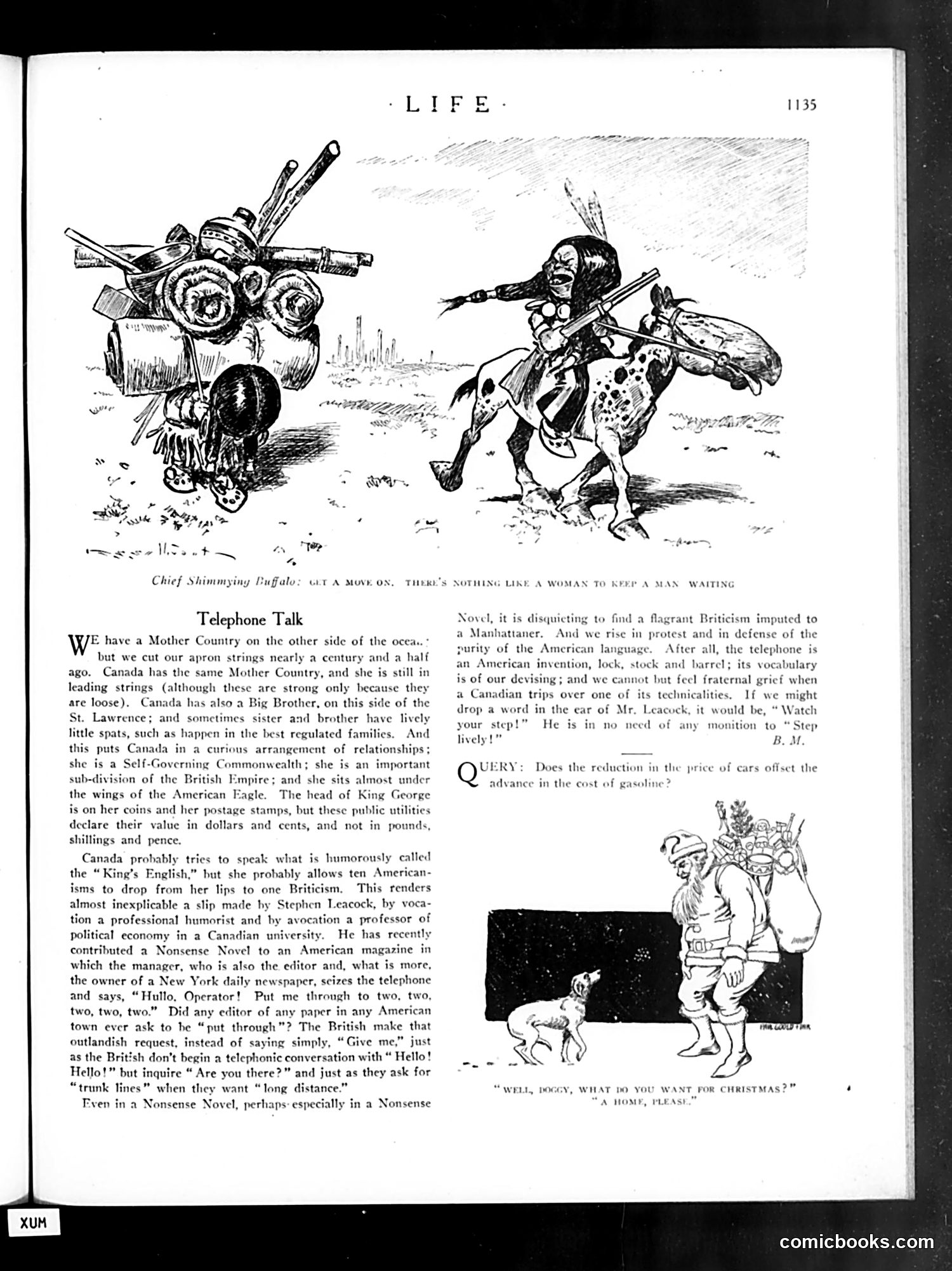
The top cartoon depicts a Native American chief on horseback fleeing from what appears to be military weaponry or industrial machinery in the background—likely satirizing the historical displacement of Indigenous peoples by American technological progress and westward expansion. The main article, "Telephone Talk," humorously critiques Canadian linguistic and cultural differences from Americans. The author mock-complains about Canadians' British English expressions and their formality on telephones (saying "Hello!" repeatedly rather than getting to business). The piece presents this as quaint colonial affectation, embodying American satirical superiority toward their northern neighbor's British cultural ties. The lower cartoon shows civilians discussing Christmas gifts, with the caption "Well, Ducky, What Do You Want for Christmas? 'At Home, Please'"—apparently commenting on wartime separation or economic hardship.
📄 Transcribed text from this page (OCR, searchable)
Machine-transcribed from the original scan — historical spelling and the odd misread are preserved.
+ % a ies Aw, Wsite > > tec cee ITs tA Chief Shimmying Buffalo: ovr a sove ox, THeK’s Telephone Talk E have a Mother Country on the other side of the ocea.* but we cut our apron strings nearly a century and a half ago. Canada has the same Mother Country, and she is still in leading strings (although these are strong only because they are loose), Canada has also a Big Brother, on this side of the St. Lawrence; and sometimes sister and brother have lively little spats, such as happen in the best regulated families. And this puts Canada in a curious arrangement of relationships; she is a Self-Governing Commonwealth; she is an important sub-division of the British Empire; and she sits almost under the wings of the American Eagle. The head of King George is on her coins and her postage stamps, but these public utilities declare their value in dollars and cents, and not in pounds, shillings and pence, Canada probably tries to speak what is humorously called the “King’s English,” but she probably allows ten Ameri isms to drop from her lips to one Briticism. This renders almost inexplicable a slip made hy Stephen Leacock, by voca- tion a professional humorist and by avocation a professor of political economy in a Canadian university. He has recently contributed a Nonsense Novel to an American magazine in which the manager, who is also the editor and, what is more, the owner of a New York daily newspaper, seizes the telephone and says, “Hullo, Operator! Put me through to two, two, two, two, two.” Did any editor of any paper in any American town ever ask to he “put through”? The British make that outlandish request, instead of saying simply, “Give me,” just as the Brit!sh don’t begin a telephonic conversation with “ Hello! Hello!” but inquire “ Are you there?” and just as they ask for “trunk lines” when they want “long distance.” Even ina Nonsense Novel, perhaps: especially in a Nonsense NOTHING LIKE A WOMAN TO KEEP A MAN WAITING Novel, it is disquieting te a Manhattane: find a flagrant Br sm imputed to And we rise in test and in defense of the purity of the American After all, the telephone is an American inventios guage. ck, is of our devising ; and we car ck and barrel; its vocabulary ot but feel fraternal grief when a Canadian trips over one of its technicalities. If we might drop a word in the ear of Mr. Leacock, it would be, * Watch your step!” He is lively!” in no need of any monition to “ Step B.M. UERY: advance in the co: Does the reduction in the © of cars offset the WANT POR CHRISTMAS?" PLEAS.” “WELL, DOGGY, WHAT po You “A HOME, comicbooks.com