
Life, 1920-12-16 · page 21 of 45
Life — December 16, 1920 — page 21: what you’re looking at
What you’re looking at
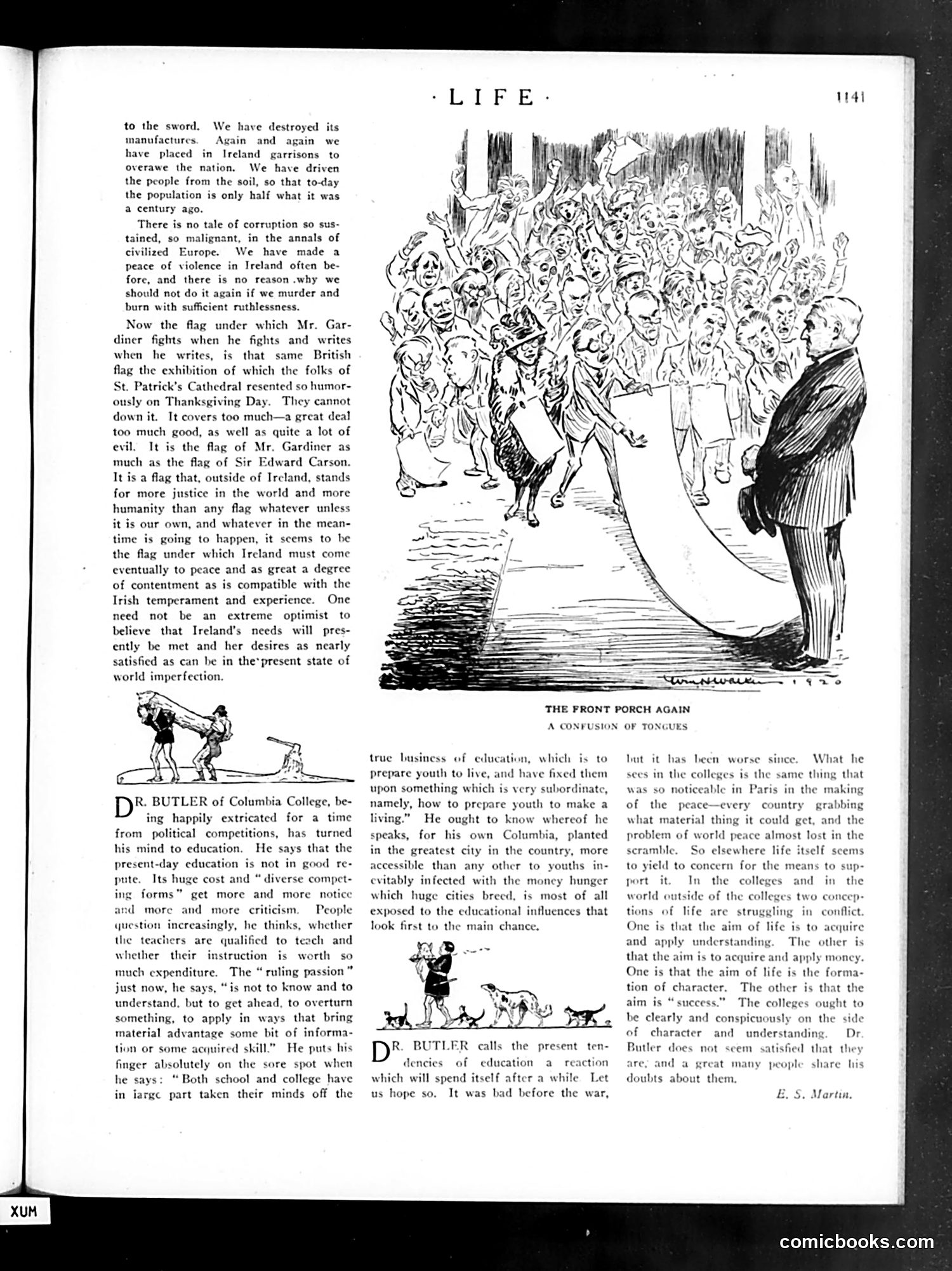
This page critiques Irish nationalism and education during the early 20th century. The main cartoon depicts a man (likely representing a British official or unionist) addressing a crowd of Irish people with raised fists and animated expressions—suggesting nationalist fervor or protest. The text discusses Irish independence, referencing Mr. Gardiner and Sir Edward Carson (likely figures in the Home Rule debate), and criticizes British colonial policy's devastation of Ireland. It condemns the contradiction of fighting under the British flag while Irish nationalism grows. The secondary article by Dr. Butler of Columbia College critiques American education, arguing that schools prioritize teaching students "how to make a living" over "how to live"—focusing on material gain rather than character formation. This reflects broader early-20th-century anxiety about education's purpose amid rapid industrialization and social change.
📄 Transcribed text from this page (OCR, searchable)
Machine-transcribed from the original scan — historical spelling and the odd misread are preserved.
to the sword. We have destroyed its manufactures. Again and again we have placed in Ireland garrisons to overawe the nation. We have driven the people from the soil, so that to-day the population is only half what it was a century ago. There is no tale of corruption so sus- tained, so malignant, in the annals of civilized Europe. We have made a peace of violence in Ireland often be- fore, and there is no reason.why we should not do it again if we murder and burn with sufficient ruthlessness. Now the flag under which Mr. Gar- diner fights when he fights and writes when he that same British flag the exhibition of which the folks of St. Patrick’s Cathedral resented so humor- ously on Thanksgiving Day. They cannot down it. It covers too much—a great deal too much good, as well as quite a lot of evil. It is the flag of Mr, Gardiner as much as the flag of Sir Edward Carson. It is a flag that, outside of Ircland, stands for more justice in the world and more humanity than any flag whatever unless it is our own, and whatever in the mean- time is going to happen, it seems to he the flag under which Ireland must come eventually to peace and as great a degree of contentment as is compatible with the Irish temperament and experience. One need not be an extreme optimist to believe that Ireland’s needs will pres- ently be met and her desires as nearly satisfied as can be in the*present state of world imperfection. writes, is R. BUTLER of Columbia College, be- ing happily extricated for a time from political competitions, has turned his mind to education. He says that the present-day education is not in good re- pute. Its huge cost and “diverse comp ing forms” get more and and criticism. People question increasingly, he thinks, whether the teach whether more notice more and more s are qualified to teach and their instruction is worth so much expenditure. The “ ruling passion just now, he says, “is not to know and to understand, but to get ahead, to overturn something, to apply in ways that bring material advantage some bit of informa- tion or some acquired skill.” He puts his finger absolutely on the sore spot when he says: “Both school and college have in large part taken their minds off the FOP YA. THE FRONT PORCH AGAIN A CONFUSION OF TONGUES true business of education, which is to prepare youth to live, and have fixed them upon something which is very subordinate, namely, how to prepare youth to make a living. He ought to know whereof he speaks, for his own Columbia, planted in the greatest city in the country, more accessible than a cvitably infected with the money hunger which huge cities breed, is most of all exposed to the educational influences that look first to the main chance, other to youths in- calls the present ten- D*® BUTLER 1 ncies of education a reaction which will spend itself after a while Let us hope so. It was bad before the war, What he sees in the colleges is the same thing that in Paris in the making but it has been worse since, was so noticeable of the country grabbing what material thing it could get, and the peace—every problem of world peace almost lost in the scramble. So elsewhere life itself seems to yield to concern for the means to sup- port it. In the colleges and in the world outside of the colleges two concep- tions of life are conflict. One is that the aim of I quire ling in cis t The that the aim is to acquire and apply money. One is that the aim of life is the forma- tion of ch; The other is that the aim is The colleges ought to be clearly and conspicuously on the side of character strug and apply understanding her is eter. “ success.” understanding Dr Butler does not seem satisfied that they and and a great many people share his ibts about them, . Martin. comicbooks.com