
Life, 1920-12-16 · page 34 of 45
Life — December 16, 1920 — page 34: what you’re looking at
What you’re looking at
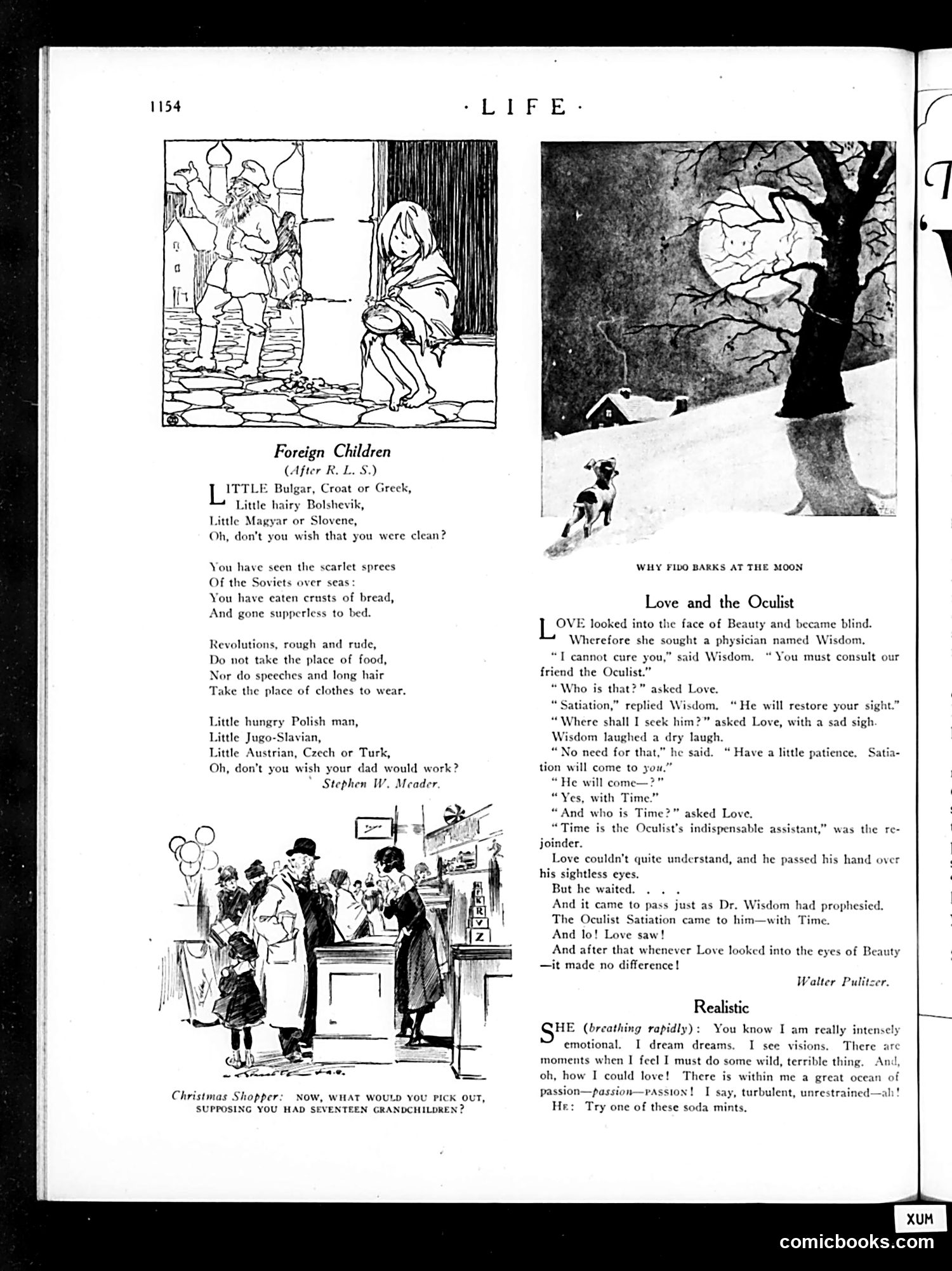
This page contains three distinct pieces of satirical content: **"Foreign Children"** is a poem (after Robert Louis Stevenson) mocking Eastern European peoples—Bulgars, Croats, Greeks, Poles, Yugoslavs, Austrians, Czechs, and Turks—as dirty, hungry, and politically unstable. It associates them with Bolshevism and suggests their poverty stems from revolution rather than practical concerns. This reflects post-WWI American xenophobia toward Eastern Europeans and anti-communist sentiment. **"Love and the Oculist"** is an allegorical fable suggesting that romantic love fades with time and satiation—a cynical commentary on marriage and passion. **"Realistic"** satirizes an overly dramatic woman's performative emotionalism by having a practical man suggest soda mints as a cure, deflating her theatrical passion. The Christmas Shopper cartoon appears to show crowded holiday shopping, likely satirizing consumer excess. The page reflects early 20th-century Life magazine's focus on social commentary and gentle mockery of human behavior and contemporary anxieties.
📄 Transcribed text from this page (OCR, searchable)
Machine-transcribed from the original scan — historical spelling and the odd misread are preserved.
i WW th i t Foreign Children (After R.L. S.) ITTLE Bulgar, Croat or Greck, Little hairy Bolshevik, Little Magyar or Slovene, Oh, don’t you wish that you were clean? You have seen the scarlet sprees Of the Soviets over seas: You have eaten crusts of bread, And gone supperless to bed. Revolutions, rough and rude, Do not take the place of food, Nor do speeches and long hair Take the place of clothes to wear. Little hungry Polish man, Little Jugo-Slavian, Little Austrian, Czech or Turk, Oh, don't you wish your dad would work? Stephen W. Meader WHY FIDO BARKS AT THE MOON Love and the Oculist OVE looked into the face of Beauty and became blind. Wherefore she sought a physician named Wisdom, “T cannot cure you,” said Wisdom. “You must consult our friend the Oculist.” “Who is that?” asked Love. atiation,” replied Wisdom, “He will restore your sight.” “Where shall I seek him?” asked Love, with a sad sigh Wisdom laughed a dry laugh. “No need for that,” he said. “ Have a little patience, Satia- tion will come to you,” “He will come—?"” “Yes, with Time “And who is Time?” asked Love. “Time is the Oculist’s indispensable assistant,” was the re- joinder. Love couldn't quite understand, and he passed his hand over his sightless eyes. But he waited. And it came to pass just as Dr. Wisdom had prophesied. The Oculist Satiation came to him—with Time. And lo! Love saw! And after that whenever Love looked into the eyes of Beauty —it made no difference! Walter Pulitzer. Realistic SHE (breathing rapidly): You know I am really intensely emotional. I dream dreams. I see visions. There are moments when I feel I must do some wild, terrible thing. And, oh, how I could love! There is within me a great ocean of passion—passion—passion! I say, turbulent, unrestrained—ah ! Christmas Shopper: Now, WHAT WOULD You PICK OUT, es SUPPOSING YOU HAD SEVENTEEN GRANDCHILDREN? He: Try one of these soda mints, comicbooks.com