
Life, 1920-12-16 · page 25 of 45
Life — December 16, 1920 — page 25: what you’re looking at
What you’re looking at
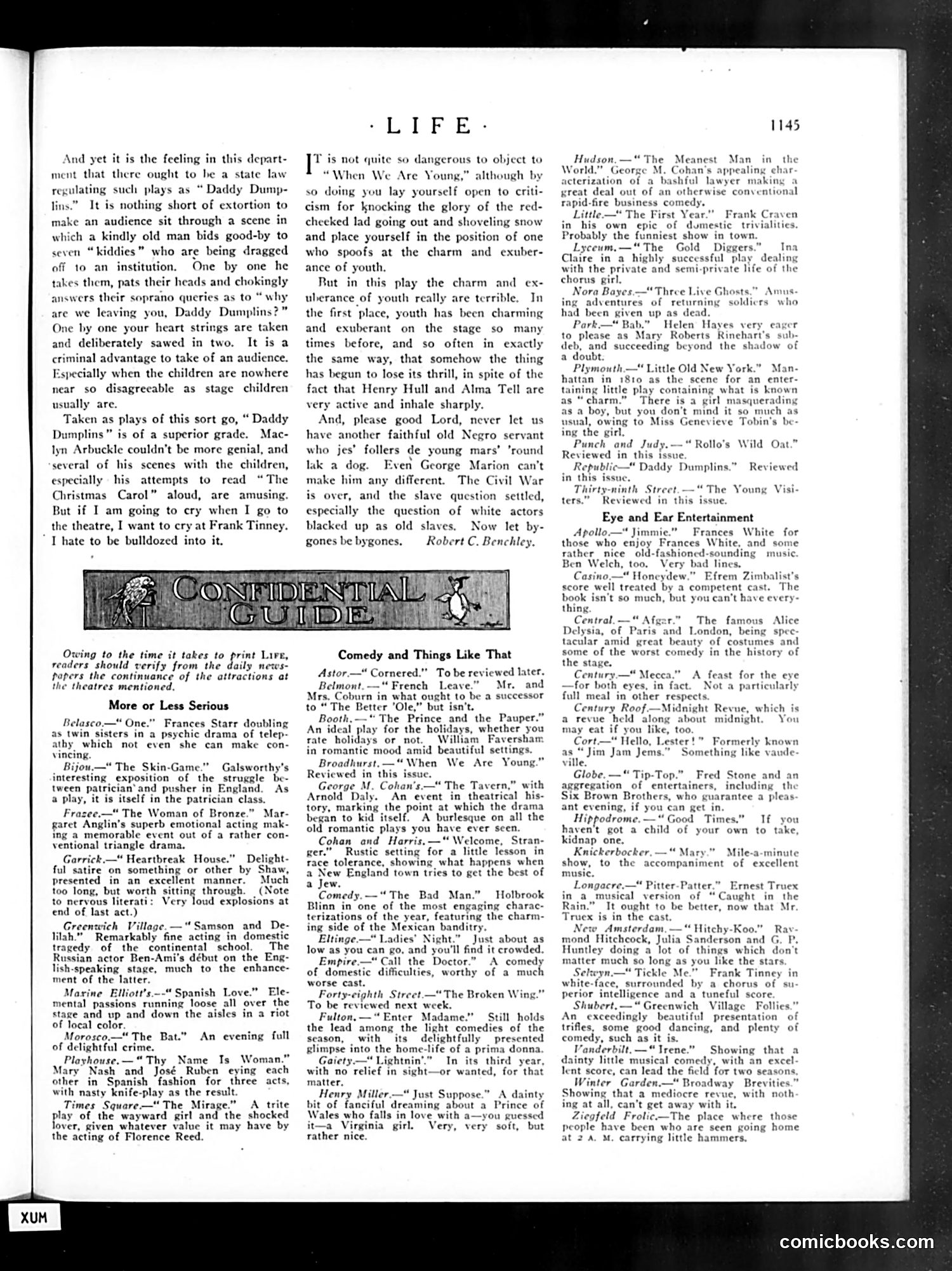
This page contains theater reviews rather than political cartoons. The critic discusses Broadway productions with characteristic early 20th-century sensibility. The main satirical target is the play "Daddy Dumplins," which the reviewer attacks for emotional manipulation—deliberately extracting tears from audiences through scenes of children being separated from their adoptive father. The critic calls this "extortion" and "criminal advantage," arguing that if audiences must cry at theater, they should do so at performer Frank Tinney's comedy rather than be "bulldozed into it." The review praises actor Maclyn Arbuckle's performance despite the play's manipulative structure. The page also lists brief reviews of other Broadway productions, mostly praising technical performances (Margaret Anglin, Ben-Ami) while criticizing tired dramatic conventions—particularly the repeated use of faithful elderly Black servants in plays, which the critic sarcastically notes should end now that "the Civil War is over, and the slave question settled."
📄 Transcribed text from this page (OCR, searchable)
Machine-transcribed from the original scan — historical spelling and the odd misread are preserved.
And yet it is the feeling in this depart- ment that there ought to be a state law regulating such plays as “Daddy Dump- lins.” It is nothing short of extortion to make an audience sit through a scene in which a kindly old man bids good-by to seven “kiddies” who are being dragged off 10 an institution. One by one he takes them, pats their heads and chokingly answers thei “why are we leaving you, Daddy Dumplins?” One by one your heart strings are taken and deliberately sawed in two. It a criminal advantage to take of an audience, Especially when the children are nowhere near so disagreeable as stage children usually are. Taken as plays of this sort go, “ Daddy Dumplins” is of a superior grade. Mac- lyn Arbuckle couldn't be more genial, and several of his scenes with the children, especially his attempts to read “The Christmas Carol” aloud, are amusing. But if I am going to cry when I go to the theatre, I want to cry at Frank Tinney. I hate to be bulldozed into it. soprano queries as to Owing to the time it takes to print Lire, readers should verify from the daily news- popers the continuance of the attractions at the theatres mentioned. More or Less Serious Belasco —* On Frances Starr doubling as twin sisters in a psychic drama of telep- athy which not even she can make con- vincing. Bijou,—"“ The Skin-Game.” Galsworthy’s interesting exposition of the struggle be- tween patrician’and pusher in England. As a play, it is itself in the patrician class. Frazee.—" The Woman of Bronze.” Mar- garet Anglin’s superb emotional acting mak- ing a memorable event out of a rather con- ventional triangle drama. Garrick. —" Heartbreak House.” Delight- ful satire on something or other by Shaw, presented in an excellent manner. Much too long, but worth sitting through. (Note to nervous literati: Very loud explosions at end of last act.) Greenwich Village. —“ Samson and De- lilah.” Remarkably fine acting in domestic tragedy of the continental school. The Russian actor Ben-Ami’s début on the Eng- lish-speaking stage, much to the enhance- ment of the latter. Marine Elliott’s.--“ Spanish Love.” Ele- mental passions running loose all over the stage and up and down the aisles in a riot of local color. Morosco.— The Bat.” of delightful crime. Playhouse. —“ Thy Name Is Woman.” Mary Nash and José Ruben eying each other in Spanish fashion for three acts, with nasty knife-play as the result. Times Square—" The Mirage.” A trite play of the wayward girl and the shocked lover, given whatever value it may have by the acting of Florence Reed. An evening full -LIFE. is not quite so dangerous to object t “When We Are Young, so doing you lay yourself open to crit cism for knocking the glory of the red- cheeked lad going out and shoveling snow and place yourself in the position of one who spoofs at the charm and exuber- ance of youth, Rut in this play the charm and ex- uberance of youth really are terrible. In the first place, youth has been charmin and exuberant on the stage so many times before, and so often in exactly the same way, that somehow the thing has begun to lose its thrill, in spite of the fact that Henry Hull and Alma Tell are very active and inhale sharply. And, please good Lord, never let us have another faithful old Negro servant who jes’ follers de young mars’ ’round lak a dog. Even George Marion can't make him any different. The Civil War is over, and the slave question settled, especially the question of white actors blacked up as old slaves. Now let by- gones be bygones. Robert C. Benchley. although t Comedy and Things Like That Astor.—“ Cornered.” To be reviewed later. Belmont. —“ French Leave.” Mr. and Mrs. Coburn in what ought to be a successor to “ The Better 'Ole,” but isn’t. Booth.“ The Prince and the Pauper.” An ideal play for the holidays, whether you rate holidays or not. William Faversham in romantic mood amid beautiful settings. Broadhurst. —“ When We Are Young.” Reviewed in this issue George M. Cohan's.—“ The Tavern,” Arnold Daly. An event in theatrical hi tory, marking the point at which the drama began to kid itself. A burlesque on all the old romantic plays you have ever scen. Cohan and Harris, —“ Welcome, Stran- ger.” Rustic setting for a little lesson in race tolerance, showing what happens when a New England town tries to get the best of a Jew. Comedy.—“ The Bad Man. Holbrook Blinn in one of the most engaging charac- terizations of the year, featuring the charm- ing side of the Mexican banditry, Eltinge.—" Ladies’ Night.” Just about as low as you can go, and you'll find it crowded. Empire.—" Call the Doctor.” A comedy of domestic difficulties, worthy of a much worse cast. Forty-eighth Street.—" The Broken Wing.” To be reviewed next week. Fulton,—“ Enter Madame.” Still holds the lead among the light comedies of the season, with its delightfully _ presented glimpse into the home-life of a prima donna. Gaiety —" Lightnin’ In its third year, with no relief in sight—or wanted, for that matter, Henry Miller—" Just Suppose.” A dainty bit of fanciful dreaming about a Prince of Wales who falls in love with a—you guessed it—a Virginia girl. Very, very soft, but rather nice. Hudson.—"“ The Meanest. Man World.” George M. Cohan’s appealing ehar acterization of a bashful lawyer great deal out of an otherwise conv rapid-fire business comedy Little —" The First Year." Frank Craven in his own epic of domestic trivialities. Probably the funniest show in town. Lyceum.—"The Gold Diggers.” Ina Claire ina highly successful play. dealing with the private and semi-private life of the chorus girl. —"Three Live es of returning had been given up as dead. Park.—* Ba Helen Hayes very eager to please as Mary Roberts Rinehart’s sul deb, and succeeding beyond the shadow of a doubt. lymonth. ttle Old New York.” Man- in 1810 as the scene for an enter- taining what is known “charm.” There is a girl masquerading as a boy, but you don’t mind it so much as usual, owing to Miss Genevieve ing the girl, Punch and Judy.—“ Rollo's Wild Reviewed in this issue. Republic—" Daddy Dumplins.” in this iss Thirty: -“The Young ters.” Reviewed in this issue. Eye and Ear Entertainment Apollo— Jimmie.” Frances White for those who enjoy Frances White, and some rather nice old-fashioned-sounding Ben Welch, too, Very bad lines, Casino,—* Honeydew.” Efrem Zimbalist’s score well treated by a competent cast. The book isn't so much, but you can’t have every- thing Central. —“ Afger.” The famous Alice Delysia, of Paris and London, being spec- tacular amid great beauty of costumes and some of the worst comedy in the history of the stage. ntury.—" Mecca.” A feast for the eye —for both eyes, in fact. Not a particularly full meal in other respects Century Roof —Midnight Revue, which is a revue held along about midnight. You may eat if you like, too. Cort—" Hello, Lester ‘ormerly known as “Jim Jam Jems.” Something like va ville. Globe. —“ Tip-Top.” Fred Stone and an aggregation of entertainers, including the Six Brown Brothers, who guarantee a pleas. ant evening, if you can get in Hippodrom Good Times.” If you haven't got a child of your own to take, kidnap one, Knickerbocker, —“ Mary.” to the accompaniment in's be- Oat.” Reviewed Visi- Mile-a-minute of excellent Longacre.— Pitter-Patter.”_ Ernest Truex in a musical version of “Caught in the Rain.” It ought to be better, now that Mr Truex is in the cast. New Amsterdam. — mond Hitchcock, Julia Huntley doing a lot o matter much so long as Tickle M white-face, surrounded by perior intelligence and a tuneful score. Shubert. —“ Greenwich Village Follies.” An_ exceedingly beautiful presentation of trifles, some good dancing, and plenty of comedy, such as it is. Vanderbilt. —" Irene.” Showing that a dainty little musical comedy, with an excel lent score, can lead the field for two seasons. Winter Garden.— Broadway Brevities.” Showing that a mediocre revue, with noth ing at all, can't get away with it, Ziegfeld Frolic.—The place where those people have been who are seen going home at 24. M. carrying little hammers, Hitchy-Koo.” Rav anderson and G. P, things which don't u like the stars nk Tinney in chorus of su comicbooks.com