
Life, 1920-12-16 · page 24 of 45
Life — December 16, 1920 — page 24: what you’re looking at
What you’re looking at
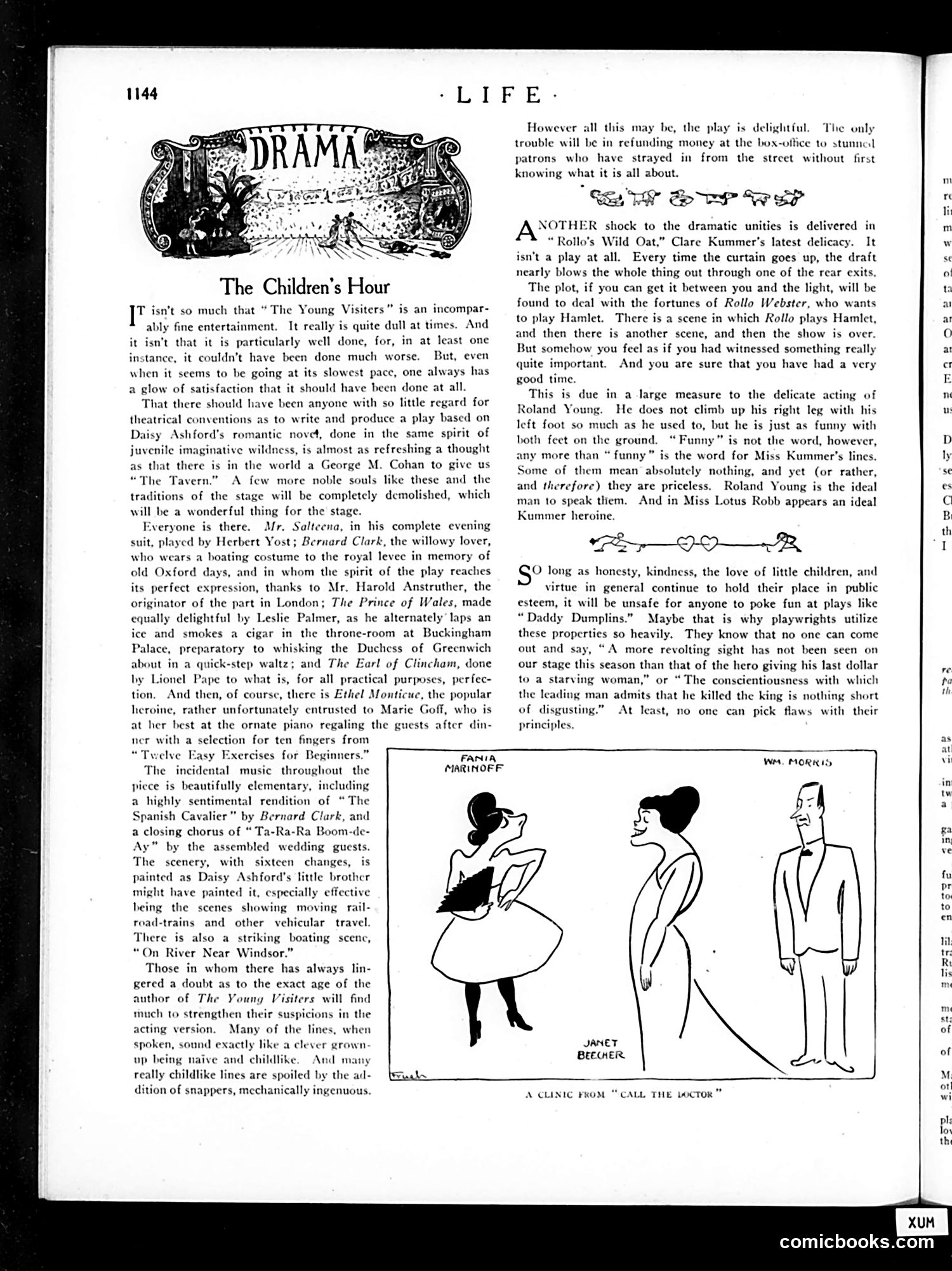
This page reviews three theatrical productions. The main cartoon at bottom, titled "A Clinic from 'Call the Doctor,'" depicts three characters—identified as Pania Markhoff, Janet Beecher, and W.H. Pickris—in what appears to be a comedic scene, likely illustrating a humorous moment from the play being discussed. The text reviews "The Children's Hour" (a stage adaptation of Daisy Ashford's novel "The Young Visitors"), "Rollo's Wild Oat" by Clare Kummer, and "Daddy Dumplins." The reviews praise the delightful absurdity of these productions—their departure from theatrical conventions and their ability to entertain despite (or because of) their illogical plots. The satire targets both the plays' deliberate nonsense and the public's hunger for wholesome entertainment featuring "honesty, kindness, the love of little children." The cartoon illustrates theatrical comedy style of the era, showing exaggerated character types typical of stage farce.
📄 Transcribed text from this page (OCR, searchable)
Machine-transcribed from the original scan — historical spelling and the odd misread are preserved.
-LIFE. The Children’s Hour T isn’t so much that * The Young Visiters” is an incompar- ably fine entertainment. It really is quite dull at times. And it isn’t that it is particularly well done, for, in at least one instance, it couldn't have been done much worse. But, even when it seems to be going at its slowest pace, one always has a glow of satisfaction that it should have been done at all. That there should have been anyone with so little regard for theatrical conventions as to write and produce a play based on Daisy Ashford’s romantic nove, done in the same spirit of juvenile imaginative wildness, is almost as refreshing a thought as that there is in the world a George M. Cohan to give us “The Tavern.” A few more noble souls like these and the traditions of the stage will be completely demolished, which will be a wonderful thing for the stage. Everyone is there. Mr. Salteena, in his complete evening suit, played by Herbert Yost; Bernard Clark, the willowy lover, who wears a boating costume to the royal levee in memory of old Oxford days, and in whom the spirit of the play reaches its perfect expression, thanks to Mr. Harold Anstruther, the originator of the part in London; The Prince of Wales, made equally delightful by Leslie Palmer, as he alternately laps an ice and smokes a cigar in the throne-room at Buckingham Palace, preparatory to whisking the Duchess of Greenwich about in a quick-step waltz; and The Earl of Clincham, done by Lionel Pape to what is, for all practical purpo: perfec- tion. And then, of course, there is Ethel Monticue, the popular heroine, rather unfortunately entrusted to Marie Goff, who is at her best at the ornate piano regaling the guests after din- ner with a selection for ten fingers from However all this may be, the play is delightful. The only trouble will be in refunding money at the box-office to stunned atrons who have strayed in from the street without first knowing what it is all about. ai Sor wer NOTHER shock to the dramatic unities is delivered in “Rollo's Wild Oat,” Clare Kummer's latest delicacy. It isn’t a play at all. Every time the curtain goes up, the draft nearly blows the whole thing out through one of the rear exits. The plot, if you can get it between you and the light, will be found to deal with the fortunes of Rollo Webster, who wants to play Hamlet. There is a scene in which Rollo plays Hamlet, and then there is another scene, and then the show is over. But somehow you feel as if you had witnessed something really quite important. And you are sure that you have had a very good time. This is due in a large measure to the delicate acting of Roland Young. He does not climb up his right leg with his left foot so much as he used to, but he is just as funny with both feet on the ground. “Funny” is not the word, however, any more than “funny” is the word for Miss Kummer’s lines. Some of them mean absolutely nothing, and yet (or rather, and therefore) they are priceless. Roland Young is the ideal man to speak them. And in Miss Lotus Robb appears an ideal Kummer heroine. Po 9- DR s honesty, kindness, the love of little children, and virtue in general continue to hold their place in public esteem, it will be unsafe for anyone to poke fun at plays like “Daddy Dumplins.” Maybe that is why playwrights utilize these properties so heavily. They know that no one can come out and say, “A more revolting sight has not been seen on our stage this season than that of the hero giving his last dollar to a starving woman,” or “The conscientiousness with which the leading man admits that he killed the king is nothing short of disgusting.” At least, no one can pick flaws with their principles. O long “Twelve Easy Exercises for Beginners.” The incidental music throughout the piece is beautifully elementary, including a highly sentimental rendition of “The Spanish Cavalier" by Bernard Clark, and a closing chorus of “ Ta-Ra-Ra Boom-de- Ay” by the assembled wedding guests. The scenery, with sixteen changes, is painted as Daisy Ashford’s little brother might have painted it, especially effective being the s road-trains FANIA, MARINOFF nes showing moving rail- and other vehicular travel. also a striking boating scene, “On River Near Windsor.” Those in whom there has always lin- gered a doubt as to the exact age of the author of The Young Visiters will find much to strengthen their suspic acting version. spoken, sound ¢: Phere i ons in the Many of the lines, when tly like a clever grown ive and childlike. And many really childlike lines are spoiled by the ad- up being ni JANET BEECHER. dition of snappers, mechanically ingenuous. A CLINIC FROM “CALL THE LoCcToR” comicbooks.co