
A complete issue · 46 pages · 1920
Life — October 28, 1920
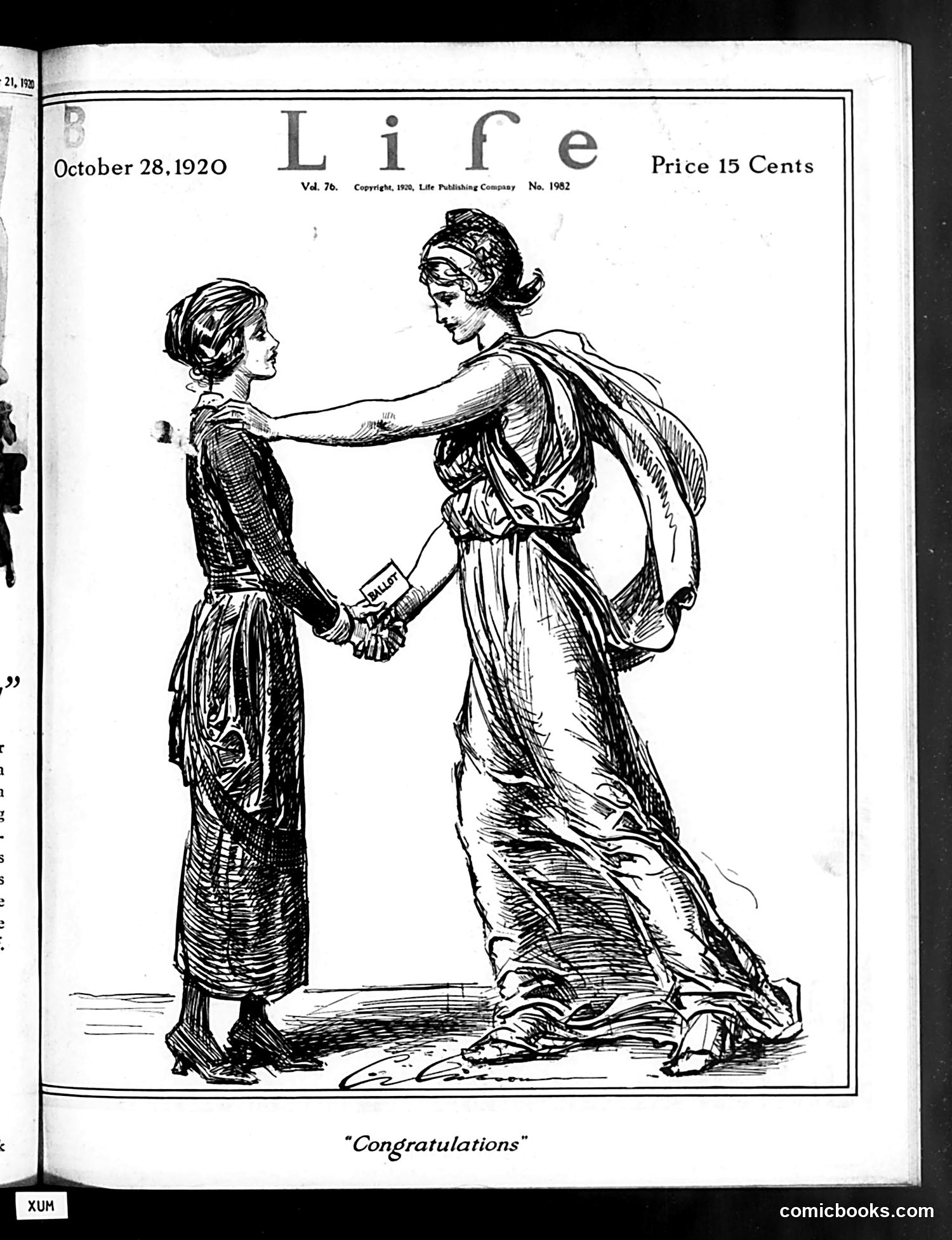
This illustration depicts two women shaking hands, titled "Congratulations." The woman on the left wears modern 1920s attire with a fitted jacket and skirt. The figure on the right, depicted as "Liberty" or "Justice" (indicated by her classical Greek-style drapery and headpiece), extends her hand in greeting. The cartoon likely celebrates women's suffrage, which was formally ratified via the 19th Amendment in August 1920—just weeks before this issue. The handshake symbolizes the greeting between an ordinary woman citizen and the personified ideal of American liberty/justice, congratulating women on finally achieving voting rights after decades of activist struggle.

This is a **full-page advertisement**, not satire or editorial content. It promotes the United States Rubber Company's new "Mono-Twin" solid truck tire, claiming it's "the fastest selling solid truck tire in America." The ad addresses truck owners directly, emphasizing **economy** as a selling point. The large photograph shows an enormous tire under a bridge or overpass, dramatically illustrating the product's size and durability. Key selling features highlighted include: - **Exclusive U.S. creation** ("non-splitting") - **Increased traction** from rubber cross-ribs and depressions - **Heavy load capacity** compared to single tires The ad uses the credibility angle ("Truck owners all over the country have learned their lesson") to suggest widespread adoption validates the product. It's straightforward industrial advertising with no satirical intent.
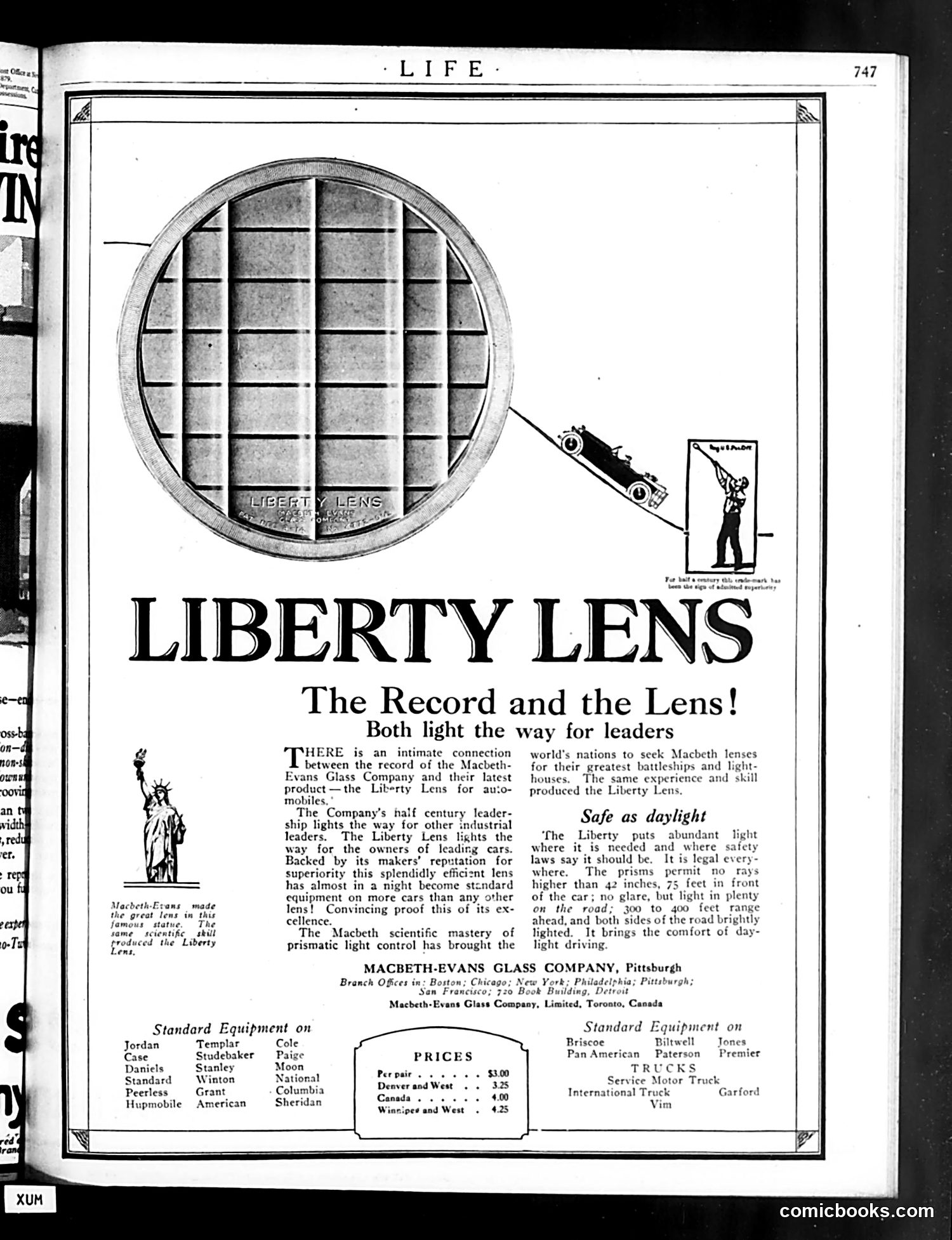
This is primarily a **product advertisement** for the Liberty Lens automobile accessory, manufactured by Macbeth-Evans Glass Company of Pittsburgh. The ad appears in *Life* magazine (page 747). The small cartoon in the upper right shows a car with the lens installed, depicting improved visibility. The Statue of Liberty illustration on the left serves as the company's logo/brand identity. The ad's rhetoric—"Both light the way for leaders"—uses patriotic symbolism to market automotive safety lenses. The comparison between the Liberty lens and the Statue of Liberty is purely metaphorical branding, not political satire. This is commercial advertising, not editorial content or political commentary. The page lists standard equipment specifications and prices ($3.00-$4.25 depending on region) for various automobile brands including Jordan, Cole, Stanley, and others.
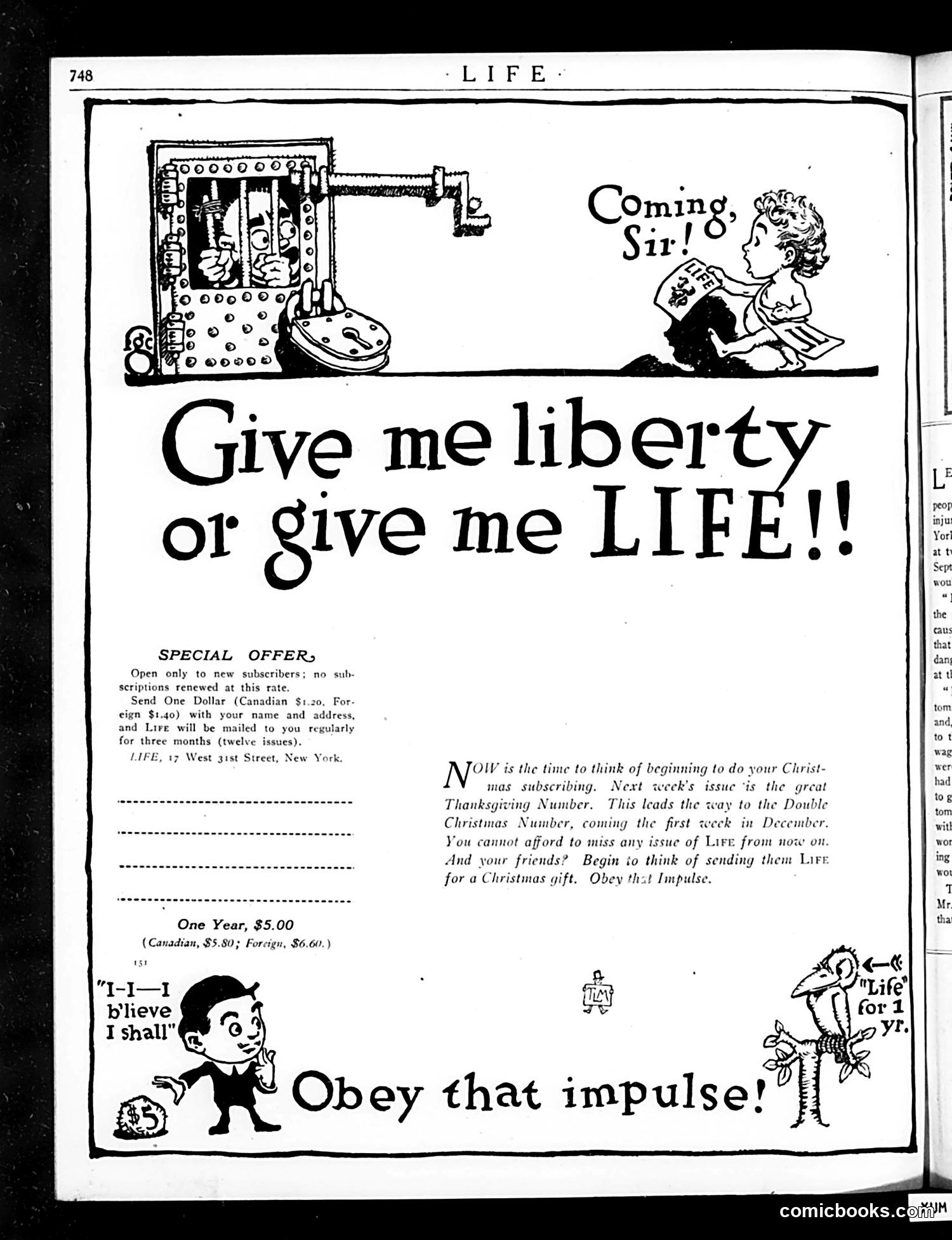
This is primarily a **subscription advertisement** for *Life* magazine, not political satire. The page promotes a special offer for new subscribers: one dollar for a three-month subscription (twelve issues). The imagery is patriotic rather than satirical. The top illustration shows a mechanical device labeled "Coming, Sir!" with a figure saying "Give me liberty or give me LIFE!!" — a play on Patrick Henry's famous Revolutionary War phrase. This links the magazine's name to American freedom. The bottom cartoon featuring a small character saying "I-I-I believe I shall" and "Obey that impulse!" is a lighthearted visual pun encouraging subscription. The messaging emphasizes subscribing before the "Double Christmas Number" arrives in December, positioning *Life* as an ideal gift. This reflects *Life*'s role as a humor and commentary magazine during the early-to-mid 20th century.
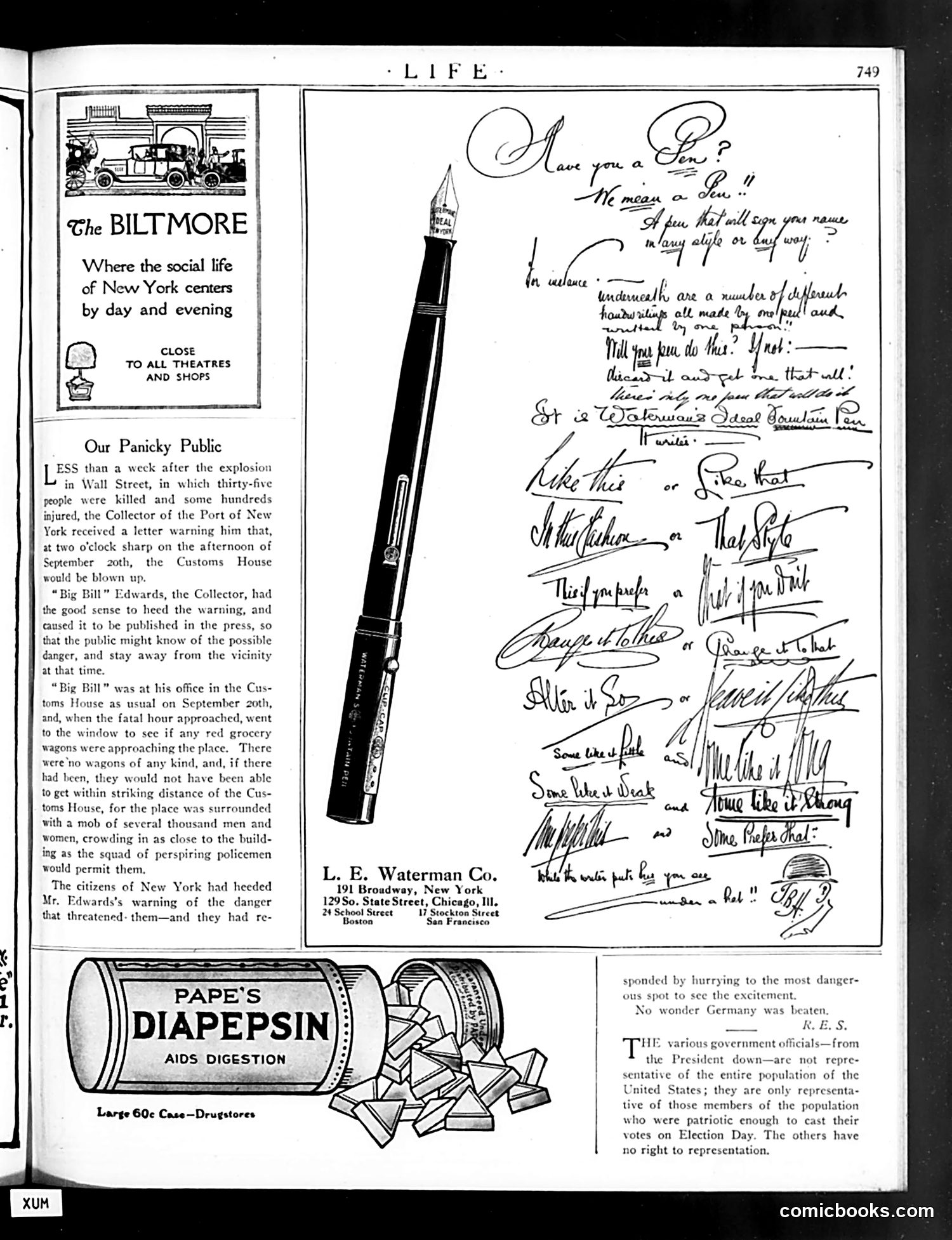
This page is primarily **advertising** interspersed with editorial content. **Advertisements visible:** - The Biltmore hotel (top left) - L.E. Waterman Co. fountain pens (center, with decorative handwriting) - Pape's Diapepsin digestive aid (bottom left) **Editorial content** ("Our Panicky Public"): Describes a 1920 Wall Street explosion warning that caused panic. Collector "Big Bill" Edwards received a threat about the Customs House being bombed at 2 PM on September 20th. He wisely publicized it to prevent danger, but citizens still crowded the area unnecessarily—satirizing public overreaction to threats. The page demonstrates **Life magazine's mix of satire, news commentary, and commercial content** typical of 1920s publications.
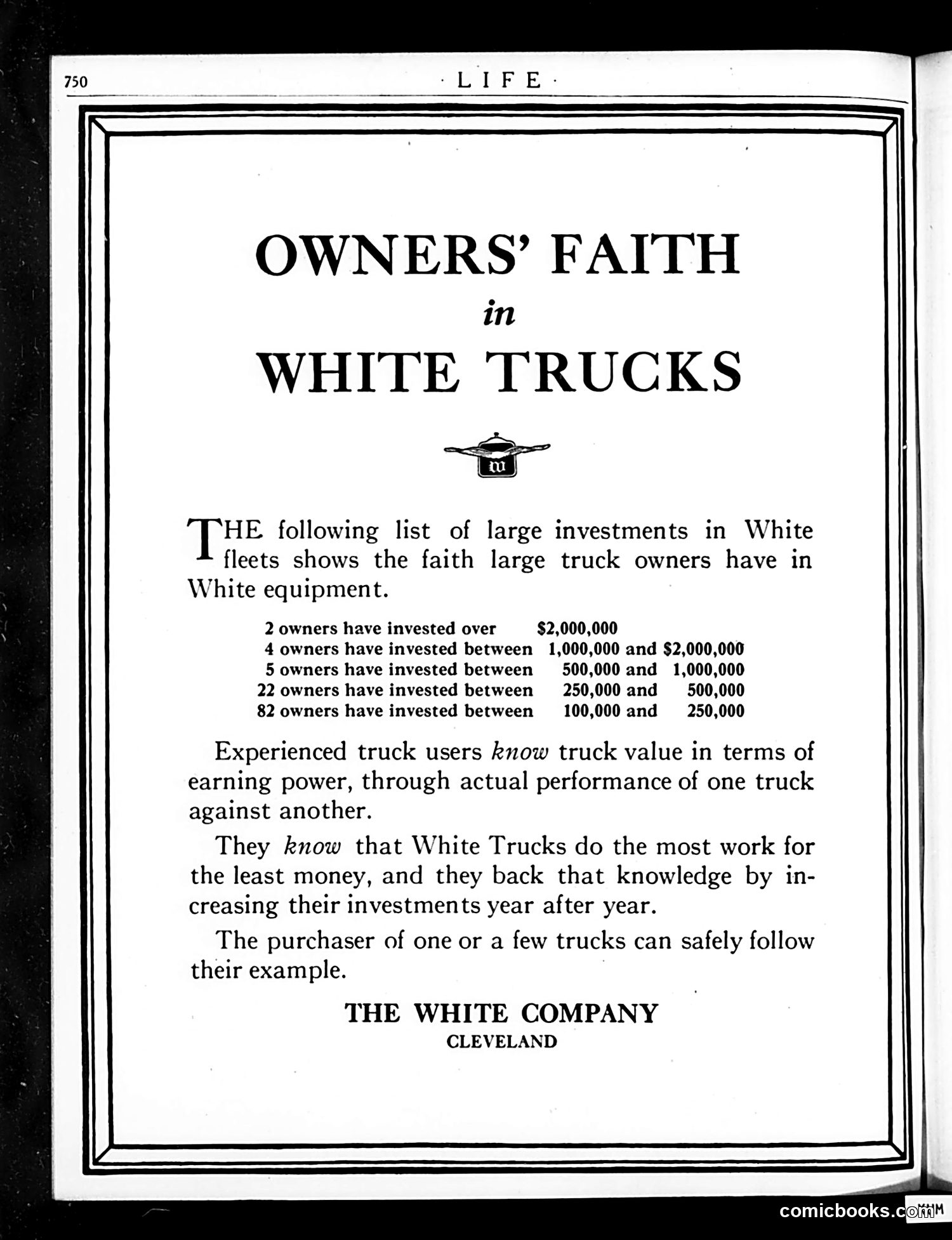
This is **not a cartoon or satire page** — it's a straightforward advertisement for White Trucks, a Cleveland-based manufacturer. The ad uses a persuasion strategy common in early 20th-century marketing: social proof through investment statistics. It claims that experienced truck fleet owners have invested millions in White equipment (ranging from $100,000 to over $2,000,000 per owner), implying this demonstrates the trucks' reliability and value. The argument is: knowledgeable professionals know White trucks "do the most work for the least money" and repeatedly buy them. Therefore, individual truck purchasers should follow their example. There is no political content or satire here — merely vintage industrial advertising using testimonial-style credibility appeals.
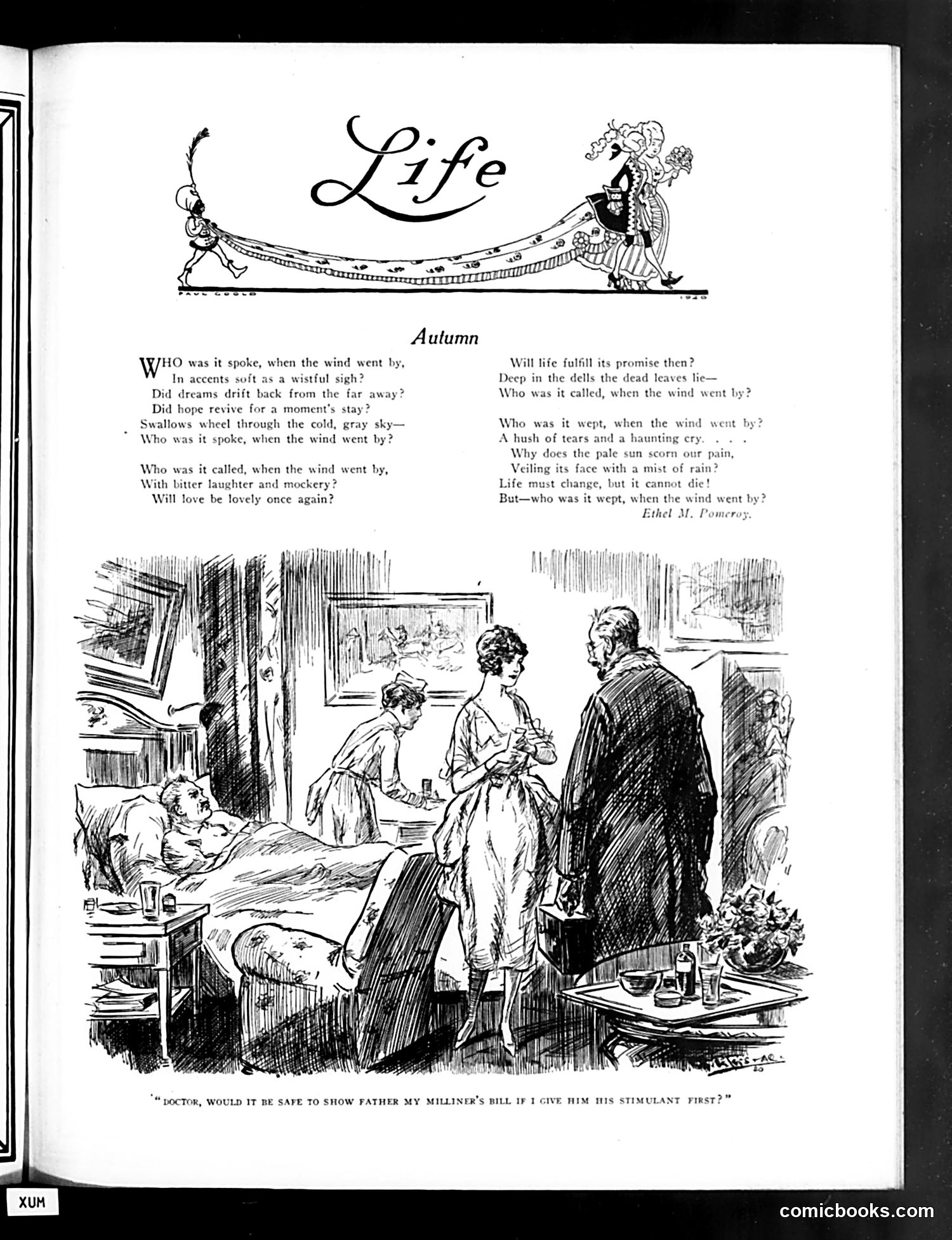
This page features a poem titled "Autumn" by Ethel M. Pomeroy exploring life's transience through autumn imagery—themes of change, death, and loss personified by wind and falling leaves. Below is a satirical cartoon showing a sickbed scene. A doctor stands with family members attending to an ill patient. The caption reads: "Doctor, would it be safe to show father my milliner's bill if I give him his stimulant first?" The joke satirizes both medical practice and domestic finances: the cartoon suggests giving the father alcohol ("stimulant") before revealing expensive millinery bills to cushion the financial shock. It mocks both the era's medical reliance on alcohol and the assumption that wives' spending habits would distress husbands—reflecting early 20th-century gender attitudes toward money and consumption.
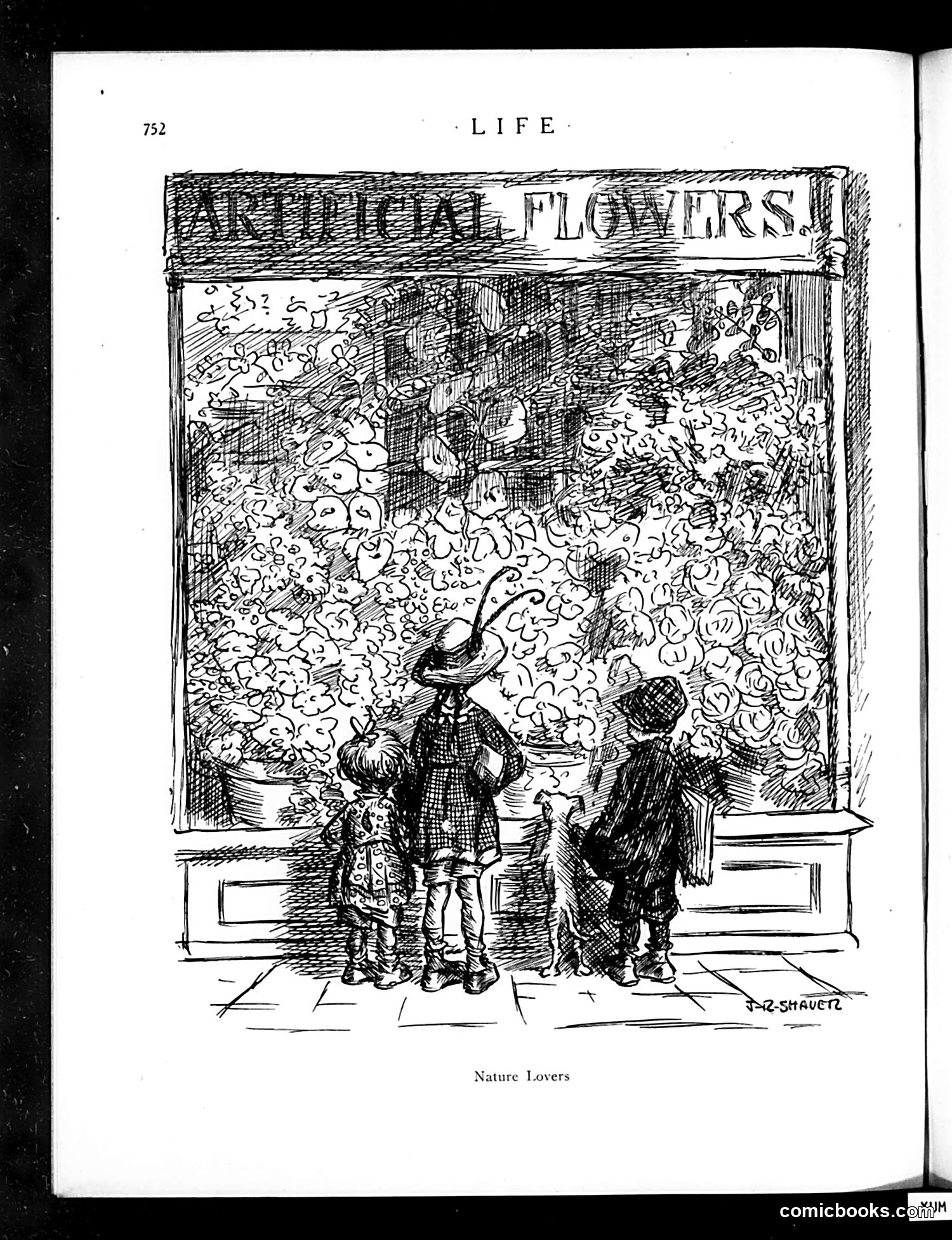
This cartoon depicts three children viewing an elaborate artificial flower display in what appears to be a shop window labeled "ARTIFICIAL FLOWERS." The illustration satirizes the disconnect between children and genuine nature in urban settings. The joke targets the irony of calling people "Nature Lovers" while they admire mass-produced, fake flowers rather than real ones. The children stand mesmerized by the artificial blooms filling the entire window display, suggesting how commercial culture and artificiality have replaced authentic natural experience. This reflects early 20th-century social commentary about urbanization removing people—especially children—from direct contact with nature, substituting manufactured alternatives instead. The satire critiques both consumer culture and the loss of genuine natural appreciation in modern city life.
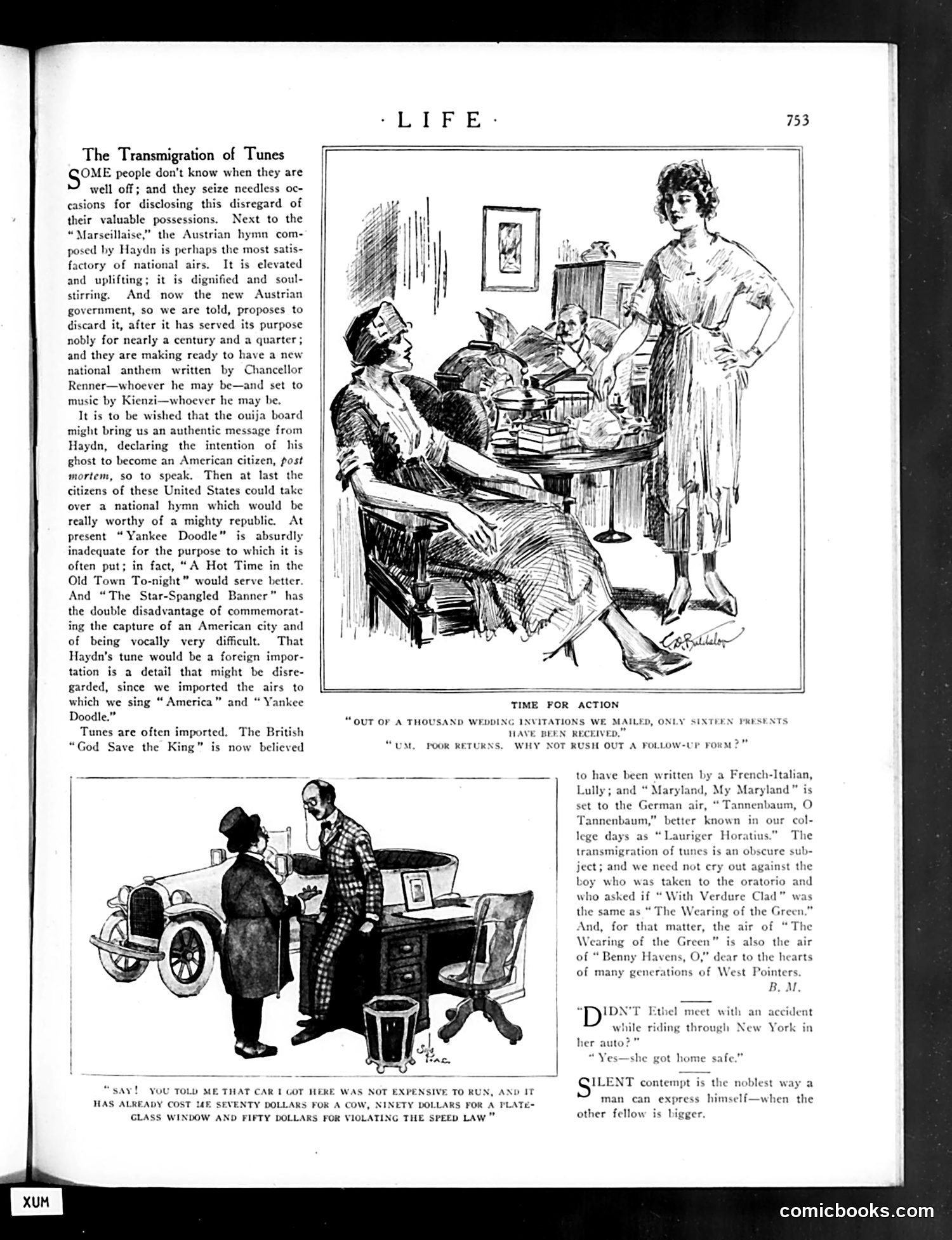
This satirical article critiques how American patriotic songs are often replaced with foreign melodies. The main argument: the Austrian national hymn composed by Haydn works better than "Yankee Doodle" for the U.S. national anthem, but importing foreign tunes is culturally problematic. The two cartoons illustrate related absurdities: the top shows a woman receiving wedding invitations while discussing imported melodies; the bottom depicts a man confronted about his car's high cost while defending the expense. The underlying satire mocks Americans' tendency to adopt foreign cultural products—whether musical compositions or automobiles—while simultaneously celebrating national identity. The piece satirizes both cultural snobbery and the contradiction between patriotic rhetoric and consumerist behavior favoring imported goods.
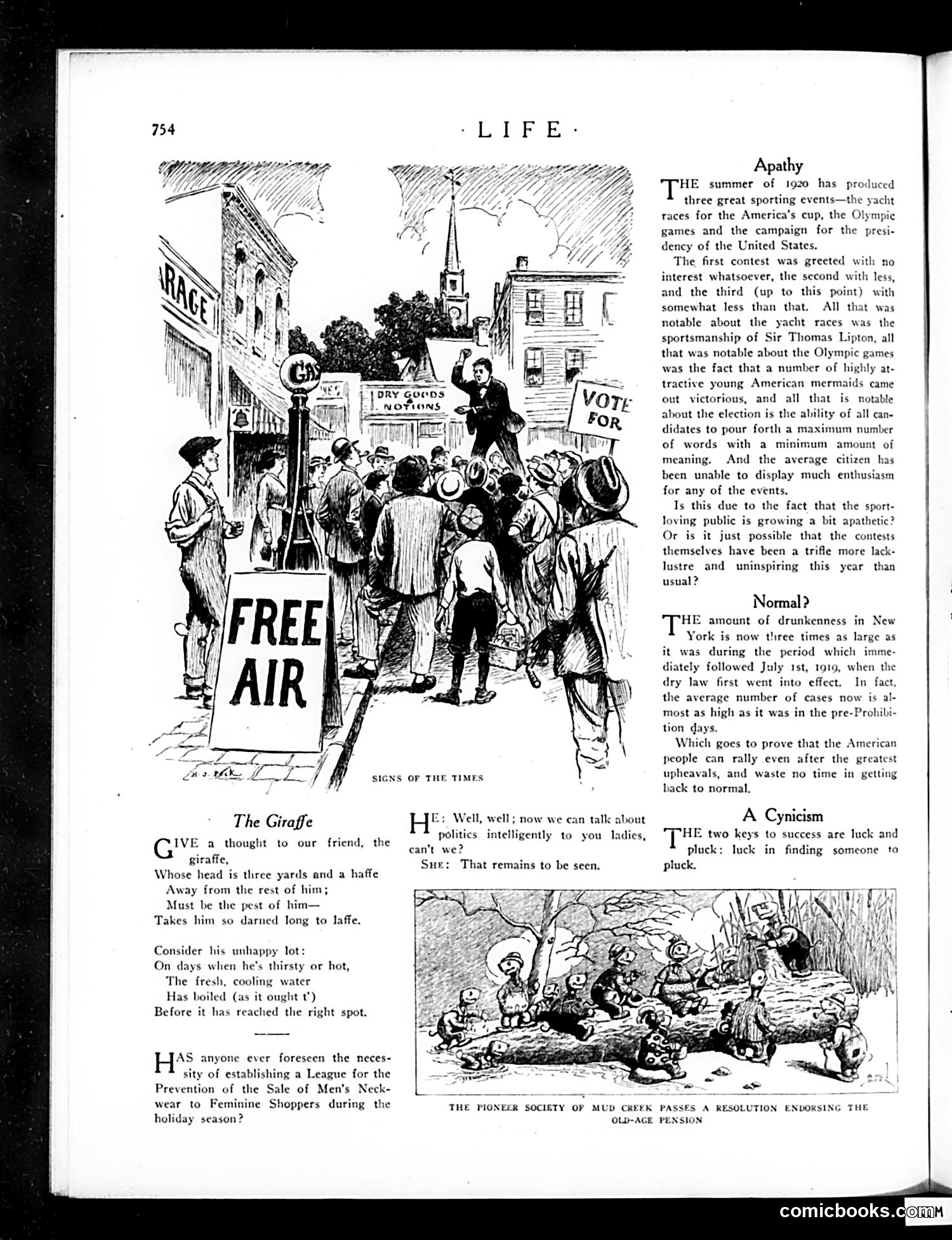
This 1920 cartoon satirizes public apathy toward major sporting events. The illustration shows a crowd gathered around a platform offering "FREE AIR" — a stark contrast to three significant concurrent events: yacht races, Olympic games, and the U.S. presidential election campaign. The satire suggests Americans are indifferent to these momentous contests, instead clustering around a trivial giveaway. The accompanying article criticizes the lack of enthusiasm for the sporting events and election, attributing this to growing public apathy or noting that the contests themselves lack their usual lustre and inspiration. The cartoon mocks American civic and sporting disengagement during the 1920 election year.
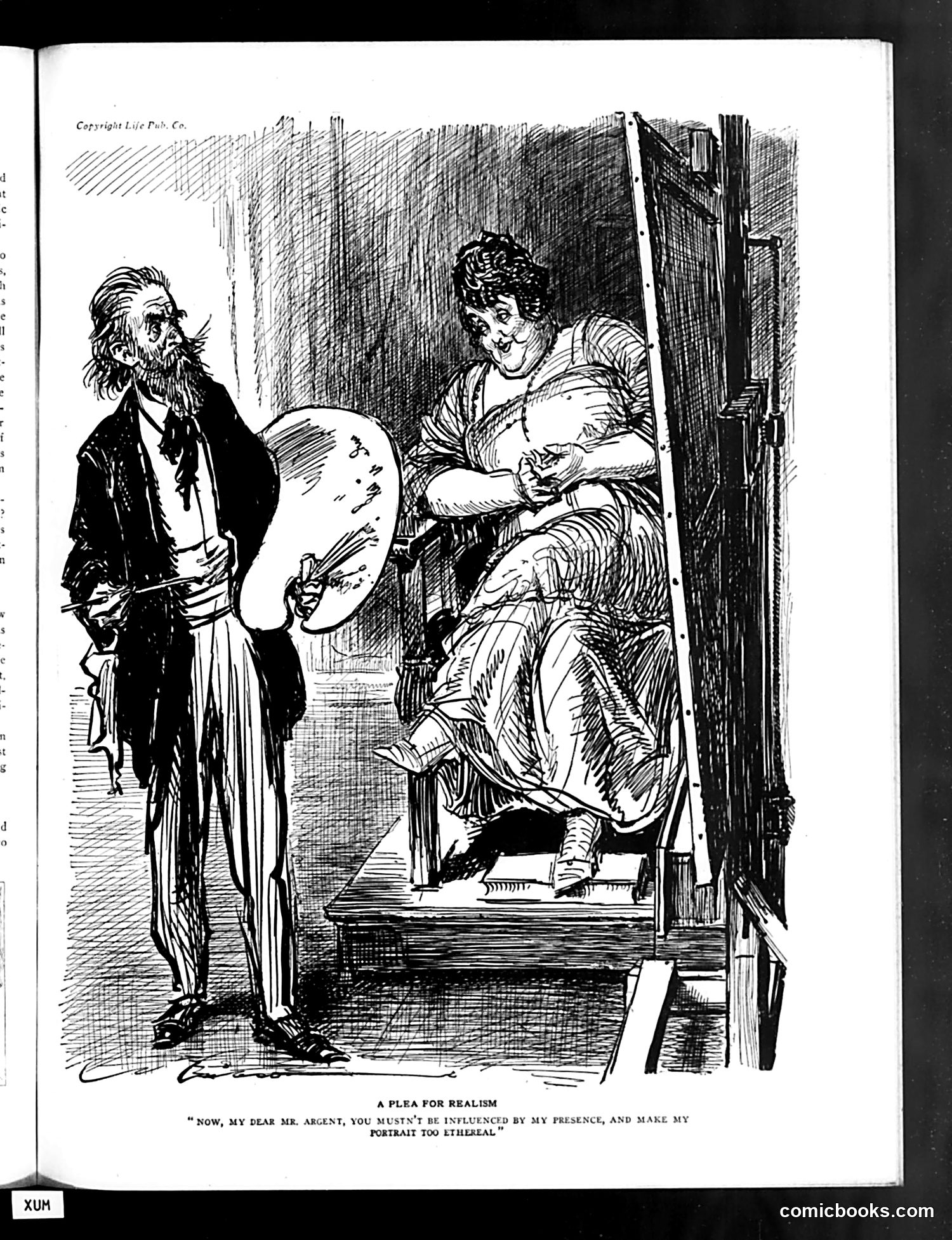
This satirical cartoon critiques artistic practice, specifically the tension between idealized portrait painting and realistic depiction. The scene shows an artist (left, holding palette) conversing with a woman seated for her portrait. The caption reads: "Now, my dear Mr. Argent, you mustn't be influenced by my presence, and make my portrait too ethereal." The joke targets the common artistic convention of flattering female subjects by rendering them as ethereal, idealized beauties rather than accurate likenesses. The woman's request for "realism" is ironic—she's actually asking the artist to make her look prettier and less realistic. The satire mocks both the artificial standards of portraiture and the vanity of subjects who demand flattery under the guise of artistic authenticity.
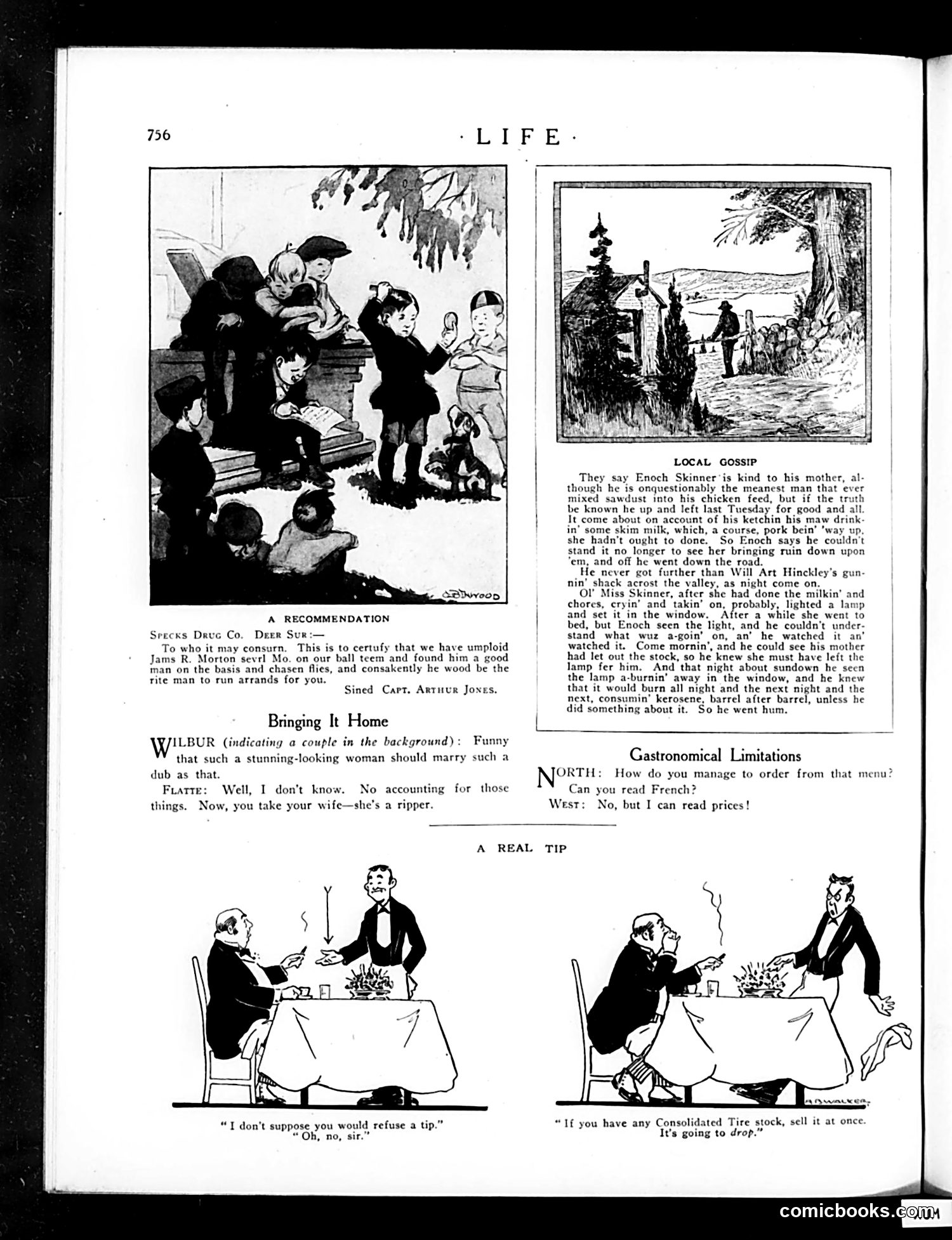
This page contains several satirical comics and brief jokes typical of early 20th-century Life magazine. **"A Recommendation"** features a drug store testimonial—apparently a satisfied customer endorsing a product to a druggist. **"Bringing It Home"** jokes about marriage: a man (Wilbur) expresses surprise that an attractive woman married someone as unattractive as her husband (Flatte), leading to a crude joke about his wife being "a ripper" (likely a Jack the Ripper reference, implying she's dangerous). **"A Real Tip"** presents two dinner scenes satirizing financial advice: the left shows someone refusing a tip, while the right shows a waiter urgently advising a diner to sell Consolidated Tire stock before it drops—mocking both tipping customs and stock market volatility. The page reflects period concerns about courtship, class, and economic uncertainty.
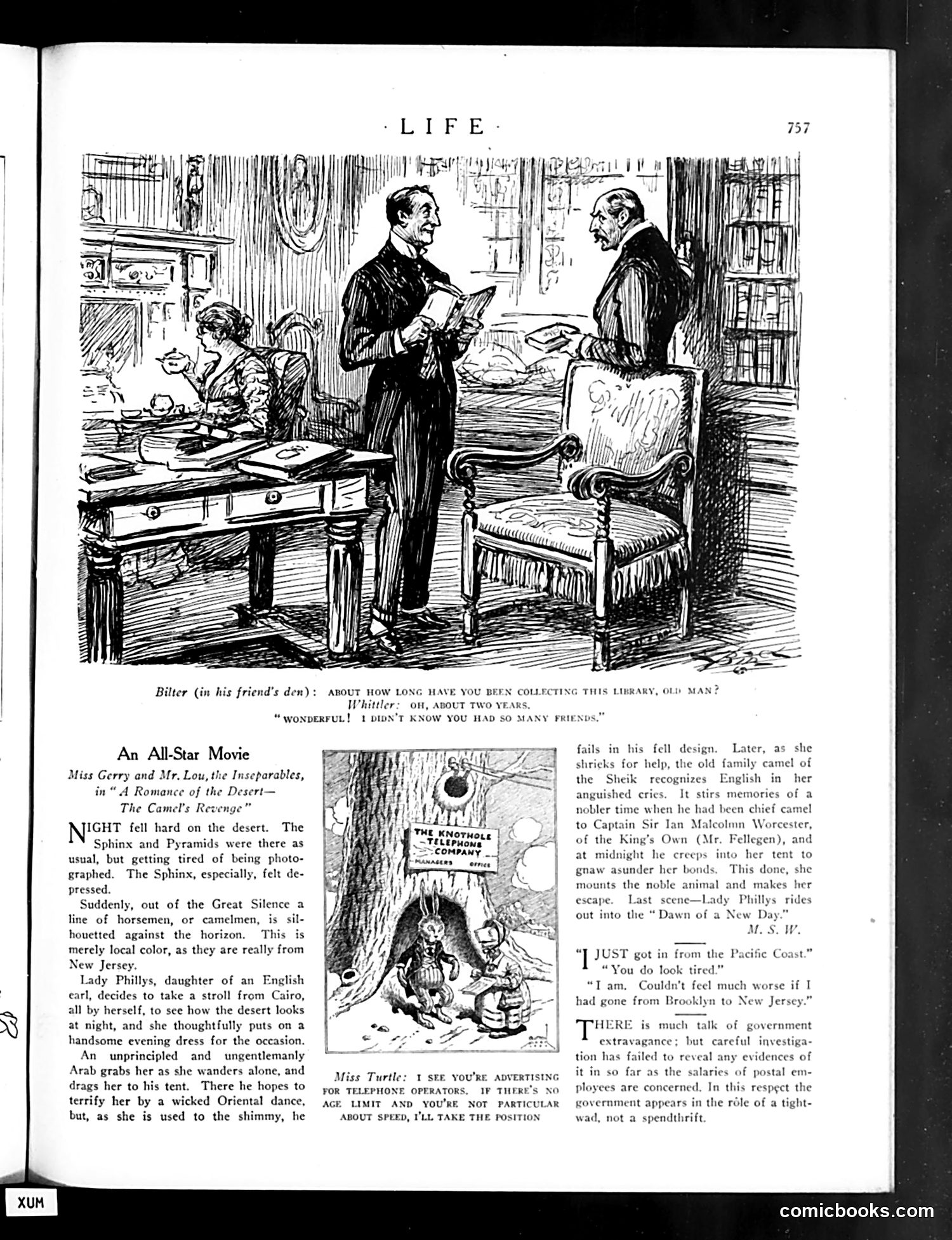
**Top Cartoon:** Shows two men in an office—one standing with a book, one seated. The caption presents a joke about book collecting: Bittler asks an older man how long he's been collecting his library, and the man replies he's been doing so for about two years, adding he didn't know the man had so many friends. **The Joke:** This is wordplay satire on social climbing. The implication is that Bittler is acquiring an impressive library not out of genuine intellectual interest, but as a status symbol to impress visitors and appear cultured. The older man's surprised comment about "so many friends" sarcastically suggests Bittler is buying books solely to gain social standing. **Overall Theme:** Mocking the pretentious use of book collections as markers of refinement among the wealthy or aspiring middle class.
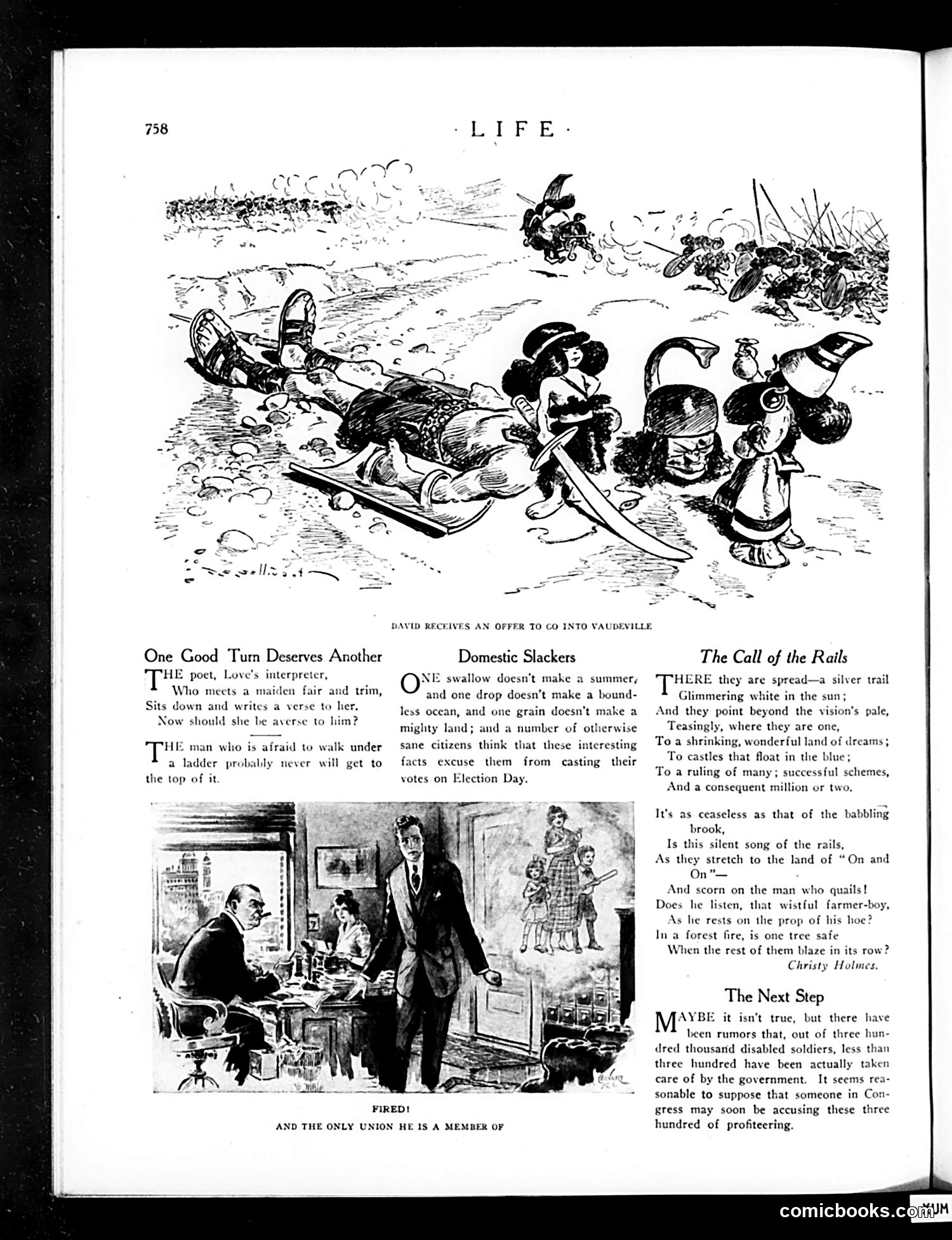
This page contains three separate satirical pieces: 1. **"One Good Turn Deserves Another"**: A poem mocking a poet who writes flattering verses to avoid honest labor. 2. **"Domestic Slackers"**: Social commentary suggesting that certain citizens avoid patriotic duty (voting on Election Day) with trivial excuses, comparing them to those avoiding military service during wartime. 3. **"The Call of the Rails"**: A poem criticizing men who shirk agricultural work during wartime labor shortages, preferring railroad jobs. References a "farmer-boy" avoiding honest farm labor. 4. **"Fired!"**: A cartoon showing a man being dismissed, captioned "AND THE ONLY UNION HE IS A MEMBER OF"—likely satirizing union membership as his only affiliation. The overarching theme targets wartime "slackers"—those avoiding patriotic contribution through work or civic participation.
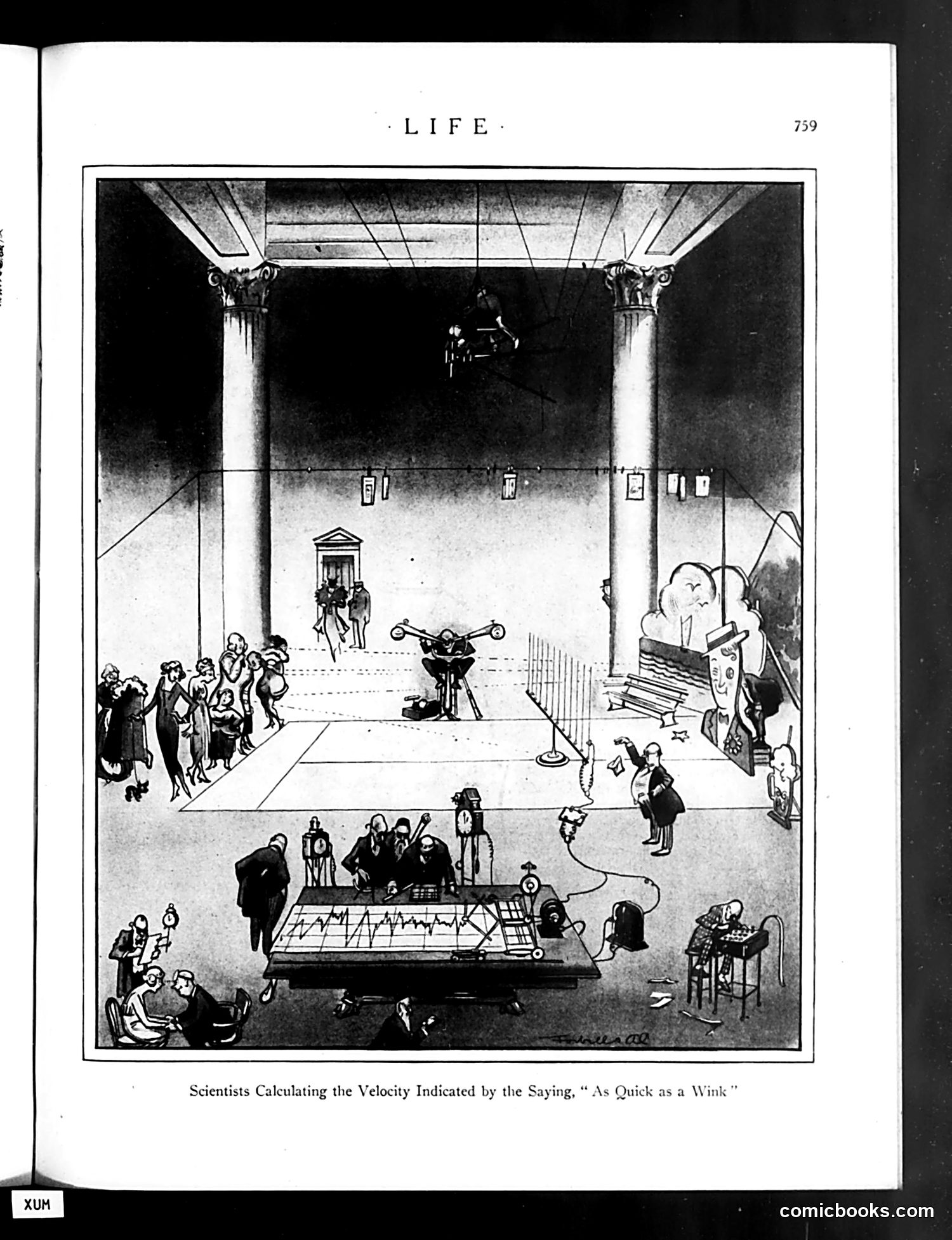
This is a satirical cartoon from *Life* magazine depicting scientists in a laboratory setting attempting to measure velocity using the colloquial phrase "as quick as a wink." The joke plays on the imprecision of everyday language versus scientific measurement. The caption indicates these researchers are literally trying to calculate speed based on an idiom—treating figurative speech as literal data. The elaborate laboratory setup with various instruments, observers, and measuring devices suggests the absurdity of applying rigorous scientific methodology to something inherently unmeasurable and subjective. The satire mocks either overcomplication of simple concepts or the challenge of quantifying human perception and expression. This reflects early-twentieth-century concerns about the limits of scientific positivism when applied to language and human experience.
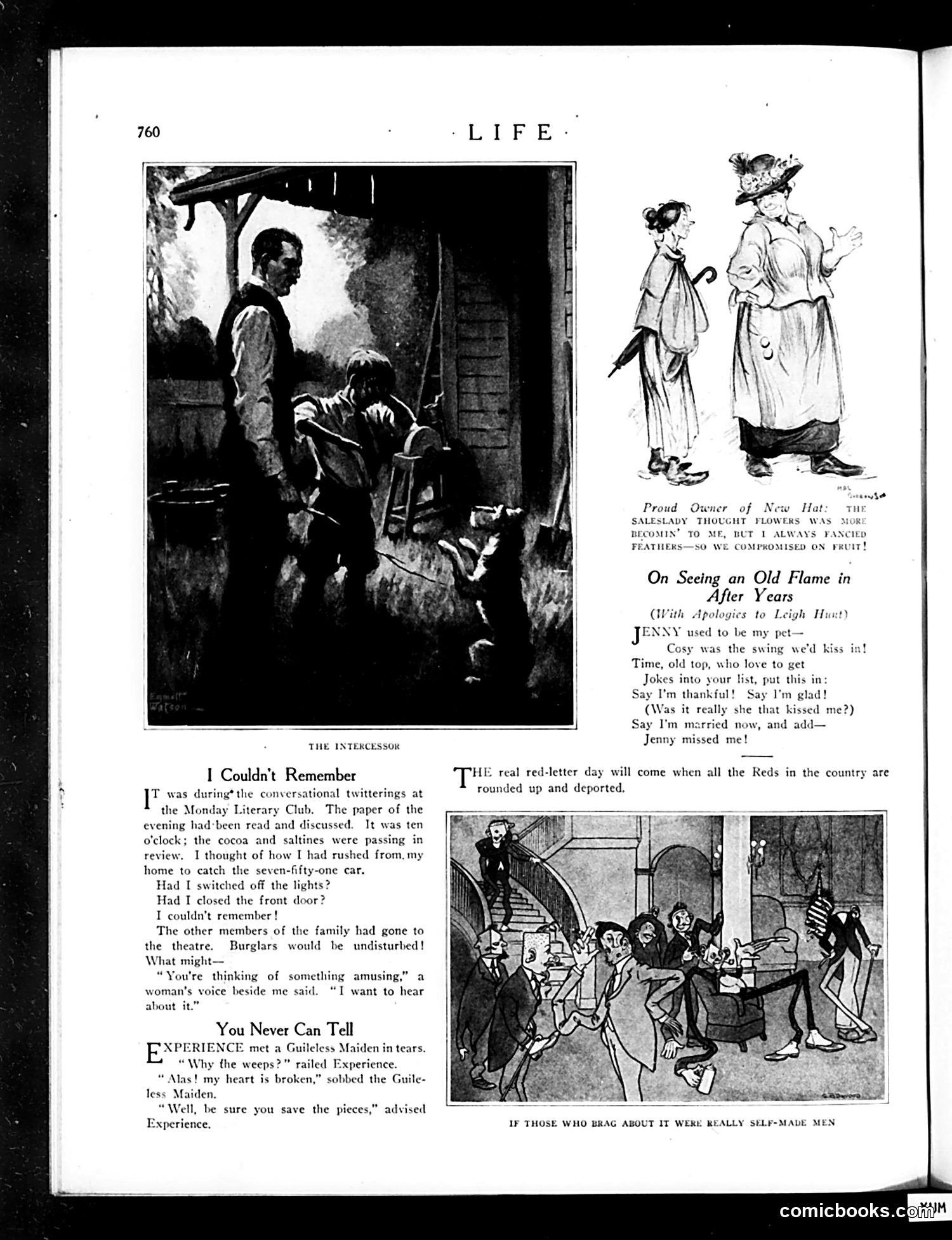
This page from *Life* magazine contains several humorous pieces satirizing early 20th-century social life: **"The Intercessor"** (left image): Shows a domestic scene where someone appears to be mediating a conflict between two people. **"On Seeing an Old Flame in After Years"** (top right): A poem poking fun at encountering an ex-romantic interest, with the speaker's nostalgia deflated by reality—they awkwardly try to cover their embarrassment. **"You Never Can Tell"** (middle): A brief anecdote about Experience meeting a heartbroken maiden, offering cynical advice about saving "the pieces" of a broken heart. **"If Those Who Brag About It Were Really Self-Made Men"** (bottom right): The cartoon satirizes self-made men by showing what appears to be people actually *making* someone, suggesting wealthy people falsely claim self-creation rather than acknowledging inherited advantages or help received.
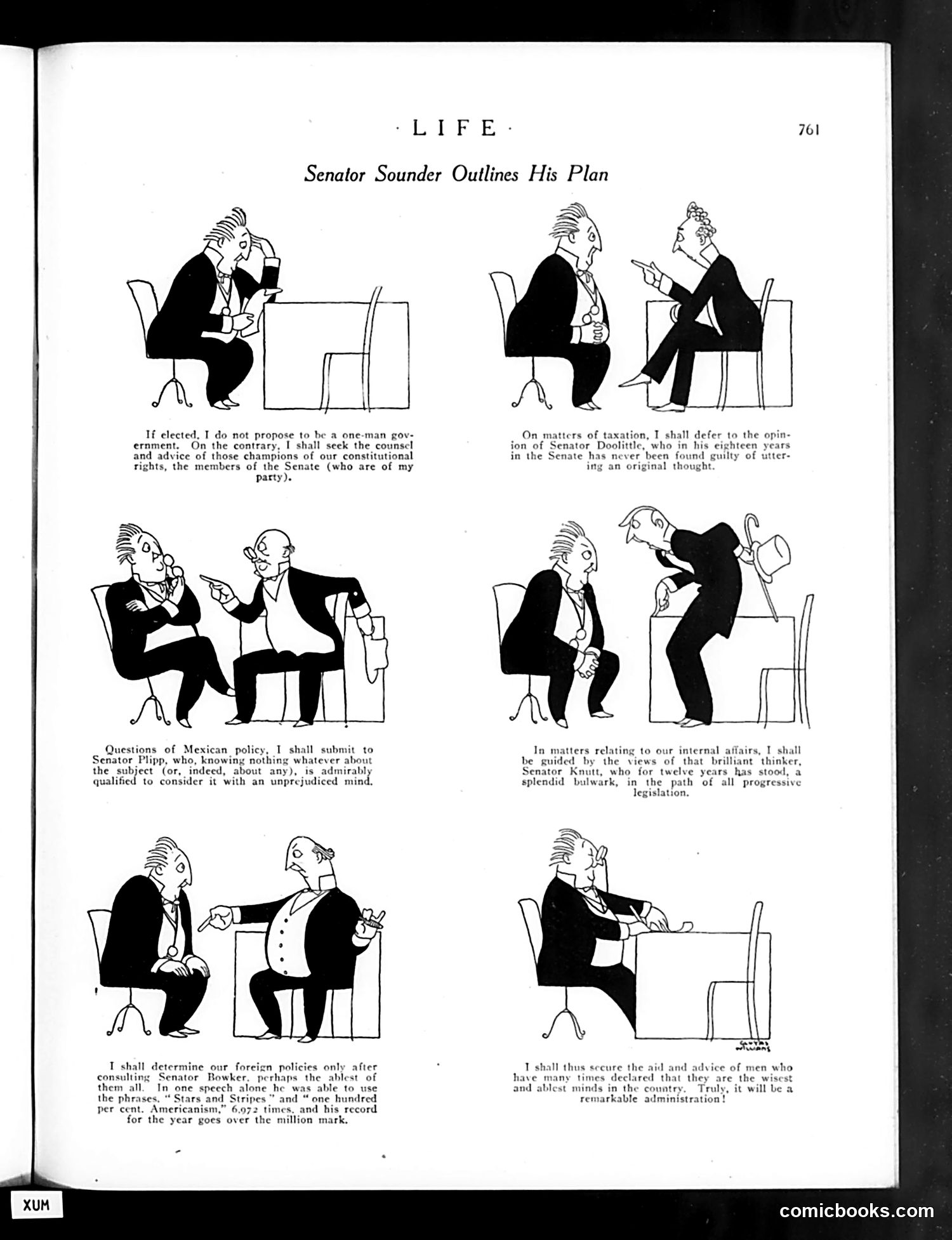
This cartoon satirizes a politician's hollow campaign promises. "Senator Sounder" claims he won't govern alone but will seek advice from fellow senators—then reveals his strategy is to defer to senators who are demonstrably incompetent or mediocre. The joke: he'll consult Senator Doolittle on taxation (who has "never been found guilty of uttering an original thought"), Senator Plipp on Mexican policy (who knows nothing about the subject), and Senator Bowker on foreign policy (whose sole qualification is mindlessly repeating patriotic clichés 6,972 times yearly). This ridicules politicians who hide behind appeals to "the wisdom of the Senate" while actually surrounding themselves with yes-men and nonentities. The satire suggests that deferring to such advisors guarantees nothing will change—exactly what Sounder promises: a "remarkable administration" of notable mediocrity masquerading as collaborative governance.
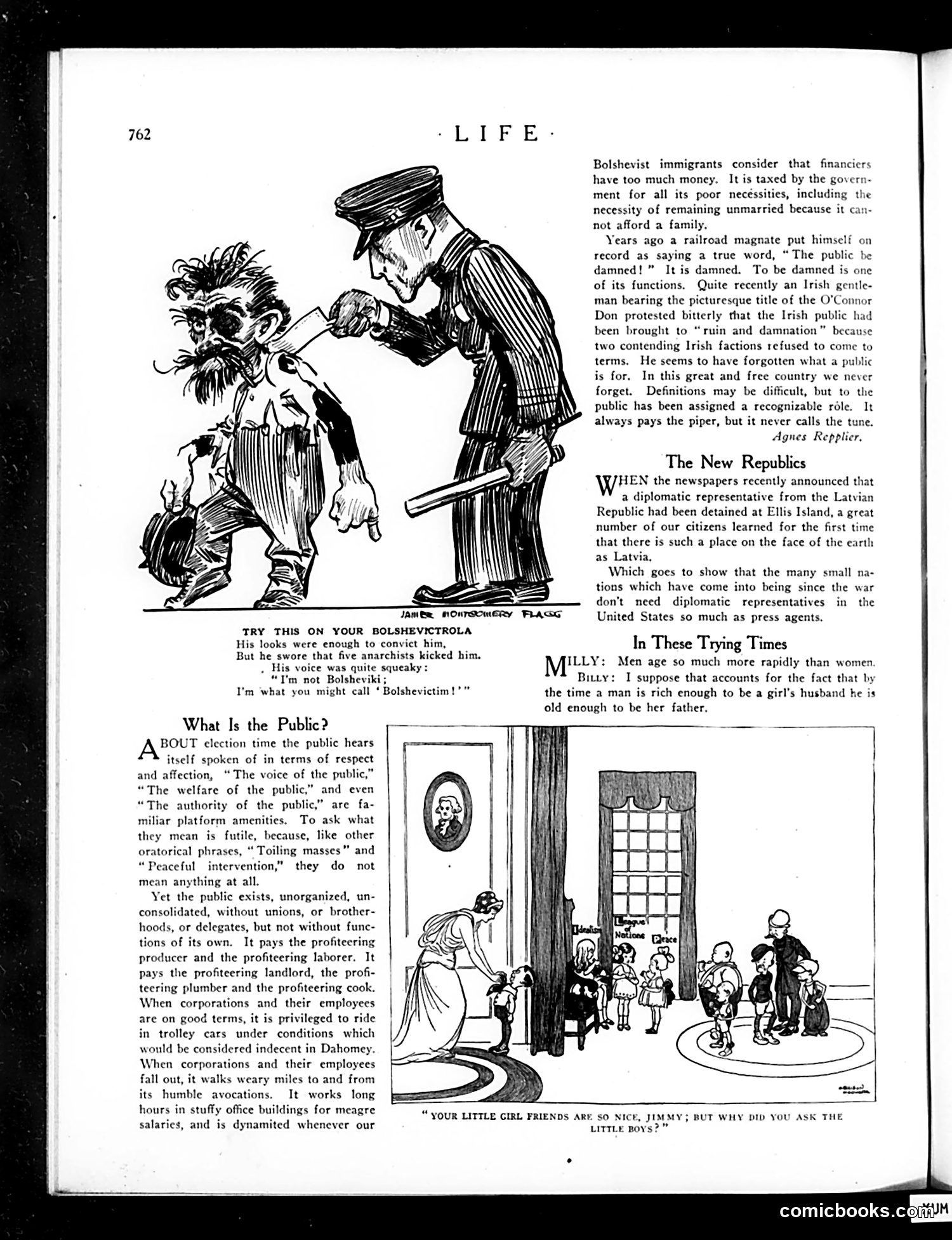
This page satirizes post-WWI American society through multiple pieces: **Top cartoon** ("Try This on Your Bolshevictrola"): Mocks Red Scare anxieties by depicting a rough-looking immigrant being interrogated. The caption plays on "Bolshevictrola" (phonograph brand), suggesting authorities assume poor immigrants are Bolsheviks. The dialogue parodies how suspects deny radical sympathies while contradicting themselves. **"What Is the Public?"** (essay by Agnes Repplier): Cynically defines "the public" as an exploited, powerless mass. It pays taxes, tolerates corporate abuse, suffers during labor disputes, and accepts politicians' empty rhetoric—but never controls outcomes. The famous railroad magnate quote "The public be damned" encapsulates the era's capitalist contempt. **"The New Republics"**: Satirizes America's indifference to newly independent nations (Latvia, etc.) emerging post-WWI, suggesting they need press agents more than diplomatic recognition. **Lower cartoon and "In These Trying Times" dialogue**: Light social humor about aging and gender. Overall tone: Sharp critique of economic inequality, corporate power, and public powerlessness during economically turbulent times.
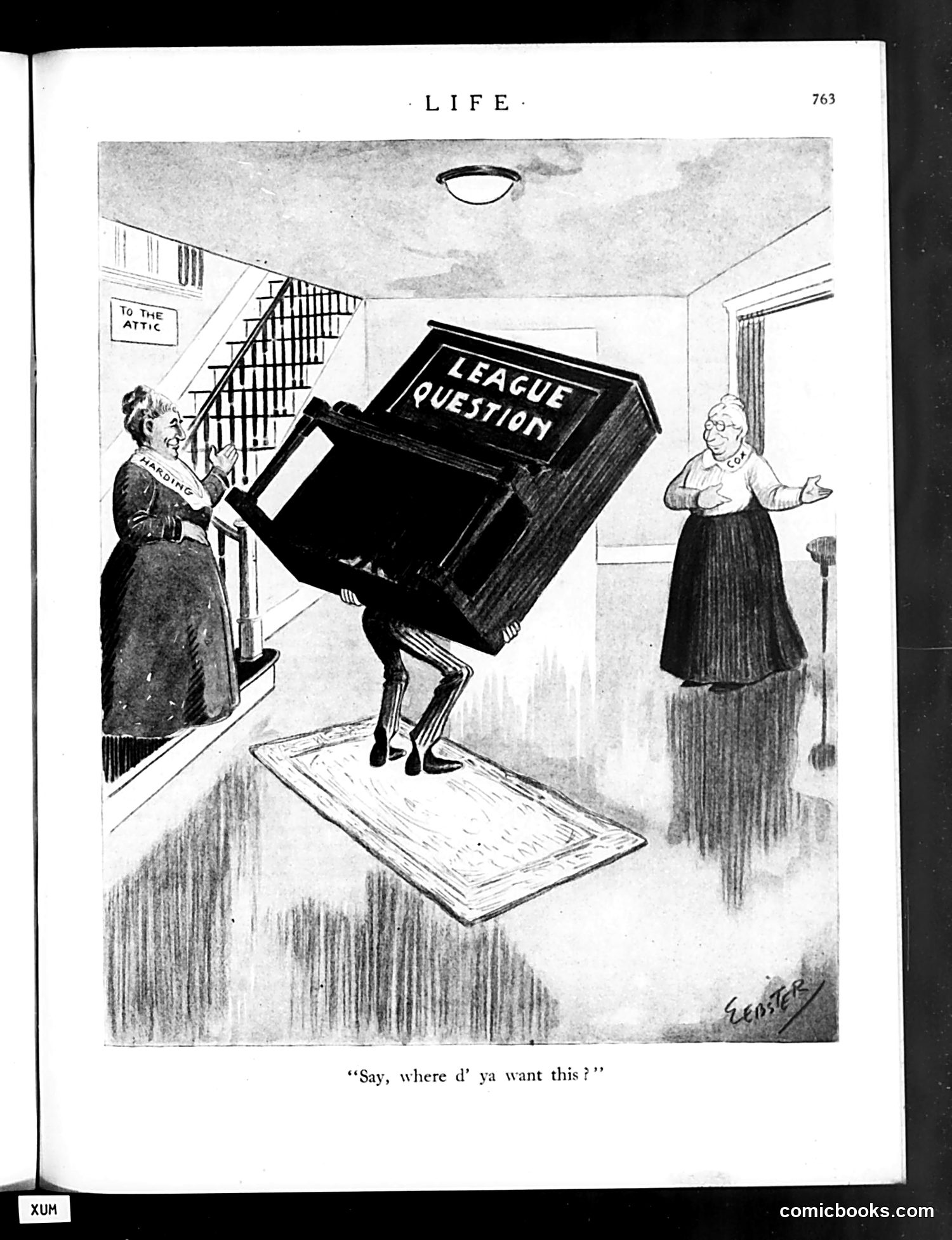
This single-panel cartoon depicts a man straining to carry an enormous crate labeled "LEAGUE QUESTION" through a domestic hallway. Two women observe—one near the stairs marked "TO THE ATTIC," the other gesturing with apparent exasperation. The satire concerns the League of Nations question, a major political debate of the 1920s-30s. The cartoonist suggests that this controversial issue is an unwieldy burden being awkwardly maneuvered through American politics. The caption "Say, where d' ya want this?" implies uncertainty about where to "store" or resolve the question. The woman gesturing likely represents American public opinion or Congress, expressing frustration with the ongoing, unresolved debate. The "attic" reference suggests the desire to literally hide the problem away. The cartoon critiques the political gridlock surrounding America's relationship with the League.
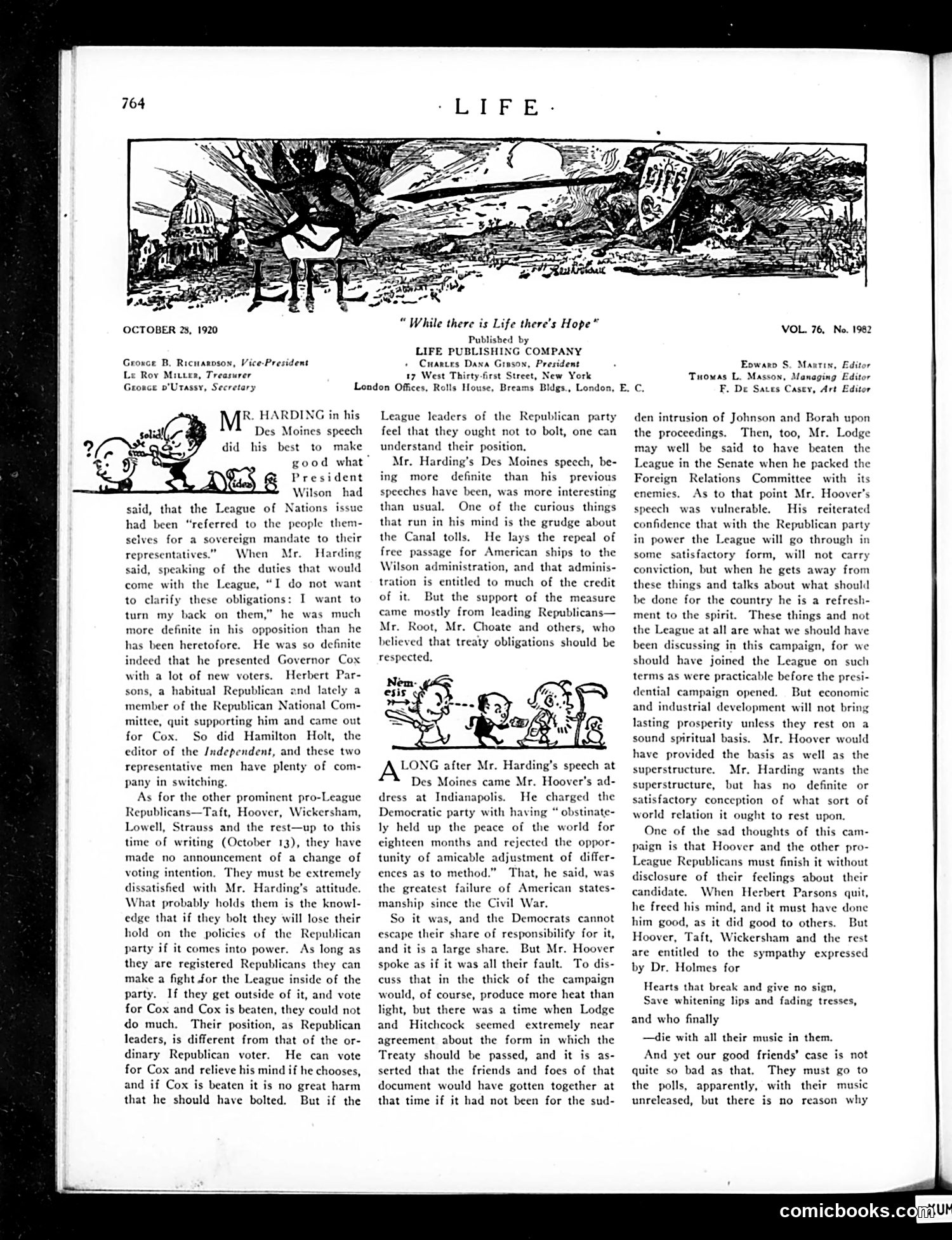
This *Life* magazine page covers the 1920 presidential campaign, specifically the League of Nations controversy. Warren G. Harding (Republican nominee) gave a Des Moines speech rejecting League obligations, stating "I want to turn my back on them." The article notes this position was so definitive it caused prominent Republicans—Herbert Parsons and Hamilton Holt—to switch support to Democratic candidate James Cox. The piece discusses tension among pro-League Republicans (Taft, Hoover, Wickersham, Lowell) who remain nominally loyal to Harding despite disagreeing with him, fearing they'd lose influence if they bolt the party. Later, Hoover's Indianapolis address blamed Democrats for obstructing the Treaty for eighteen months. The author suggests both parties share responsibility, implying the political positioning around League ratification was complex and contested as Election Day approached. The cartoons (specific content unclear from description) likely satirize this political maneuvering.
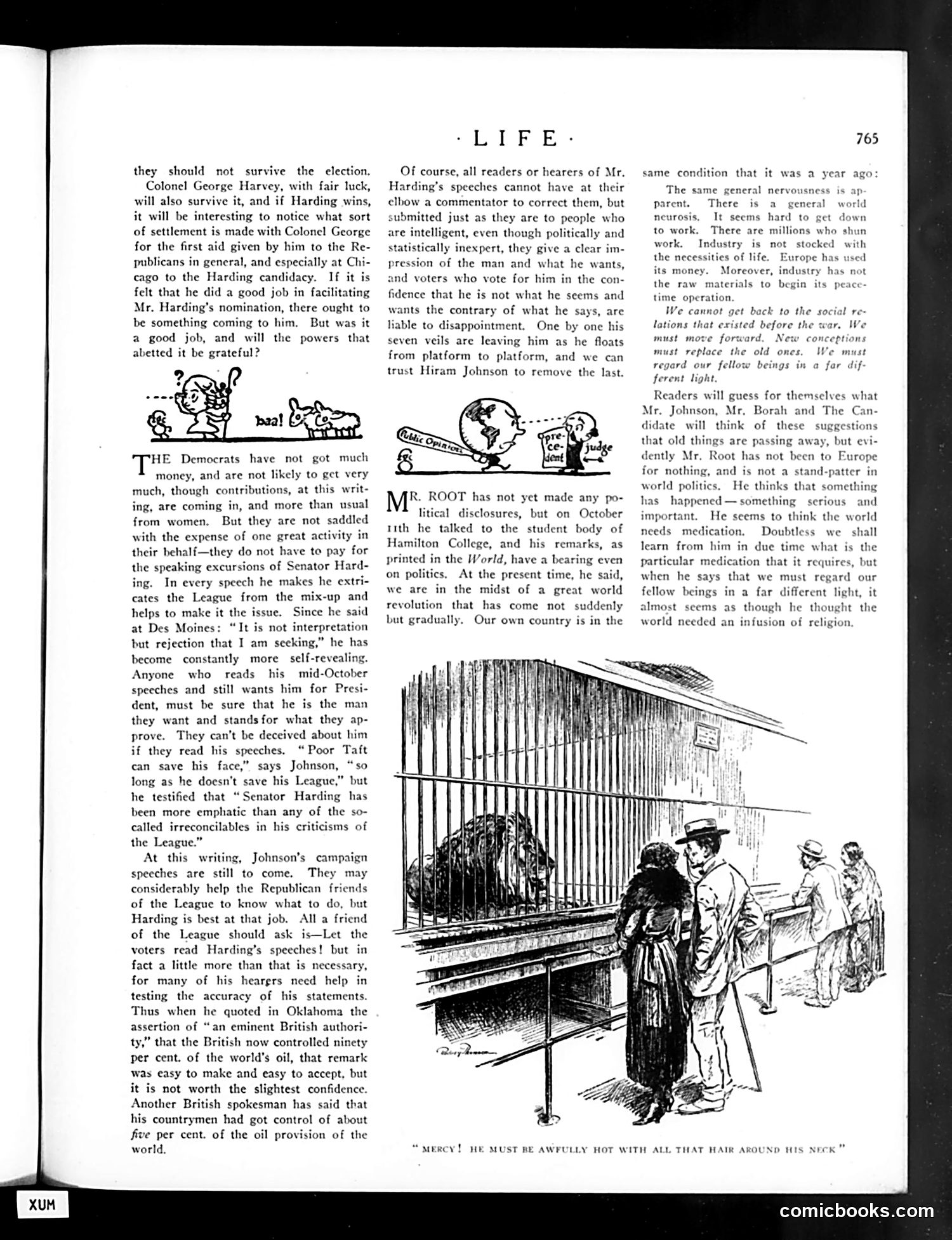
This page analyzes the 1920 U.S. presidential election, specifically criticizing Republican candidate Warren G. Harding's campaign speeches about the League of Nations. **Key Figures:** - **Harding**: Republican presidential candidate whose statements are scrutinized for inconsistency and factual errors - **Colonel George Harvey**: Republican operative who aided Harding's nomination - **Senator Hiram Johnson**: Progressive Republican ally of Harding - **Elihu Root**: Former Secretary of State offering commentary on post-war social unrest **The Satire:** The article mocks Harding for making vague, contradictory statements about League rejection versus interpretation, and for citing false statistics (claiming Britain controlled 90% of world oil when actual figures were much lower). The cartoonist/author argues voters should read Harding's speeches directly to understand his true positions, implying they'll reveal his weakness and inconsistency. **Context:** The 1920 election centered on whether America would join Woodrow Wilson's League of Nations—a divisive issue. The piece uses Harding's own words as indictment.
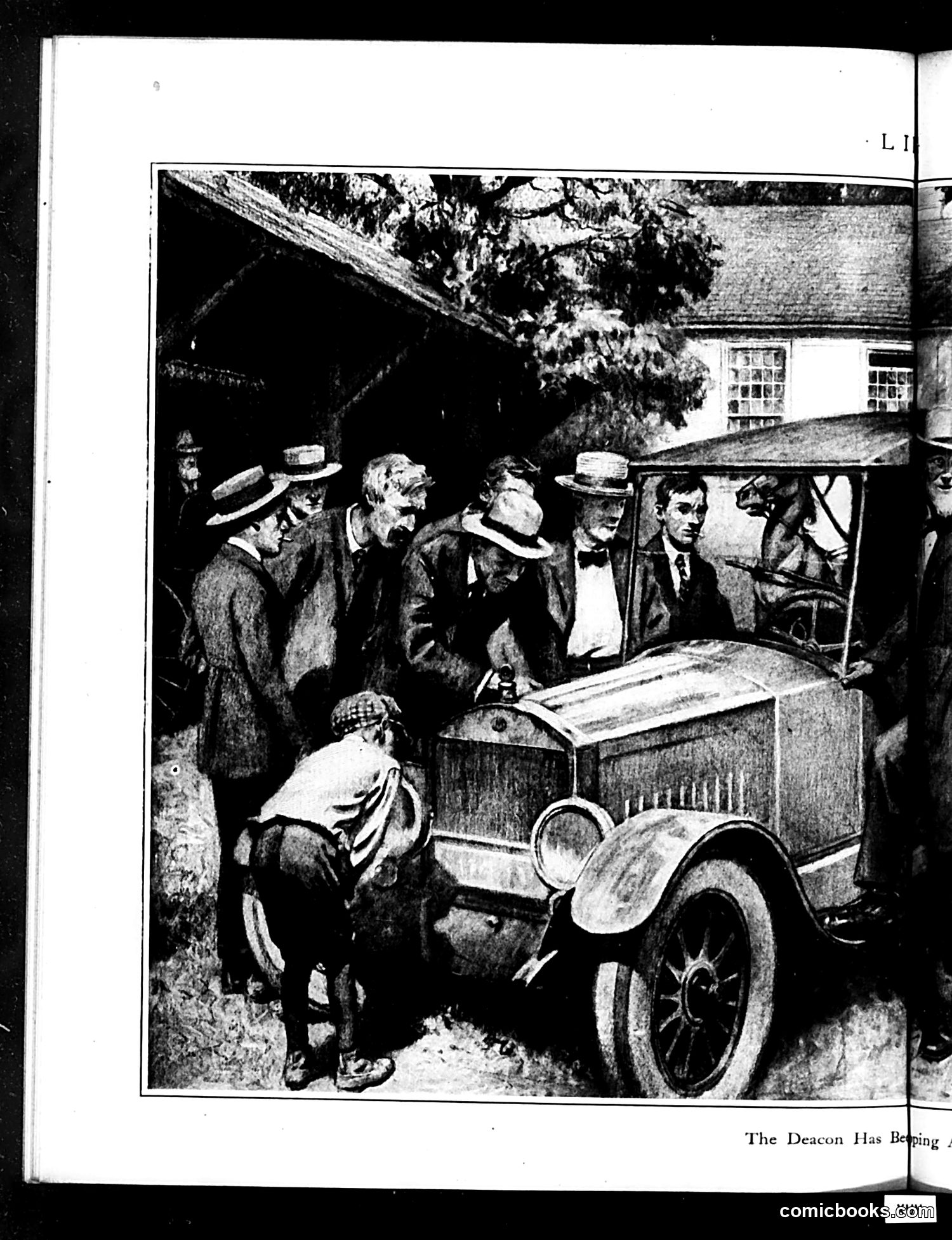
This page shows a black and white photograph or illustration (not a cartoon) depicting what appears to be a scene from a narrative or serial story. The caption reads "The Deacon Has Been..." suggesting this is part of a larger narrative. The image shows a group of men in early 20th-century clothing (straw hats, formal wear) gathered around an automobile, with a young boy in the foreground. There's a building visible in the background. The scene appears to depict some kind of dramatic moment or confrontation. Without the complete caption or surrounding context from the Life magazine issue, I cannot definitively explain the specific satirical or narrative point being made. The fragmentary text and lack of accompanying article make it unclear whether this is political satire, social commentary, or fictional storytelling.
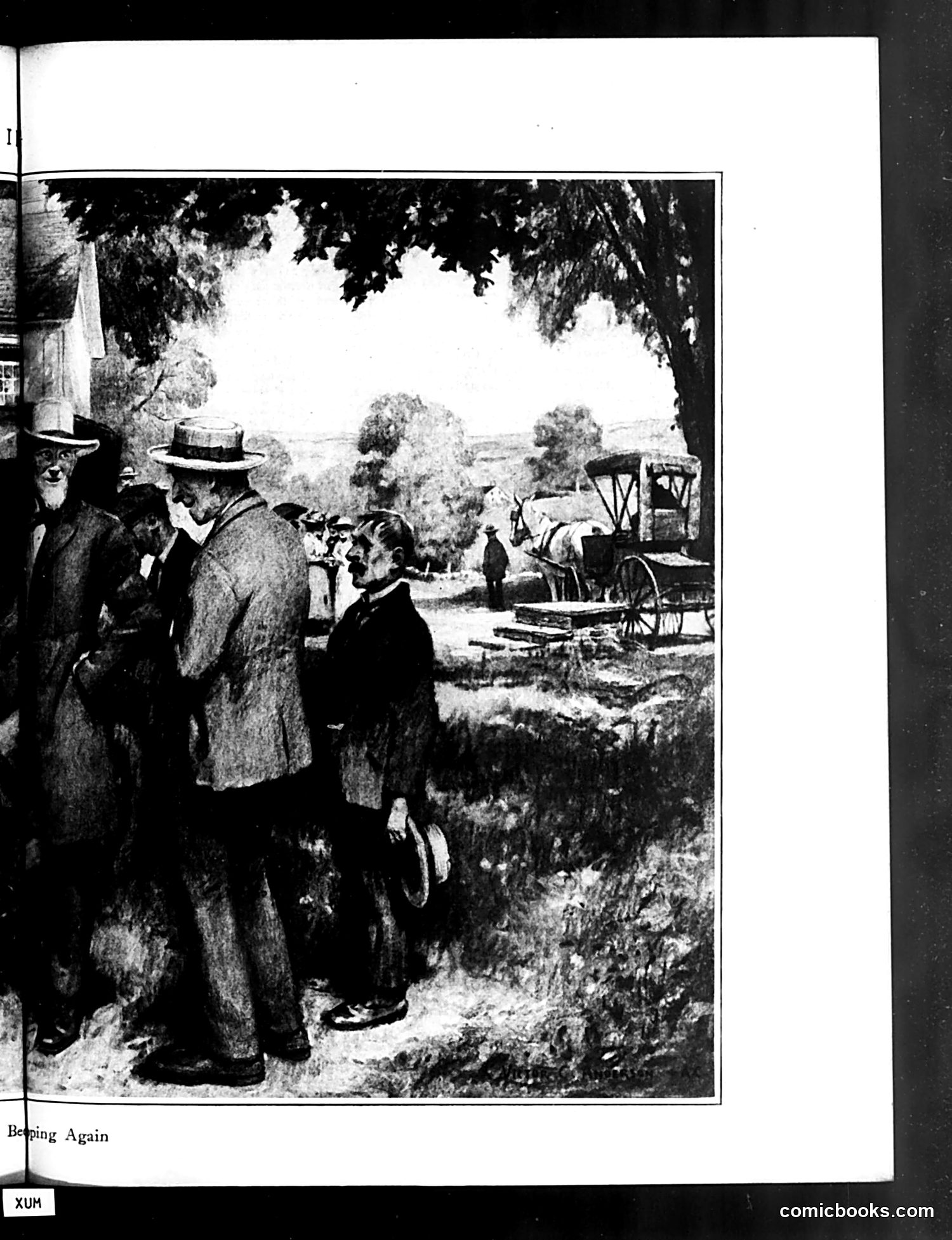
This page from *Life* magazine shows a satirical illustration titled "Beeping Again." The image depicts well-dressed gentlemen in Victorian or Edwardian-era clothing gathered under a tree, observing what appears to be road construction or repair work in the distance, with horse-drawn vehicles visible. The caption "Beeping Again" likely refers to automobile horns—a relatively modern technology at the time. The satire appears to mock the intrusion of modern machinery and noise into rural or pastoral settings, contrasting formally-dressed observers with the industrial activity they're witnessing. The gentleman's apparent disapproval or bemusement suggests social commentary on technological progress disrupting traditional ways of life. Without additional context, the specific political figures or events referenced remain unclear.
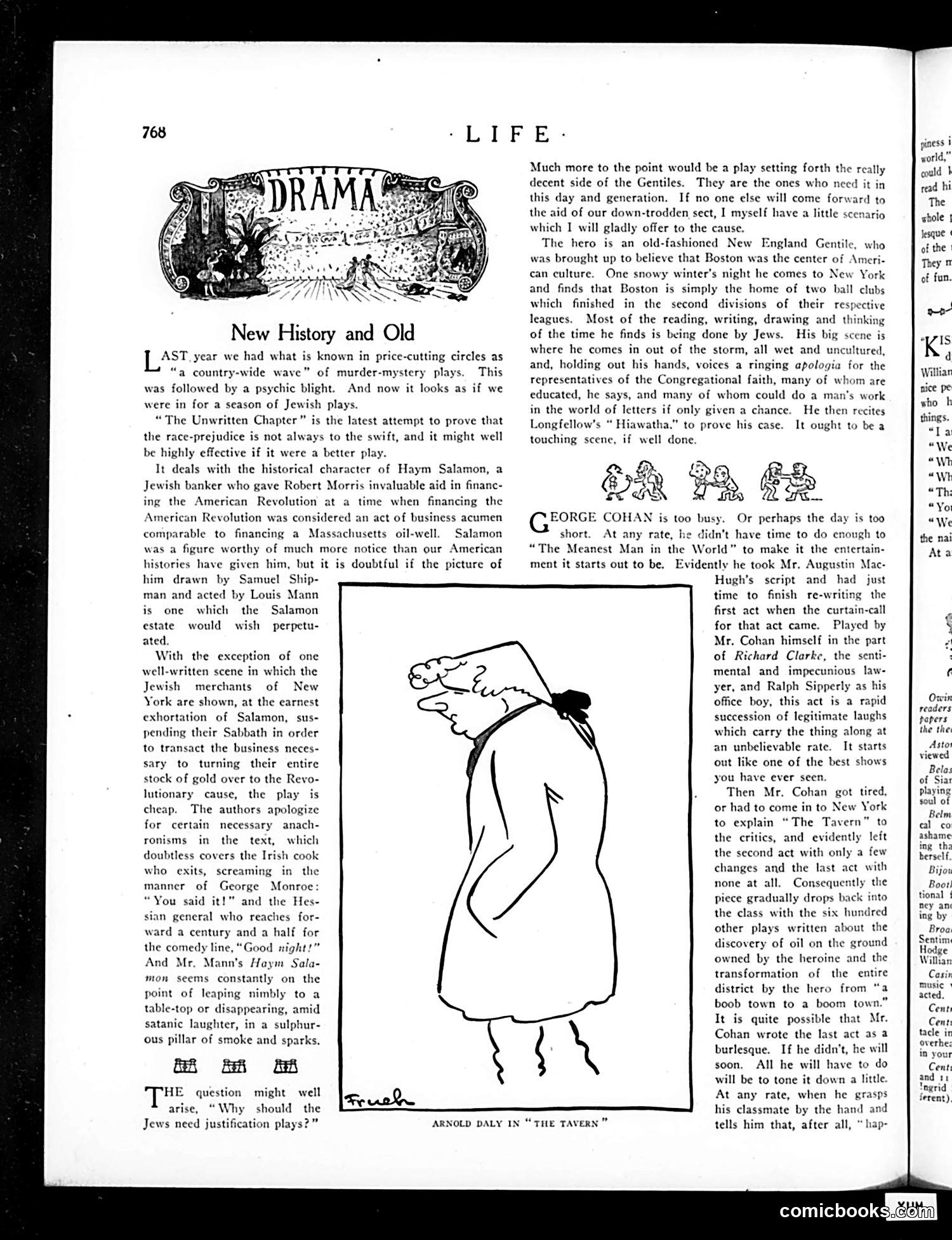
This page reviews contemporary Broadway plays, particularly addressing a perceived "season of Jewish plays." The critic dismisses "The Unwritten Chapter"—about Haym Salomon, the Jewish banker who financed the American Revolution—as poorly executed despite its worthy subject. The cartoon depicts **Arnold Daly** in "The Tavern," showing a figure in period dress. The page's satirical thrust appears in the closing argument: rather than Jewish playwrights needing to justify their community through drama, the critic sardonically proposes the *opposite*—a play featuring a "down-trodden" New England Gentile who must apologize for his cultural inferiority upon discovering that Jews dominate New York's intellectual and artistic life. This reversal reflects 1920s-era tensions around Jewish assimilation, cultural contributions, and gentile anxiety about shifting cultural hierarchies in American cities, particularly New York. The satire mocks the premise that any group needs theatrical "justification."
This page contains theater reviews from Life magazine's "Confidential Guide" section, not political cartoons. The small decorative header illustration showing cherubs with "Confidential Guide" is purely ornamental—not satirical commentary. The reviews critique Broadway productions, focusing on acting quality and dramatic merit. Robert C. Benchley (a famous critic) reviews "The Outrageous Mrs. Palmer," criticizing its reliance on a temperamental actress character who loses appeal when her son's death in France (WWI reference) makes her sympathetic. He notes the play lacks the sophistication of similar contemporary works. Other notices cover musicals like "Kissing Time" and various comedies, with brief assessments of their entertainment value. The reviews are straightforward critical commentary rather than satire—typical of Life's theater coverage during this era before it became primarily a photojournalism magazine.
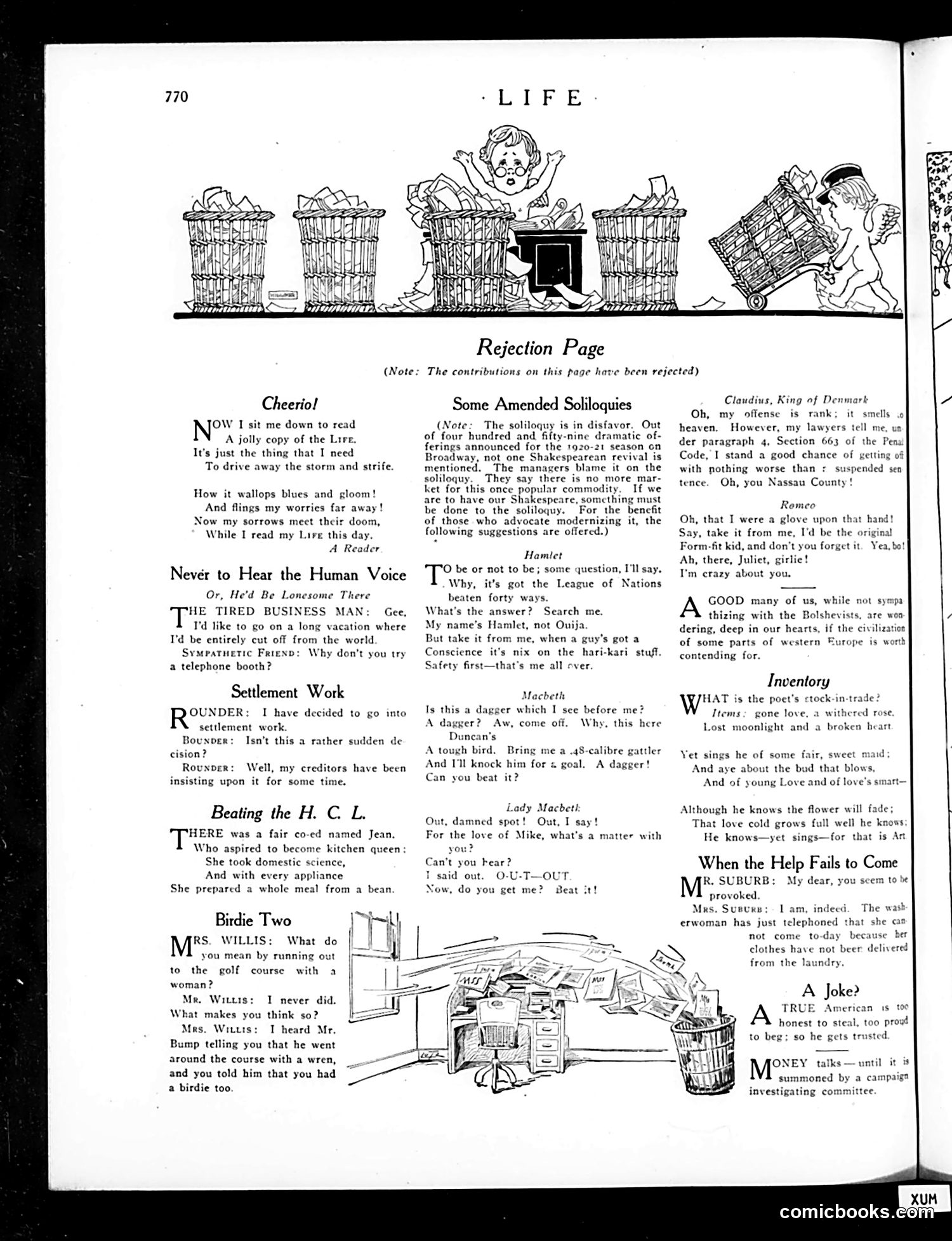
This is a humor page featuring rejected submissions to Life magazine. The top illustration shows overflowing waste baskets and a cherub emerging from one—a visual metaphor for rejected material. The page collects deliberately weak jokes and puns that didn't meet publication standards. Notable examples include: - **"Beating the H.C.L."**: A limerick about a co-ed making a meal from a single bean—satirizing wartime food rationing and high cost-of-living (H.C.L.). - **"Birdie Two"**: A golf joke playing on "birdie" (golf term) and actual birds. - **"Some Amended Soliloquies"**: Modernized Shakespeare (Hamlet, Macbeth, Romeo) in contemporary slang—mocking attempts to update classic works for 1920s audiences, with references to the League of Nations and .48-calibre guns. The collection mocks both failed submissions and contemporary trends: wartime economics, Bolshevism anxiety, and theatrical modernization. It's self-aware humor about why certain material doesn't work—the magazine's way of being playfully dismissive while entertaining readers.
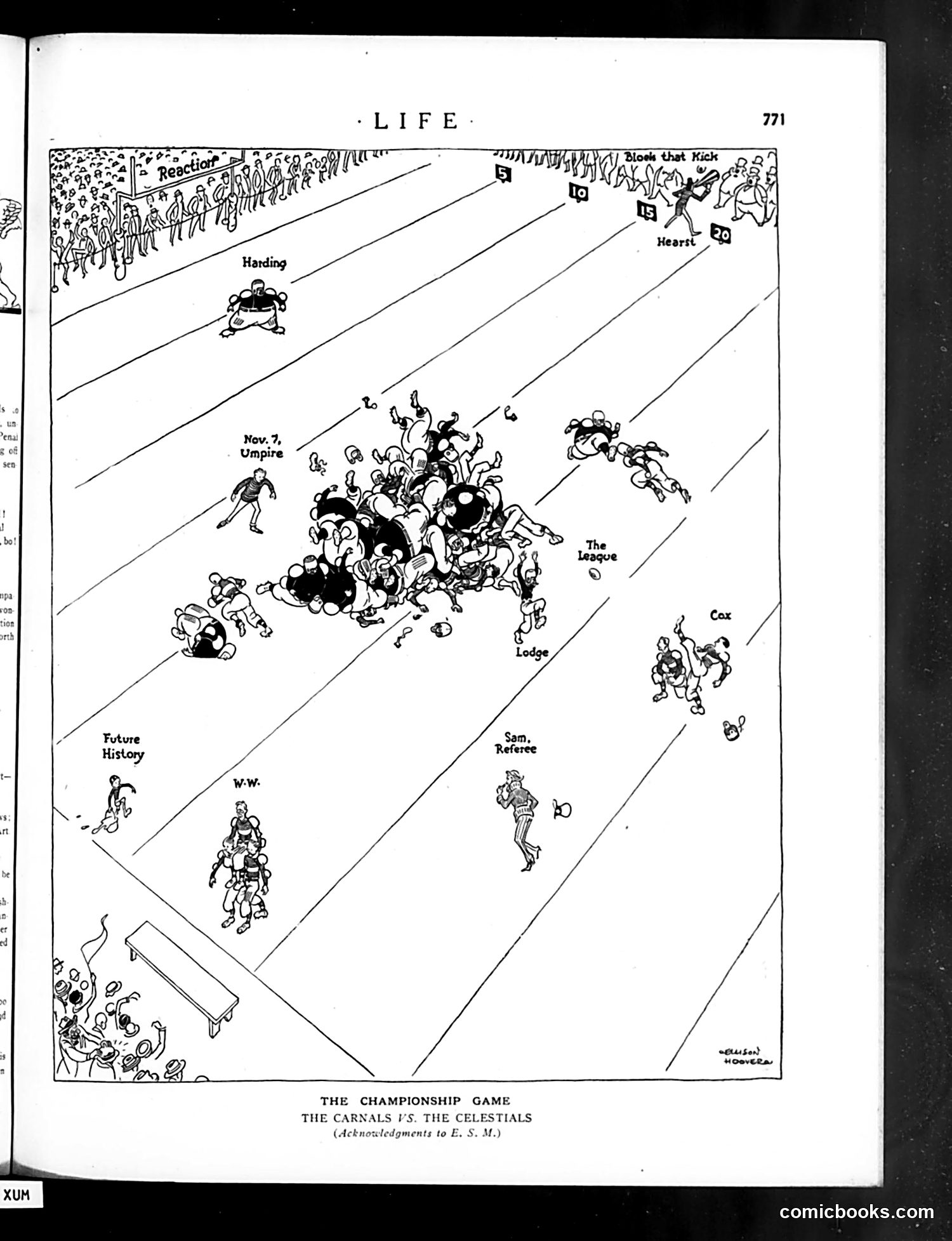
This satirical cartoon depicts a chaotic football game between "The Carnals" and "The Celestials"—representing worldly/physical versus spiritual/heavenly forces. The field shows various labeled figures including "Heart," "The League," "Lodge," and others, suggesting different social institutions and human drives competing for dominance. Key elements include a massive central collision of players, an umpire labeled "Nov. 7" (likely referencing a specific election date), and sideline figures like "Harding" (Warren G. Harding, U.S. President), "W.W." (unclear), "Sam, Referee," and "Cox" (likely James M. Cox, 1920 presidential candidate). "Future History" appears as a distant observer. The cartoon satirizes American society as a battle between competing moral and social forces, with politics and institutions as the "players." The credited acknowledgment suggests this references a specific contemporary commentary or event.
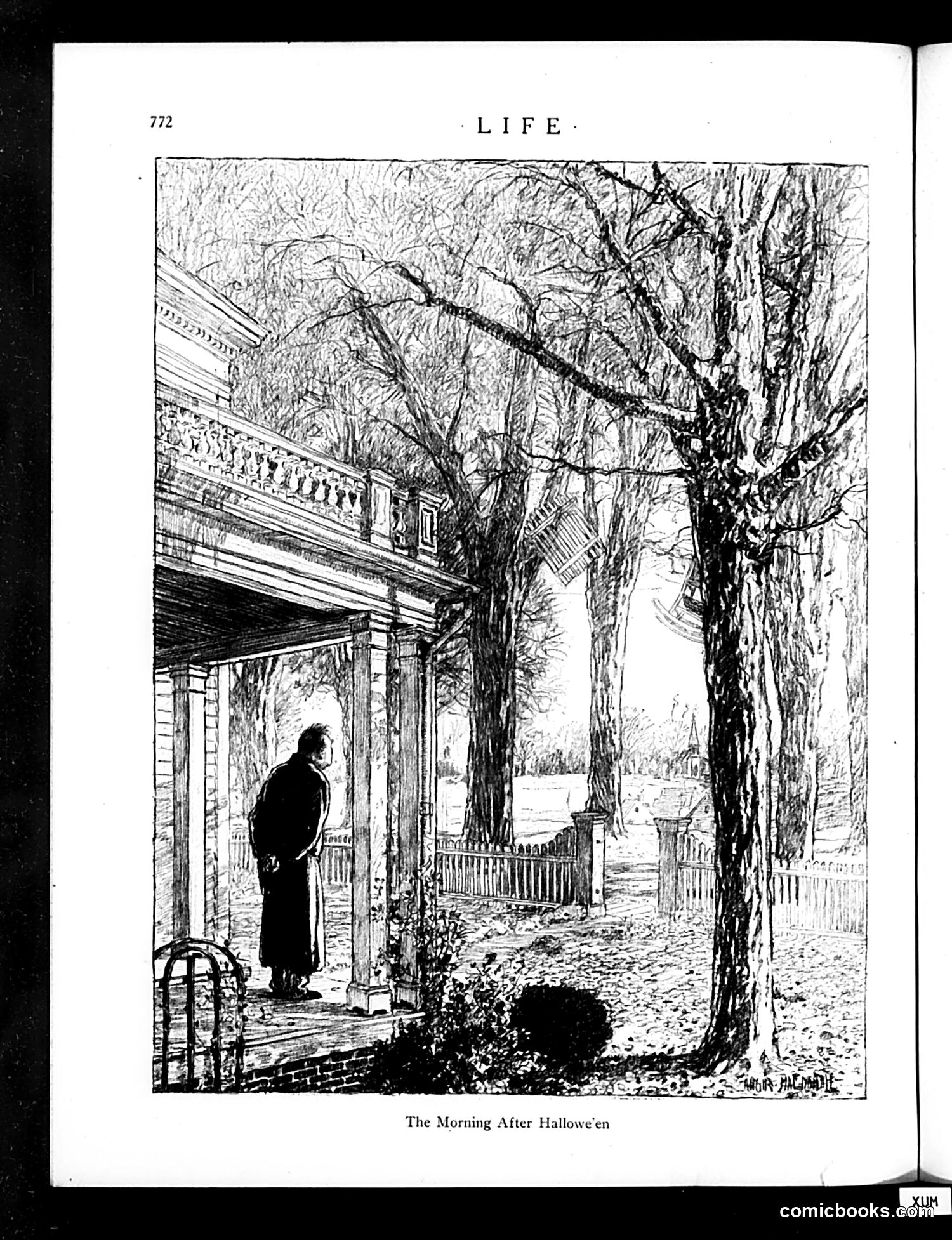
This is a black-and-white illustration showing a solitary figure in dark clothing standing on a house porch, gazing out at a rural landscape with bare trees and a fence. The title references the morning following Halloween night. The image appears to be a contemplative or melancholic scene rather than satirical commentary. Without additional context or visible caricatures, the specific political or social satire is unclear. The composition suggests themes of reflection, loneliness, or the contrast between Halloween's revelry and the quiet aftermath. The piece may simply be a atmospheric illustration exploring mood and nostalgia rather than commentary on current events or public figures typical of *Life* magazine's satirical content. More contextual information would be needed to determine if there's intended social criticism.
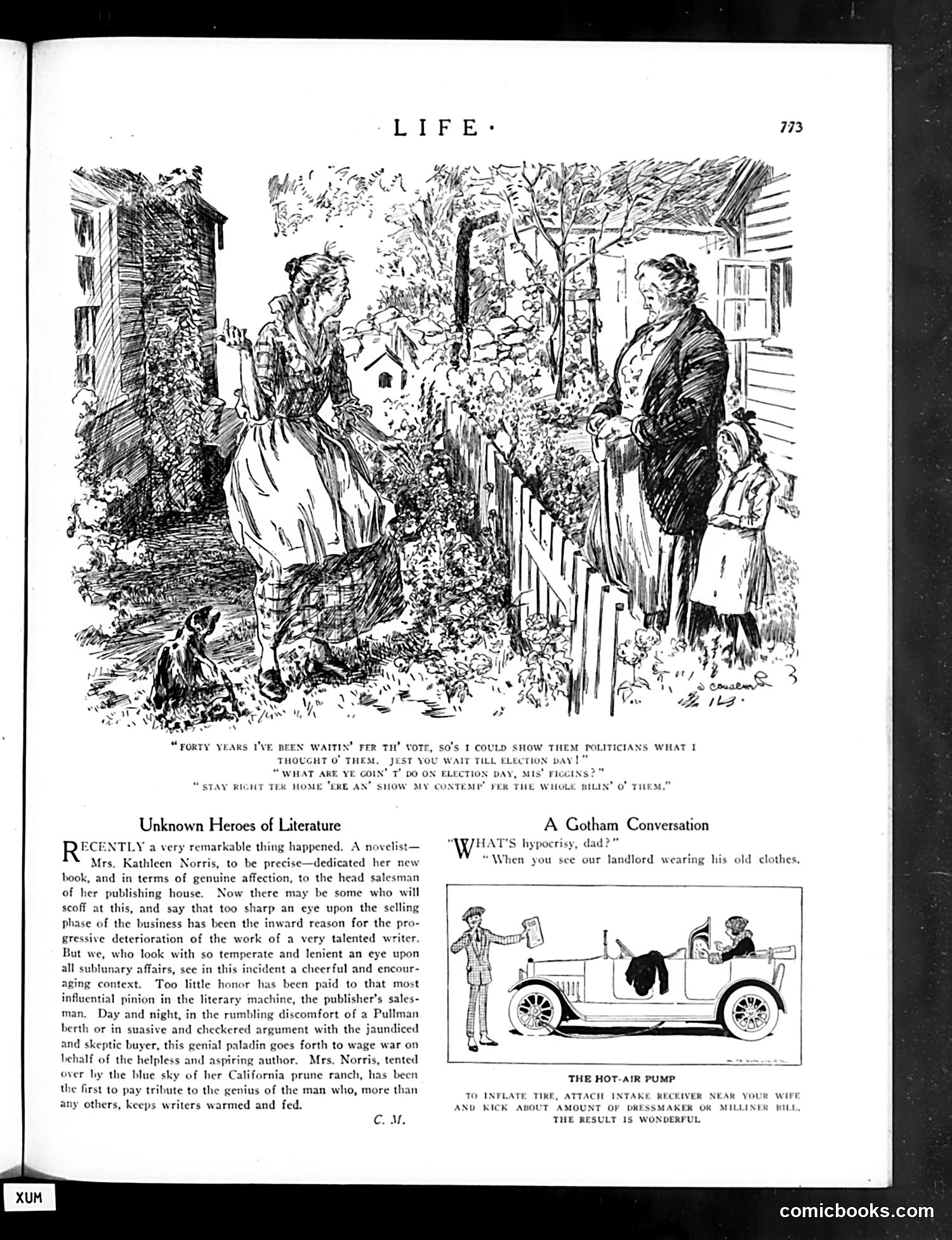
The top cartoon satirizes women's newly won voting rights (likely referencing the 19th Amendment, 1920). An elderly woman declares she's waited forty years to vote and "show them politicians what I thought o' them." When asked her election day plans, she announces she'll stay home to demonstrate her contempt for all politicians. The joke's bitter irony: after decades fighting for suffrage, she expresses her freedom by refusing to vote—suggesting voter disillusionment or cynicism about whether politicians deserved the responsibility women fought to gain. It critiques both the limitations of voting as meaningful political change and possibly women's frustration that gaining the vote didn't translate to actual political power or representation. The lower cartoon, "A Gotham Conversation," defines hypocrisy through domestic economics: a father describes seeing their landlord wear shabby clothes while complaining about his wife's dressmaker bills—exposing class hypocrisy and financial pretense among landlords.
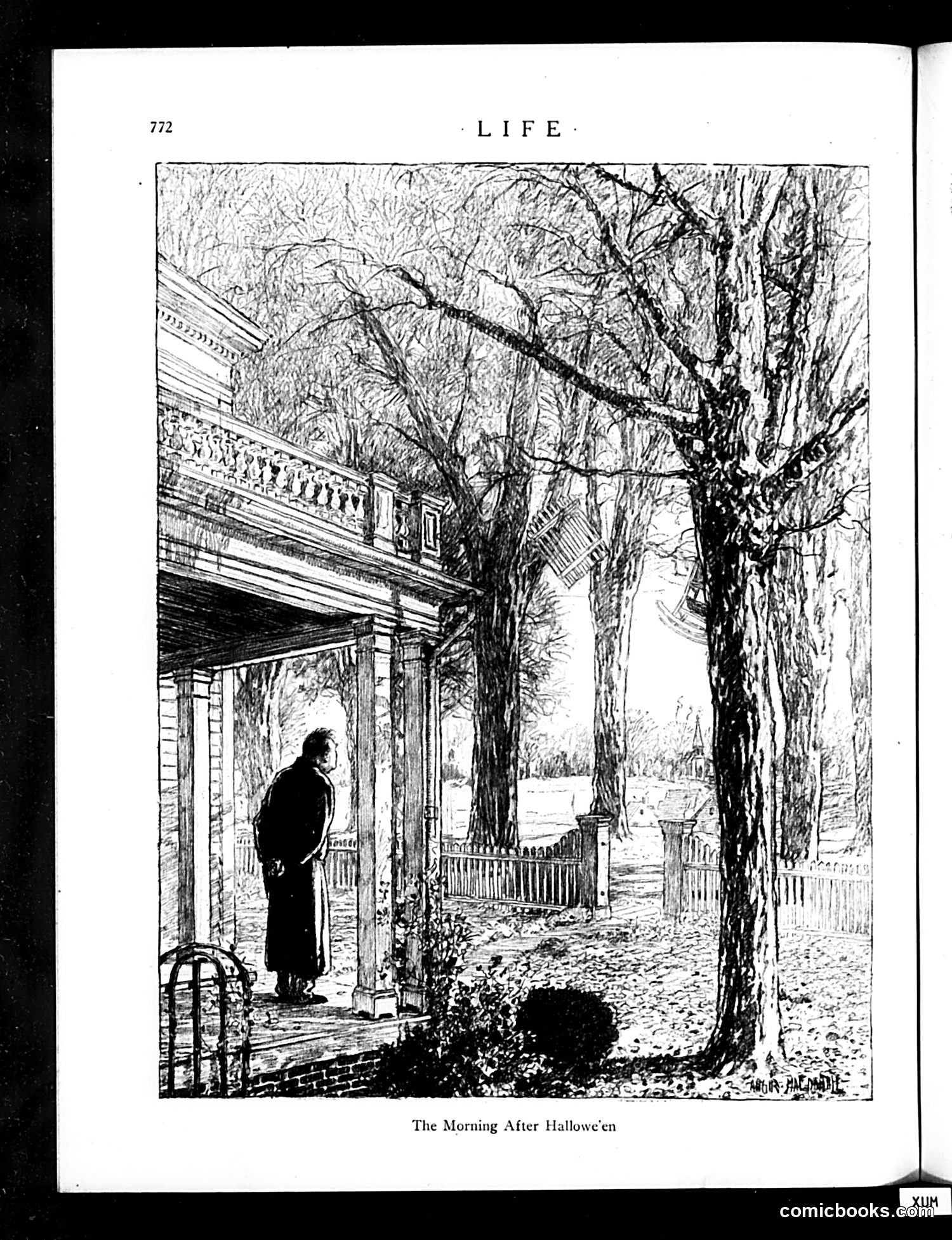
This is a pen-and-ink illustration from *Life* magazine depicting a solitary figure in dark clothing standing on a house porch, gazing out at a bare, autumn landscape. The scene conveys melancholy and reflection. The title suggests this illustrates the emotional letdown following Halloween celebrations—a common theme in American culture of the era. The figure's posture and the desolate scenery (bare trees, empty grounds) evoke a sense of anticlimax or loss after festivity ends. Without additional context from the magazine's surrounding text or date, the precise satirical intent remains unclear. However, the image appears to be a straightforward commentary on post-holiday emotional deflation rather than political satire. The artistic style and sensibility suggest early-to-mid 20th century publication.
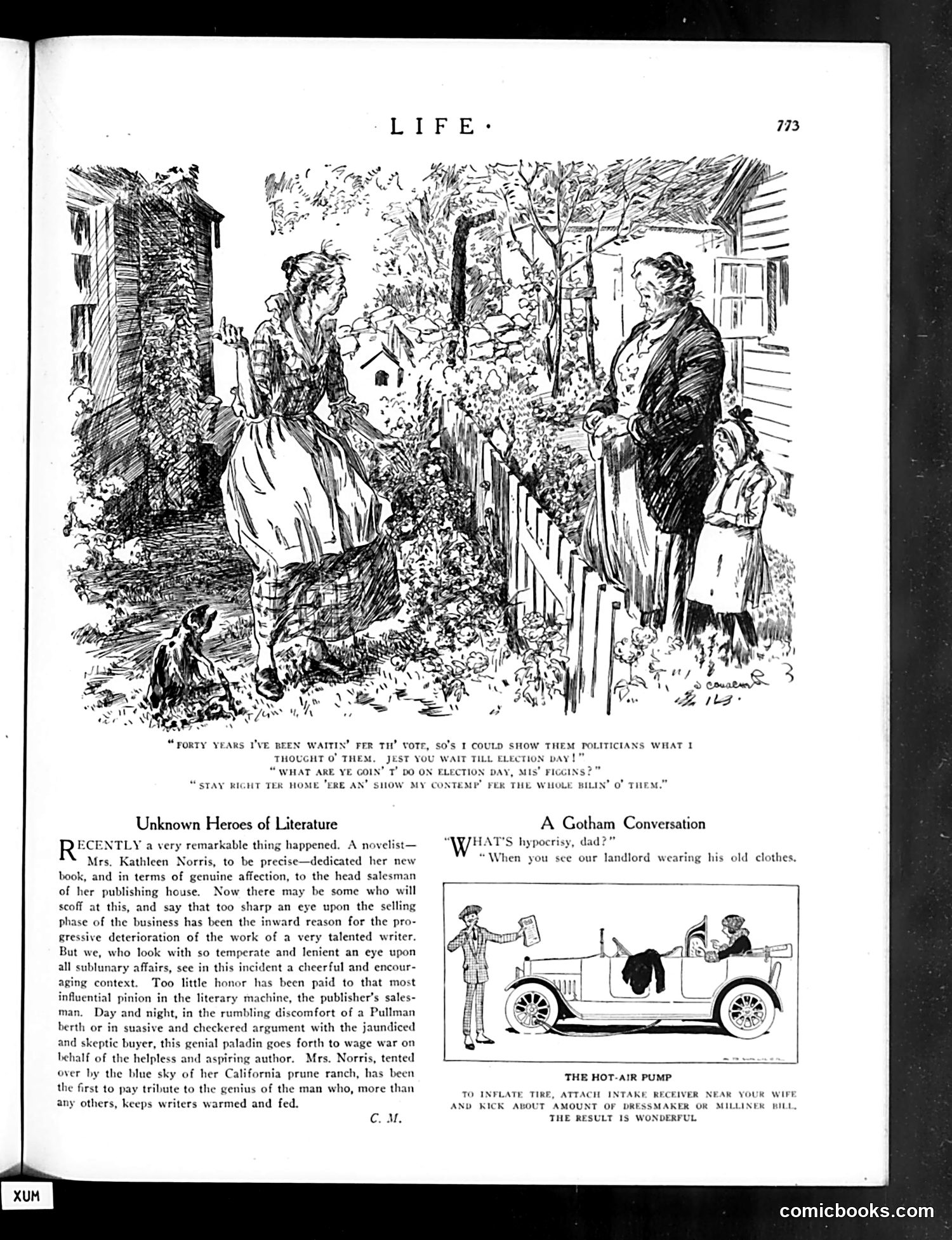
**Top Cartoon**: This depicts female suffrage frustration. A woman, having waited forty years for voting rights, plans to express her contempt for politicians by staying home on election day rather than voting. The satire mocks both the absurdity of this protest strategy and, implicitly, the delay in granting women's suffrage—she's waited four decades only to abstain. The dialect suggests working-class commentary on political disillusionment. **"Unknown Heroes of Literature"**: A brief essay praising novelist Kathleen Norris for dedicating her book to her publisher's head salesman. It celebrates the often-overlooked role of salesmen in supporting writers' careers and livelihoods, treating commercial success as worthy of literary recognition rather than beneath serious artistic consideration. **"A Gotham Conversation"**: A humorous domestic sketch defining hypocrisy: a father explains it by pointing to their landlord wearing shabby clothes (implying the landlord is actually wealthy but pretends poverty to avoid appearing ostentatious). **"The Hot-Air Pump"**: A joke about using marital complaints about spending as "hot air" to inflate car tires.
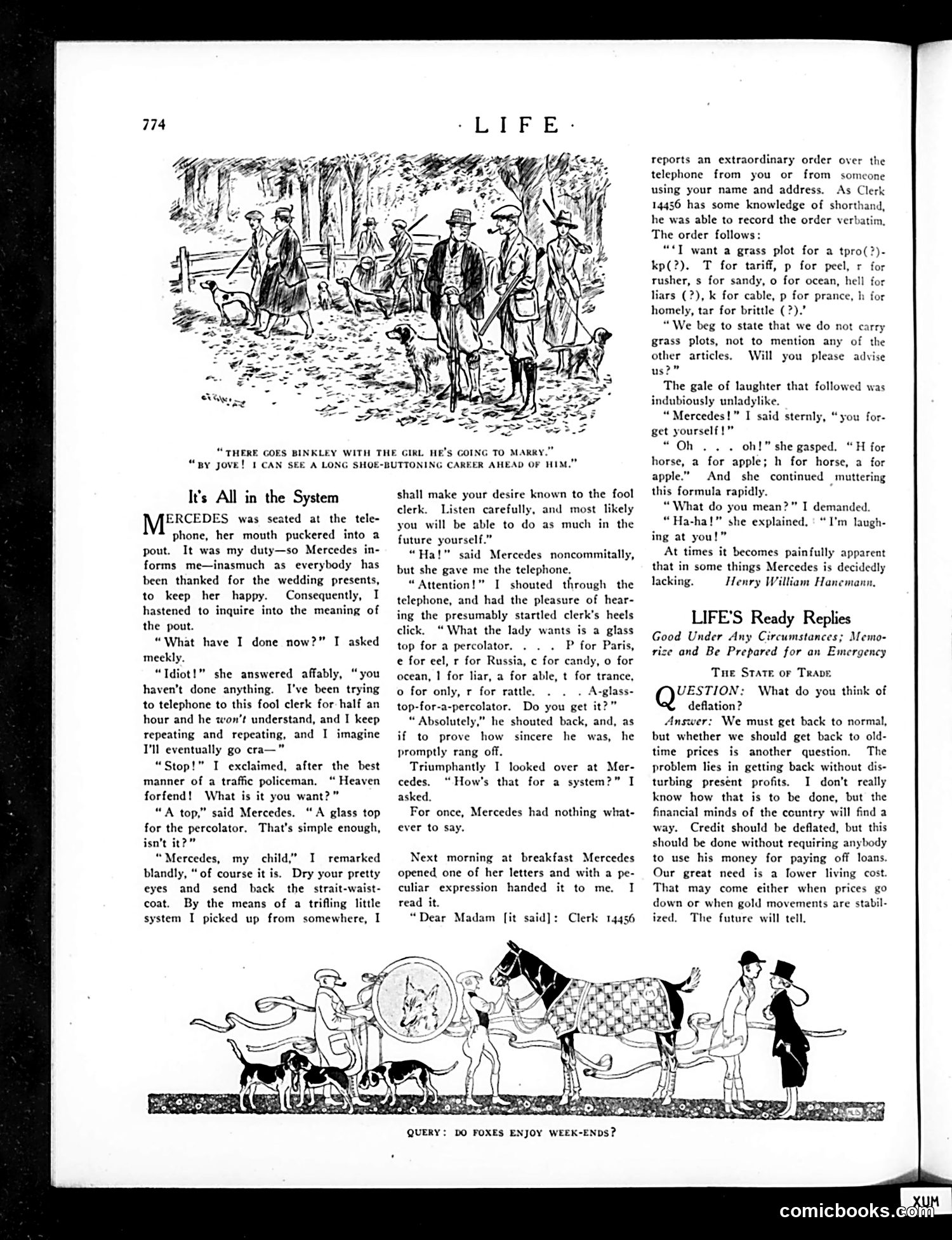
This is a humorous domestic comedy story satirizing the disconnect between husbands and wives, and the futility of "systematic" solutions to communication problems. The narrator devises an elaborate phonetic spelling system to order a glass percolator top from a telephone clerk—spelling each letter with words (P for Paris, etc.). He's proud of this "system," but the clerk mishears it catastrophically, recording "grass plot," "hell for liars," and "tar for brittle." The joke exposes the absurdity of the husband's condescension toward his new wife Mercedes. His complicated "system" fails worse than simple direct speech would have. Mercedes gets the last laugh, laughing at him while she mutters the correct phonetic alphabet. The accompanying cartoon above shows a similar marital dynamic about wedding presents and domesticity, with the caption joking that Binkley faces a lifetime of "shoe-buttoning" (domestic servitude). The satire targets masculine overconfidence and the gap between male pretensions of logical problem-solving and actual domestic reality.
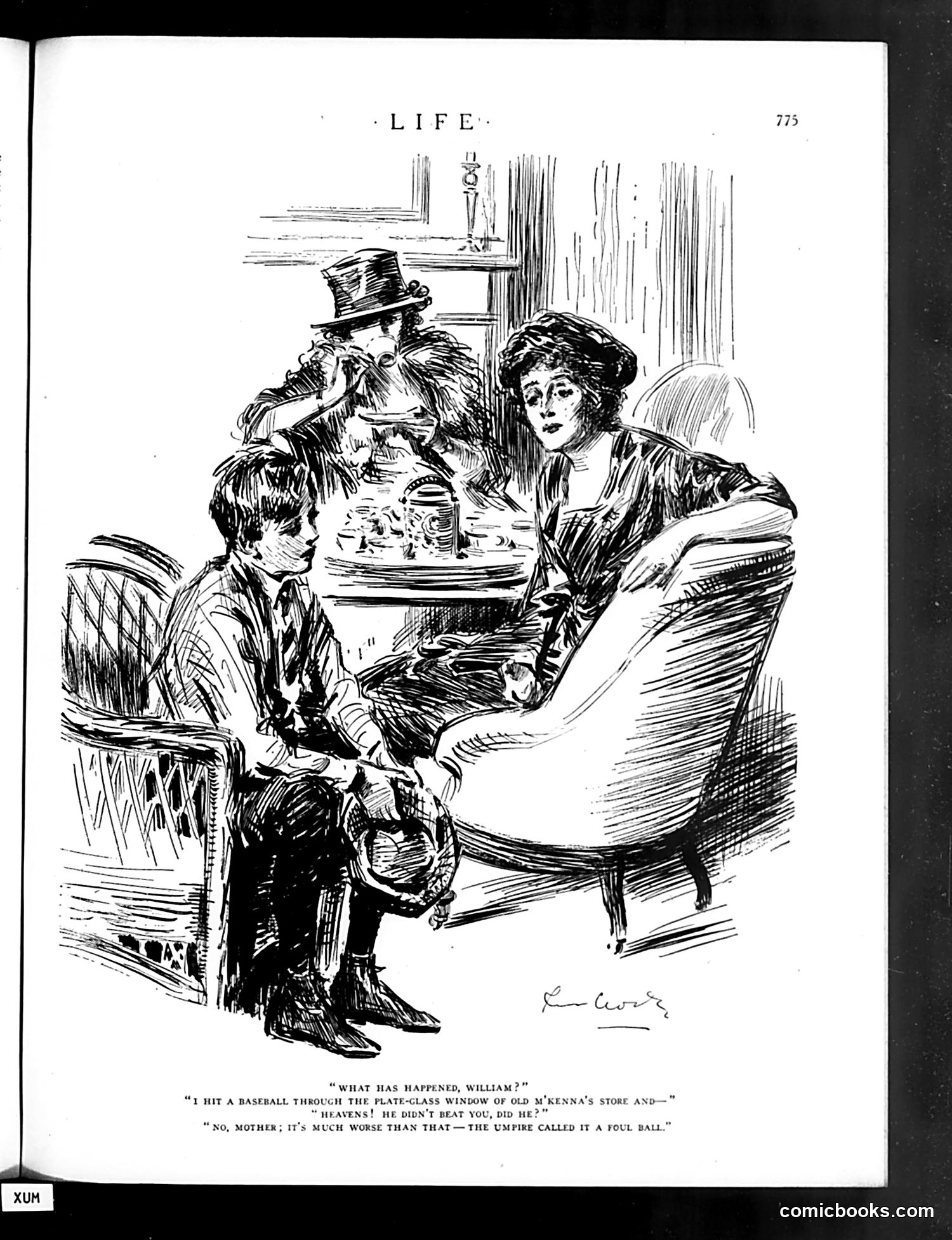
This is a humorous domestic scene satirizing baseball culture and parental priorities. A boy (William) reports breaking a store window with a baseball to his concerned mother and another adult (likely his father, in the top hat). The joke's twist: the mother fears the store owner beat the boy—a reasonable punishment for property damage. But William says something "much worse" happened: the umpire called it a foul ball, meaning the rule-breaking invalidated the play itself. The satire mocks how seriously Americans took baseball and its rules, suggesting that among baseball enthusiasts, an embarrassing sporting violation was worse than actual property damage. It's gentle social commentary on the era's baseball obsession and the inverted values of devoted fans.
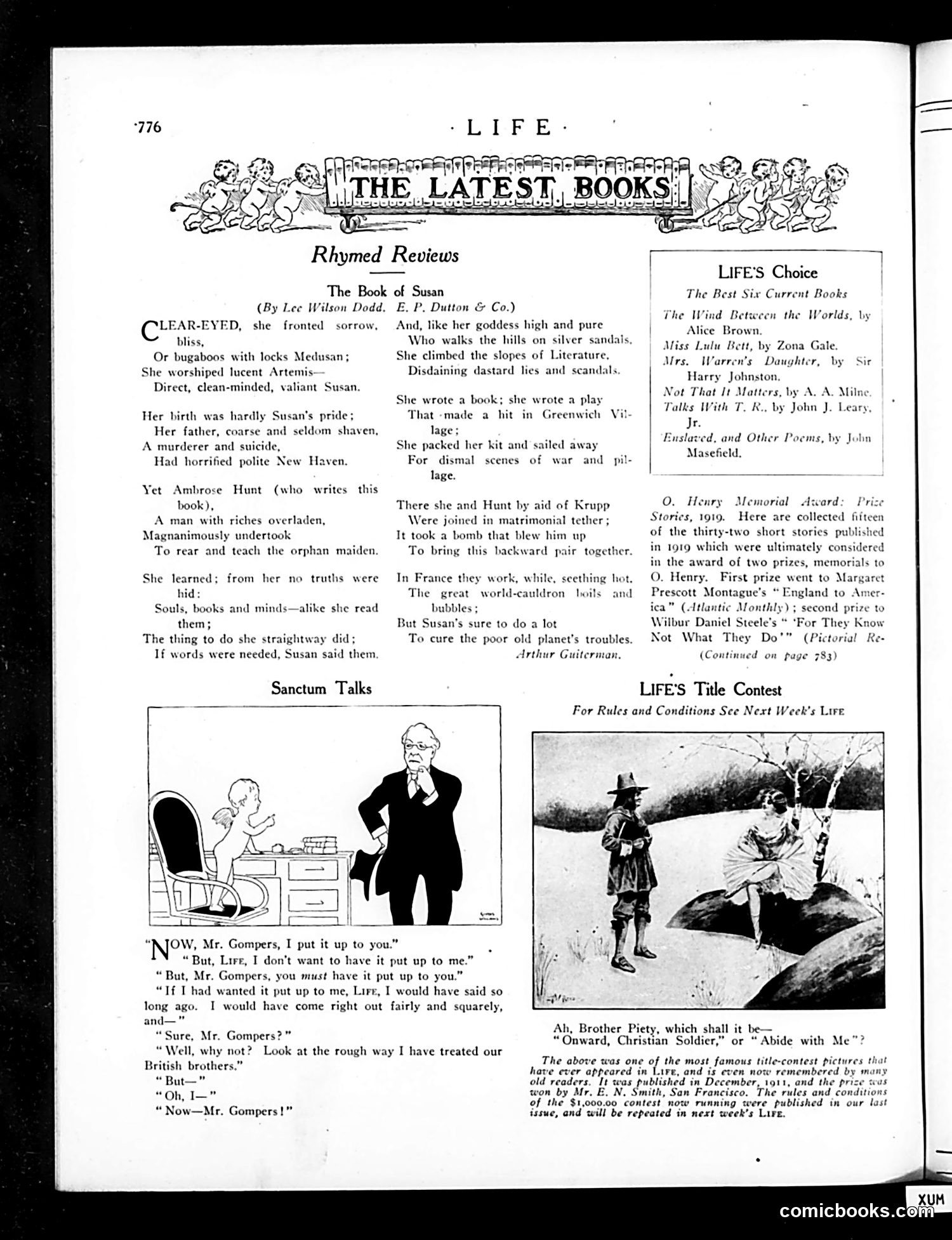
This cartoon satirizes labor leader **Samuel Gompers** (head of the American Federation of Labor), depicted as a stubborn negotiator. The joke turns on a play of words: "Life" (the magazine's personified mascot) repeatedly insists on "putting it up to" Gompers—meaning presenting him with a proposal or decision. Gompers resists, claiming he doesn't want things "put up to" him, then contradicts himself by saying if he *had* wanted it, he would have said so already. The satire mocks Gompers' evasiveness and reluctance to take clear positions during labor disputes. His reference to treating "British brothers" roughly suggests contentious union negotiations of the era. The cartoon captures the frustration of dealing with someone who refuses direct commitment or clear answers—a common criticism of Gompers during early 20th-century labor conflicts. The page itself is primarily a book review section, not political commentary.
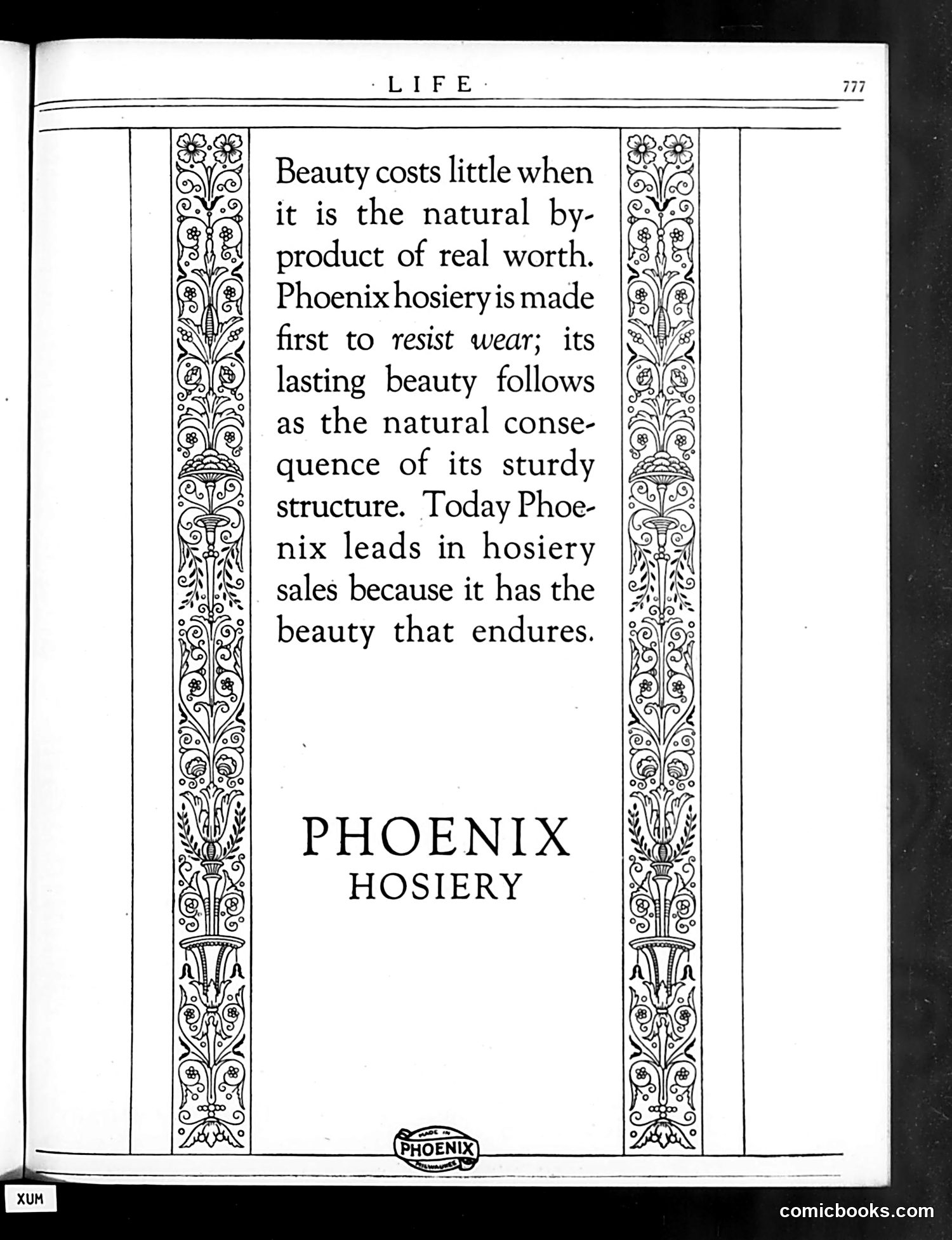
This is a full-page advertisement for Phoenix Hosiery, not a political cartoon. The page features ornamental decorative borders flanking centered text that promotes women's stockings. The ad's message emphasizes that Phoenix hosiery's beauty comes from its durability and quality construction rather than superficial design. It argues that because the product is made to "resist wear," its attractiveness naturally follows from this sturdy engineering. The copywriting suggests Phoenix leads in sales because customers value lasting practicality over temporary aesthetics. For modern readers: this reflects early 20th-century advertising strategy, appealing to consumers' rational self-interest (durability and value) while still promising beauty—common marketing for utilitarian goods marketed to women.
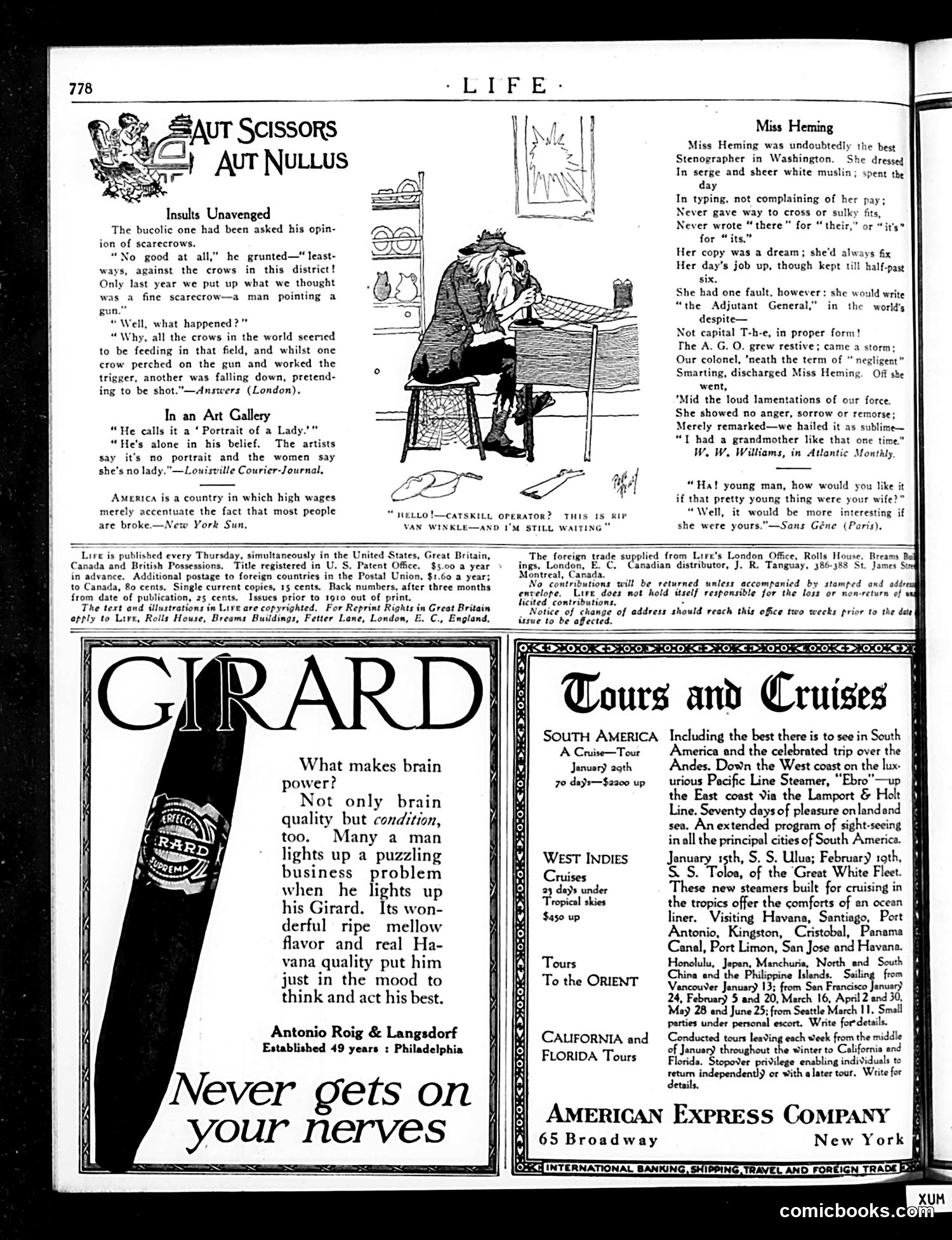
This page contains several brief humorous anecdotes typical of Life's satirical format, plus advertisements. The main cartoon/comic content includes: - A rural dialogue mocking a farmer's scarecrow failure: crows were so clever they worked the gun's trigger and faked being shot - An art gallery joke about an unflattering portrait - A stenographer story about "Miss Heming," a perfect typist discharged for one quirk: refusing to capitalize "the" in "The Adjutant General," which technically violated military protocol The humor targets bureaucratic rigidity (firing an excellent employee over formatting), human vanity (bad art defended as portraits), and animal intelligence (outwitting scarecrows). The page is primarily **advertising-driven**, featuring Girard cigars and American Express travel cruises. The Girard ad claims cigars aid business problem-solving—a period advertising trope linking smoking to masculine success and clear thinking.
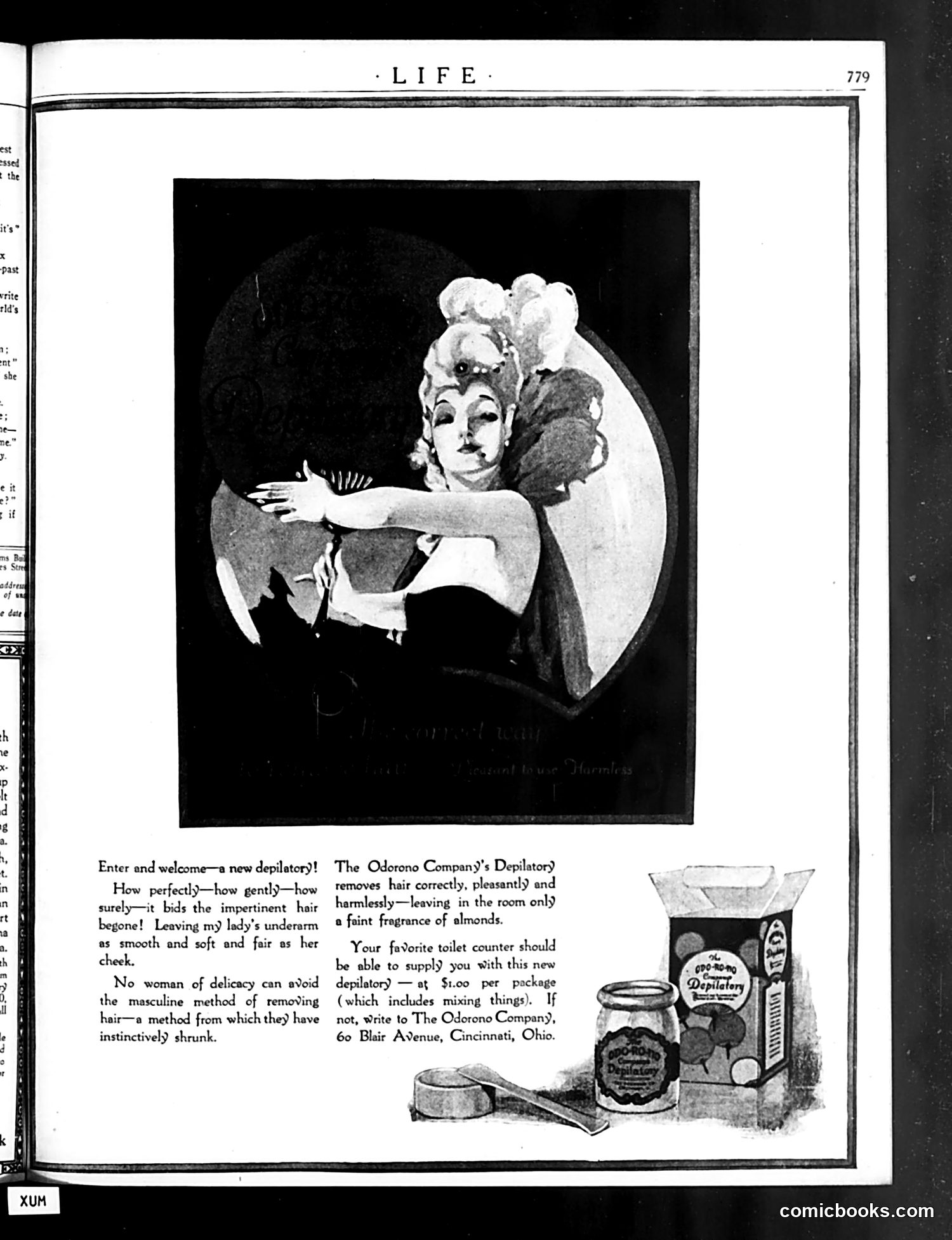
This is an **advertisement** for Odorono's depilatory product, not political satire. The page promotes hair removal for women's underarms—then a novel beauty concern. The illustration shows a glamorous woman examining her underarm, styled in 1920s fashion with elaborate hair and makeup. The accompanying text uses period-appropriate language emphasizing "delicacy" and femininity, positioning hair removal as essential for proper womanhood. Key context for modern readers: **underarm hair removal was not standard practice until the early 20th century.** This ad helped normalize the practice by framing natural body hair as "impertinent" and unfeminine. The emphasis on the product being "pleasant" and leaving only "faint fragrance of almonds" addresses women's likely hesitation about chemical depilatories. The $1.00 price and mail-order option indicate this was a premium product for affluent consumers. This represents early **consumer advertising targeting female insecurity**—a marketing strategy that became dominant throughout the 20th century.
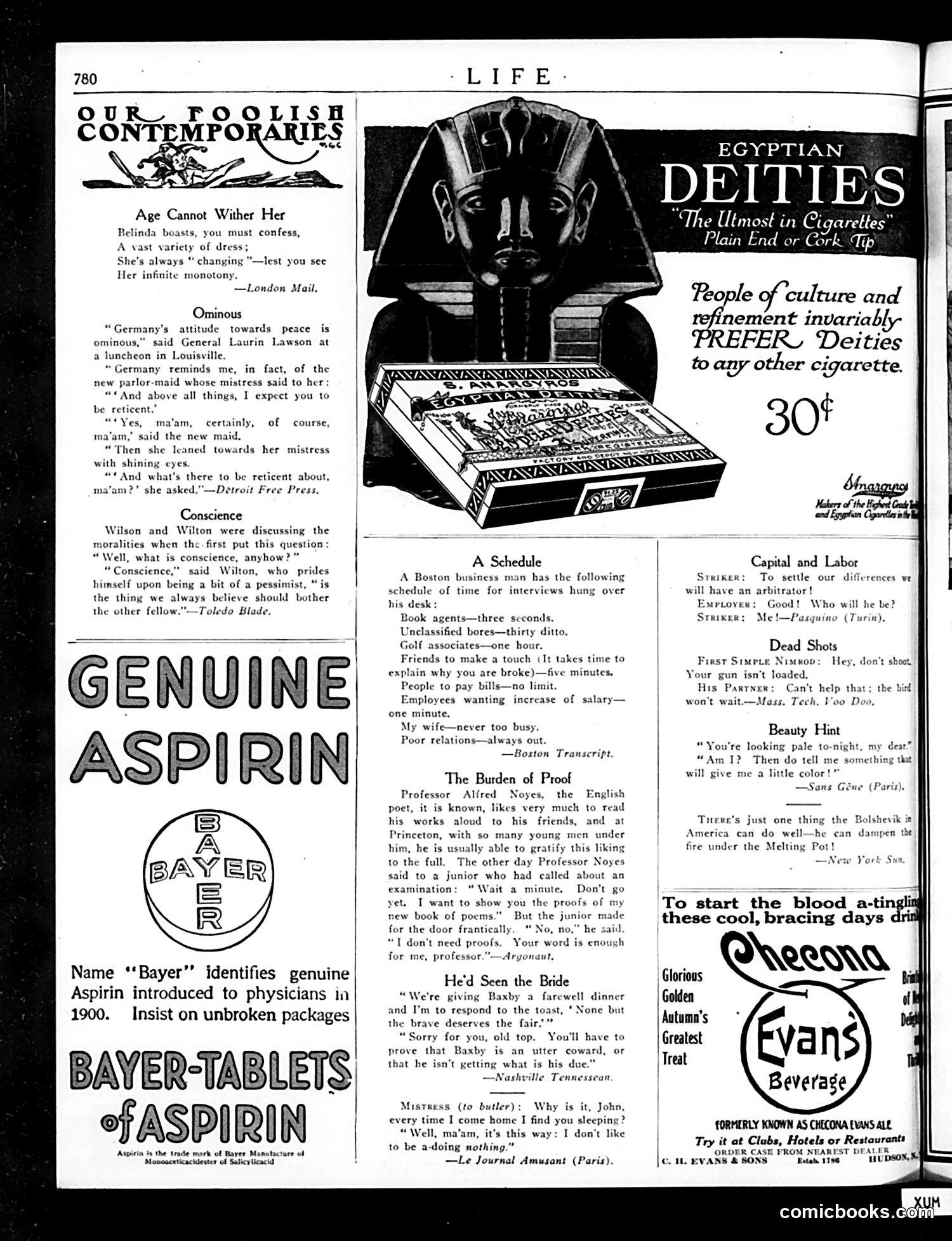
This page consists primarily of **short humorous anecdotes and advertisements** rather than political cartoons. The jokes target social foibles of the era: **"Age Cannot Wither Her"** mocks a woman named Belinda for constantly changing appearance to hide monotony. **"Ominous"** uses a parlor-maid anecdote to satirize Germany's diplomatic stance (likely pre-WWI tension). **"Conscience"** presents cynical commentary: conscience is what we believe *should* bother others, not ourselves. **"The Burden of Proof"** jokes about Professor Alfred Noyes's reputation for reading his poetry aloud—so tedious a junior flees rather than hear new work. **"Dead Shots"** offers dark humor about incompetent hunting. The advertisements—**Bayer Aspirin** and **Egyptian Deities cigarettes**—are period typical. The page exemplifies Life's satirical format: short, biting observations on vanity, hypocrisy, and social pretension aimed at educated readers.
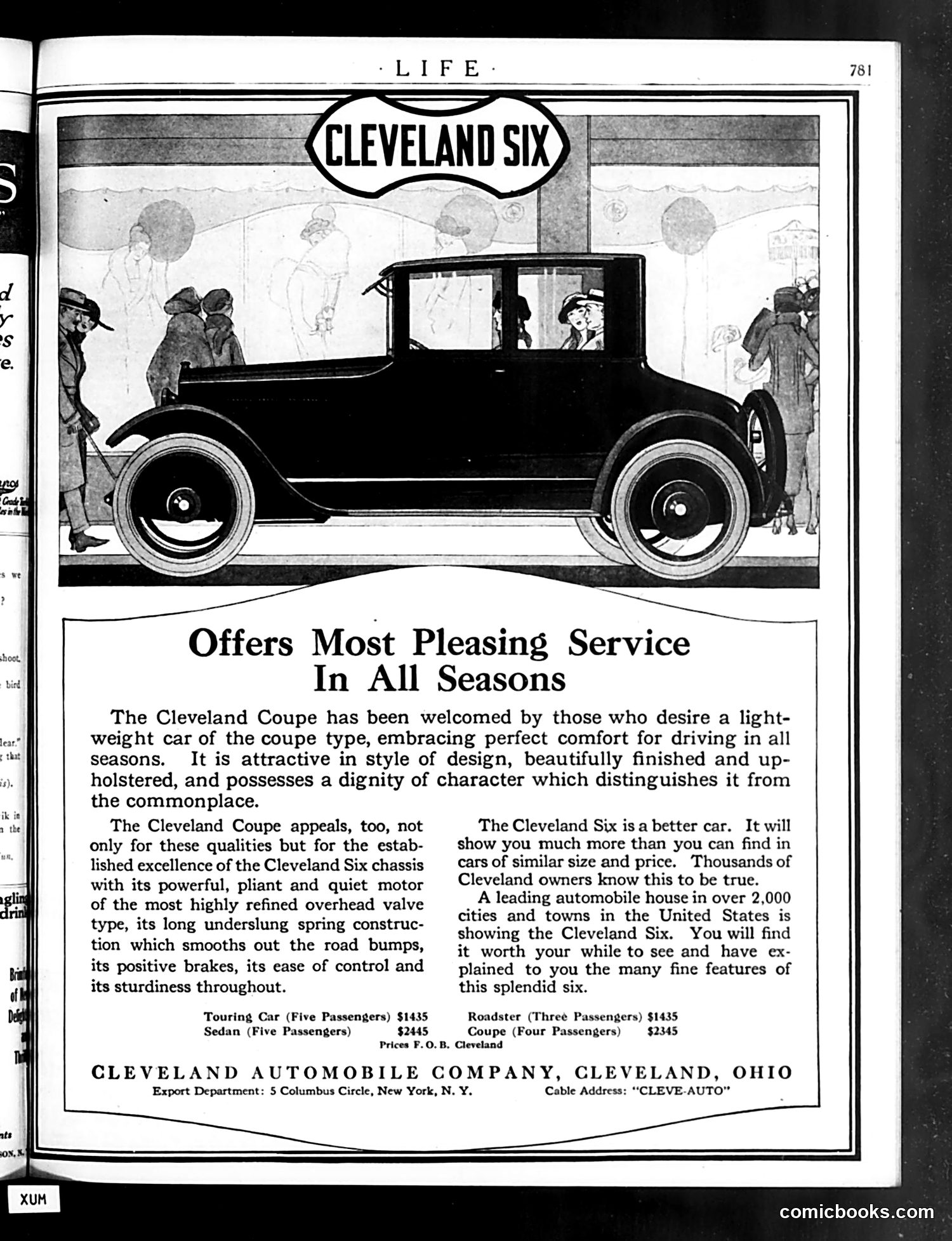
This is not a political cartoon but a **full-page automobile advertisement** from *Life* magazine (page 781). It promotes the Cleveland Six automobile manufactured by the Cleveland Automobile Company in Ohio. The ad features an illustration of a sleek, black coupe with well-dressed passengers and pedestrians in period clothing, emphasizing the car's stylish appeal. The text highlights the vehicle's engineering features—overhead valve motor, underslung springs, powerful brakes—positioning it as superior to competing coupes of similar price and size. Four models are listed with prices ranging from $1,435 to $2,445 (F.O.B. Cleveland). The ad notes the car is available at dealerships in over 2,000 U.S. cities and towns. There is no satire or political commentary—this is straightforward commercial advertising typical of early automotive marketing in American magazines.
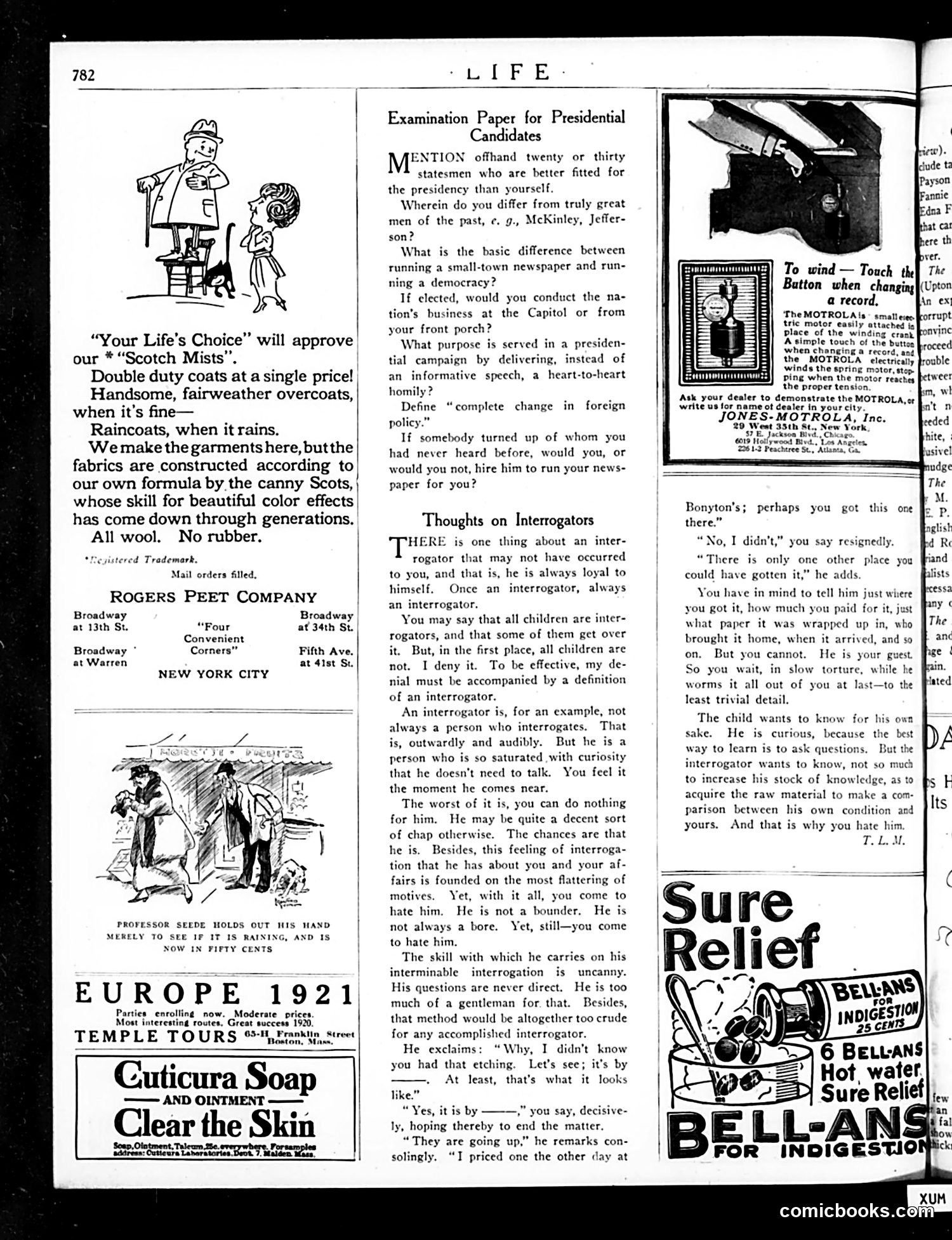
This page contains two main satirical pieces: 1. **"Examination Paper for Presidential Candidates"** — A mock test ridiculing candidates' fitness for office. It asks absurd questions like whether they'd run the nation from the Capitol or "front porch" (likely referencing Warren G. Harding's famous "Front Porch Campaign" of 1920), and sarcastically demands they name statesmen better qualified than themselves. The satire mocks the superficiality of campaign rhetoric and suggests most candidates lack genuine qualifications. 2. **"Thoughts on Interrogators"** — A humorous essay defining the annoying personality type obsessed with asking questions. The author describes interrogators as perpetually curious people who drive others to distraction through indirect, relentless questioning disguised as polite conversation—all while insisting they mean well. The remaining content is period advertising (Rogers Peet clothing, Cuticura Soap, Temple Tours, Bellans indigestion remedy).
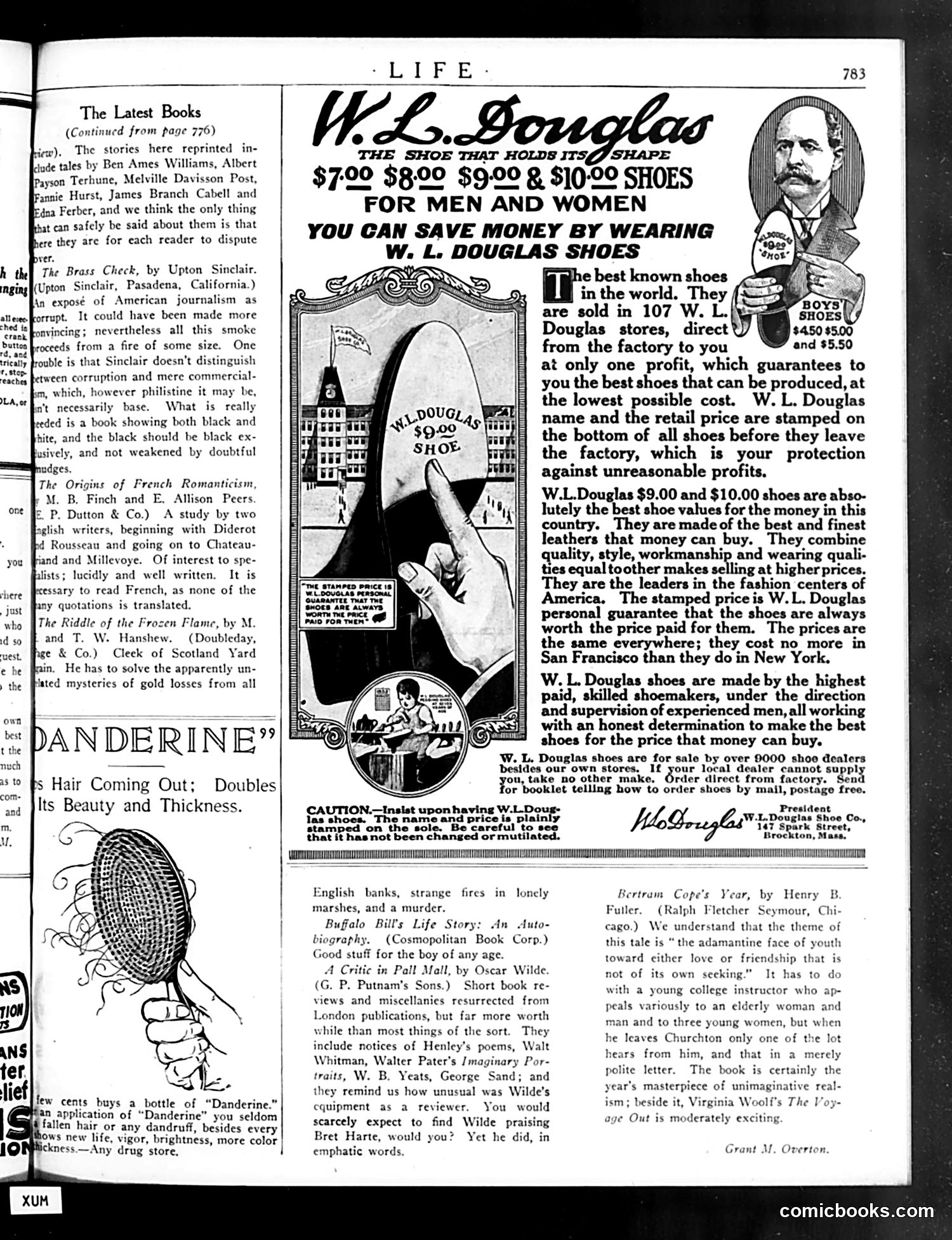
This page is primarily **advertising and book reviews**, not political satire. The dominant feature is a large **W.L. Douglas Shoes advertisement** occupying roughly two-thirds of the space, featuring the company founder's portrait and marketing copy emphasizing factory-direct sales and quality craftsmanship. The smaller left column contains book reviews of contemporary works, including titles by Upton Sinclair and studies of French literature. A minor advertisement for "Danderine" hair product appears at the bottom left. **No political cartoon or satirical content is present.** The page reflects early 20th-century advertising conventions—prominently displaying branded goods with testimonial-style copy claiming value and quality. The Danderine ad uses typical period marketing rhetoric about product effectiveness. This appears to be a standard magazine page mixing editorial content with paid advertising, representative of Life's business model rather than its satirical editorial voice.
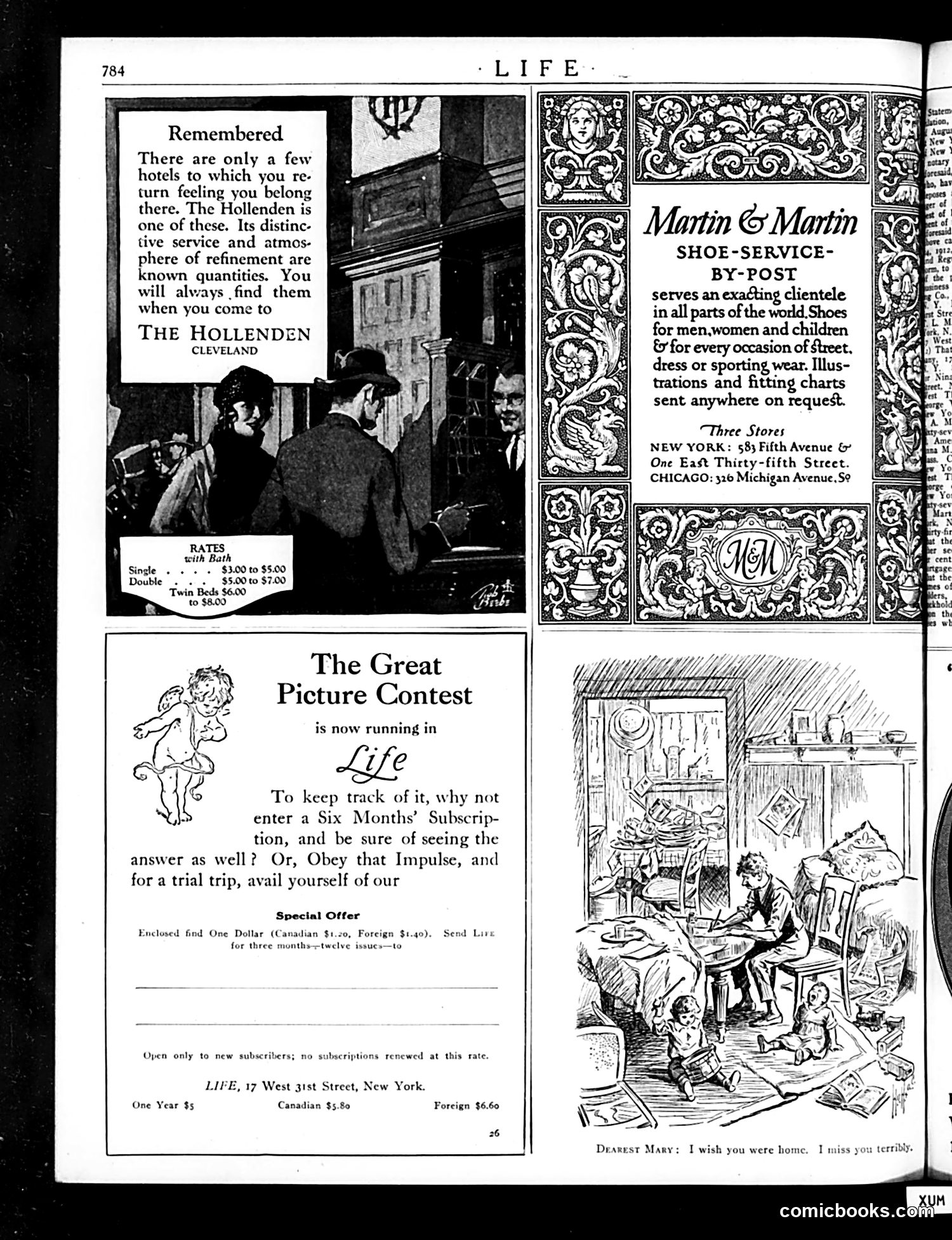
This page is primarily **advertising and subscription promotion**, not political satire. The content includes: **Advertisements:** - The Hollenden Hotel (Cleveland) promoting upscale hospitality - Martin & Martin shoe-service-by-post for mail-order footwear **Magazine Promotion:** - "The Great Picture Contest" - Life is running an ongoing visual puzzle contest - A special subscription offer: one dollar gets three months (12 issues) of Life magazine - Promotional rates listed for various subscription lengths **Cartoon/Illustration:** The right-side cartoon shows a domestic interior scene with caption "Dearest Mary: I wish you were home. I miss you terribly." This appears to be a humorous domestic vignette—likely depicting a man surrounded by household chaos while his wife is away, suggesting the implicit joke that domestic tasks become overwhelming without her presence. The page reflects early 20th-century consumer culture and magazine subscription marketing practices rather than political commentary.
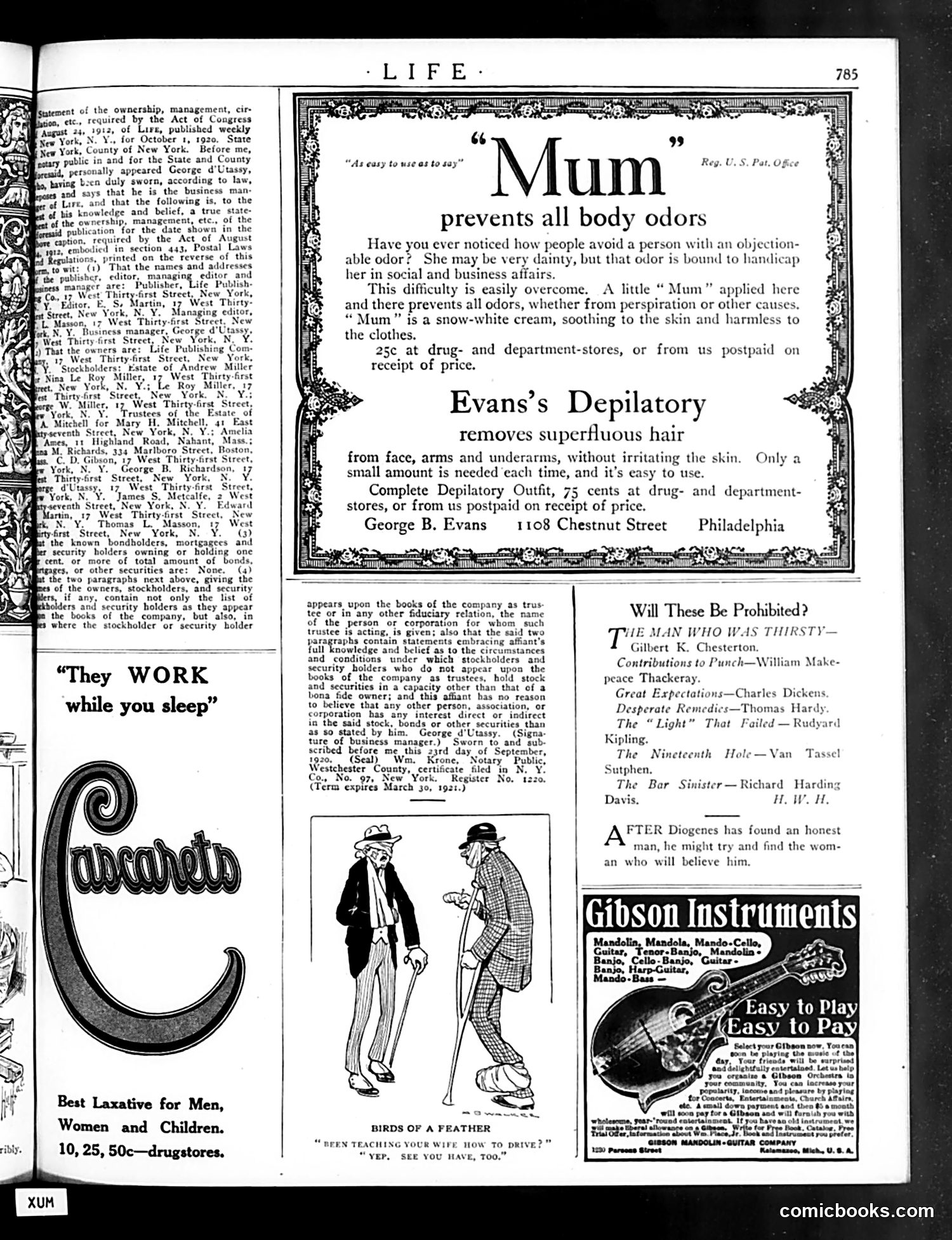
This page is primarily **administrative and advertising content** rather than political satire. The masthead section documents Life Publishing's ownership and management (required legal filing). The main content consists of three product advertisements: **Mum** deodorant, **Evans's Depilatory** hair removal cream, and **Cascarets** laxative—typical early 20th-century patent medicines. The only cartoon present is small and labeled "BIRDS OF A FEATHER," showing two men discussing teaching wives to drive. It's a mild domestic joke reflecting early automobile-era anxieties about women drivers—not political satire. The page also lists literary works under "Will These Be Prohibited?" (Chesterton, Thackeray, Dickens, Hardy, Kipling), suggesting contemporary debate about censorship. **Overall assessment**: This is a standard magazine page mixing legal notices, consumer advertisements, and light humor—not a vehicle for significant political commentary.
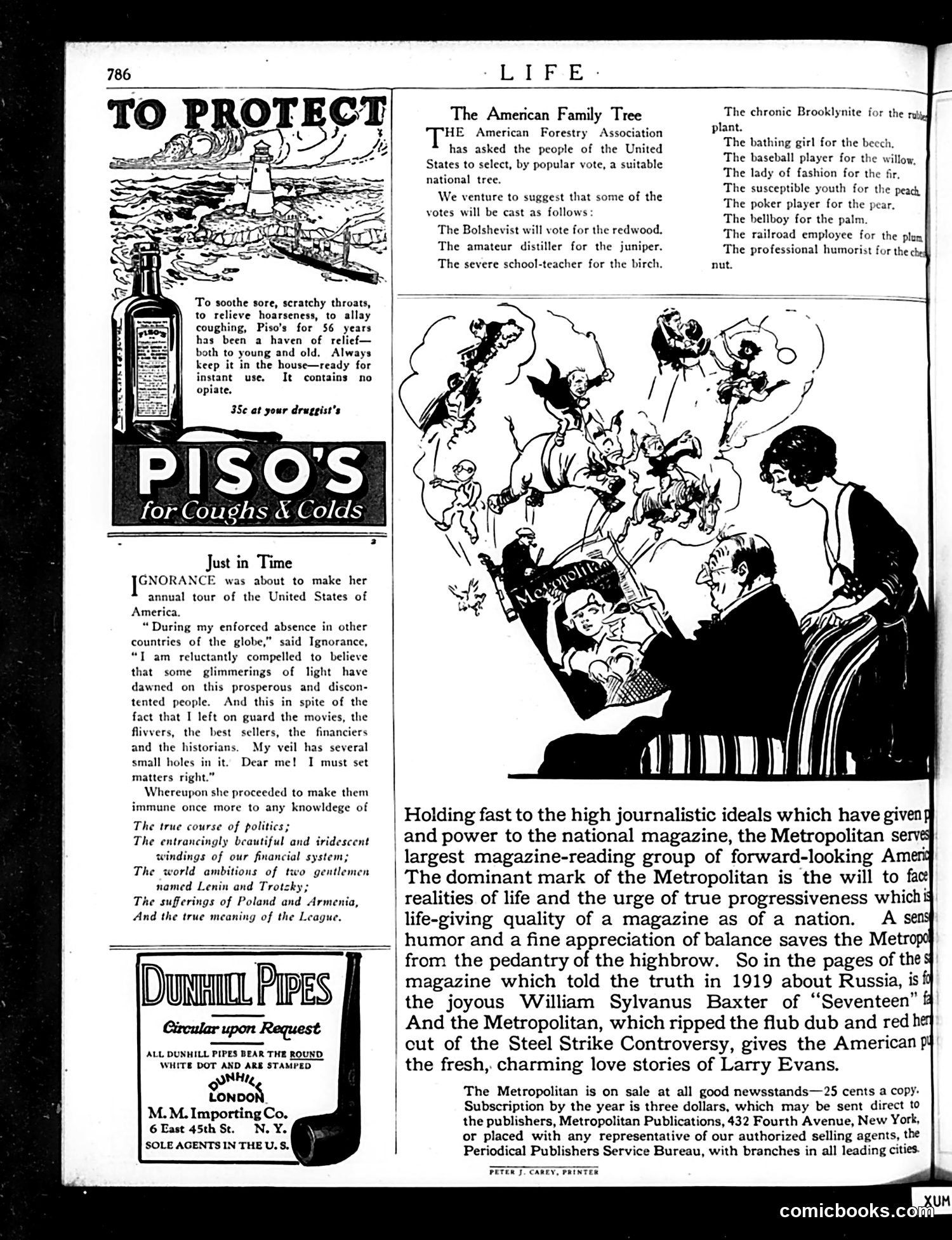
This satirical cartoon personifies **Ignorance** as a female figure preparing to tour America, lamenting that her influence has weakened during her "absence." She resolves to restore public ignorance by controlling information about: - Political realities - Financial systems - Lenin and Trotsky (Russian Revolution leaders) - The suffering of Poland and Armenia - The League of Nations The satire mocks what Life magazine saw as forces *maintaining* American ignorance: **"the movies, the flivvers [cheap cars], the best sellers, the financiers and the historians."** This reflects 1920s progressive concerns that commercial entertainment, consumerism, and establishment institutions deliberately kept Americans uninformed about radical politics, international affairs, and social justice issues. The cartoon criticizes both Ignorance itself and the systems enabling it—suggesting these forces actively suppress informed citizenship rather than accidentally lacking knowledge.
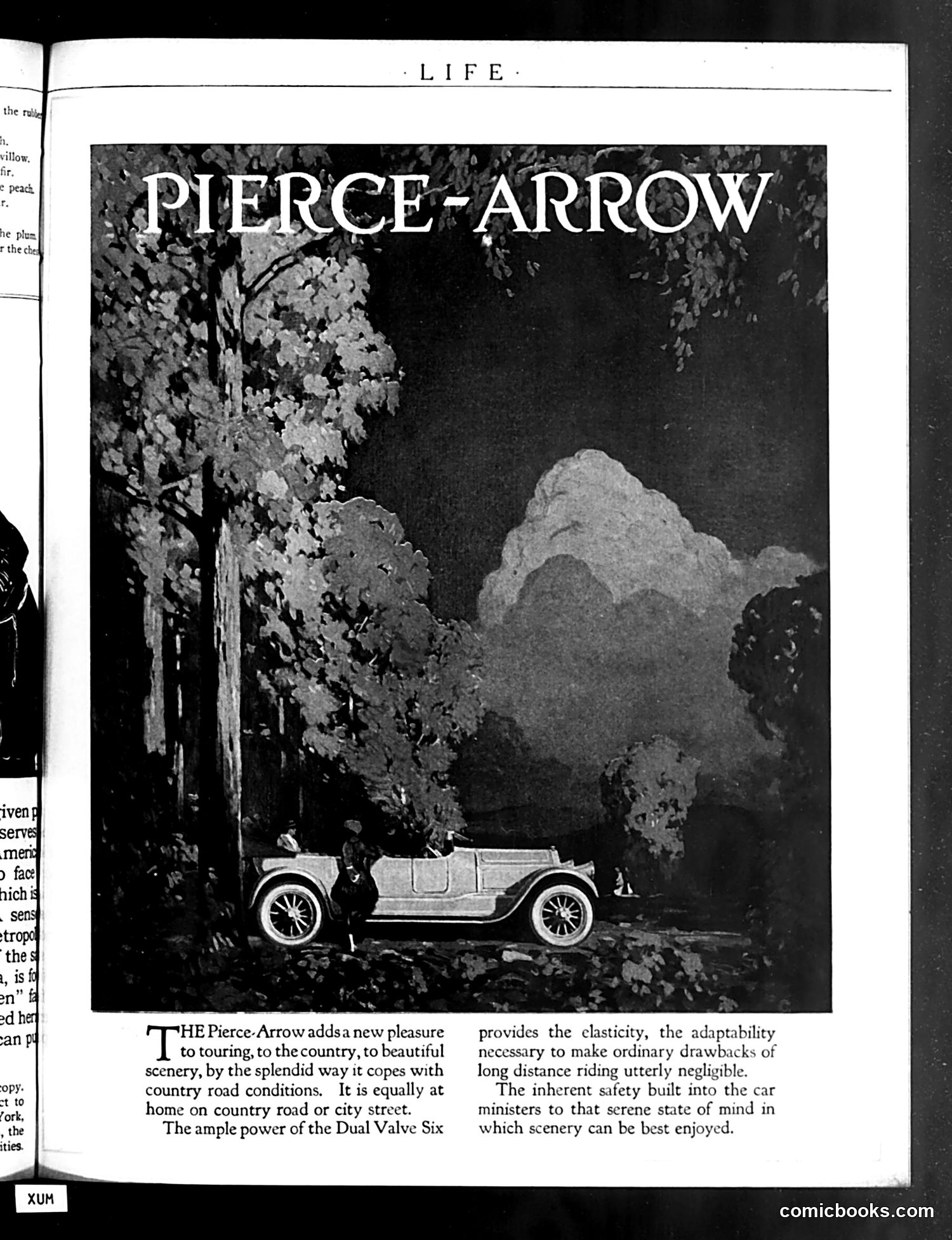
This is a **car advertisement**, not a political cartoon or satire. It appears in *Life* magazine and promotes the Pierce-Arrow automobile, specifically its "Dual Valve Six" engine model. The image shows an elegant early-automobile (likely 1910s-1920s) positioned on a scenic country road surrounded by trees and dramatic clouds, with figures standing nearby. The advertisement's text emphasizes the car's practical virtues: reliable performance on rough country roads and city streets alike, engine power, safety features, and comfort for leisurely touring. The "point" is purely commercial: Pierce-Arrow positions its vehicle as equally capable in rural and urban settings while delivering the psychological comfort ("serene state of mind") necessary to enjoy scenic travel—a luxury appeal targeting affluent motorists.
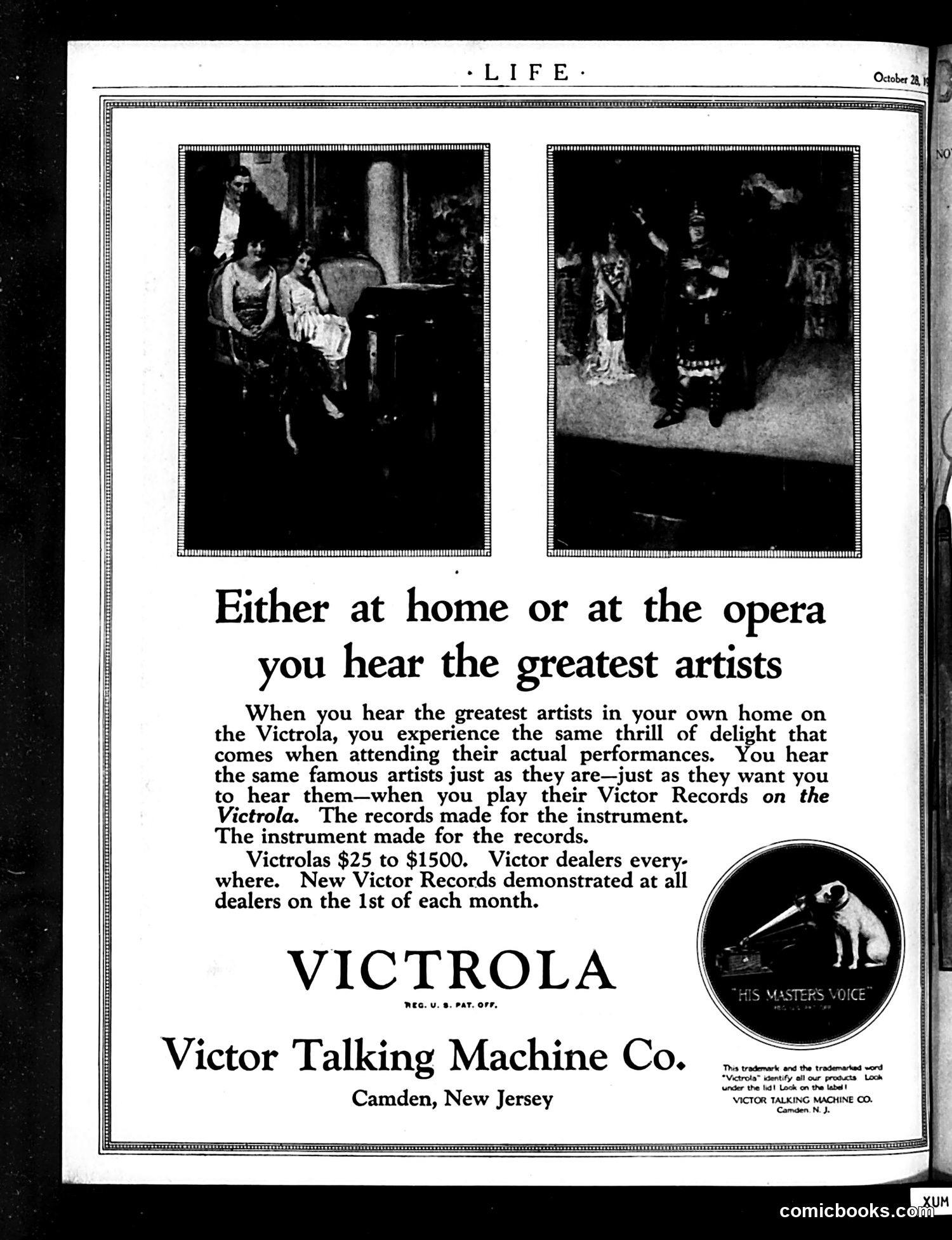
This is a **full-page advertisement**, not satire or political commentary. It promotes the Victrola, an early phonograph/record player manufactured by Victor Talking Machine Co. of Camden, New Jersey. The two photographs show the product's appeal: listeners enjoying recorded music at home (left) and at formal events (right), claiming the home experience matches live opera performances. The famous "His Master's Voice" logo—the dog listening to a gramophone—appears in the circular trademark. The pitch emphasizes that Victor Records were made specifically for Victrola machines, creating a complementary product ecosystem. Pricing ranged from $25 to $1,500 (substantial sums in this era), making it aspirational technology for middle to upper-class households seeking cultural refinement without attending live performances. This reflects early 20th-century attitudes about bringing "high culture" into homes via mechanical reproduction.