
Life, 1920-10-28 · page 21 of 46
Life — October 28, 1920 — page 21: what you’re looking at
What you’re looking at
This page analyzes the 1920 U.S. presidential election, specifically criticizing Republican candidate Warren G. Harding's campaign speeches about the League of Nations. **Key Figures:** - **Harding**: Republican presidential candidate whose statements are scrutinized for inconsistency and factual errors - **Colonel George Harvey**: Republican operative who aided Harding's nomination - **Senator Hiram Johnson**: Progressive Republican ally of Harding - **Elihu Root**: Former Secretary of State offering commentary on post-war social unrest **The Satire:** The article mocks Harding for making vague, contradictory statements about League rejection versus interpretation, and for citing false statistics (claiming Britain controlled 90% of world oil when actual figures were much lower). The cartoonist/author argues voters should read Harding's speeches directly to understand his true positions, implying they'll reveal his weakness and inconsistency. **Context:** The 1920 election centered on whether America would join Woodrow Wilson's League of Nations—a divisive issue. The piece uses Harding's own words as indictment.
📄 Transcribed text from this page (OCR, searchable)
Machine-transcribed from the original scan — historical spelling and the odd misread are preserved.
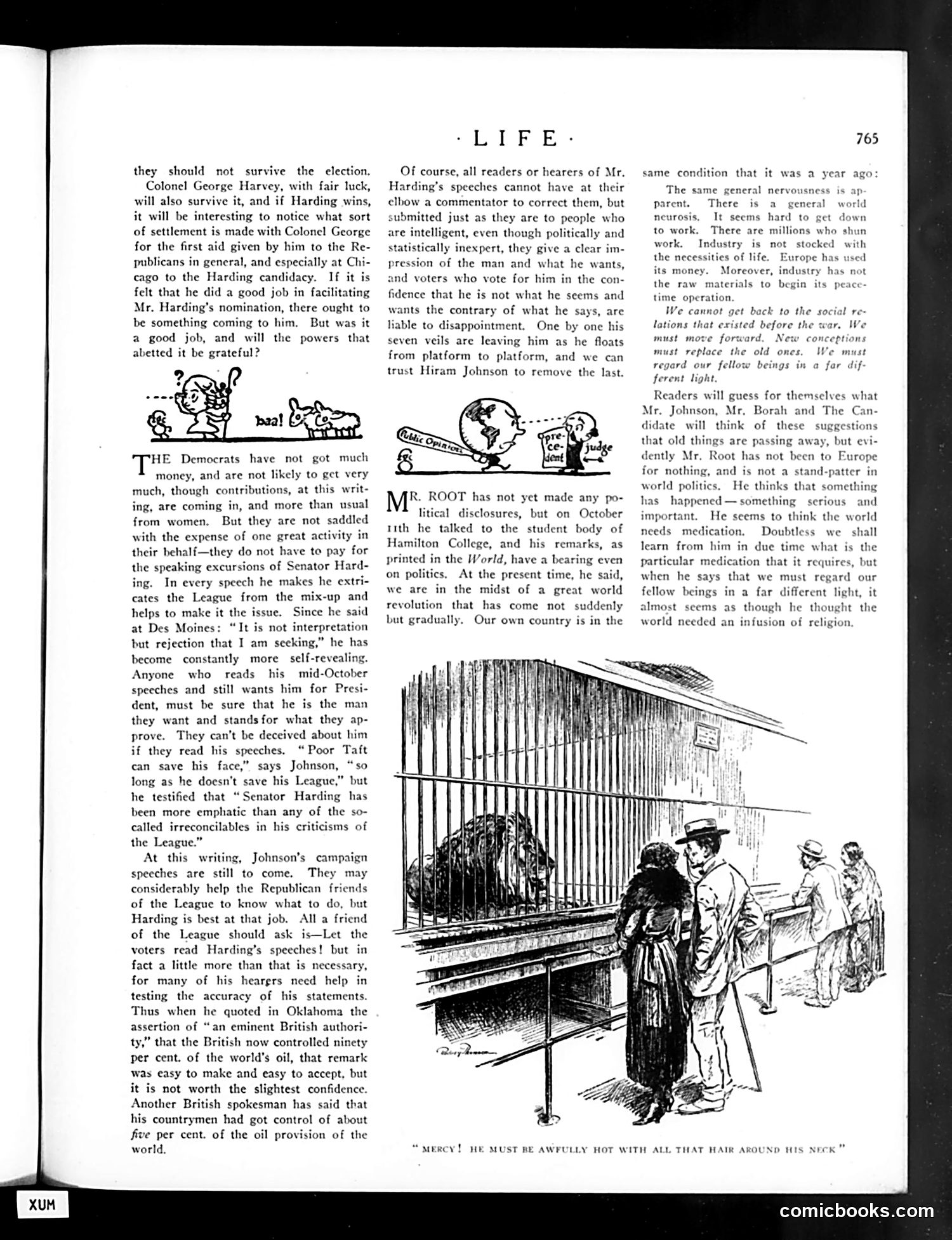
they should not survive the election. Colonel George Harvey, with fair luck, will also survive it, and if Harding wins, it will be interesting to notice what sort of settlement is made with Colonel George for the first aid given by him to the Re- publicans in general, and especially at Chi- cago to the Harding candidacy. If it is felt that he did a good job in facilitating Mr. Harding's nomination, there ought to be something coming to him. But was it a good job, and will the powers that abetted it be grateful? HE Democrats have not got much money, and are not likely to get very much, though contributions, at this writ- ing, are coming in, and more than usual from women. But they are not saddled with the expense of one great activity in their behalf—they do not have to pay for the speaking excursions of Senator Hard- ing. In every speech he makes he extri- cates the League from the mix-up and helps to make it the issue. Since he said at Des Moines: “It is not interpretation but rejection that I am seeking,” he has become constantly more self-revealing. Anyone who reads his mid-October speeches and still wants him for Presi- dent, must be sure that he is the man they want and stands for what they ap- prove. They can’t be deceived about him if they read his speeches. “Poor Taft can save his face,” says Johnson, “so long as he doesn’t save his League,” but he testified that “Senator Harding has been more emphatic than any of the so- called irreconcilables in his criticisms of the League.” At this writing, Johnson’s campaign speeches are still to come. They may considerably help the Republican friends of the League to know what to do, but Harding is best at that job. All a friend of the League should ask is—Let the voters read Harding’s speeches! but in fact a little more than that is necessary, for many of his heargrs need help in testing the accuracy of his statements. Thus when he quoted in Oklahoma the assertion of “an eminent British authori- ty,” that the British now controlled ninety per cent. of the world’s oil, that remark was easy to make and easy to accept, but it is not worth the slightest confidence. Another British spokesman has said that his countrymen had got control of about five per cent. of the oil provision of the world, “LIFE. Of course, all readers or hearers of Mr. Harding’s speeches cannot have at their elbow a commentator to correct them, but submitted just as they are to people who are intelligent, even though politically and statistically inexpert, they give a clear im- pression of the man and what he wants, and voters who vote for him in the con- fidence that he is not what he seems and yants the contrary of what he says, are liable to disappointment. One by one his seven veils are leaving him as he floats from platform to platform, and we can trust Hiram Johnson to remove the last. R. ROOT has not yet made any po- litical disclosures, but on October 11th he talked to the student body of Hamilton College, and his remarks, as printed in the World, have a bearing even on politics, At the present time, he said, we are in the midst of a great world revolution that has come not suddenly but gradually. Our own country is in the “sercy! HE MUST RE AWFULLY HOT WITH 765 same condition that it was a year ago: The same general nervous ap pare There is a general w neurosis, It seems hard to get to work. There are millions who shun work. Industry is not stocked the necessities of life. Europe has used Moreover, industry has not materials to begin its peace- down with its money. the raw time operation. We cannot get back to the social re- lations that existed before the war, We must ¢ forward. New conc must replace the old ones, We regard our fellow beings in a far ferent light. ptions Readers will guess for themselves what Mr. Johnson, Mr, Borah and The will think of these that old things are passing away, but evi- dently Mr. Root has not been to Europe for nothing, and is not a stand-patter in world politic: He thinks that something has happened — something and important. He seems to think the world tion. Doubtless we shall learn from him in due time what is the particular medication that it requires, but when he says that we must regard our fellow beings in a far different light, it almost seems as though he thought the world needed an infusion of religion. didate suggestions serious needs medi ALL THAT HAIR AROUND HIS NECK" comicbooks.com