
Life, 1920-10-28 · page 20 of 46
Life — October 28, 1920 — page 20: what you’re looking at
What you’re looking at
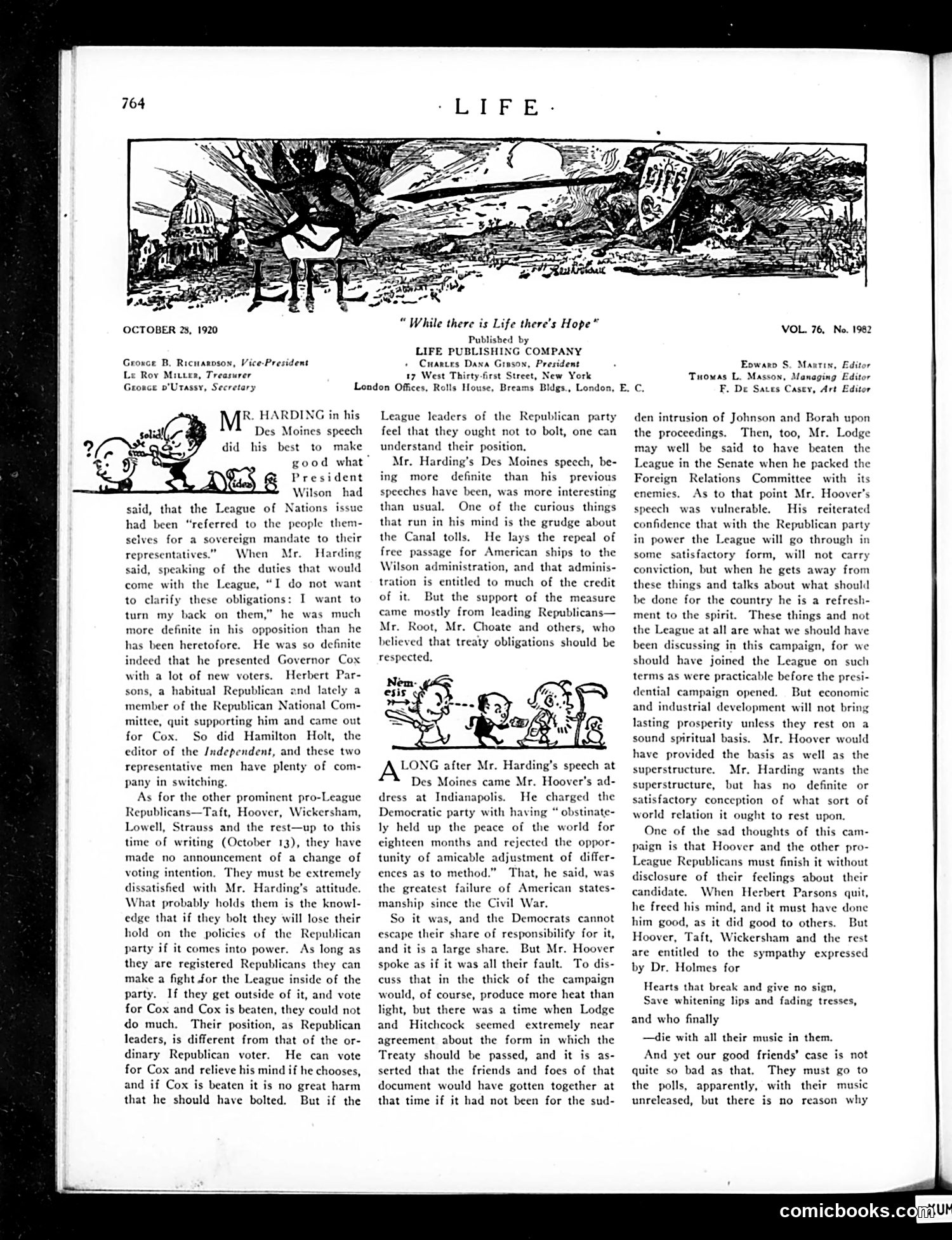
This *Life* magazine page covers the 1920 presidential campaign, specifically the League of Nations controversy. Warren G. Harding (Republican nominee) gave a Des Moines speech rejecting League obligations, stating "I want to turn my back on them." The article notes this position was so definitive it caused prominent Republicans—Herbert Parsons and Hamilton Holt—to switch support to Democratic candidate James Cox. The piece discusses tension among pro-League Republicans (Taft, Hoover, Wickersham, Lowell) who remain nominally loyal to Harding despite disagreeing with him, fearing they'd lose influence if they bolt the party. Later, Hoover's Indianapolis address blamed Democrats for obstructing the Treaty for eighteen months. The author suggests both parties share responsibility, implying the political positioning around League ratification was complex and contested as Election Day approached. The cartoons (specific content unclear from description) likely satirize this political maneuvering.
📄 Transcribed text from this page (OCR, searchable)
Machine-transcribed from the original scan — historical spelling and the odd misread are preserved.
OCTOBER 23, 1920 Groxce B. Ricnarpson, Vice-President Le Rov Mites, Treasurer Gronce p'Urassy, Secretar R. HARDING in his Des Moines speech did his best to make good what’ President Wilson had said, that the League of Nations issue had been “referred to the people them- selves for a sovereign mandate to their representatives.” When Mr. Harding said, speaking of the duties that would come with the League, “I do not want to clarify these obligations: I want to turn my back on them,” he much more definite in his opposition than he has been heretofore. He was so definite indeed that he presented Governor Cox with a lot of new voters. Herbert Par- sons, a habitual Republican end lately member of the Republican National Com- quit supporting him and came out for Cox. So did Hamilton Holt, the editor of the Independent, and these two representative men have plenty of com- pany in switching. As for the other prominent pro-League Republicans—Taft, Hoover, Wickersham, Lowell, Strauss and the rest—up to this time of writing (October 13), they have made no announcement of a change of voting intention. They must be extremely dissatisfied with Mr. Harding's attitude. What probably holds them is the knowl- edge that if they bolt they will lose their hold on the policies of the Republican party if it comes into power. As long as they are registered Republicans they can make a fight for the League inside of the party. If they get outside of it, and vote for Cox and Cox is beaten, they could not do much. Their position, as Republican leaders, is different from that of the or- dinary Republican voter. He can vote for Cox and relieve his mind if he chooses, and if Cox is beaten it is no great harm that he should have bolted. But if the was mitte “While there is Life there's Hope” Published by LIFE PUBLISHING COMPANY Cuartes Dana Ginson, President 17 West Thirty-first Street, New York London Offices, Rolls House, Breams Bldgs., London, E. C. League leaders of the Republican party feel that they ought not to bolt, one can understand their position, Mr. Harding's Des Moines speech, be- ing more definite than his previous speeches have been, was more interesting than usual. One of the curious things that run in his mind is the grudge about the Canal tolls. He lays the repeal of free passage for American ships to the Wilson administration, and that adminis- tration is entitled to much of the credit of it. But the support of the measure came mostly from leading Republicans— Mr. Root, Mr. Choate and others, who believed that treaty obligations should be respected, LONG after Mr. Harding’s speech at Des Moines came Mr. Hoover's ad- dress at Indianapolis. He charged the Democratic party with having “ obstinate- ly held up the peace of the world for eighteen months and rejected the oppor- tunity of amicable adjustment of differ- ences as to method.” That, he said, was the greatest failure of American states- manship since the Civil War. So it was, and the Democrats cannot escape their share of responsibility for ii and it is a large share. But Mr. Hoover spoke as if it was all their fault. To dis- cuss that in the thick of the campaign would, of course, produce more heat than light, but there was a time when Lodge and Hitchcock seemed extremely near agreement about the form in which the Treaty should be passed, and it is as- serted that the friends and foes of that document would have gotten together at that time if it had not been for the sud- VOL. 76, No. 1982 Eowaro S. Mantix, Editor Tuowas L. Masson, Managing Editor F. De Sates Casey, Art Editor den intrusion of Johnson and Borah upon the proceedings. Then, too, Mr. Lodge may well be said to have beaten the League in the Senate when he packed the Foreign Relations Committee with its enemies. As to that point Mr. Hoover's speech was vulnerable. His reiterated confidence that with the Republican party in power the League will go through in some satisfactory form, will not carry conviction, but when he gets away from these things and talks about what should be done for the country he is a refresh- ment to the spirit. These things and not the League at all are what we should have been discussing in this campaign, for we should have joined the League on such terms as were practicable before the presi- dential campaign opened. But economic and industrial development will not bring lasting prosperity unless they rest on a sound spiritual basis. Mr. Hoover would have provided the basis as well as the superstructure. Mr, Harding wants the superstructure, definite or satisfactory conception of what sort of world relation it ought to rest upon. bat has no One of the sad thoughts of this cam- paign is that Hoover and the other pro- League Republicans must finish it without disclosure of their feelings about their candidate. When Herbert Parsons quit, he freed his mind, and it must have done him good, as it did good to others. But Hoover, Taft, Wickersham and the rest are entitled to the sympathy expressed by Dr. Holmes for Hearts that break and give no sign, Save whitening lips and fading tresses, and who finally —die with all their music in them. And yet our good friends’ case is not quite so bad as that. They must go to the polls, apparently, with their music unreleased, but there is no reason why comicbooks.comy)