
Life, 1920-10-28 · page 24 of 46
Life — October 28, 1920 — page 24: what you’re looking at
What you’re looking at
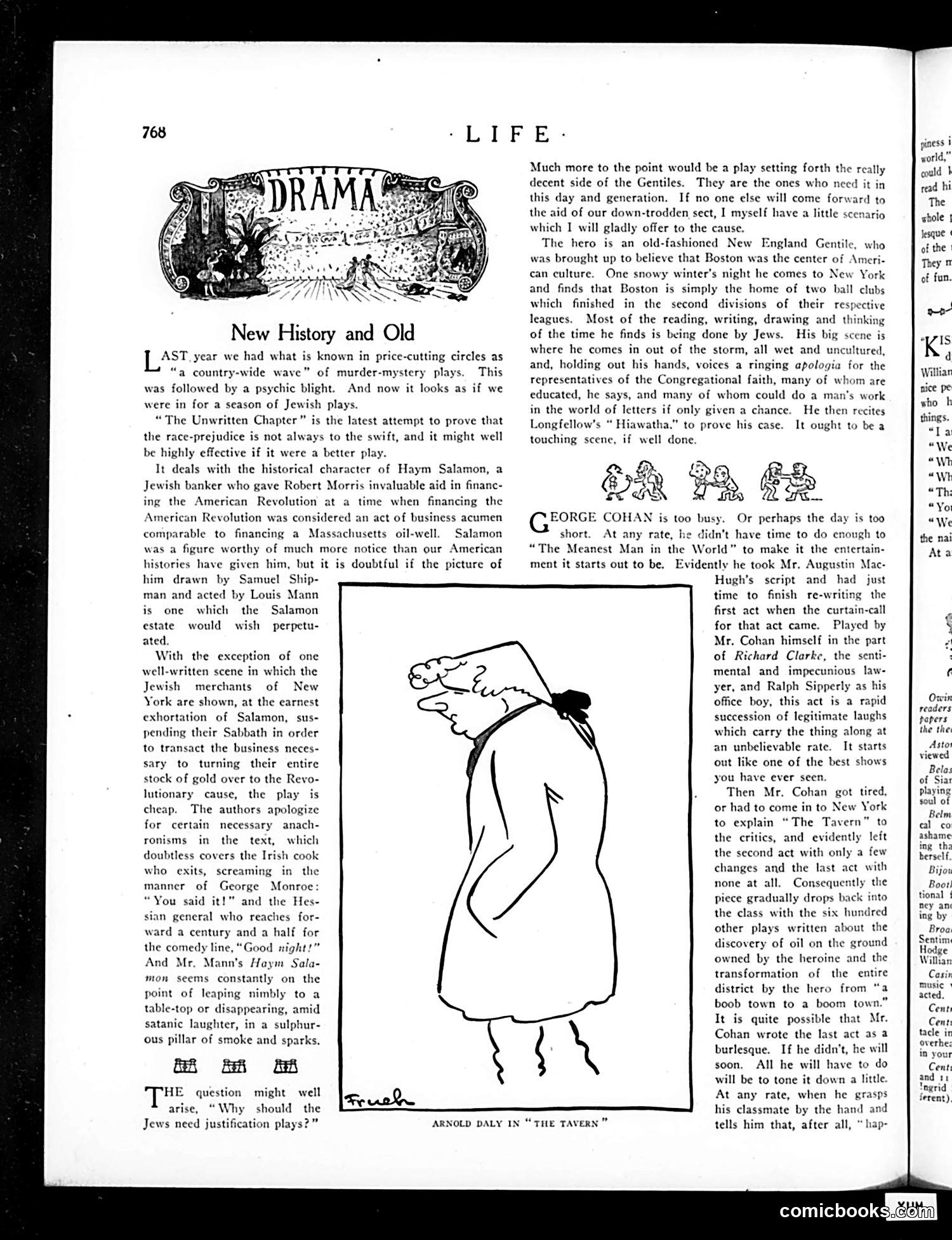
This page reviews contemporary Broadway plays, particularly addressing a perceived "season of Jewish plays." The critic dismisses "The Unwritten Chapter"—about Haym Salomon, the Jewish banker who financed the American Revolution—as poorly executed despite its worthy subject. The cartoon depicts **Arnold Daly** in "The Tavern," showing a figure in period dress. The page's satirical thrust appears in the closing argument: rather than Jewish playwrights needing to justify their community through drama, the critic sardonically proposes the *opposite*—a play featuring a "down-trodden" New England Gentile who must apologize for his cultural inferiority upon discovering that Jews dominate New York's intellectual and artistic life. This reversal reflects 1920s-era tensions around Jewish assimilation, cultural contributions, and gentile anxiety about shifting cultural hierarchies in American cities, particularly New York. The satire mocks the premise that any group needs theatrical "justification."
📄 Transcribed text from this page (OCR, searchable)
Machine-transcribed from the original scan — historical spelling and the odd misread are preserved.
‘LIFE: New History and Old L‘st year we had what is known in price-cutting circles as a country-wide wave” of murder-mystery plays. This was followed by a psychic blight. And now it looks as if we were in for a season of Jewish plays. “The Unwritten Chapter” is the latest attempt to prove that the race-prejudice is not always to the swift, and it might well be highly effective if it were a better play. It deals with the historical cha: Jewish banker who gave Robert Morris invaluable aid in financ- ing the American American Revolution was considered an act of business acumen ter of Haym Salamon, a Revolution at a time when financing the Salamon was a figure worthy of much more notice than our American histories have given him, but it is doubtful if the picture of him drawn by Samuel Ship- man and acted by Louis Mann which the Salamon would wish perpetu- comparable to financing a Massachusetts oil-well. is one estate ated. With the exception of one well-written scene in which the Jewish merchants of New York are shown, at the earnest exhortation of Salamon, sus- pending their Sabbath in order to transact the business neces- sary to turning their entire stock of gold over to the Revo- lutionary cause, the play is cheap. The authors apologize for certain aA necessary anach- the text, which doubtless covers the Irish cook who exits, screaming in the manner of George Monroe: “You said it!” and the Hes- n general who reaches for- ward a century and a half for the comedy line, “Good night!” And Mr, Mann's Haym Sala- mon seems constantly on the point of leaping nimbly to a table-top or disappearing, amid satanic laughter, in a sulphur- ous pillar of smoke and sparks. GR Hi A HE question might arise, “Why should the Jews need justification plays?” ronisms in well Feo ARNOLD DALY IN Much more to the point would be a play setting forth the really decent side of the Gentiles. They are the ones who need it in this day and generation. If no one else will come forward to the aid of our down-trodden sect, I myself have a little scenario which I will gladly offer to the cause. The hero is an old-fashioned New England Gentile, who was brought up to believe that Boston was the center of Ameri- can culture. One snowy winter's night he comes to New York and finds that Boston is simply the home of two ball clubs which finished in the second divisions of their respective leagues. Most of the reading, writing, drawing and thinking of the time he finds is being done by Jews. His big scene is where he comes in out of the storm, all wet and uncultured, and, holding out his hands, voices a ringing apologia for the representatives of the Congregational faith, many of whom are educated, he says, and many of whom could do a man’s work in the world of letters if only given a chance. Longfellow’s “ Hiawatha.” to prove his case. touching scene, if well done. Ho FR GS EORGE COHAN is too busy. short. He then recites It ought to be a Or perhaps the day is too At any rate, he didn't have time to do enough to “The Meanest Man in the World” to make it the entertain- ment it starts out to be. Evidently he took Mr. Augustin Mac- Hugh’s script and had just time to finish re-writing the first act when the curtain-call for that act came. Played by Mr. Cohan himself in the part of Richard Clarke, the senti- mental and impecunious law- yer, and Ralph Sipperly as his office boy, this act is a rapid succession of legitimate laughs which carry the thing along at an unbelievable rate. It starts out like one of the best shows you have ever seen. Then Mr. Cohan got tired, or had to come in to New York to explain “The Tavern” to the critics, and evidently left the second act with only a few changes and the last act with none at all. Consequently the piece gradually drops back into the class with the six hundred other plays written about the discovery of oil on the ground owned by the heroine and the transformation of the entire district by the hero from “a boob town to a boom town.” It is quite possible that Mr. Cohan wrote the last act as a burlesque. If he didn’t, he will soon. All he will have to do will be to tone it down a little. At any rate, when he grasps his classmate by the hand and THE TAVERN” tells him that, after all, iS d Willian nice pe who h things. “Lai “We “wt “Wh “Th: “Yo “We the nai Ata Orin readers popers the the Asto viewed Bela: of Siar playing soul of Belm al co ashame ing tha herself Bijot Boot tional | ney an ing by Broa: Sentim Hodge Wink Casis music | acted. Cent Cent tacle ir ferent), comicbookScoml