
A complete issue · 48 pages · 1920
Life — August 5, 1920
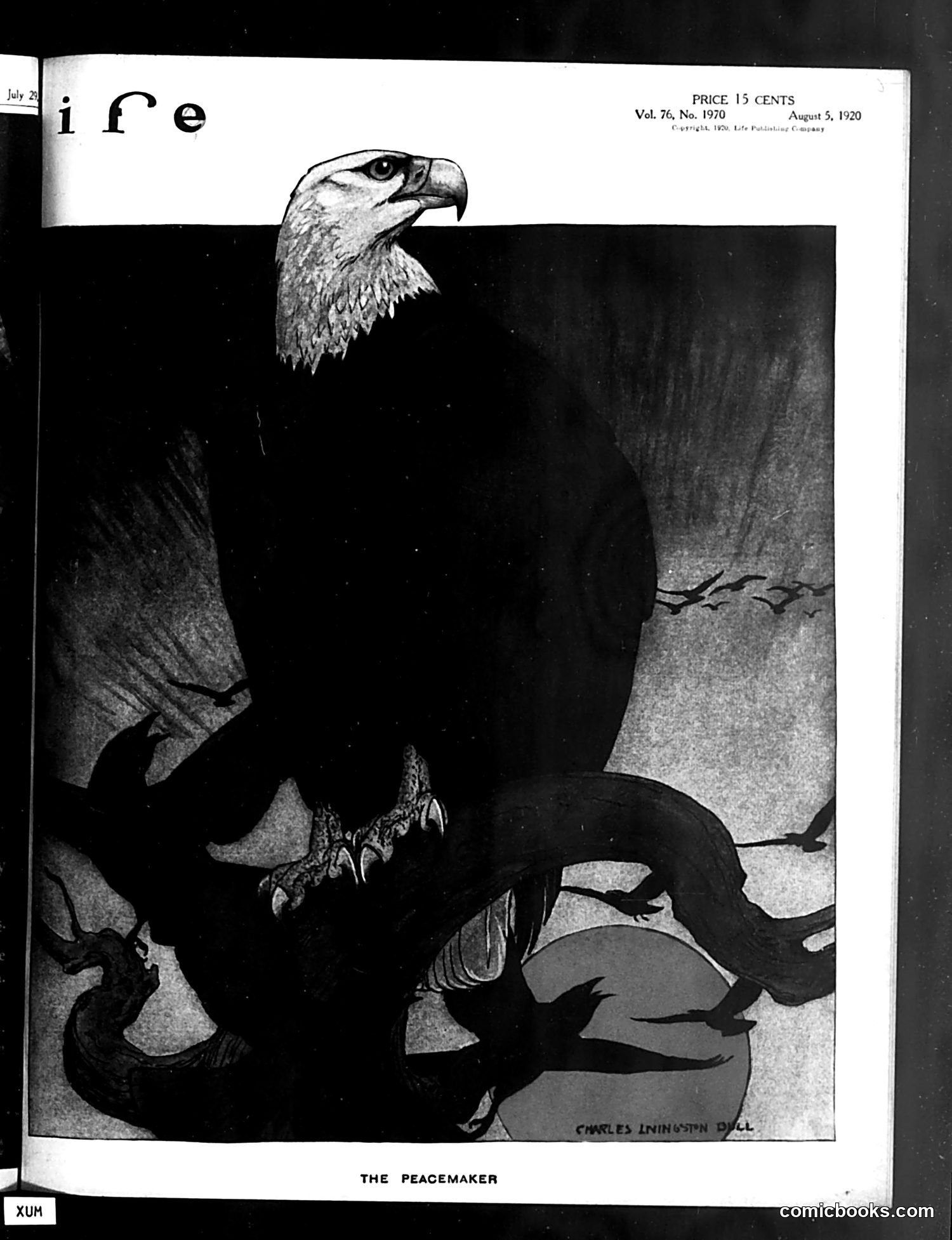
This cartoon, dated August 5, 1920, depicts an eagle (symbolizing America) perched atop what appears to be a serpent or snake. The title "The Peacemaker" is ironic—the eagle's aggressive posture and talons suggest military force rather than peaceful negotiation. The cartoon likely comments on American foreign policy following World War I. The eagle probably represents the United States, while the snake may symbolize either a foreign adversary or conflict itself. The artist (Charles Livingston Bull, per the signature) appears to satirize American "peacekeeping" efforts as fundamentally aggressive or militaristic. Without additional context about specific 1920 diplomatic events, the exact target remains unclear, though it critiques U.S. interventionism or military approaches to international disputes.
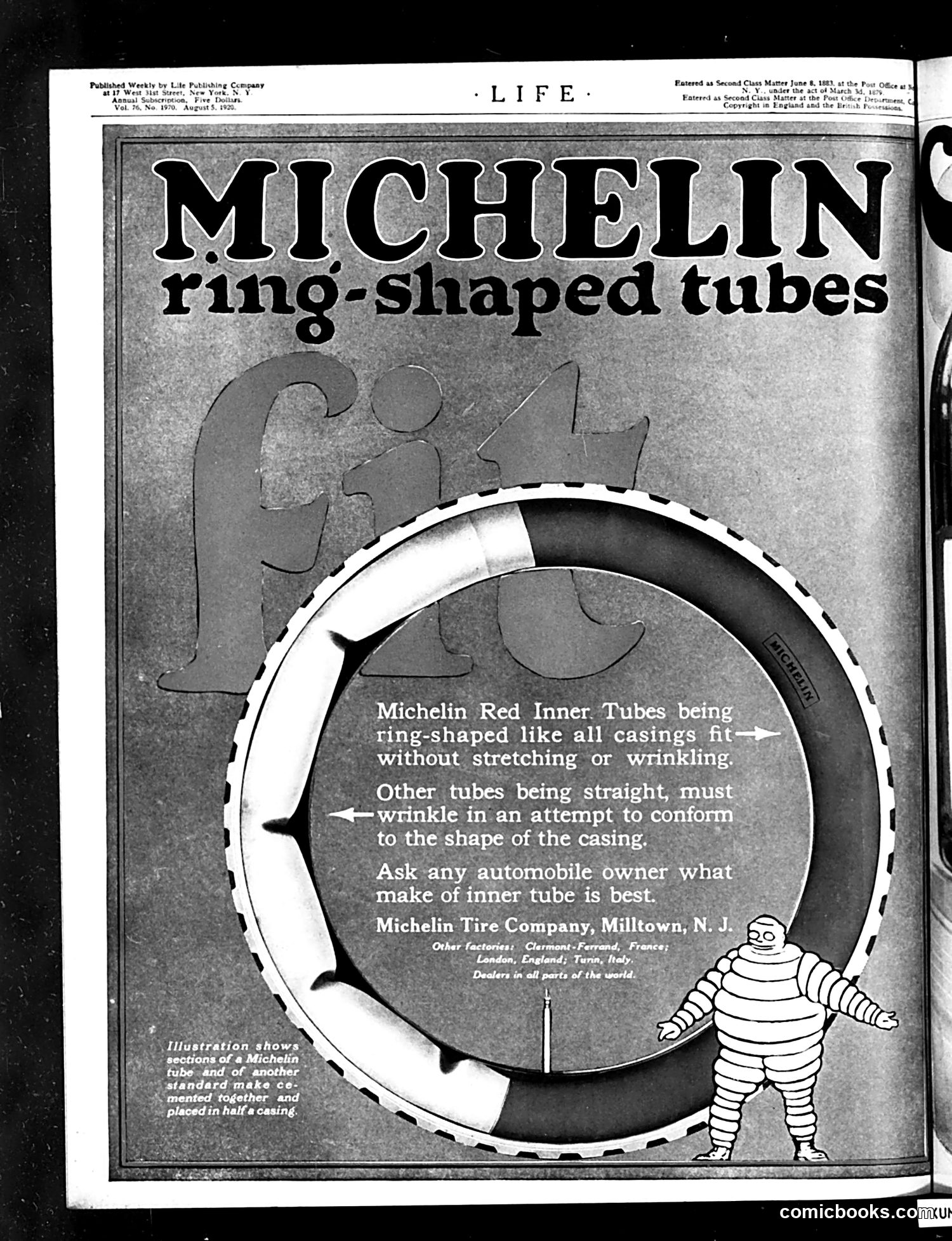
This is **a Michelin tire advertisement**, not political satire. The page promotes Michelin's ring-shaped inner tubes through the company's famous mascot, Bibendum (the "Michelin Man")—the rotund, bandage-wrapped figure shown at bottom right. The ad's selling point: Michelin tubes are ring-shaped, allowing them to fit tire casings smoothly without wrinkling. Competing straight tubes, the ad claims, must wrinkle to conform to the casing's shape. The cross-section illustration demonstrates this difference visually. The mascot appears cheerful and authoritative, endorsing the product's superiority. There is no political or social satire here—this is straightforward commercial advertising leveraging brand recognition and comparative product claims typical of early 20th-century magazine marketing.
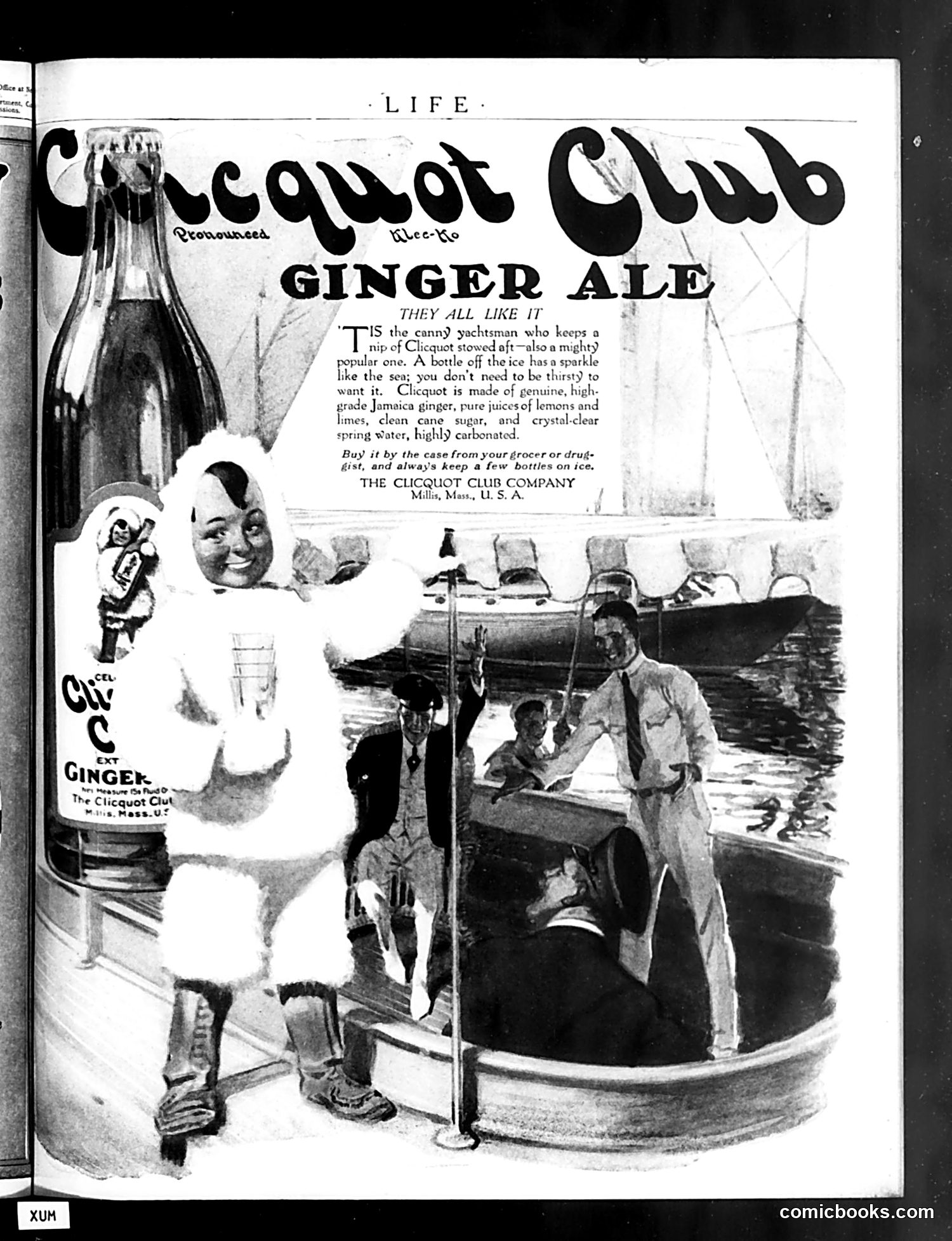
This is primarily a **product advertisement**, not political satire. The page promotes Clicquot Club Ginger Ale from The Clicquot Club Company in Millis, Massachusetts. The ad uses whimsical imagery featuring what appears to be **cartoon mascots or characters** (possibly gnomes or elves) enjoying the beverage. The text emphasizes the product's quality ingredients: genuine Jamaica ginger, lemon and lime juices, cane sugar, and carbonated spring water. A scene depicts people boating or fishing, suggesting leisure and recreation—implying the ginger ale is suitable for outdoor activities and social occasions. The phrase "They All Like It" emphasizes universal appeal. This reflects early 20th-century advertising strategy: associating commercial products with leisure, nature, and conviviality rather than relying solely on factual product claims.
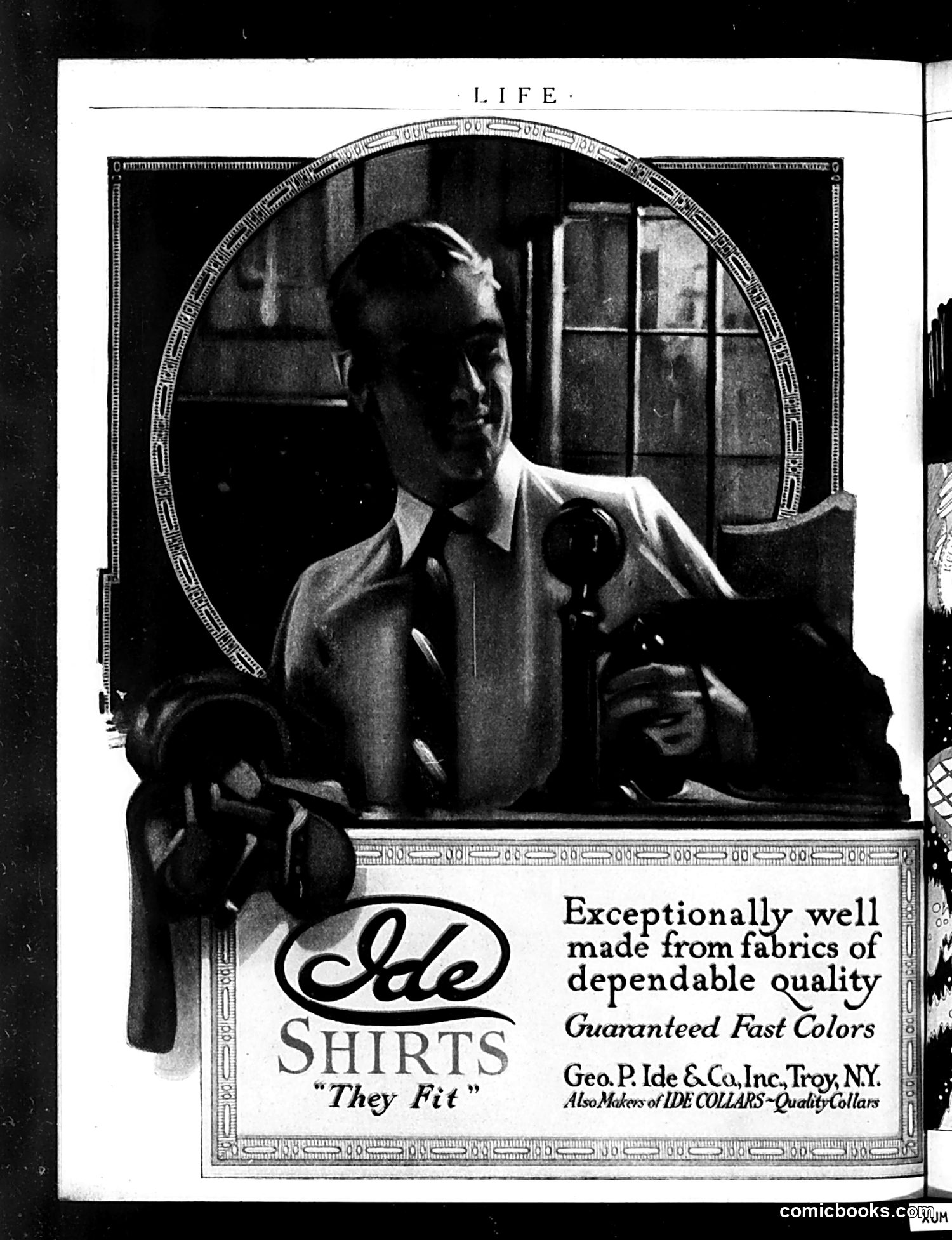
This page is primarily **advertising, not political satire**. It features a full-page advertisement for Ide Shirts ("They Fit"), manufactured by Geo. P. Ide & Co., Inc. of Troy, New York. The advertisement shows a man in profile examining his reflection in a mirror, wearing a dress shirt. The image emphasizes fit and appearance. The ad copy promises shirts are "Exceptionally well made from fabrics of dependable quality" with "Guaranteed Fast Colors." The company also manufactured Ide Collars, noted as "Quality Collars." The decorative border and professional photography are typical of early 20th-century magazine advertising design. This is straightforward commercial marketing rather than political commentary or satire.
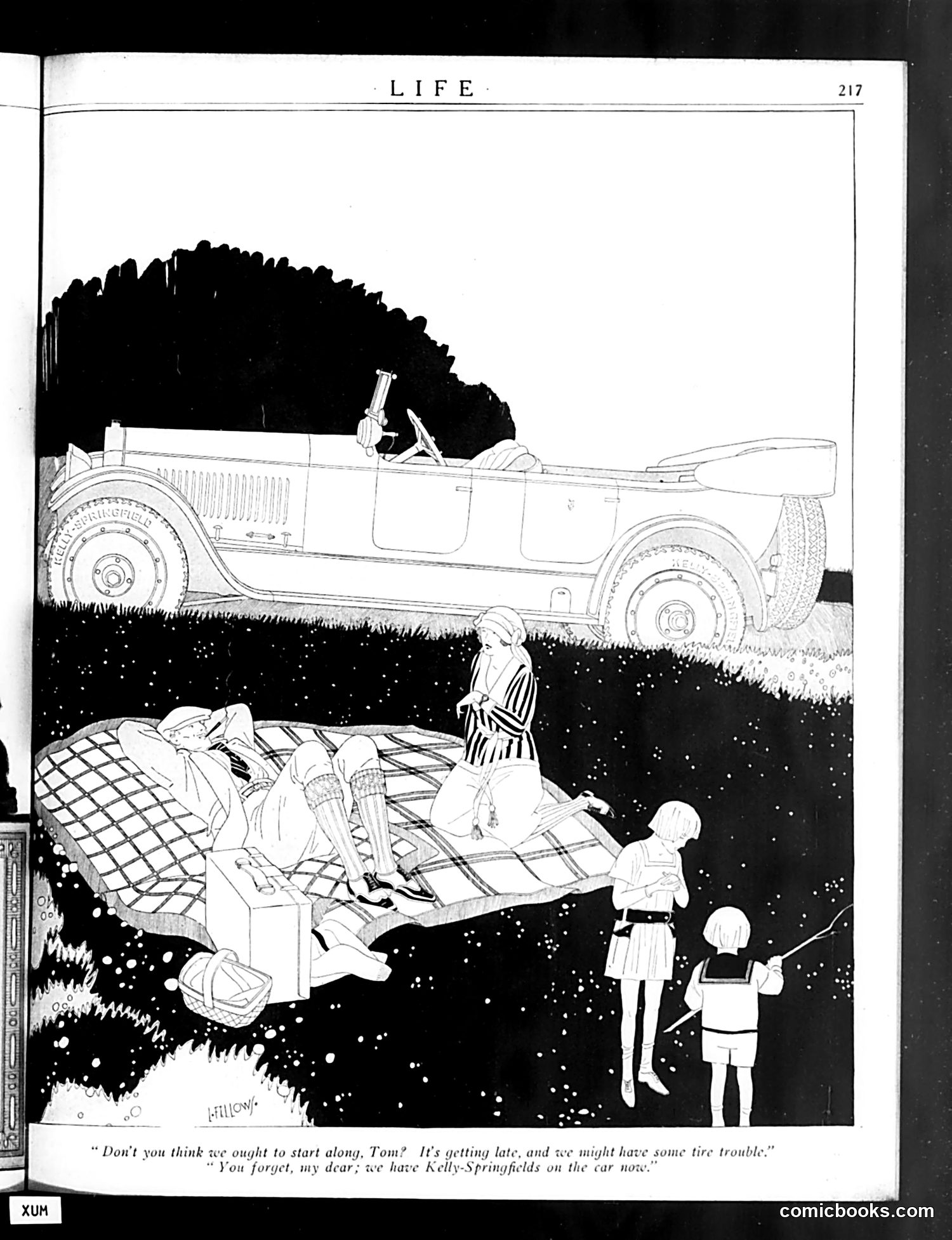
This appears to be a humorous domestic scene from an early 20th-century Life magazine illustration. The cartoon depicts a nighttime picnic or camping scenario where a woman (possibly named Kelly based on the dialogue) is reclining on a blanket while a man sits in a parked automobile above. Two children stand nearby observing the scene. The caption's joke relies on the double meaning of "tire trouble"—the man mentions they have "Kelly-Springfields on the car" (a real tire brand), while the woman suggests they should depart soon to avoid literal tire problems from driving at night. The satire appears to target either automotive safety concerns or possibly the emerging social practice of automobile courtship/dating among young couples, presented here as somewhat absurd domestic behavior.
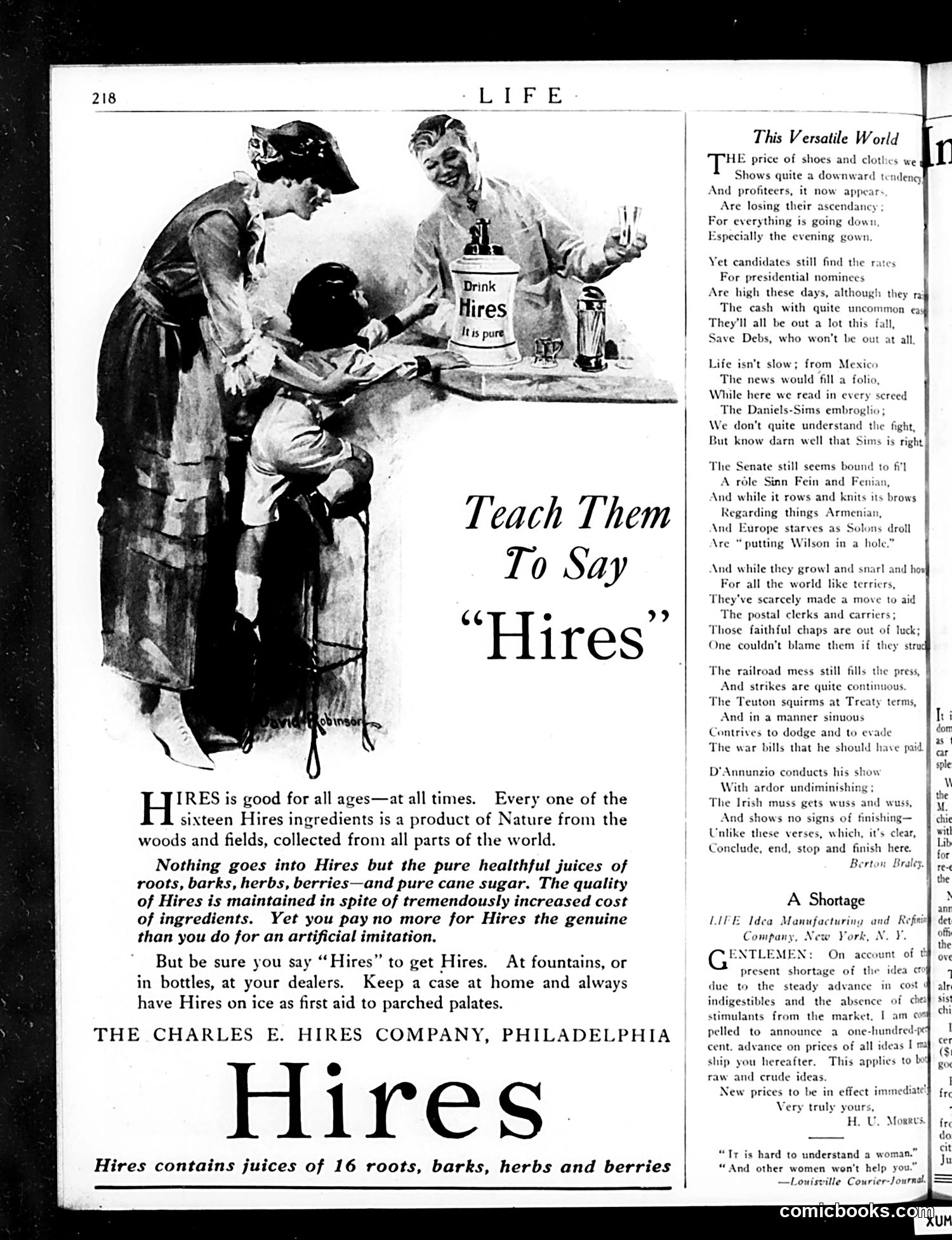
This page is primarily a **Hires Root Beer advertisement** occupying most of the space. The illustration shows a woman teaching a child to pronounce "Hires," framed as wholesome instruction about a natural product made from "16 roots, barks, herbs and berries." On the right side is **"This Versatile World,"** a satirical poem commenting on contemporary 1920s issues: declining prices, presidential elections, the Daniels-Sims Prohibition debate, Senate politics, railroad strikes, and postal worker troubles. References to "Wilson in a hole" and Armenian/European matters suggest post-WWI context. The poem is cynical about economic conditions and political dysfunction, contrasting sharply with the earnest, family-friendly Hires ad beside it—a typical juxtaposition of serious social commentary with commercial content in Life magazine.
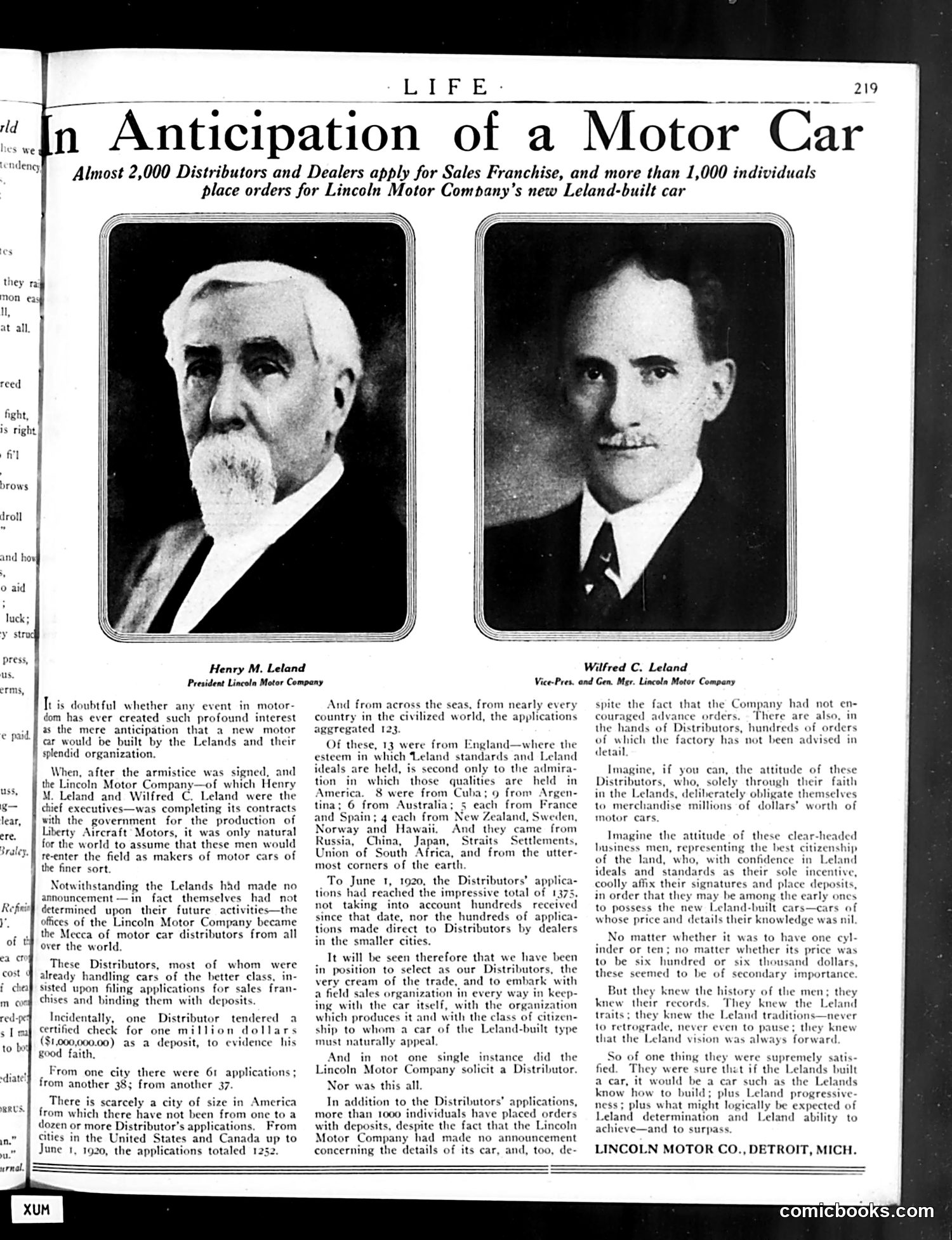
This is not a cartoon but rather a news/advertising feature in *Life* magazine about the Lincoln Motor Company's new Leland-built automobile. The page features portraits of Henry M. Leland (President) and Wilfred C. Leland (Vice-President and General Manager) of Lincoln Motor Company. The article describes massive public enthusiasm for the car: nearly 2,000 distributors and dealers applied for sales franchises, and over 1,000 individuals placed advance orders—despite the company making no public announcement about the vehicle's details or specifications. The piece celebrates this response as evidence of the Lelands' reputation and the public's confidence in their engineering standards and business integrity. It emphasizes the applications came from across America and internationally, reflecting the Lelands' prestige in automotive manufacturing.
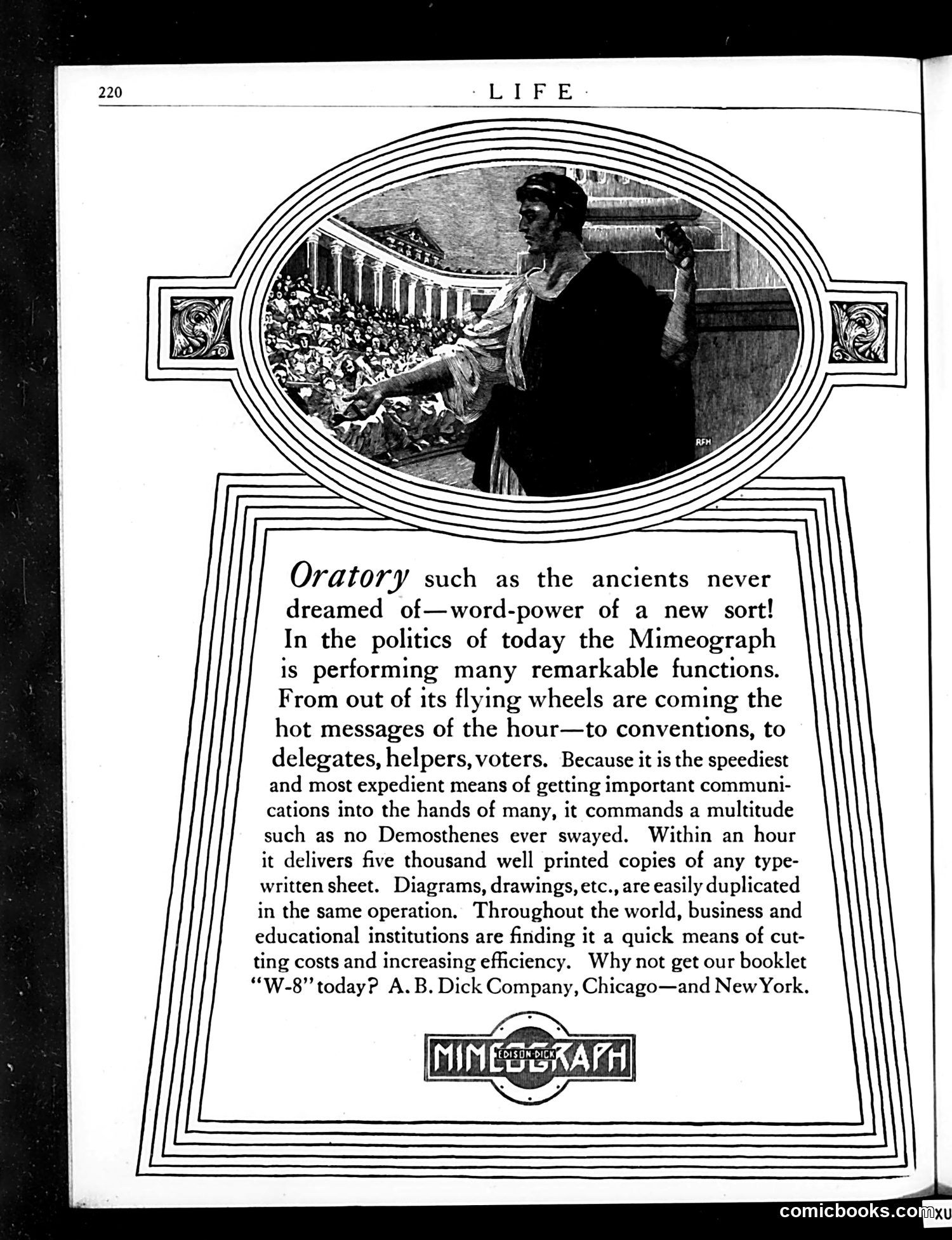
This is an advertisement for the Mimeograph machine by A.B. Dick Company. The image shows a classical orator addressing a large crowd in what appears to be a Roman amphitheater, comparing ancient oratory to modern mass communication. The ad argues that the Mimeograph represents a new form of rhetorical power—able to distribute "hot messages" to thousands simultaneously (five thousand copies per hour). It references Demosthenes, the famous ancient Greek orator, suggesting the machine surpasses even classical eloquence through sheer efficiency and reach. The satire is gentle: comparing a mechanical duplicator to ancient rhetoric humorously emphasizes the machine's practical value to politicians, businesses, and educators seeking cost-effective mass communication—a significant concern in early 20th-century America before electronic media.
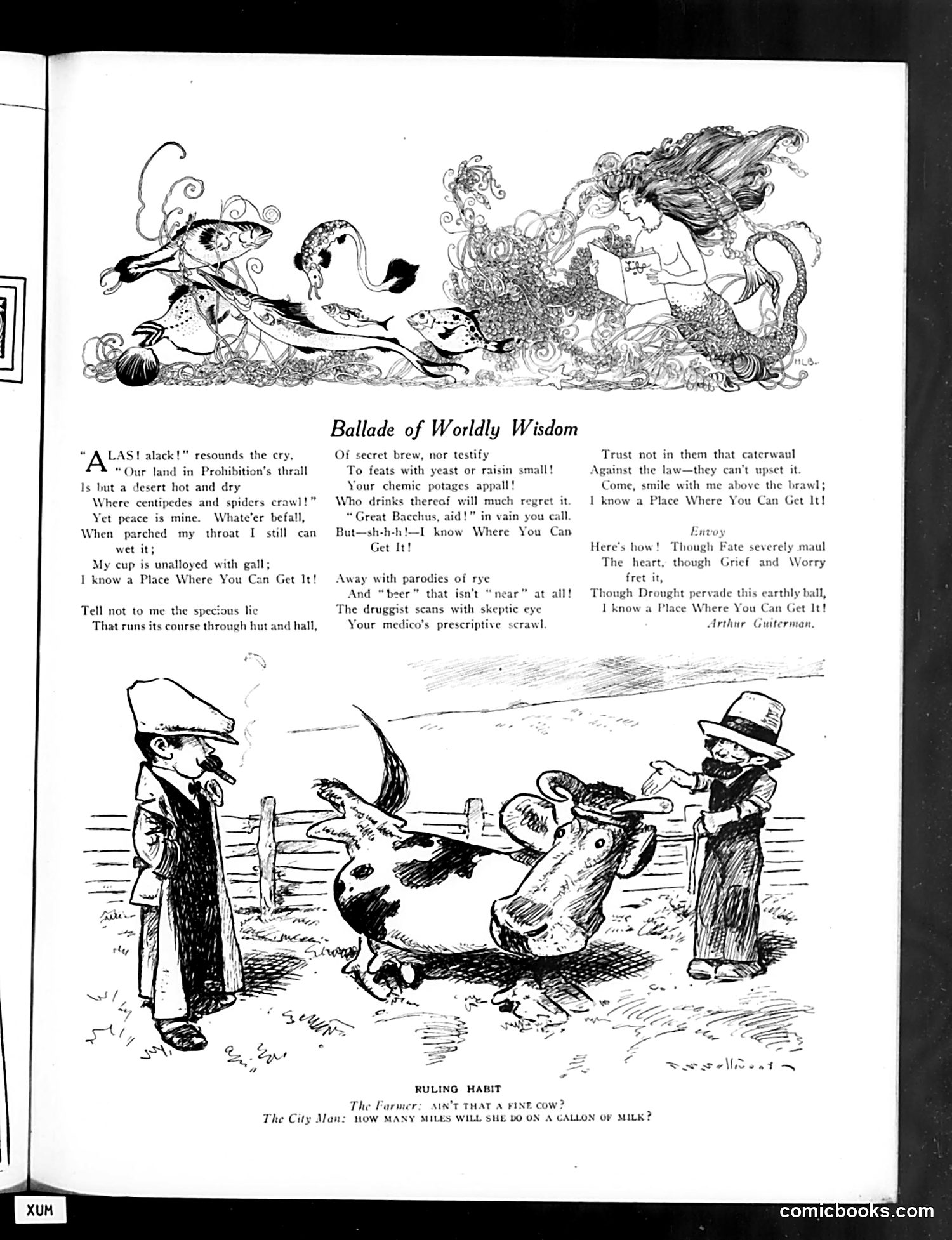
The top illustration depicts an underwater scene with mermaids and fantastical creatures, accompanying a humorous poem mocking various vices and follies. The verse warns against drinking dubious homemade "chemick potages," avoiding "beer," and trusting in "specious lies." References to Prohibition-era concerns appear evident (mentions of "rye" and illegal brewing). The refrain "I know a Place Where You Can Get It!" satirizes widespread knowledge of prohibition violations. The bottom cartoon, titled "Ruling Habit," shows two well-dressed men and a cow. A farmer boasts "AIN'T THAT A FINE COW?" while the city man responds by asking "HOW MANY MILES WILL SHE DO ON A GALLON OF MILK?" This mocks urban ignorance of rural agriculture, satirizing the disconnect between city and country dwellers regarding farm productivity.
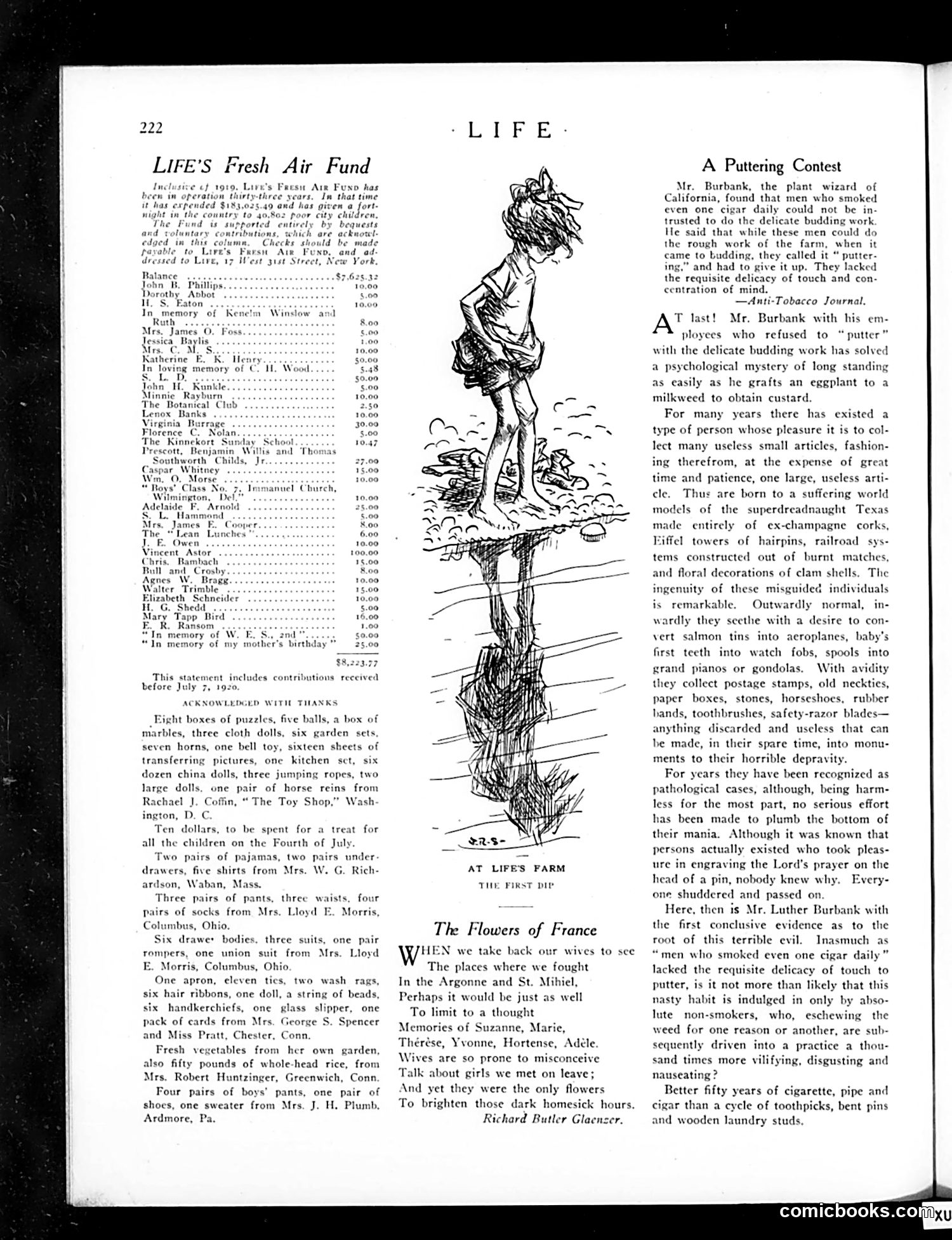
This cartoon satirizes men who collect useless items obsessively. The illustration shows an extremely thin, elongated figure—a caricature of a compulsive collector—being forced to take a bath. His emaciated frame emphasizes his pathological nature. The accompanying article mocks a specific type of person whose "pleasure it is to collect many useless small articles"—describing such collectors as psychological oddities comparable to "ex-champagne corks, Eiffel towers of hairpins, railroad systems constructed out of bent matches." The satire targets the absurdity of hoarding worthless objects: postage stamps, old necklies, paper boxes, stones, horseshoes, rubber bands, and toothbrushes. The forced bathing represents an intervention—suggesting such compulsive behavior requires treatment. The humor lies in mocking this particular personality disorder as ridiculous and unsanitary.
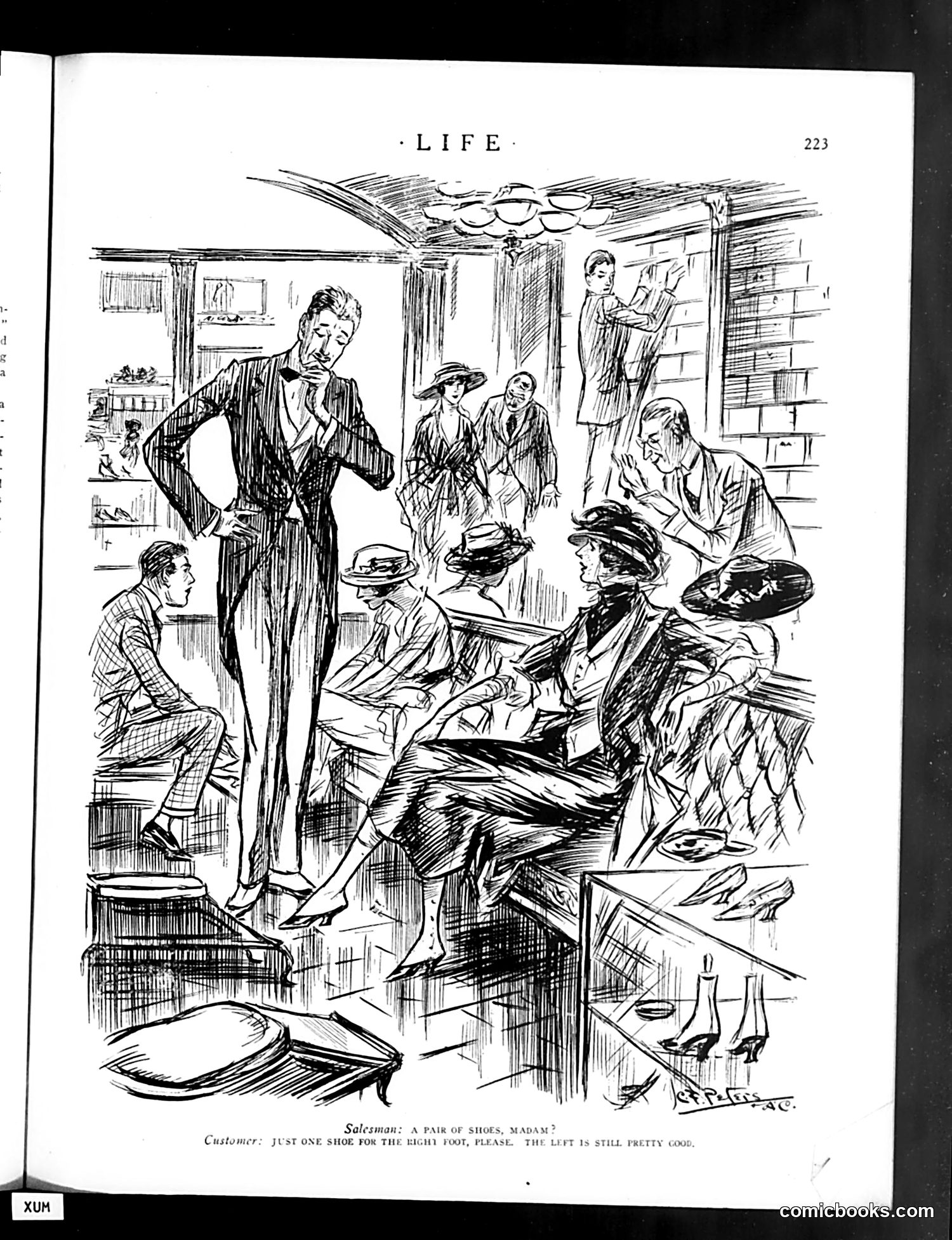
This is a single-panel cartoon from *Life* magazine depicting a shoe salesman's shop. The salesman stands elevated on a platform, addressing a group of seated female customers wearing hats. The caption reads: "Salesman: 'A PAIR OF SHOES, MADAM? JUST ONE SHOE FOR THE RIGHT FOOT, PLEASE. THE LEFT IS STILL PRETTY GOOD.'" The satire targets post-WWI economic hardship and rationing. Rather than selling complete pairs, the salesman is reduced to selling single shoes—a darkly comic exaggeration of scarcity and poverty during the period. The well-dressed customers represent middle-class women forced to make do with partial goods, reflecting the broader economic struggle after the war when resources remained scarce and prices inflated.
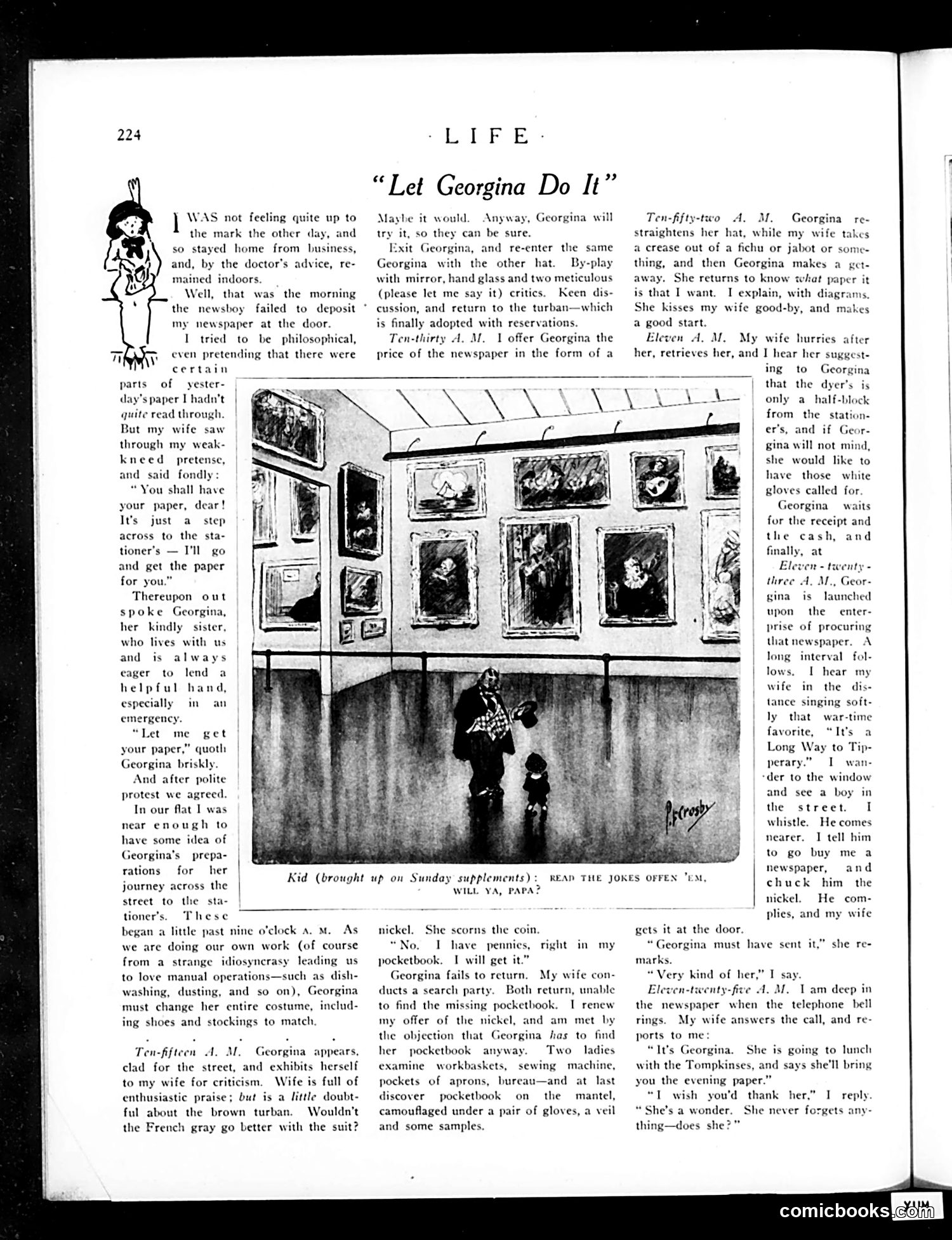
This is a humorous domestic narrative about a wife named Georgina who becomes the family's solution to every problem. The story satirizes early 20th-century gender roles by showing how a capable wife gets increasingly burdened with tasks—from fetching newspapers to searching for lost items to handling social obligations. The illustration shows Georgina being sent on errands around the neighborhood. The satire's point: husbands (and apparently the entire family) reflexively delegate responsibilities to the available woman, treating her competence as license to overload her with chores. The repeated refrain "Let Georgina do it" mocks how easily women's helpfulness becomes exploitation through casual assumption rather than explicit demand.
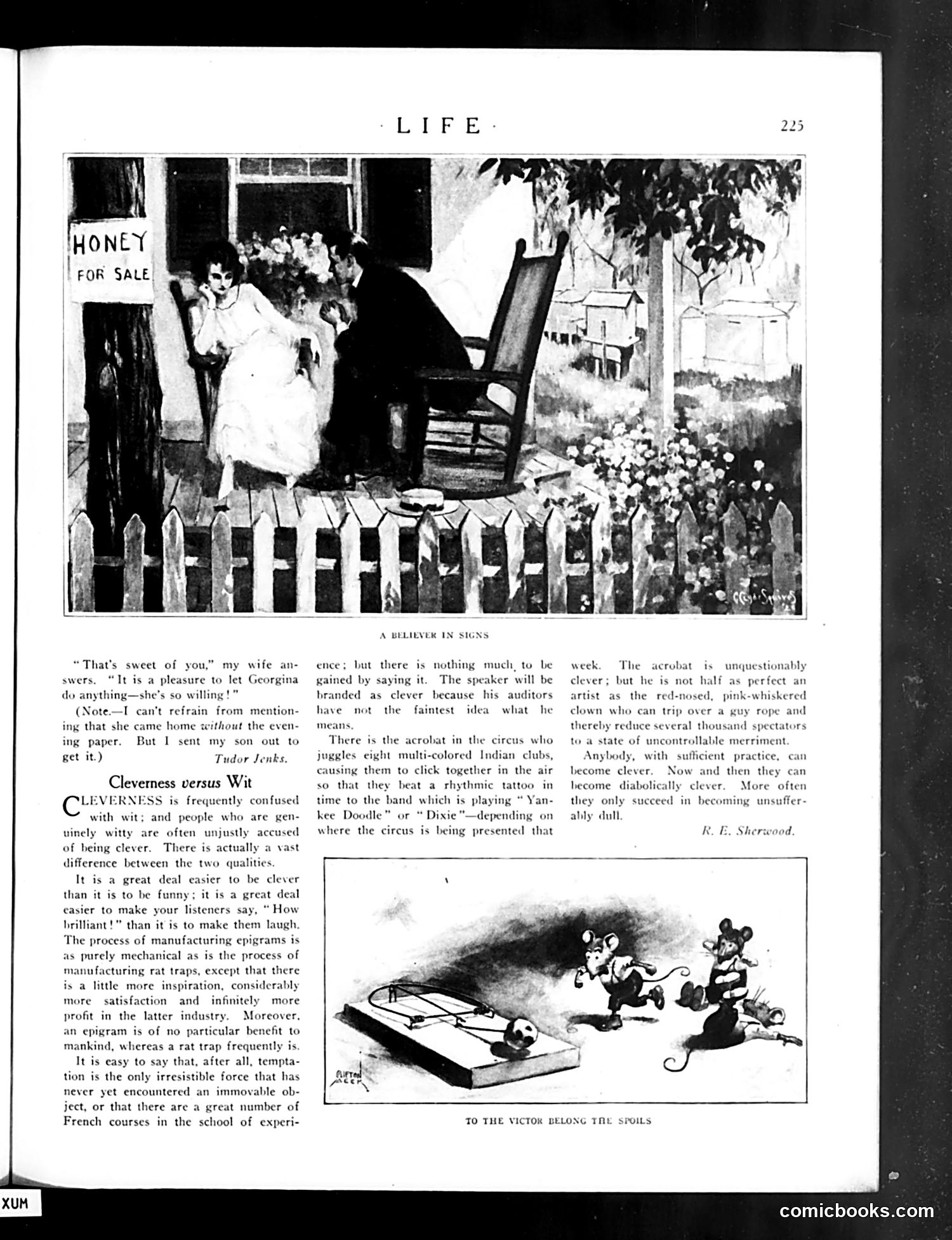
**Top Illustration:** "A Believer in Signs" shows a rural scene with a "Honey for Sale" sign. The cartoon satirizes the gap between clever advertising and actual results—the text notes that while signage can be witty, it doesn't guarantee sales or success. This critiques empty rhetoric and false promises. **Bottom Cartoon:** "To the Victor Belong the Spoils" depicts mice celebrating over a trapped mousetrap, anthropomorphically enjoying their victory. This is a visual pun on the political phrase "to the victor belong the spoils," suggesting that winning brings undeserved rewards regardless of merit—here, ironically, the "victors" (mice) don't recognize the actual danger they face. Both pieces mock overconfidence and the disconnect between perception and reality.
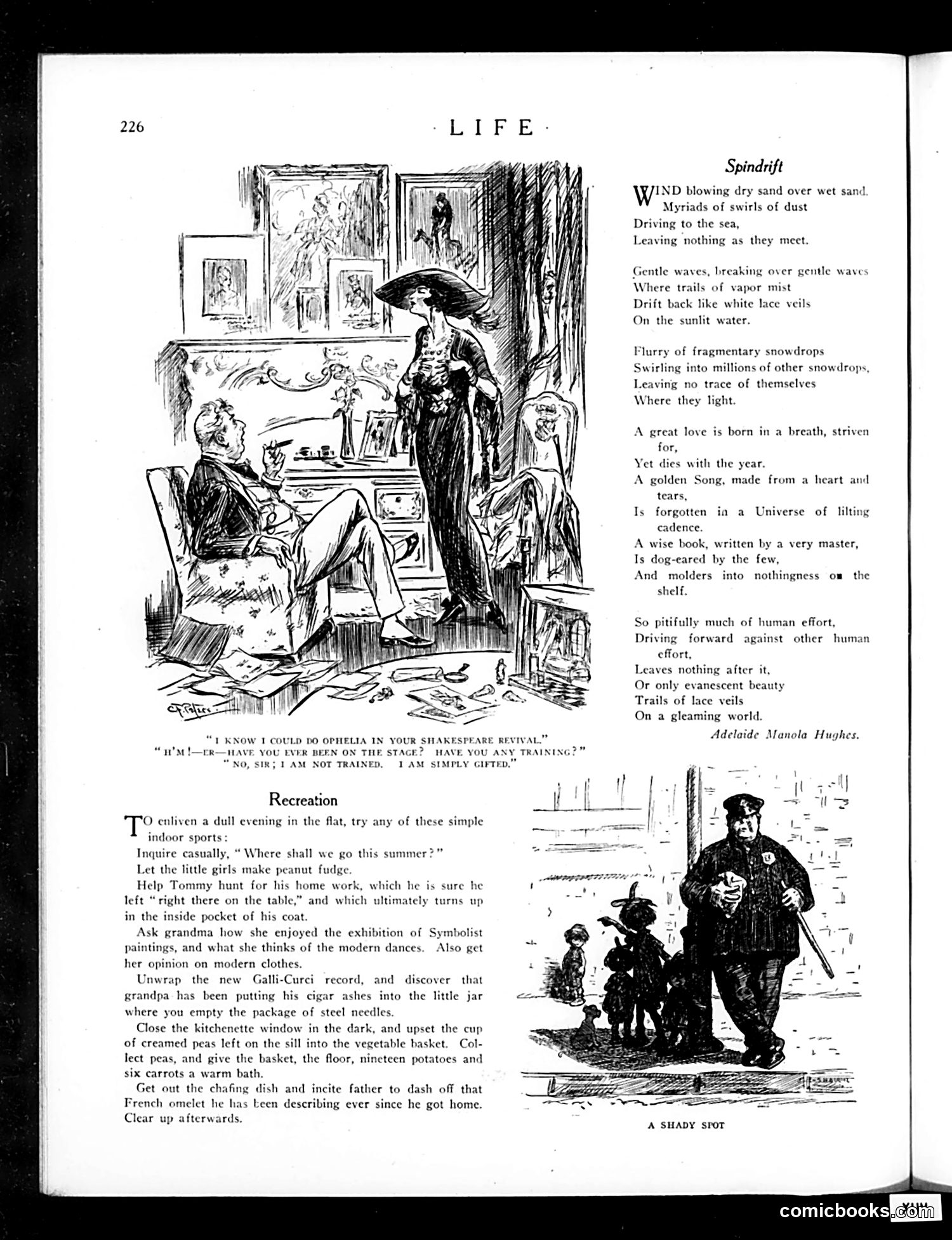
This page contains two distinct sections: **"Spindrift"** (top) is a poem by Adelaide Manola Hughes about transient natural phenomena—wind, sand, waves, snow—used as metaphors for human effort and artistic creation. The poem reflects on how much human work is forgotten or disappears like these ephemeral elements. The accompanying sketch shows an artist's studio with a woman and man in conversation. **"Recreation"** (bottom) is humorous domestic advice suggesting indoor activities to enliven dull evenings: having girls make fudge, helping children with homework, asking grandmother about modern art and fashion, playing phonograph records, and organizing a family charades game. The accompanying illustration shows a man with two children fishing at a riverside—a simple leisure activity. The overall tone is gently satirical about middle-class domestic life and entertainment.
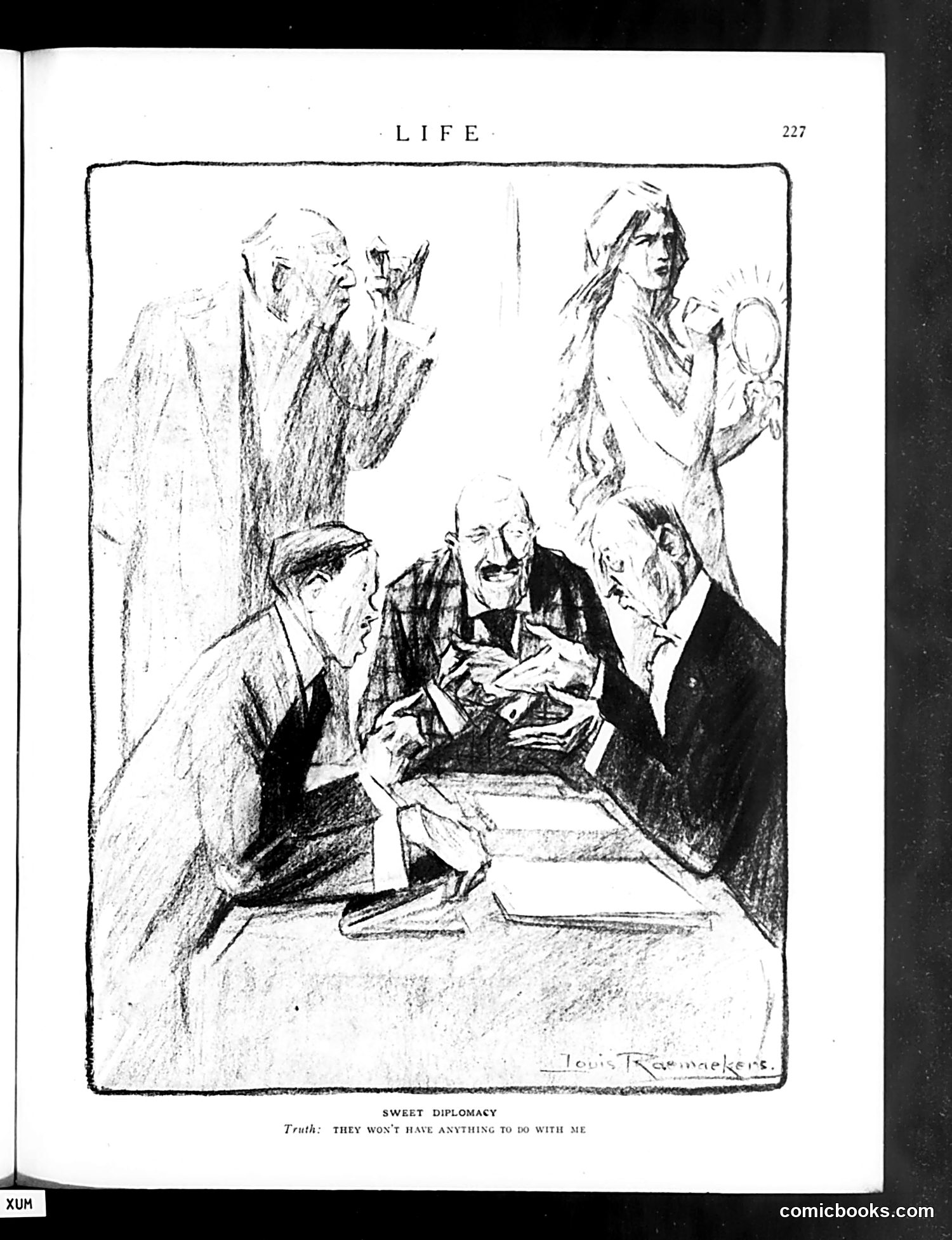
This cartoon by Louis Ranmackers depicts what appears to be diplomatic negotiations. Three men in formal dress sit at a table, with two ghostly figures looming above them in the background. The caption reads: "Truth: They won't have anything to do with me." The satire suggests that during diplomatic discussions, truth is absent or irrelevant—the negotiators proceed without regard for truthfulness. The spectral figures likely represent truth and perhaps justice or morality, hovering uselessly above the proceedings. This reflects early-20th-century cynicism about international diplomacy as inherently dishonest, where nations negotiate through deception rather than honest dealing. The cartoon critiques the gap between diplomatic pretense and actual intent.
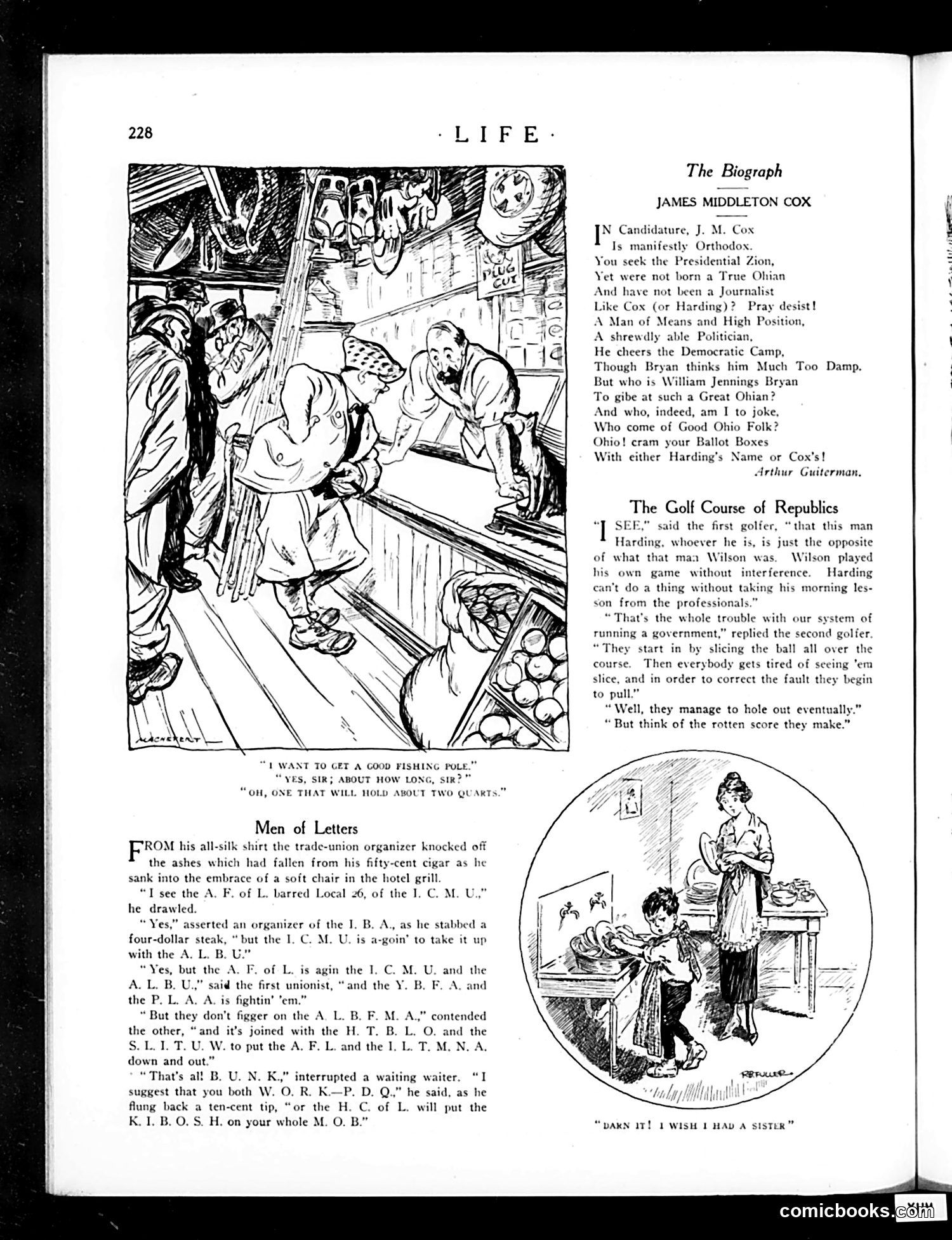
This page from *Life* magazine contains political and labor satire from the early 20th century. **"The Biograph"** section mocks James Middleton Cox (Democratic presidential candidate) through verse, comparing him unfavorably to Woodrow Wilson and suggesting he lacks the stature for high office. **"The Golf Course of Republicans"** uses golf as metaphor for Republican governance—specifically critiquing President Harding's administrative style versus Wilson's. It suggests Republican leaders rely on professional advisors and constantly "correct" policy mistakes, creating perpetual bungling. **"Men of Letters"** satirizes labor union alphabet soup—the bewildering proliferation of union acronyms (A.F. of L., I.C.M.U., A.L.B.U., etc.). The joke mocks how union organizers use incomprehensible jargon, making labor politics seem absurdly bureaucratic and inaccessible.
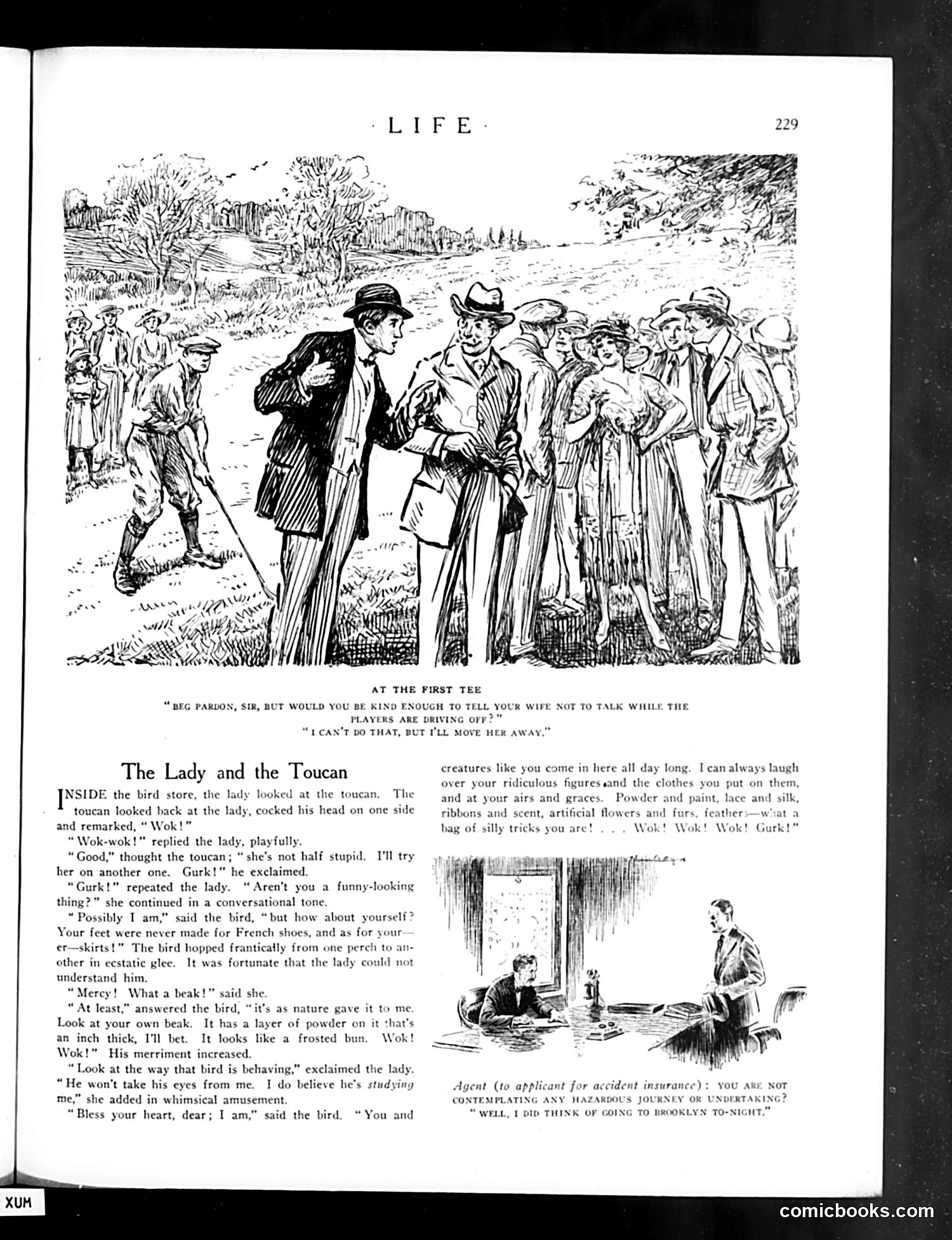
This page contains two distinct satirical pieces from early 20th-century Life magazine: **"At the First Tee" (top cartoon):** A golf-course scene mocking social etiquette. A man asks another golfer to restrain his chatty wife during play, but declines to move her himself—suggesting that husbands lack authority over wives' behavior, or that the request is absurdly polite given the obvious solution. **"The Lady and the Toucan" (main story):** A humorous dialogue where a woman in a bird shop mimics a toucan's sounds, unaware the bird is actually insulting her. The toucan mocks her appearance (powder-caked face, tight French shoes, artificial accessories), while she interprets his behavior as innocent study. The satire targets women's fashion obsession and cosmetics culture—the bird represents blunt truth about vanity. **"Agent to Applicant" (bottom cartoon):** Dark humor about insurance. A man considers a trip to Brooklyn so dangerous it qualifies as a "hazardous journey," mocking Brooklyn's reputation as a rough, crime-ridden neighborhood.
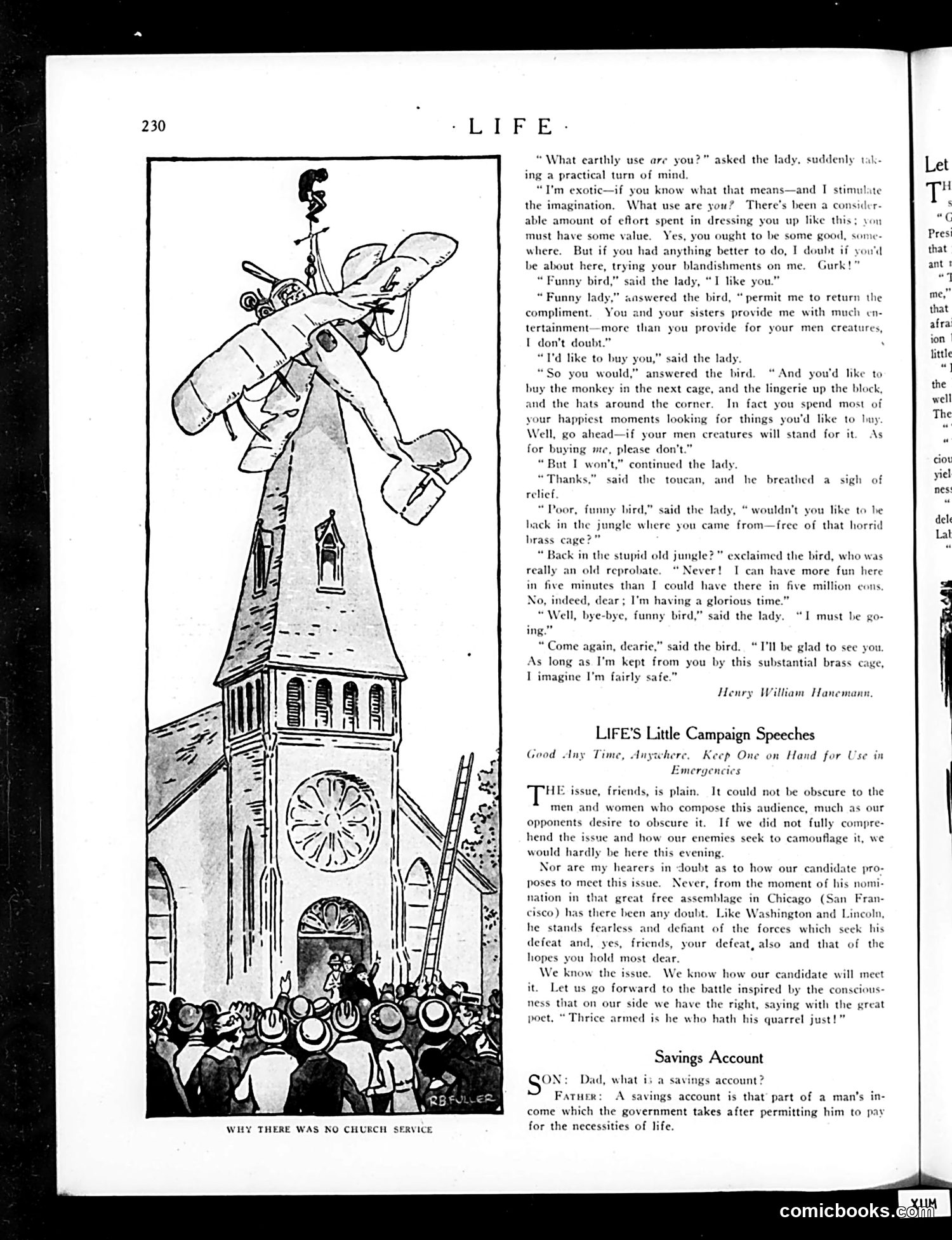
**Main Cartoon ("Why There Was No Church Service"):** The illustration depicts a tall church tower surrounded by a large crowd wearing hats, with what appears to be a toucan perched atop the steeple holding various items. The accompanying dialogue (by Henry William Hanemann) is a witty exchange between a lady and the bird about consumerism and freedom. The satire targets early 20th-century consumer culture: the bird represents exotic temptation and entertainment that distracts people from traditional institutions (the church). The lady's constant desire to buy things reflects emerging consumer materialism, while the bird's refusal to return to nature satirizes people preferring artificial urban pleasures. The church sits empty because the crowd is distracted by commercial entertainment and shopping—a critique of how consumer capitalism was displacing religious life in American society. **Lower Section:** Includes a generic "campaign speech" template (mocking political rhetoric's predictability) and a brief comic about "savings accounts"—where the father's definition that savings equals what government takes after necessities is dark humor about taxation or financial hardship.
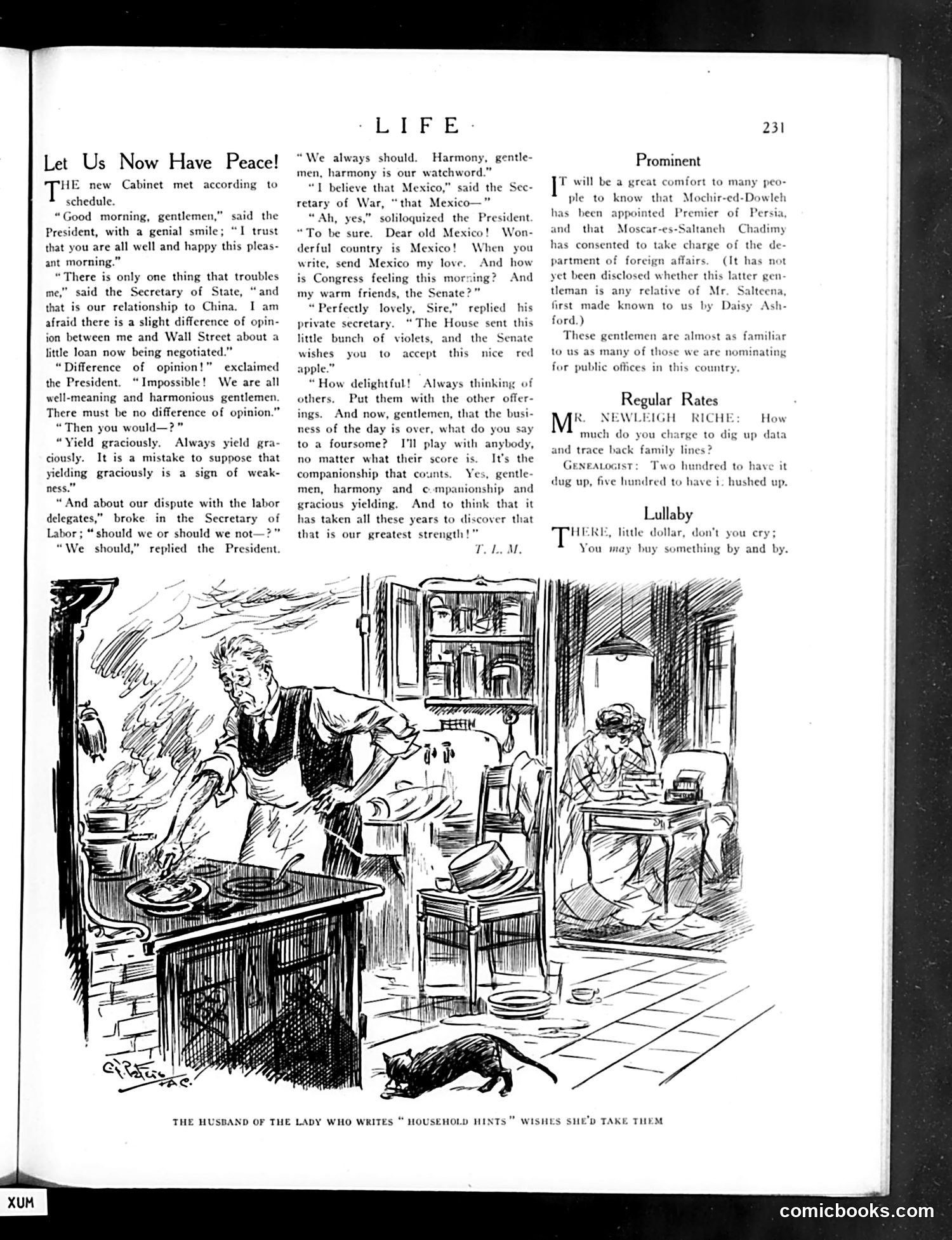
This page satirizes a newly-appointed presidential Cabinet meeting focused on achieving "harmony" above all else. The President advocates gracious yielding on every issue—China policy, labor disputes, and Mexico—prioritizing consensus and companionship over substantive decision-making. The main cartoon (bottom) depicts a chaotic household where a man cooks while a woman works at a desk, illustrating the caption's joke: the husband of a "household hints" columnist wishes his wife would take her own advice—implying her domestic suggestions don't match reality. Additional satirical items mock: - **"Regular Rates"**: A genealogist charging more to hide family history than discover it—commentary on class pretension - **"Lullaby"**: A poem addressing money as if to a child, suggesting Americans' naive faith in economic security The overall tone critiques political passivity and superficial harmony-seeking while depicting gender role confusion and economic anxiety of the era.
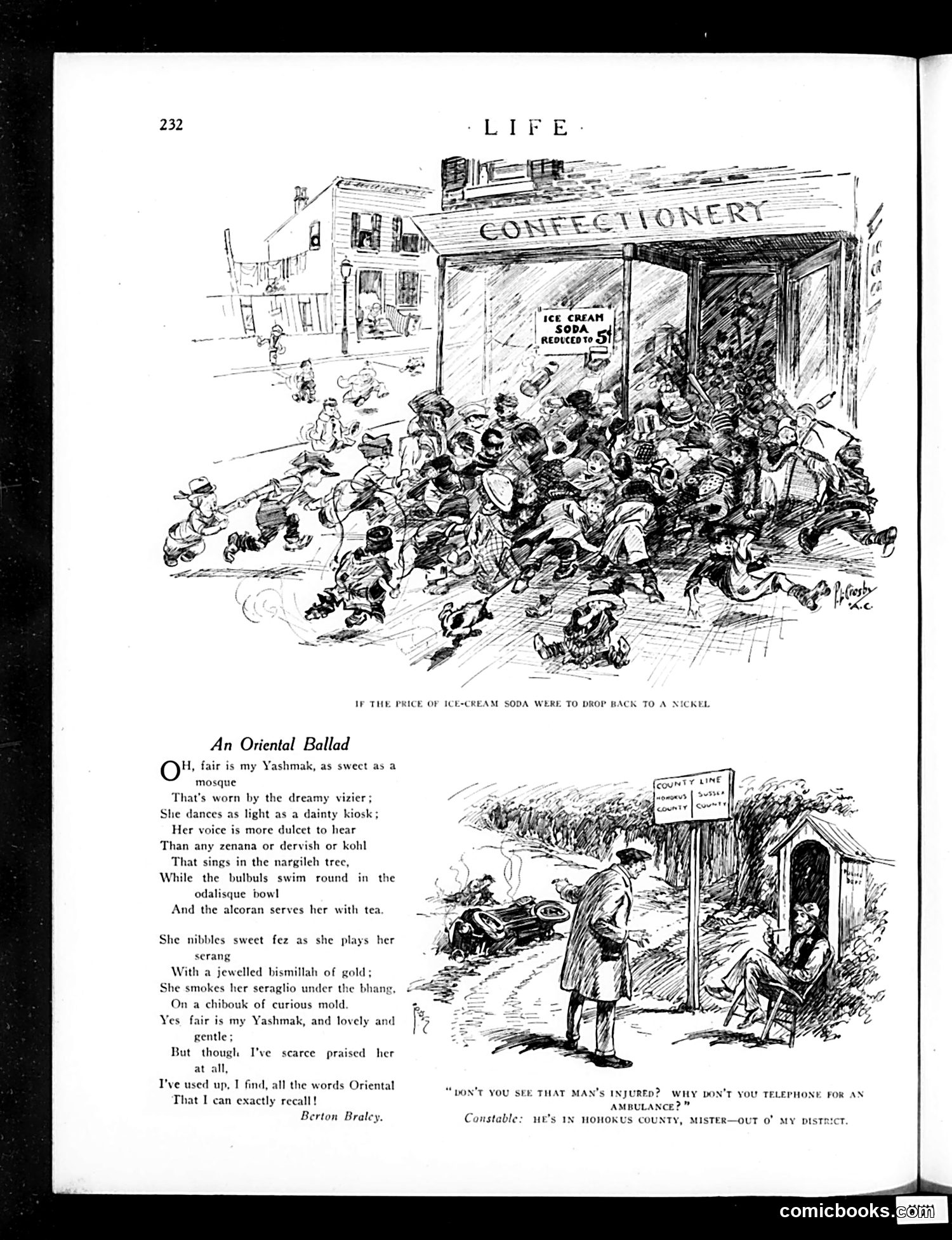
This page contains two separate satirical pieces: **Top Cartoon**: Shows a chaotic crowd mobbing a confectionery shop with a sign advertising "Ice Cream Soda Reduced to 5¢." The caption jokes that if ice-cream sodas dropped back to a nickel's price, the result would be pandemonium. This satirizes consumer behavior and price-sensitivity—the implication being that a nickel price would create such demand that crowds would overwhelm the shop. (Context: A nickel was historically cheap; the joke reflects economic anxieties about inflation or deflation.) **Bottom**: Two pieces: - A nonsensical poem titled "An Oriental Ballad" by Berton Braley, mockingly stringing together pseudo-Oriental vocabulary (yashmak, vizier, zenana, kohl, etc.) until the speaker admits he's simply exhausted his supply of exotic-sounding words. This satirizes orientalism and flowery, affected verse. - A cartoon showing a constable refusing to help an injured man, claiming jurisdiction lies in "Hohokus County" outside his district—mocking bureaucratic buck-passing and jurisdictional excuses for inaction.
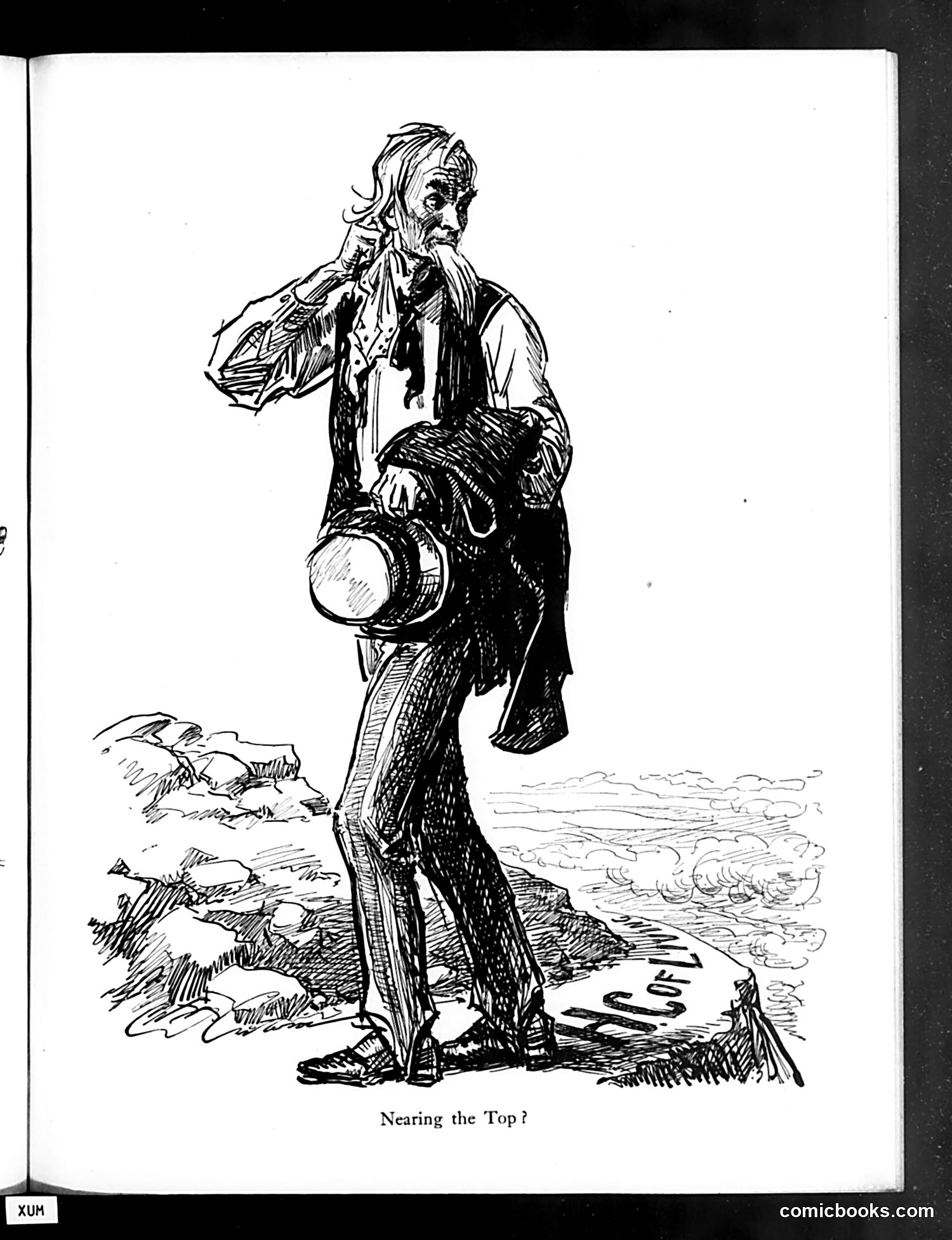
This political cartoon depicts an elderly man with a long beard, dressed in worn clothing and carrying a hat and bundle, climbing a steep rocky mountain. The caption's question "Nearing the Top?" suggests commentary on ambition or aspiration. The figure appears to be a laborer or working-class individual—the shabby clothes, advanced age, and meager possessions suggest someone who has struggled long. The "top" likely represents success, wealth, or social advancement. The satire likely critiques either false hopes about upward mobility or the grueling difficulty of achieving success in a class-stratified society. Without specific historical dating visible, the exact political target remains unclear, though the image evokes themes common to turn-of-the-century American satirical commentary on labor and class.
This page discusses the 1920 U.S. presidential election, featuring two Ohio statesmen: Governor **James Cox** (Democratic candidate) and **Warren Harding** (Republican nominee). The satire centers on their carefully neutral positions on the League of Nations—the contentious international organization President Wilson championed but Congress rejected. The cartoons mock **Hiram Johnson** (progressive Republican senator), depicted sitting safely on a California porch facing the ocean, avoiding eastward—symbolizing how he and other politicians dodge difficult foreign policy questions. The text criticizes their evasiveness: they won't clearly state positions because the League divided both parties and the electorate. The page also skewers **A.G. Gardiner**, a British editor who criticizes American non-involvement in European affairs while Americans prefer avoiding such entanglements. The overall satire: American politicians and public alike are dodging responsibility for post-WWI global complications.
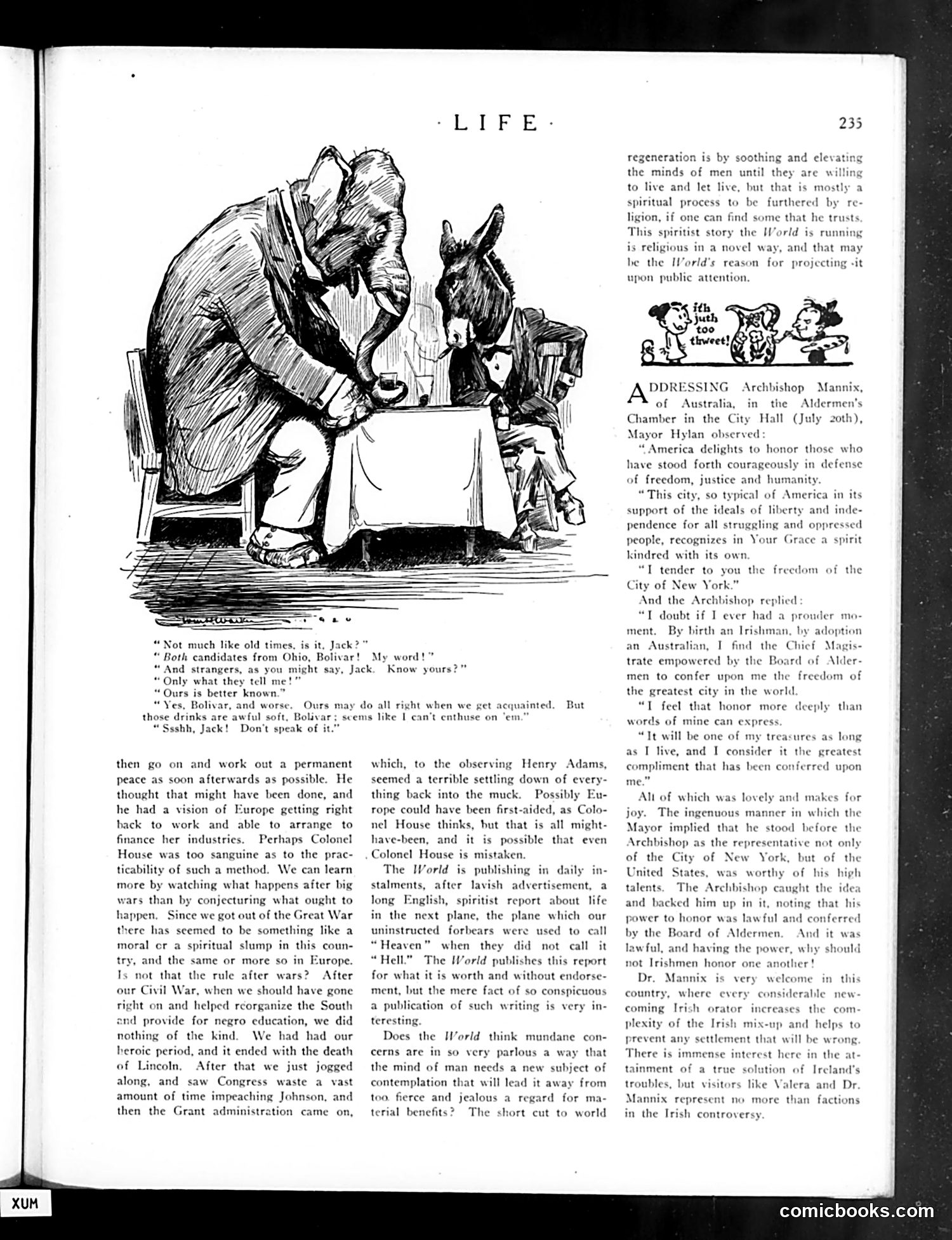
## The Main Cartoon The sketch depicts two men (labeled "Jack" and "Bolivar") at a table with drinks, discussing American politics. The dialogue references "both candidates from Ohio"—likely referring to the 1920 presidential election when both major-party nominees (James Cox for Democrats, Warren G. Harding for Republicans) were Ohio natives. The men express cynicism about the candidates, with one saying their choice "is better known" but "worse," and dismissing the drinks as "awful soft"—suggesting disappointment with watered-down options. ## The Point The satire mocks voter dissatisfaction with post-WWI American leadership choices. The "soft drinks" metaphor suggests weak, uninspiring candidates. This reflects broader post-war malaise the text discusses—a "spiritual slump" following the Great War, contrasting with earlier heroic periods like Lincoln's era. ## Secondary Content The page also includes a tribute to Archbishop Mannix of Australia, whom Mayor Hylan honored for defending freedom and justice—seemingly genuine praise rather than satire.
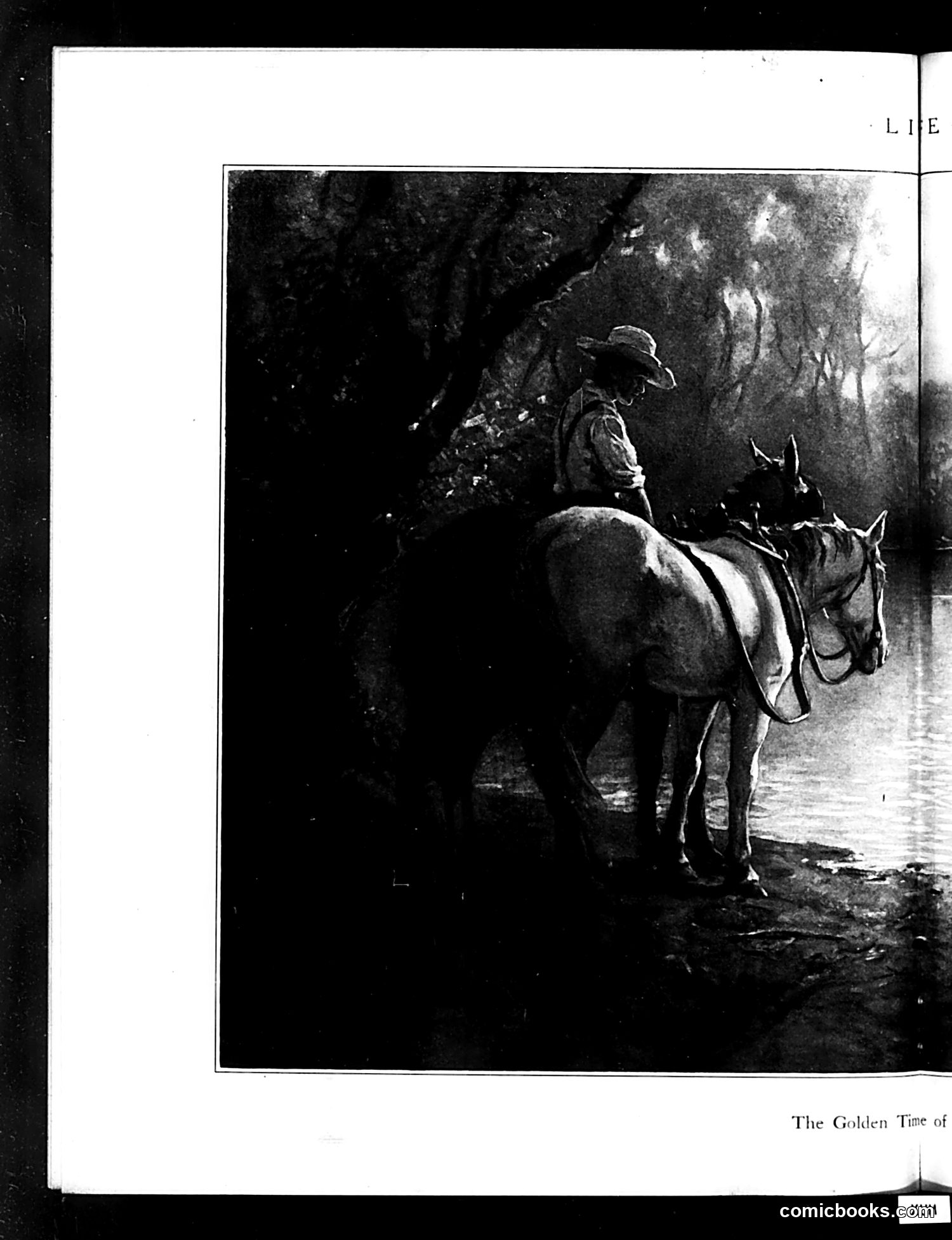
This appears to be a page from *Life* magazine featuring a black and white photograph rather than a cartoon. The image shows a cowboy on horseback at what appears to be a water's edge or stream, wearing period Western attire including a hat and saddle. The caption reads "The Golden Time of" (text cut off). Without the complete caption or additional context visible on the page, the specific satirical point is unclear. The image could be referencing Western romanticism, frontier mythology, or possibly commenting on nostalgia for an earlier American era—common *Life* magazine themes. However, without the full caption or additional text, I cannot definitively explain what aspect of "the golden time" this photograph is satirizing or what social/political commentary it intends.
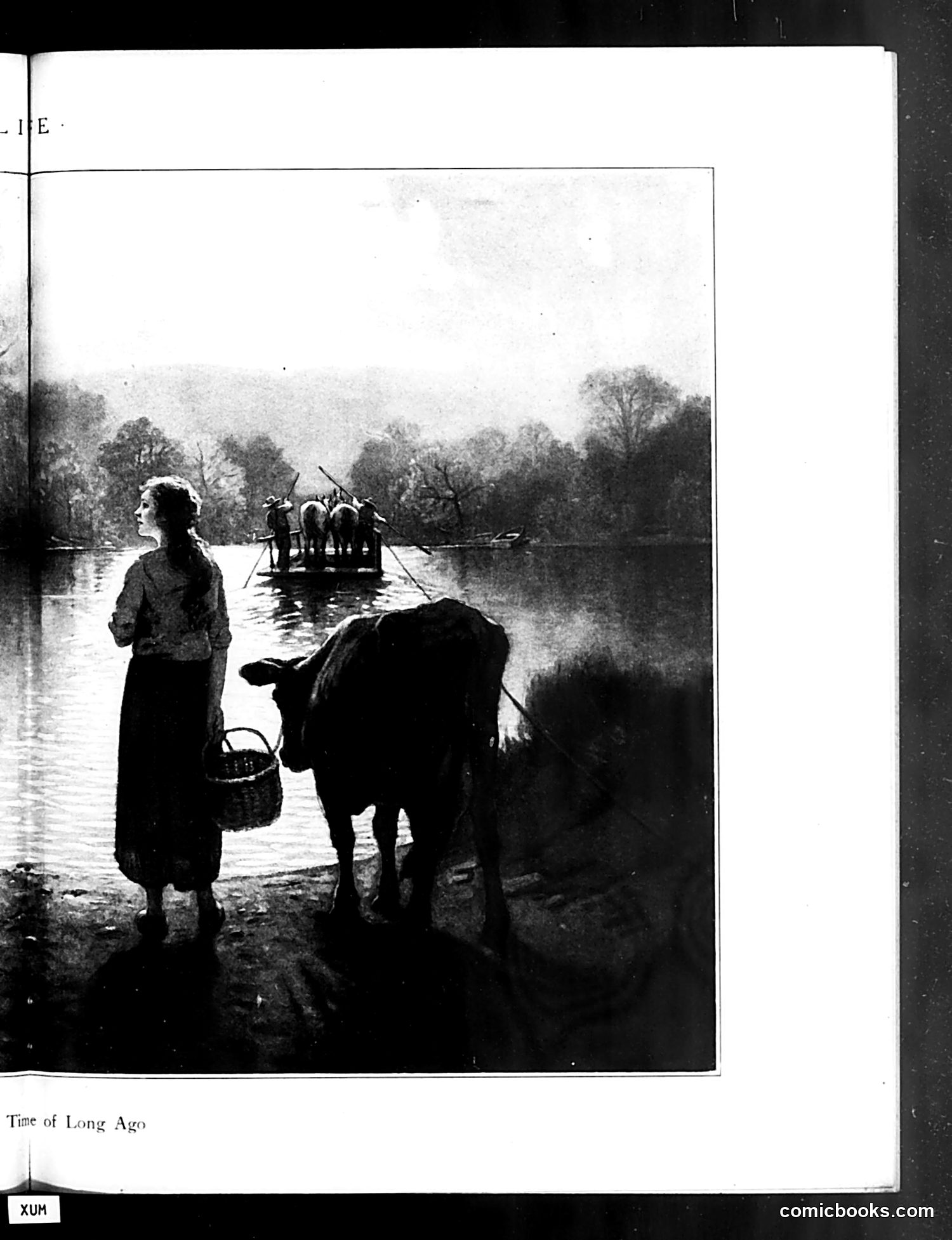
This appears to be a nostalgic illustration titled "Time of Long Ago" from Life magazine. The image depicts a silhouetted scene of a woman standing by a riverbank holding a basket, accompanied by a cow. In the background, a flat-bottomed boat or ferry with cattle crosses the water, surrounded by bare trees. The composition suggests rural, pre-industrial life—likely referencing an earlier American agricultural era. The romantic, atmospheric quality of the silhouettes evokes sentimentality for a simpler past. Without additional context, the specific satirical or political point remains unclear, though Life often used such imagery to either mock nostalgia for agrarian life or critique contemporary industrial society through idealized rural contrast.
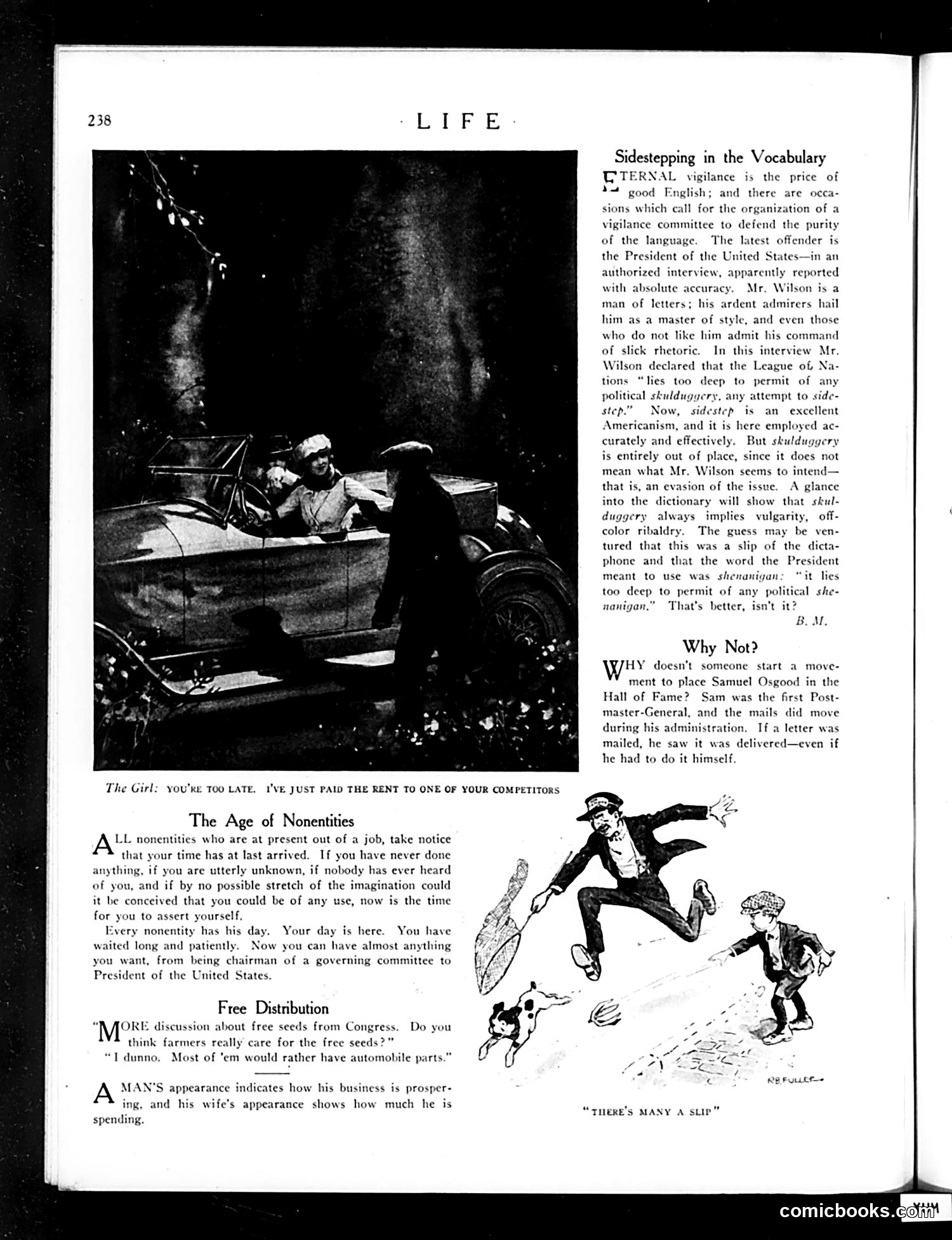
**Main Content: "Sidestepping in the Vocabulary"** This section critiques President Wilson's word choice in a public interview. Wilson used "skulduggery" when discussing the League of Nations, but the author argues this is incorrect—"skulduggery" means vulgar or indecent behavior, not political evasion. The author suggests Wilson meant "shenanigan" instead, humorously questioning whether this was a dictaphone error from a supposedly eloquent president. **Secondary Pieces:** - "Why Not?" sarcastically proposes honoring Samuel Osgood, the first Postmaster-General, for actually delivering mail—a jab at current postal inefficiency. - "The Age of Nonentities" mocks how unqualified people can now reach high office (including presidency), suggesting the political system lacks merit-based selection. - "Free Distribution" jokes that farmers prefer auto parts to free government seeds. **Overall Theme:** The page satirizes governmental incompetence and linguistic pretension, particularly under Wilson's administration, using wordplay and ironic proposals as comedic vehicles.
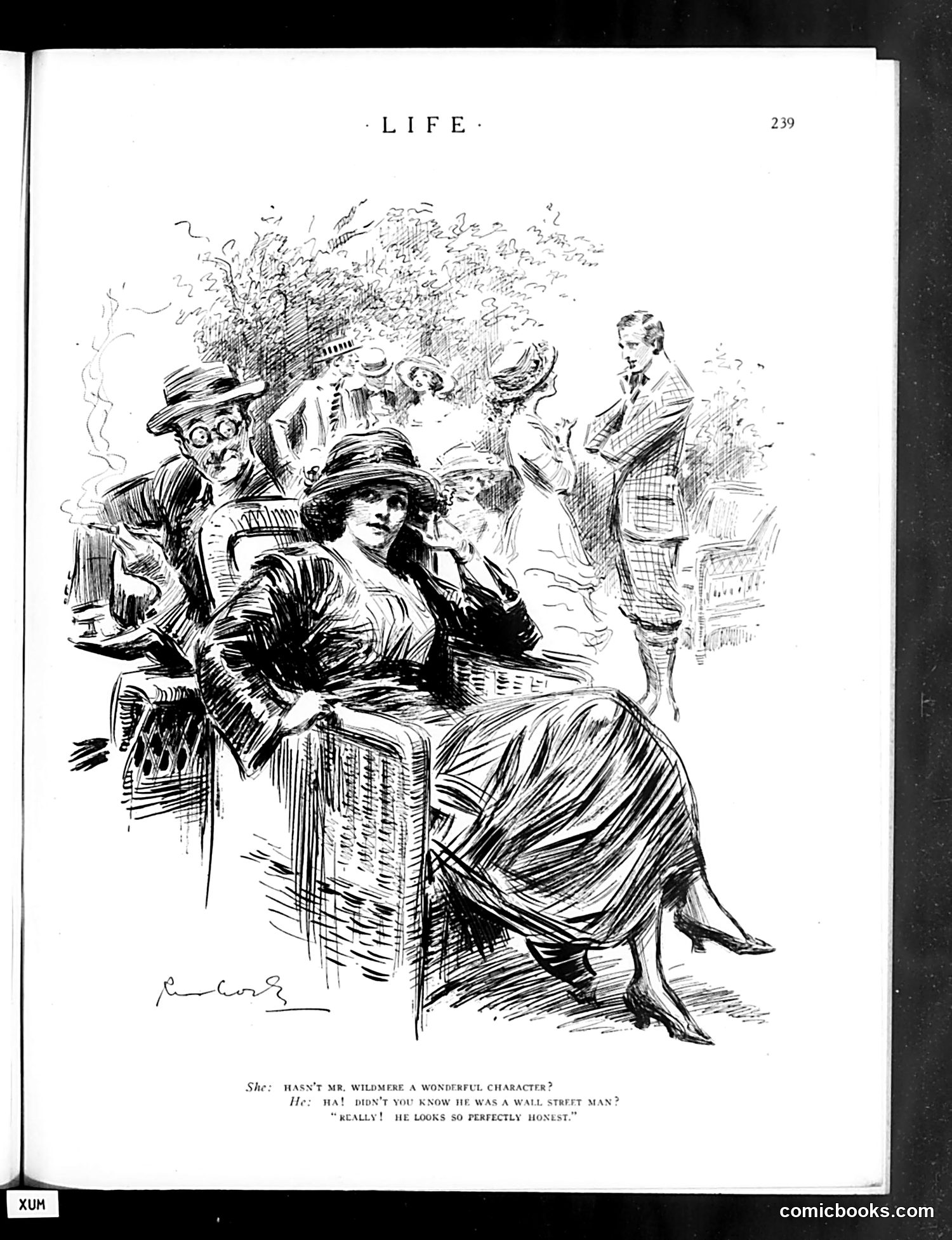
This Life magazine cartoon satirizes the perceived dishonesty of Wall Street financiers during the early 20th century. The joke hinges on ironic contrast: a woman expresses surprise that a man "looks so perfectly honest" upon learning he's a Wall Street businessman—implying that Wall Street men are typically *dishonest*. The cartoon reflects public skepticism toward financial markets and investment practices of the era. The woman's astonishment suggests that honest appearance and Wall Street involvement are seen as mutually exclusive—a pointed commentary on the reputation financiers had earned, likely following various market scandals or manipulations. The sketch style is characteristic of Life's satirical approach to contemporary social and economic criticism.
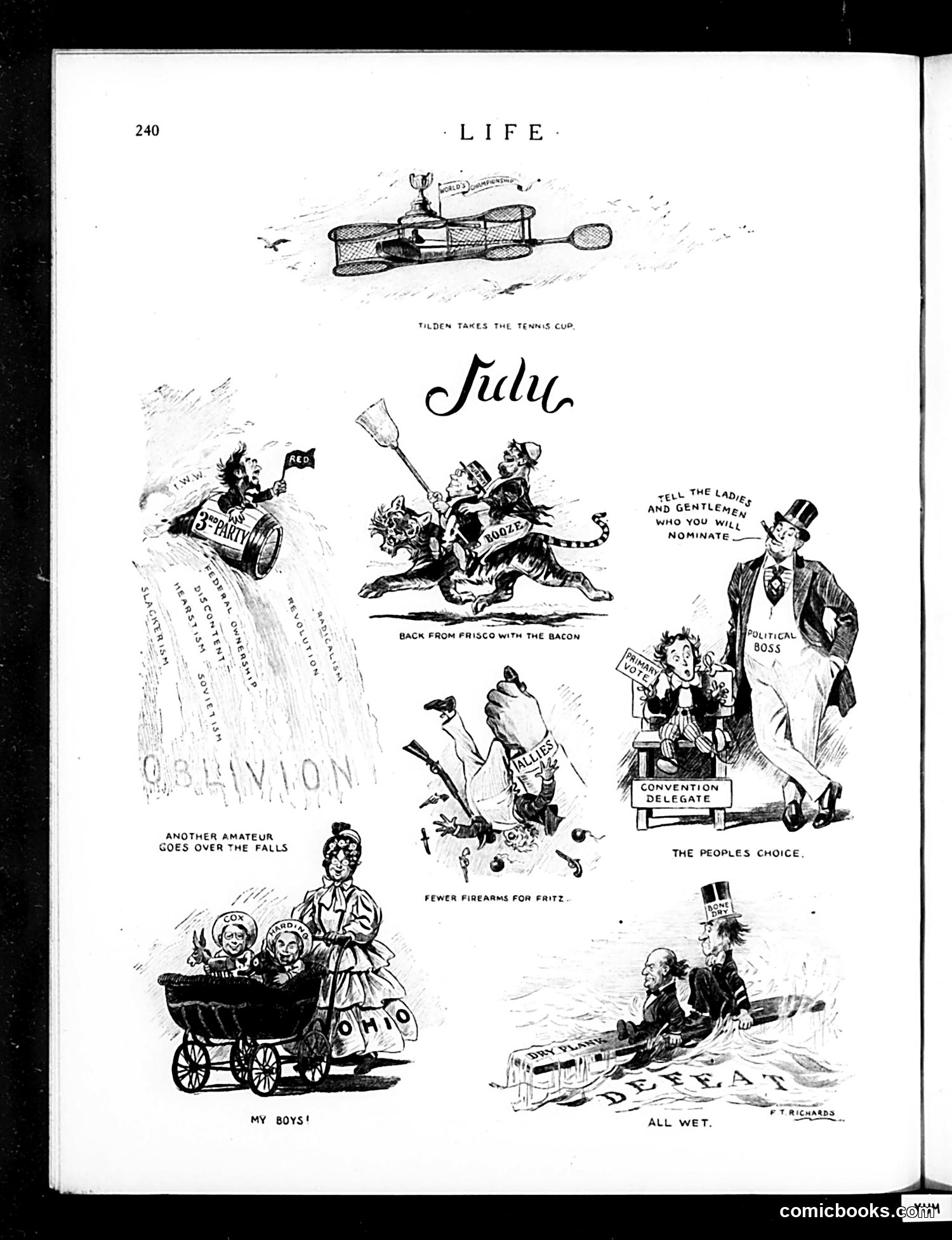
This page satirizes 1920s American life through seven cartoon vignettes. The title references Bill Tilden, a famous tennis champion, whose victory "takes the tennis cup." The cartoons mock various contemporary figures and activities: - "Back from Frisco with the Bacon" ridicules someone's dubious accomplishments - "Fewer Firearms for Fritz" appears to reference German military restrictions post-WWI - "Another Amateur Goes Over the Falls" satirizes daredevil stunts - "The People's Choice" and "Convention Delegate" mock political machinery and bosses influencing nominations - "My Boys!" depicts a woman with children in a carriage labeled "Ohio" - "All Wet" shows figures in water, likely mocking political failures or unpopular policies The cartoons collectively critique American politics, masculine posturing, and social follies of the era, using exaggerated caricature typical of Life's satirical approach.
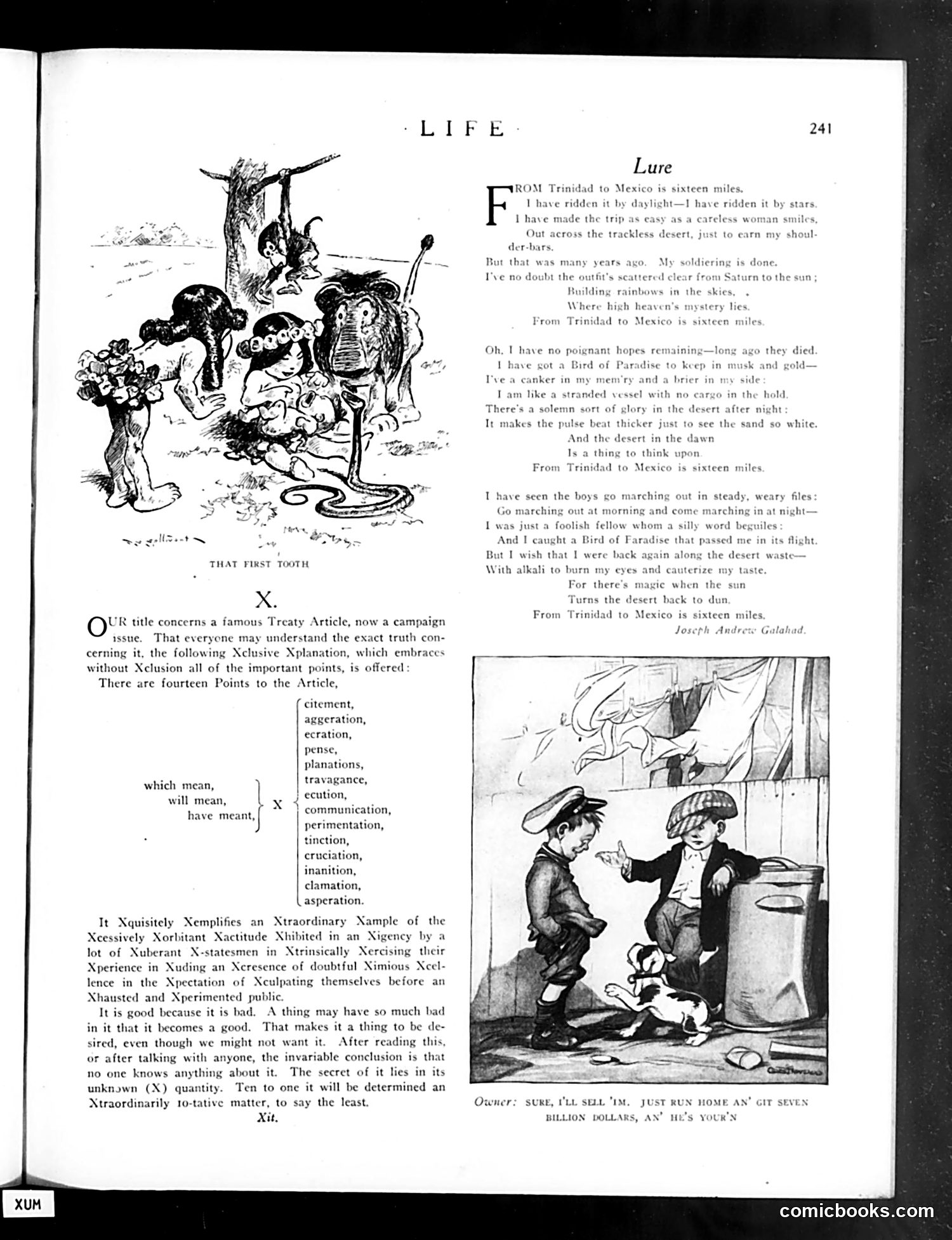
**The "X" Section** satirizes the obscurity of a major Treaty Article in contemporary political debate (likely Wilson's Fourteen Points, given the historical context). Life mocks how politicians use deliberately confusing language—14 points supposedly explained through words stripped of their initial letters (excitement → "citement," exaggeration → "ggeration"). The joke is that this "Xclusive Xplanation" explains nothing; it demonstrates how political rhetoric deliberately obscures rather than clarifies. The text concludes: no one actually understands what's being discussed, making it perfectly suited for political use. **The Bottom Cartoon** depicts a naive seller offering property (likely land) to a buyer. The owner claims it's worth "seven billion dollars"—an absurdly inflated price suggesting either a con artist, delusional optimism, or satirical commentary on wildly overvalued real estate deals common in that era. Both sections target political and commercial obfuscation through wordplay and false value.
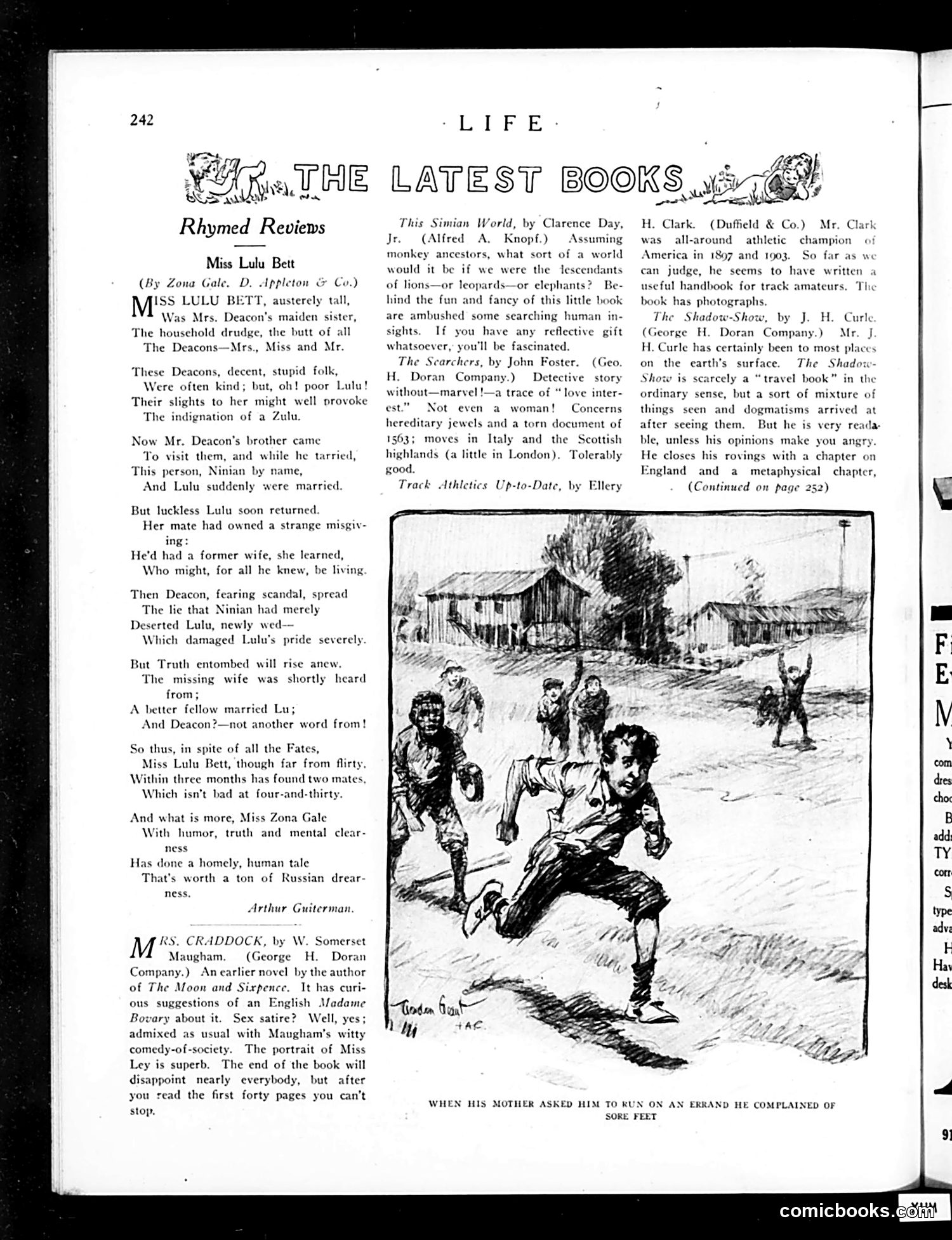
This page is primarily **book reviews** in verse and prose, not political cartoons. The single illustration depicts a domestic scene: children running errands, with one boy complaining of sore feet to his mother. The cartoon's humor is **generational and timeless**—it satirizes a child's reluctance to do chores by exaggerating minor discomfort into a complaint. There's no specific political or social reference; it's gentle domestic comedy about childhood behavior that would resonate in any era. The book reviews themselves focus on contemporary 1920s literature, including *Miss Lulu Bett* (a story of a mistreated woman finding independence and remarriage) and works by W. Somerset Maugham. The reviews use rhyme and wit to make literary criticism entertaining for *Life*'s readers, emphasizing humor and social observation as selling points for these novels. The page represents *Life*'s role as a **literary and cultural commentary magazine**, blending high-brow book discussion with low-brow domestic humor.
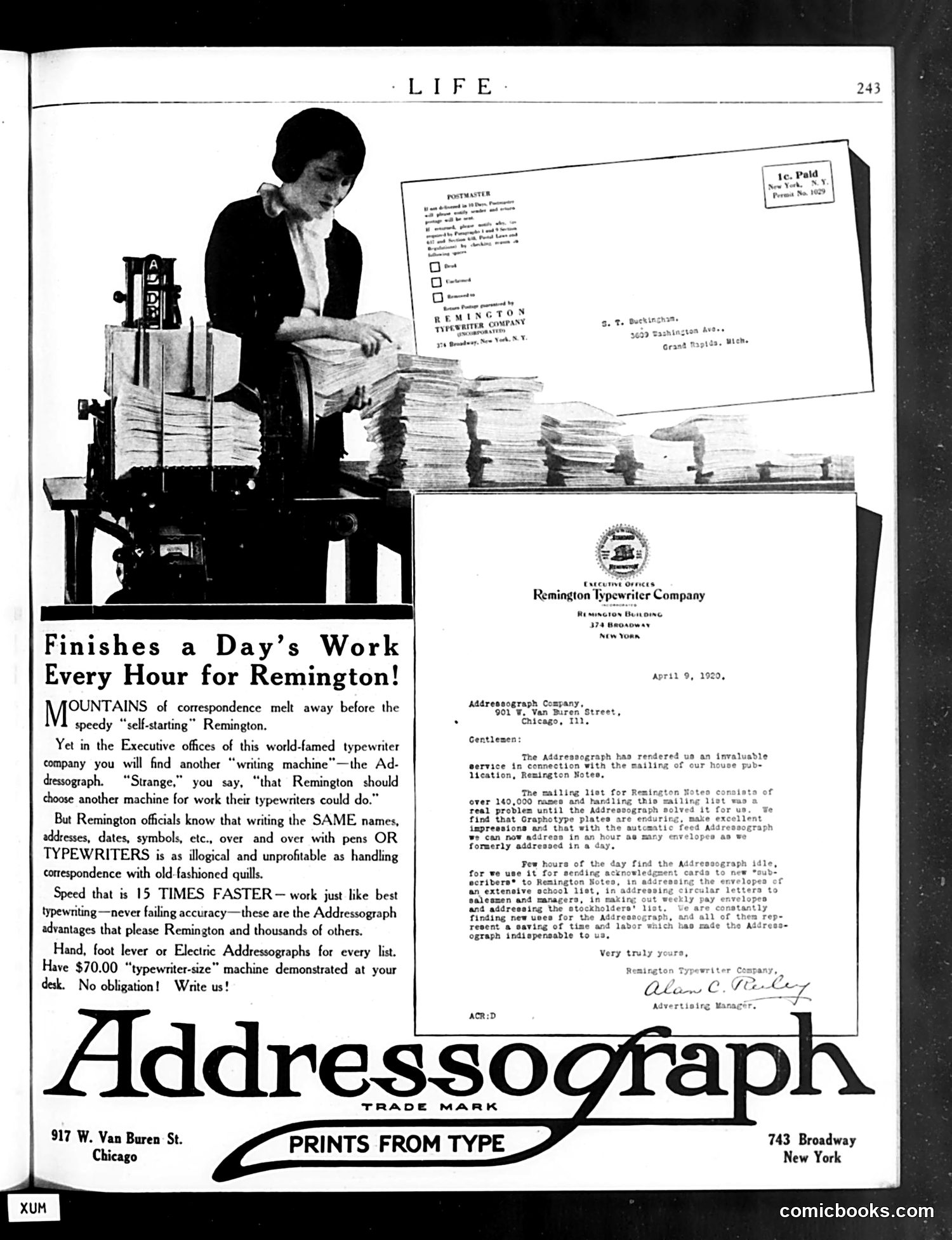
This is primarily a **product advertisement**, not a political cartoon. It promotes the Addressograph, a mechanical mail-addressing device made by Remington Typewriter Company. The ad uses ironic humor: Remington, famous for typewriters, paradoxically endorses a *different* machine—the Addressograph—for repetitive addressing tasks. The accompanying letter from Remington's own executives (dated April 9, 1923) serves as testimonial, claiming the Addressograph handles 140,000+ names more efficiently than manual typing. The visual shows a woman operating the device, surrounded by stacks of addressed envelopes. The joke is the logical contradiction: Remington admits their typewriters are *worse* for this job than a specialized competitor's product. This self-deprecating approach was meant to build credibility by seeming honest about tool-specific efficiency—suggesting Remington values the right tool over brand loyalty. The ad emphasizes speed ("15 TIMES FASTER") and the drudgery of repetitive addressing work, a genuine office problem in the pre-digital era.
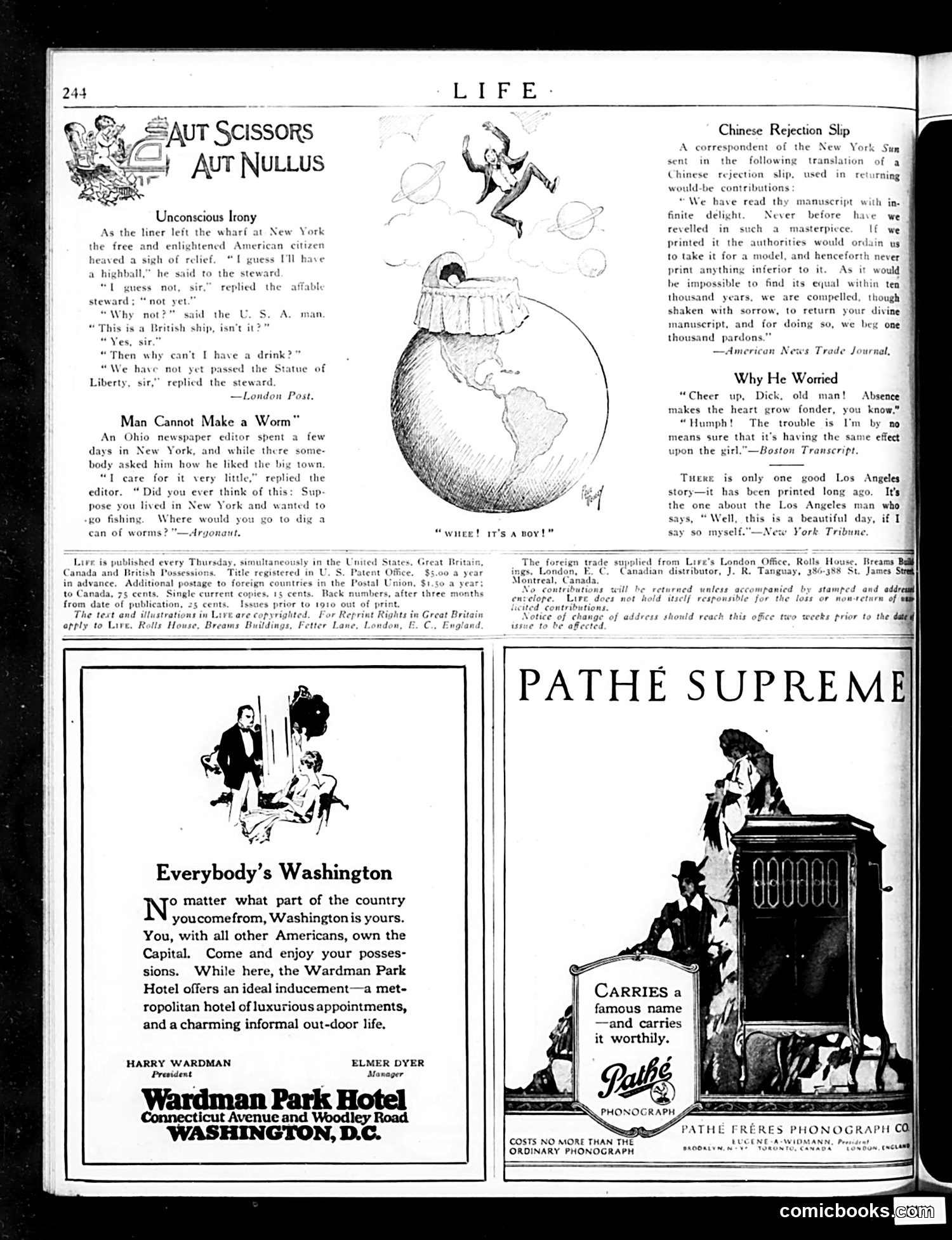
This page contains several brief humorous anecdotes and advertisements typical of early 20th-century Life magazine. **The cartoons/jokes satirize:** 1. **"Unconscious Irony"** — A British ship steward denies an American passenger a drink because they haven't passed the Statue of Liberty yet, implying Britain hasn't fully adopted American freedoms (drinking culture). 2. **"Man Cannot Make a Worm"** — An Ohio editor complains New York is useless because you can't find worms there for fishing—absurdist humor about impractical city life. 3. **"Chinese Rejection Slip"** — Satire of overly-polite rejection letters, using exaggerated Chinese courtesy to mock the form. 4. **"Why He Worried"** — A man jokes that absence makes hearts grow fonder, but worries his girlfriend isn't experiencing the same effect—a domestic anxiety joke. The page also includes period advertisements for the Wardman Park Hotel (Washington D.C.) and Pathé phonographs, which occupied significant space in Life's revenue model.
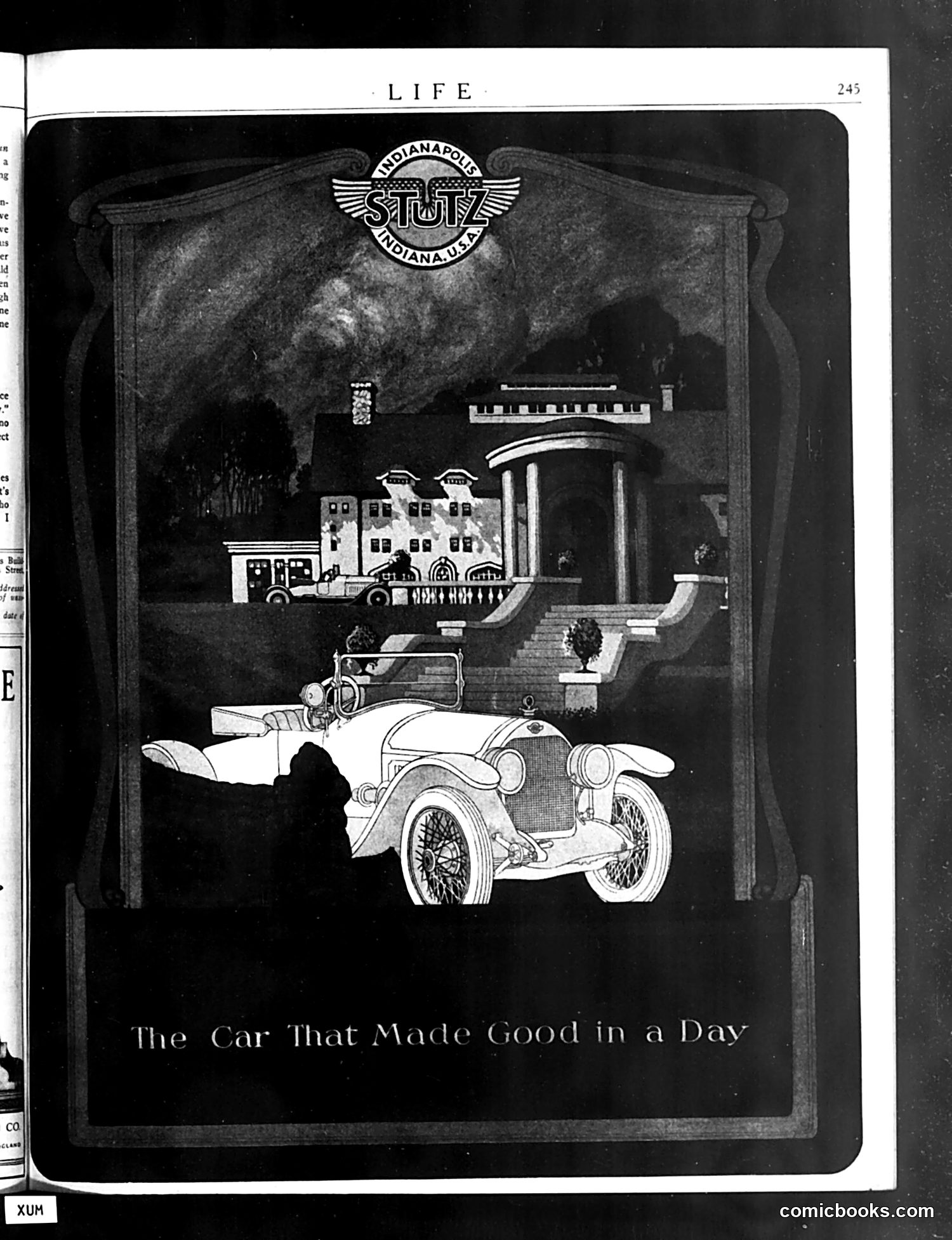
This is a Stutz automobile advertisement from *Life* magazine (page 245). The headline "The Car That Made Good in a Day" uses a colloquial phrase suggesting rapid success or vindication. The advertisement depicts a Stutz sports car in the foreground with an elaborate fantasy scene behind it—featuring classical architecture, a grand building, and what appears to be racing or manufacturing activity. The imagery suggests speed, prestige, and industrial achievement. The ad likely references the Stutz brand's racing heritage or a specific competitive victory that generated publicity. The theatrical, dream-like background composition was typical of 1920s luxury automobile advertising, using aspirational imagery to associate the vehicle with success, modernity, and social advancement. The exact historical event referenced remains unclear without additional context.
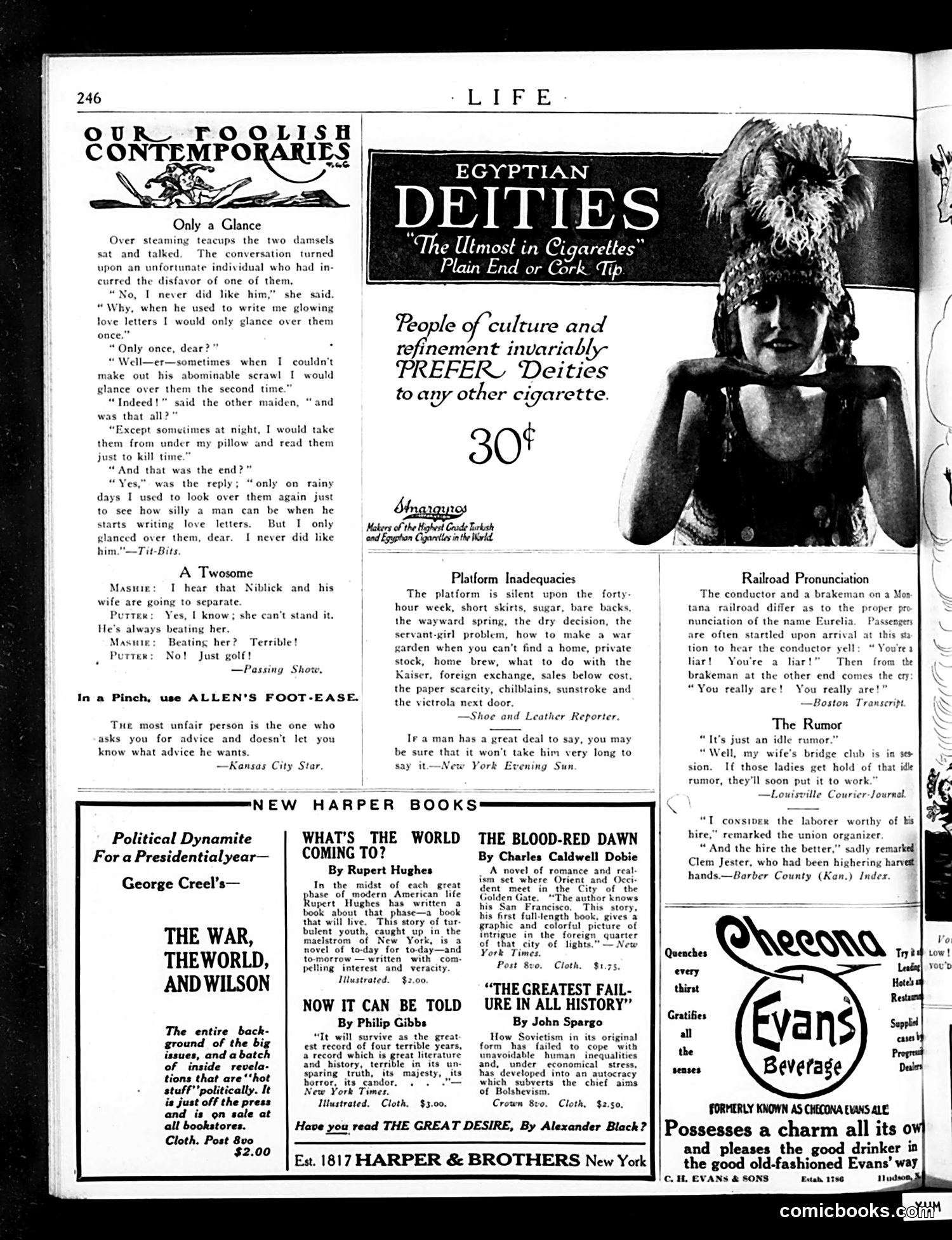
This page is primarily **advertising and short humor pieces**, not political cartoons. The dominant feature is an **Egyptian Deities cigarette advertisement**, showing a woman's photograph with taglines about cultural refinement preferring their brand (30¢). The humor content consists of brief satirical anecdotes: - **"Only a Glance"**: A woman admits she repeatedly read love letters despite claiming indifference, satirizing female dishonesty about romance. - **"A Twosome"**: A husband says his wife is "beating" him; the punchline reveals he means at golf, not domestic abuse. - **"Platform Inadequacies"** and **"Railroad Pronunciation"**: Brief workplace absurdities about labor conditions and mispronounced station names. - **"The Rumor"**: A woman fears her bridge club will spread gossip about her. The page also advertises Harper & Brothers books on political topics (Wilson, WWI). The humor reflects early 20th-century gender stereotypes (women as gossips, dishonest in love) and workplace satire typical of *Life* magazine's style.
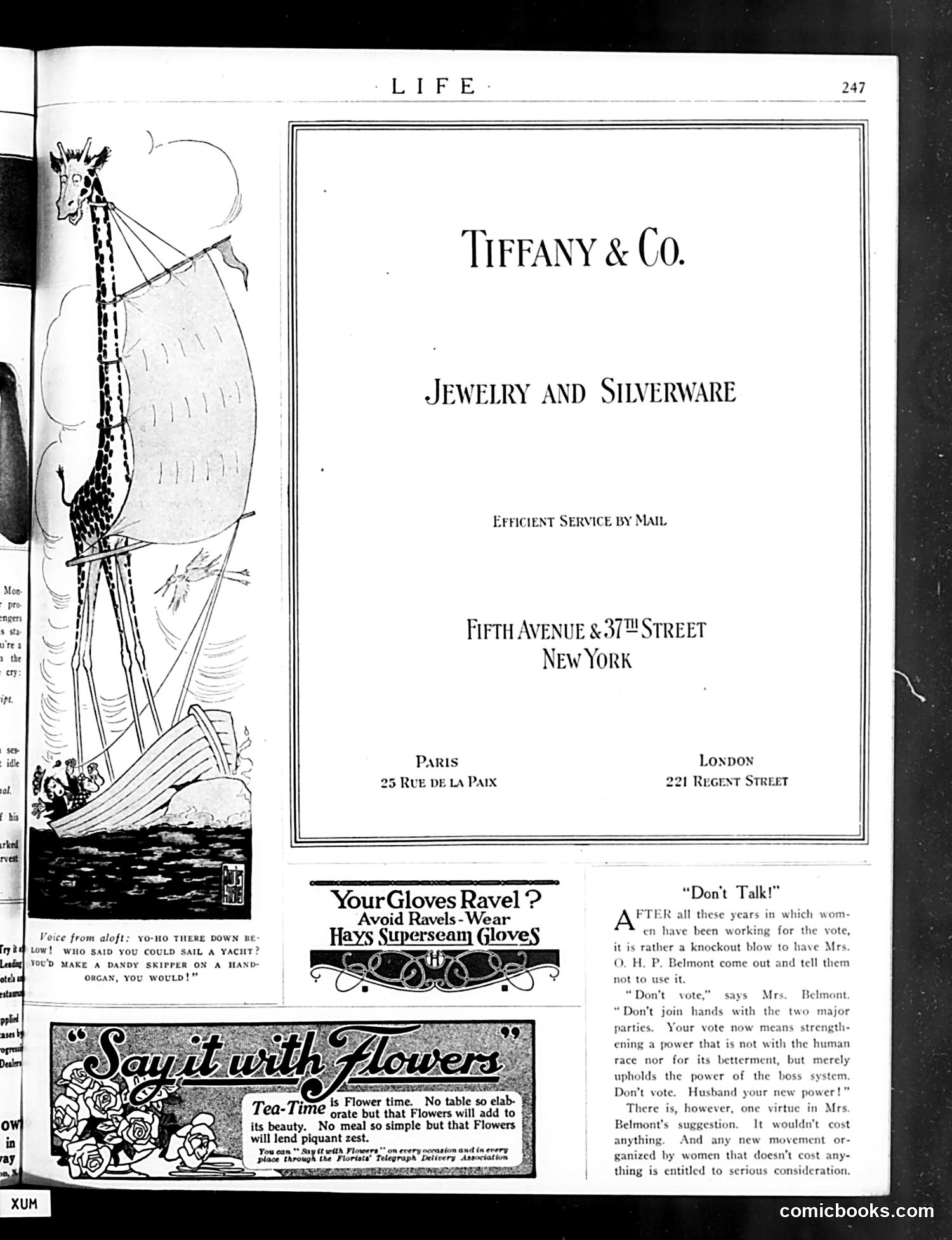
This page primarily features advertisements (Tiffany & Co., glove and flower ads) alongside a brief satirical commentary titled "Don't Talk!" The piece mocks **Mrs. O. H. P. Belmont**, a prominent suffragist who apparently advised newly enfranchised women *not* to vote. Belmont argued that voting would strengthen the existing "boss system" rather than genuinely empower women, and urged them to "husband" their newfound power instead. The Life magazine commentary is sharply sarcastic: it presents Belmont's suggestion as actually having one merit—it costs nothing. The final jab implies that any women's movement costing nothing deserves "serious consideration," a backhanded insult suggesting her advice is worthless because it requires no real effort or investment. This reflects early 20th-century debates within the suffrage movement itself about how newly voting women should exercise political power.
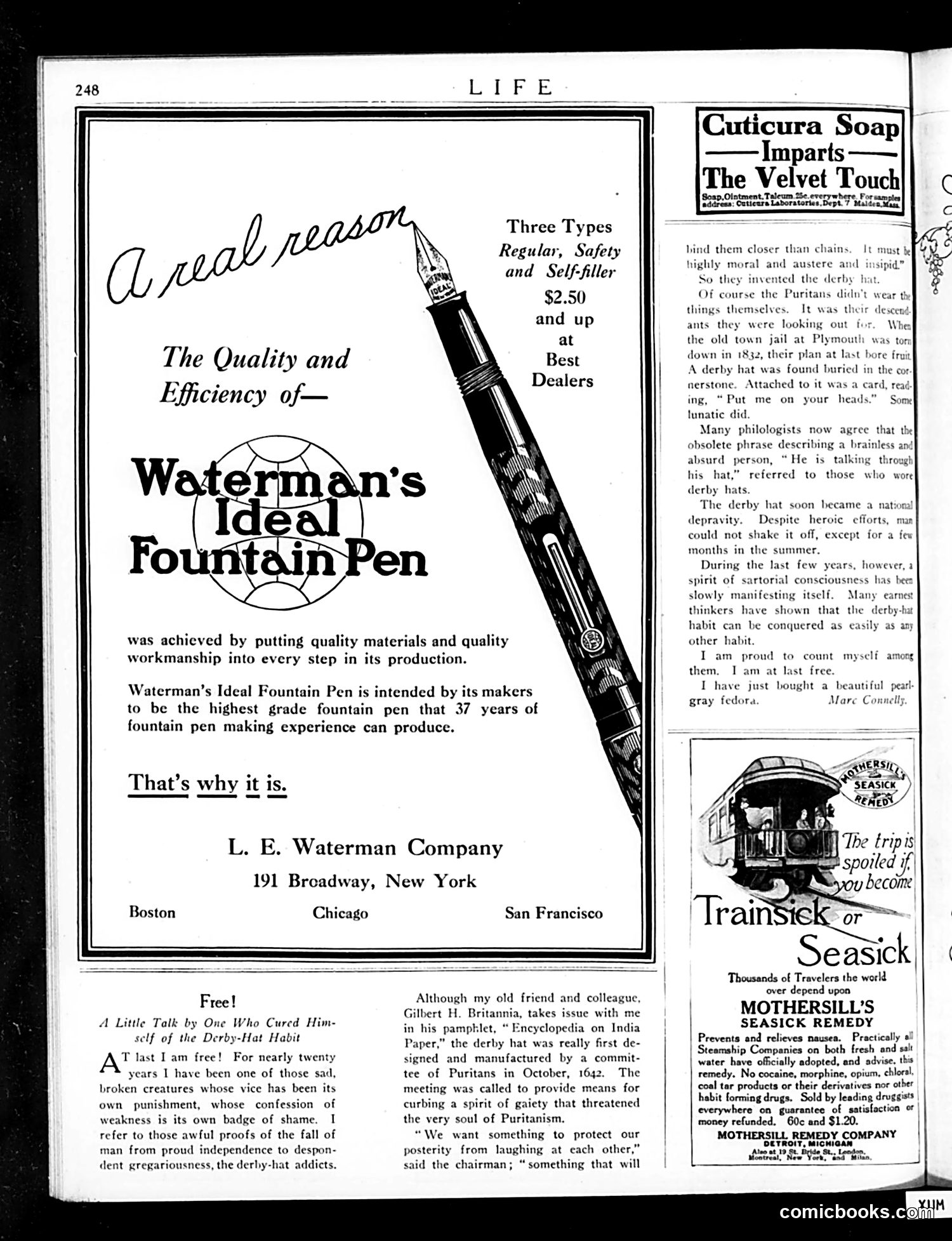
This page combines advertisements with a humorous essay titled "A Little Talk by One Who Cured Himself of the Derby-Hat Habit." **The Main Satire:** The essay mocks derby hat wearers through absurdist history. It claims Puritans invented the derby in 1642 specifically to suppress joy and enforce dullness—describing it as a tool of conformity and social control. The author presents himself as having overcome a shameful "addiction" to wearing derby hats, now liberated by switching to a fedora. **The Social Joke:** This satirizes early 20th-century American conformity and fashion conventions. The derby hat was standard formal wear for businessmen and the respectable classes, so the essay ridicules how fashion dictates behavior and identity. By treating hat-wearing as a "vice" and "depravity," the author mocks both fashion obsession and the moral rigidity associated with traditional dress codes. **Context for Modern Readers:** The derby hat symbolized establishment conformity; rejecting it represented personal freedom—a subtle critique of how fashion enforces social expectations. The page's advertisements (Waterman pens, Cuticura Soap, seasickness remedy) are period marketing.
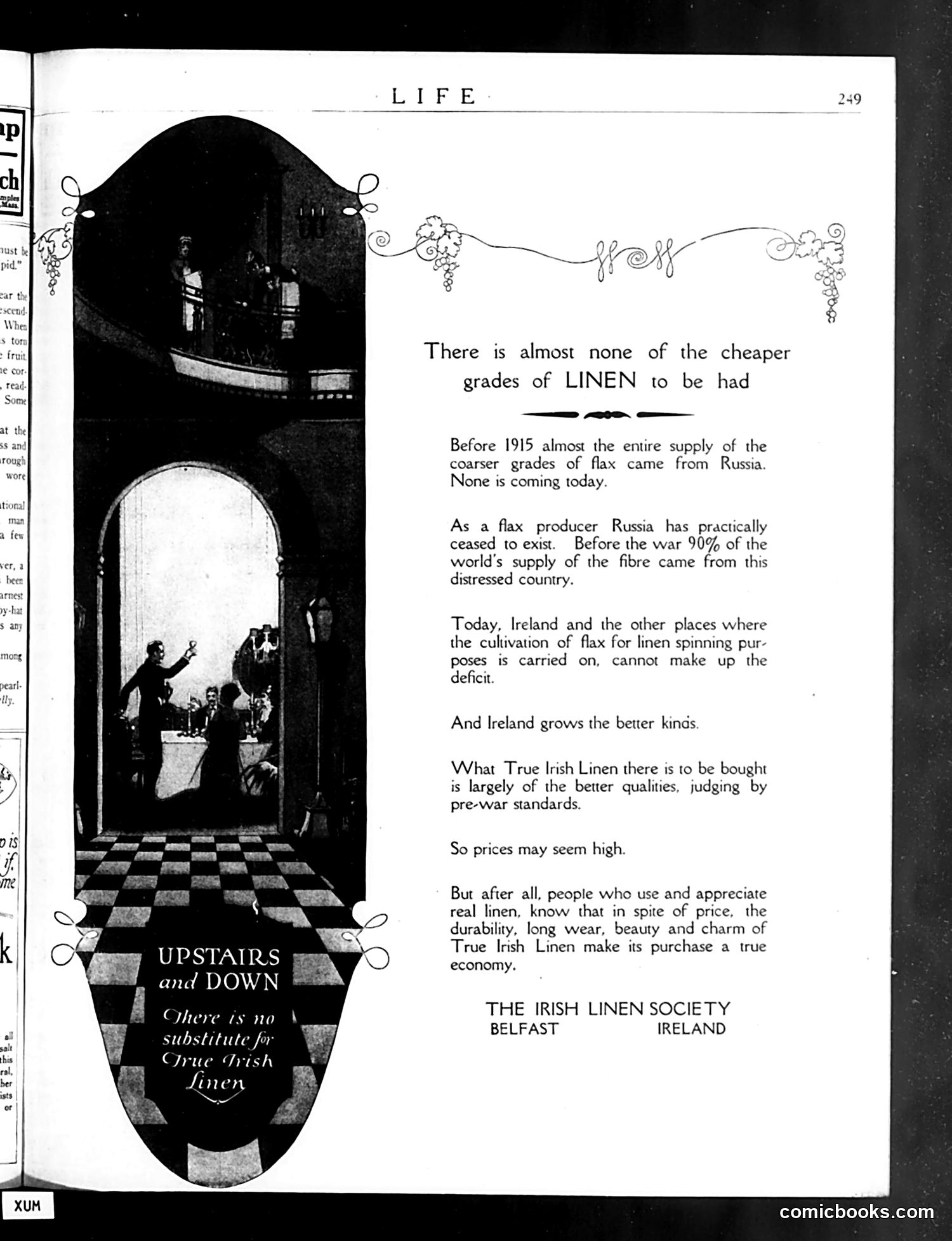
This is a **advertisement for Irish linen**, not a political cartoon. The dramatic illustration labeled "Upstairs and Down" depicts an elegant interior (likely a mansion) with figures in formal dress, emphasizing linen's association with luxury and refinement. The ad's argument addresses post-WWI economic disruption: Russia, which supplied 90% of the world's cheap flax before 1915, had ceased production (due to the Russian Revolution and civil war). This created a linen shortage, making prices appear high. The Irish Linen Society argues that while True Irish Linen costs more, its superior quality, durability, and beauty justify the expense. The message: don't buy cheaper substitutes—invest in Irish linen's proven value. The page reflects early 1920s concerns about postwar supply chains and manufacturing realignment, particularly Ireland's economic opportunity as Russia withdrew from international trade.
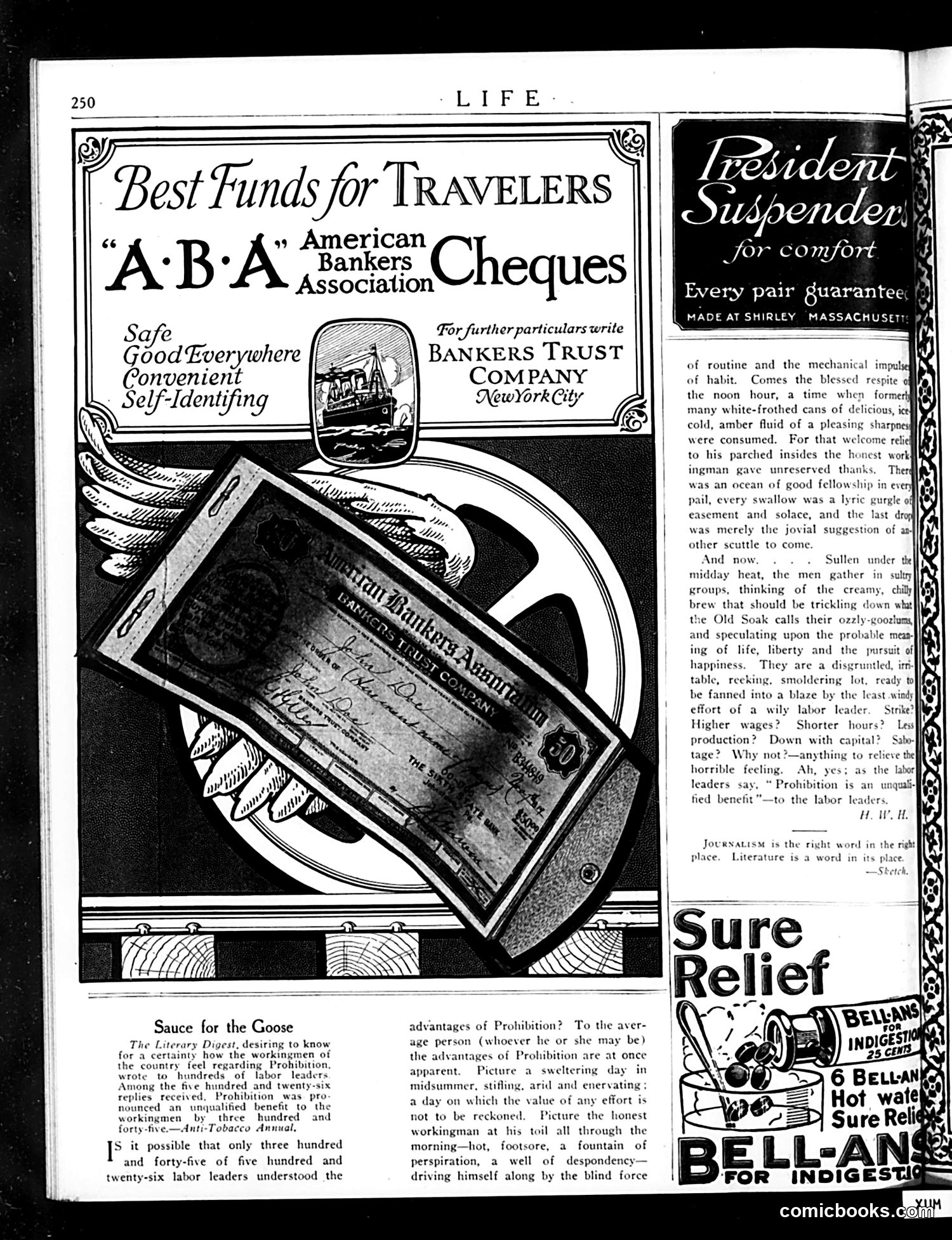
The left page features an advertisement for traveler's cheques from Bankers Trust Company—not a cartoon. The main satirical content is the article **"Sauce for the Goose,"** which critiques Prohibition's claimed benefits. The satire works by *accepting* Prohibition supporters' logic to expose its absurdity: **The argument:** Labor leaders surveyed claimed Prohibition benefits workers. The article sarcastically asks: could they all understand something the "average person" doesn't? **The satirical point:** It then *describes* a laborer's experience—sweating in summer heat, desperately wanting a cold beer at noon, which gave him joy and solidarity. Now, under Prohibition, that same worker is "sullen" and angry, easily manipulated by labor agitators demanding strikes and revolution. **The implied critique:** Prohibition actually *harms* workers by removing their simple comfort, making them resentful and radical—the opposite of the claimed benefit. The phrase "to the labor leaders" suggests union bosses supported Prohibition because discontent serves their organizing interests, not workers' actual welfare. This reflects 1920s anti-Prohibition sentiment among those who saw the policy as paternalistic and destabilizing.
This is **not a cartoon or satirical content** — it's a straightforward **advertisement** for W. & J. Sloane, a high-end interior design and furniture company. The page promotes decorative fabrics for summer use, emphasizing their departure from "conventional, hackneyed" patterns. The company highlights that many designs are authentic 18th-century chintz replicas, while others are original and exclusive to them. The ad appeals to affluent customers by noting the fabrics' beautiful colorings and mentions that many patrons use them year-round despite initially viewing them as seasonal. The only notable detail for modern readers is the explicit claim of "restricted" (exclusive) designs—a marketing strategy emphasizing luxury and exclusivity. The page represents typical period advertising in *Life* magazine, which mixed satire with upscale product promotion.
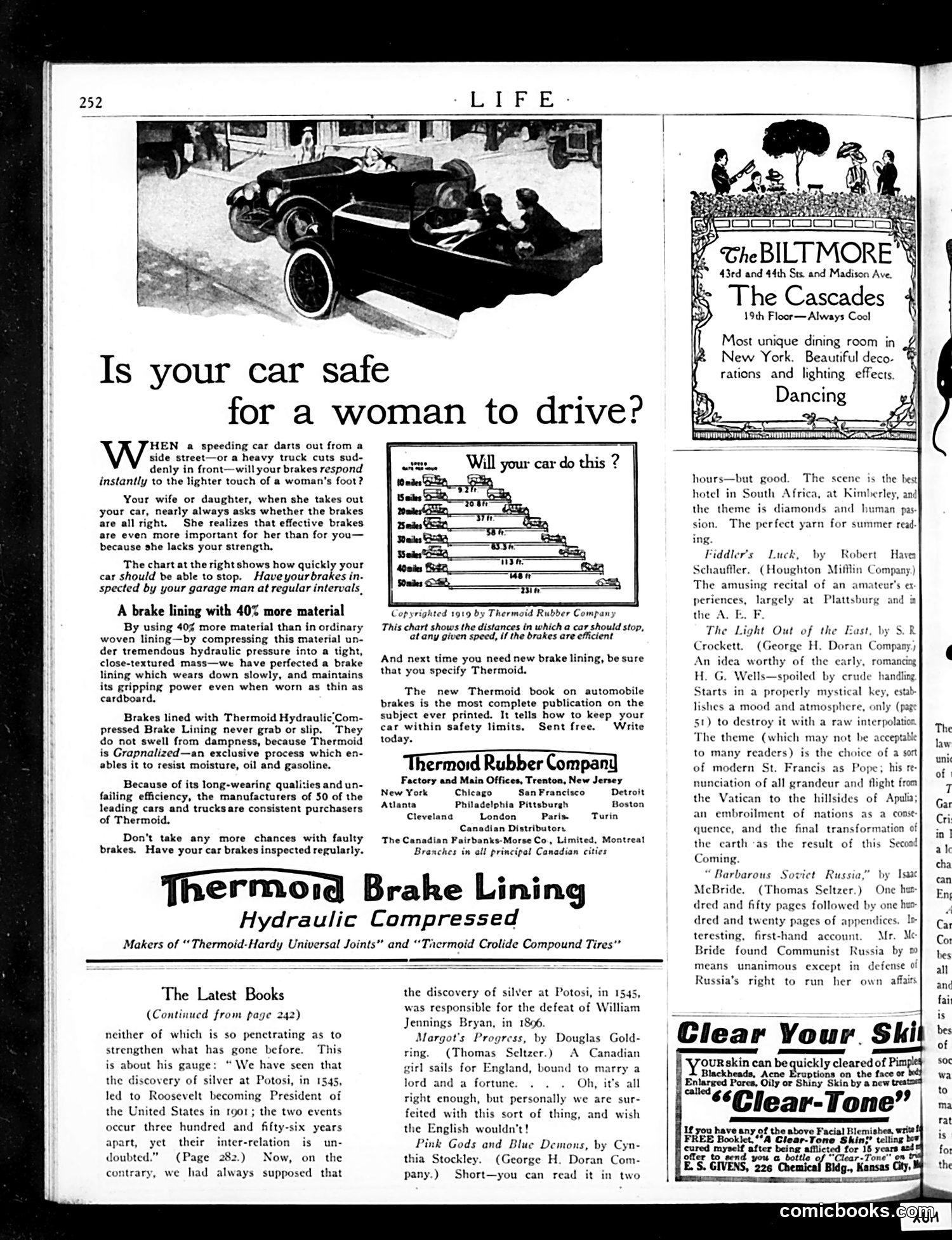
This page is primarily a **brake lining advertisement** disguised as safety advice. The headline "Is your car safe for a woman to drive?" uses sexism as a selling tool—it assumes women drivers are weaker and therefore need superior brakes more urgently than men. The accompanying photograph shows a car that has skidded or crashed, presumably illustrating brake failure. The chart demonstrates stopping distances at various speeds. The ad's strategy exploits early 20th-century gender anxieties: women's newfound automobile access created concerns about their physical capability. By framing brake safety as especially critical for female drivers, Thermoid Rubber Company positioned their product as protectively paternalistic while actually targeting all car owners' safety concerns. The page also contains book reviews and a restaurant advertisement, typical of *Life* magazine's mixed advertising and editorial content.
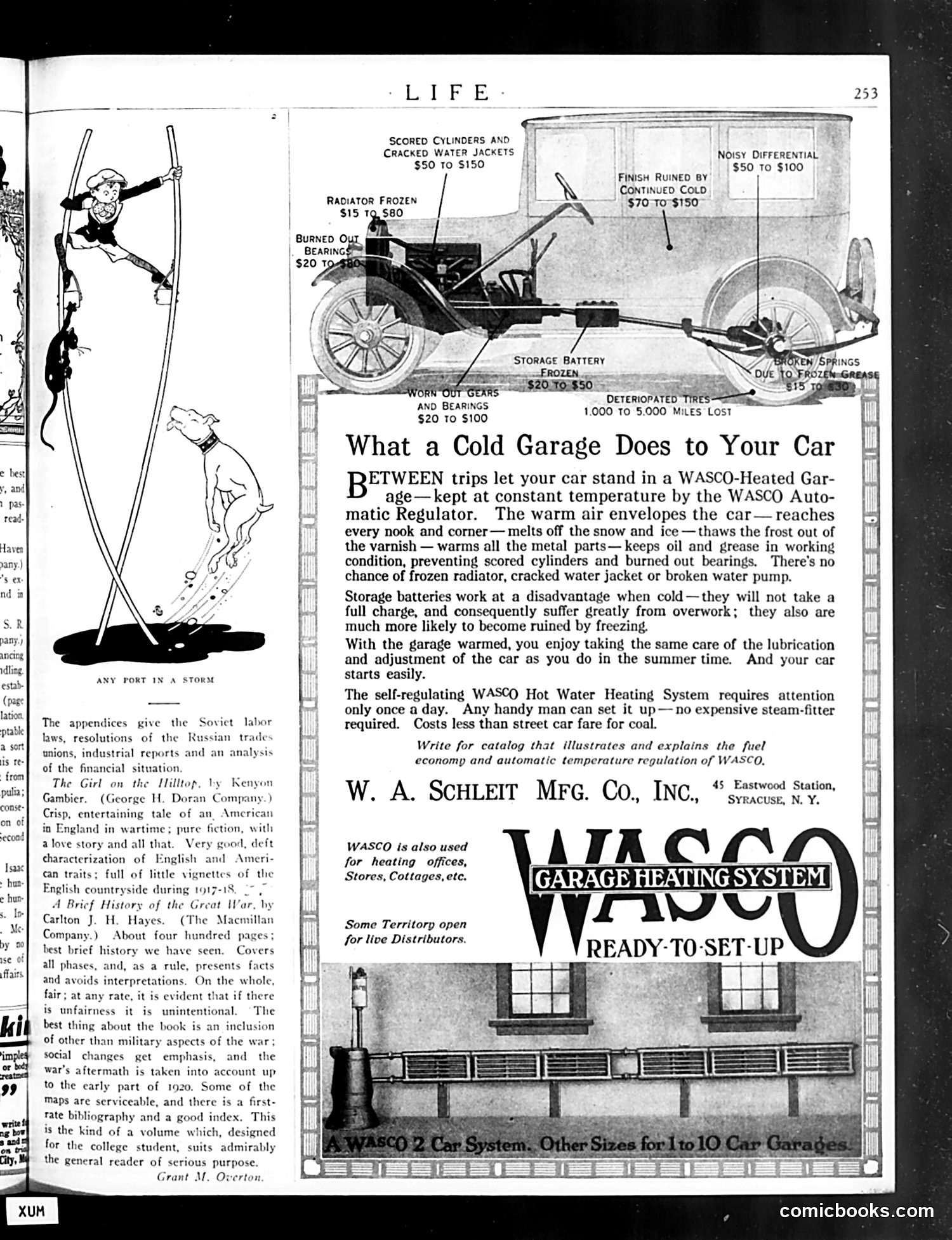
This page is primarily **advertising**, not political satire. The dominant content is a WASCO garage heating system advertisement occupying roughly two-thirds of the page. The small cartoon in the upper left, titled "Any Port in a Storm," depicts two figures (appears to be sailors or military personnel) seeking shelter, likely referencing wartime hardship—a topical reference given the book reviews below discuss WWI history. The main advertisement uses a cutaway diagram of a car to illustrate damage from cold garages: frozen radiators, cracked water jackets, worn bearings, deteriorated tires. The pitch argues that heated garages prevent costly winter damage and battery failure. This reflects 1920s automotive concerns when garages lacked heating and winter car maintenance was genuinely problematic. The page's lower half contains book reviews, including *A Brief History of the Great War*, indicating this issue addressed post-WWI America adjusting to peacetime. **Context for modern readers:** This represents early 20th-century consumer advertising targeting affluent car owners facing real mechanical vulnerabilities before modern antifreeze and battery technology.
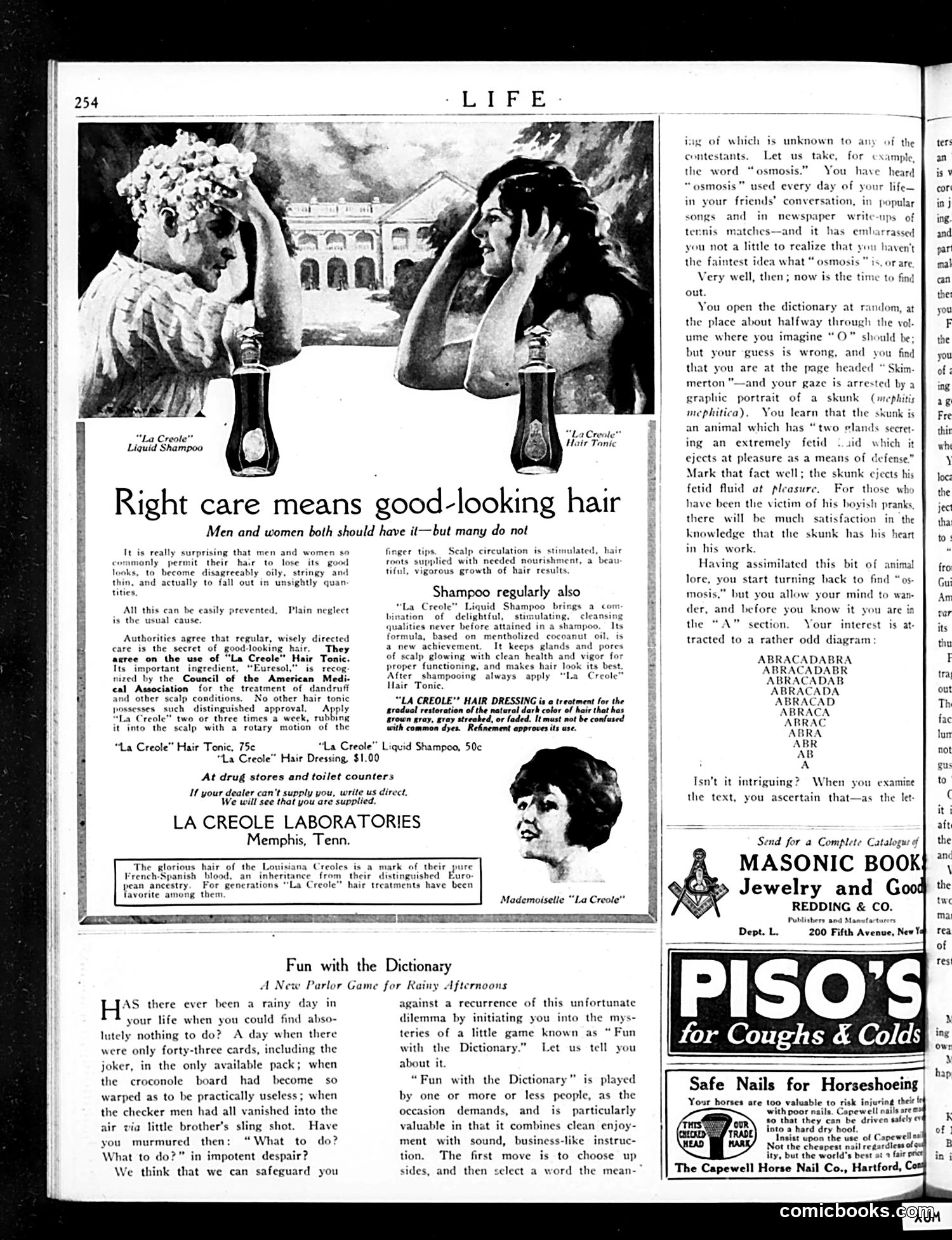
This page is primarily **advertising**, not political satire. The dominant content promotes "La Creole" hair products (shampoo, tonic, and hair dressing) marketed to both men and women concerned about hair loss and appearance. The imagery shows two figures—a woman and a man—in early 20th-century dress, demonstrating the products' effects. The advertisement emphasizes that "La Creole" contains "Euresol," recognized by the American Medical Association for treating dandruff and scalp conditions. The smaller article, "Fun with the Dictionary," is a **parlor game** for rainy days—a period amusement where players choose obscure words (the example given is "osmosis") and try to guess their meanings from a dictionary. The page contains no political cartoons or social satire. It represents typical Life magazine content from this era: advertisements mixed with light entertainment articles for middle-class readers seeking both beauty solutions and indoor leisure activities.
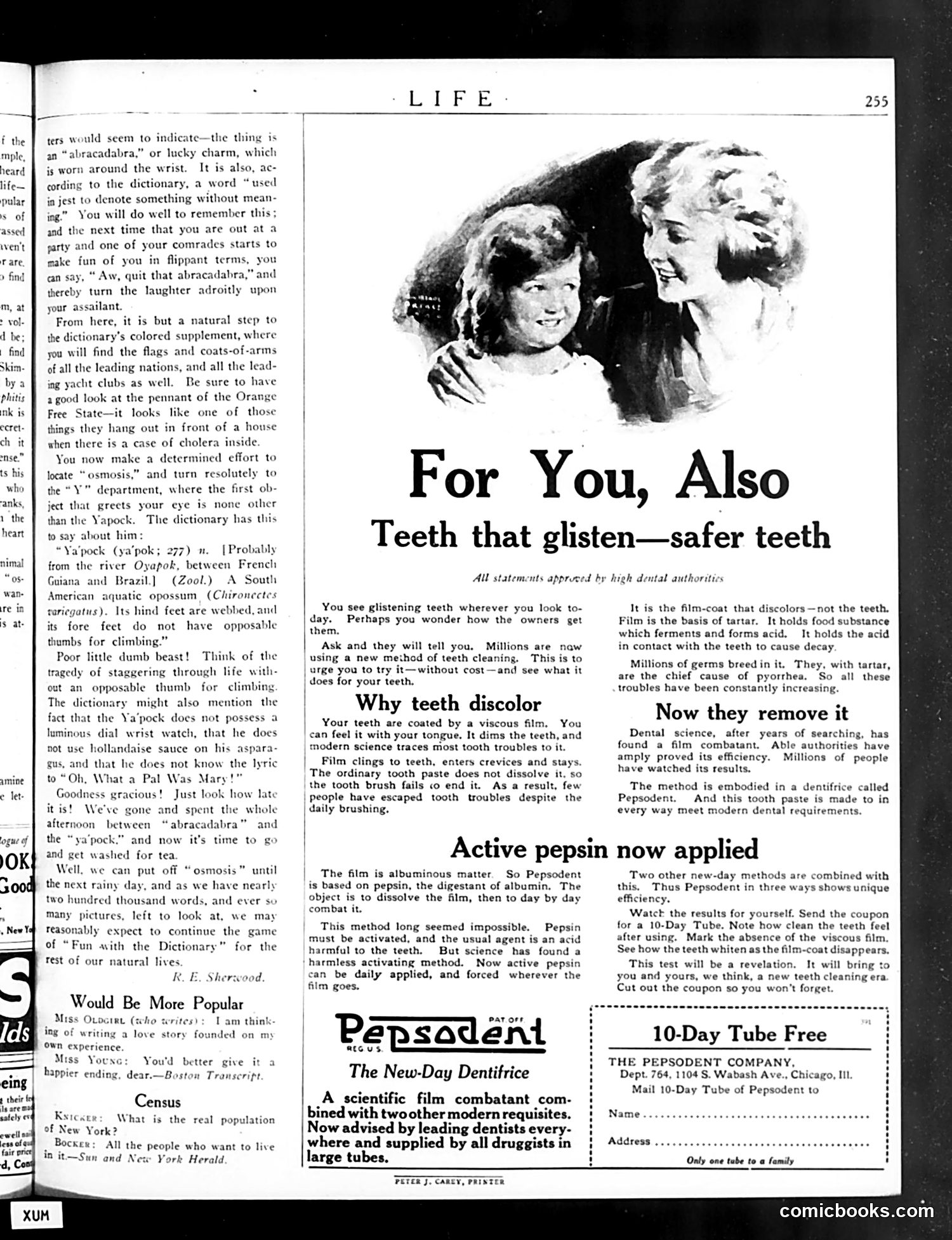
This page is primarily a **toothpaste advertisement** for Pepsodent, not political satire. The top portion contains humorous dictionary-based essays typical of *Life* magazine's satirical content, but the dominant feature is a large advertisement promoting Pepsodent's "New-Day Dentifrice." The ad addresses tooth discoloration by explaining that a viscous film—not the teeth themselves—causes yellowing and decay. It claims Pepsodent's innovation uses "active pepsin" to dissolve this film more effectively than ordinary toothpaste. The advertisement emphasizes scientific endorsement ("approved by high dental authorities") and offers a free 10-day trial tube to convince readers of its efficacy. The image shows two women smiling, displaying the "glistening teeth" promised by the product. This represents early twentieth-century dental marketing targeting middle-class consumers through *Life* magazine's popular readership.
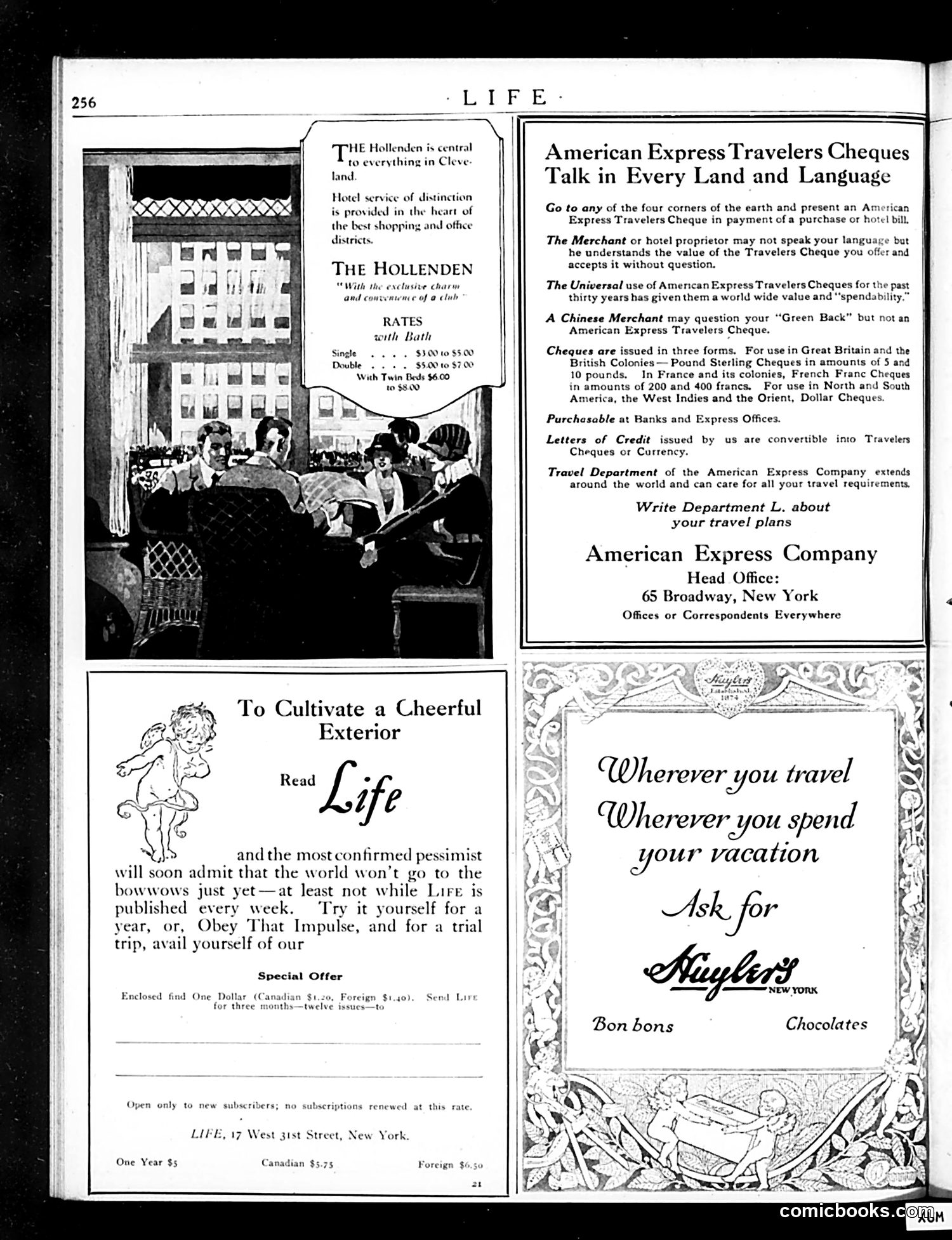
This page is primarily **advertising**, not editorial content or political satire. It contains three main ads: 1. **The Hollenden Hotel** (Cleveland)—promoting upscale lodging with "exclusive charm" 2. **American Express Travelers Cheques**—the main advertisement, emphasizing the cheques' universal acceptance globally, even by non-English speakers ("A Chinese Merchant may question your 'Green Back' but not an American Express Travelers Cheque"). This reflects early 20th-century assumptions about international commerce and racial/cultural stereotypes. 3. **Life Magazine subscription offer** and **Kuyler chocolates**—smaller promotions The only satirical element is the small cartoon urging readers to subscribe to *Life* itself, claiming the magazine prevents world pessimism. The page reflects 1920s travel culture and American commercial confidence abroad.
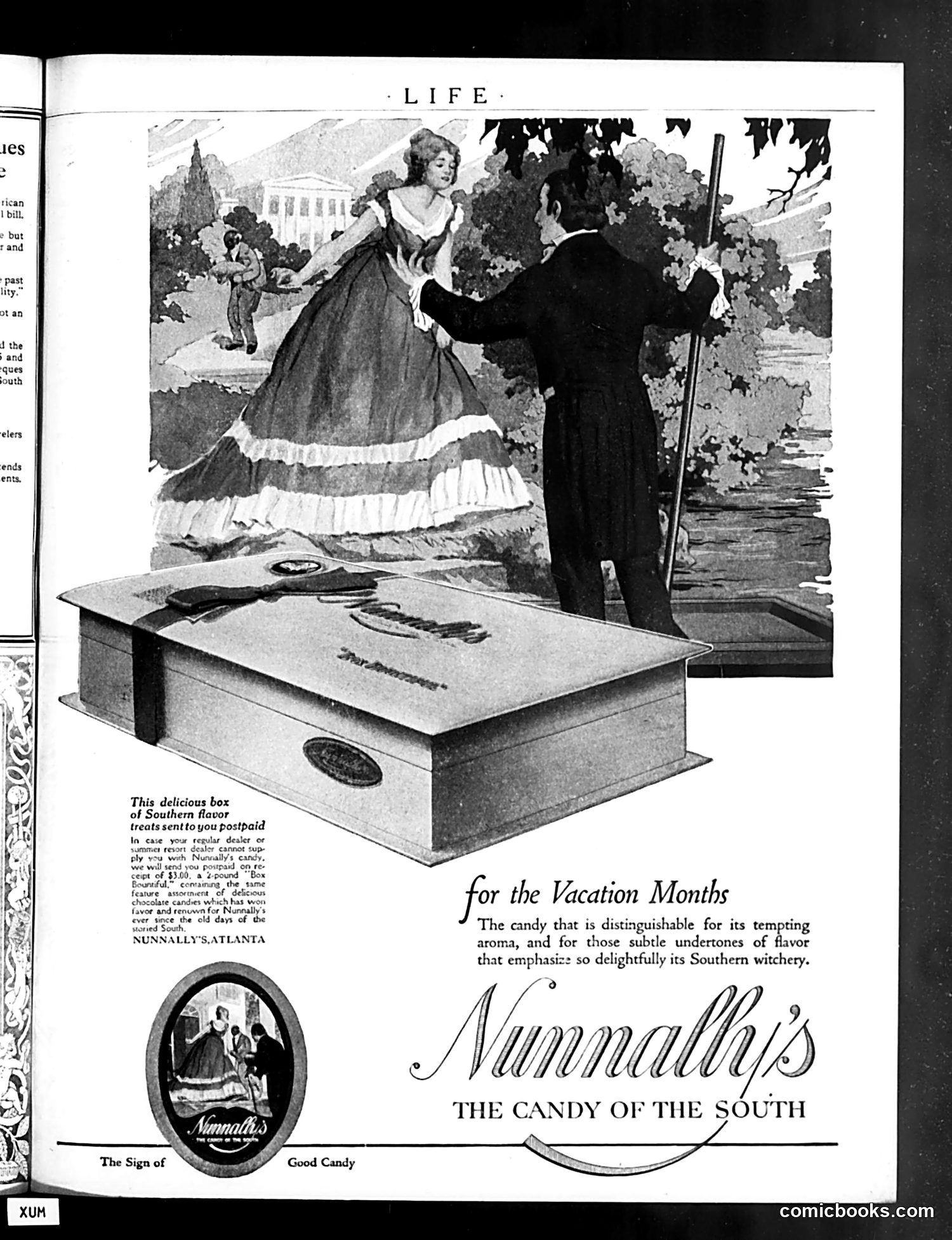
This page is primarily **advertising, not satire or political commentary**. It promotes Nunnally's candy, a Southern confection brand. The upper illustration depicts a romantic garden scene—a man presenting flowers to a woman in an elegant dress, with a Southern mansion visible in the background. This imagery evokes antebellum Southern gentility and romance. The ad copy emphasizes "Southern flavor" and "Southern witchery," marketing the candy through nostalgic appeals to Southern charm and genteel tradition. A decorative oval logo at bottom left reads "The Sign of Good Candy." The ad's romantic tableau and repeated "Southern" references suggest the product was being marketed to consumers seeking an idealized version of the Old South—a common advertising strategy of the early 20th century. There is no evident political satire on this page.
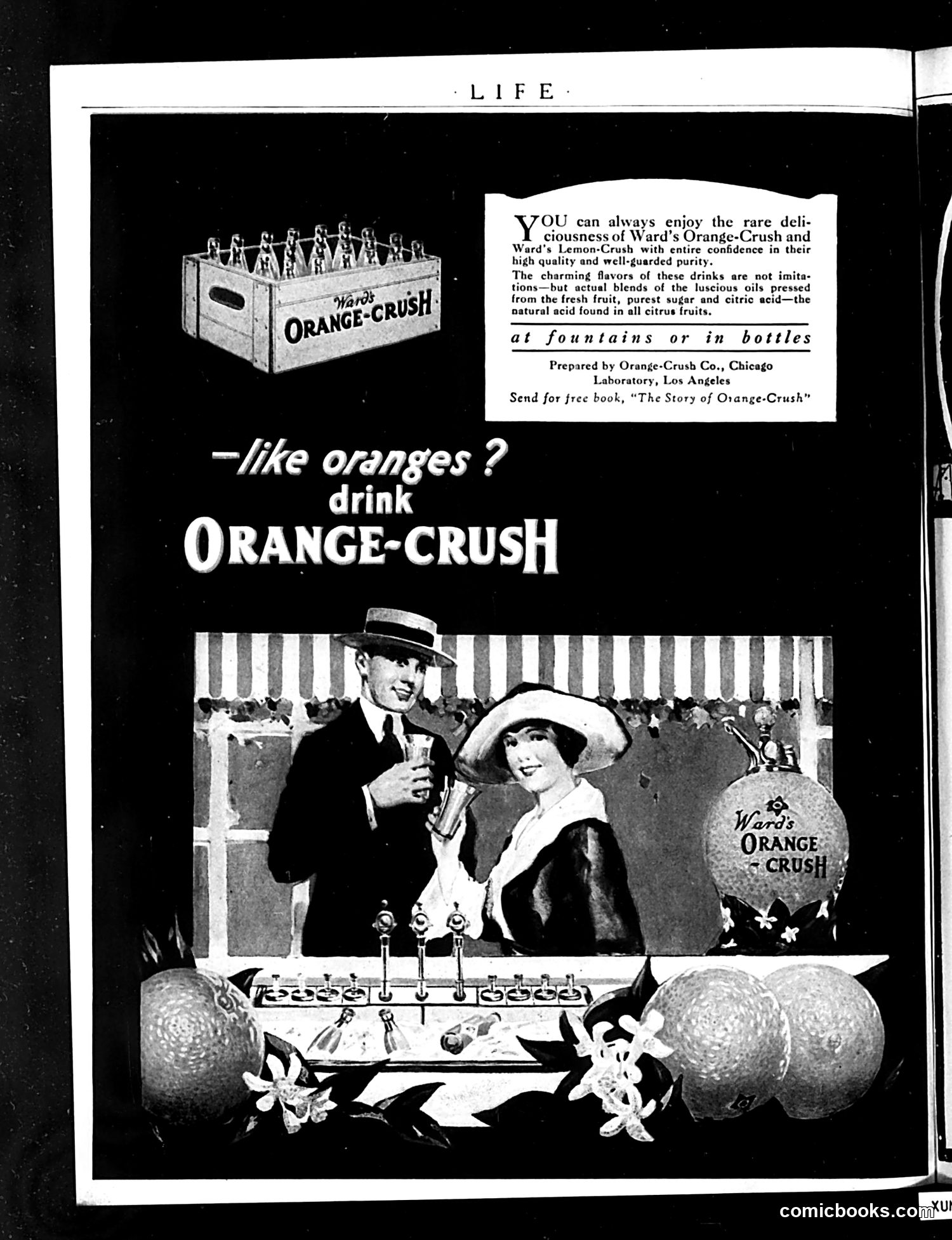
This is primarily a **product advertisement** for Ward's Orange-Crush beverage, not political satire. The page uses a romantic scene set at what appears to be a social venue (possibly a sports event, given the striped backdrop and crowd) to market the drink. The ad's humor is gentle and lifestyle-focused: a well-dressed couple in 1920s attire enjoys Orange-Crush at a fountain counter, with the tagline "like oranges? drink ORANGE-CRUSH" emphasizing the drink's natural fruit origin. The accompanying text emphasizes purity and authenticity—that the beverage contains actual pressed fruit oils and natural citric acid, not imitations. This suggests contemporary consumer concerns about product quality and ingredient transparency were significant marketing angles. The offer of a free book, "The Story of Orange-Crush," reflects early twentieth-century advertising strategies using educational materials to build brand loyalty.
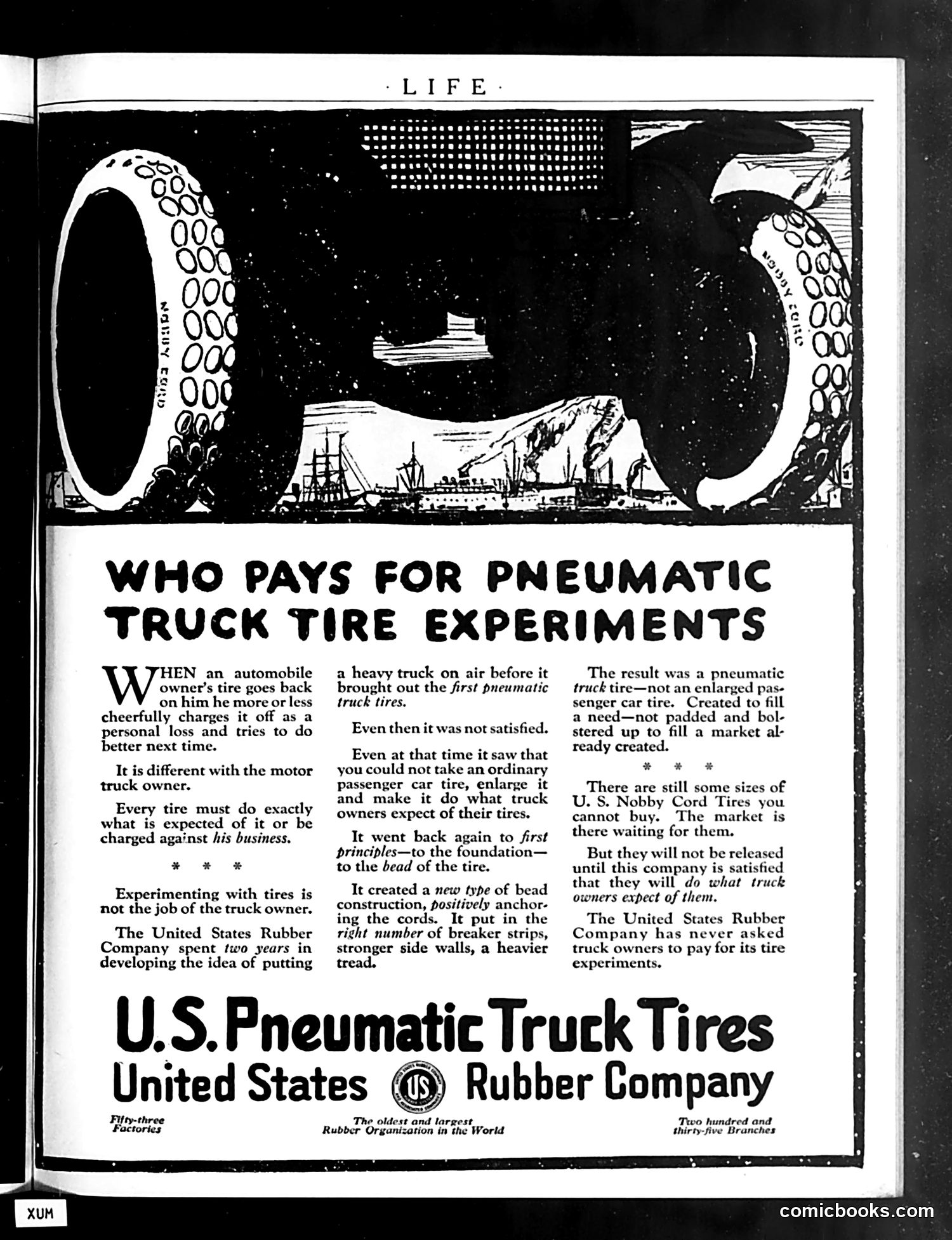
This is primarily **advertising content**, not satire or political commentary. It's a U.S. Rubber Company advertisement promoting their pneumatic truck tires. The page argues that unlike regular car owners who absorb tire failures as personal loss, truck owners need reliable tires because failures directly impact their business. The ad positions U.S. Rubber as the responsible company that invested two years developing specialized truck tires—not simply enlarging passenger car tires—and crucially, **never charged truck owners for these experiments**. The implicit contrast is with competitors who apparently do pass experimental costs onto customers. The ad emphasizes that U.S. Rubber bears development expenses themselves and only releases products meeting exacting standards, even if this means some tire sizes remain unavailable until perfected. The illustration shows enormous truck tires framing an industrial harbor scene, emphasizing scale and industrial durability—the stakes of reliable trucking infrastructure.
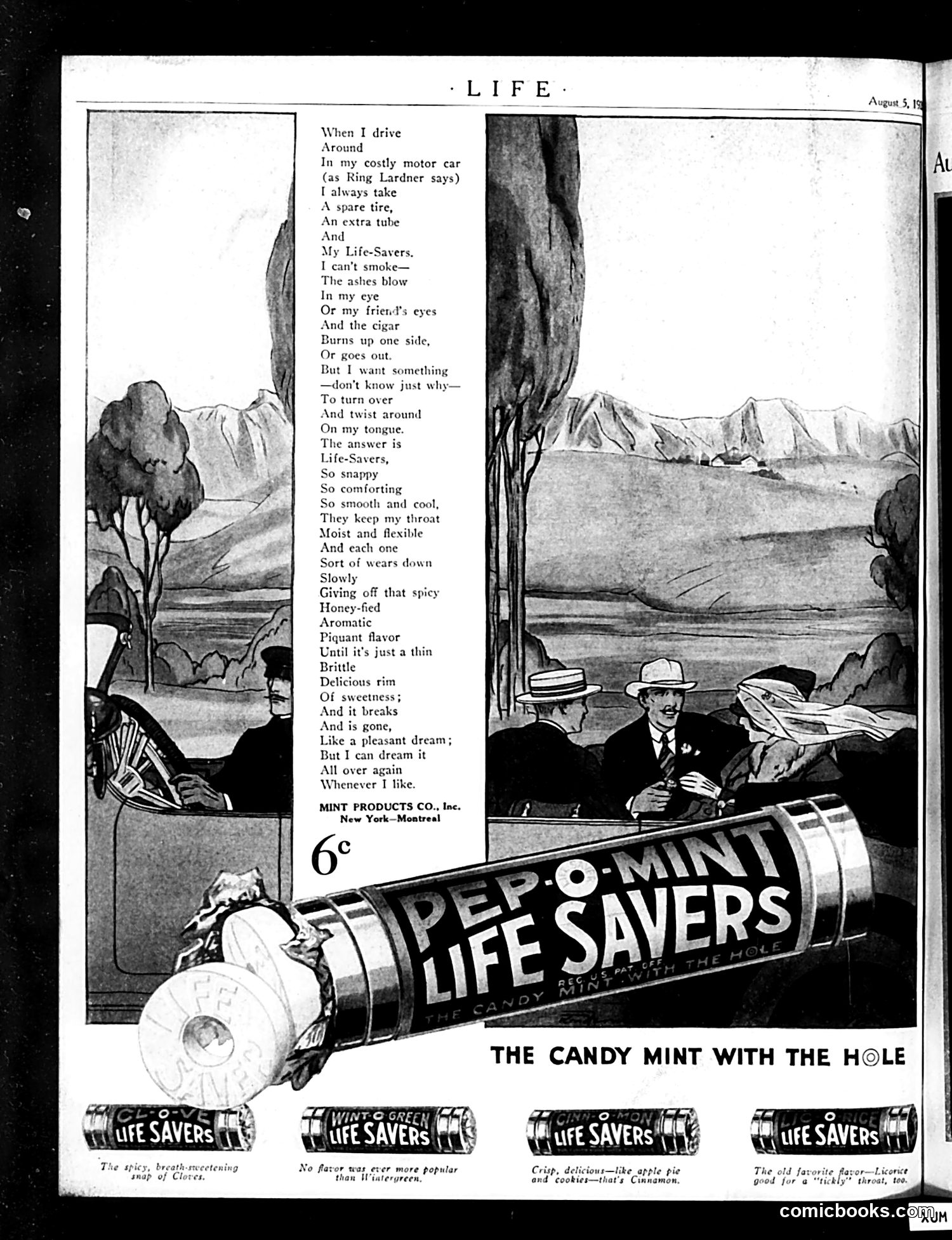
This is primarily a **Life Savers candy advertisement** disguised as editorial content. The page features a poem (attributed to writer Ring Lardner) describing the pleasures of Life Savers mints while driving a car. **The "Satire":** The humor lies in the mock-serious, poetic treatment of an ordinary candy. The poem adopts the romantic, self-indulgent tone of literary verse to describe the mundane experience of sucking on a mint—how it slowly dissolves, the flavor release, the sensory experience. It's tongue-in-cheek advertising that treats the product with exaggerated reverence. **Visual Content:** The illustration shows men driving in an open car in a desert landscape, with a large Life Savers package displayed prominently. Below are product variants (Wintergreen, Cinnamon, etc.). **Historical Context:** This represents early 20th-century advertising that blurred lines between editorial and commercial content—common in magazines like Life. The car-driving scenario and focus on comfort while motoring reflects the 1920s automobile culture. The "joke" is essentially: **why write a poem about candy? Because Life Savers hired the magazine to.**