
Life, 1920-08-05 · page 22 of 48
Life — August 5, 1920 — page 22: what you’re looking at
What you’re looking at
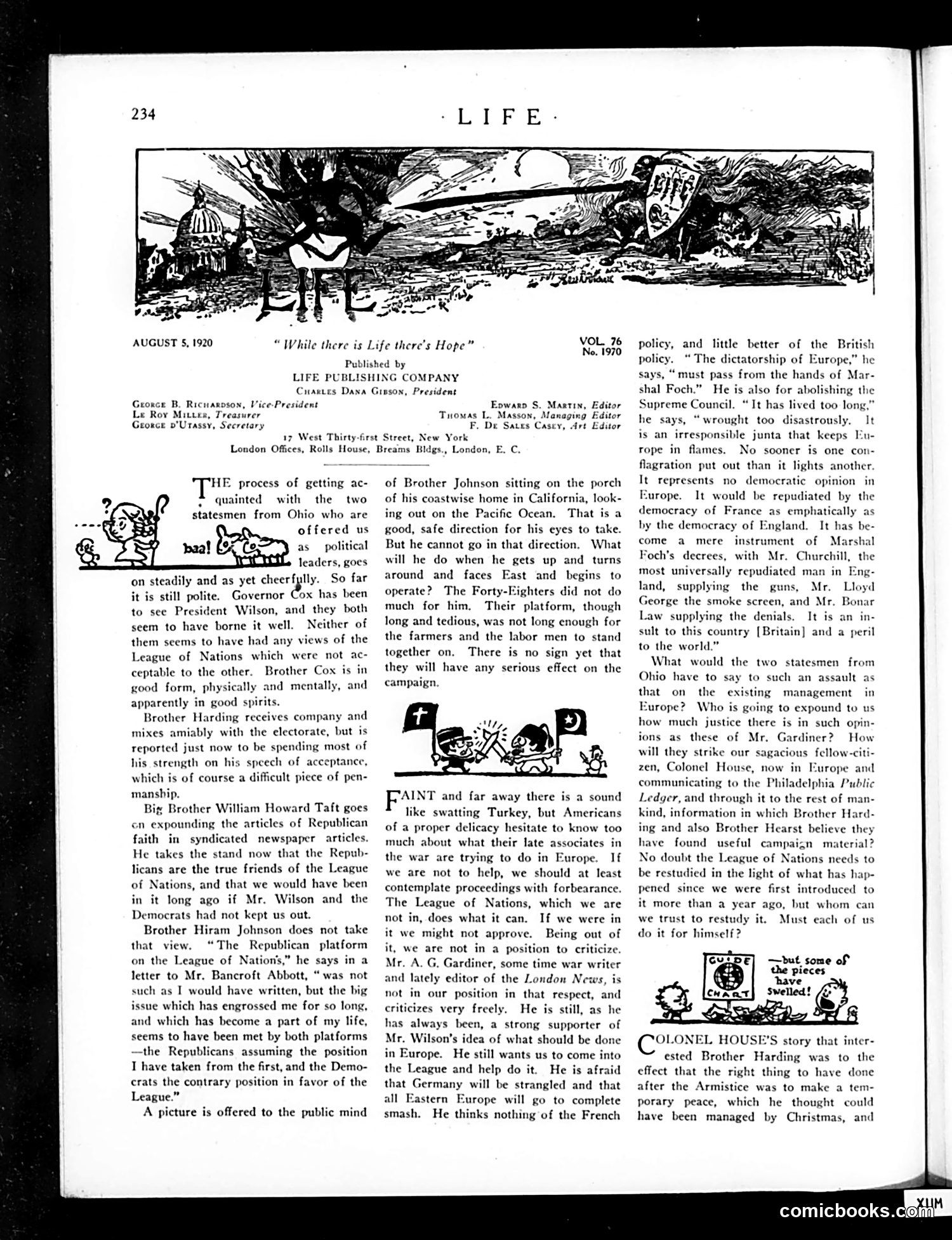
This page discusses the 1920 U.S. presidential election, featuring two Ohio statesmen: Governor **James Cox** (Democratic candidate) and **Warren Harding** (Republican nominee). The satire centers on their carefully neutral positions on the League of Nations—the contentious international organization President Wilson championed but Congress rejected. The cartoons mock **Hiram Johnson** (progressive Republican senator), depicted sitting safely on a California porch facing the ocean, avoiding eastward—symbolizing how he and other politicians dodge difficult foreign policy questions. The text criticizes their evasiveness: they won't clearly state positions because the League divided both parties and the electorate. The page also skewers **A.G. Gardiner**, a British editor who criticizes American non-involvement in European affairs while Americans prefer avoiding such entanglements. The overall satire: American politicians and public alike are dodging responsibility for post-WWI global complications.
📄 Transcribed text from this page (OCR, searchable)
Machine-transcribed from the original scan — historical spelling and the odd misread are preserved.
AUGUST 5, 1920 “While there is Life there's Hope” Published by LIFE PUBLISHING COMPANY Cuantes Dana Gipson, President Groce B. Ricuarosox, Vice-President Le Roy Mittes, Treasurer Georce v’Urassy, Secretary Eowaro S. Mastin, Editor Tuomas L. Masson, Managing Editor F, Dr Sates Casey, drt Editor 17 West Thirty-first Street, New York London Offices, Rolls House, Breams Bldgs, London, E. C. HE process of getting ac- S quainted with the two statesmen from Ohio who are offered us as political leaders, goes ‘on steadily and as yet cheerfully. So far it is still polite. Governor és has been to see President Wilson, and they both seem to have borne it well. Neither of them seems to have had any views of the League of Nations which were not ac- ceptable to the other. Brother Cox is in good form, physically and mentally, and apparently in good spirits. Brother Harding receives company and mixes amiably with the electorate, but is reported just now to be spending most of his strength on his speech of acceptance, which is of course a difficult piece of pen- manship. Big Brother William Howard Taft goes cn expounding the articles of Republican faith in syndicated newspaper articles. He takes the stand now that the Repub- licans are the true friends of the League of Nations, and that we would have been it long ago if Mr. Wilson and the Democrats had not kept us out. Brother Hiram Johnson does not take that “The Republican platform on the League of Nation's,” he says in a letter to Mr. Bancroft Abbott, “was not such as I would have written, but the big issue which has engrossed me for so long, and which has become a part of my life, seems to have been met by both platforms —the Republicans assuming the position I have taken from the first, and the Demo- crats the contrary position in favor of the League.” A picture is offered to the public mind view, of Brother Johnson sitting on the porch of his coastwise home in California, look- ing out on the Pacific Ocean. That is a good, safe direction for his eyes to take. But he cannot go in that direction, What will he do when he gets up and turns around and faces East and begins to The Forty-Eighters did not do much for him. Their platform, though long and tedious, was not long enough for the farmers and the labor men to stand together on. There no sign yet that they will have any serious effect on the campaign. operate? FASt and far away there is a sound like swatting Turkey, but Americans of a proper delicacy hesitate to know too much about what their late associates in the war are trying to do in Europe. If we are not to help, we should at least contemplate proceedings with forbearance. The League of Nations, which we are not in, does what it can. If we were in it we might not approve. Being out of it, we are not in a position to criticize. Mr. A. G, Gardiner, some time war writer and lately editor of the London News, not in our position in that respect, and criticizes very freely. He is still, as he has always been, a strong supporter of Mr. Wilson's idea of what should be done in Europe. He still wants us to come into the League and help do it. He is afraid that Germany will be strangled and that all Eastern E smash. rope will go to complete He thinks nothing of the French policy, and little better of the British policy. “The dictatorship of Europe,” he says, “must pass from the hands of Mar- shal Foch.” He is also for abolishing the Supreme Council. “It has lived too long,” he says, “wrought too disastrously. It is an irresponsible junta that keeps Eu- rope in flames. No sooner is one con- flagration put out than it lights another. It represents no democratic opinion in Europe. It would be repudiated by the democracy of France as emphatically as by the democracy of England. It has be- come a instrument of Marshal Foch's with Mr. Churchill, the most universally repudiated man in Eng- land, supplying the guns, Mr. Lloyd George the smoke screen, and Mr. Bonar Law supplying the denials. It is an in- sult to this country [Britain] and a peril to the world.” What would the two statesmen Ohio have to s: that on the Europe? mere decre from to such an assault as existing management in Who is going to expound to us how much justice there is in such opin- ions as these of Mr. Gardiner? How will they strike our sagacious fellow-citi- zen, Colonel House, now in Europe and communicating to the Philadelphia Public Ledger, and through it to the rest of man- kind, information in which Brother Hard- ing and also Brother Hearst believe they have found useful material? No doubt the League of Nations needs to be restudied in the light of what has hap- pened since we were first introduced to it more than a year ago, but whom can we trust to restudy it. Must each of us do it for himself? campaign —dut some of the pieces S story that inter- ested Brother Harding was to the effect that the right thing to have done after the Armistice was to make a tem- porary peace, which he thought could have been managed by Christmas, and comicbooks.com