
Life, 1920-08-05 · page 23 of 48
Life — August 5, 1920 — page 23: what you’re looking at
What you’re looking at
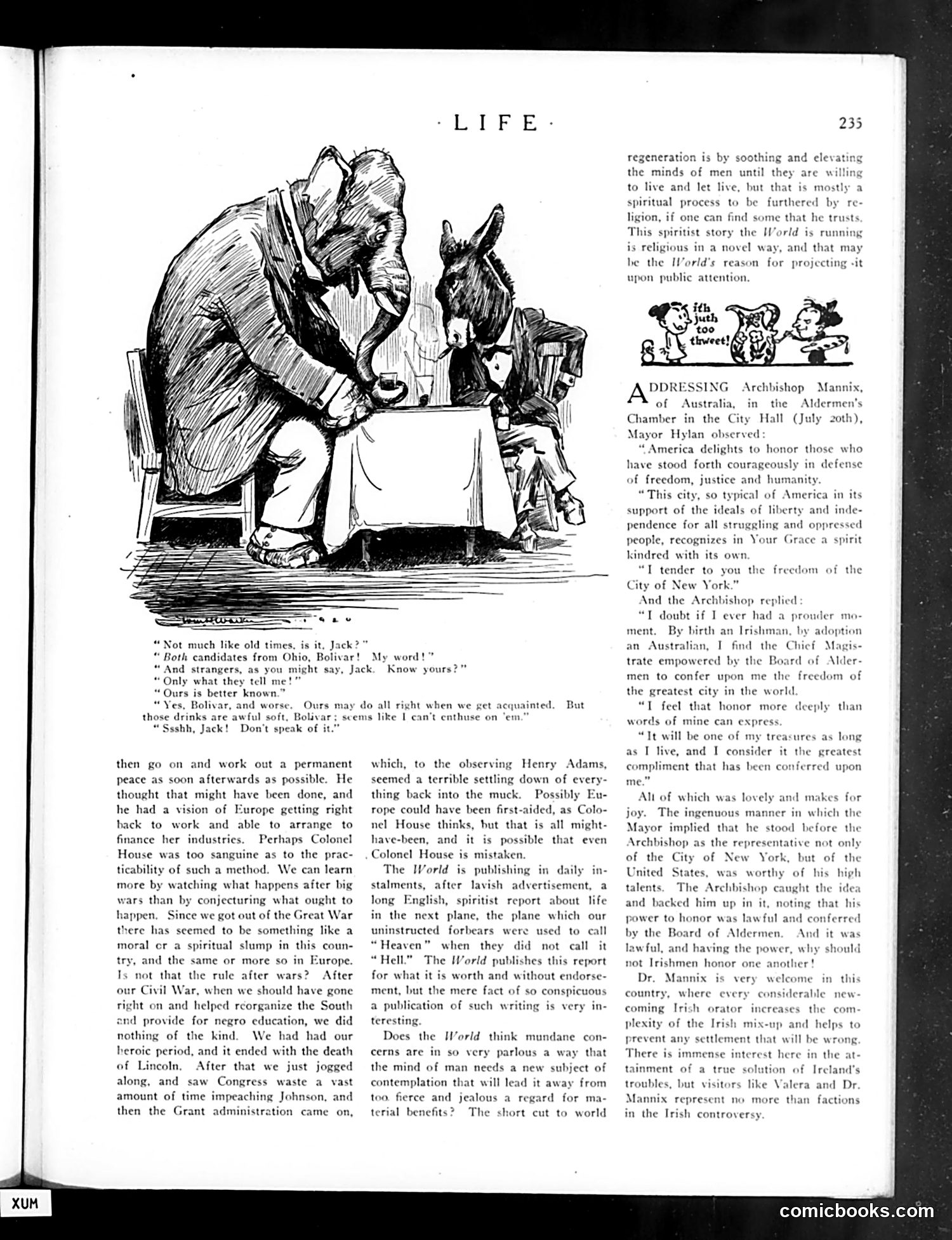
## The Main Cartoon The sketch depicts two men (labeled "Jack" and "Bolivar") at a table with drinks, discussing American politics. The dialogue references "both candidates from Ohio"—likely referring to the 1920 presidential election when both major-party nominees (James Cox for Democrats, Warren G. Harding for Republicans) were Ohio natives. The men express cynicism about the candidates, with one saying their choice "is better known" but "worse," and dismissing the drinks as "awful soft"—suggesting disappointment with watered-down options. ## The Point The satire mocks voter dissatisfaction with post-WWI American leadership choices. The "soft drinks" metaphor suggests weak, uninspiring candidates. This reflects broader post-war malaise the text discusses—a "spiritual slump" following the Great War, contrasting with earlier heroic periods like Lincoln's era. ## Secondary Content The page also includes a tribute to Archbishop Mannix of Australia, whom Mayor Hylan honored for defending freedom and justice—seemingly genuine praise rather than satire.
📄 Transcribed text from this page (OCR, searchable)
Machine-transcribed from the original scan — historical spelling and the odd misread are preserved.
“Not much like old times, is it, Jack?” * Both candidates from Ohio, Bolivar! as you might say, Jack “And strangers tell me “ Ours is better known.” “Yes, Bolivar, and worse. those drinks are awful soft, Boliva’ “Ssshh, Jack! Don't speak of it.” then go on and work out a permanent peace as soon afterwards as possible. He thought that might have been done, and he had a vision of Europe getting right hack to work and able to arrange to finance her industries. Perhaps Colonel House was too sanguine as to the prac- ticability of such a method. We can learn re by watching what happens after big ars than by conjecturing what ought to appen, ince we got out of the Great War there has scemed to be something like a moral er a spiritual slump in this coun- try, and the same or more so in Europe. Ts not that the rule after After our Civil War, when we should have gone right on and helped rcorganize the South and provide for negro education, we did nothing of the kind. We had had our heroic period, and it ended with the death of Lincoln. After that we just jogged along, and saw Congress waste a vast amount of time impeaching Johnson, and then the Grant administration wars? came on, Ours may do all right when we get ac scems like I can’t enthuse on ‘em. My word!” Know yours inted. But which, to the observing Henry Adams, seemed a terrible settling down of every- thing back into the muck. Possibly Eu- rope could have been first-aided, as Colo- nel House thinks, but that is all might- have-been, and it is possible that even Colonel House is mistaken. The World is publishing in daily in- stalments, after lavish advertisement, a long Ei about life in the next plane, the plane which our uninstructed glish, spiritist report were used to call “Heaven” they did not call it “Hell.” The World publishes this report for what it is worth and without endorse- ment, but the mere fact of so conspicuous forbears when a publication of such writing is very in- teresting. Does the World think munda cerns are in so very parlous a way that © con- the mind of man needs a new subject of contemplation that will lead it away from regard for ma- rt cut to world too. fierce and jealous a terial benefits? The sh regeneration is by soothing and ele the minds of men until they are to live and let live, but that is r spiritual process to be furthered by ligion, if one can find some that he tru This spiritist story the Morld is running dstly is religious in a novel way, and that may he the World's upon public attention, reason projecting -it SING of Australia, in the Aldermen's Chamber in the City Hall (July 20th), Archbishop Mannix, Mayor Hylan observed America delights to honor those who have stood forth courageously in defense f freedom, justice and humanity “This city, so typical of America in its support of the ideals of liberty and inde- pendence for all struggling and oppressed people, recognizes in Your Grace a spirit kindred with its own, “T tender to you the City of New York.” And the Archbishop replied freedom of the “I doubt if I ever had a prouder mo- ment, By birth an Irishman, by adoption an Australian, I Chief Mag trate empowered by the Board of Alder men to confer upon me the the greatest city in the world. find the freedom of “T feel that honor more deeply than words of mine can express “Tt will be one of my treasures as long as I live, and I consider it the greatest compliment that has been conferred upon me All of which was love makes for joy. The ingenuous manner in which the Mayor implied that he stood before the Archbishop as the representative not only of the City of New United States, was worthy of his high talents. The Archbishop ca and backed him up in it, n York, but of the ht the idea ng that his 1 conferred And it wful, and having the power, why should power to honor was lawful by the Board of Aldermen was not Irishmen honor one another! Dr. Mannix is very welcome in this country, where every considerable new- coming Irish plexity of the Ir orator increases the com mix-up and helps to prevent any settlement that will be wrong. There is immense interest here in the at- tainment of a true solution of troubles, but visitors like Valera and Dr. Mannix represent no more than factions in the Irish controversy comicbooks.com