
Life, 1920-08-05 · page 10 of 48
Life — August 5, 1920 — page 10: what you’re looking at
What you’re looking at
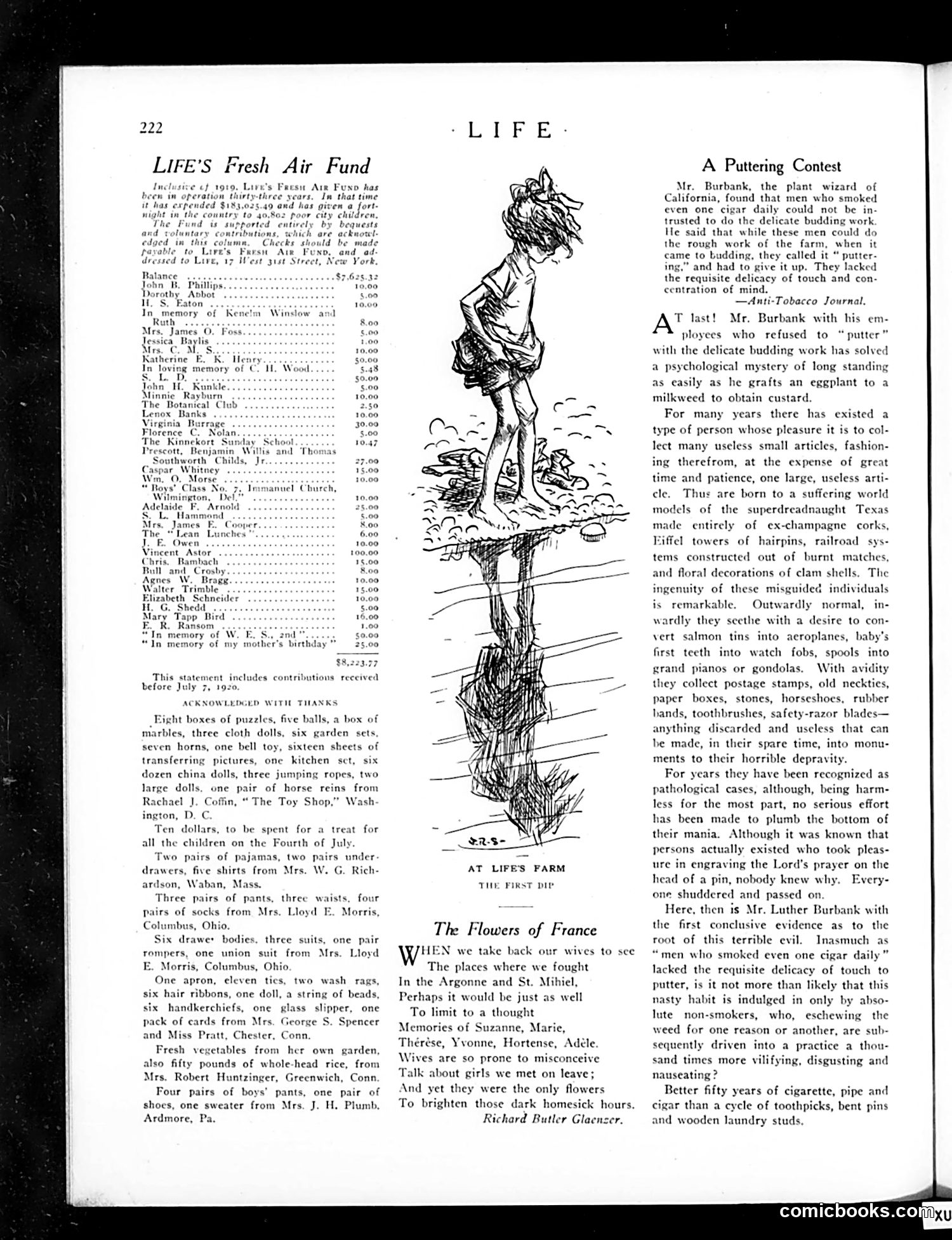
This cartoon satirizes men who collect useless items obsessively. The illustration shows an extremely thin, elongated figure—a caricature of a compulsive collector—being forced to take a bath. His emaciated frame emphasizes his pathological nature. The accompanying article mocks a specific type of person whose "pleasure it is to collect many useless small articles"—describing such collectors as psychological oddities comparable to "ex-champagne corks, Eiffel towers of hairpins, railroad systems constructed out of bent matches." The satire targets the absurdity of hoarding worthless objects: postage stamps, old necklies, paper boxes, stones, horseshoes, rubber bands, and toothbrushes. The forced bathing represents an intervention—suggesting such compulsive behavior requires treatment. The humor lies in mocking this particular personality disorder as ridiculous and unsanitary.
📄 Transcribed text from this page (OCR, searchable)
Machine-transcribed from the original scan — historical spelling and the odd misread are preserved.
LIFE’S Fresh Air Fund Inclusive of 1919. Live's Fares Arr Fuxp has been in operation thirty-three years. In that time it has d$ 9 and has given a fort- night to 40.802 poor city children, rted entirely by In loving 1 $ Ss $0.00 : 30.00 Nolan... 2222 suitee $.00 Kinnekort Sunday | School 10.47 scott, Benjamin Willis and Thomas sthworth Childs, Jr ar Whitney ... 2. manuel Chureh, Adelaide F. eteareeee oo Owen 10.00 incent Astor 109.00 is, Rambach 1.00 Bull and Crosby é Roo Agnes W. Bragg...---+ 10. Walter Trimbl Schnei This stateme before July 7, ACKNOWLEDGED WITH THANKS Eight boxes of puzzles, five balls, a box of marbles, three cloth dolls, six garden sets seven horns, one bell toy, sixteen she transferring pictures, one kitchen set, six dozen chir large dolls Rachael J dolls, three jumping ropes, two one pair of horse reins from . “The Toy Shop,” Wash ington, D. € Ten dollars, to be spent for a treat for all the children on the Fourth of July. Two pairs of pajamas, two p: drawers, five shirts from Mrs. W. G. Rich- ardson, Waban, Mass. Three pairs of pants, threc Lloyd E rs under four Morris, waists, pairs of socks from Mrs Columbus, Ohio. Six drawe+ bodies. three suits, one pair rompers, from Mrs. Lloyd E. Morris, Columbus, Ohio One apron, eleven tics, rags, six hair ribbons, one doll, a string of beads, six handkerchiefs, one glass slipper, one k of cards from Mrs. pencer and Miss Pratt, Chester, Conn. one union suit two wash George Fresh vegetables from her own garden, also fifty pounds of whole-head rice, from Mrs. Robert Huntzinger, Greenwich, Conn Four pairs of boys’ pants, one pair of shoes, one sweater from Mrs. J. H. Plumb, Ardmore, Pa, AT LIFE'S FARM THE FIRST DIP The Flowers of France HEN we take back our wives to sce The places where we fought In the Argonne and St. Mihiel, Perhaps it would be just as well To limit to a thought Memories of Suzanne, Marie, Thérése, Yvonne, Hortense, Adéle. Wives are so prone to misconceive Talk about girls we met on leave; And yet they were the only flowers To brighten those dark homesick hours. Richard Butler Glaenzer, A Puttering Contest Mr. Burbank, the plant wizard of California, found that men who smoked even one cigar daily could not be in- trusted to do the delicate budding work. Ife said that while these men could do the rough work of the farm, when it came to budding, they called it “ putter- ” and had to give it up. They lacked the requisite delicacy of touch and con- centration of mind. —Anti-Tobacco Journal. Mr. who refused to “putter” with the delicate budding work has solved a psychological mystery of long standing T last! ployees Burbank with his em- as easily as he grafts an eggplant to a milkweed to obtain custard. For type of person whose pleasure it is to col- many years there has existed a lect many useless small articles, fashion- ing therefrom, at the expense of great time and patience, one large, useless arti- ele. Thus are born to a suffering world models of the superdreadnaught Texas made entirely of ex-champagne corks, Eiffel towers of hairpins, railroad sys- tems constructed out of burnt matche: and floral decorations of clam shells. The ingenuity of these misguided individuals is remarkable. Outwardly normal, in- wardly they seethe with a desire to con- vert salmon tins into aeroplanes, baby’s first teeth into watch fobs, spools into With avidity collect postage stamps, old neckties, paper boxes, stones, horseshoes, rubber hands, toothbrushes, safety-razor blades— grand pianos or gondolas. anything discarded and uscless that can be made, in their spare time, into monu- ments to their horrible depravity. For years they have been recognized as pathological cases, although, being harm- less for the most part, no serious effort has been made to plumb the bottom of their mania. Although it was known that persons actually existed who took pleas- ure in engraving the Lord’s prayer on the head of a pin, nobody knew why, Every- one shuddered and passed on. Here, then is Mr. Luther Burbank with the first conclusive evidence as to the root of this terrible evil. Inasmuch as “men who smoked even one cigar daily” lacked the requisite delicacy of touch to putter, is it not more than likely that this nasty habit is indulged in only by abso- lute who, eschewing the weed for one reason or another, are sub- sequently driven into a practice a thou- sand times more vilifying, disgusting and nauseating ? Better fifty years of cigarette, pipe and cigar than a cycle of toothpicks, bent pins and wooden laundry studs, non-smokers, comicbooks.commy