
A complete issue · 40 pages · 1920
Life — April 29, 1920
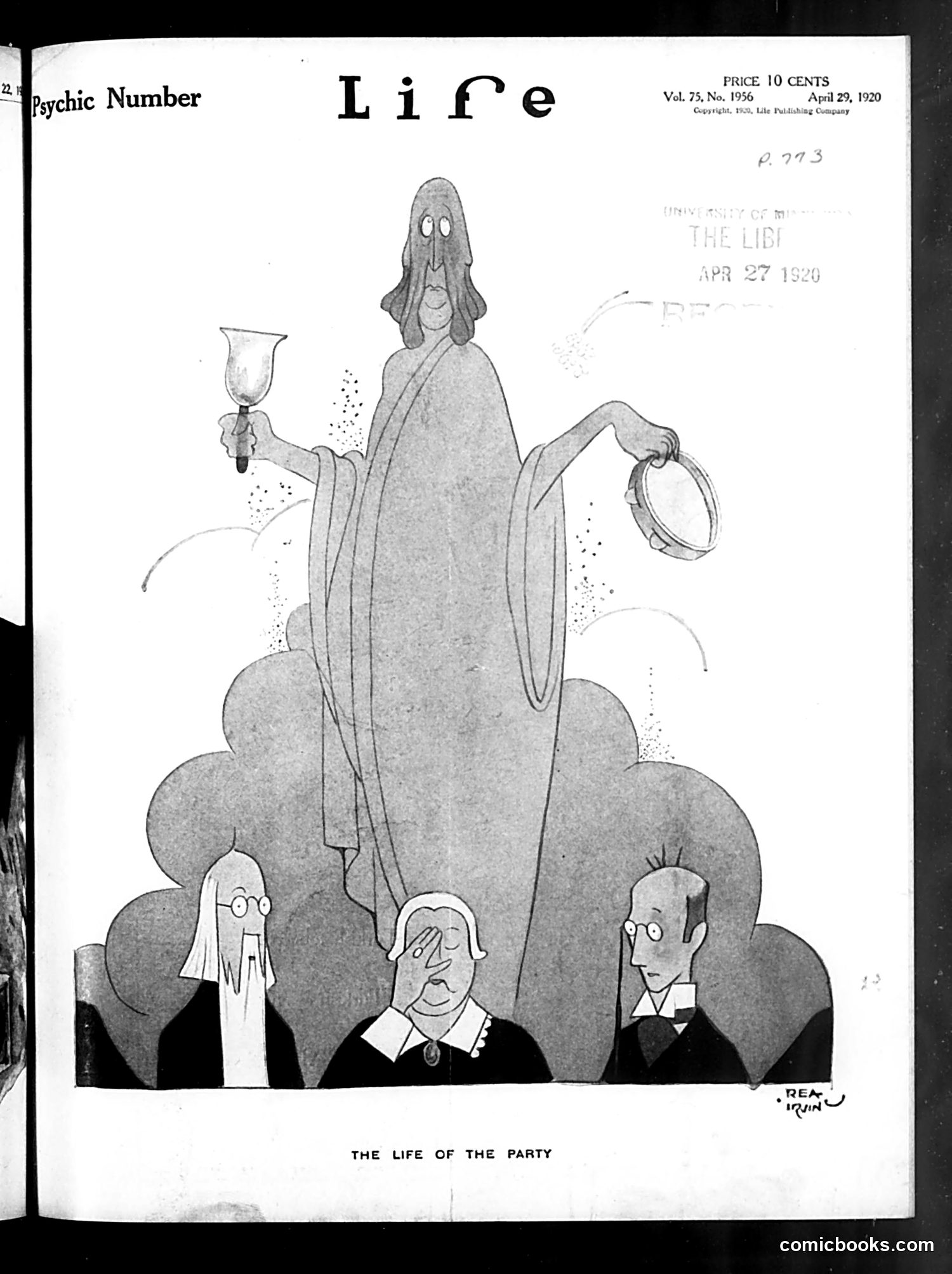
This 1920 cartoon satirizes political leadership during Prohibition. The tall, ghostly figure holding a wine glass and decanter appears to represent alcohol itself or its personification—now "the life of the party" despite being newly illegal under the 18th Amendment (ratified January 1920). Three smaller figures below, depicted as ordinary citizens or politicians, look upward. Their expressions suggest bewilderment or concern about alcohol's continued cultural presence despite Prohibition's legal ban. The satire critiques the gap between Prohibition law and social reality: despite federal prohibition, alcohol remained central to American social life and culture. The cartoon suggests that banning alcohol couldn't kill its appeal—it remained "the life of the party" regardless of legal status.
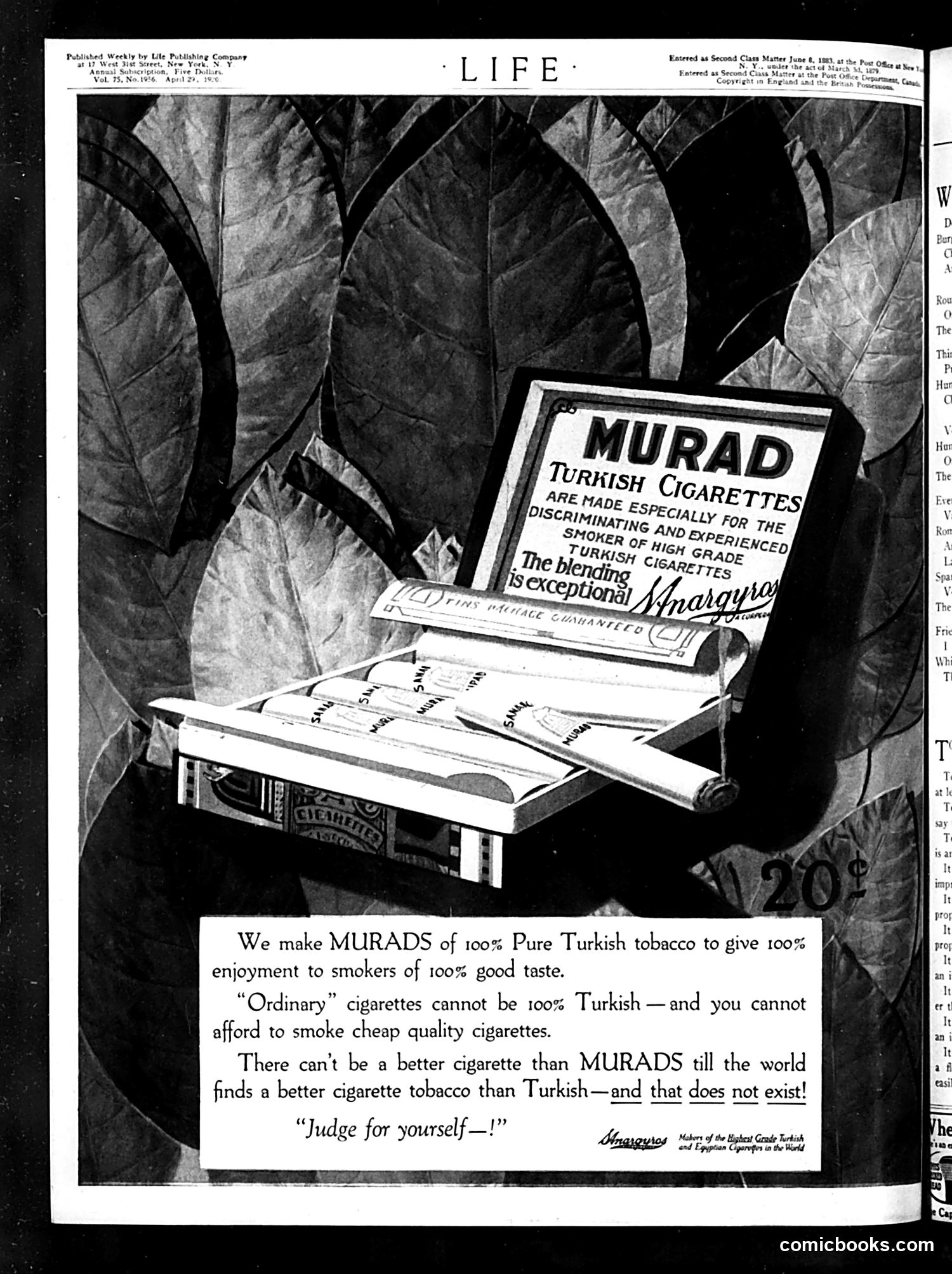
This page is **primarily an advertisement**, not satire or political commentary. It's a Murad cigarette ad from Life magazine, featuring a product display of Turkish cigarettes nestled among large tobacco leaves. The ad makes marketing claims rather than satirical points: Murad cigarettes are "made especially for the discriminating and experienced smoker of high grade Turkish cigarettes," emphasizing "100% Pure Turkish tobacco." The copy argues that ordinary cigarettes cannot be purely Turkish and that superior tobacco quality justifies the price. The only potentially humorous element is the tagline "Judge for yourself!" — a mild invitation to test the product — but this is straightforward advertising copy, not satire. There are no political figures, caricatures, or social commentary present.
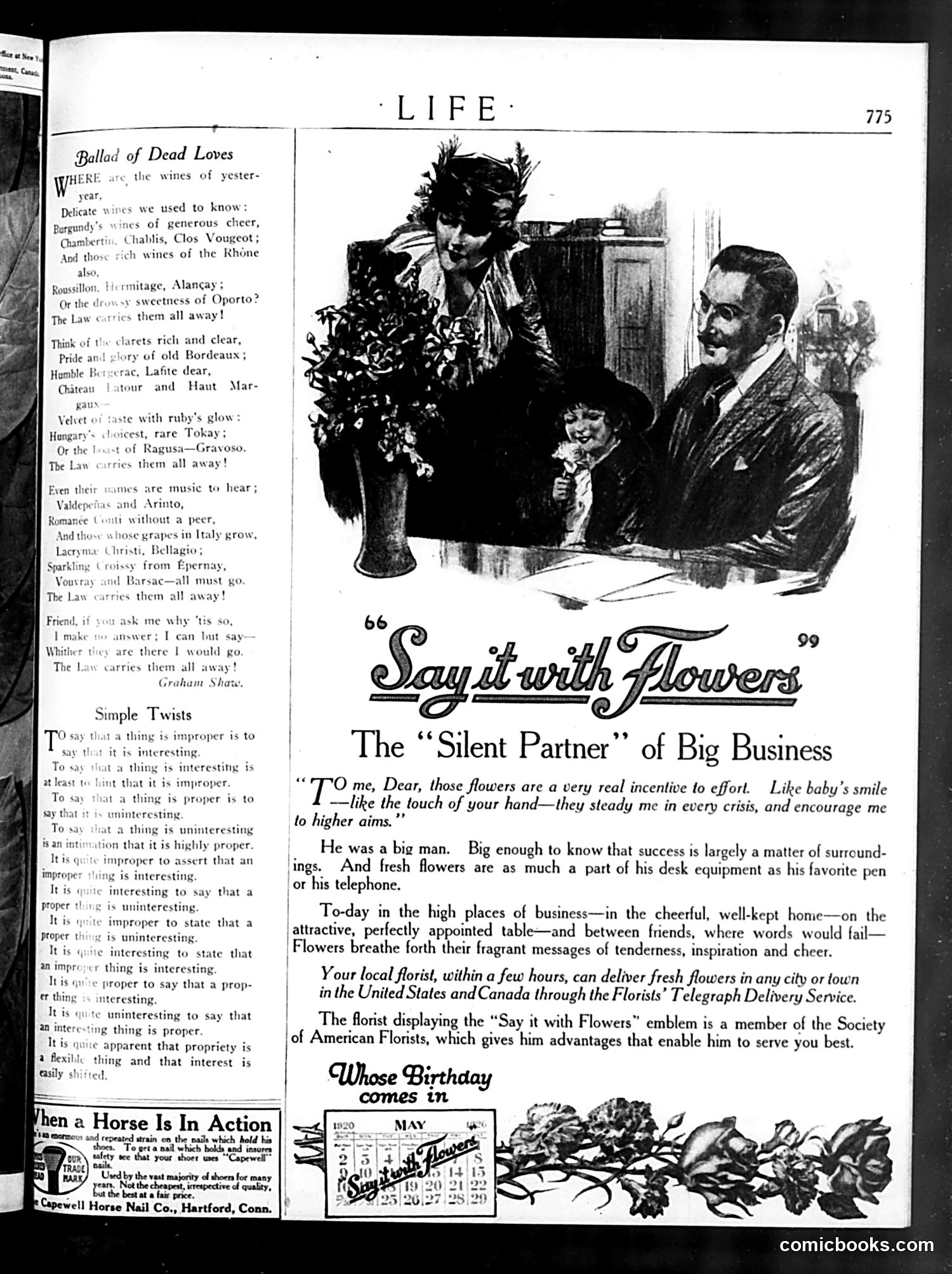
This page is primarily **advertising**, not political satire. The main content is a "Say it with Flowers" advertisement (numbers 66-99) promoting the florist industry and the Society of American Florists' telegram delivery service. The advertisement features a businessman at his desk receiving flowers, with the tagline that flowers serve as a "silent partner" in business—providing encouragement during crises. The copy emphasizes that fresh flowers are office equipment as essential as pens or telephones. The left column contains unrelated content: a poem titled "Ballad of Dead Loves" (lamenting extinct wine varieties), a philosophical piece called "Simple Twists," and a small advertisement for horse collars. This reflects early 20th-century commercial messaging targeting white-collar professionals.
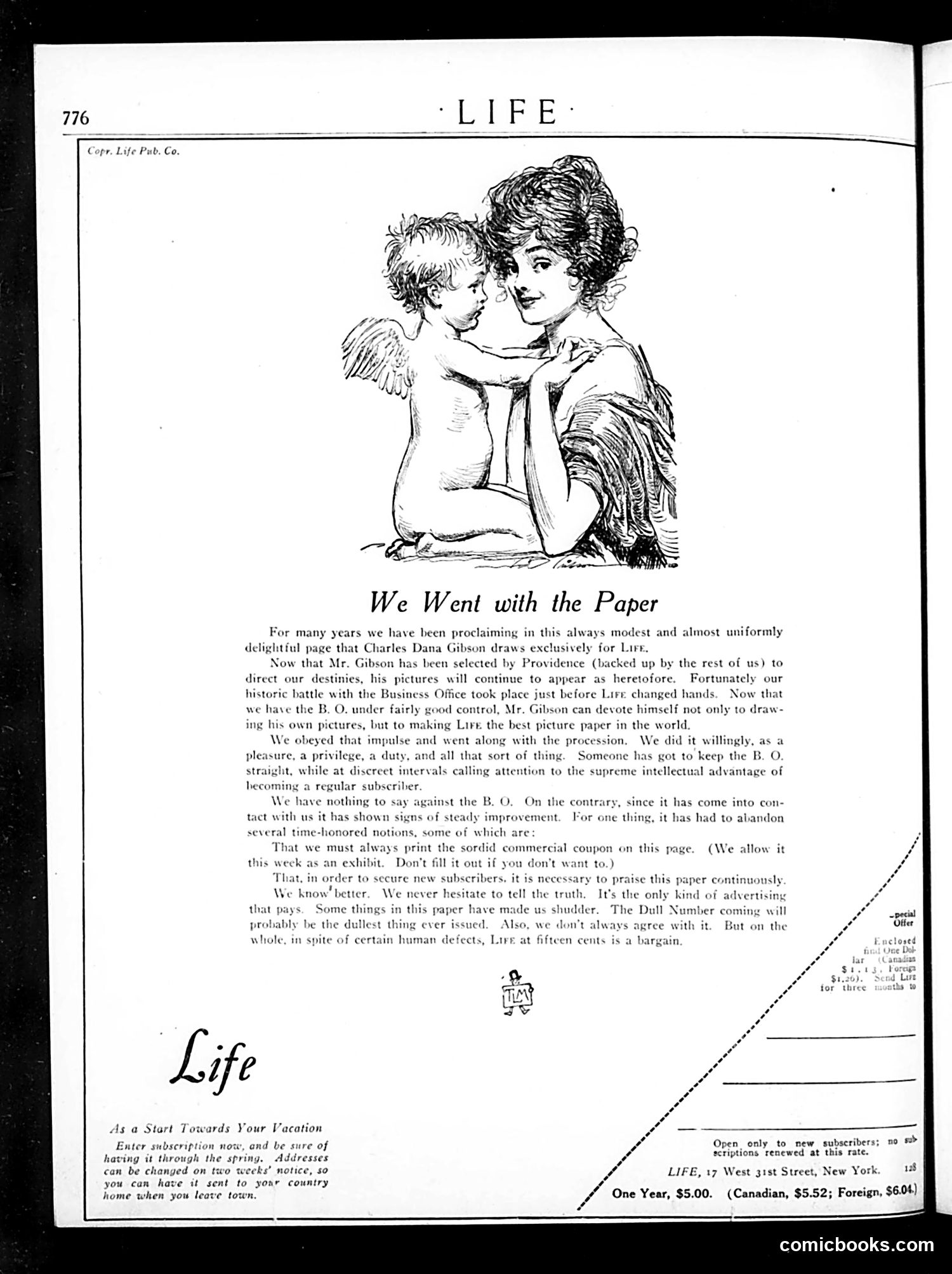
This page is primarily **promotional content** for *Life* magazine itself, not a political cartoon. The illustration shows a woman with a cherub or young child, titled "We Went with the Paper." The text explains that **Charles Dana Gibson** (the famous illustrator known for creating the "Gibson Girl") draws exclusively for *Life*. The magazine announces that Gibson will continue contributing despite *Life* changing ownership—the Business Office recently took control from previous management. The promotional copy humorously acknowledges *Life's* modest success and gently pokes fun at itself, mentioning the "Dull Number" and claiming the magazine is "a bargain" at fifteen cents. The page also advertises a vacation offer for new subscribers and subscription rates (one year: $5.00).
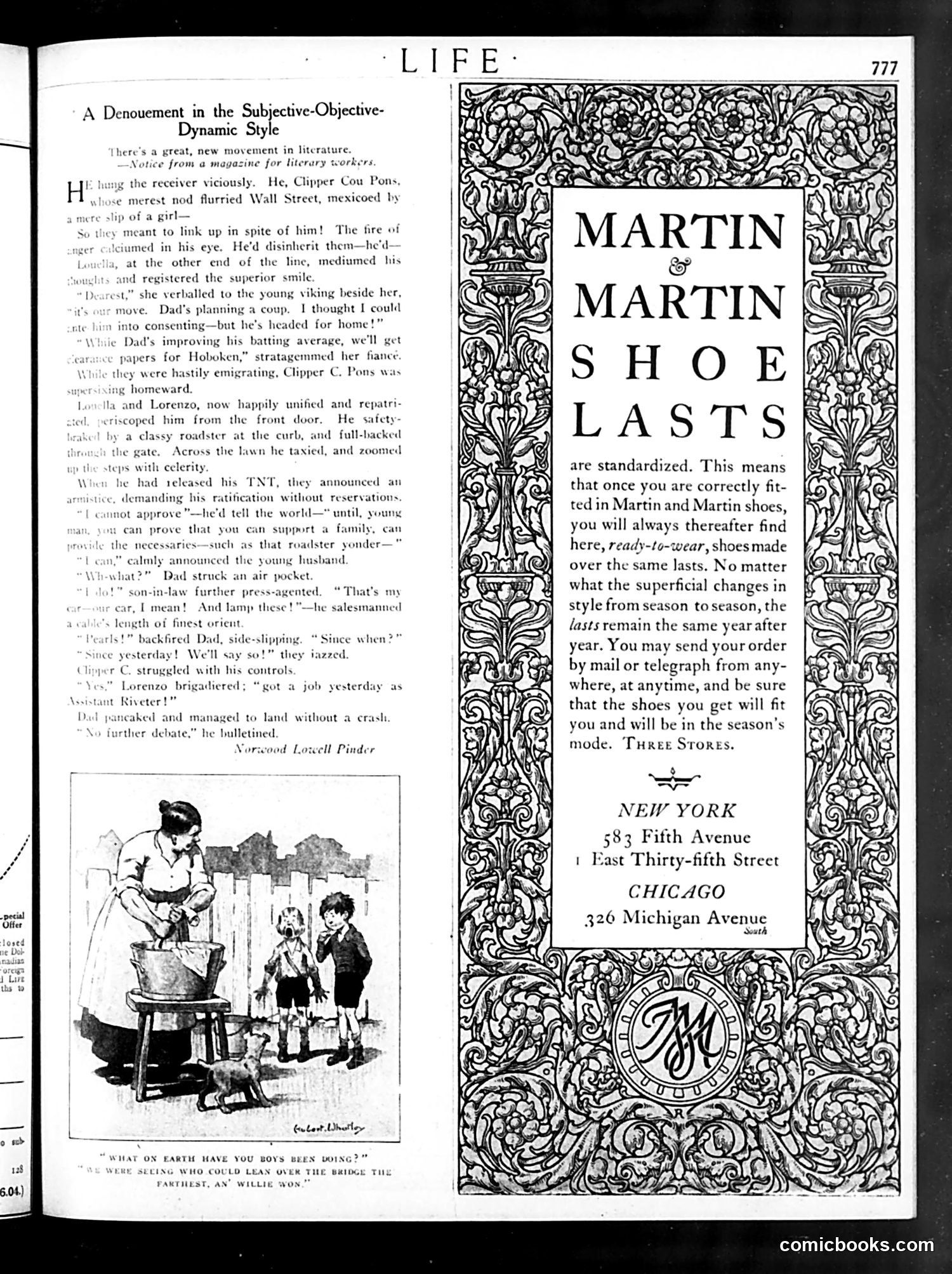
This page contains **one cartoon and one advertisement**, not political content. **The Cartoon** ("What on Earth Have You Boys Been Doing?") depicts a woman (likely a mother) discovering children covered in mud. The humor is domestic and timeless—adults scolding messy children. The caption references "Willie Won," suggesting a child character, but the joke relies on universal parental exasperation rather than specific satire. **The Advertisement** (right side) promotes Martin & Martin Shoe Lasts—standardized shoe molds ensuring consistent fit across seasons. This is straightforward commercial copy emphasizing product reliability and mail-order convenience, with offices in New York and Chicago. Neither element contains political satire or social commentary requiring historical context beyond appreciating period humor and advertising practices.
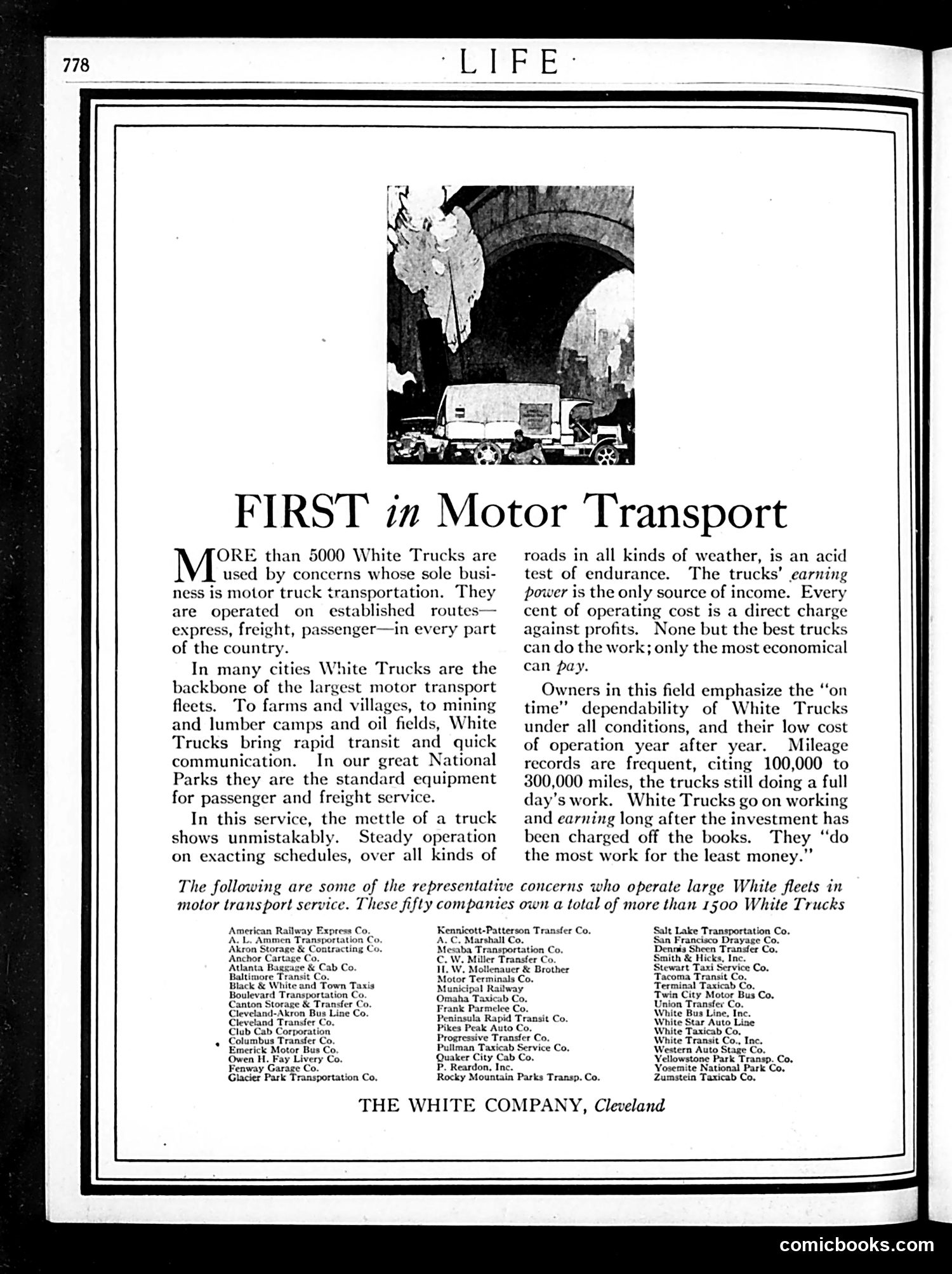
This page is primarily **advertising content**, not satire or editorial cartoon. It's a paid advertisement for White Trucks (The White Company, Cleveland), presented in the style of a magazine article. The image shows a White truck beneath an archway, symbolizing reliability and durability. The text emphasizes White Trucks' dominance in commercial transportation—over 5,000 in use nationwide for business, farming, mining, and national parks. The advertisement highlights practical selling points: steady operation on all schedules, low operating costs, and high mileage records (100,000-300,000 miles cited). It includes a list of 50 companies operating White truck fleets. There is no political satire here—this is straightforward commercial advertising dressed in the editorial language typical of 1920s-era corporate promotion.
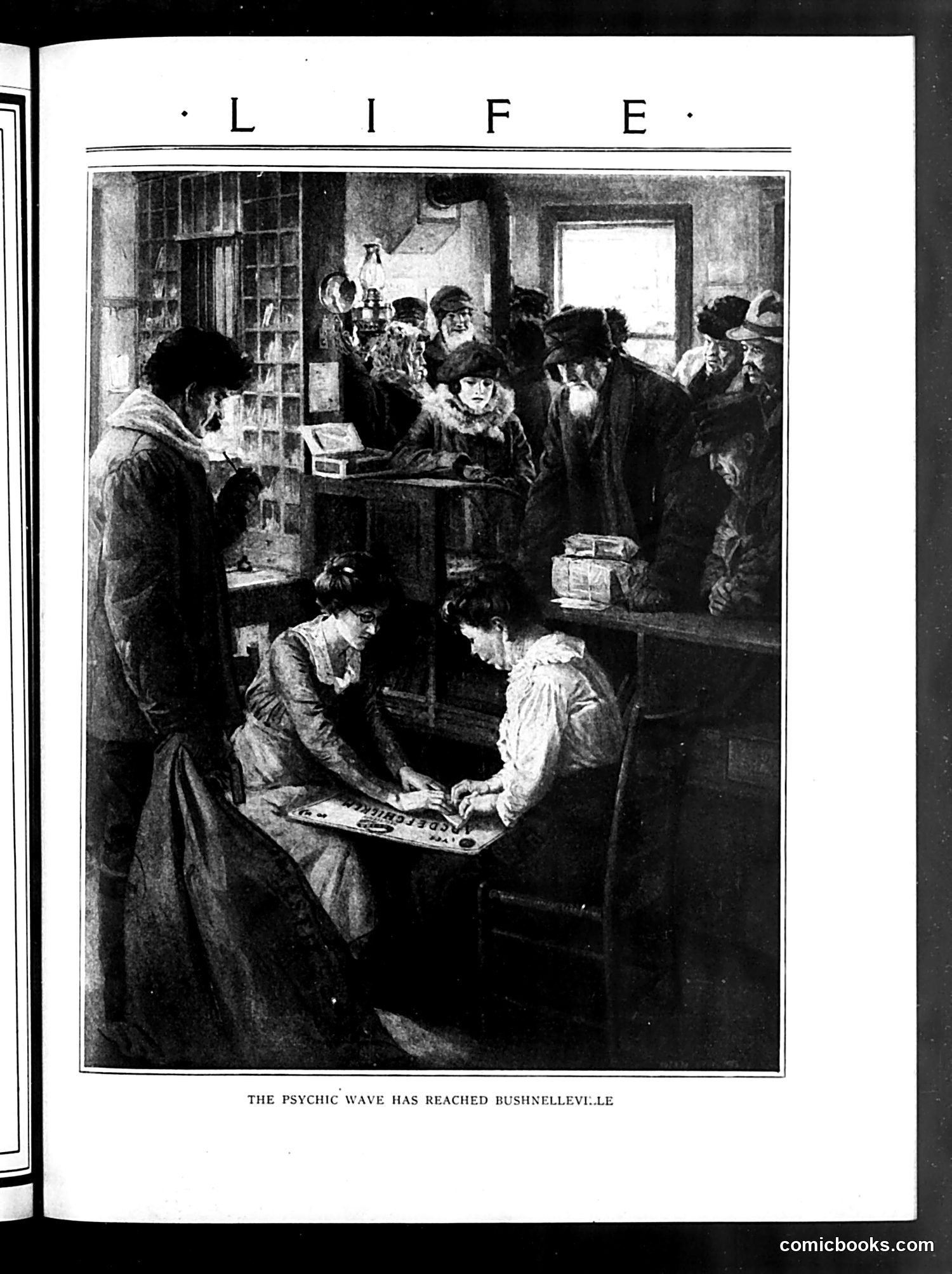
This satirical illustration depicts a fortune-telling or spiritualist shop scene, likely mocking the early 20th-century craze for spiritualism and psychic phenomena. The caption suggests that even a small town ("Bushnelleville") has been reached by this trend. The image shows a crowded shop with two women appearing to conduct a séance or reading at a table in the foreground, while numerous townspeople crowd around, observing intently. The composition satirizes how spiritualism had become a widespread cultural phenomenon, reaching even remote communities. The satire targets the gullibility of ordinary people who believed in psychic powers and spiritualist practices, mocking both the practitioners and the eager customers willing to pay for such services. This reflects Life magazine's frequent critique of popular superstitions and pseudoscience.
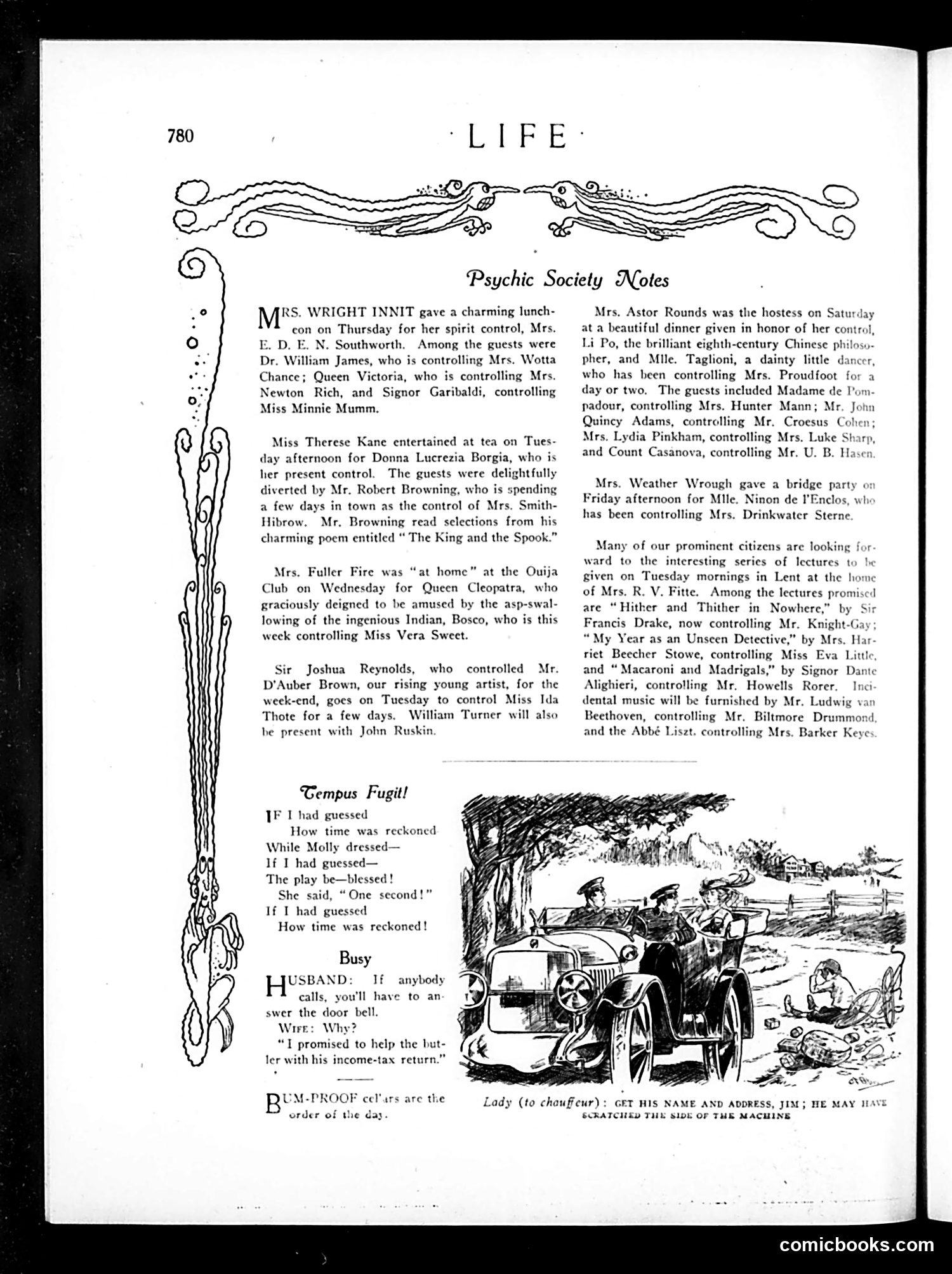
This page contains **social gossip and humor** rather than political satire. The "Psychic Society Notes" section reports on wealthy New York society members and their activities—dinner parties, tea entertainments, and lecture series. Names like "Mrs. Astor Rounds" and references to "controlling" others suggest these are accounts of social gatherings among the city's elite. The bottom section includes three brief humorous items: "Tempus Fugit!" (time flies), a joke about a busy husband, and a one-liner about "bump-proof cars." The illustration shows a **vintage automobile** with passengers, captioning a scene about getting a chauffeur's name and address. This is light domestic humor typical of Life's satirical approach to middle and upper-class American life.
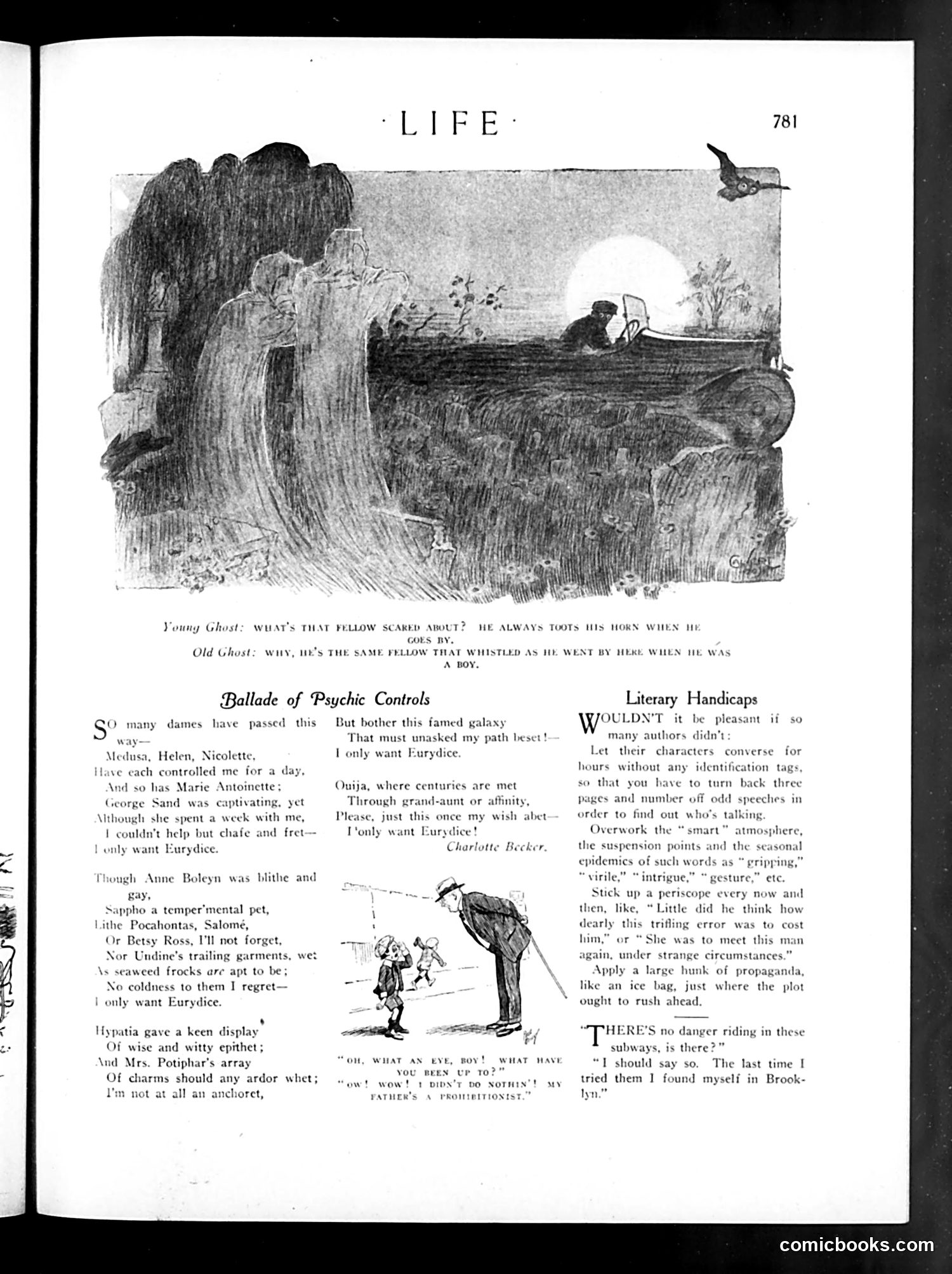
The main cartoon depicts two ghosts in conversation by a riverbank at sunset. A young ghost asks an old ghost why a particular fellow "always toots his horn when he goes by." The old ghost replies that this is the same man who "whistled as he went by here when he was a boy." This is a gentle, timeless joke about human consistency—a commentary on how people's habits and mannerisms persist unchanged throughout their lives. There's no specific political or social satire here; rather, it's observational humor about human nature and the passage of time, using the supernatural framing device to span decades. The page also contains poetry and a "Literary Handicaps" column discussing author challenges, plus an unrelated cartoon about a father and child.
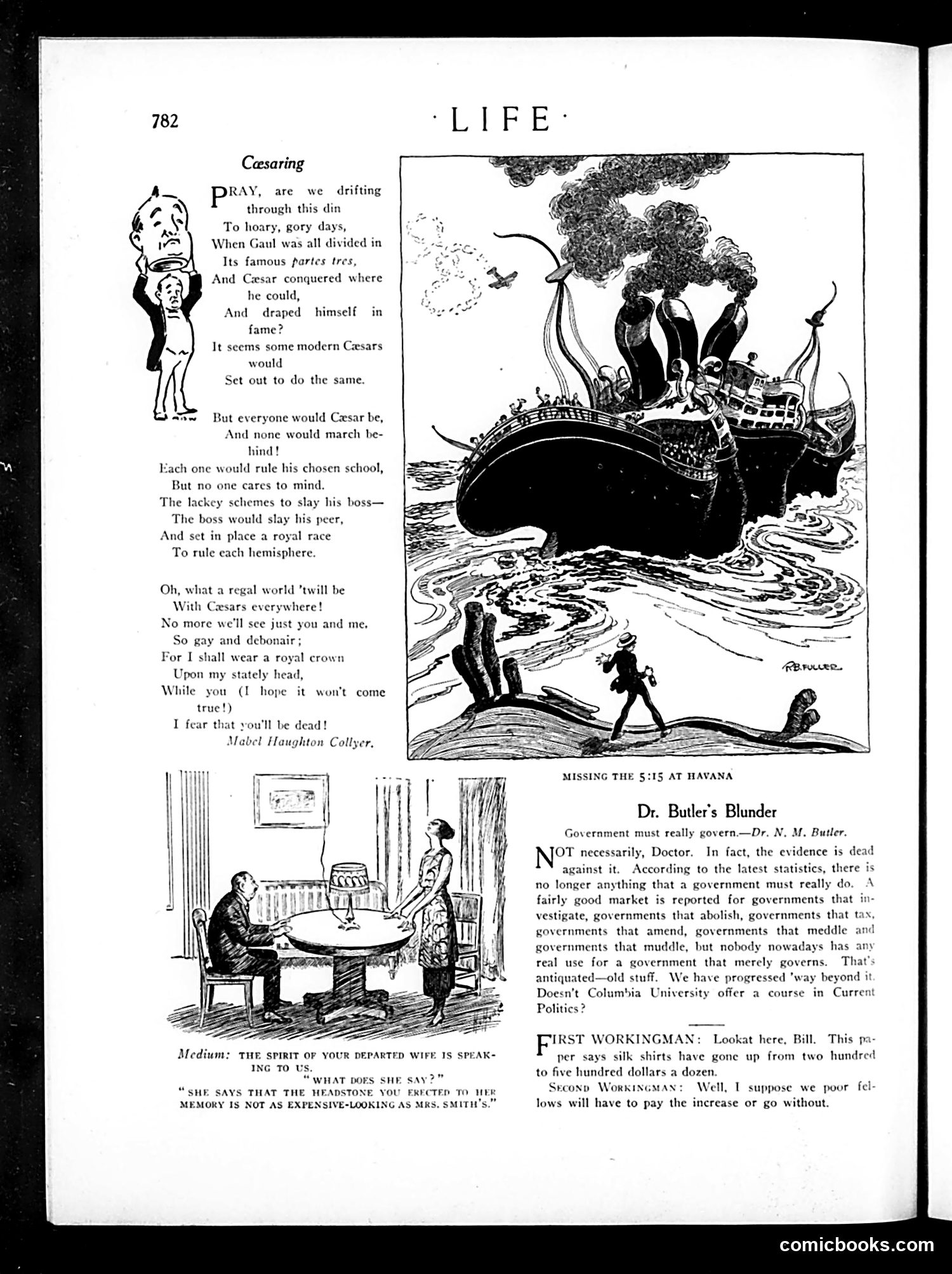
This page contains three distinct satirical pieces: 1. **"Caesaring"** (left): A poem mocking ambitious modern leaders who aspire to conquer like Julius Caesar. The speaker fantasizes about becoming an all-powerful dictator ruling "each hemisphere," wearing a royal crown. The satire targets contemporary political ambition and megalomania. 2. **"Missing the 5:15 at Havana"** (top right): An illustration showing what appears to be a chaotic maritime scene with a ship, likely satirizing governmental inefficiency or a specific political mishap involving travel/transportation. 3. **"Dr. Butler's Blunder"** (bottom right): A dialogue piece debating whether governments should actively govern or remain passive. It includes a séance cartoon and workingmen discussing rising prices for silk shirts—satirizing both spiritualism and economic hardship affecting working classes. The page reflects early 20th-century American anxieties about authoritarianism, government effectiveness, and economic costs.
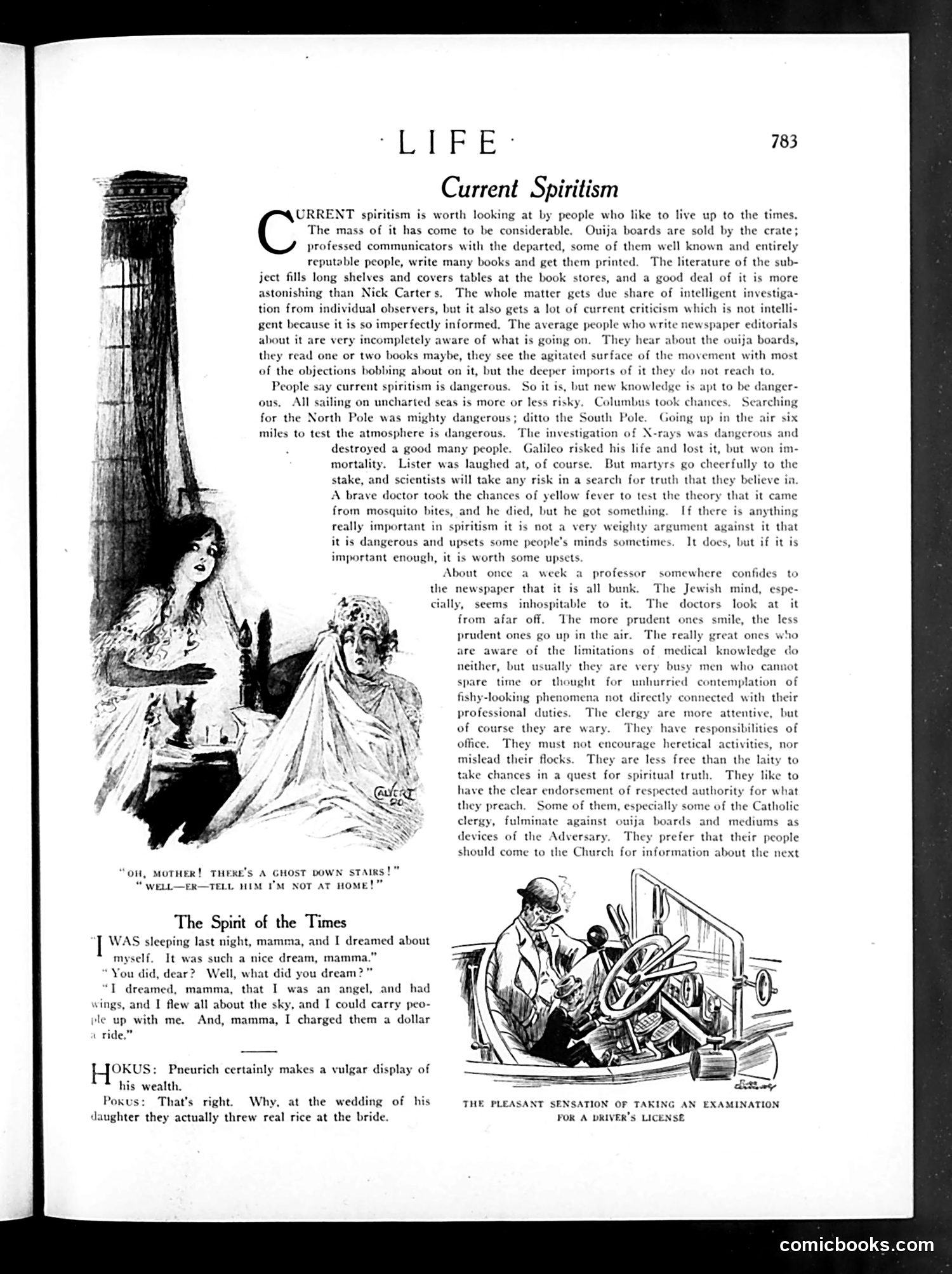
This page satirizes **Spiritualism**—the popular early-20th-century movement claiming to contact deceased spirits through mediums and ouija boards. The top illustration depicts a séance scene with a woman "communicating" with ghosts on a staircase, mocking believers' credulity. The accompanying essay criticizes spiritualism as dangerous pseudoscience while acknowledging its mass appeal. The author argues that while some dismiss it as bunk, spiritualists have considerable cultural influence through books, lectures, and reputable practitioners. The lower cartoon about a driver's license examination jokes about modern bureaucratic absurdity—unrelated to the spiritualism theme. The small dialogue between "Horus" and "Pokus" mocks wealth display, using names suggesting stage illusion ("hocus pocus"), implying spiritualists are mere charlatans exploiting the wealthy.
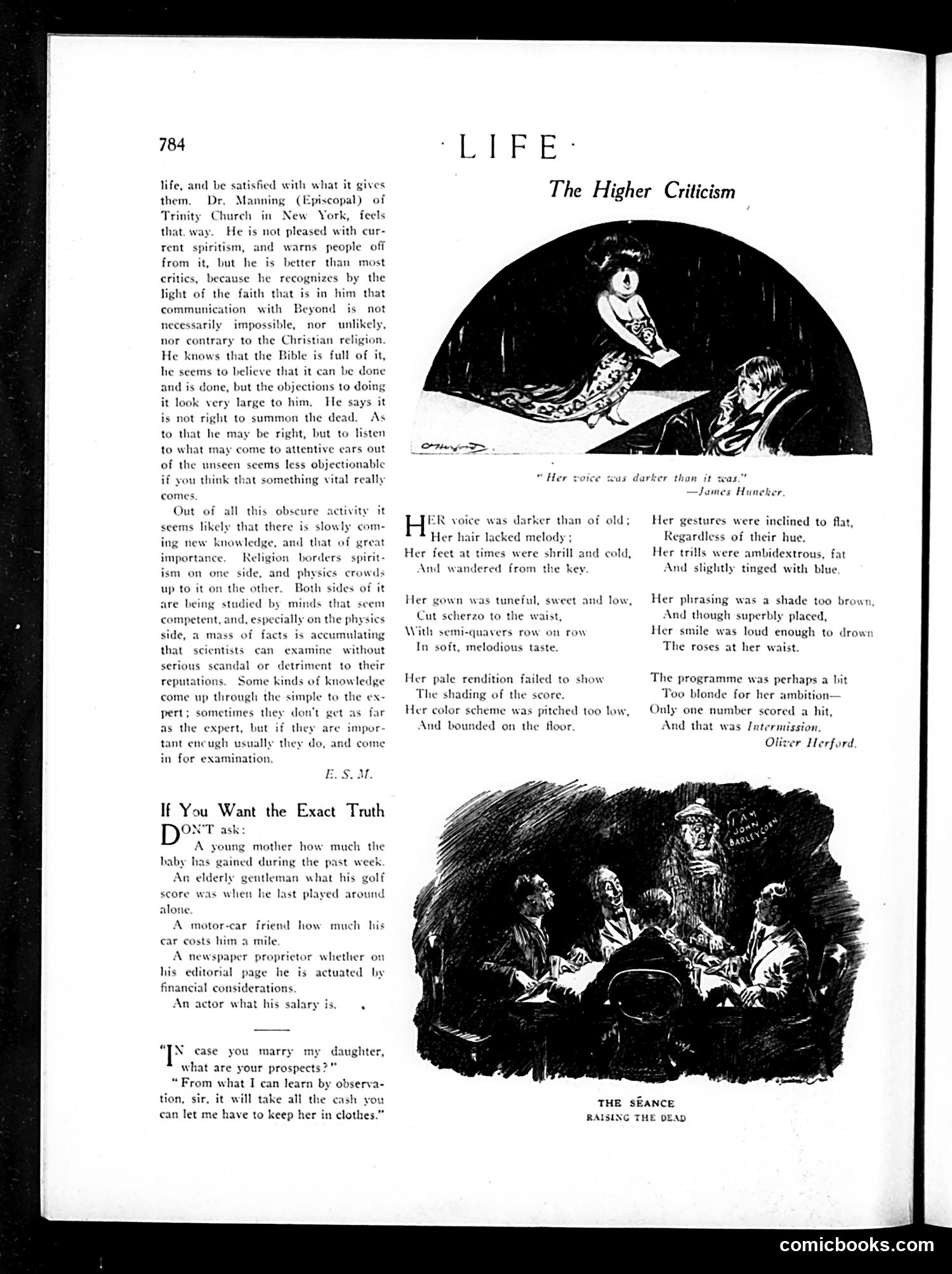
This page contains literary criticism and humorous social commentary rather than political cartoons. **"The Higher Criticism"** section critiques a female performer (likely an opera singer, given references to "score" and "programme"). The accompanying illustration and James Hueffer's satirical poem mock her vocal quality ("darker than it was"), awkward gestures, and poor performance despite technical competence. The critique suggests she's technically trained but lacks artistry—a common target of period theater criticism. **"If You Want the Exact Truth"** presents brief humorous anecdotes about everyday social situations: people exaggerating claims (about babies' weight gain, golf scores, car speed), and a satirical joke about a prospective son-in-law's financial prospects. The bottom illustration labeled "THE SÉANCE: RAISING THE DEAD" appears unrelated to the text above it. The page reflects early 20th-century American magazine humor focused on social pretension and human nature rather than politics.
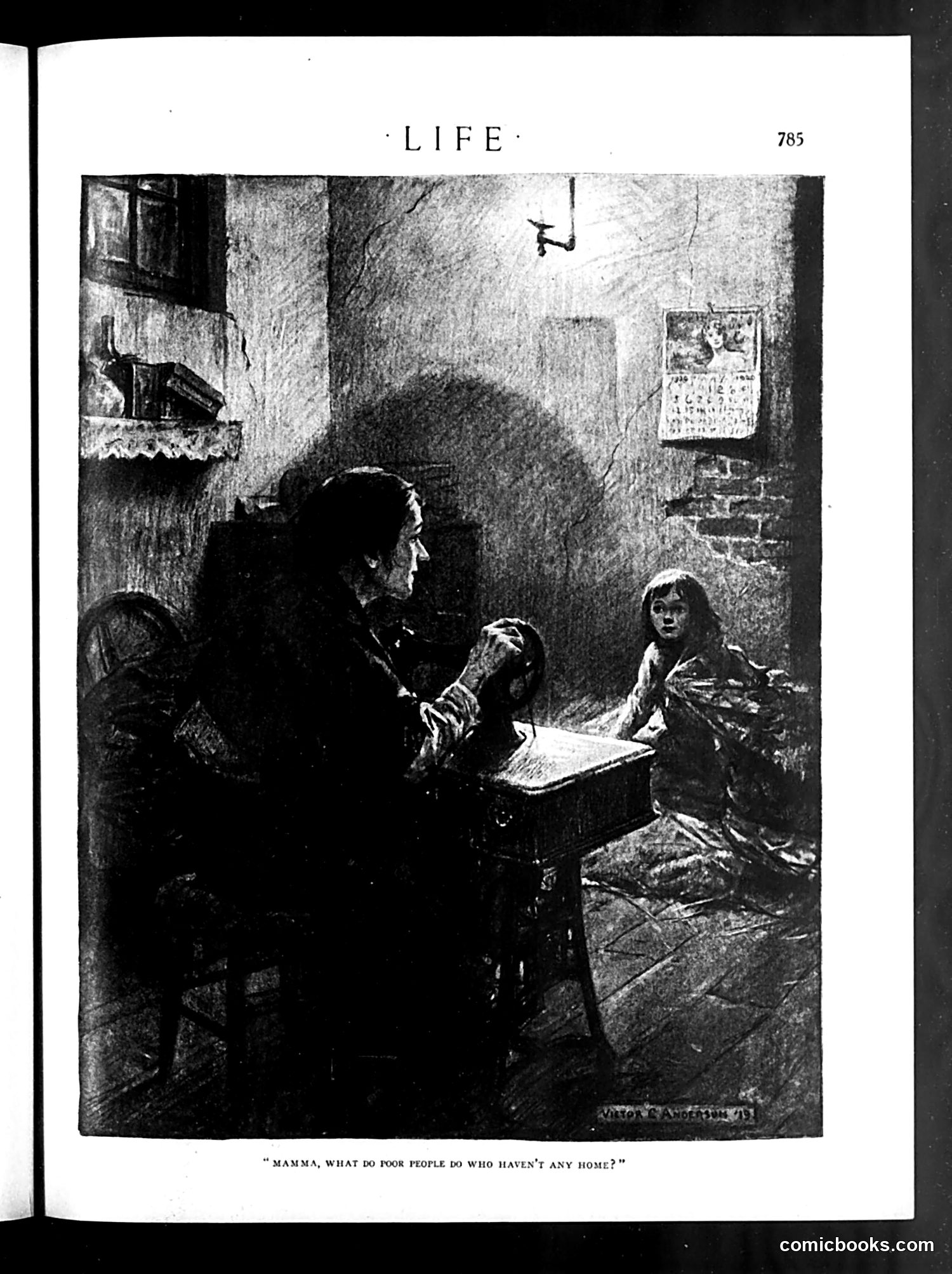
This illustration depicts a social commentary on homelessness and poverty. An adult (likely a mother or caregiver) sits at a table with a young child in a sparse, deteriorating room—note the bare walls, simple furnishings, and posted notices suggesting poor living conditions. The caption reads: "MAMMA, WHAT DO POOR PEOPLE DO WHO HAVEN'T ANY HOME?" The satire operates through the child's innocent question, which exposes the uncomfortable reality that society had no clear answer for its homeless population. The illustration's dark, gritty aesthetic emphasizes the bleakness of poverty during what appears to be the early 20th century. The image critiques both the existence of homelessness and society's failure to adequately address it.
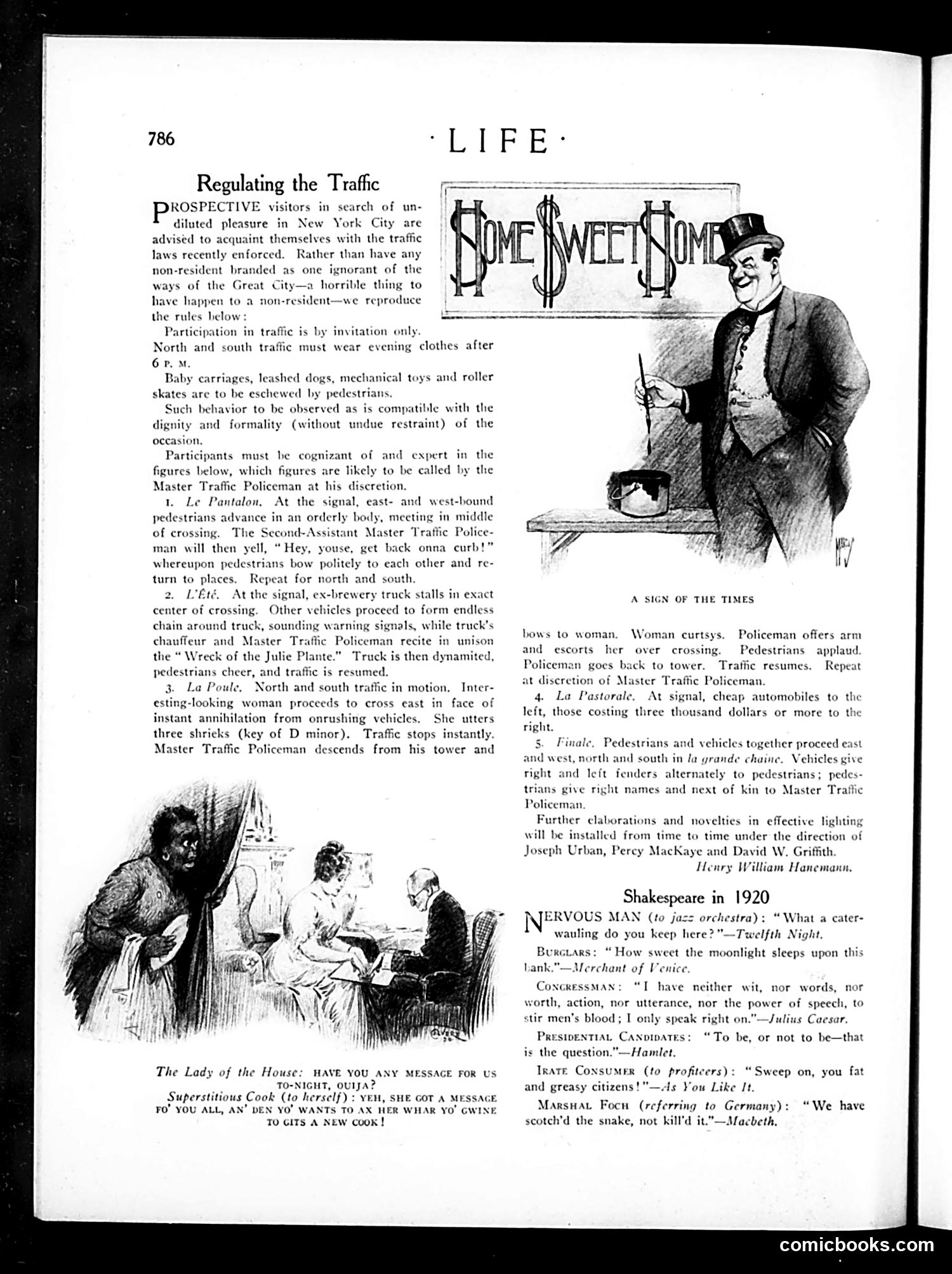
This piece mocks proposed "traffic regulations" for New York City presented as humorous mock-rules. The illustration shows a portly "Master Traffic Policeman" directing pedestrians and vehicles in absurdly elaborate choreography—described as "Le Pantalon," "L'Été," and "La Finale"—with pedestrians performing synchronized movements like a formal dance. The satire targets the chaos of NYC traffic in the early 1920s and the impractical solutions being proposed. The elaborate, ballet-like descriptions mock the attempt to impose rigid order on the city's notoriously chaotic streets. The drawing emphasizes the policeman's authority and pomposity, suggesting that such control was both impossible and ridiculous given New York's actual traffic conditions.
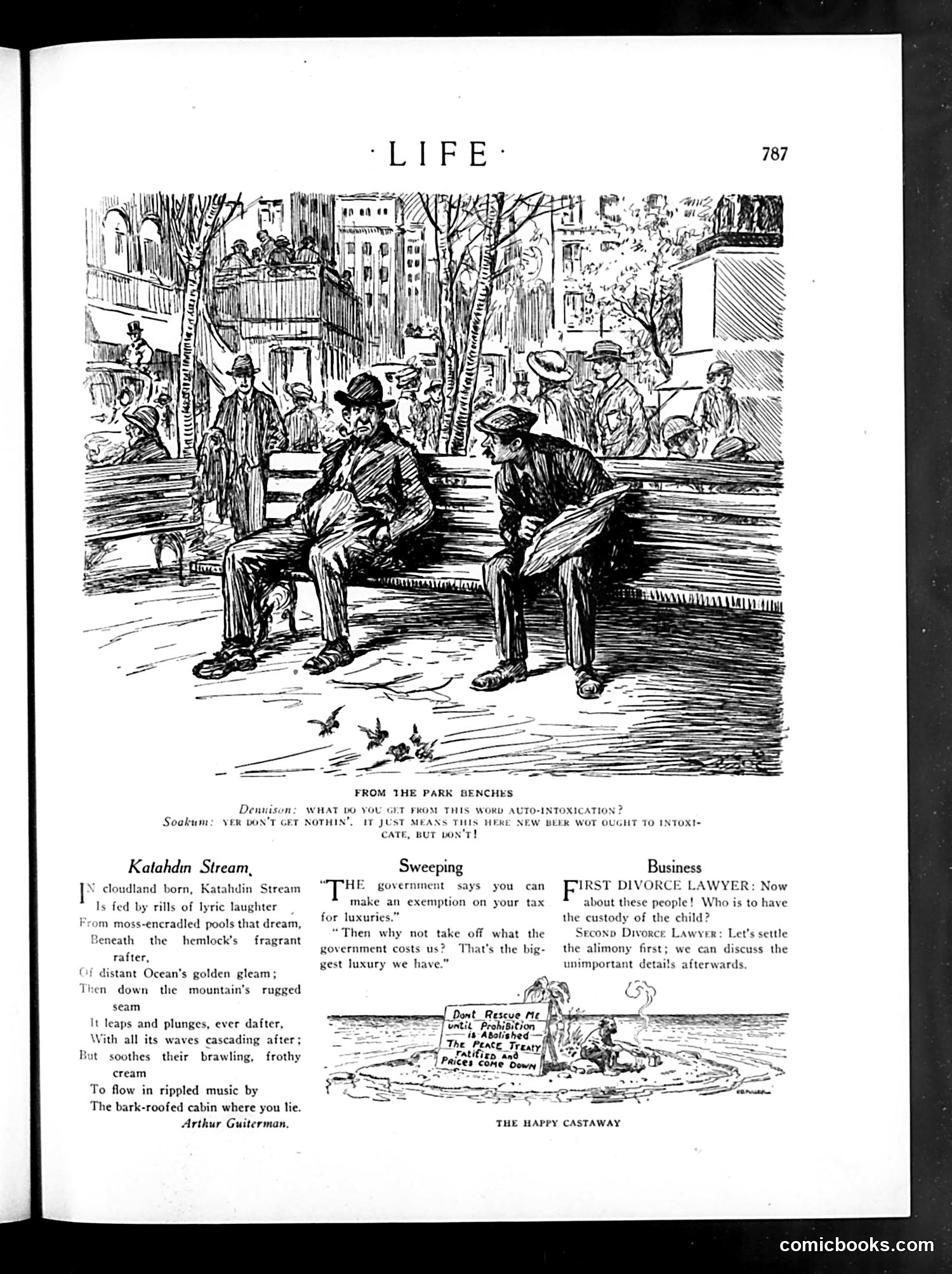
This page contains three distinct pieces of satirical content: **"From the Park Benches"** (top): A cartoon depicting men on a park bench discussing "auto-intoxication"—likely referring to drunkenness or intoxication from alcohol consumption, a timely topic given Prohibition-era debates. **Three Poems/Sections**: "Katahdin Stream" (nature poetry by Arthur Guiterman), "Sweeping" (a joke about tax exemptions for government luxuries), and "First Divorce Lawyer" (a humorous dialogue about custody disputes). **"The Happy Castaway"** (bottom): A small cartoon showing a castaway on an island with a sign referencing Prohibition and the Peace Treaty—satirizing how even isolation cannot escape contemporary legal/political constraints. The overall theme appears to be social commentary on 1920s American life, particularly Prohibition enforcement and governmental hypocrisy.
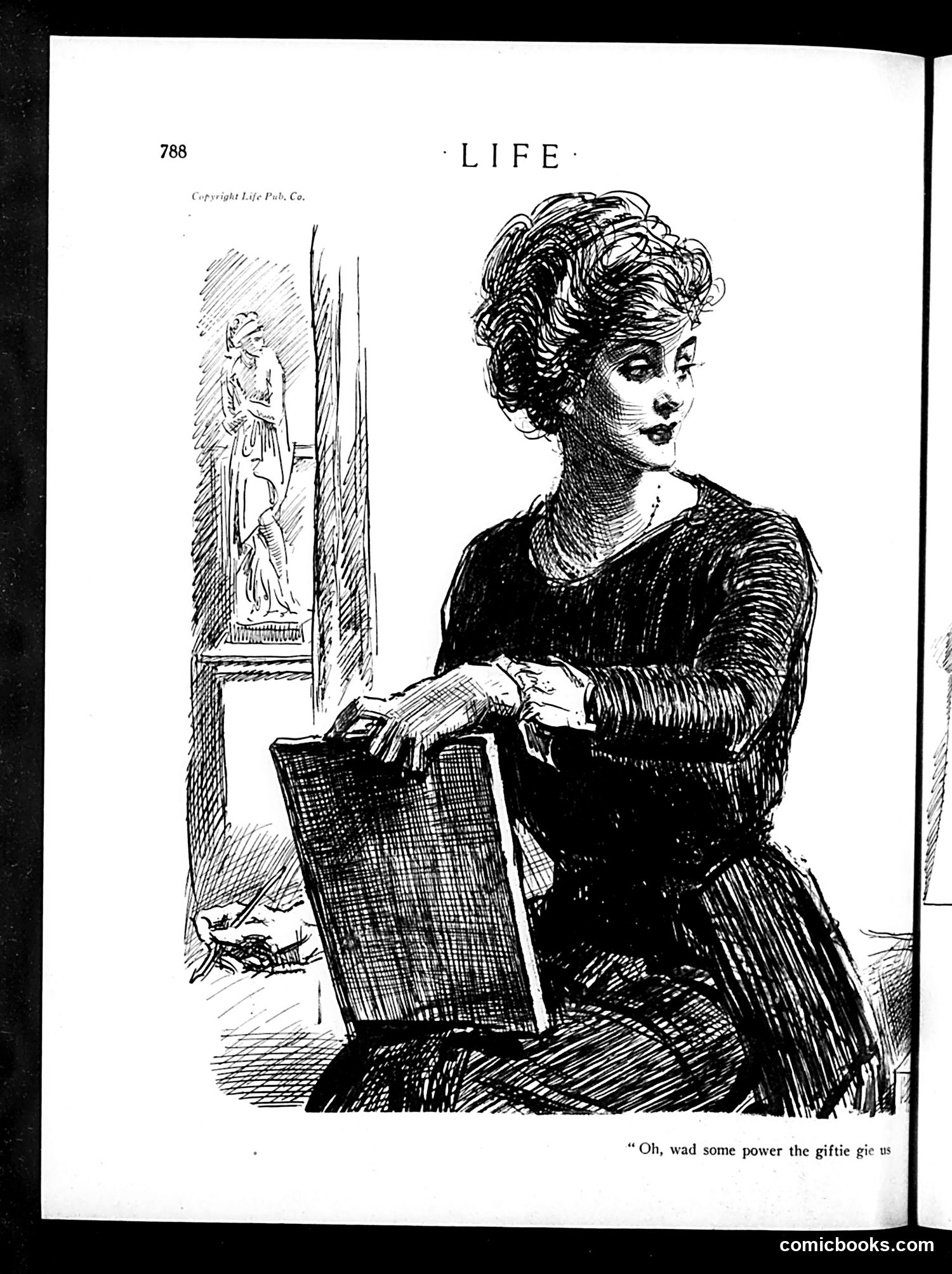
This page from *Life* magazine (page 788) features a satirical illustration of a woman examining what appears to be a needlework or textile sample. The caption quotes Robert Burns: "Oh, wad some power the giftie gie us"—a reference to his poem "To a Louse," which laments human inability to see ourselves as others see us. The cartoon appears to satirize female vanity or self-deception, likely critiquing women's blind spots regarding their own appearance or behavior. The formal dress, elaborate hairstyle, and the woman's focused examination of the textile suggest commentary on middle or upper-class feminine concerns. The Burns quotation implies irony: the woman lacks the self-awareness the poem advocates for. Without the artist's name visible, the specific target remains somewhat unclear.
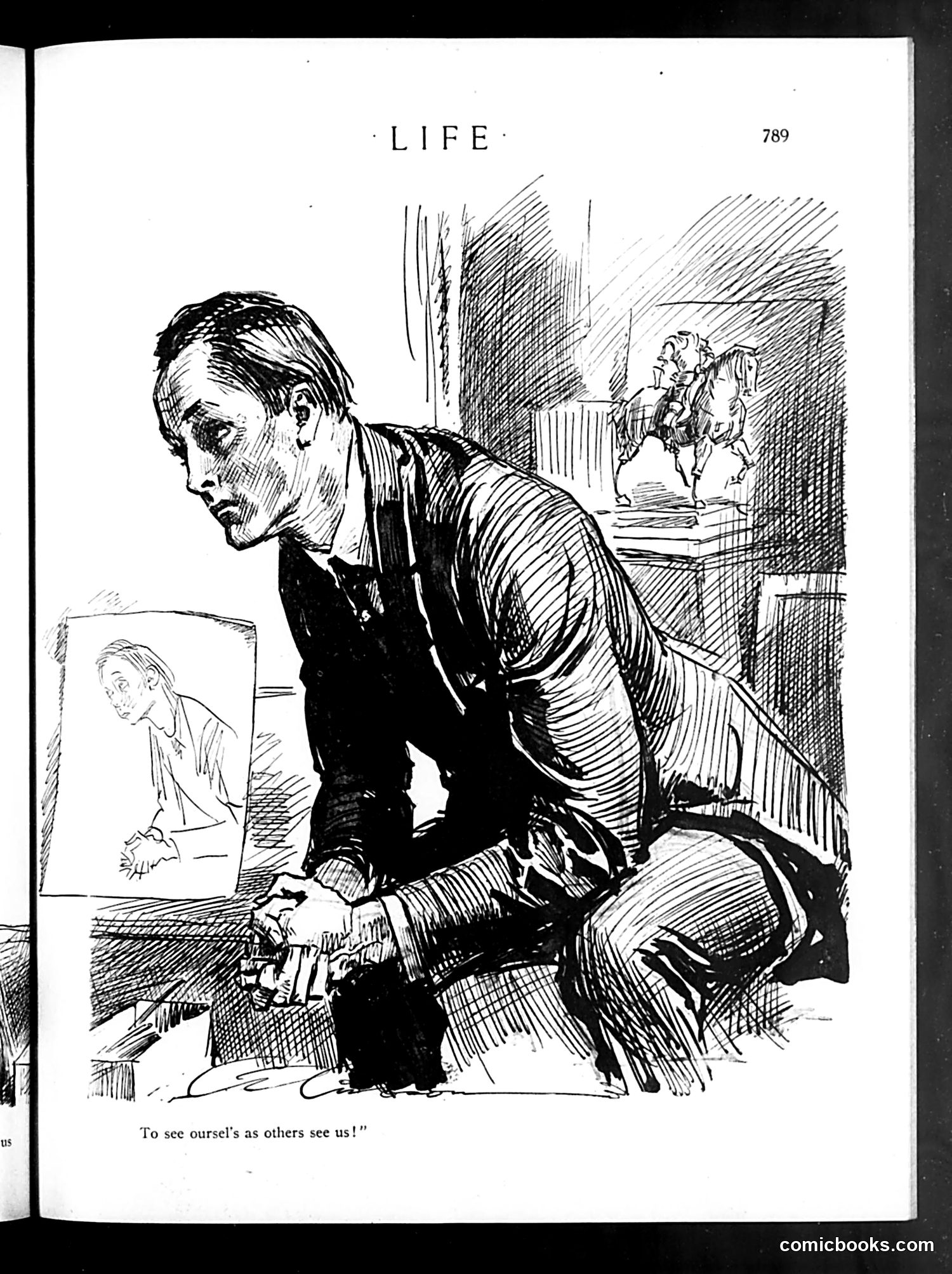
This single-panel cartoon depicts a man in formal attire examining his own reflection in a mirror, with the caption "To see ourself as others see us!" The image appears to reference Robert Burns' famous 1785 poem "To a Louse," which contains the line "O wad some Pow'r the giftie gie us / To see oursels as ithers see us" (Oh would some power give us the gift to see ourselves as others see us). The cartoon's meaning is philosophical rather than specifically political: it satirizes human self-perception and vanity, suggesting a gap between how people view themselves and how others perceive them. The formal-dressed man's serious expression while contemplating his reflection emphasizes this disconnect. The work appears to be commentary on human nature and self-awareness rather than commentary on a specific contemporary figure or event.
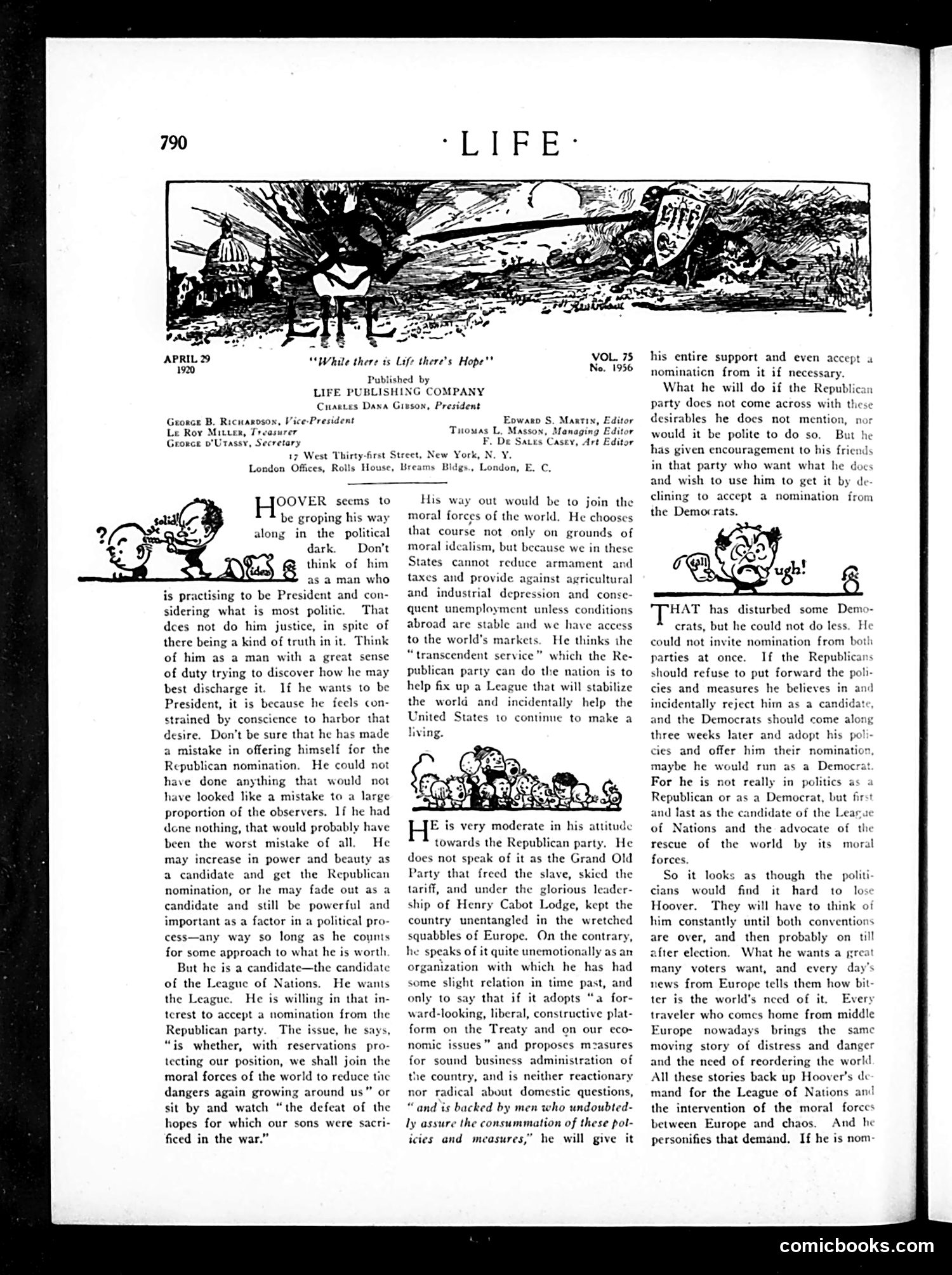
This page discusses Herbert Hoover's potential 1920 presidential candidacy. The text presents Hoover as a principled figure motivated by conscience rather than political calculation, positioning him as a candidate of the League of Nations. The cartoons appear to mock Hoover's political positioning. Small caricatures show him "groping" in political darkness—a visual metaphor for his uncertain path. The satire suggests Hoover is awkwardly navigating Republican politics while promoting League membership, an unpopular position among many Republicans at the time. The text humorously outlines Hoover's conditional support for the Republican party, noting his moderate criticisms and his demands for a "forward-looking" platform. The satire lies in portraying his pragmatic self-interest (stabilizing world markets for American commerce) as moral idealism—suggesting his humanitarian League advocacy conveniently aligns with business interests. The overall tone is gently mocking: Hoover appears well-intentioned but politically awkward.
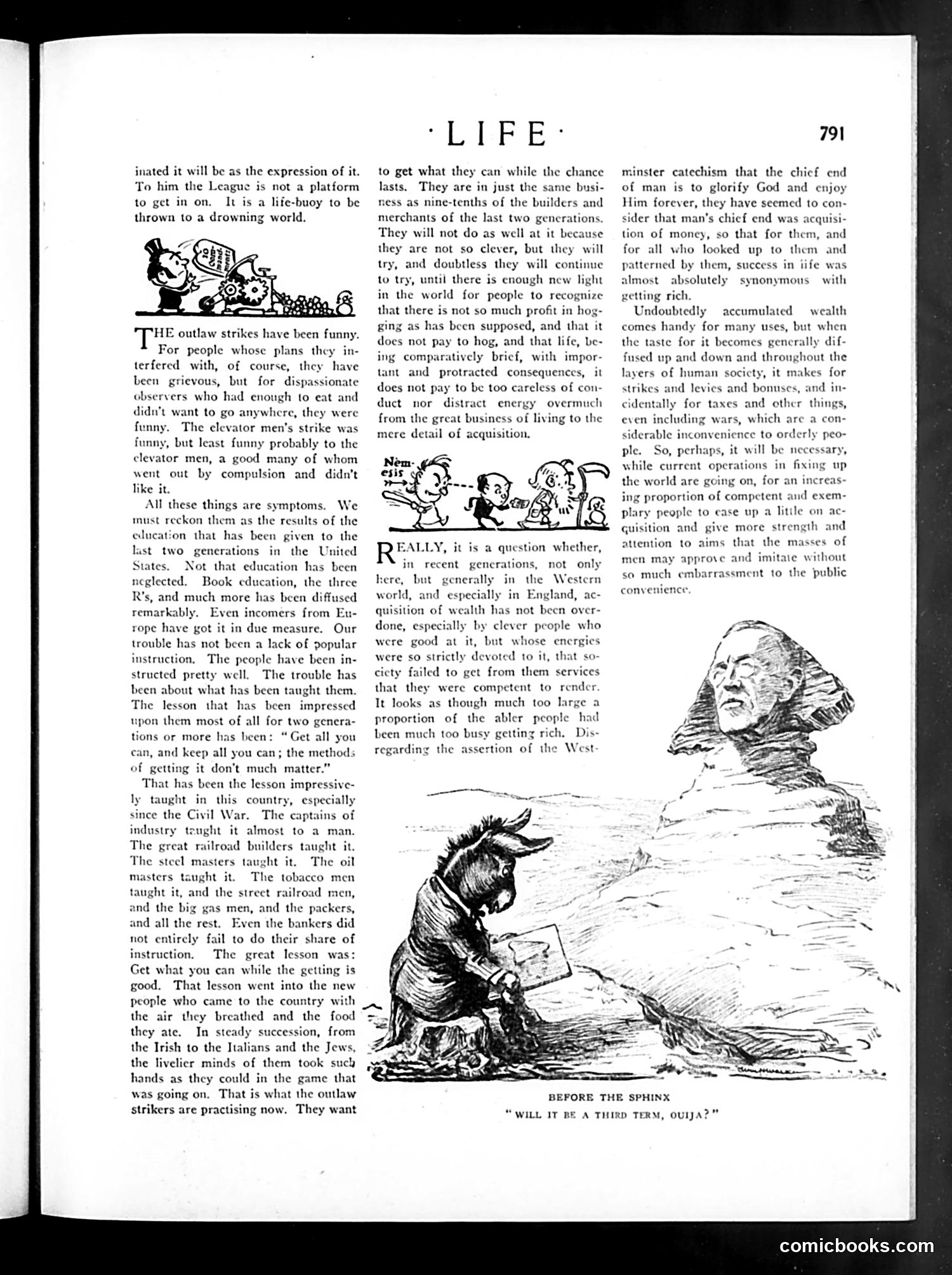
This page critiques American capitalism and the "get rich quick" ethic that dominated late 19th and early 20th-century society. **Main argument:** The author argues that wealthy industrialists—railroad barons, steel magnates, oil tycoons, bankers—taught successive waves of immigrants (Irish, Italians, Jews) that acquisition of money was life's supreme goal, without ethical restraint. Now, "outlaw strikers" are simply applying this same lesson by trying to "get what they can while the chance lasts." The irony is sharp: society taught greed, then acts shocked when workers practice it. **The cartoon** (captioned "BEFORE THE SPHINX / WILL IT BE A THIRD TERM, OU?") shows a donkey examining the Great Sphinx, likely a political reference, though the specific context is unclear from this page alone. The essay essentially argues that labor unrest is society's own creation—the inevitable result of teaching generations that ruthless self-interest is the highest virtue.
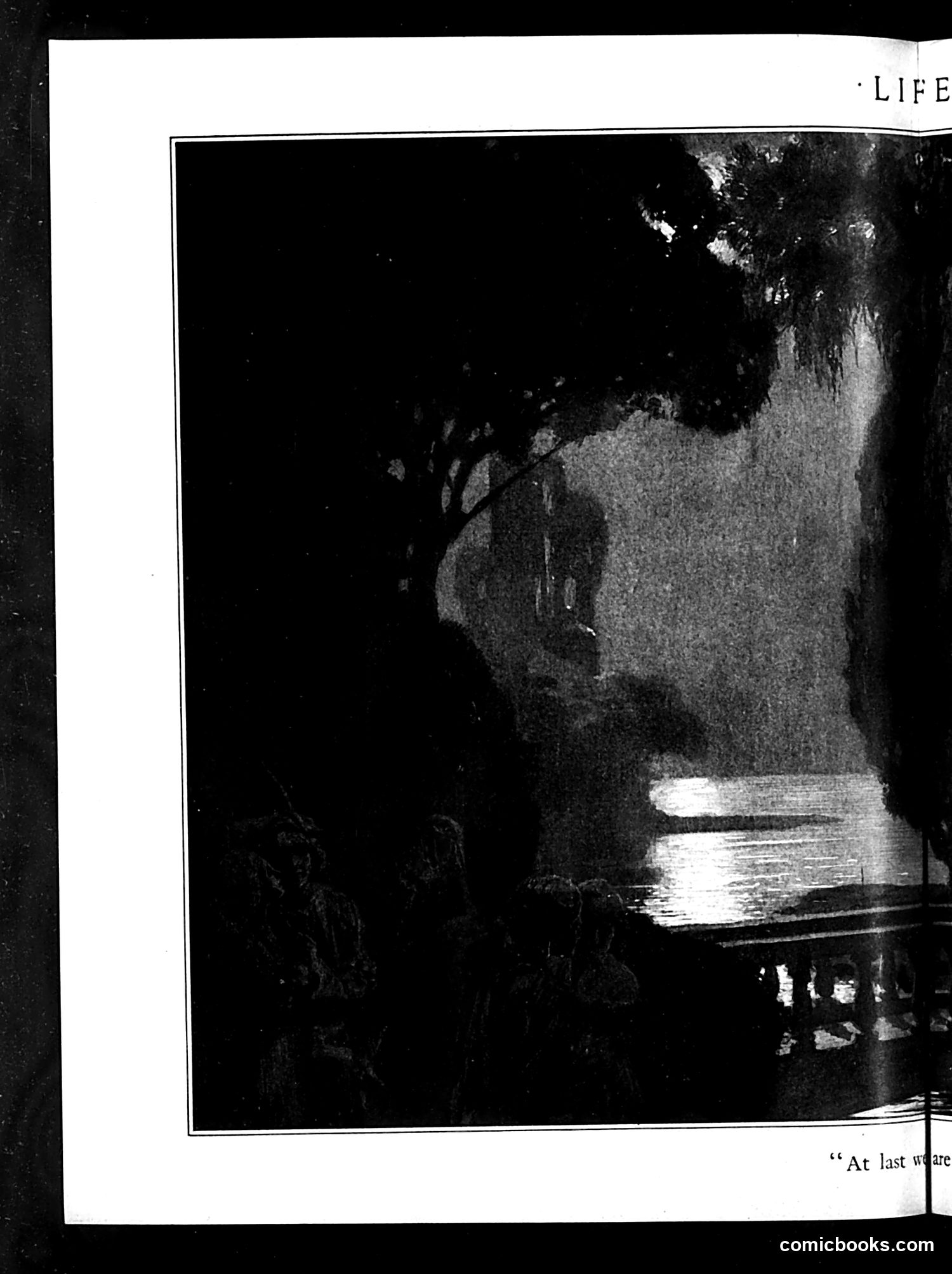
This appears to be a page from Life magazine featuring a dramatic black-and-white photograph or illustration. The image shows what seems to be an interior scene with strong contrasts between light and shadow—possibly a room or cave-like space with a figure visible in the darker area and bright light (perhaps moonlight or a window) creating stark illumination. The partial caption reads "At last we are," but without the complete text, the specific meaning is unclear. The image's dramatic, atmospheric quality suggests it may accompany a story, editorial piece, or satirical commentary, but the fragmented OCR text and cropped caption prevent certain identification of the subject matter or intended satire. More context would be needed to explain the cartoon's or article's point to modern readers.
This page is too dark and degraded to interpret with confidence. The image shows what appears to be a silhouetted interior scene, possibly depicting figures in a room, but details are obscured by poor contrast and image quality. The partial visible text reads "st w@are alone" (likely "...st we are alone" or similar), suggesting dialogue, but without seeing the complete caption or identifying any distinct figures or caricatures, I cannot reliably explain the cartoon's meaning or political/social commentary. To properly analyze this Life magazine content, a clearer reproduction would be needed to identify any recognizable figures, understand the full context, and explain the satirical point to a modern reader.
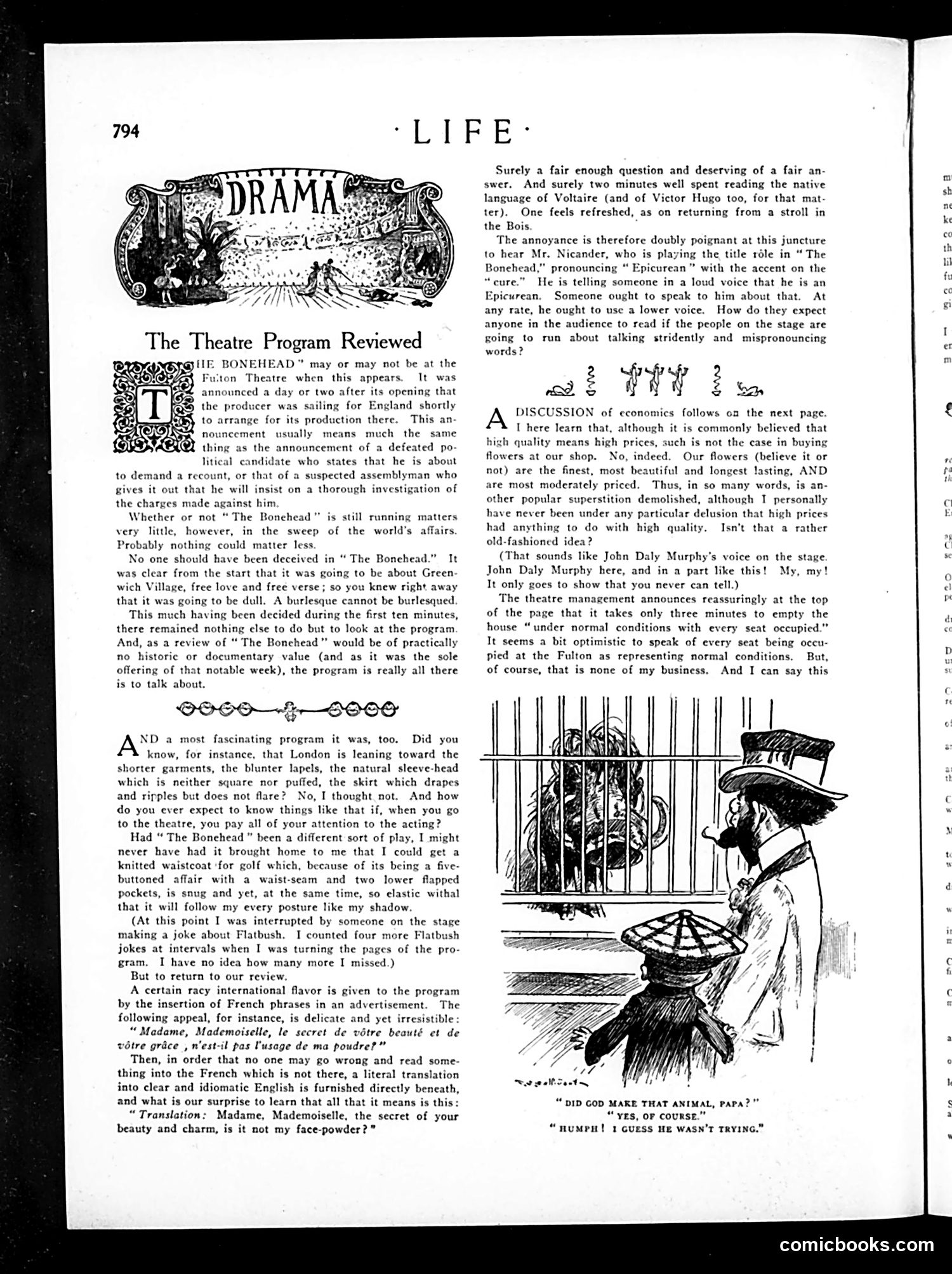
This page reviews the theater program of "The Bonehead," a play set in Greenwich Village dealing with free love and free verse themes—which the critic dismisses as inherently unburlesqueable and dull. The main cartoon depicts a man at a birdcage, with dialogue: "Did God make that animal, Papa?" / "Yes, of course." / "Humph! I guess he wasn't trying." The satire targets the play's shallow subject matter and the audience's inattention to acting. The critic humorously notes that theater programs—with advertisements for London fashion, French perfume with literal translations, and repeated "Flatbush jokes"—are more interesting than the actual performance. He mocks an actor's mispronunciation of "Epicurean" and the general mediocrity of the production, suggesting the program itself is the only worthwhile content. The cartoon's joke appears to reflect broader skepticism about human (or divine) competence—fitting the page's tone of witty dismissal.
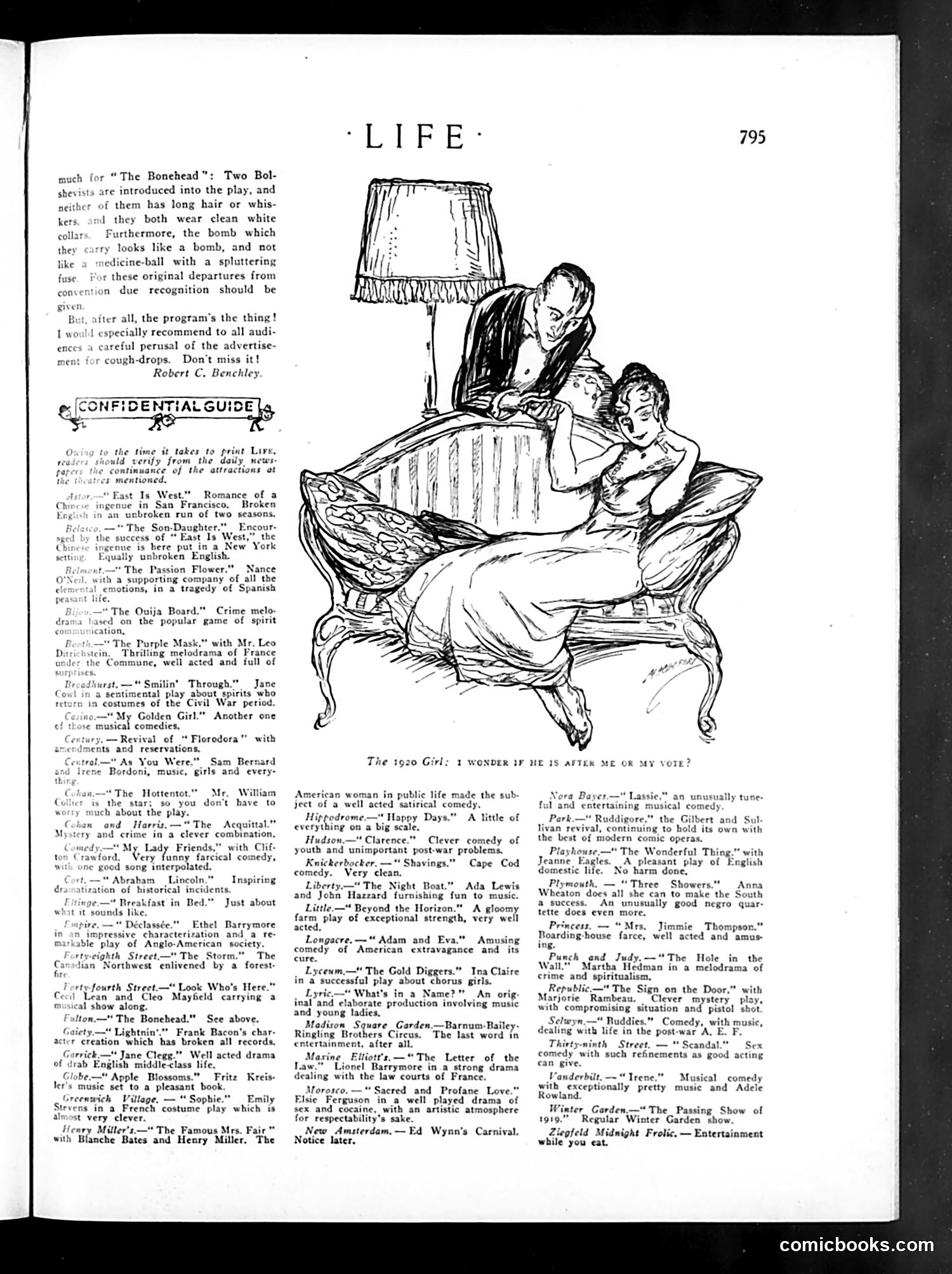
This page contains theater reviews and a cartoon captioned "The 1920 Girl: I Wonder if He is After Me or My Vote?" **The Cartoon's Meaning:** The illustration depicts a young woman being courted by a man while sitting in a parlor. The joke hinges on women's newly won suffrage—the 19th Amendment had just been ratified in 1920. The caption suggests ambiguity about the man's intentions: is he romantically interested in the woman herself, or is he politically motivated to court her because she now has voting power? **Social Context:** This satirizes the sudden shift in women's political status. Previously, women were excluded from voting; now they constitute a significant electoral bloc. The cartoon mocks how quickly male attention might shift from purely romantic to politically calculating once women gained electoral power. It's a light commentary on women's newfound influence in American politics. **Additional Content:** The page is mostly theater listings for New York productions, with a brief review of "The Bonehead" play at the Fulton Theatre, noting its satirical treatment of Bolshevists.
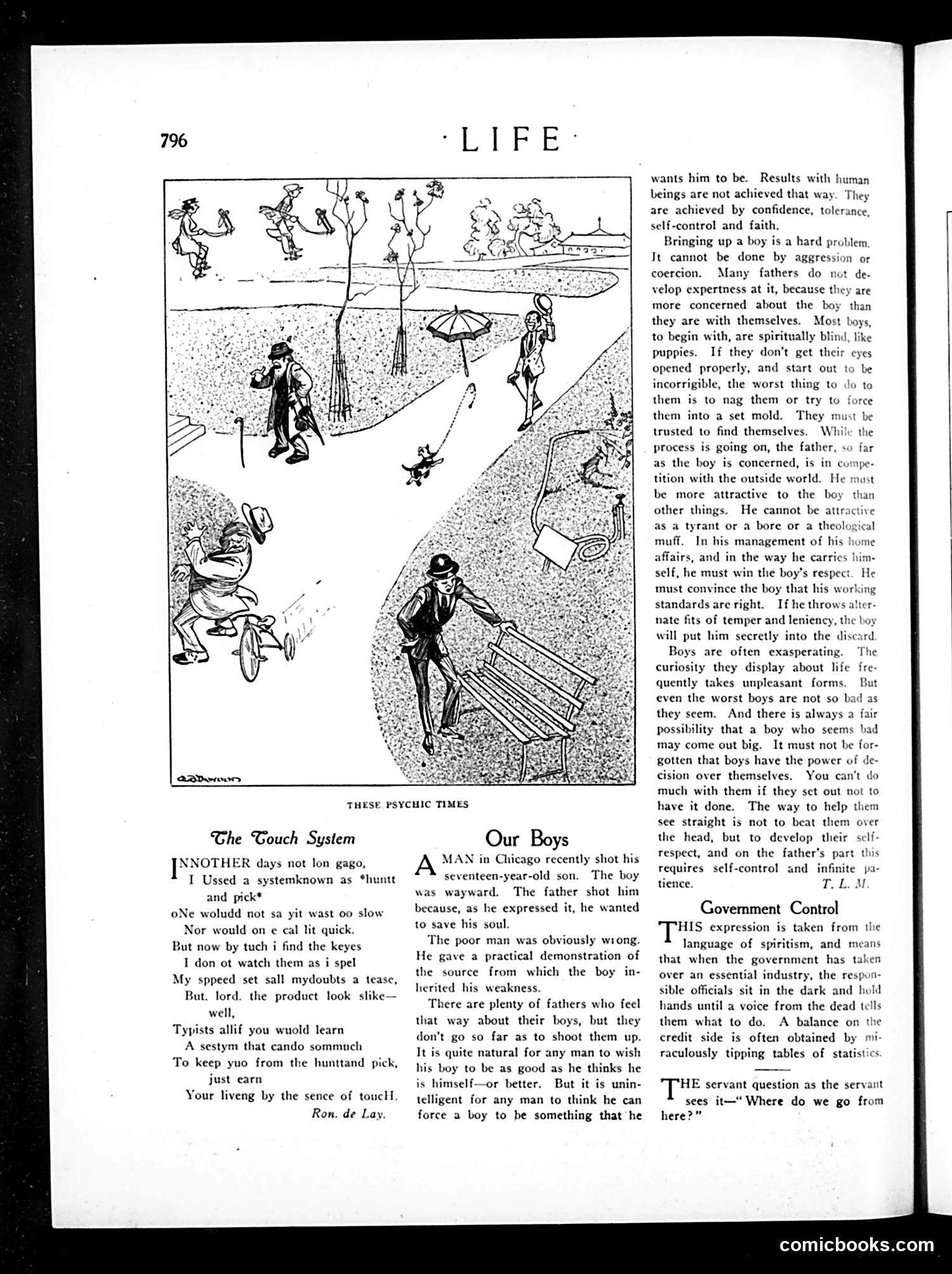
This Life magazine page contains three distinct pieces: **"The Couch System"** (left) is a humorous poem mocking touch-typing instruction, filled with intentional typos to satirize the irony of learning efficient typing while producing garbled output. **"Our Boys"** (center/right) is a serious essay responding to a recent Chicago news story in which a father shot his seventeen-year-old son, claiming he wanted to "save his soul." The author argues this demonstrates the father's own weakness and advocates for raising boys through confidence, tolerance, and respect rather than force or coercion—a progressive parenting philosophy for the era. The essay emphasizes that boys must develop self-respect and trust themselves. **"Government Control"** (bottom right) sarcastically critiques government management of essential industries, suggesting officials operate blindly ("sit in the dark") and manipulate statistics to create favorable impressions rather than solving real problems. The page juxtaposes light humor with substantive social commentary on parenting and governance.
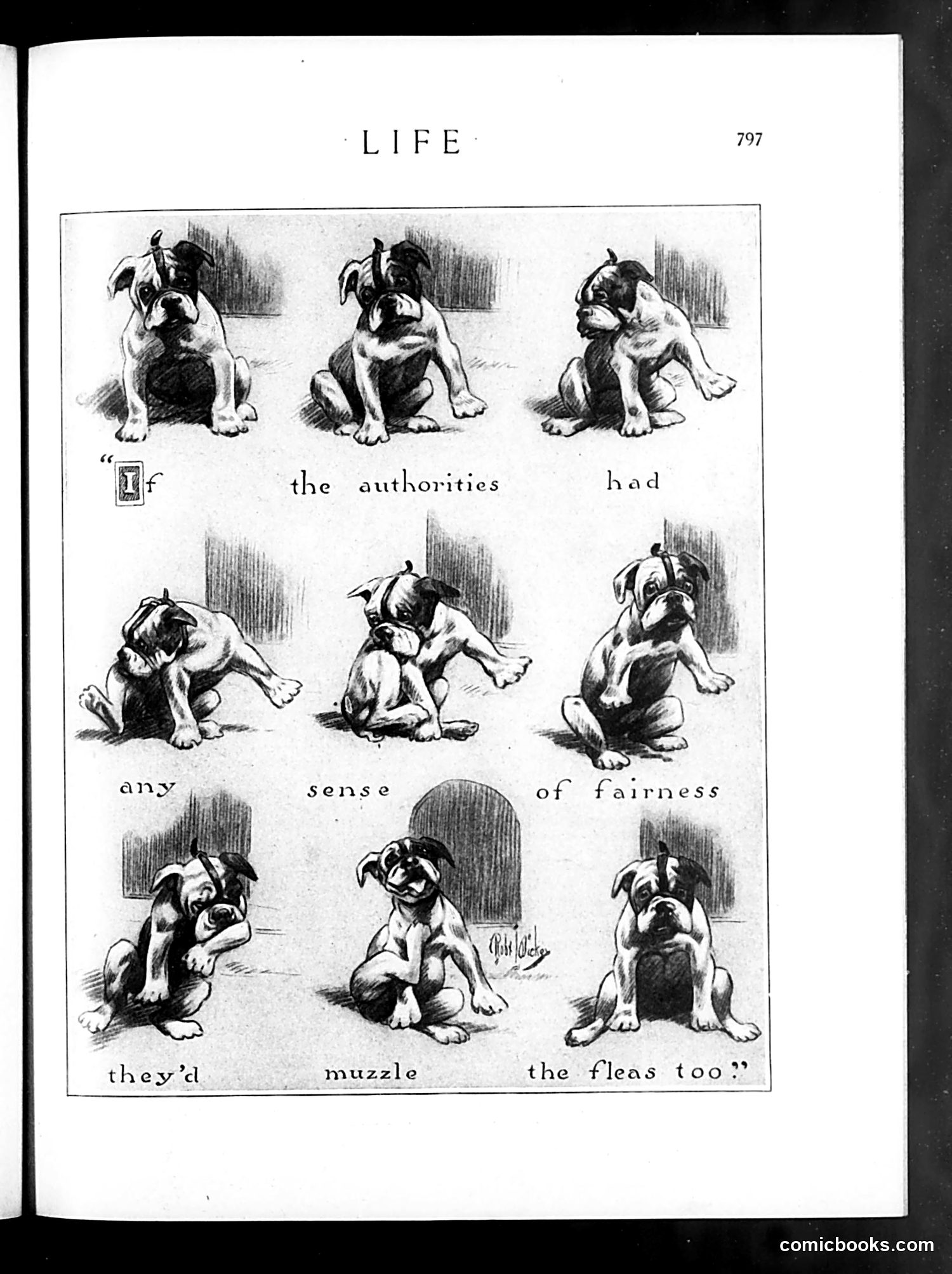
This single-panel cartoon depicts nine identical bulldogs in various poses, with text reading: "If the authorities had any sense of fairness they'd muzzle the fleas too." The cartoon is a satire on government regulation and fairness. The "authorities" muzzling dogs appears to reference laws restricting dogs (likely regarding dangerous breeds or public safety). The joke's point: if the government muzzles dogs for fairness/safety, they should also address fleas—a smaller but significant problem affecting dogs. The repetition of the same dog suggests the absurdity of singling out one problem while ignoring others. It criticizes selective or incomplete regulatory enforcement, implying that authorities are being hypocritical or illogical in their approach to public safety measures.
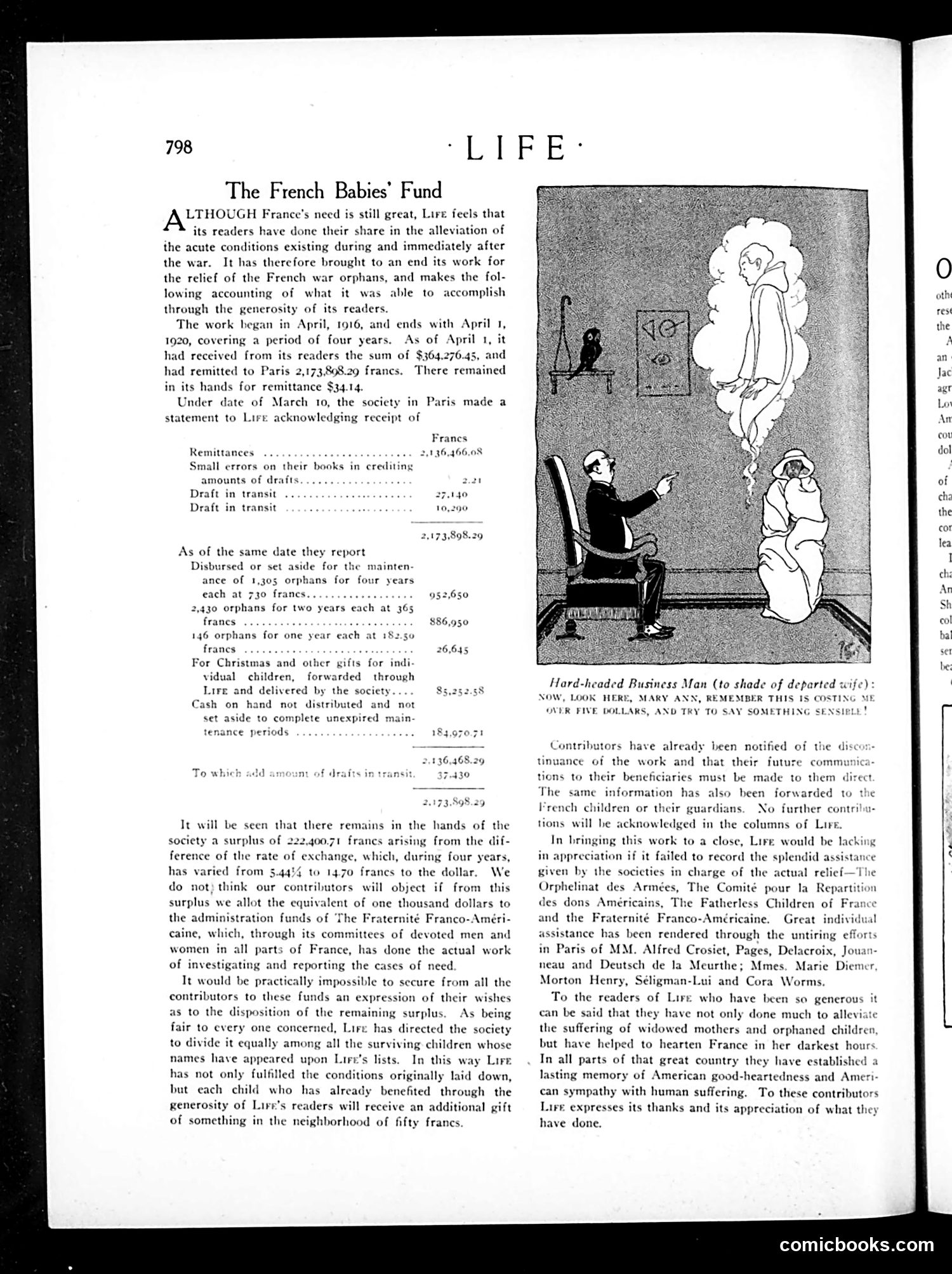
This page reports on Life magazine's successful four-year fundraising campaign (1916-1920) to aid French war orphans following World War I. The text details financial accounting: readers contributed $364,276.45, which supported relief for over 3,800 orphans through various assistance programs. The accompanying cartoon satirizes American materialism. A "hard-headed business man" communes with his deceased wife's spirit, complaining the séance costs five dollars—implying he begrudges even modest expenses for spiritual contact, much less charitable giving. The satire suggests some Americans prioritize money over sentiment or social responsibility. The article emphasizes Life's philanthropic work and gratefully acknowledges French and Franco-American organizations that administered actual relief efforts on the ground in Paris.
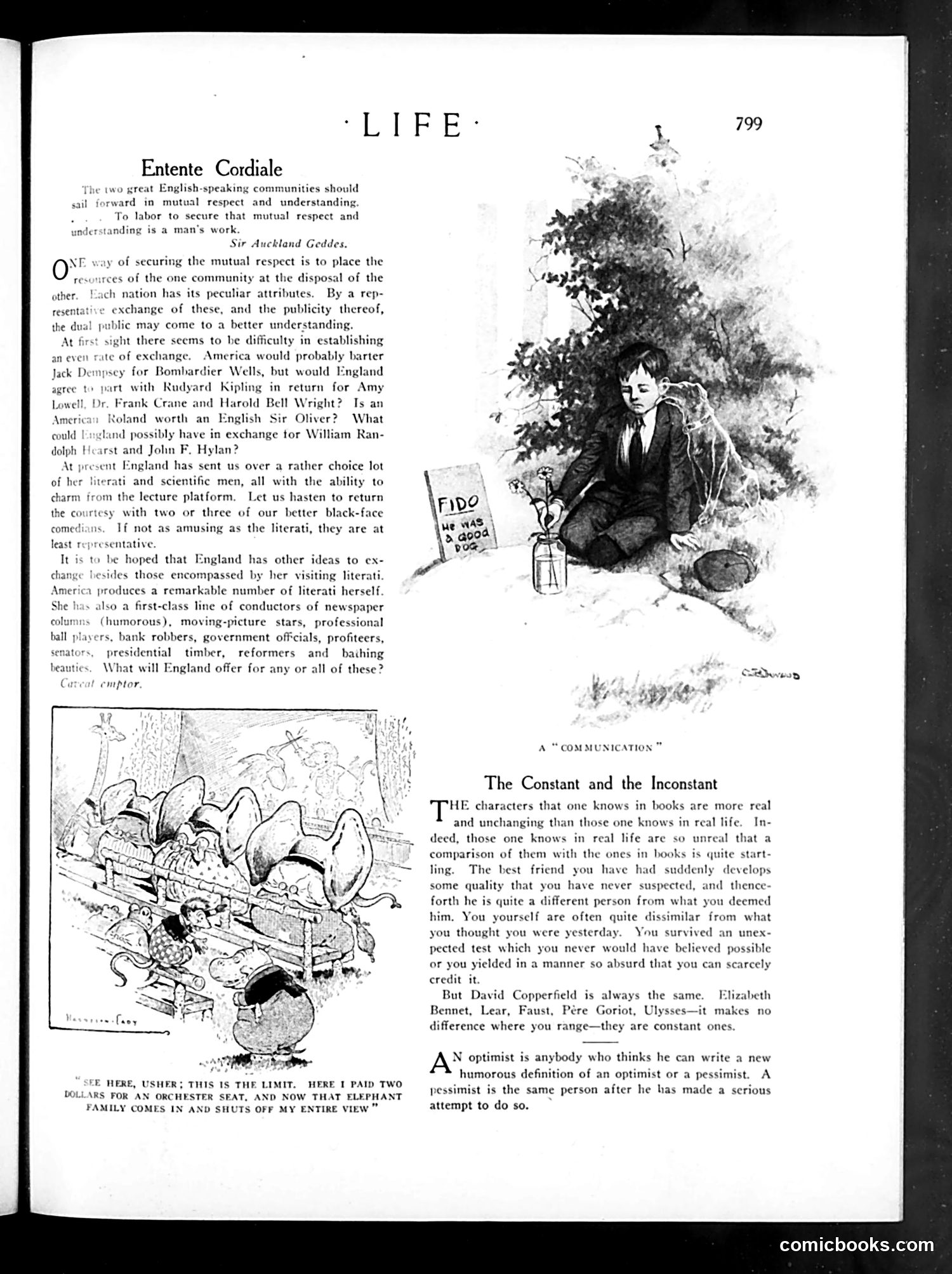
This page satirizes proposed cultural exchanges between America and Britain. The upper article, attributed to Sir Auckland Geddes (a British diplomat), suggests mutual respect requires exchanging each nation's notable figures and resources. The satire mocks this idea by proposing absurd trades: America would "barter" boxer Jack Dempsey for British boxer Bombardier Wells, but would England really give up Rudyard Kipling for American writers Frank Crane and Harold Bell Wright? The piece ridicules American celebrities by listing them alongside "bank robbers" and "bathing beauties," implying America has little of cultural value to offer. The lower cartoon shows an angry theater patron complaining to an usher about an elephant family blocking his view—a literal visual pun on the exchange concept's impracticality. The pages' tone suggests Americans felt defensive about their cultural standing relative to Britain during this period of Anglo-American relations.
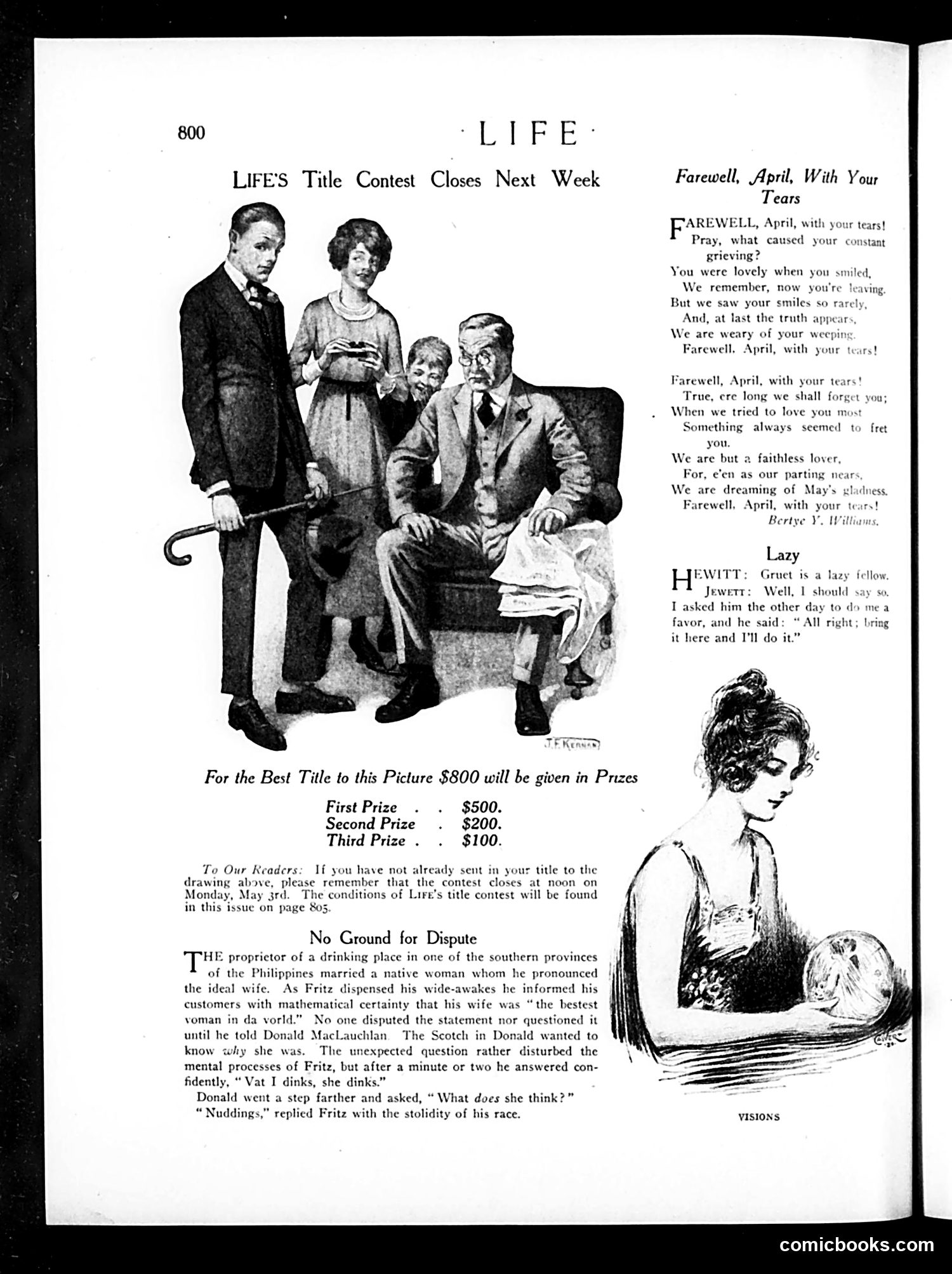
This page contains **three distinct satirical pieces**: 1. **Title Contest**: Life is running a competition asking readers to caption an illustration of a family group. The $800 prize pool ($500/$200/$100) reflects the magazine's engagement with its audience. 2. **"Farewell, April"**: A sentimental poem personifying April as a weeping month bidding farewell as May approaches—typical turn-of-century sentimental verse used as filler. 3. **"No Ground for Dispute"**: A joke satirizing an immigrant (Fritz, likely German) living in the Philippines who claims his wife is "the bestest voman in da vorld." The humor relies on ethnic stereotype—his broken English dialect and his answer that his wife thinks only "Nuddings" (nothing), implying she has no independent thought. The joke mocks both the husband's uncritical devotion and assumptions about women's intellectual capacity. It's gentle period comedy rather than sharp satire.
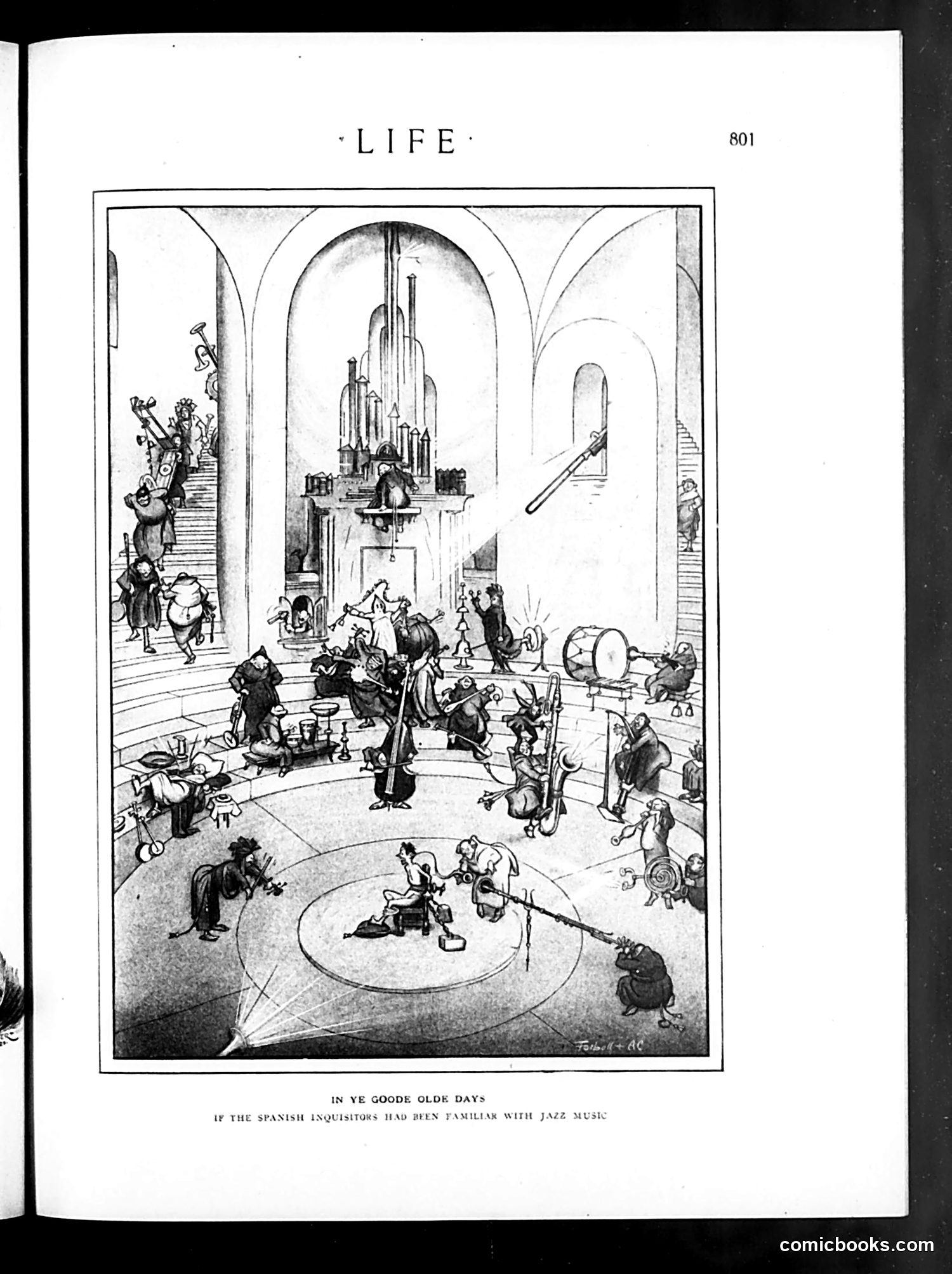
This is a satirical cartoon depicting a medieval cathedral interior where the Spanish Inquisition appears to be conducting torture sessions, but the victims are being subjected to jazz music instead of traditional instruments of pain. The joke is a counterfactual: "If the Spanish Inquisitors had been familiar with jazz music." It's mocking jazz as inherently tortuous or unpleasant-sounding—a common dismissive criticism of the genre in the 1920s-1930s. The cartoon suggests jazz music itself could serve as an instrument of torture equivalent to the Inquisition's brutal methods. This reflects the period's cultural anxiety about jazz, which was often attacked by critics as discordant "noise" rather than legitimate music. The satire targets both the Inquisition (as the ultimate evil) and jazz detractors by equating disapproval of the music with medieval torture.
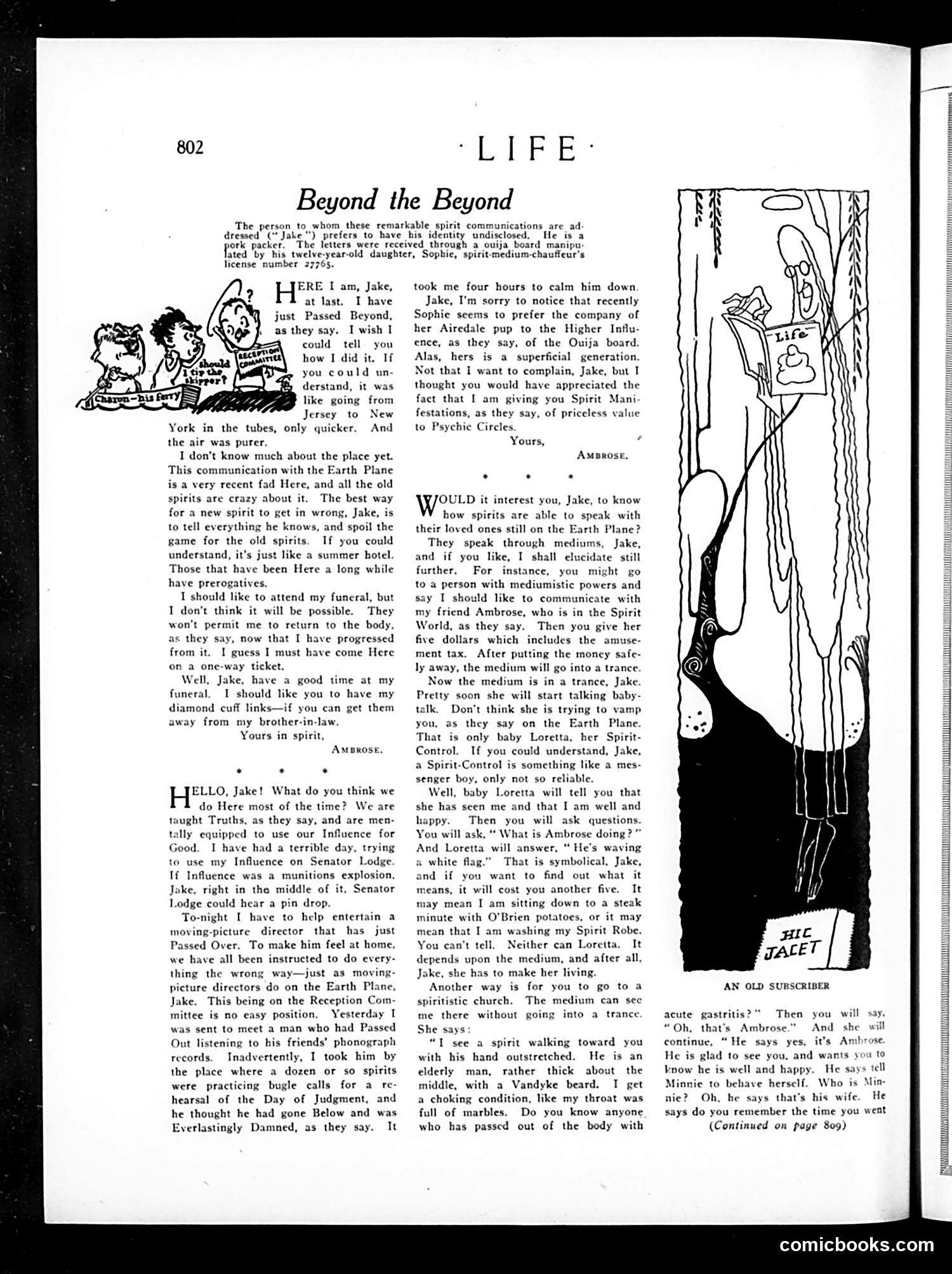
This Life magazine piece satirizes the 1920s spiritualism craze—séances, Ouija boards, and spirit mediums claiming contact with the dead. The humor targets credulous believers and charlatan mediums exploiting them. "Jake," a pork packer, receives messages allegedly from his deceased friend Ambrose via Ouija board operated by Jake's twelve-year-old daughter Sophie. The satire works on multiple levels: the spirits discuss mundane afterlife concerns (attending funerals, entertaining other spirits); Ambrose complains about his inability to influence Senator Lodge; and the text mocks the jargon spiritualists used ("Passed Beyond," "Earth Plane," "Spirit-Control"). The cartoon ridicules the setup itself—a child "medium" more interested in her dog than spiritual matters, mediums charging fees (including "amusement tax"), and the absurdity that spirits communicate through unreliable intermediaries. The illustration shows the domestic, almost comedic nature of this supposedly profound spiritual contact.
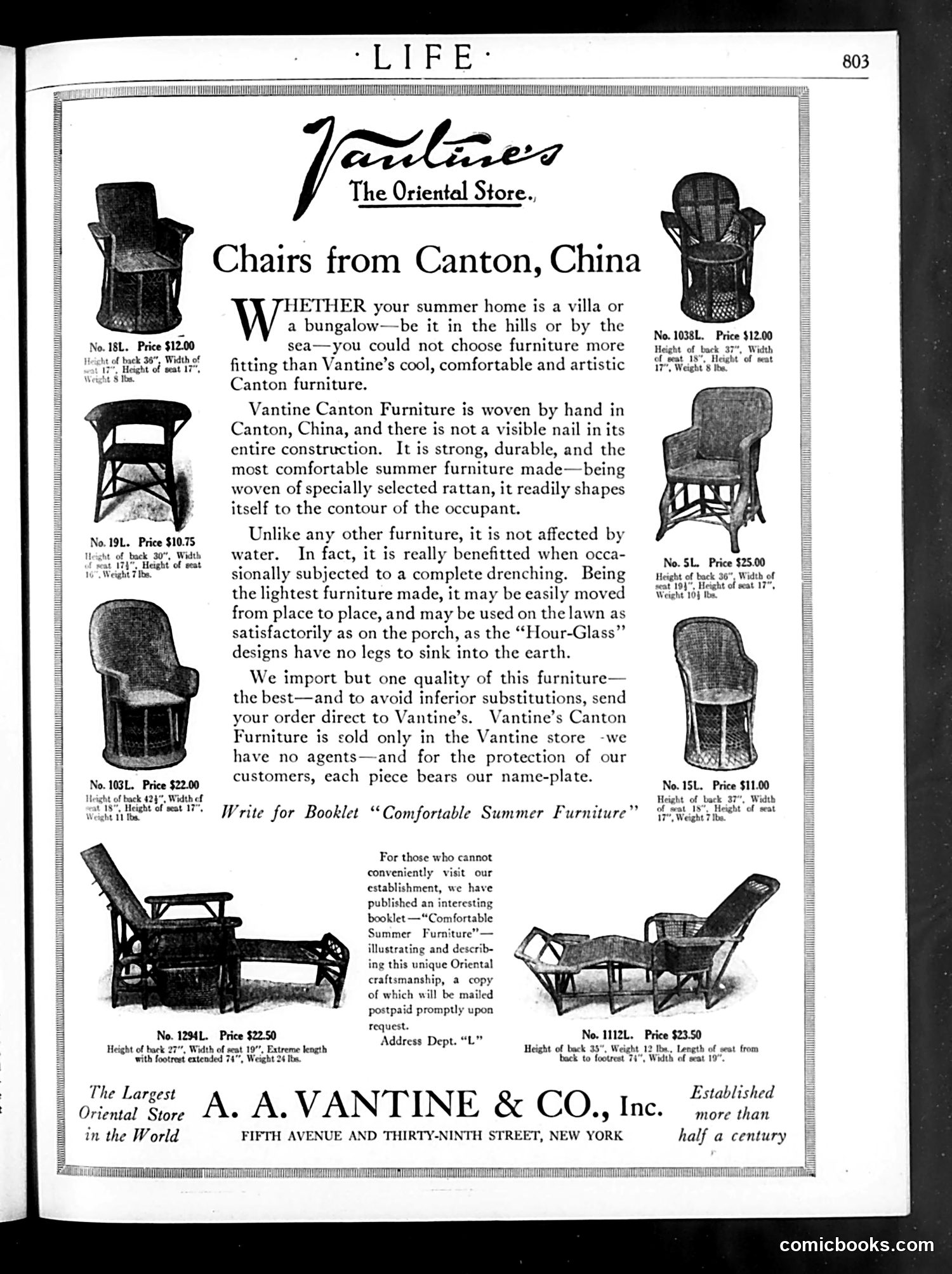
This is **not a cartoon or satirical content**—it's a straightforward advertisement for A. A. Vantine & Co., a luxury furniture retailer. The page appears in *Life* magazine (a venue that mixed advertising with humor). The ad promotes hand-woven rattan chairs imported from Canton, China, marketed as ideal "summer furniture" for wealthy homeowners with villas and bungalows. The sales pitch emphasizes exotic craftsmanship, durability, water-resistance, and lightness. Notably, the ad stresses direct ordering through Vantine's to avoid "inferior substitutions," implying concern about counterfeit Oriental furniture flooding the market. The only potentially period-specific detail is the casual exoticization of "Oriental" goods as luxury items for the American leisure class—reflecting early 20th-century tastes. The phrase "Largest Oriental Store in the World" suggests competitive branding in what was apparently a thriving import market. No satire or political content is evident.
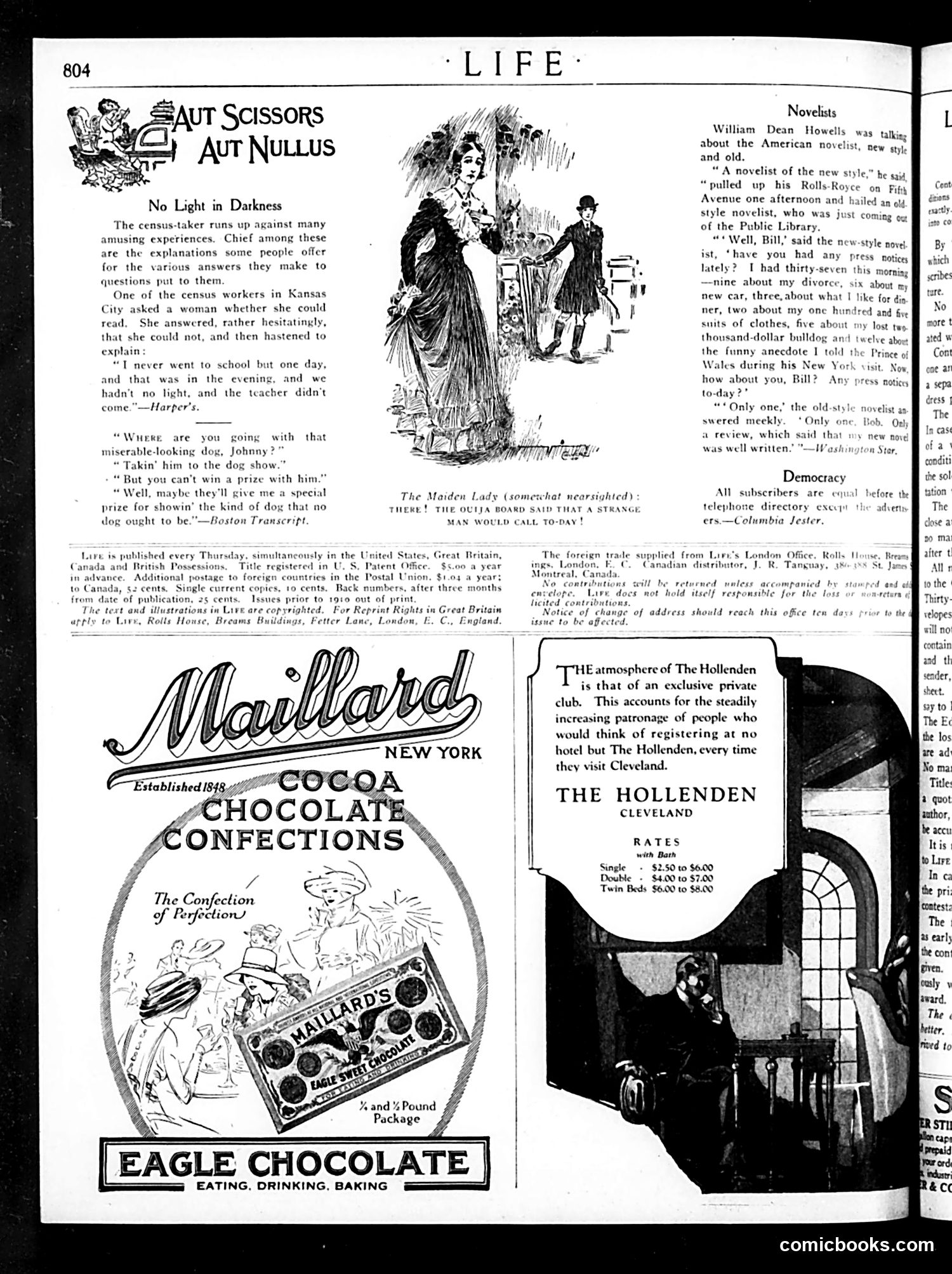
This page from *Life* magazine contains three brief satirical pieces about American society: **"No Light in Darkness"** mocks census-taking by showing a woman's absurd explanation for illiteracy—she attended school for one evening session without electricity. The joke highlights rural poverty and lack of educational access. **"Where are you going with that miserable-looking dog?"** is a humorous exchange where a boy says he's taking an ugly dog to a show, expecting to win not for appearance but for "showing the kind of dog that no dog ought to be"—gentle social satire on competitive absurdity. **The Howells exchange** satirizes the contrast between old and new literary styles: the wealthy modernist novelist boasts of frivolous experiences (divorce, cars, bulldogs), while the old-fashioned writer proudly mentions receiving one positive review. It critiques superficiality in contemporary literature. The page is otherwise dominated by period advertisements for chocolate, cocoa, and a Cleveland hotel.
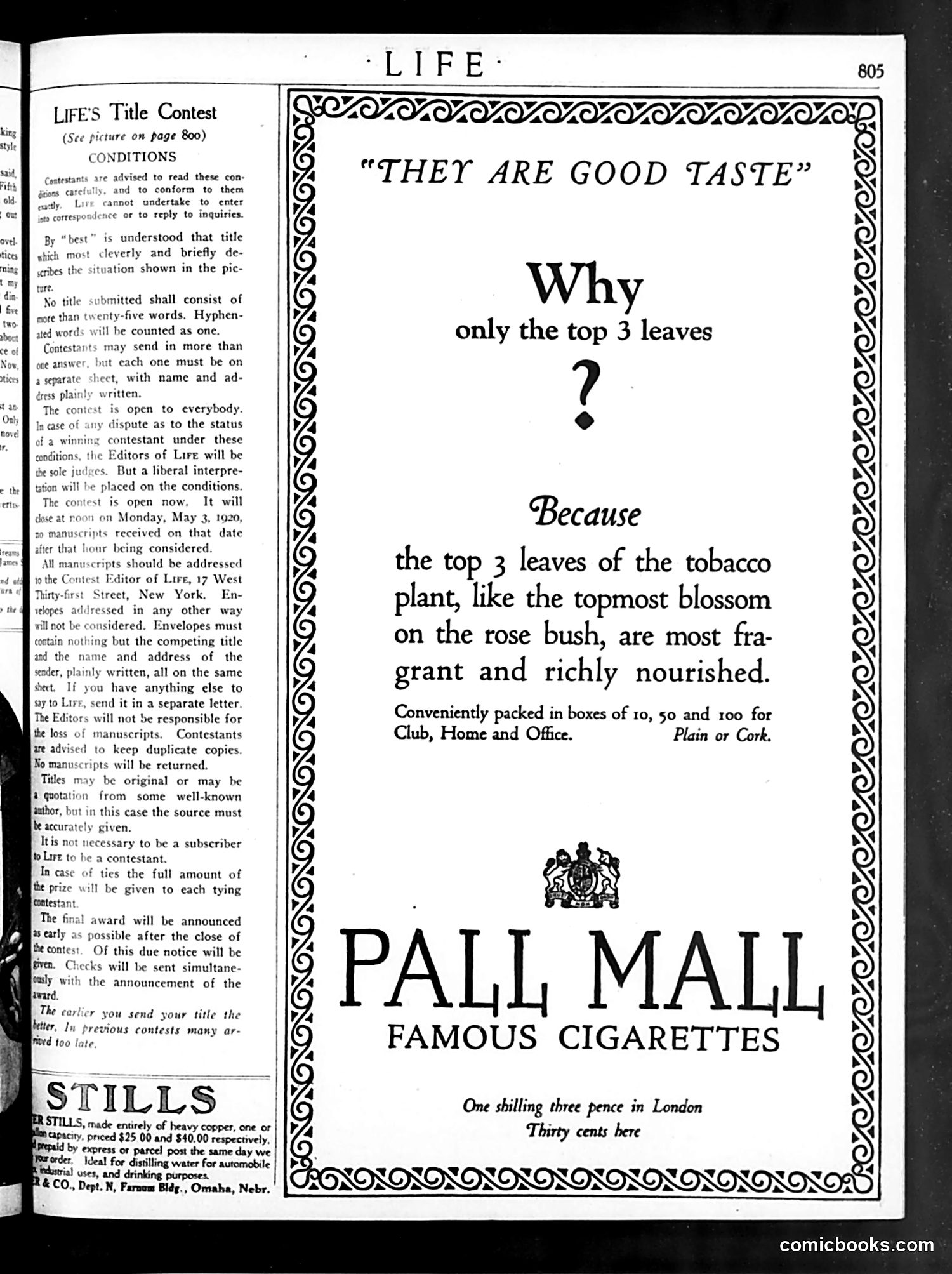
This page consists primarily of **two advertisements and contest rules**, not political satire. The left column announces **Life's Title Contest** (deadline May 3, 1920), inviting readers to submit clever captions for an illustration on page 800. The rules specify entries must be 25 words or fewer, original or quoted (with attribution), and submitted with name and address. The right side is a **Pall Mall cigarettes advertisement** featuring the tagline "They Are Good Taste." The ad uses a botanical metaphor—comparing the top three leaves of tobacco plants to the "topmost blossom on the rose bush"—to justify why only premium leaves are used. This appeals to quality-conscious consumers. A small advertisement at bottom left promotes **copper stills** for distilling water, likely alluding to Prohibition (which began in 1920), though the ad euphemistically mentions "drinking purposes." The page reflects early 1920s consumer culture and marketing strategies rather than containing political commentary or recognizable caricatures.
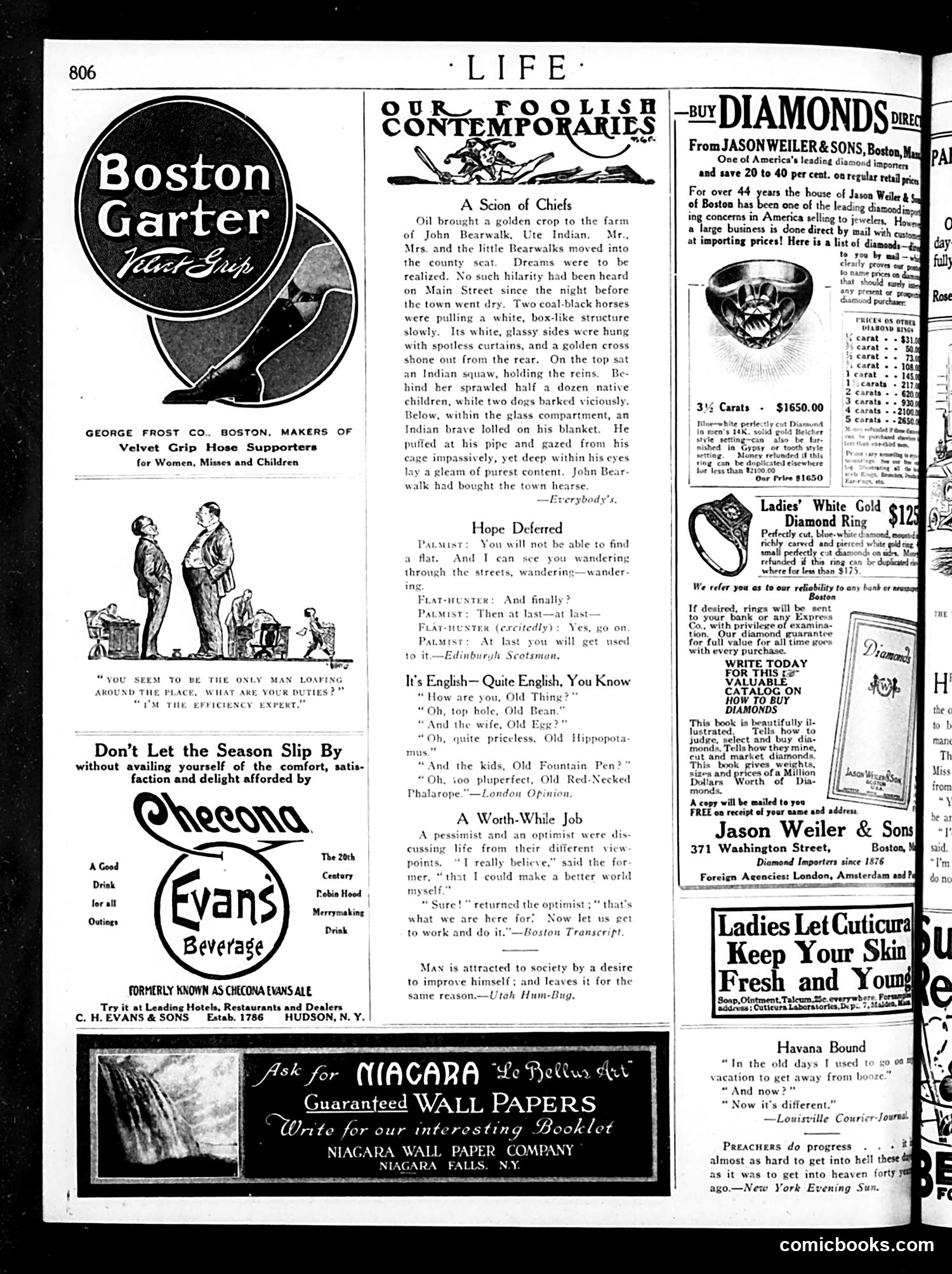
This page is **primarily advertising** with minimal editorial cartooning. The main satirical cartoon appears in the upper left: a businessman labeled "the efficiency expert" lounges idle while asking workers what their duties are—a joke about the absurdity of efficiency experts themselves being unproductive. This mocks the early-20th-century "efficiency expert" craze. The page contains several short humorous pieces: "A Scion of Chiefs" humorously describes a Ute Indian family's newfound wealth from oil, purchasing an elaborate hearse-like carriage and parading through town. Other pieces include philosophical quips and dialogue jokes typical of Life's satirical humor style. The remainder consists of advertisements: Boston Garter hose supporters, Evans beverage, Niagara wallpaper, diamond rings from Jason Weiler & Sons, and skin care products. The diamond advertisements emphasize mail-order purchasing and significant savings compared to retail prices.
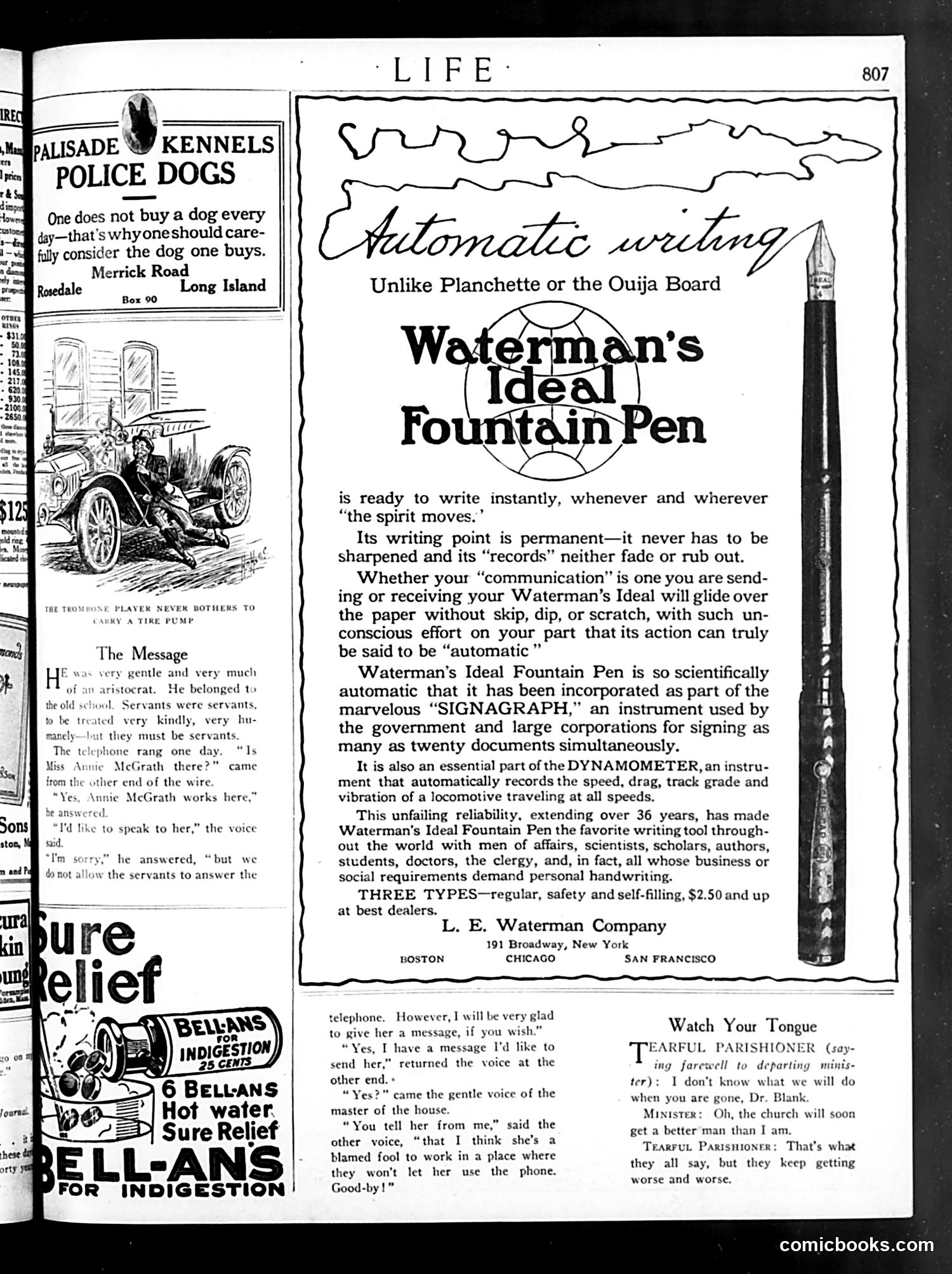
This page contains a satirical story and advertisements reflecting early-20th-century class attitudes. **"The Message" Story:** A wealthy, aristocratic man refuses to let his servant Annie McGrath answer the telephone, maintaining strict servant-master hierarchy. A caller then tells him Annie is a "blamed fool" for working somewhere that won't permit her phone use. The satire mocks the master's outdated, rigid class consciousness—his insistence on formal deference actually undermines his own dignity and exposes the absurdity of such rigid social rules. **Other Content:** - Police dog kennels advertisement (Palisade Kennels, Long Island) - Full-page Waterman's Ideal Fountain Pen advertisement emphasizing reliability and "automatic" writing - Bellans indigestion remedy ad - "Watch Your Tongue" joke about a departing minister The humor relies on contemporary readers understanding servant-employer dynamics and class distinctions that would be unfamiliar to modern audiences.
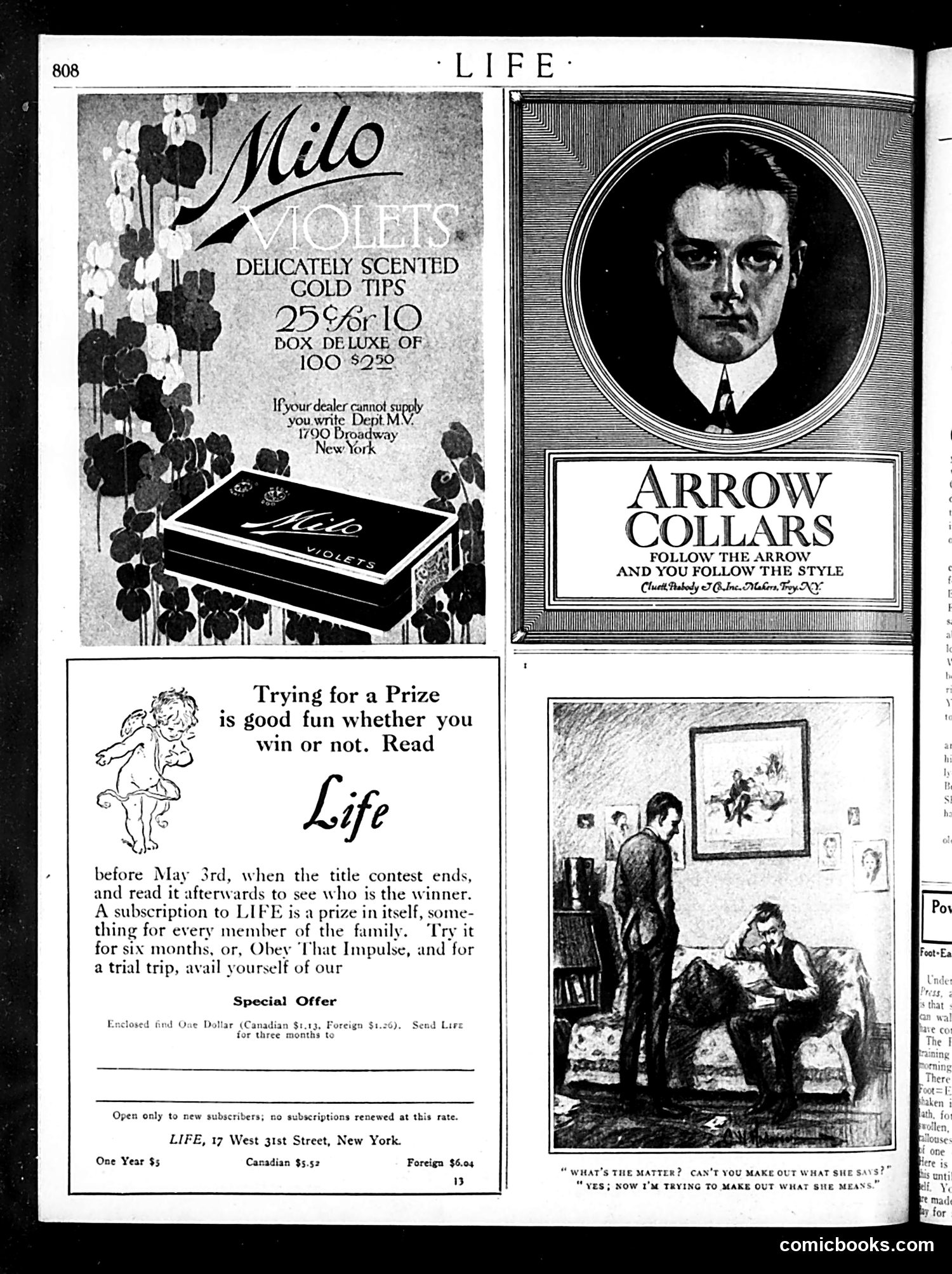
This page is primarily **advertising and subscription promotion** rather than political satire. It contains: **Milo Violets ad** (top left): Delicately scented cigarettes with gold tips, priced at 25¢ for 10. **Arrow Collars ad** (top right): Features a male portrait promoting the brand's style leadership. **Life subscription contest** (center): Invites readers to enter a title-naming contest before May 3rd, with subscription prizes. The special offer promotes a one-dollar trial subscription. **Cartoon illustration** (bottom right): Shows two men discussing a woman's unclear statement—one says he can hear her but struggles to understand her meaning. This appears to be **gentle satire about gender communication**, a common early-20th-century trope suggesting women's speech was confusing or duplicitous, rather than serious social criticism. The page reflects 1920s consumer culture and conventional gender humor of the era.
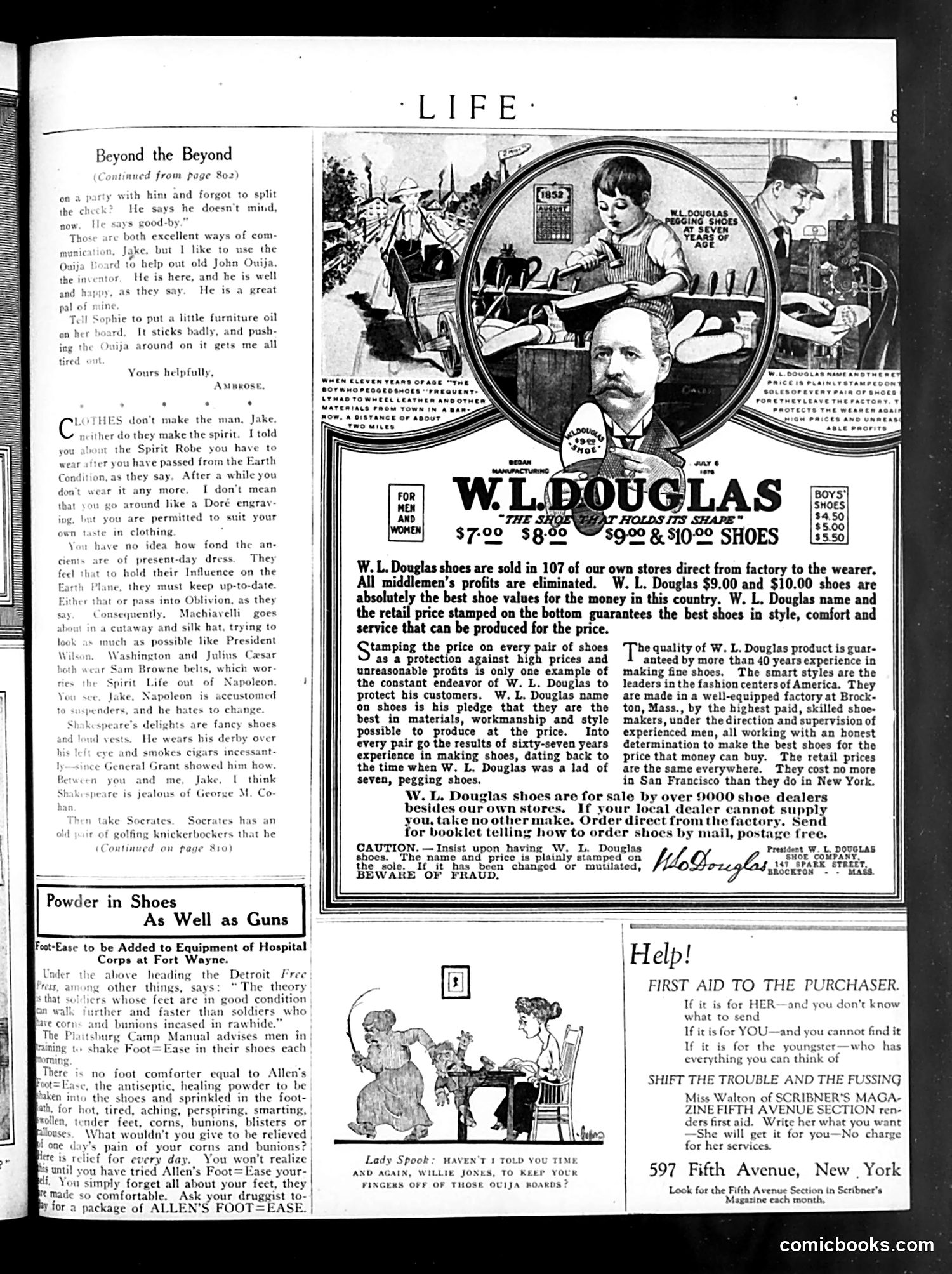
This page is primarily **advertising**, dominated by a large W. L. Douglas shoe advertisement occupying the center and lower portion. The upper left contains the conclusion of an article titled "Beyond the Beyond" (continued from page 802), which appears to be satirical commentary on afterlife beliefs. It references famous historical figures—Napoleon, Shakespeare, Machiavelli, Julius Caesar—imagined wearing different clothing styles in the afterlife, suggesting contemporary vanity concerns persist even after death. The humor derives from treating the afterlife as mundane and subject to fashion conventions. Below that is a brief article titled "Powder in Shoes as Well as Guns," discussing the U.S. Army's adoption of foot powder (Allen's Foot-Ease) for soldiers at Fort Wayne, with humorous commentary on foot comfort. The W. L. Douglas shoe ad emphasizes direct factory-to-consumer sales, eliminating middlemen and claiming superior value. A small sidebar advertisement for Scribner's Magazine appears in the lower right. The page reflects early 20th-century concerns: consumer economics, military preparedness, and satirical treatment of spiritualism.
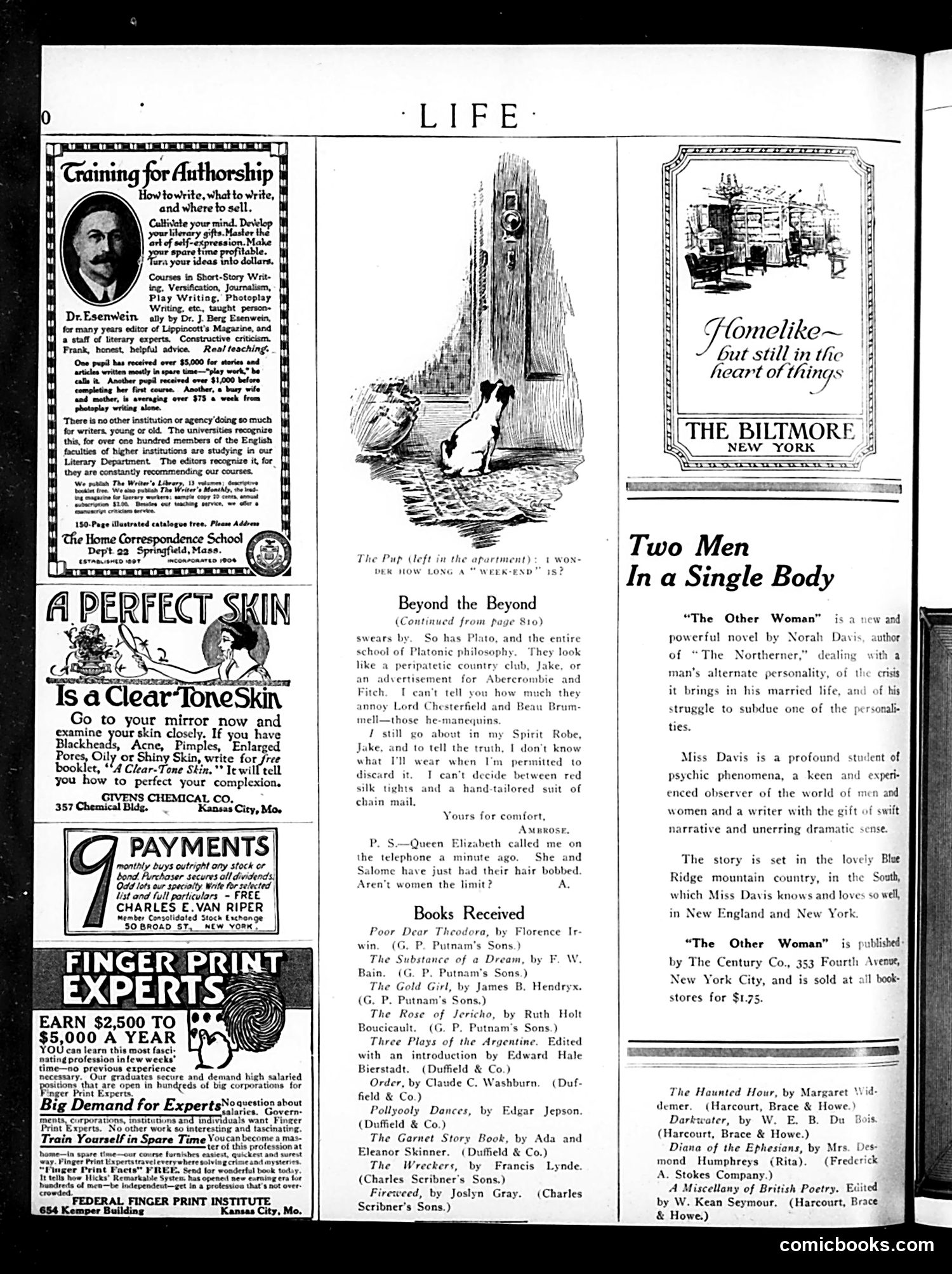
This single-panel cartoon depicts a small dog sitting in an apartment, gazing up at a tall architectural structure (appearing to be a skyscraper or building exterior). The caption reads: "The Pup (left in the apartment): I wonder how long 'a week-end' is?" **The Satire:** This is a joke about the then-modern phenomenon of weekend trips and urban leisure culture. The humor lies in the dog's perspective—the animal cannot comprehend human time concepts or the temporary nature of a "weekend." Left behind in an empty apartment, the dog experiences the separation as indefinite, unable to understand when its owner will return. **Context:** This reflects early 20th-century developments in work schedules and weekend recreation, particularly among urban middle-class workers who could afford trips away from the city. The cartoon gently mocks both human absent-mindedness (leaving the dog) and the increasingly abstract, structured nature of modern time management in industrial society.
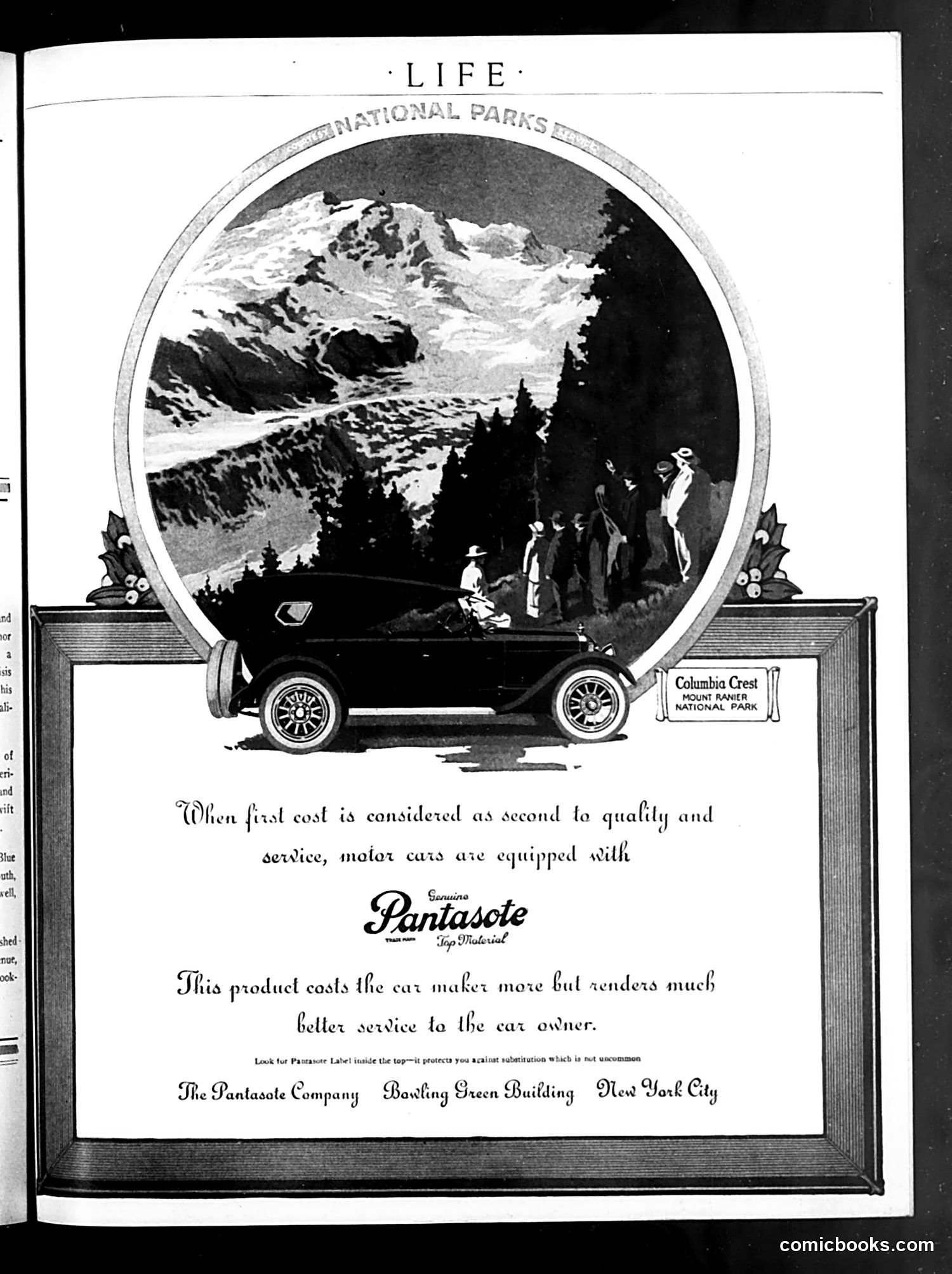
This is primarily a **product advertisement**, not political satire. It promotes Pantasote, a automotive material (likely upholstery or protective coating), positioned as a quality upgrade. The ad features a luxury car positioned before a scenic circular vignette of a National Park landscape (labeled "Columbia Crest") with tourists visible. The imagery suggests aspirational travel and leisure—appealing to car owners' desire for reliable, quality vehicles. The sales pitch claims that while Pantasote costs manufacturers more, it provides superior service to car owners, justifying the higher price. The warning about "substitution" suggests market competition and counterfeit products were concerns. The overall message targets middle-to-upper-class car buyers in the 1920s-30s era, emphasizing quality-of-life benefits alongside product durability.
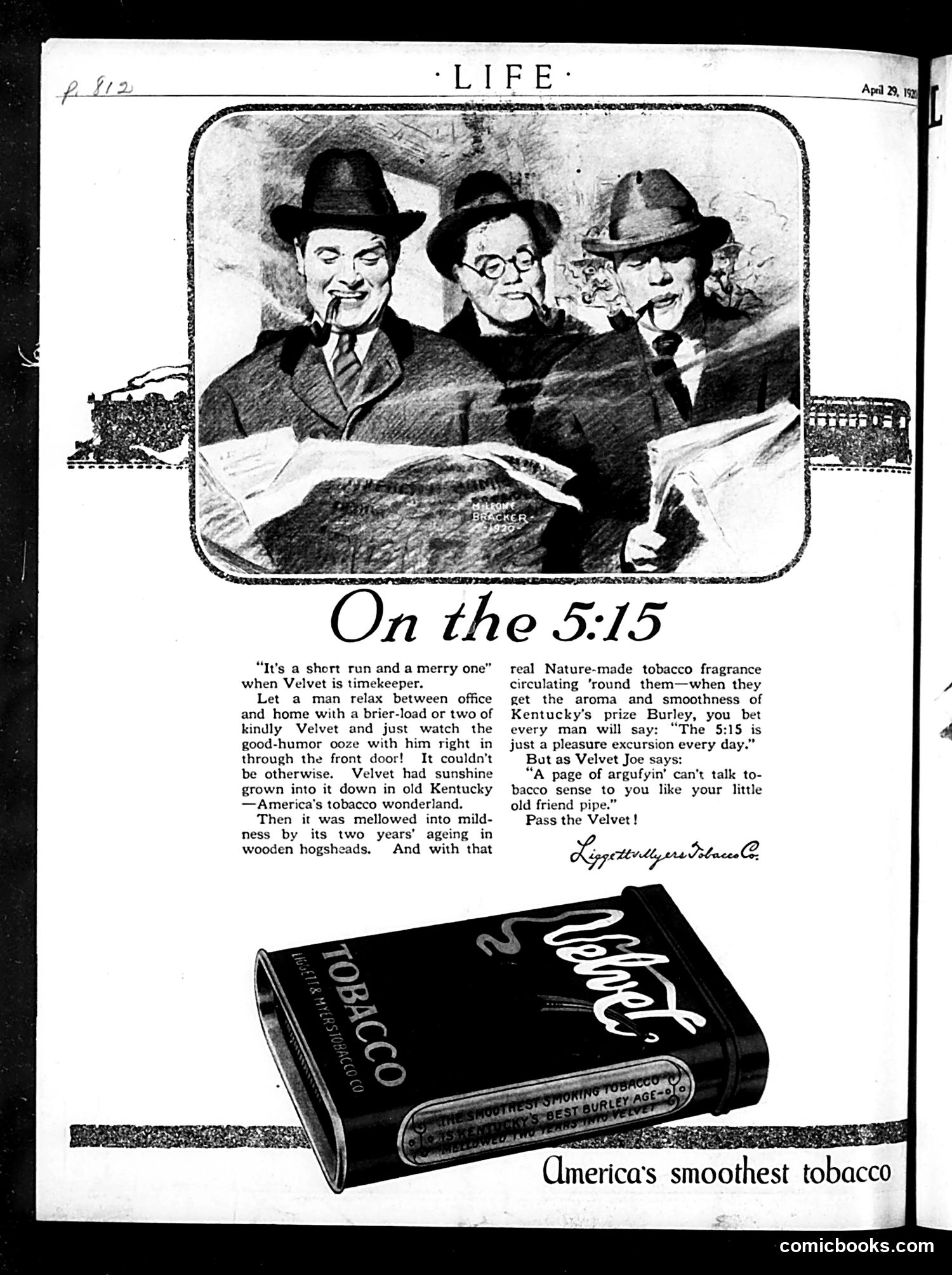
This is primarily a **tobacco advertisement**, not political satire. The page shows three men in suits and hats examining what appears to be a map or document, with the headline "On the 5:15" (referring to a commuter train). The ad promotes **Velvet brand pipe tobacco** by suggesting that smoking it transforms the evening commute home into a pleasant experience. The copy uses folksy language ("Velvet Joe," "kindly Velvet") and emphasizes the product's Kentucky origin and aging process to establish quality and refinement. The three figures appear to be generic businessmen of the 1920s era, not specific caricatures of identifiable individuals. The "joke" is simply that Velvet tobacco makes the daily grind enjoyable—a common advertising trope of the period that associates a consumer product with improved mood and social ease. The page reflects early 20th-century attitudes when tobacco advertising in mainstream magazines was routine and uncontroversial.