
Life, 1920-04-29 · page 19 of 40
Life — April 29, 1920 — page 19: what you’re looking at
What you’re looking at
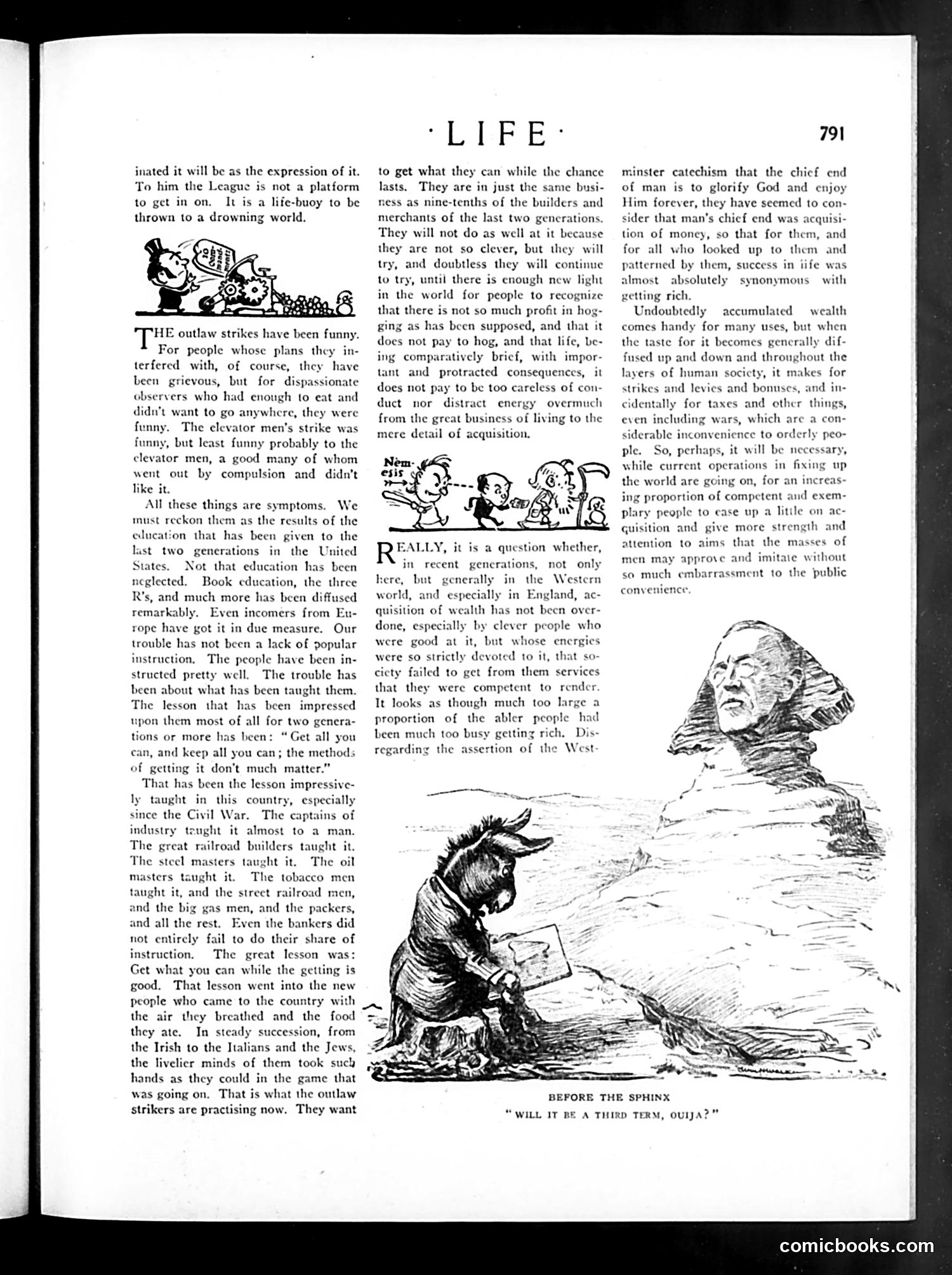
This page critiques American capitalism and the "get rich quick" ethic that dominated late 19th and early 20th-century society. **Main argument:** The author argues that wealthy industrialists—railroad barons, steel magnates, oil tycoons, bankers—taught successive waves of immigrants (Irish, Italians, Jews) that acquisition of money was life's supreme goal, without ethical restraint. Now, "outlaw strikers" are simply applying this same lesson by trying to "get what they can while the chance lasts." The irony is sharp: society taught greed, then acts shocked when workers practice it. **The cartoon** (captioned "BEFORE THE SPHINX / WILL IT BE A THIRD TERM, OU?") shows a donkey examining the Great Sphinx, likely a political reference, though the specific context is unclear from this page alone. The essay essentially argues that labor unrest is society's own creation—the inevitable result of teaching generations that ruthless self-interest is the highest virtue.
📄 Transcribed text from this page (OCR, searchable)
Machine-transcribed from the original scan — historical spelling and the odd misread are preserved.
inated it will be as the expression of it. To him the League is not a platform to get in on, It is a life-buoy to be thrown to a drowning world. THE outlaw strikes have been funny. For people whose plans they in- terfered with, of course, they have been grievous, but for dispassionate observers who had enough to eat and didn't want to go anywhere, they were funny. The elevator men’s strike was funny, but least funny probably to the clevator men, a good many of whom went out by compulsion and didn't li . All these things are symptoms. We must reckon them as the results of the education that has been given to the last two generations in the United States. Not that education has been neglected. Book education, the three R's, and much more has been diffused remarkably. Even incomers from Eu- rope have got it in due measure. Our trouble has not been a lack of popular instruction, The people have been in- structed pretty well. The trouble has been about what has been taught them. The lesson that has been impressed upon them most of all for two genera- tions or more has been: “Get all you can, and keep all you can; the methods of getting it don’t much matter.” That has been the lesson impressive- ly taught in this country, especially since the Civil War. The captains of industry teught it almost to a man. The great railroad builders taught it. The steel masters taught it. The oil masters taught it. The tobacco men taught it, and the street railroad men, and the big gas men, and the packers, and all the rest. Even the bankers did not entirely fail to do their share of instruction. The great lesson was: Get what you can while the getting is good, That lesson went into the new people who came to the country w the air they breathed and the food they ate. In steady succession, from the Irish to the Italians and the Jews, the livelier minds of them took such hands as they could in the game that was going on. That is what the outlaw strikers are practising now. They want “LIFE: to get what they can while the chance lasts. They are in just the same busi- ness as nine-tenths of the builders and merchants of the last two gencrations. They will not do as well at it because they are not so clever, but they will try, and doubtless they will continue to try, until there is enough new light in the world for people to recognize that there is not so much profit in hog- ging as has been supposed, and that it does not pay to hog, and that life, be- ing comparatively brief, with impor- tant and protracted consequences, it does not pay to be too careless of con- duct nor distract energy overmuch from the great business of living to the mere detail of acquisition. EALLY, it is a question whether, in recent generations, not only rere, but generally in the Western world, and especially in England, ac- quisition of wealth has not been over- done, especially by clever people who were good at it, but whose energies were so strictly devoted to it, that so- cicty failed to get from them services that they were competent to render. It looks as though much too large a proportion of the abler people had been much too busy getting rich. Dis- regarding the assertion of the West 791 minster catechism that the chief end of man is to glorify God and enjoy Him forever, they have seemed to con- sider that man’s chief end was acquisi- tion of money, so that for them, and for all who looked up to them and patterned by them, success in iife was absolutely getting rich, Undoubtedly accumulated comes handy for many uses, but when the taste for it becomes generally dif- fused up and down and throughout the layers of human socicty, it makes for strikes and levies and bonuses, 4 in- cidentally for taxes and other things, even including wars, which are a con- almost synonymous with wealth siderable inconvenience to orderly peo- ple. So, perhaps, it will be necessa while current operations in fixing up the world are going on, for an increas- ing proportion of competent and exem- plary people to case up a litile on ac- quisition and give more strength and attention to aims that the masses of men may approve and imitate without so much embarrassment to the public convenience: BEFORE THE SPHINX “WILL IT BE A THIRD TERM, OUIJA?"” comicbooks.com