
Life, 1920-04-29 · page 18 of 40
Life — April 29, 1920 — page 18: what you’re looking at
What you’re looking at
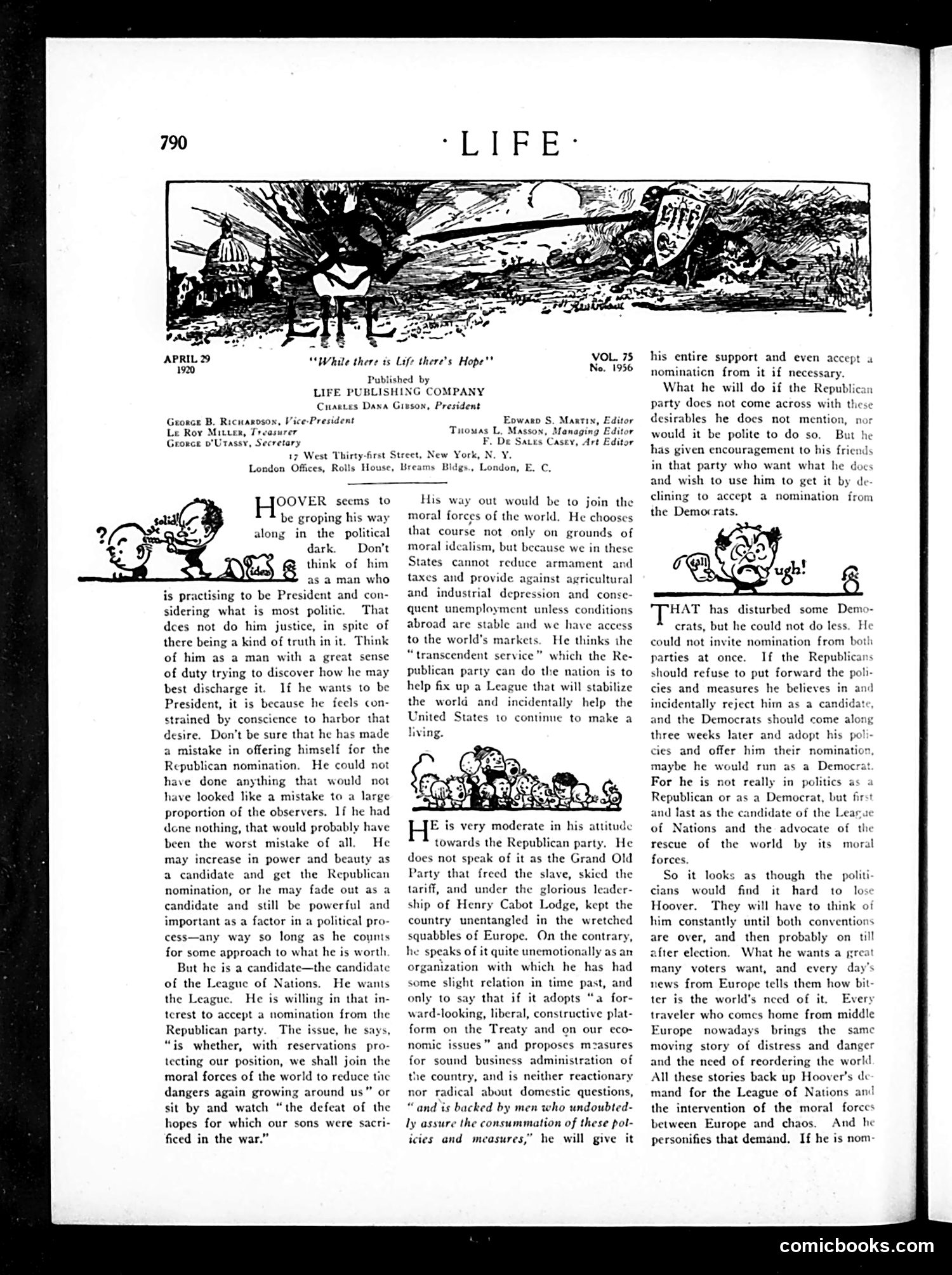
This page discusses Herbert Hoover's potential 1920 presidential candidacy. The text presents Hoover as a principled figure motivated by conscience rather than political calculation, positioning him as a candidate of the League of Nations. The cartoons appear to mock Hoover's political positioning. Small caricatures show him "groping" in political darkness—a visual metaphor for his uncertain path. The satire suggests Hoover is awkwardly navigating Republican politics while promoting League membership, an unpopular position among many Republicans at the time. The text humorously outlines Hoover's conditional support for the Republican party, noting his moderate criticisms and his demands for a "forward-looking" platform. The satire lies in portraying his pragmatic self-interest (stabilizing world markets for American commerce) as moral idealism—suggesting his humanitarian League advocacy conveniently aligns with business interests. The overall tone is gently mocking: Hoover appears well-intentioned but politically awkward.
📄 Transcribed text from this page (OCR, searchable)
Machine-transcribed from the original scan — historical spelling and the odd misread are preserved.
APRIL 29 1920 “While there ts Life there's Hope"* Published by LIFE PUBLISHING COMPANY Cuartes Dana Ginson, President x, Vice-President asurer etary 17 West Th Grorce B. Ricwaroso tier, 7 Grorce v'Utassy, ty-first § London Offices, Rolls House, OOVER seems to be groping his way along in the political dark. Don't think of him as a man who is practising to be President and con- sidering what is most politic. That dces not do him justice, in spite of there being a kind of truth in it. Think of him as a man with a great sense of duty trying to discover how he may best discharge it. If he wants to be President, it is because he feels con- strained by conscience to harbor that desire. Don’t be sure that he has made a mistake in offering himself for the Republican nomination. He could not have done anything that would not have looked like a mistake to a large proportion of the observers. 1f he had dene nothing, that would probably have been the worst mistake of all, He may increase in power and beauty as a candidate and get the Republican nomination, or he may fade out as a candidate and still be powerful and important as a factor in a political pro- cess—any way so long as he counts for some approach to what he is worth But he is a candidate—the candidate of the League of Nations. He wants the League. He is willing in that in- terest to accept a nomination from the Republican party. The issue, he “is whether, with reservations pro- tecting our position, we shall join the moral forces of the world to reduce tire dangers again growing around us" or sit by and watch “the defeat of the hopes for which our sons were sacri- ficed in the war.” ays, Eowaro S, Martix, Editor Tuomas L. Masson, Managing Editor F. De Satus Casey, Art Editor reet, New York, N.Y, Breams Bldgs., London, E. C, His way out would be to join the moral forces of the world, He chooses that course not only on grounds of moral idealism, but be States cannot reduce armament and taxes and provide against agricultural and industrial depression and conse- quent unemployment unless conditions abroad are stable and we have access to the world’s markets. He thinks the “transcendent service” which the Re- publican party can do the nation is to help fix up a League that will stabilize the world and incidentally help the United States to continue to make a living. ause we in these is very moderate in his attitude towards the Republican party. He does not speak of it as the Grand Old Party that freed the slave, skied the tariff, and under the glorious leader- ship of Henry Cabot Lodge, kept the country unentangled in the wretched squabbles of Europe. On the contrary, he speaks of it quite unemotionally as an organization with which he has had some slight relation in time past, and only to say that if it adopts “a for- ward-looking, liberal, constructive plat- form on the Treaty and on our eco- nomic issues” and proposes mzasures for sound business administration of the country, and is neither reactionary nor radical about domestic questions, “and is backed by men who undoubted- ly assure the consummation of these pol- icies and measures,” he will give it his entire support and even accept a nominaticn from it if necessary. What he will do if the Repub party does not come across with these desirables he does not mention, nor would it be polite to do so. But he has given encouragement to his friend in that party who want what he does and wish to use him to get it by de- clining to accept a nomination from the Democrats. HAT has disturbed some Demo- crats, but he could not do less. He could not invite nomination from both parties at once. If the Republicans should refuse to put forward the poli- cies and measures he believes in and incidentally reject him as a candidate and the Democrats should come al three weeks later and adopt his poli- cies and offer him their nomination. maybe he would run as a Democr For he is not really in politics as Republican or as a Democrat, but first and last as the candidate of the Lear, of Nations and the advocate of rescue of the world by its fore the moral So it looks as though the politi cians would find it hard to Ic Hoover. They will have to think of him constantly until both conventions are over, and then probably on till after election. What he wants a great many voters want, and every day news from Europe tells them how bit- ter is the world’s need of it. Every traveler who comes home from middle rope brings the same moving story of distress and danger and the need of reordering the world All these stories back up Hoover's de mand for the League of Nations and the intervention of the moral forces between Europe and chaos. And he personifies that demand. If he is nom nowadays comicbooks.com