
Life, 1920-04-29 · page 24 of 40
Life — April 29, 1920 — page 24: what you’re looking at
What you’re looking at
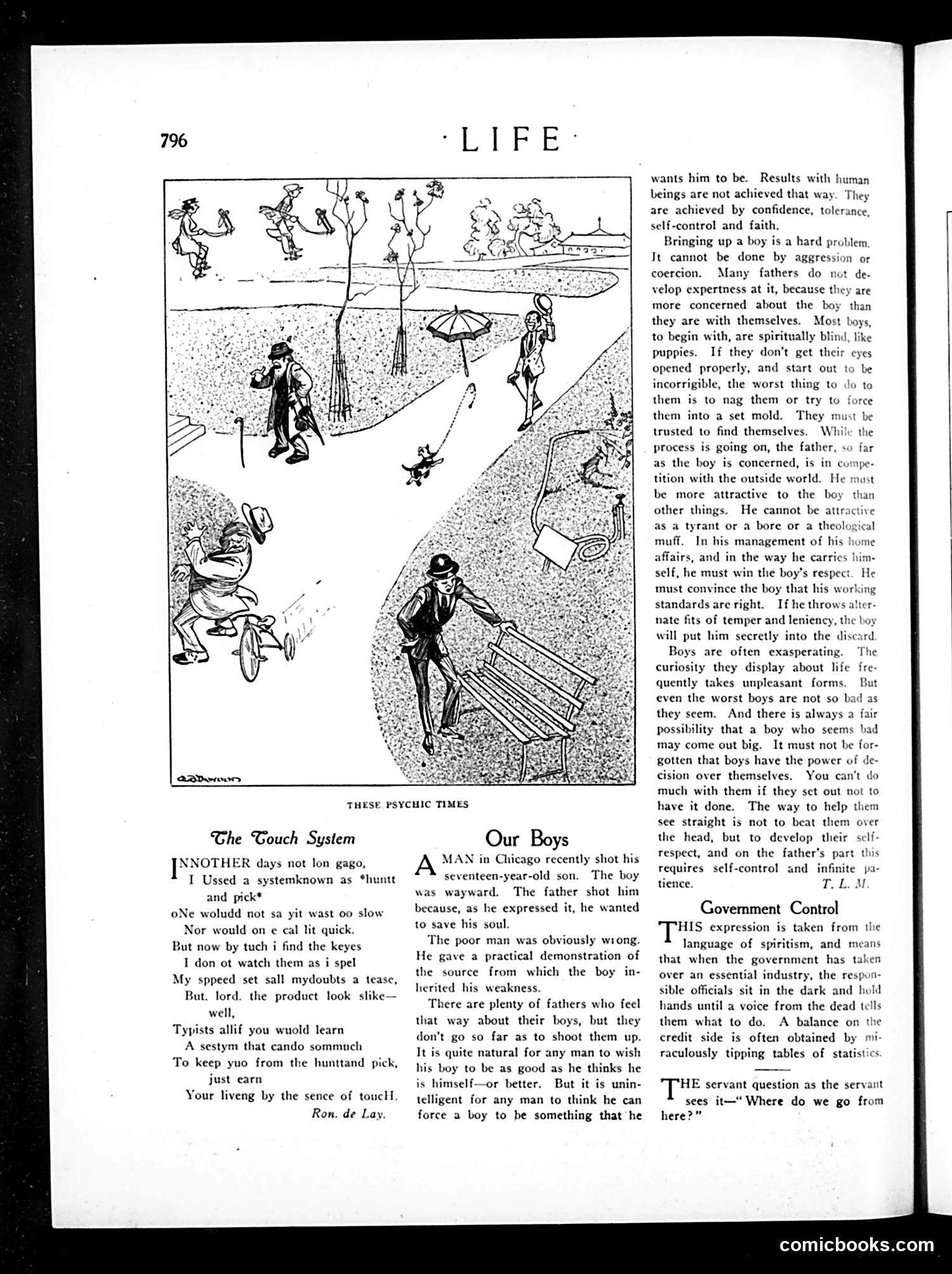
This Life magazine page contains three distinct pieces: **"The Couch System"** (left) is a humorous poem mocking touch-typing instruction, filled with intentional typos to satirize the irony of learning efficient typing while producing garbled output. **"Our Boys"** (center/right) is a serious essay responding to a recent Chicago news story in which a father shot his seventeen-year-old son, claiming he wanted to "save his soul." The author argues this demonstrates the father's own weakness and advocates for raising boys through confidence, tolerance, and respect rather than force or coercion—a progressive parenting philosophy for the era. The essay emphasizes that boys must develop self-respect and trust themselves. **"Government Control"** (bottom right) sarcastically critiques government management of essential industries, suggesting officials operate blindly ("sit in the dark") and manipulate statistics to create favorable impressions rather than solving real problems. The page juxtaposes light humor with substantive social commentary on parenting and governance.
📄 Transcribed text from this page (OCR, searchable)
Machine-transcribed from the original scan — historical spelling and the odd misread are preserved.
THESE PSYCHIC TIMES The Couch System NNOTHER days not lon gago, I Ussed a systemknown as *huntt and pick* oNe woludd not sa yit wast oo slow Nor would on e cal lit quick But now by tuch i find the keyes I don ot watch them as i spel My sppeed set sall mydoubts a tease, But. lord. the product look slike— well, Typists allif you wuold learn A sestym that cando sommuch To keep yuo from the hunttand pick, just earn Your liveng by the sence of toucH. Ron. de Lay. Our Boys MAN in Chicago recently shot his seventeen-year-old son. The boy was wayward. The father shot him because, as he expressed it, he wanted to save his soul. The poor man was obviously wiong. He gave a practical demonstration of the source from which the boy in- herited his weakness. There are plenty of fathers who feel that way about their boys, but they don’t go so far as to shoot them up. It is quite natural for any man to wish his boy to be as good as he thinks he is himself—or better. But it is unin- telligent for any man to think he can force a boy to be something that he wants him to be. Results with human beings are not achieved that way. They are achieved by confidence, tolerance, self-control and faith. Bringing up a boy is a hard problem. Jt cannot be done by aggression or coercion. Many fathers do not de- velop expertness at it, because th more concerned about the boy than they are with themselves. Most boys, to begin with, are spiritually blind, like puppies. If they don't get their eyes opened properly, and start out to be incorrigible, the worst thing to do to them is to nag them or try to force them into a set mold. They must be trusted to find themselves. While the process is going on, the father, so far as the boy is concerned, is in compe- tition with the outside world. He must be more attractive to the boy other things. He cannot be attra as a tyrant or a bore or a theolo; muff. In his management of his | affairs, and in the way he carries self, he must win the boy's respect. He must convince the boy that his working standards are right. If he throws alter- nate fits of temper and leniency, the boy will put him secretly into the discard Boys are often exasperating. The curiosity they display about life fre- quently takes unpleasant forms. But even the worst boys are not so bad as they seem. And there is always a fair possibility that a boy who seems bad may come out big. It must not be for- gotten that boys have the power of de- cision over themselves. You can't do much with them if they set out not to have it done. The way to help them see straight is not to beat them over the head, but to develop their self- respect, and on the father’s part thi requires self-control and infinite tience. T..L. aL Government Control HIS expression i language of spir that when the government has taken over an essential industry, the resp sible officials sit in the dark and hol hands until a voice from the dead tells them what to do. A balance on the credit side is often obtained by mi- raculously tipping tables of statistics. taken from the m, and means HE servant question as the servant sees it—“ Where do we go from here?” comicbooks.com