
Life, 1920-04-29 · page 27 of 40
Life — April 29, 1920 — page 27: what you’re looking at
What you’re looking at
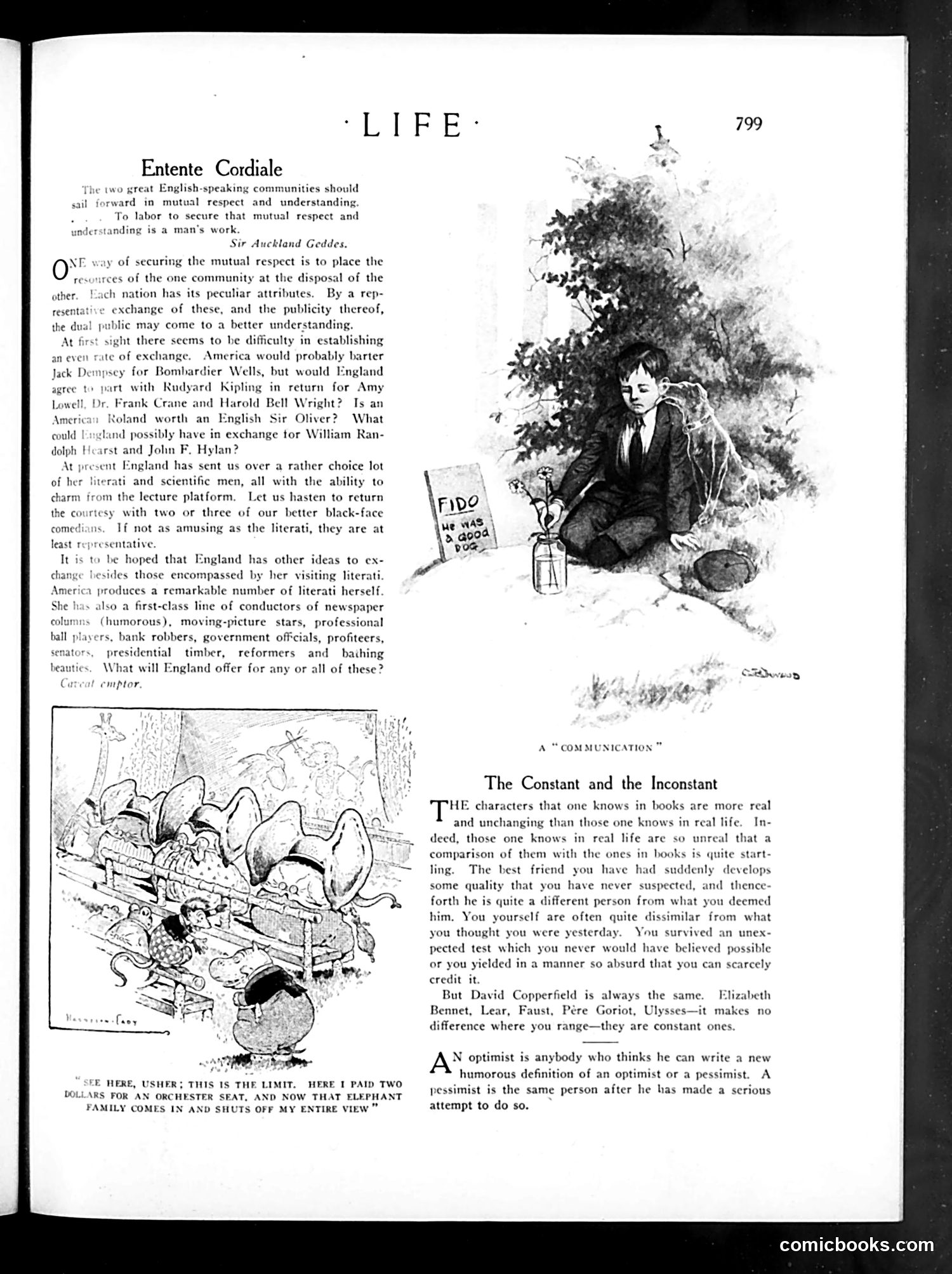
This page satirizes proposed cultural exchanges between America and Britain. The upper article, attributed to Sir Auckland Geddes (a British diplomat), suggests mutual respect requires exchanging each nation's notable figures and resources. The satire mocks this idea by proposing absurd trades: America would "barter" boxer Jack Dempsey for British boxer Bombardier Wells, but would England really give up Rudyard Kipling for American writers Frank Crane and Harold Bell Wright? The piece ridicules American celebrities by listing them alongside "bank robbers" and "bathing beauties," implying America has little of cultural value to offer. The lower cartoon shows an angry theater patron complaining to an usher about an elephant family blocking his view—a literal visual pun on the exchange concept's impracticality. The pages' tone suggests Americans felt defensive about their cultural standing relative to Britain during this period of Anglo-American relations.
📄 Transcribed text from this page (OCR, searchable)
Machine-transcribed from the original scan — historical spelling and the odd misread are preserved.
‘LIBRE: Entente Cordiale he two great English-speaking communities should sail forward in mutual respect and understanding. To labor to secure that mutual respect and rstanding is a man's work. Sir Auckland Geddes. ay of securing the mutual respect is to place the oO . resources of the one community at the disposal of the Each nation has its peculiar attributes. By a rep- exchange of these, and the publicity thereof, plic may come to a better understanding. zht there seems to be difficulty in establishing America would probably barter other. resent the dual At first an event Jack Dempsey for Bombardier Wells, but would England agree ty part with Rudyard Kipling in return for Amy Frank Crane and Harold Bell Wright? Is an Roland worth an English Sir Oliver? What could |-ngland possibly have in exchange tor William Ran- dolph Hearst and John F, Hylan? \t present England has sent us over a rather choice lot of her literati and scientific men, all with the ability to Let us hasten to return of our better black-face ite of exchange. Lowell, Dr Americ charm from the lecture platform. with two or three If not as amusing as the literati, they are at the courtesy comedi least rey It is to be hoped that England has other ideas to eo change besides those encompassed by her visiting literati America produces a remarkable number of literati herself. She has also a first-class line of conductors of newspaper columns sentative, (humorous), moving-picture stars, professional ball players, bank robbers, government offcials, profiteers, timber, reformers and bathing What will England offer for any or all of these? Caveat emptor. presidential beauties HERE I PAID TWO ANT FE HERE, USHER; THIS IS THE LIMIT. DOLLARS FOR AN ORCHESTER SEAT, AND NOW THAT ELE FAMILY COMES IN AND SHUTS OFF MY ENTIRE VIEW A “COMMUNICATION ” The Constant and the Inconstant HE characters that one knows in books are more real and unchanging than those one knows in real life. In- deed, those one knows in real life are so unreal that a comparison of them with the ones in books is quite start- ling. The best friend you have had suddenly develops some quality that you have never suspected, and thence- forth he is quite a different person from what you deemed him. You yourself are often quite dissimilar from what you thought you were yesterday. You survived an unex- pected test which you never would have believed possible or you yielded in a manner so absurd that you can scarcely credit But David Copperfield is always the same. Elizabeth Bennet, Lear, Faust, Pére Goriot, Ulysses—it makes no difference where you range—they are constant ones, A optimist is anybody who thinks he can write a new humorous definition of an optimist or a pessimist. A pessimist is the same person after he has made a scrious attempt to do so. comicbooks.com