
Life, 1920-04-29 · page 14 of 40
Life — April 29, 1920 — page 14: what you’re looking at
What you’re looking at
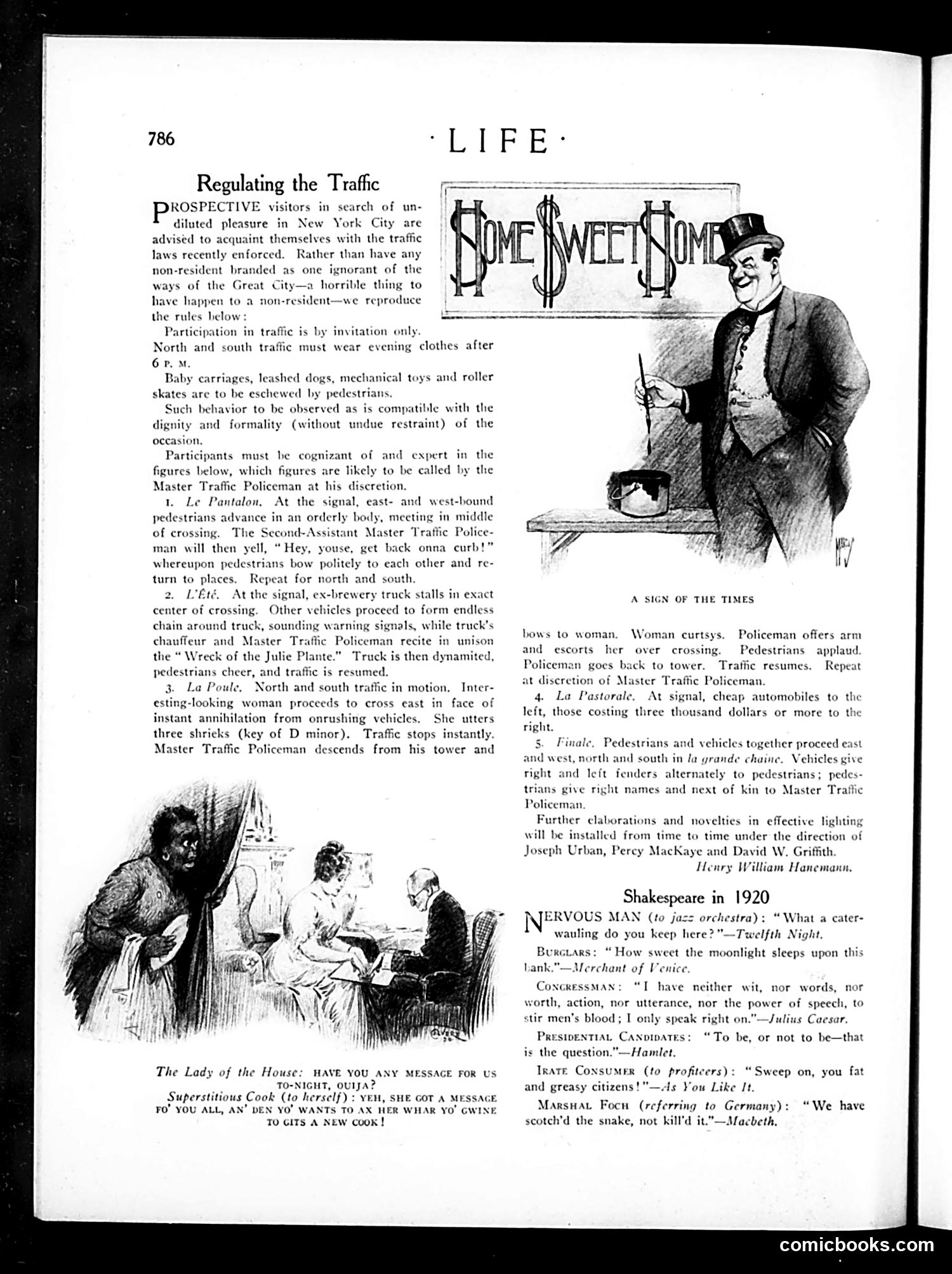
This piece mocks proposed "traffic regulations" for New York City presented as humorous mock-rules. The illustration shows a portly "Master Traffic Policeman" directing pedestrians and vehicles in absurdly elaborate choreography—described as "Le Pantalon," "L'Été," and "La Finale"—with pedestrians performing synchronized movements like a formal dance. The satire targets the chaos of NYC traffic in the early 1920s and the impractical solutions being proposed. The elaborate, ballet-like descriptions mock the attempt to impose rigid order on the city's notoriously chaotic streets. The drawing emphasizes the policeman's authority and pomposity, suggesting that such control was both impossible and ridiculous given New York's actual traffic conditions.
📄 Transcribed text from this page (OCR, searchable)
Machine-transcribed from the original scan — historical spelling and the odd misread are preserved.
786 Regulating the Traffic ROSPECTIVE visitors in search of un- diluted pleasure in New York City are advised to acquaint themselves with the traffic laws recently enforced. Rather than have any non-resident branded as one ignorant of the ways of the at City—a horrible thing to have happen to a non-resident—we reproduce the rules below: Participation in traffic is by invitation only. North and south traffic must wear evening clothes after Op. ™M. Baby carriages, leashed dogs, mechanical toys and roller skates are to be eschewed by pedestrians, Such behavior to be observed as is compatible with the dignity and formality (without undue restraint) of the occasion. Participants must be cognizant of and expert in the figures below, which figures are likely to be called by the Master Traffic Policeman at his discretion, 1. Le Pantalon, At the signal, east- and west-bound pedestrians advance in an orderly body, meeting in middle of crossing. The Second-Assistant Master Tratiic Police- man will then yell, “Hey, youse, get back onna curb!” whereupon pedestrians bow politely to each other and re- turn to places. Repeat for north and south. té. At the signal, ex-brewery truck stalls in exact center of crossing. Other vehicles proceed to form endless chain around truck, sounding warning signals, while truck's chauffeur and Master Traffic Policeman recite in unison the “ Wreck of the Julie Plante.” Truck is then dynamited, pedestrians cheer, and traffic is resumed. 3. La Poule, North and south traffic in motion, Inter- esting-looking woman proceeds to cross east in face of instant annihilation from onrushing vehicles. he utters three shrieks (key of D minor). Traffic stops instantly. Master Traffic Policeman descends from his tower and The Lady of the House: HAVE YOU ANY MESSAGE FOR US TO-) T, OUIJA? Superstitious Cook (to herself): yeu A MESSAGE FO’ YOU ALL, AN’ DEN YO’ WANTS TO AX HER WHAR YO" GWINE TO GITS A NEW Cook! A SIGN OF THE TIMES hows to woman. Woman curtsys. Policeman offers arm and escorts her over crossing. Pedestrians applaud. Policeman goes back to tower. Traffic resumes. Repeat discretion of Master Traffic Policeman. 4. La Pastorale, At signal, cheap automobiles to the left, those costing three thousand dollars or more to the right. 3. Finale, Pedestrians and vehicles together proceed east and west, north and south in la grande chaine. Vehicles give right and left fenders alternately to pedestrians; pedes- trians give right names and next of kin to Master Traffic Policeman Further claborations and novelties in effective lighting will be installed from time to time under the direction of Joseph Urban, Percy MacKaye and David W. Gri Henry William Hanemann, Shakespeare in 1920 orchestra): “What a cater- wauling do you keep here? "—Twelfth Night. Burctars: “How sweet the moonlight sleeps upon thi hank."—Merchant of Venice. ConcressMAN: “T have neither wit, nor words, nor worth, action, nor utterance, nor the power of speech, to stir men's blood; I only speak right on.”"—Julius Caesar. PresipentIaL CANDIDATES: is the question.”—Hamlet. Irate Consumer (to profiteers): “Sweep on, you fat and greasy citizens!"—als You Like /t. MarsHat Focu (referring to Germany): scotch'd the snake, not kill’d it."—Macbeth. “To be, or not to be—that “We have comicbooks.com