
A complete issue · 48 pages · 1920
Life — February 19, 1920
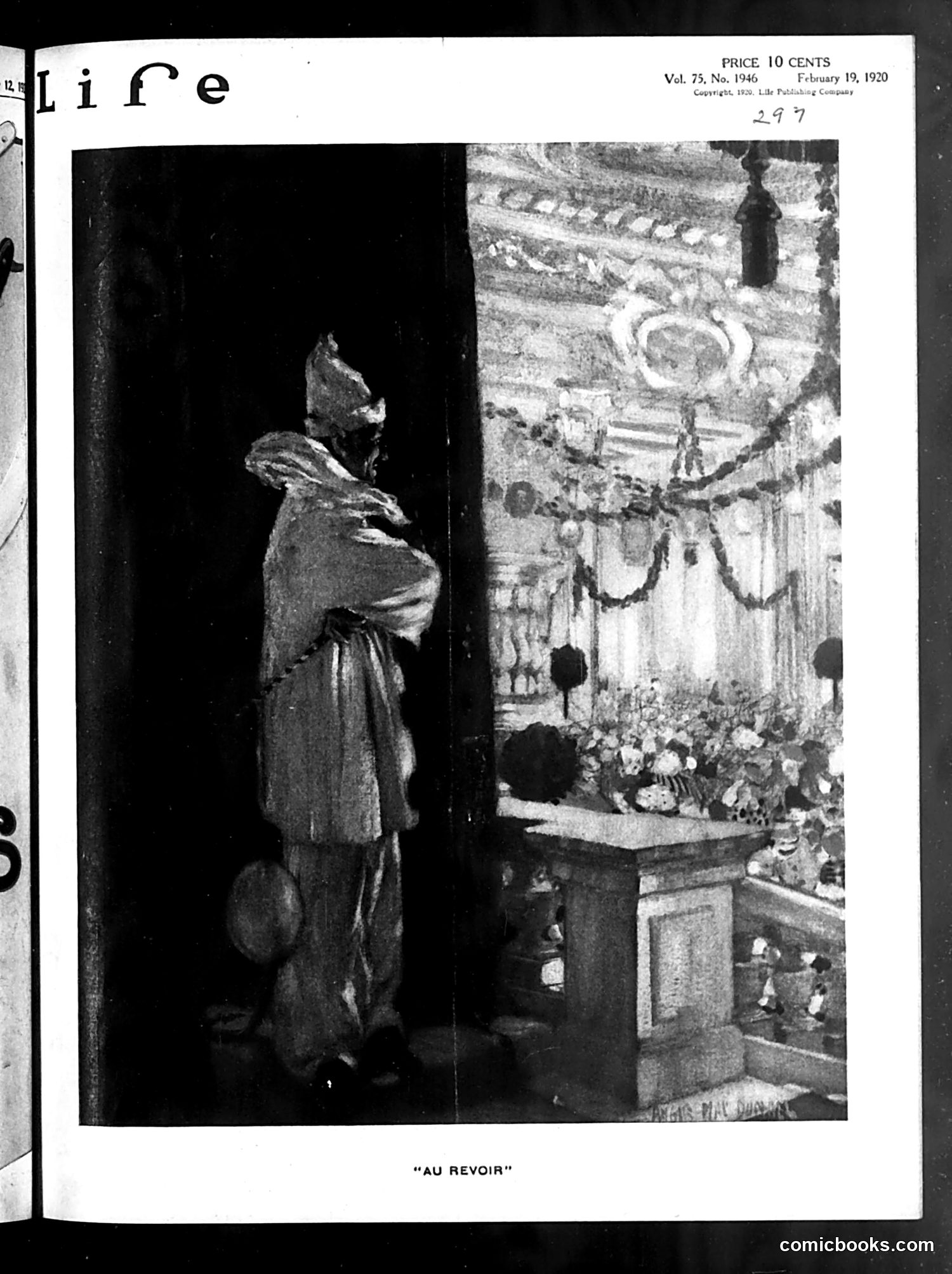
This page shows a two-part illustration titled "Au Revoir" (French for "goodbye"). The left image depicts a solitary figure in a long coat and hat, shown in profile against darkness, appearing to depart. The right image shows an ornate interior space—possibly a ballroom or formal venue—decorated with elaborate garlands, wreaths, and floral arrangements, with figures gathered inside. The satire likely comments on post-WWI social transitions, with the solitary departing figure contrasting sharply with continued festive civilian life. Given the February 1920 date (shortly after WWI's November 1918 armistice), this may reference soldiers returning home or the shift from wartime to peacetime society. The French title emphasizes the European context, suggesting commentary on America's relationship to post-war Europe.
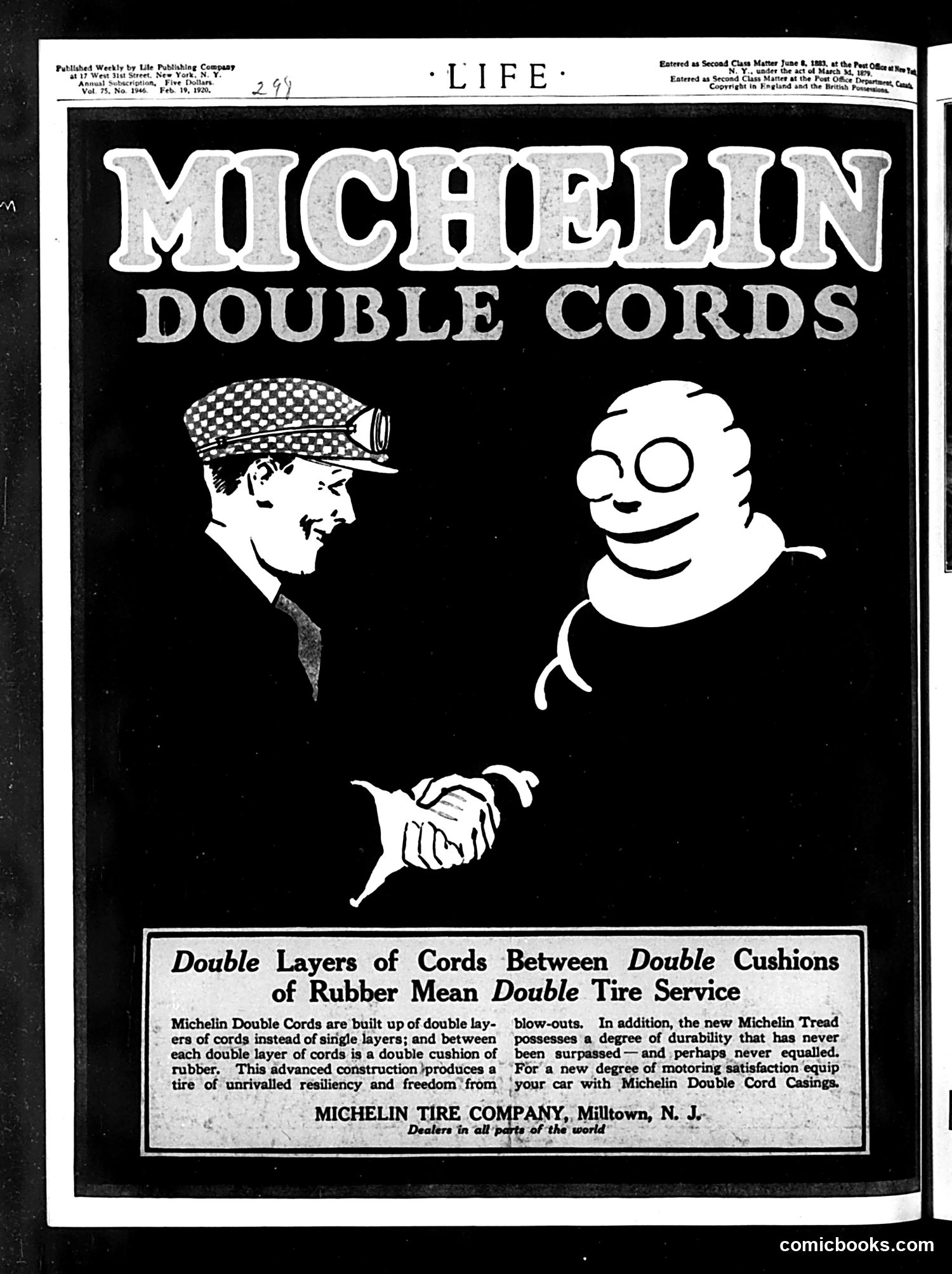
This is a **Michelin tire company advertisement**, not political satire. The page appears from *Life* magazine (dated Feb. 19, 1920, based on the header). The cartoon shows two figures shaking hands: a man in a checkered cap (likely representing a motorist or driver) greeting a cheerful, anthropomorphic tire character. This personification was common in early automotive advertising. The ad promotes Michelin's "Double Cords" tire technology—featuring double layers of cords between rubber cushions for improved durability and puncture resistance. The handshake symbolizes the beneficial relationship between driver and product. The tone is lighthearted and friendly, typical of 1920s consumer advertising using cartoon mascots to make technical products seem approachable and trustworthy to average car owners.
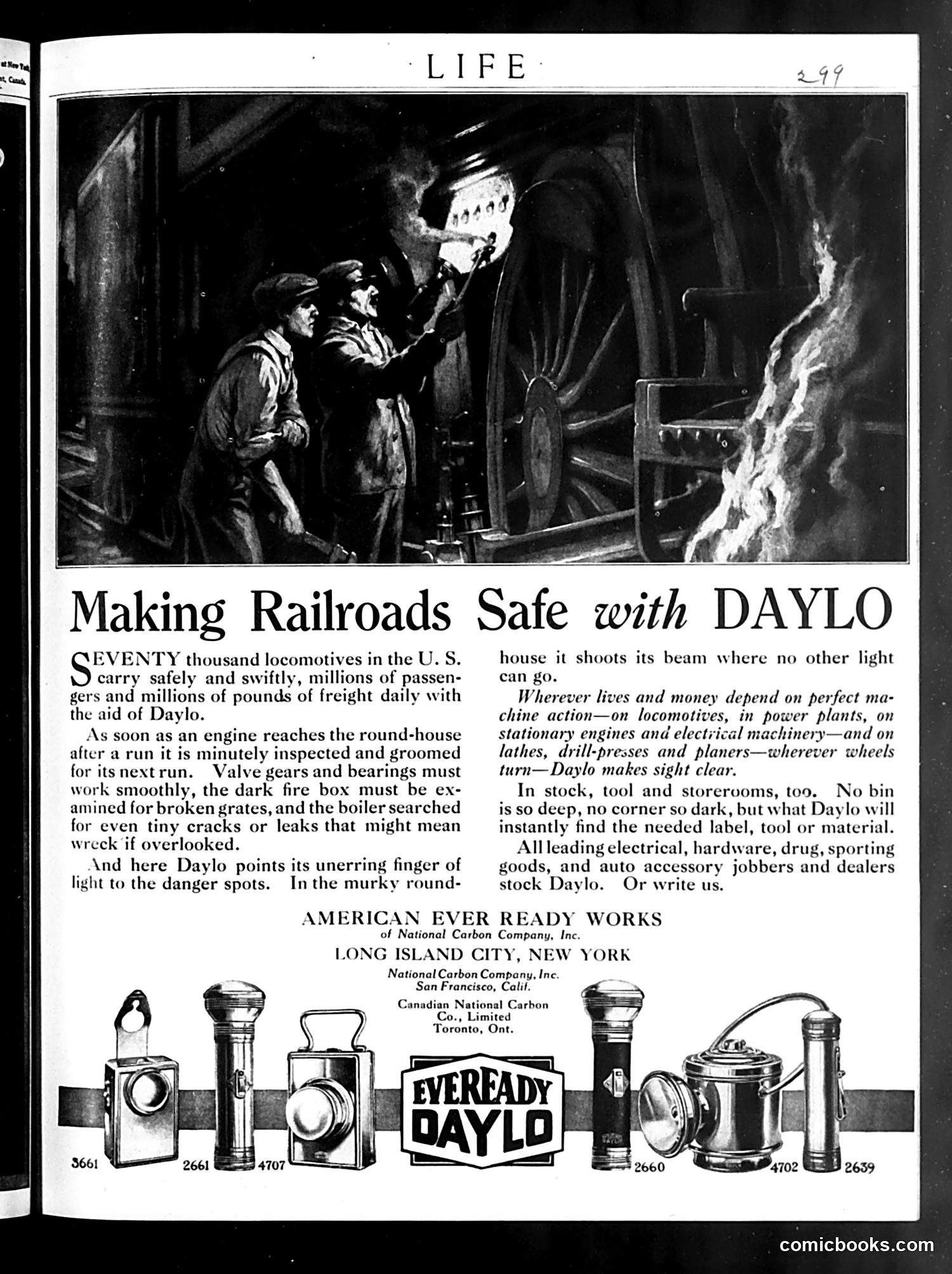
This is **not satire or a political cartoon** — it's a straightforward advertisement for Eveready Daylo flashlights, disguised as an article. The image shows railroad workers using flashlights to inspect a locomotive in dark conditions. The accompanying text praises Daylo's reliability for railroad safety inspections, claiming the product can illuminate "danger spots" that other lights miss. The bottom section displays various Eveready flashlight models with product numbers. This represents early 20th-century advertising strategy: Life magazine's format blurred the line between editorial content and paid advertisements. The "article" format lent credibility to product claims about industrial utility and safety — in this case, suggesting Daylo flashlights were essential for preventing railroad accidents, thereby justifying their purchase to industrial buyers.
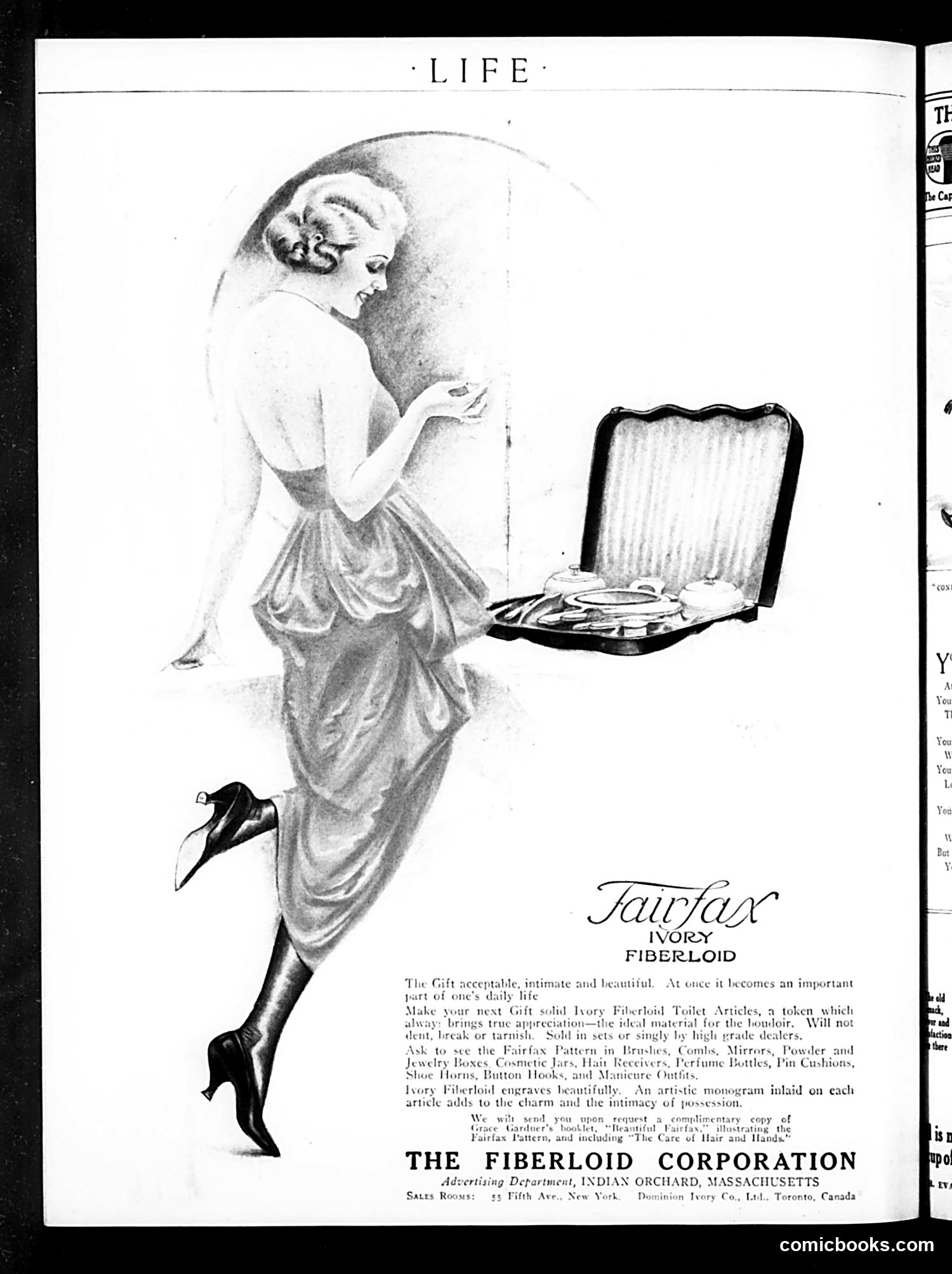
This page is **primarily an advertisement**, not political satire. It promotes "Fairfax Ivory Fiberloid" toilet articles—a brand of cosmetic and personal care products made from early celluloid-like material. The illustration depicts a stylized 1920s woman in fashionable dress, holding an open suitcase of Fairfax products. The accompanying text emphasizes that these items make ideal gifts: "The Gift acceptable, intimate and beautiful." The ad lists specific products: brushes, combs, mirrors, powder boxes, perfume bottles, hair receivers, and manicure sets—typical vanity items of the era. The satirical elements typical of *Life* magazine are absent here; this is straightforward product marketing aimed at affluent consumers, with the company's address in Indian Orchard, Massachusetts.
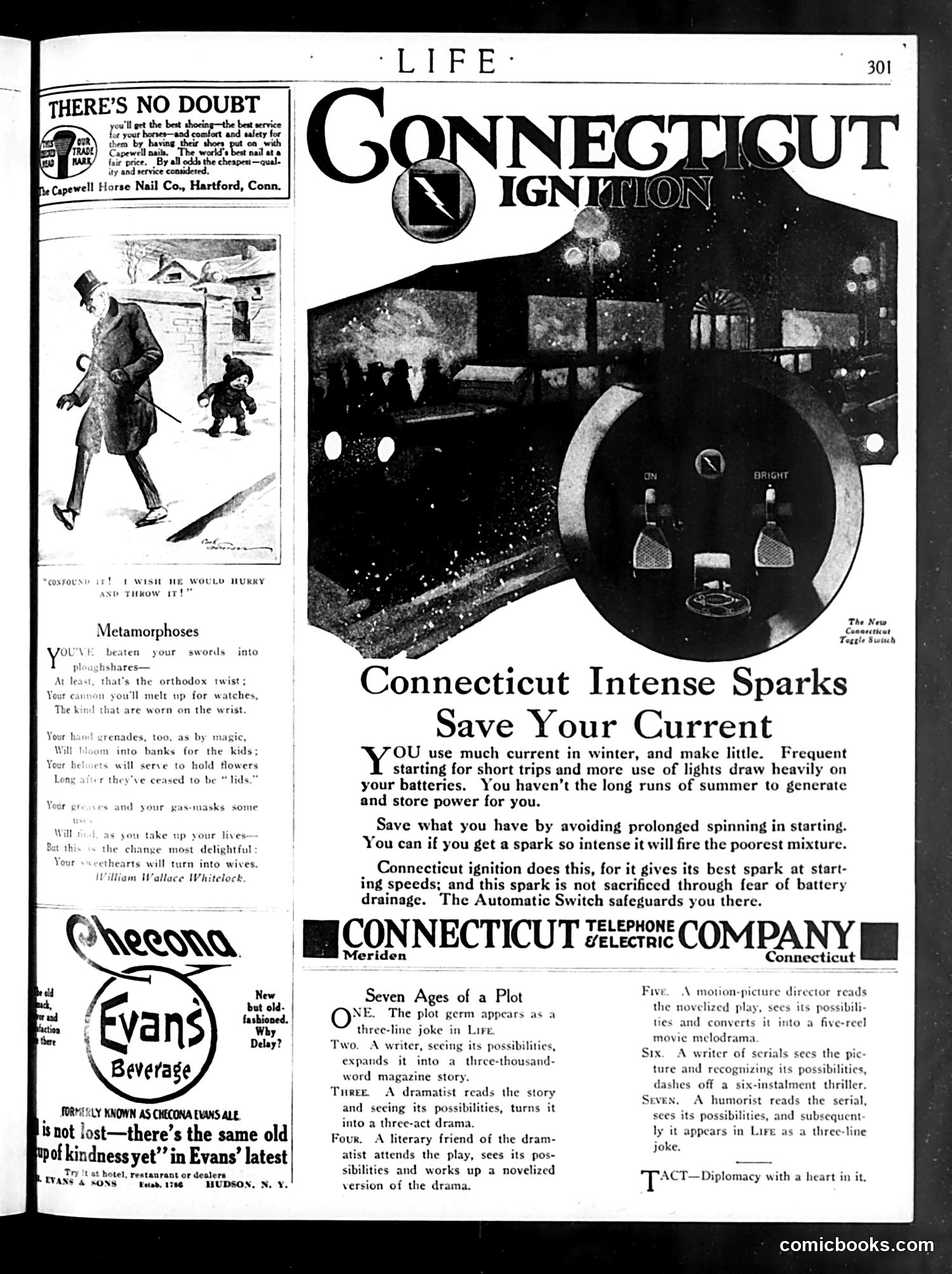
This page is primarily **advertising and light humor** rather than political satire. The main content features: 1. **Connecticut Ignition advertisement** - A large product ad for car ignition systems, emphasizing they provide intense sparks to start vehicles reliably in winter while conserving battery power. 2. **"Metamorphoses" poem** - A humorous piece by William Wallace Whitelock about how items worn on the wrist (watches, grenades, bracelets, etc.) transform through magic—lighthearted wordplay rather than satire. 3. **Minor advertisements** - Including Evans Beverage and Capewell Horse Nail Company ads. 4. **"Seven Ages of a Plot"** - A brief literary commentary about how dramatists and writers adapt stories across different formats. The page contains **no significant political commentary**—it reflects early 20th-century consumer advertising and genteel humor.
This is an editorial statement from Life magazine's staff defending their ongoing labor dispute with the Business Office. The magazine's workers had walked out demanding fair subscription rates and refusing to publish coupons they considered exploitative. Life's editors assert their principles: no compulsory coupons, honest advertising, and editorial independence from business pressures. They acknowledge occasionally yielding to business demands but argue "the right will prevail." The piece emphasizes Life won't accept censorship of coming issue numbers or allow the B.O. (Business Office) to insert false praise. The accompanying silhouette illustrations of people in various positions of conflict or negotiation visually reinforce the dispute's human stakes and the magazine's defiant stance on worker and editorial autonomy.
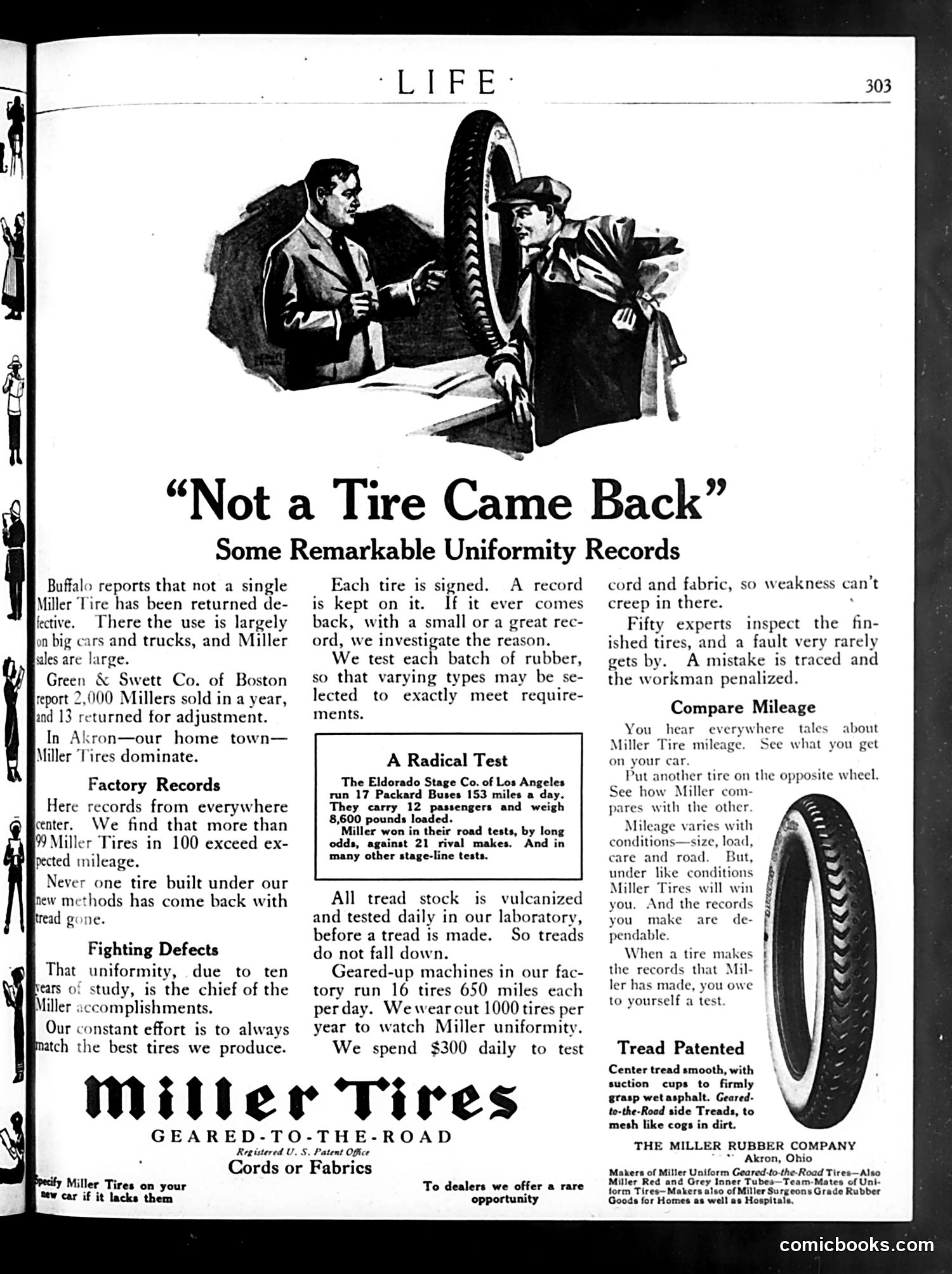
This is primarily a **tire company advertisement**, not political satire. The page promotes Miller Tires of Akron, Ohio, using the headline "Not a Tire Came Back" to claim exceptional durability and quality control. The illustration shows two men examining a large tire—likely a salesman and customer—presenting the product as reliable. The ad emphasizes Miller's manufacturing rigor: testing methods, vulcanization processes, daily inspections, and detailed record-keeping. The "radical test" section boasts that Miller tires equipped buses running 153 miles daily carrying 12 passengers and 8,600 pounds of cargo, outperforming 21 competitor brands. This reflects early-20th-century advertising strategy: using technical superiority claims and detailed production practices to build consumer confidence in an industrial product.
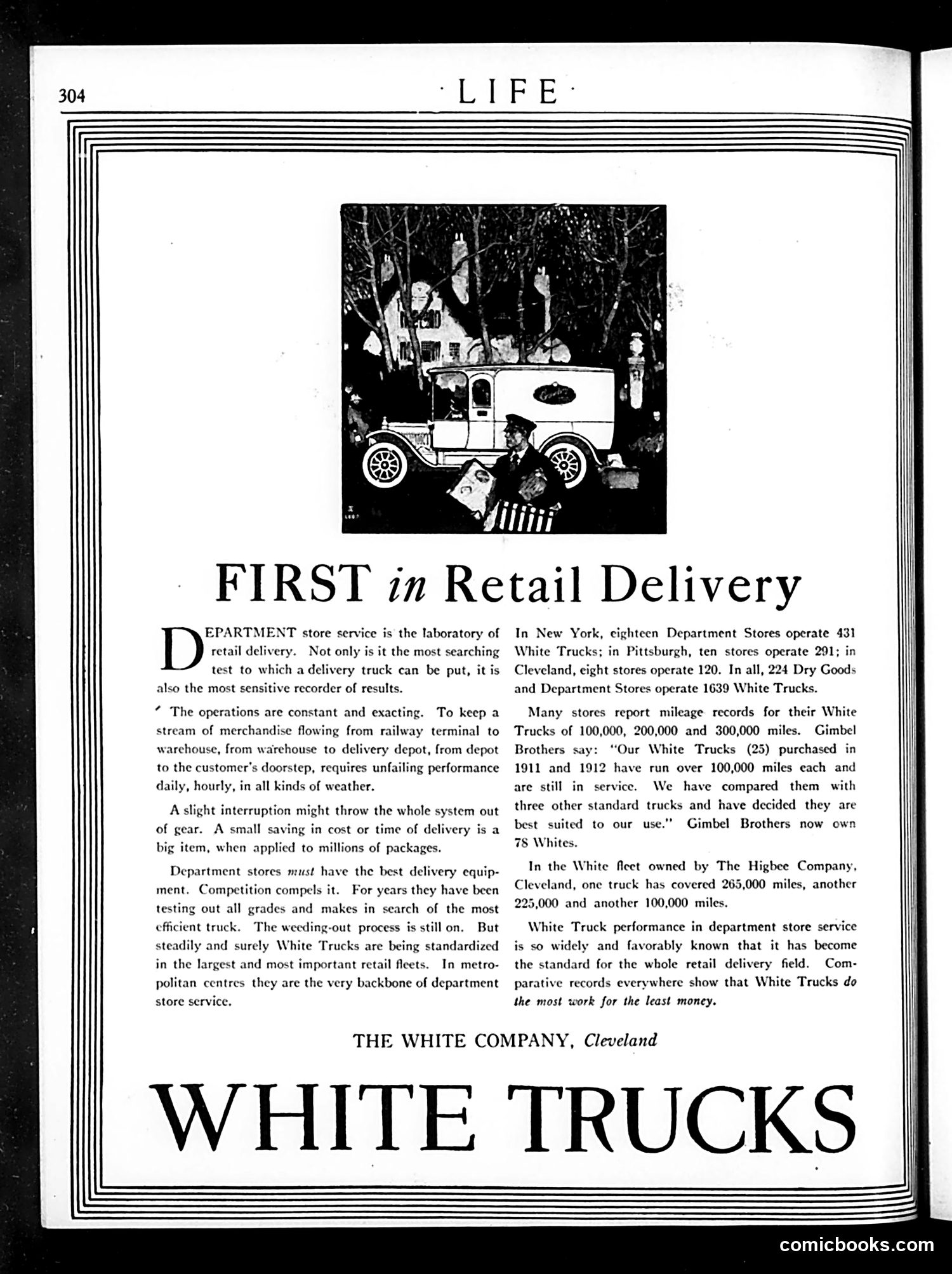
This page is primarily a **commercial advertisement** for White Trucks, a Cleveland-based vehicle manufacturer. The ad emphasizes White Trucks' superiority in retail delivery service for department stores. The illustration shows a delivery truck at night with uniformed delivery personnel and customers. The text highlights that major department store chains nationwide—including 431 trucks in New York alone—rely on White Trucks for their operations. The ad references specific mileage records (trucks with over 100,000-300,000 miles still in service) as proof of reliability. The key sales pitch appears in italics: "White Trucks **do the most work for the least money**." This is a straightforward product advertisement rather than satire or political commentary—typical of Life magazine's commercial content from this era (appears to be 1920s-1930s based on the vehicle style).
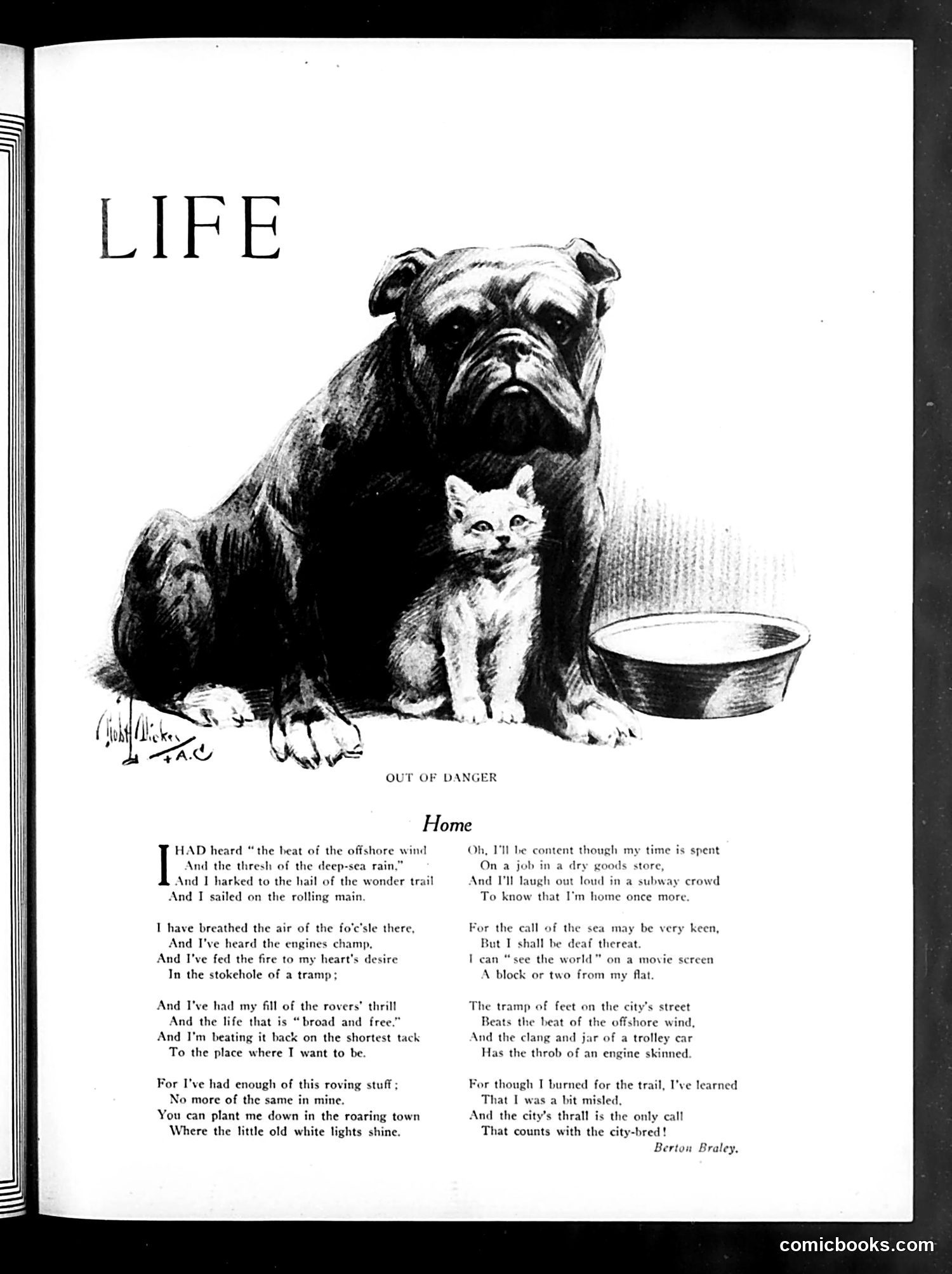
This page features an illustration titled "Out of Danger" showing a large bulldog protecting a small kitten, paired with a poem called "Home" by Berton Braley. The cartoon appears to use animal metaphor: the bulldog likely represents a protective force (possibly Britain or a strong ally), while the kitten suggests vulnerability or a smaller nation requiring protection. The image's caption "Out of Danger" paired with the poem's themes of homesickness and returning from adventure suggests this reflects WWI-era sentiment—someone who has experienced conflict abroad now yearns for domestic safety and stability. The poem explicitly contrasts the romance of adventure ("the call of the sea," "roving stuff") with the comfort of returning home to simple pleasures and city life. This resonates with post-war disillusionment and soldiers' desires to return to normalcy.
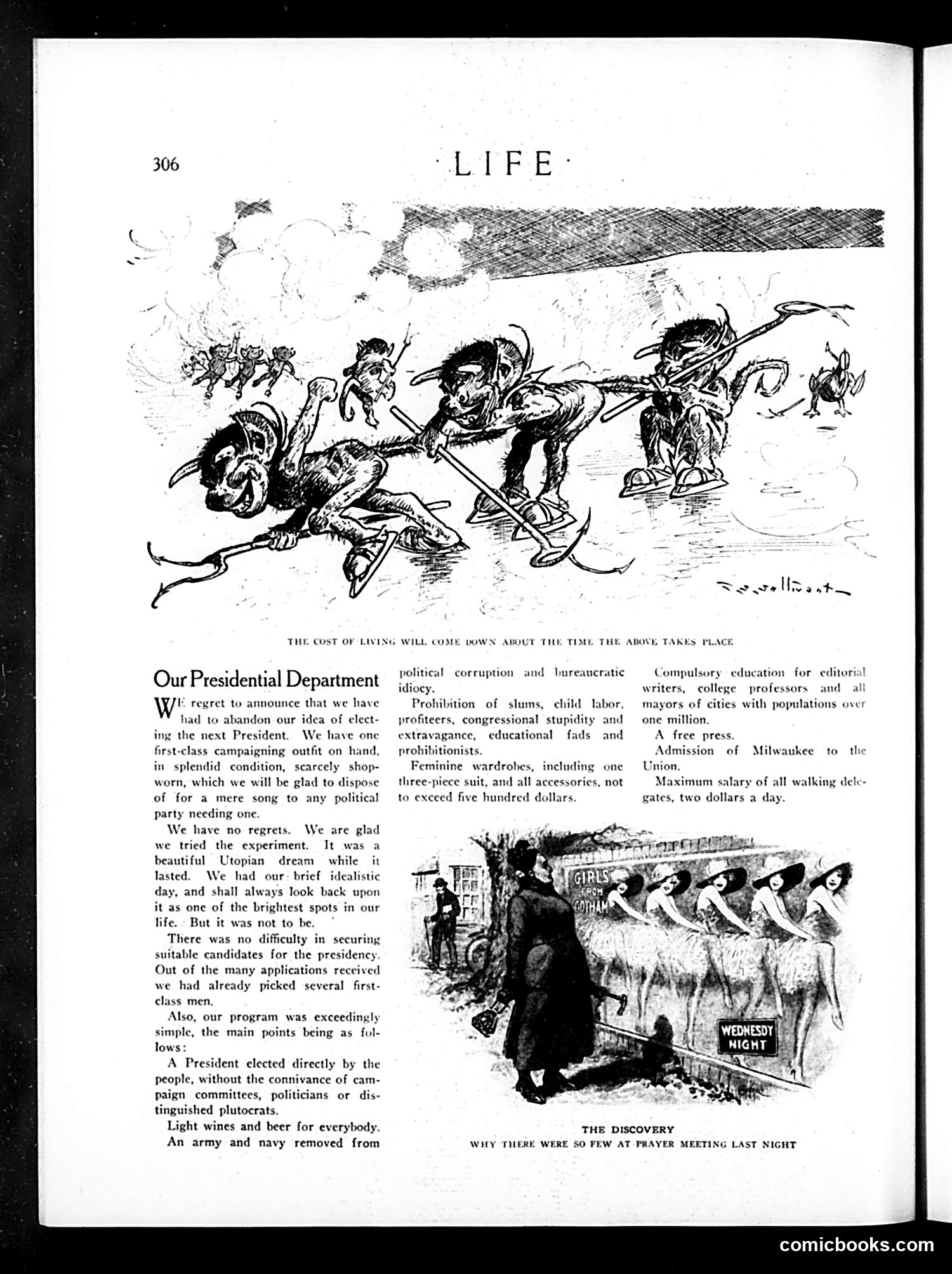
The top cartoon depicts demonic or devilish figures engaged in a chaotic scene, illustrating "THE COST OF LIVING WILL COME DOWN ABOUT THE TIME THE ABOVE TAKES PLACE"—suggesting the cost of living will decrease when hell freezes over, a cynical commentary on inflation. The "Our Presidential Department" section satirizes a failed election cycle. Life's editors humorously announce they're "abandoning" their preferred presidential candidate and must dispose of campaign materials. The tone mocks the difficulty of finding suitable candidates and the disappointment of the political process. The bottom illustration, "THE DISCOVERY," shows men outside a building with women visible through windows, captioned "WHY THERE WERE SO FEW AT PRAYER MEETING LAST NIGHT"—a morality joke suggesting men discovered alternative entertainment venues instead of attending religious services.
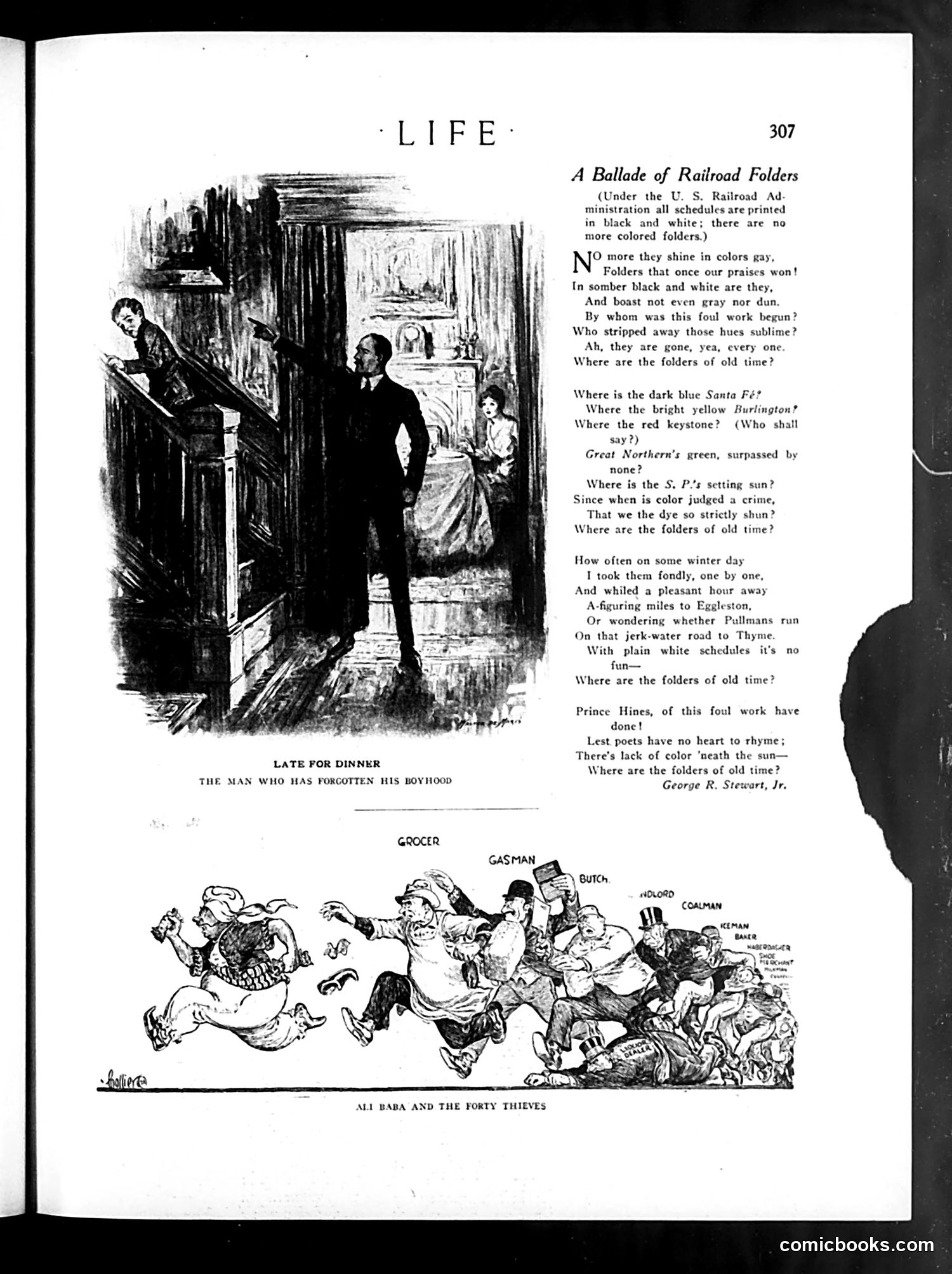
**Top Section:** The sketch "Late for Dinner: The Man Who Has Forgotten His Boyhood" shows a man arriving home to his family, apparently having neglected domestic responsibilities—a commentary on adult preoccupations causing men to lose youthful joy and family connection. **Middle Section:** "A Ballad of Railroad Folders" by George R. Stewart, Jr. laments the disappearance of colorful railroad promotional materials. The poem nostalgically references once-vibrant folders for lines like the Santa Fe, Burlington, and Great Northern—now reduced to plain black-and-white schedules under U.S. Railroad Administration standardization (likely WWI-era wartime controls). It's a whimsical critique of bureaucratic efficiency replacing commercial artistry and visual appeal. **Bottom Section:** The cartoon "Ali Baba and the Forty Thieves" appears to be a political allegory using the classic tale, though specific identifications of the labeled figures remain unclear from this reproduction.
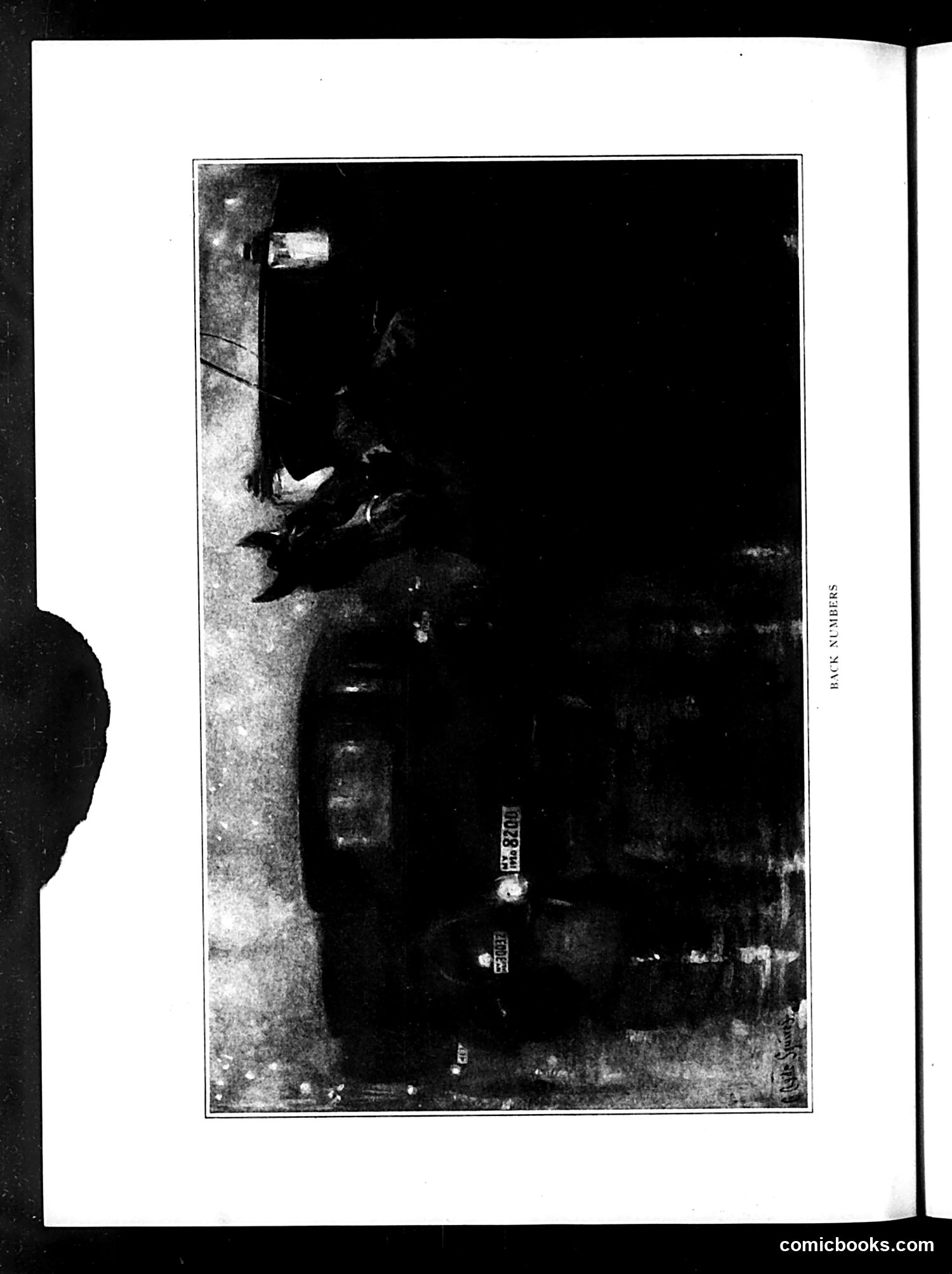
This page appears to be primarily a **photograph rather than a satirical cartoon**. The image shows what seems to be an interior scene photographed in low light conditions, rotated 90 degrees. The quality is quite poor, making specific details difficult to discern. The text visible on the right margin reads "BANK NUMBERS," suggesting this may be documenting some financial or banking-related subject matter. Without clearer visibility of the image content or accompanying article text beyond "BANK NUMBERS," I cannot reliably identify specific figures, political references, or satirical intent. The page appears to be from *Life* magazine's documentary or news photography section rather than its satirical cartoon content.
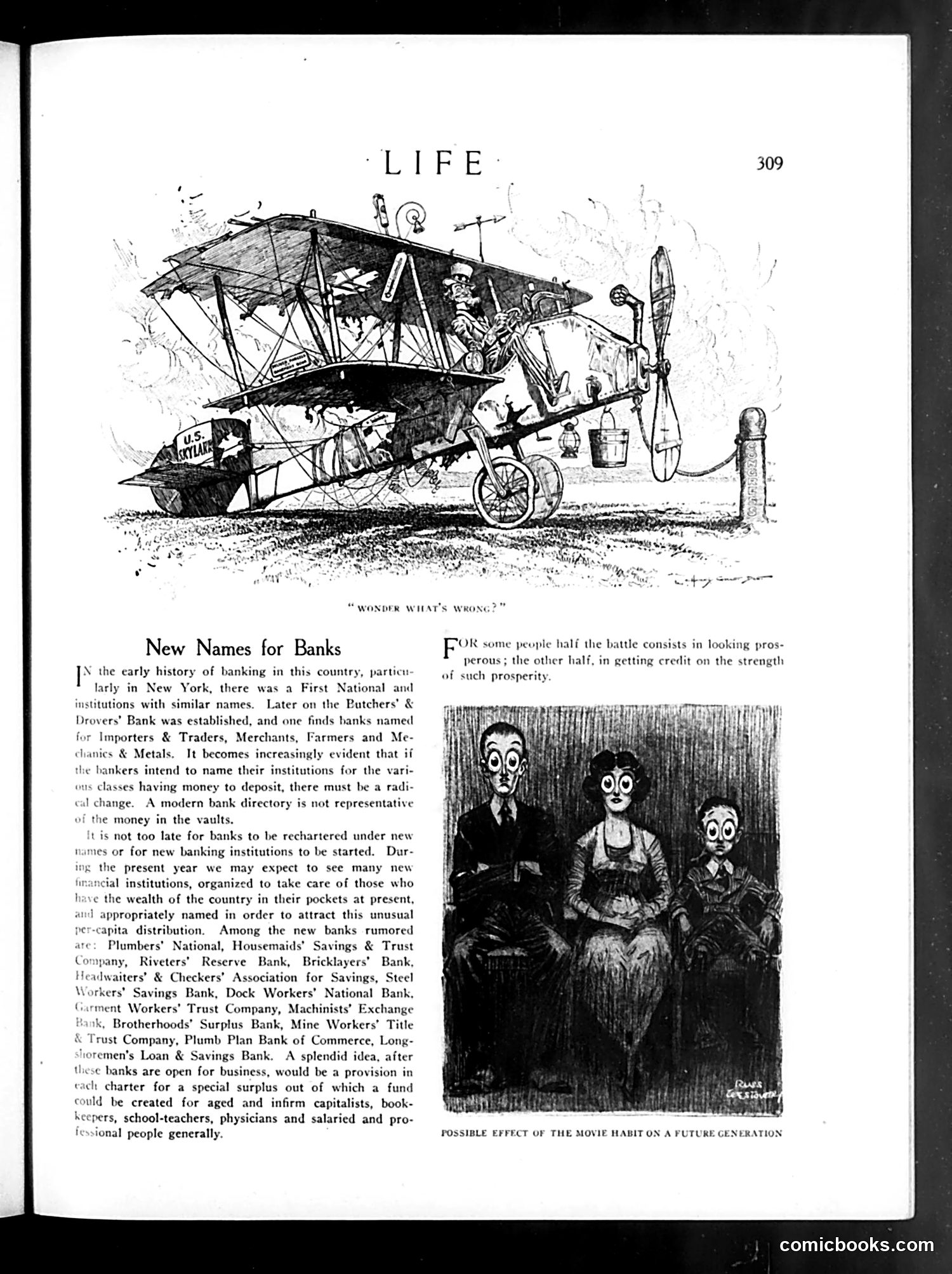
**Top Cartoon ("Wonder What's Wrong?"):** This depicts an absurdly overloaded, jury-rigged aircraft or flying machine, literally falling apart mid-flight with occupants barely hanging on. It's a satirical commentary on poorly-constructed or unstable enterprises—likely referencing chaotic business ventures or speculative financial schemes of the era. **Bottom Image:** Captioned "Possible Effect of the Movie Habit on a Future Generation," it shows three children with exaggerated, bulging eyes staring intensely forward. This satirizes contemporary concerns about cinema's influence on youth, suggesting moviegoing could produce psychological or behavioral changes in children—a common anxiety during early film's popularity. **Text Section:** Discusses new bank names targeting specific working-class professions (plumbers, dock workers, farmers), reflecting post-WWI financial democratization efforts.
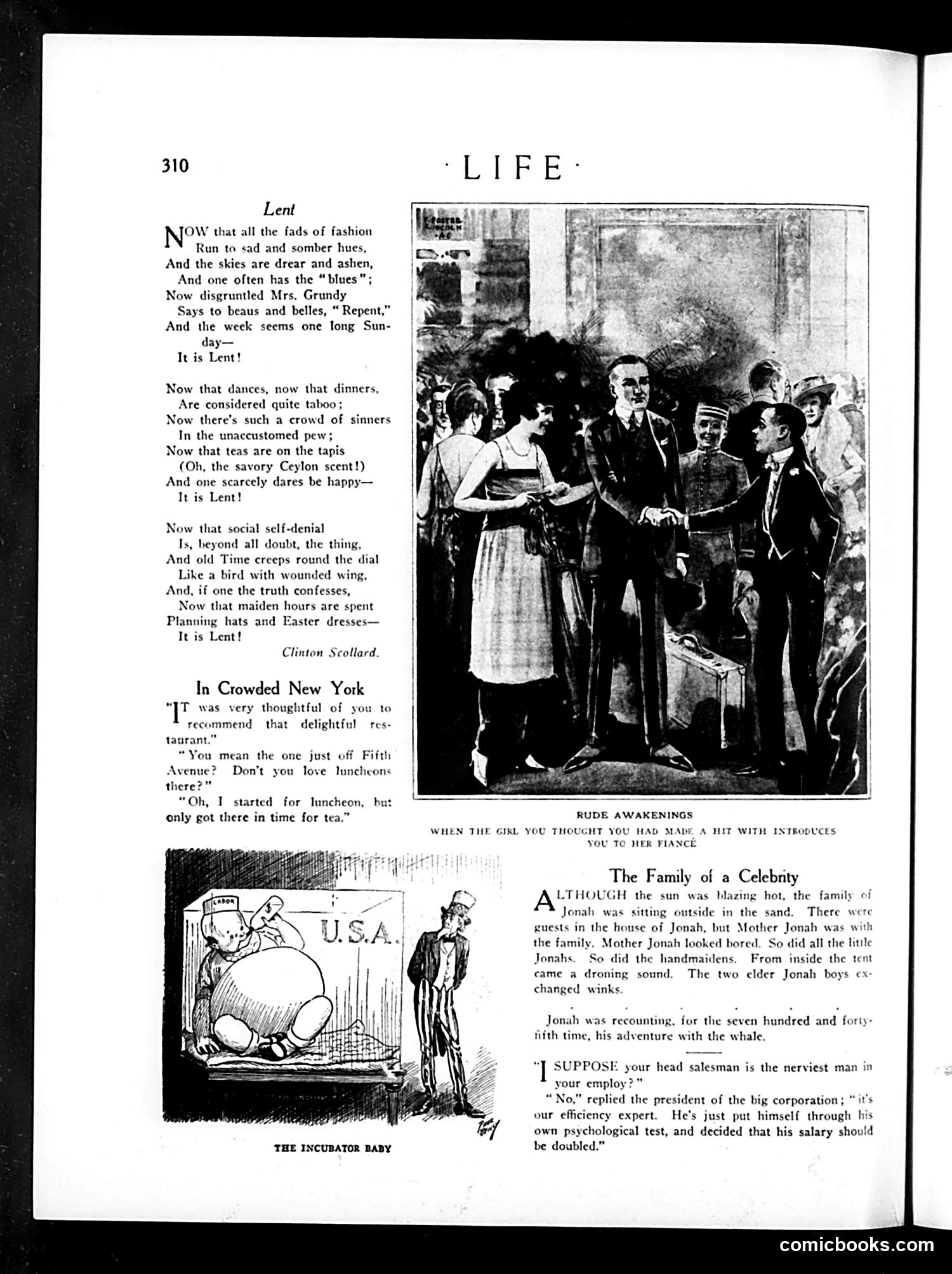
**"Lent" poem by Clinton Scollard:** A satirical poem mocking the hypocrisy of Lenten observance—how society abandons fashionable indulgences (dances, dinners, fancy clothes) during this religious period, yet uses the time for vanity projects like "hats and Easter dresses." The joke is that self-denial becomes self-focused vanity. **"The Incubator Baby" cartoon:** This appears to be political commentary on American expansion or foreign policy, depicting the U.S. (represented as a figure) incubating something, with a thin, elongated figure (possibly representing a foreign nation or colonial territory) standing nearby observing. The exact reference is unclear without additional context. **"In Crowded New York" and "Family of a Celebrity":** Humorous anecdotes about urban social life and celebrity culture.
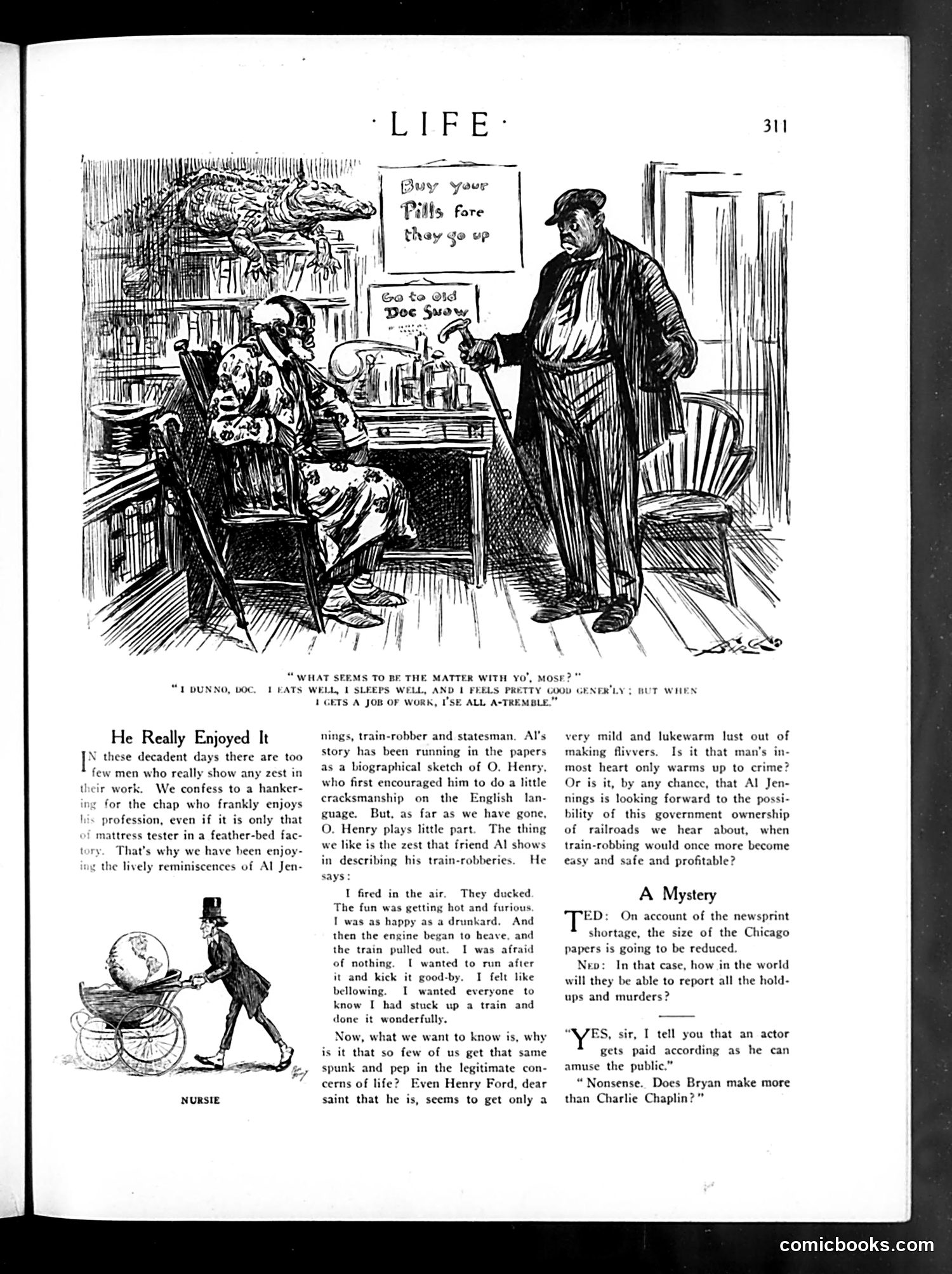
The main cartoon depicts a man at a desk speaking with another man standing beside him. The seated man appears disheveled and troubled, while two signs visible in the background read "Buy your Pills fore they go up" and "Go to old Doc Swayz." The caption quotes the standing man asking about the seated man's condition, with the seated man responding that he sleeps well and feels good generally, but becomes "all a-tremble" when he gets work. This satirizes the anxiety and stress of employment during uncertain economic times (likely the 1920s-30s), suggesting that even having a job causes nervous distress. The signs advertising pills and doctors reinforce the theme of widespread anxiety about economic instability and health concerns during this period.
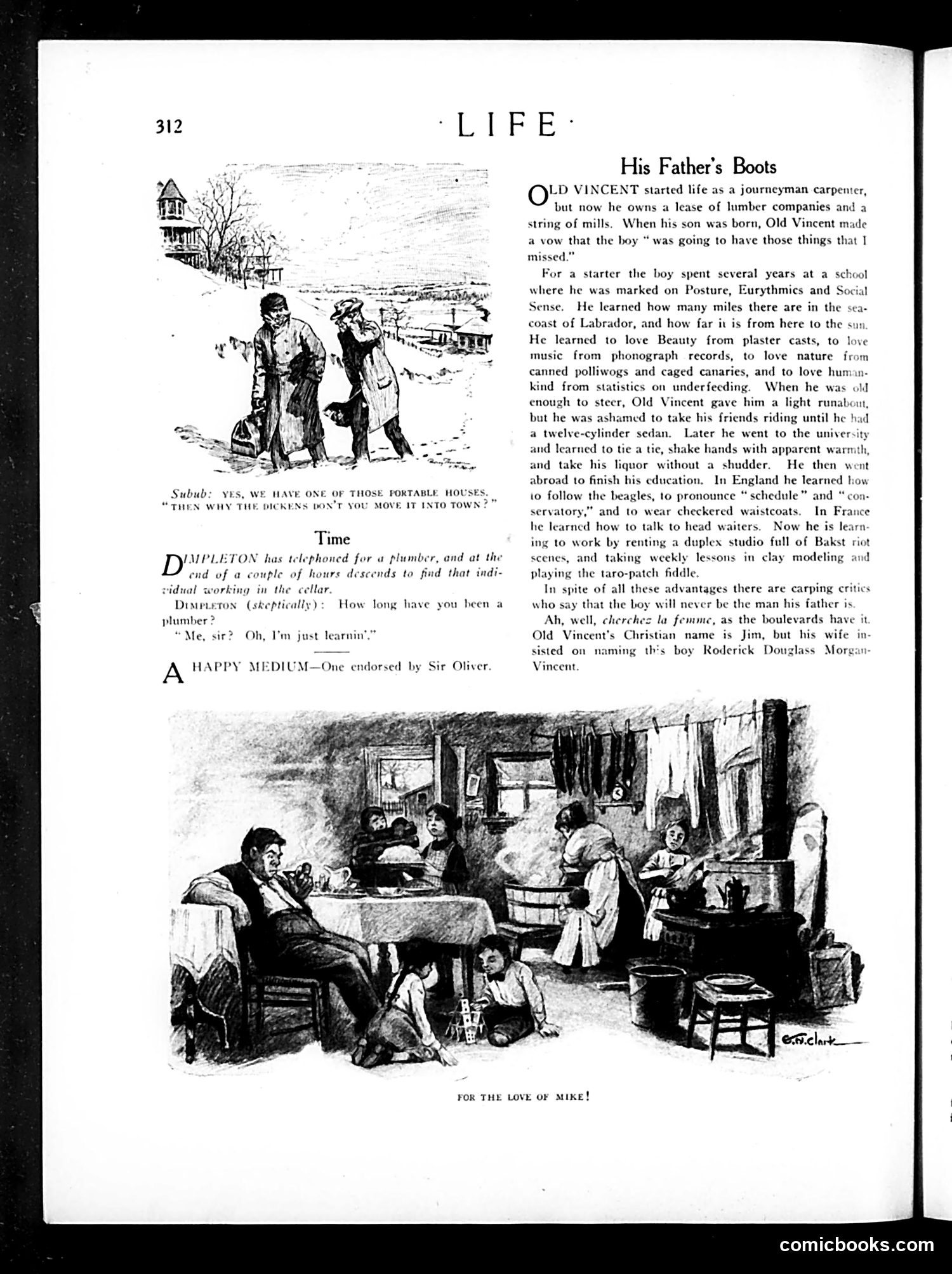
This satirical piece mocks wealthy self-made men who over-educate their sons into uselessness. Old Vincent, a successful lumber industrialist, vows to give his boy everything he himself lacked. The result: the son receives excessive schooling in impractical subjects (Eurythmics, plaster-cast aesthetics, caged-canary appreciation), European finishing school, and dilettante pursuits like clay modeling and "taro-patch fiddle." The joke's bitter edge: despite all advantages, critics say the boy will never match his father's practical competence. The French phrase "cherchez la femme" (blame the woman) suggests the mother—insisting on the pretentious name "Roderick Douglass Morgan-Vincent"—bears responsibility. The satire targets early-20th-century anxiety about inherited wealth producing soft, impractical heirs. A self-made man's son, overindulged and overeducated in genteel pursuits, becomes inferior to his hardworking father—a common Progressive-era concern about American vigor and character.
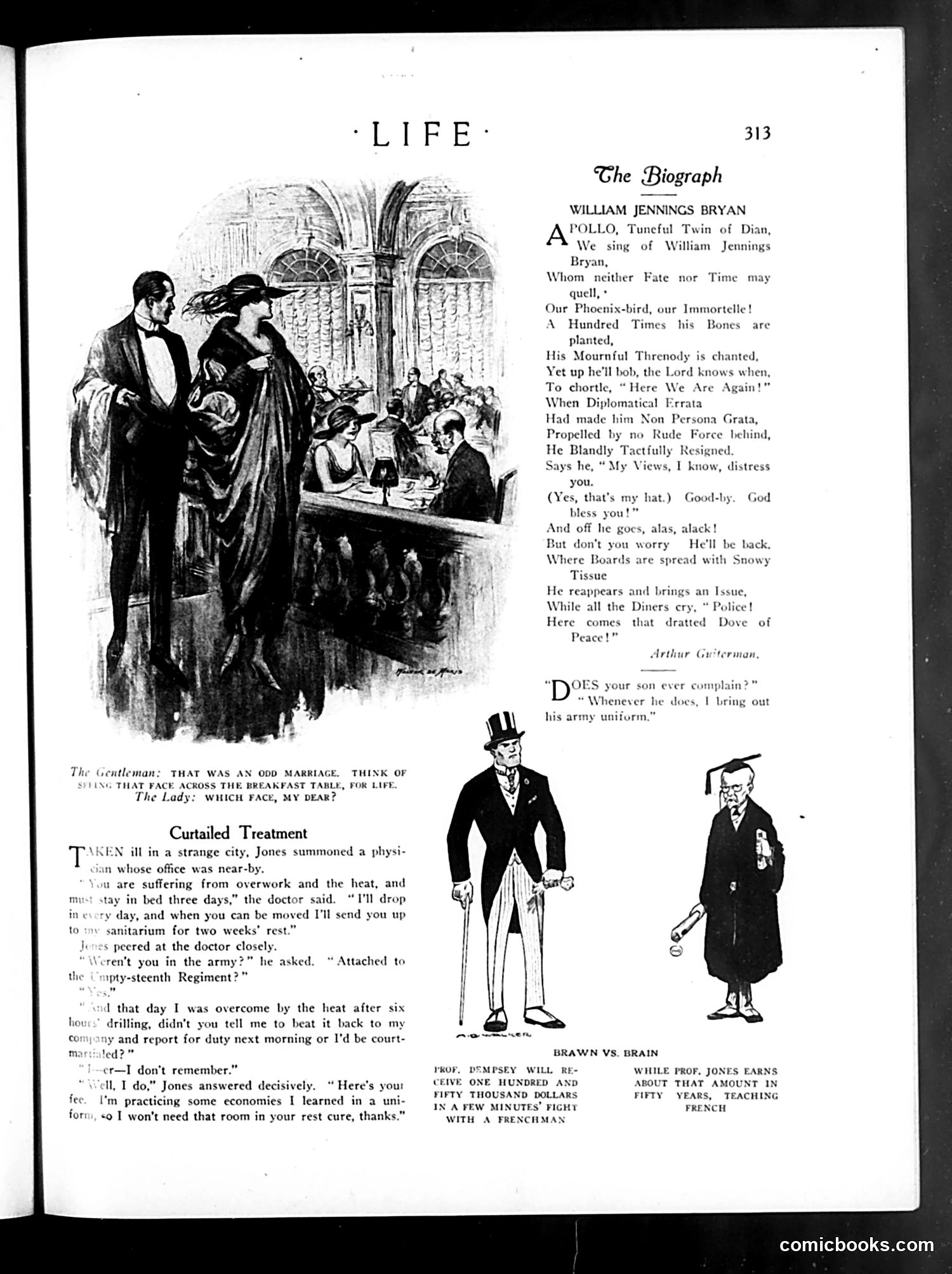
This page satirizes **William Jennings Bryan**, the three-time presidential candidate (1896, 1900, 1908) who kept returning to politics despite repeated defeats. The poem mocks his persistent comebacks—comparing him to a phoenix that repeatedly "bobs" back up. References to "Non Persona Grata" and "Diplomatical Errata" likely allude to his service as Secretary of State under Wilson, then his resignation over foreign policy disagreements. The joke: Bryan was famous for his moral crusades and speaking tours ("Where Boards are spread with Snowy Tissue / He reappears and brings an Issue"). Life presents him as an indestructible political nuisance—always returning despite being repeatedly rejected by voters. The page also contains unrelated humorous anecdotes about a doctor and army service, plus two small cartoons comparing "Brawn vs. Brain"—boxer Dempsey earning $150,000 in minutes versus Professor Jones earning that amount teaching French over 50 years.
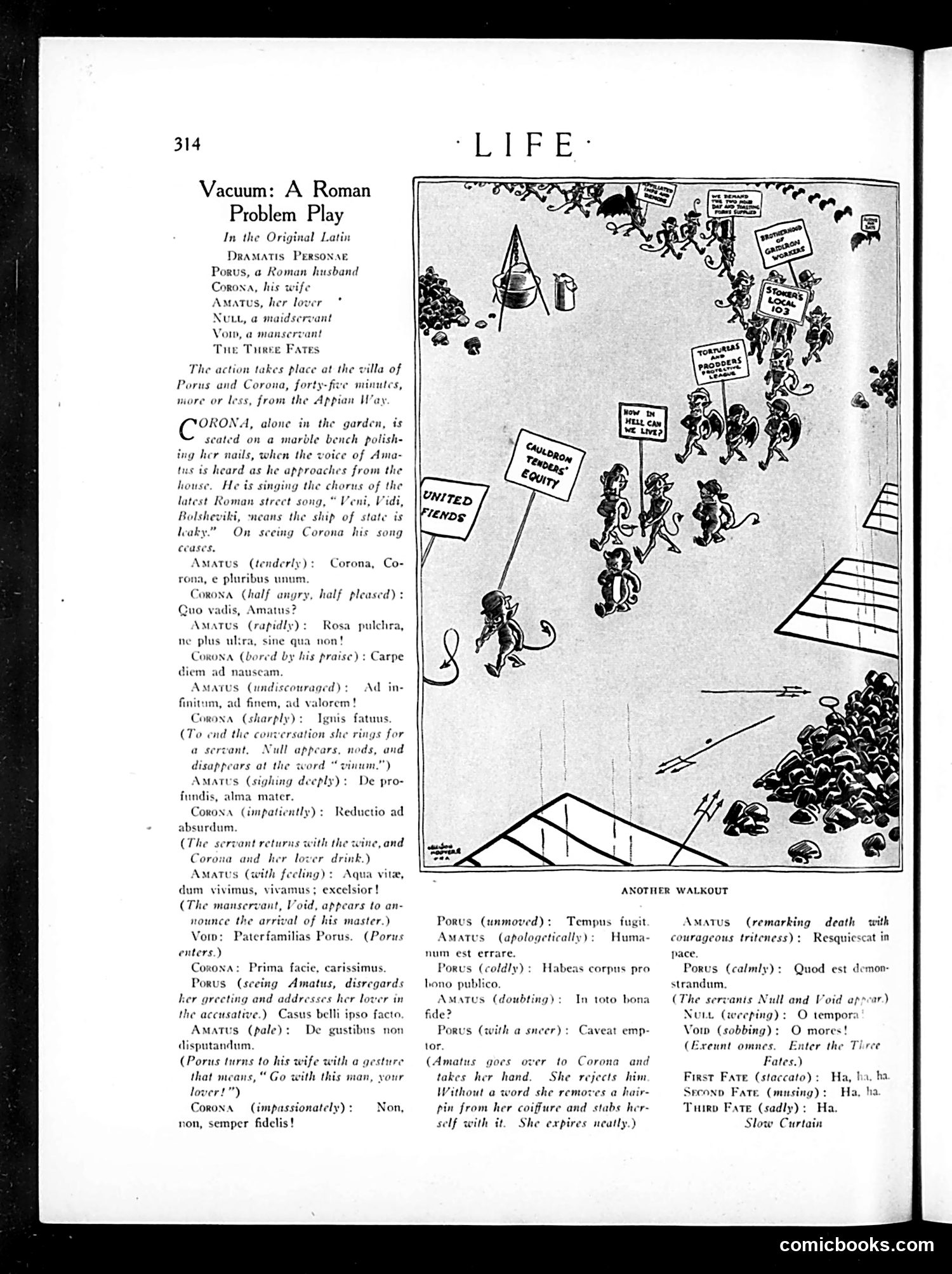
This satirical sketch mocks contemporary theatrical melodramas—likely the popular "problem plays" addressing marital infidelity and social scandal. By translating a tawdry love-triangle plot into Latin with faux-classical dialogue ("Tempus fugit," "Caveat emptor"), Life ridicules both the overwrought conventions of serious drama and pretentious audiences who believed such works profound. The cartoon accompanying the text (showing chaotic figures and signs referencing modern issues) contrasts with the "timeless Roman setting," suggesting these supposedly serious plays merely recycle trivial contemporary gossip in classical drag. The absurd ending—Corona's suicide with a hairpin—parodies the genre's reliance on melodramatic death scenes. The piece satirizes 1920s theater culture, implying that serious dramatists used classical framing to dignify shallow domestic scandals into art.
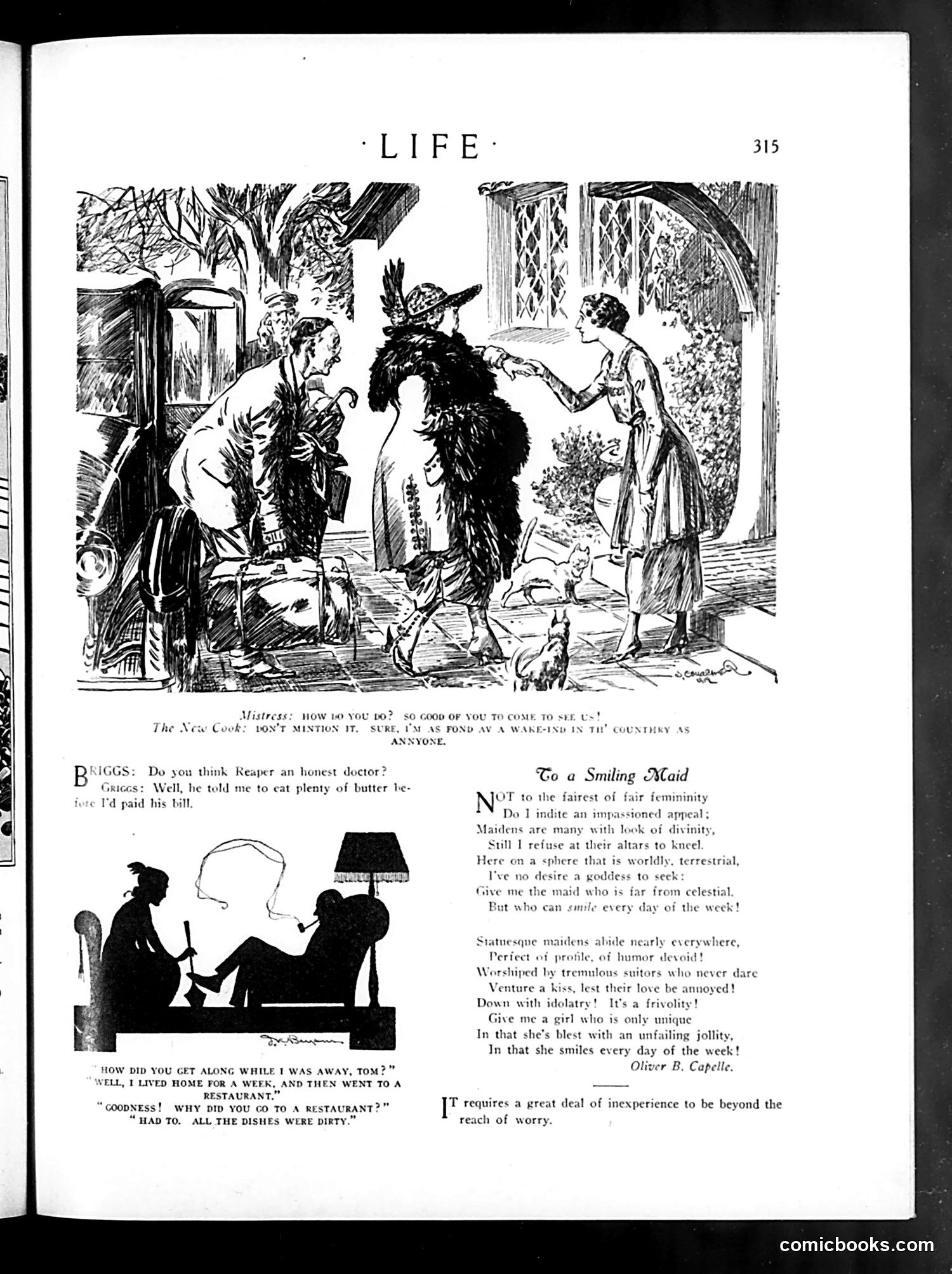
This page contains three distinct humor pieces typical of early 20th-century Life magazine: **Top cartoon**: A domestic scene satirizing servant-employer relations. A mistress greets her "new cook" while guests arrive. The cook's thick dialect ("Don't mention it, sure I'm as fond of a wake-end in th' country as anyone") uses Irish-immigrant stereotyping common to the era's humor—poking fun at working-class speech patterns and attitudes. **Middle cartoon**: A silhouette of a man's feet up, lazy on furniture, with dialogue about surviving a week alone. The joke relies on domestic helplessness—a man cannot manage housework without a woman. **"To a Smiling Maid" poem**: Oliver B. Capelle's sentimental verse celebrates cheerful, accessible women over aloof "statues" maidens, valuing genuine warmth over classical beauty ideals. **Bottom cartoon**: A husband jokes about eating restaurant food while his wife was away because home dishes were dirty—again depicting masculine domestic incompetence as humorous. The page's recurring theme: gender roles and class stereotypes presented as comedy.
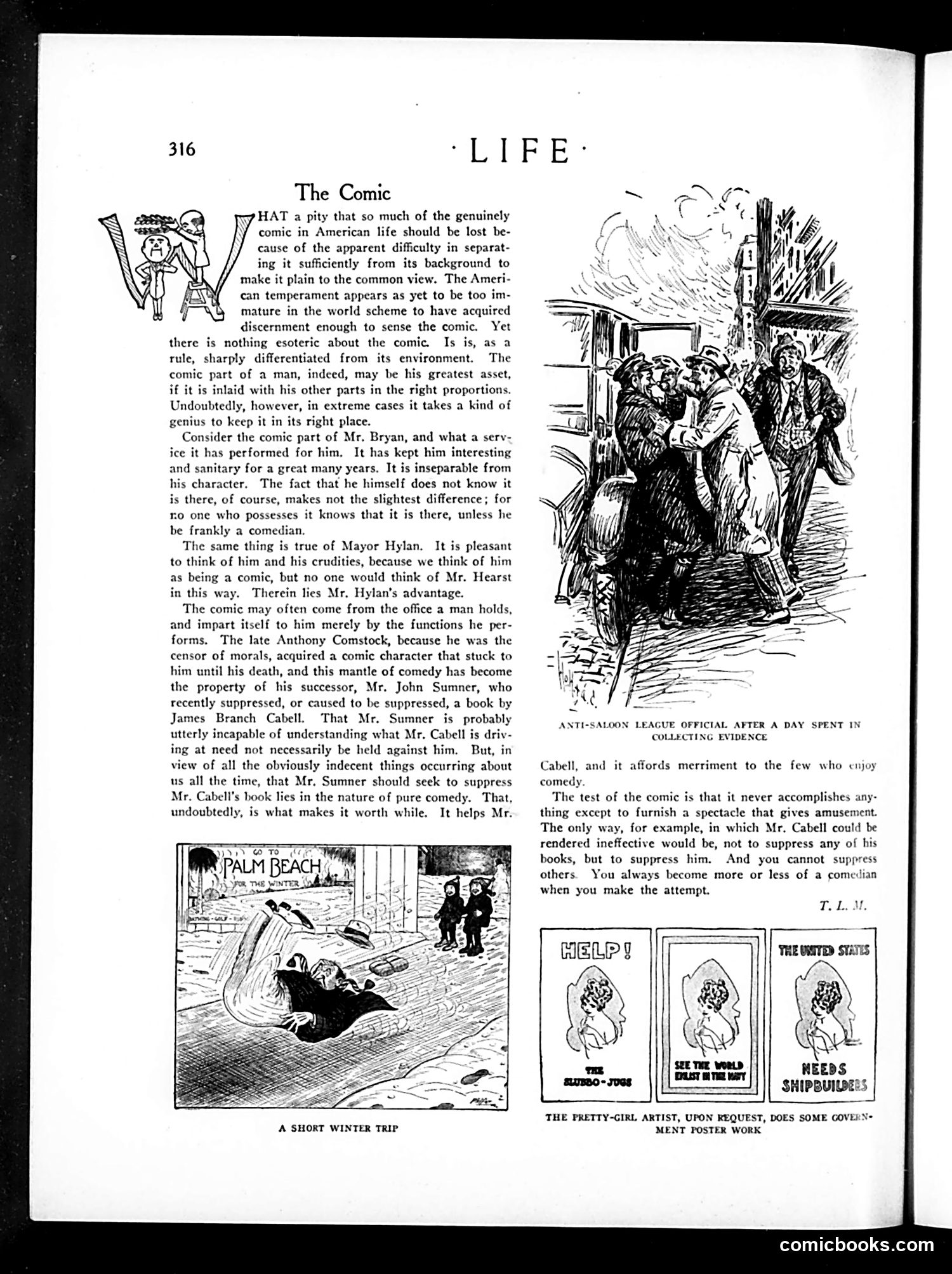
This page from *Life* magazine discusses American humor and features several satirical cartoons. The main essay argues that genuine comedy in American life often goes unrecognized because Americans lack cultural sophistication. It praises figures like William Jennings Bryan and Mayor Hylan as naturally comic—unknowingly so—without realizing it. The piece then critiques **John Sumner**, successor to moral censor Anthony Comstock, for suppressing James Branch Cabell's book. The satire: Sumner's censorship efforts are themselves absurdly comic, and the censorship actually helps Cabell by generating attention. The point is that attempts to suppress art through moral policing are inherently ridiculous. The cartoons include: an "Anti-Saloon League official" collecting evidence (likely depicting prohibition enforcement as pretextual drinking); a "Short Winter Trip" scene; and a "pretty-girl artist" doing government poster work—all mocking bureaucratic or moral authority figures.
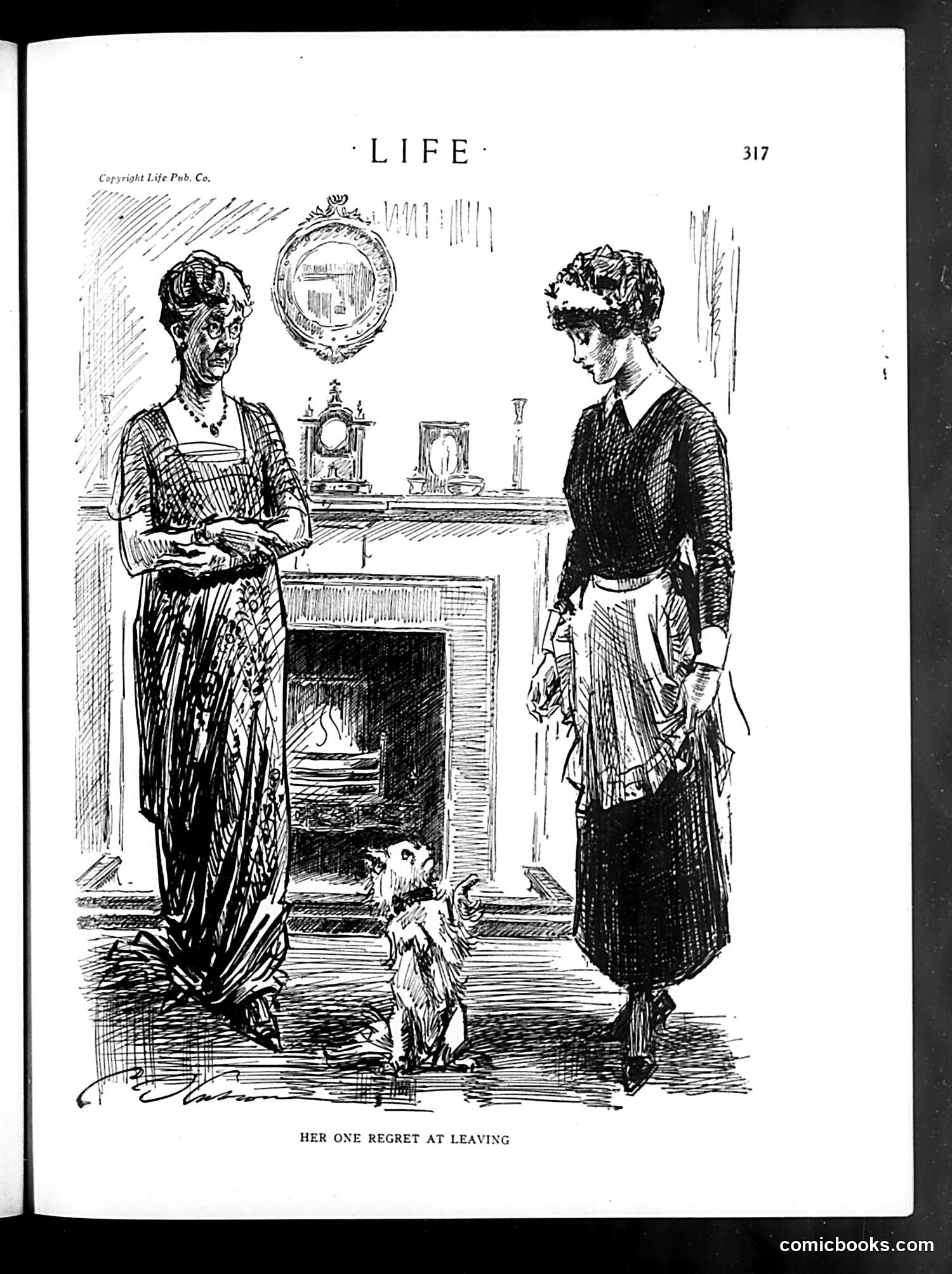
This illustration depicts two well-dressed women in an early 20th-century interior, with a small dog between them. The caption reads "Her One Regret at Leaving," suggesting a departure scenario—possibly a servant or employee leaving a household position. The satire appears to target class dynamics and sentimentality: the woman on the right (likely the employer) expresses regret at the departure, but her emotion is directed toward the small pet dog rather than the departing woman herself. This satirizes the irony of wealthy households valuing their animals over their domestic staff, suggesting that employers showed more affection to pets than to the working-class women who served them. The joke relies on the uncomfortable contrast between genuine concern and misplaced priorities.
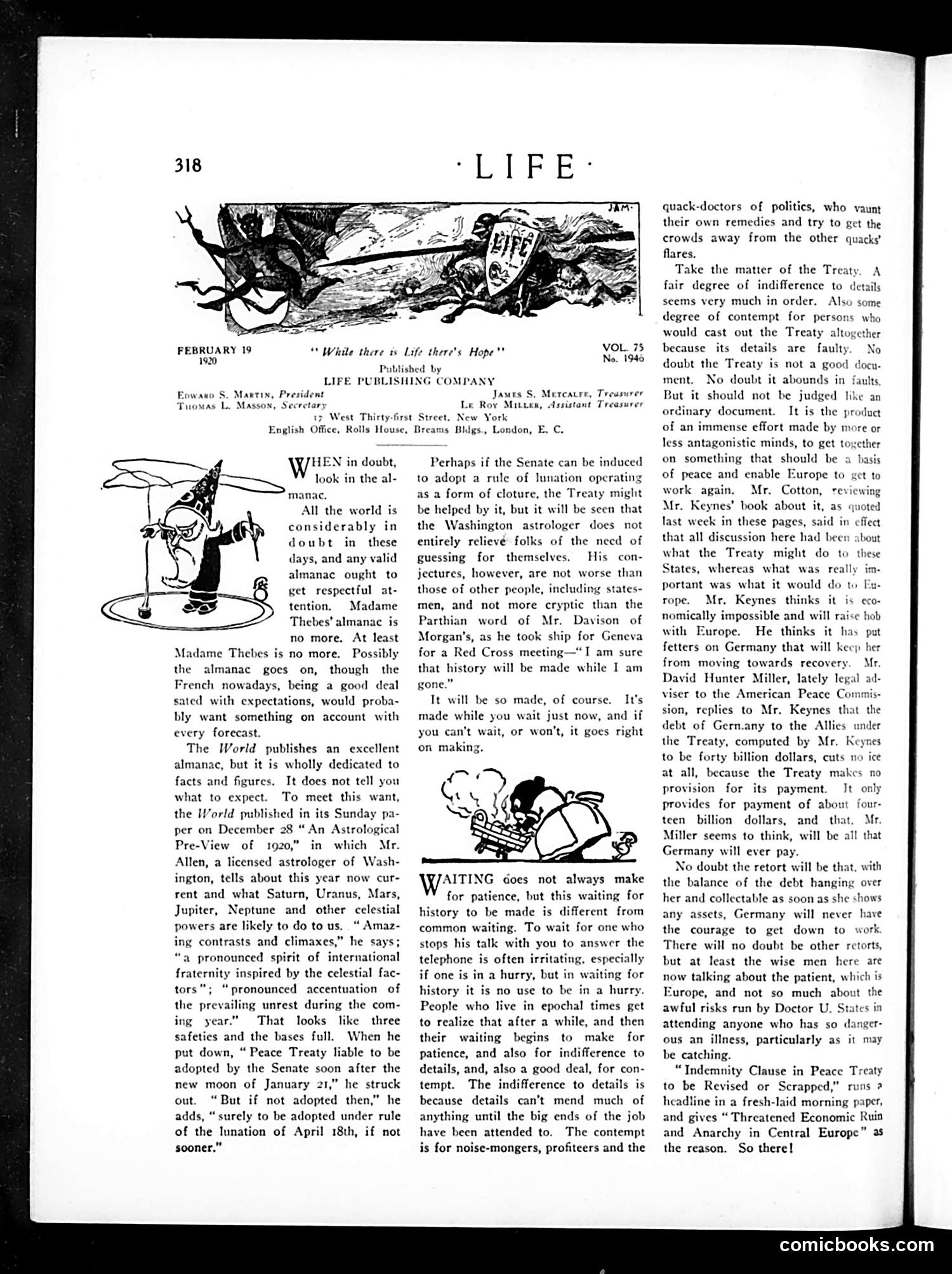
This page satirizes post-WWI political uncertainty, particularly surrounding the League of Nations Treaty. The cartoons mock reliance on astrology and fortune-telling during turbulent times. The first cartoon depicts someone consulting an almanac or fortune-teller—visual mockery of Americans seeking certainty through mystical means. The text references "Madame Thebes" (a famous French fortune-teller, now deceased) and a Washington astrologer's vague predictions about the Treaty's Senate adoption, which could occur either in January or April depending on lunar cycles. The satire suggests that political forecasters are as unreliable as fortune-tellers. The author argues the Treaty shouldn't be rejected for minor flaws, comparing criticism to expecting perfection from a document produced by "antagonistic minds" attempting compromise. The piece criticizes "quack-doctors of politics" who exploit public anxiety with alternative remedies—a pointed jab at politicians opposing the Treaty through misleading rhetoric rather than substantive debate.
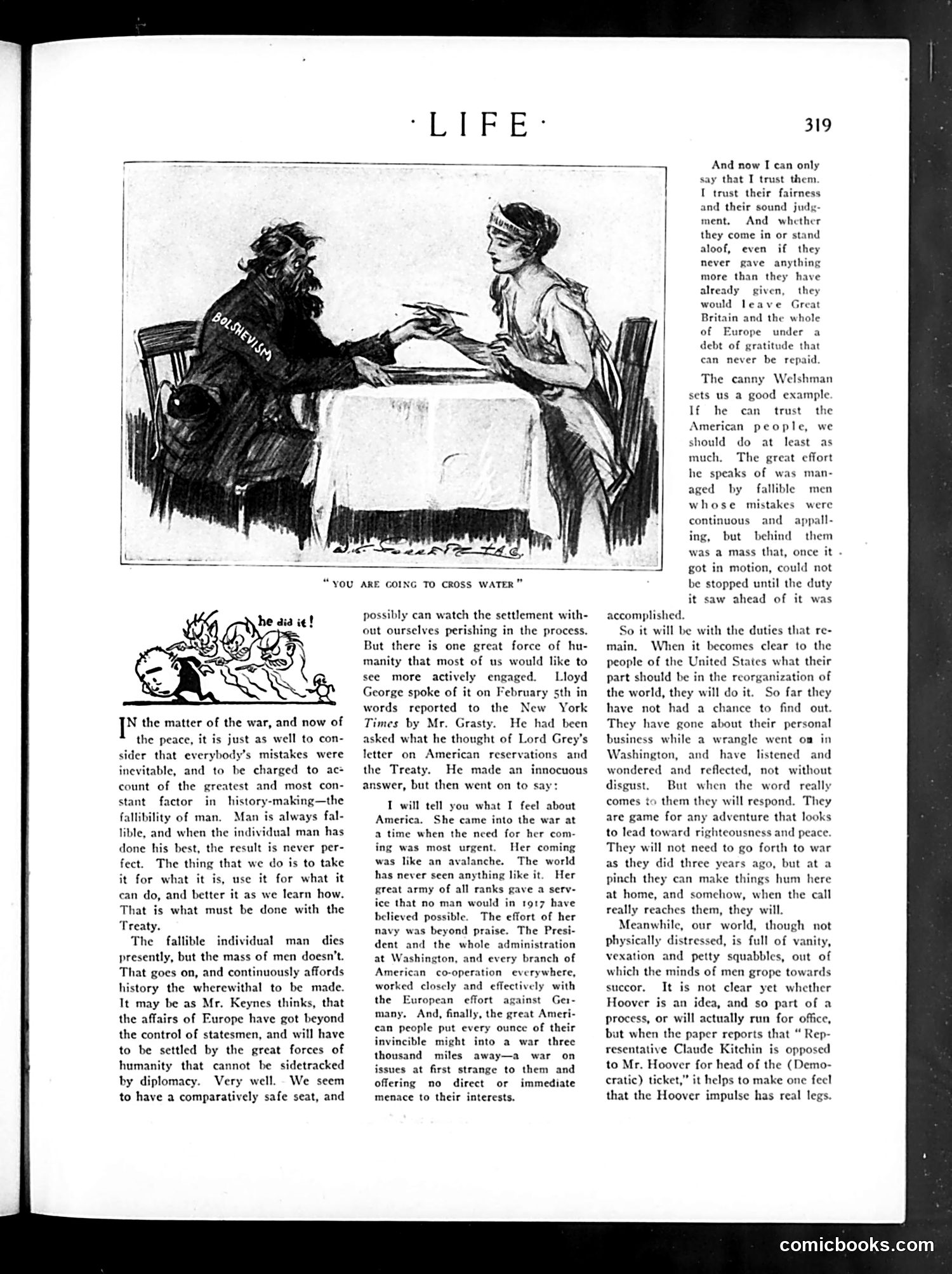
This page contains a cartoon and editorial commentary about post-World War I peace negotiations, likely from 1919. **The Cartoon**: Shows two figures at a table labeled "YOU ARE GOING TO CROSS WATER." The figure on the left appears to be labeled "BOLSHEVISM" based on visible text, facing a younger man across the table—likely representing America or an American negotiator. **The Text's Context**: The editorial discusses Lloyd George's February 5th remarks praising America's massive military and industrial contribution to WWI. It argues Americans should trust their leaders to reorganize post-war Europe, and that American public opinion will ultimately guide policy decisions. **The Satire**: The cartoon likely satirizes negotiations with Bolshevik Russia or concerning communist influence in post-war Europe. The "crossing water" reference suggests America considering direct involvement in European communist/political upheaval. The juxtaposition suggests tension between American idealism and revolutionary ideology. The page reflects American anxiety about their proper role in reshaping Europe while managing new ideological threats.
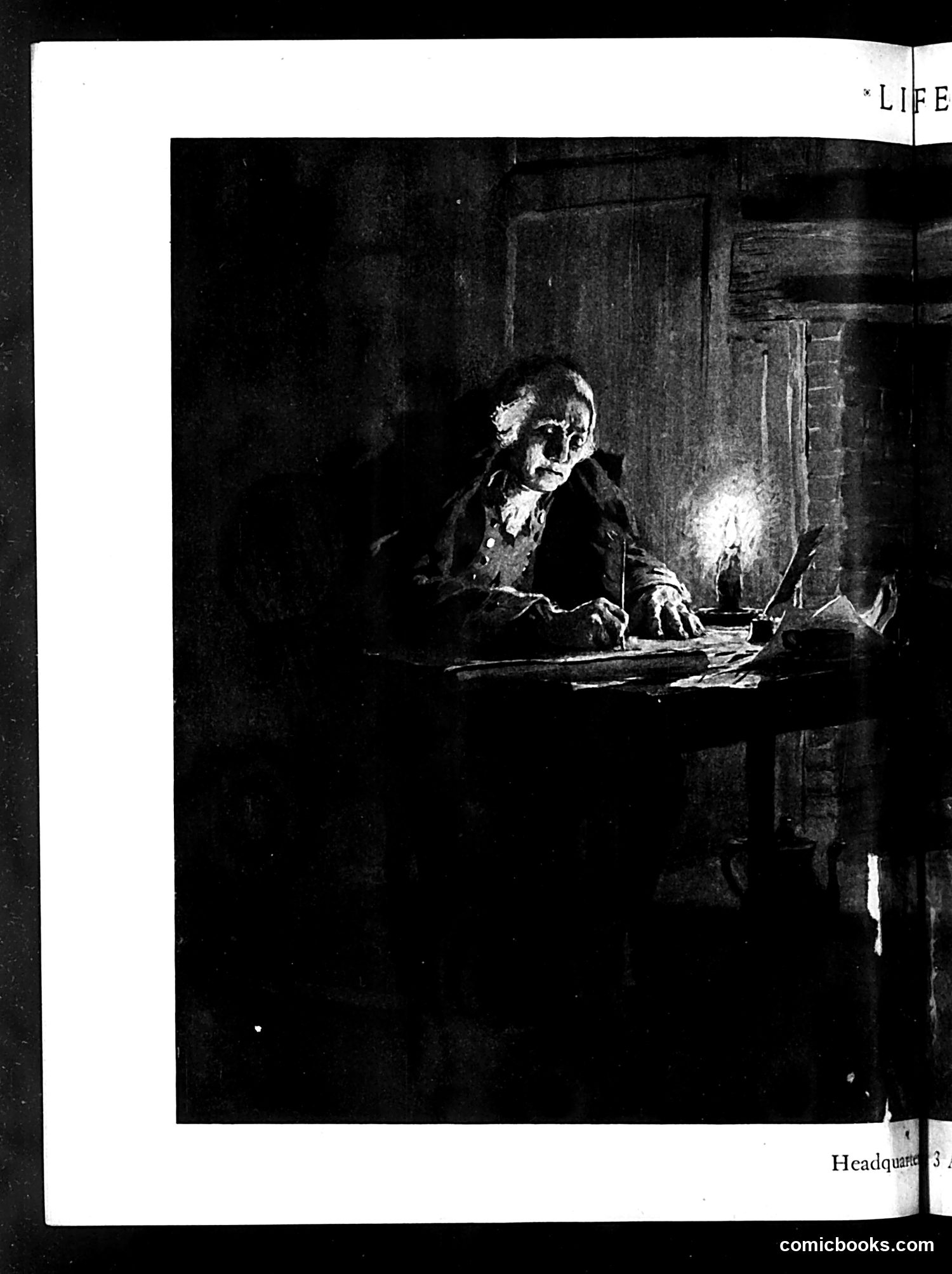
This appears to be a dramatic illustration from *Life* magazine showing an elderly man hunched over a desk by candlelight, writing or working on documents. The figure has white hair and wears dark clothing, positioned in a dimly lit, shadowy interior setting that evokes mystery or secrecy. Without additional visible text identifying the specific figure or historical context on this page, I cannot definitively state who this represents or what political/social commentary the image intends. The dramatic lighting and solitary workplace suggest themes of dedication, burden, or clandestine activity—common subjects for satirical commentary—but the exact reference remains unclear from the image alone. The page footer reads "Headquar[ters]" (cut off), but this provides insufficient context for interpretation.
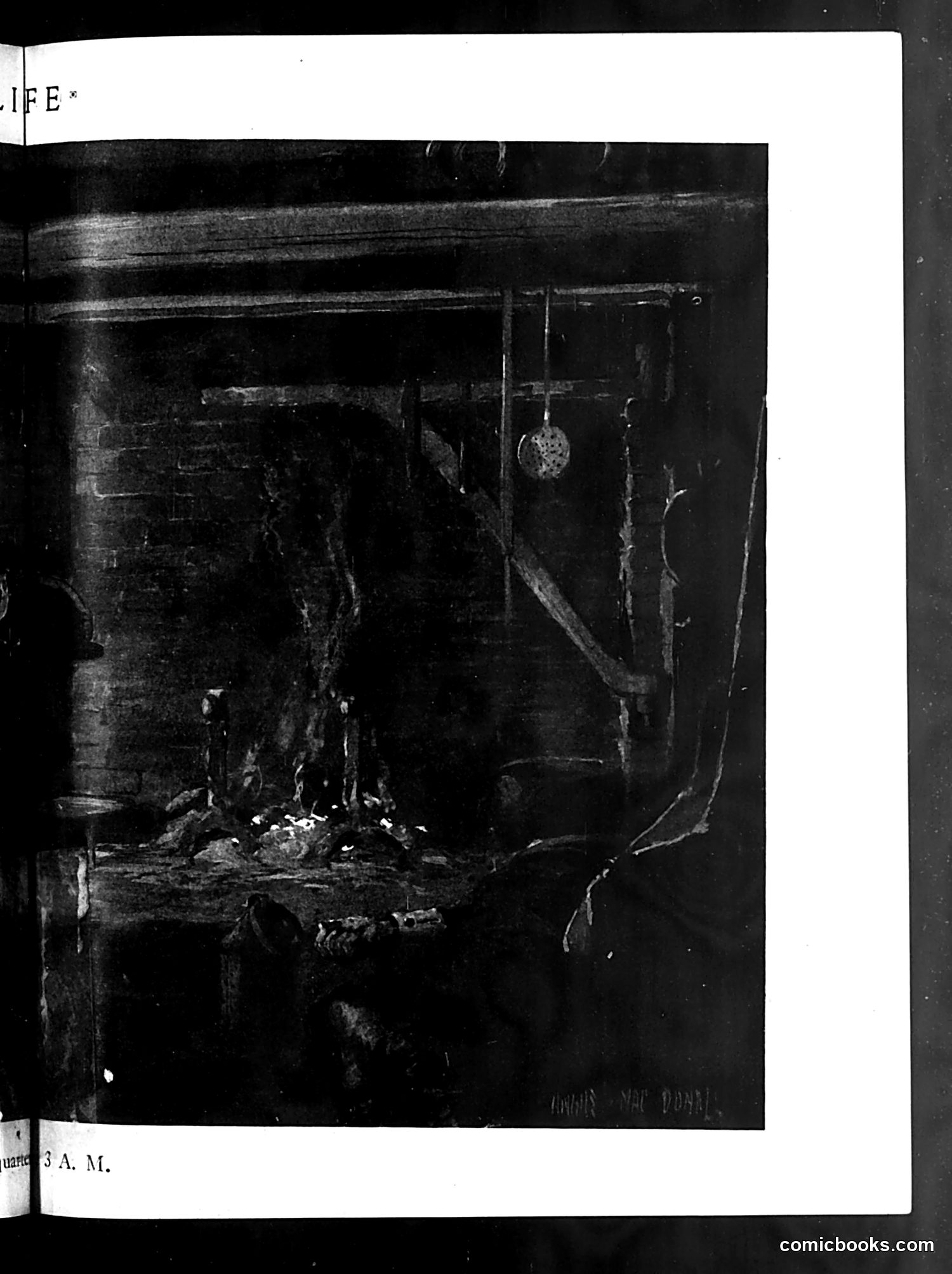
I can see this is a dark, high-contrast black and white photograph or illustration showing what appears to be an interior architectural space with structural elements like beams and walls. However, the image quality is quite poor—extremely dark with limited visible detail—making it difficult to identify specific figures, caricatures, or satirical content with confidence. The OCR text only shows "comicbooks.com," which appears to be a watermark rather than page content. Without legible text or clearer imagery, I cannot reliably identify what political or social commentary this page contained or who any figures might represent. To provide accurate historical analysis as you've requested, I would need either a clearer image or the actual OCR'd text from the page.
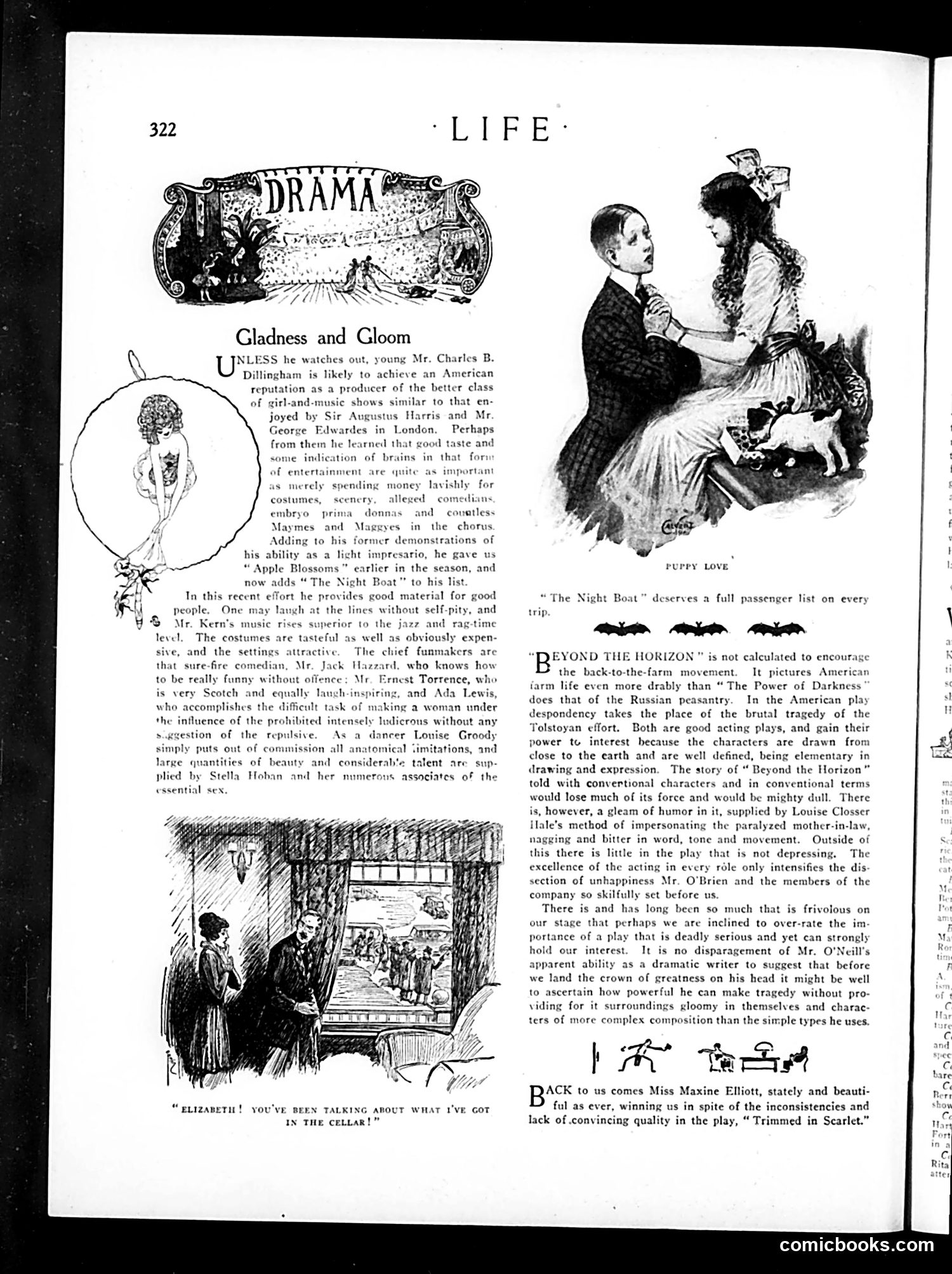
This page reviews three Broadway productions. The main cartoon depicts a cellar scene with the caption "Elizabeth! You've been talking about what I've got in the cellar!"—a joke about Prohibition (the alcohol ban in effect 1920-1933). Someone has been gossiping about hidden liquor. The reviews discuss: 1. **"The Night Boat"** by Charles B. Dillingham—a musical praised for tasteful humor, good music by Mr. Kern, and talented performers including Jack Hazzard and Ada Lewis, who plays a woman "under the influence of the prohibited" (drunk) without being offensive. 2. **"Beyond the Horizon"**—described as bleak, depicting American farm life grimly. The reviewer notes it's well-acted but questions whether its relentless depression warrants calling it great drama. 3. **"Trimmed in Scarlet"**—featuring actress Maxine Elliott, criticized for inconsistencies despite her charm. The page exemplifies how Prohibition-era theater addressed forbidden alcohol humorously while serious drama tackled rural American despair.
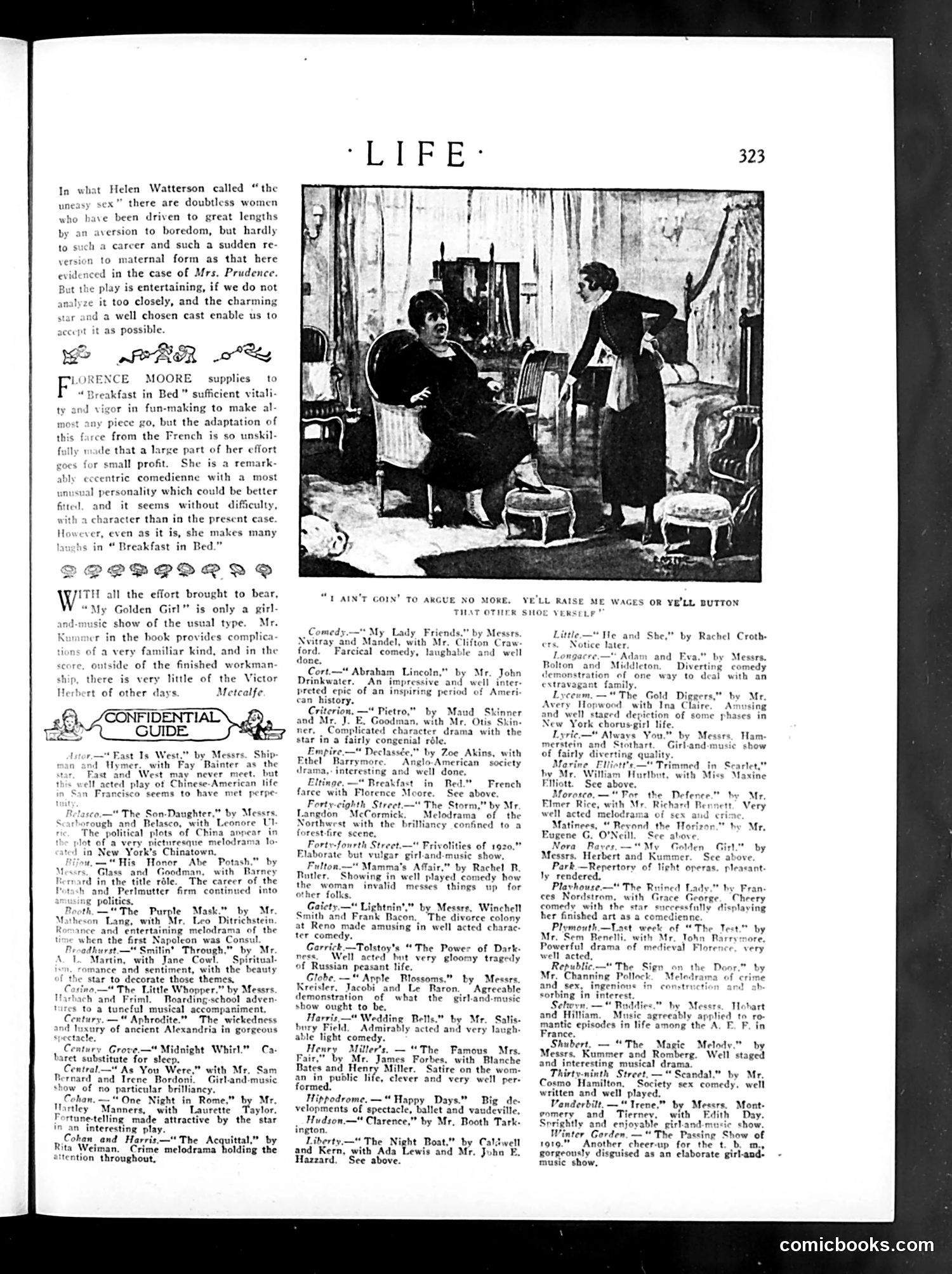
This page reviews theatrical productions on Broadway, with a photograph illustrating a scene from "Breakfast in Bed," a French farce starring Florence Moore. The image shows two women in period dress in what appears to be a bedroom setting, with the caption quoting dialogue: "I ain't goin' to argue no more. Ye'll raise me wages or ye'll button that other shoe yerself." The reviews are typical theater criticism of the era, praising or critiquing performances and productions. The satire is gentle—the critic notes that while Moore is a "remarkably eccentric comedienne," the French farce's adaptation is "unskillfully made," limiting her comic effectiveness. The page represents early 20th-century Broadway culture, when theater was a major entertainment form. Most productions listed are comedies, farces, and melodramas—popular genres of the period. The reviews assume readers are familiar with Broadway venues and performers, indicating Life's audience was urban and theater-going.
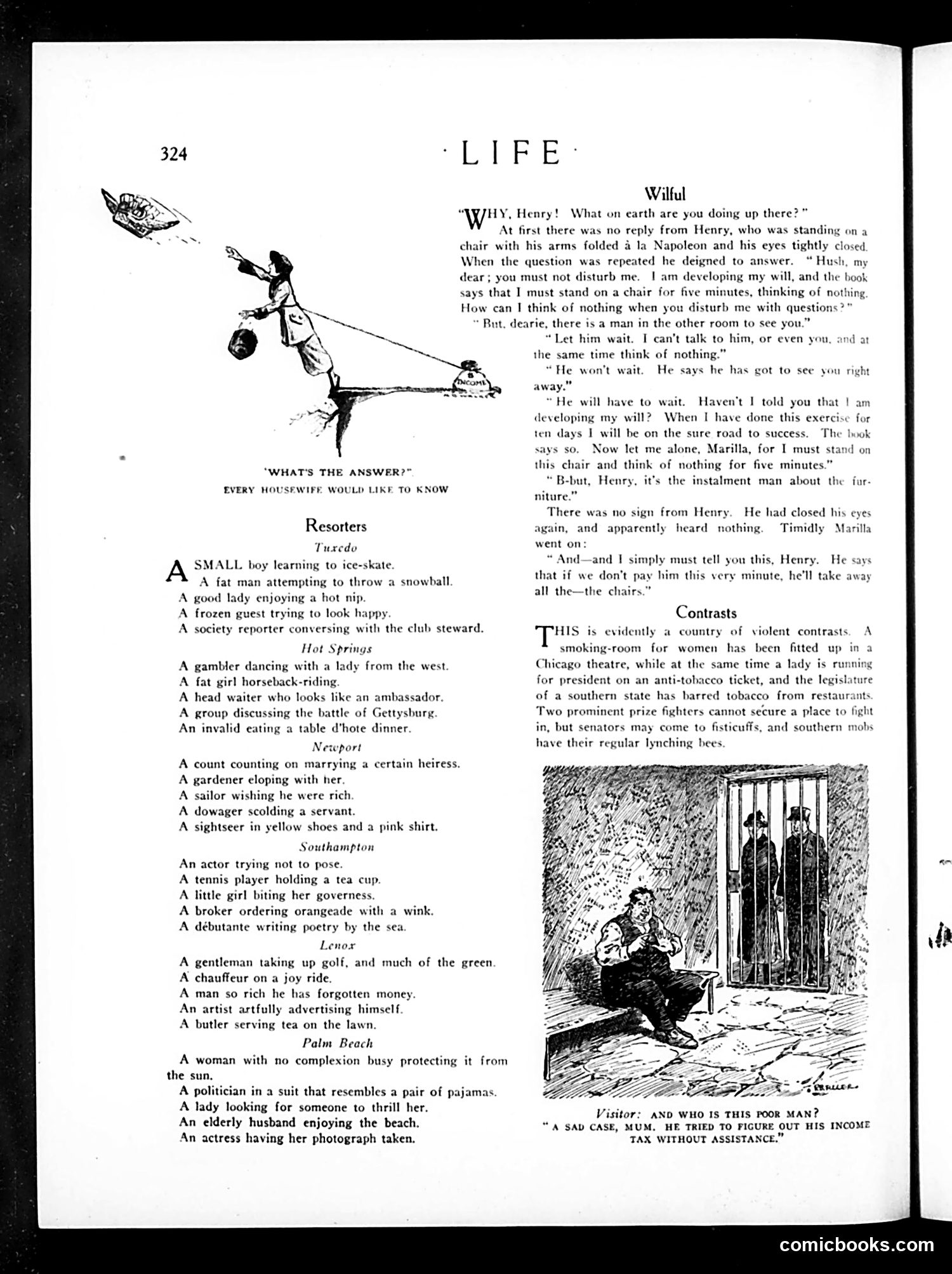
**Main Cartoon ("Wilful"):** Henry stands on a chair in Napoleon pose, attempting to "develop his will" by thinking of nothing for five minutes—a self-help exercise popular in the early 1900s. His wife Marilla interrupts repeatedly with increasingly urgent news: a visitor waits, then an installment man demands payment for furniture. The joke satirizes both Henry's ridiculous self-improvement obsession and his obliviousness to real domestic problems. The punchline arrives when she finally threatens the furniture will be repossessed—the very chairs he stands on—yet he remains unmoved, embodying willful denial of financial reality. **"Resorters" Section:** Humorous observations of wealthy leisure-class vacationers at fashionable resorts (Tuxedo, Newport, etc.), highlighting their affectations and contradictions: actors who "try not to pose," rich men who've "forgotten money," overdressed sightseers. **"Contrasts" Section:** Commentary on American hypocrisy—smoking rooms for women coexist with anti-tobacco campaigns; senators fight in Congress while prize fighters are barred from fighting. **Lower Cartoon:** A servant explains a destitute man tried calculating his income tax without help—contemporary satire on newly complex (1913+) tax law.
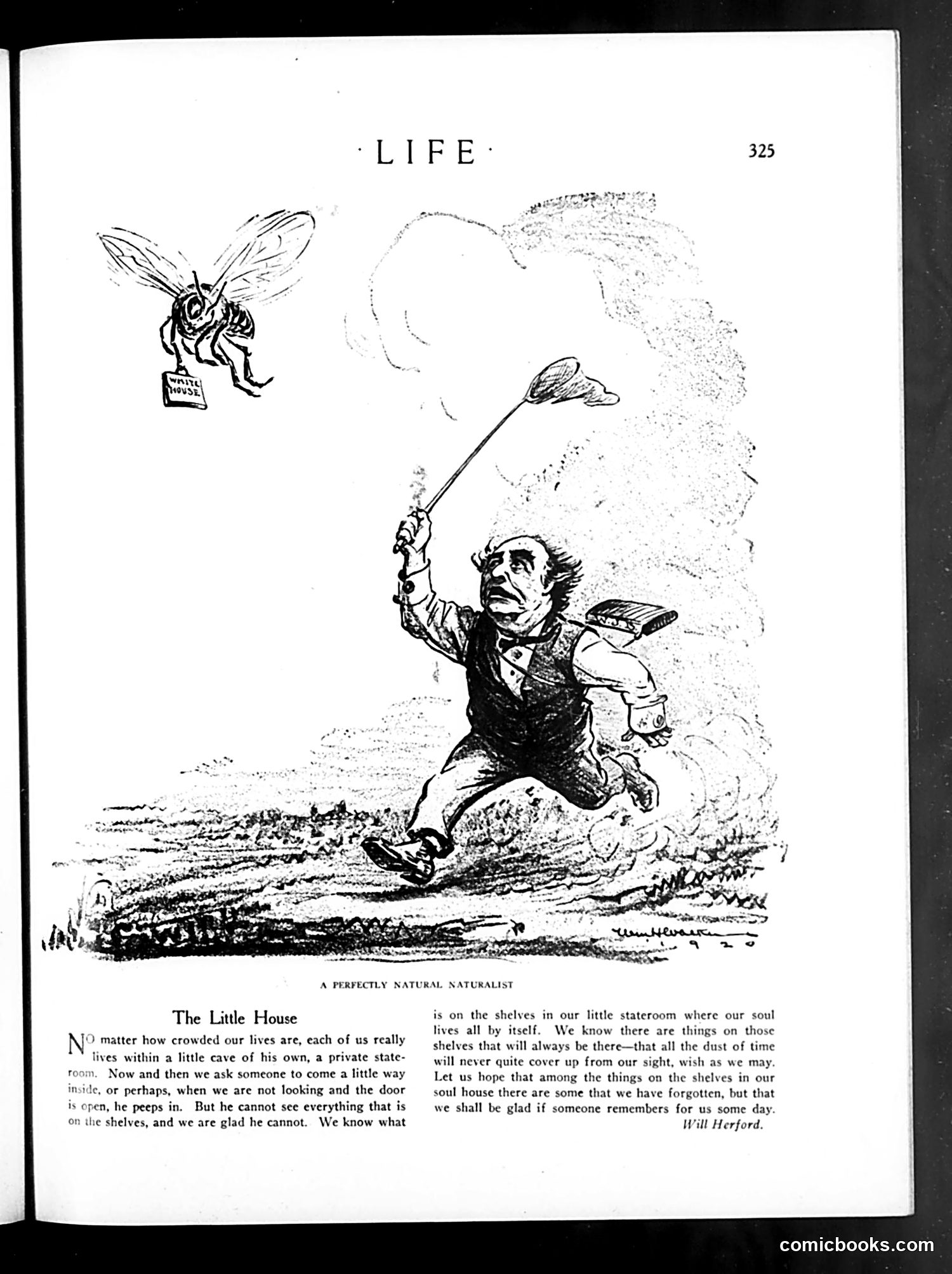
The cartoon depicts a man with a net chasing a bee labeled "LIFE," illustrating the essay "A Perfectly Natural Naturalist." The image is satirical commentary on how humans attempt to capture and control life itself—presented as an impossible, futile pursuit. The accompanying essay "The Little House" uses metaphor to discuss privacy and the inner self. It suggests each person maintains a private "stateroom" of the soul containing memories and thoughts—some shared, others deliberately hidden. The piece argues we should value forgotten memories that others might help us recover, emphasizing the interior emotional life we keep private from the world. Together, the cartoon and text suggest life cannot be pinned down or fully examined, much like the contents of one's inner house remain partially unknowable—even to ourselves.
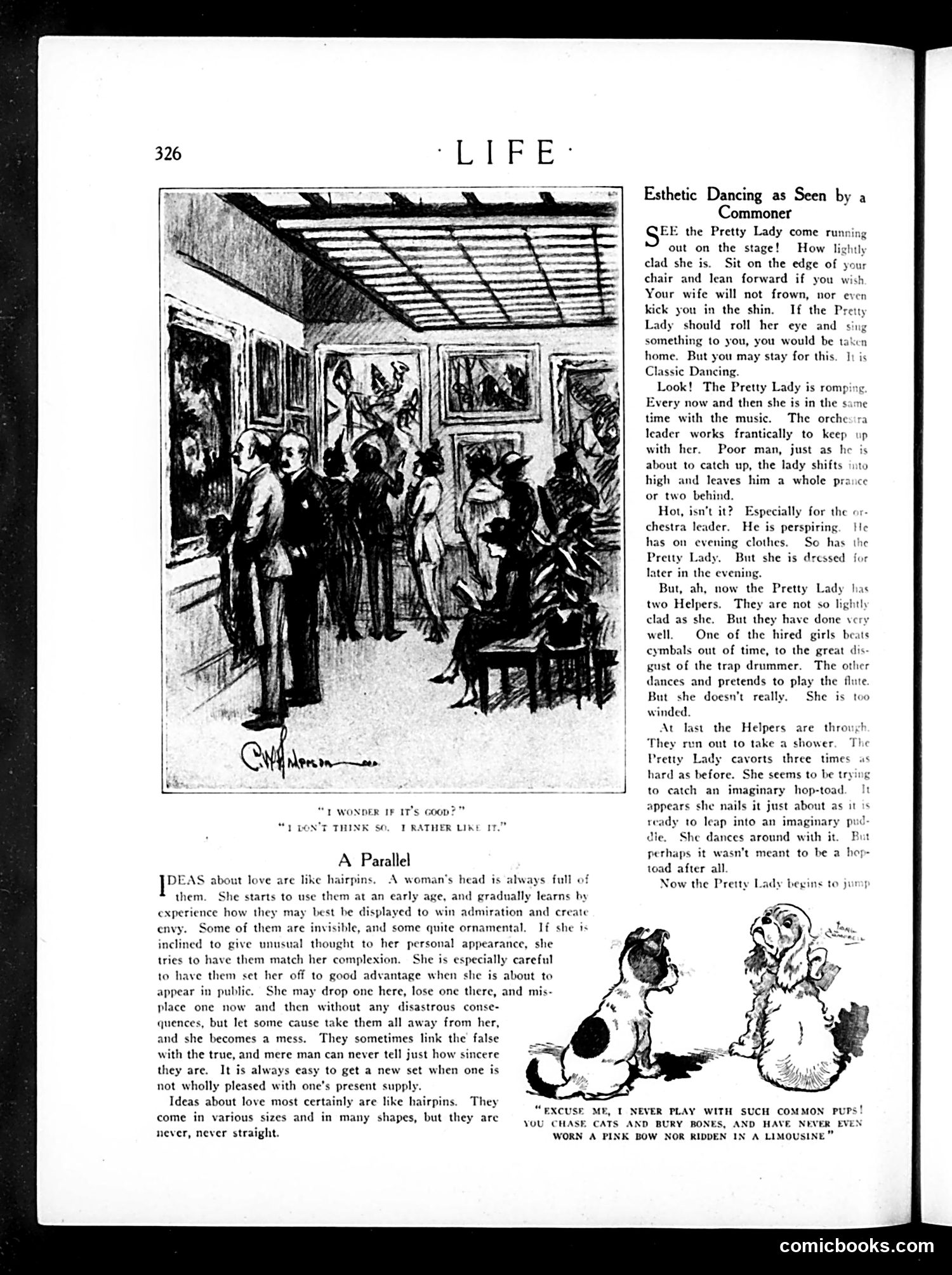
This page contains two satirical pieces mocking early 20th-century cultural pretensions. **"Aesthetic Dancing as Seen by a Commoner"** ridicules modern interpretive dance (likely referencing Isadora Duncan-style "free" dance). The narrator—positioned as an ordinary spectator—describes a scantily-clad "Pretty Lady" performer whose movements don't sync with the orchestra, leaving the exhausted conductor scrambling to follow her. The satire targets both the dancer's self-importance and the absurdity of the art form itself: she appears to be chasing an imaginary toad and pretending to play instruments she isn't actually using. The piece mocks this as pretentious nonsense dressed up as high art. **"A Parallel"** uses an extended metaphor comparing women's ideas about love to hairpins—decorative, variable, never straight, easily lost or replaced. It suggests women manipulate romantic notions for social advantage, much as they arrange hairpins for appearance. Both pieces use satirical exaggeration to critique contemporary fashions in art and gender relations, reflecting early 20th-century attitudes toward modernism and women.
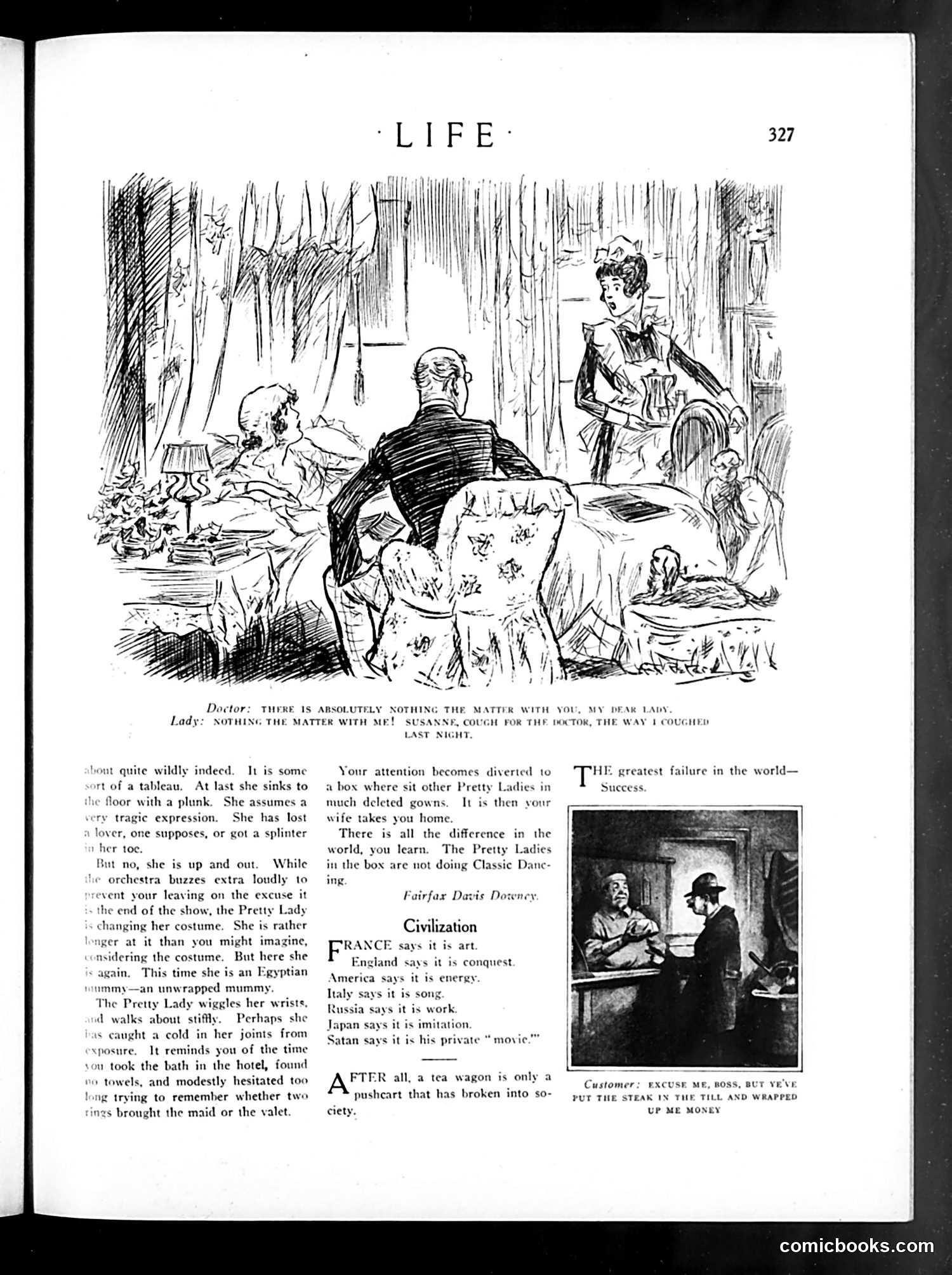
This page contains several brief satirical pieces typical of Life's humor: **Top cartoon**: A doctor reassures a hypochondriac woman that nothing is wrong with her—ironic, since she's visibly distressed. The satire mocks both malingering patients and doctors' perfunctory examinations. **"Civilization" piece**: A witty list where different nations define civilization through their values (France: art; England: conquest; America: energy; Russia: work; Japan: imitation). Satan's definition as "his private movie" suggests civilization itself is entertainment or delusion—darkly satirizing post-WWI disillusionment about Western progress. **Bottom cartoon**: A restaurant customer and cashier have switched items—money wrapped, steak in till—a visual gag about comic incompetence. **"Tea wagon" quip**: Social climbing humor: a lowly pushcart achieves respectability through rebranding as a "tea wagon." The page satirizes hypochondria, false civilization, and class pretensions—typical early-20th-century American magazine humor.
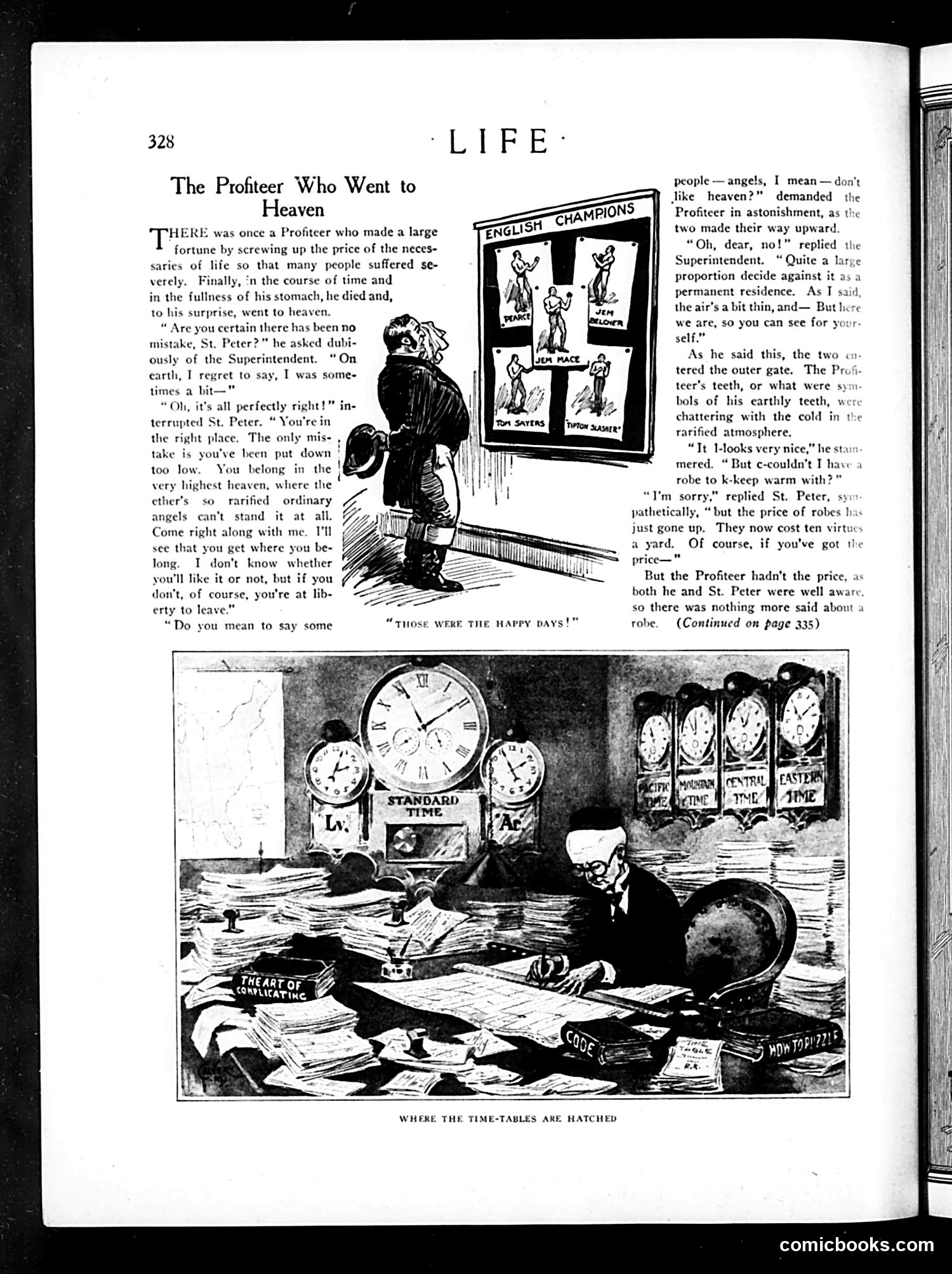
This is a satirical moral fable critiquing wartime profiteering. A wealthy businessman who made his fortune by inflating prices on necessities—causing public suffering—dies and goes to heaven. St. Peter places him in the coldest, highest heaven (where even angels avoid), then reveals the story's punchline: when the profiteer asks for a robe to stay warm, St. Peter informs him robes now cost "ten virtues a yard"—the profiteer has no virtues to pay with, having spent his earthly life pursuing profit over people. The satire works through ironic reversal: heaven uses the profiteer's own logic against him. What earned him wealth on earth (exploiting scarcity and desperation) leaves him helpless in the afterlife. The lower cartoon shows time-keeping mechanisms, likely referencing wartime efficiency or industrial production that enabled profiteering. The piece targets unscrupulous businessmen who exploited wartime shortages (likely WWI era, given Life magazine's context).
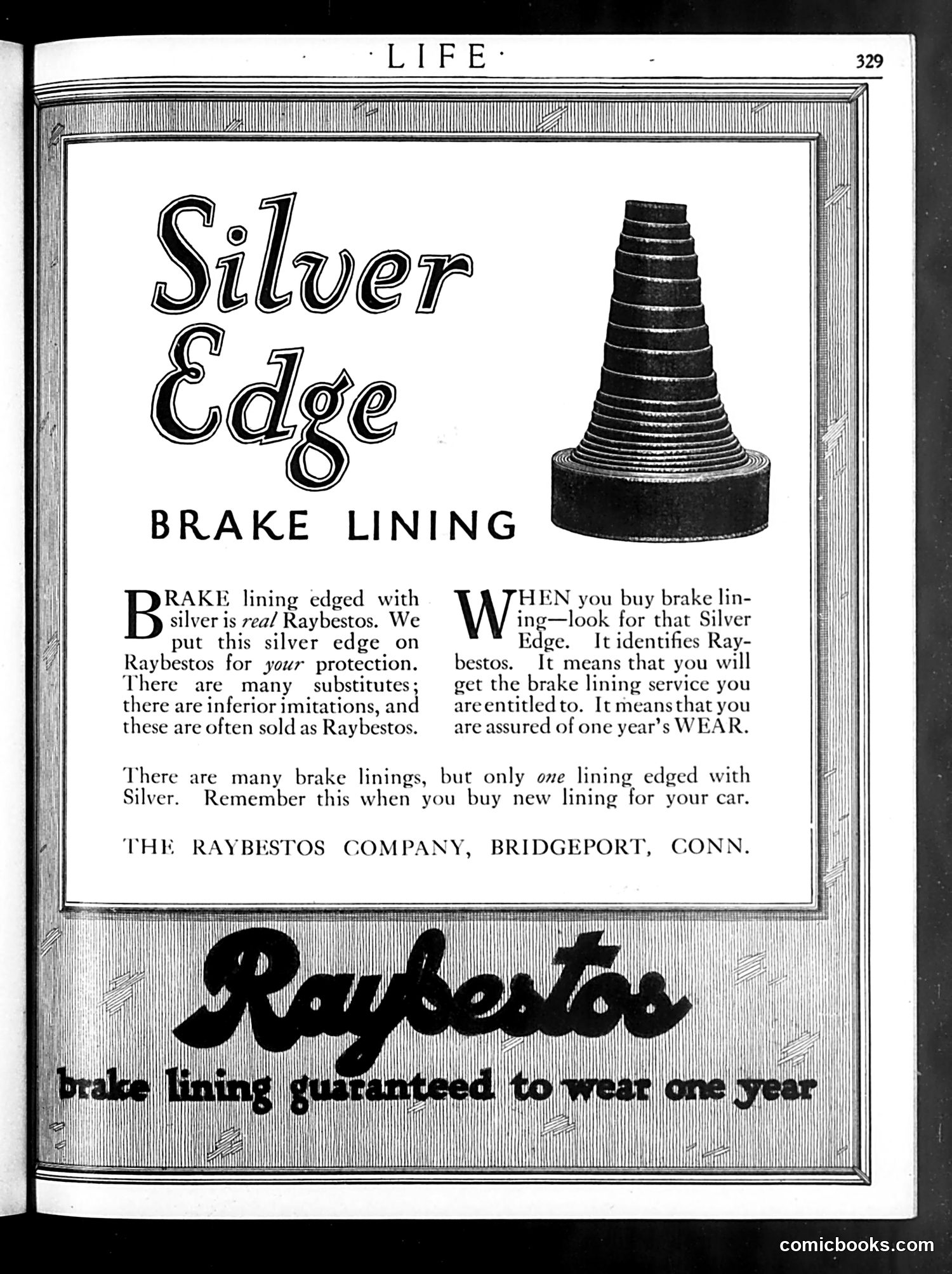
This is a **straightforward advertisement**, not a political cartoon or satire. It's a Raybestos brake lining product ad from *Life* magazine (page 329). The page promotes "Silver Edge" brake linings, manufactured by The Raybestos Company of Bridgeport, Connecticut. The ad's message is practical and consumer-focused: Raybestos brand brake linings are distinguished by a silver-colored edge, which serves as an identifier to ensure customers receive genuine Raybestos products rather than inferior imitations or substitutes. The silver edge also guarantees one year's wear. The illustrated cone-shaped product shown is the brake lining itself. The ad emphasizes that while many brake linings exist, only Raybestos has this silver edge—a marketing strategy to help consumers identify authentic products in an era when counterfeits apparently were a concern. This reflects early 20th-century automotive commerce and brand differentiation tactics.
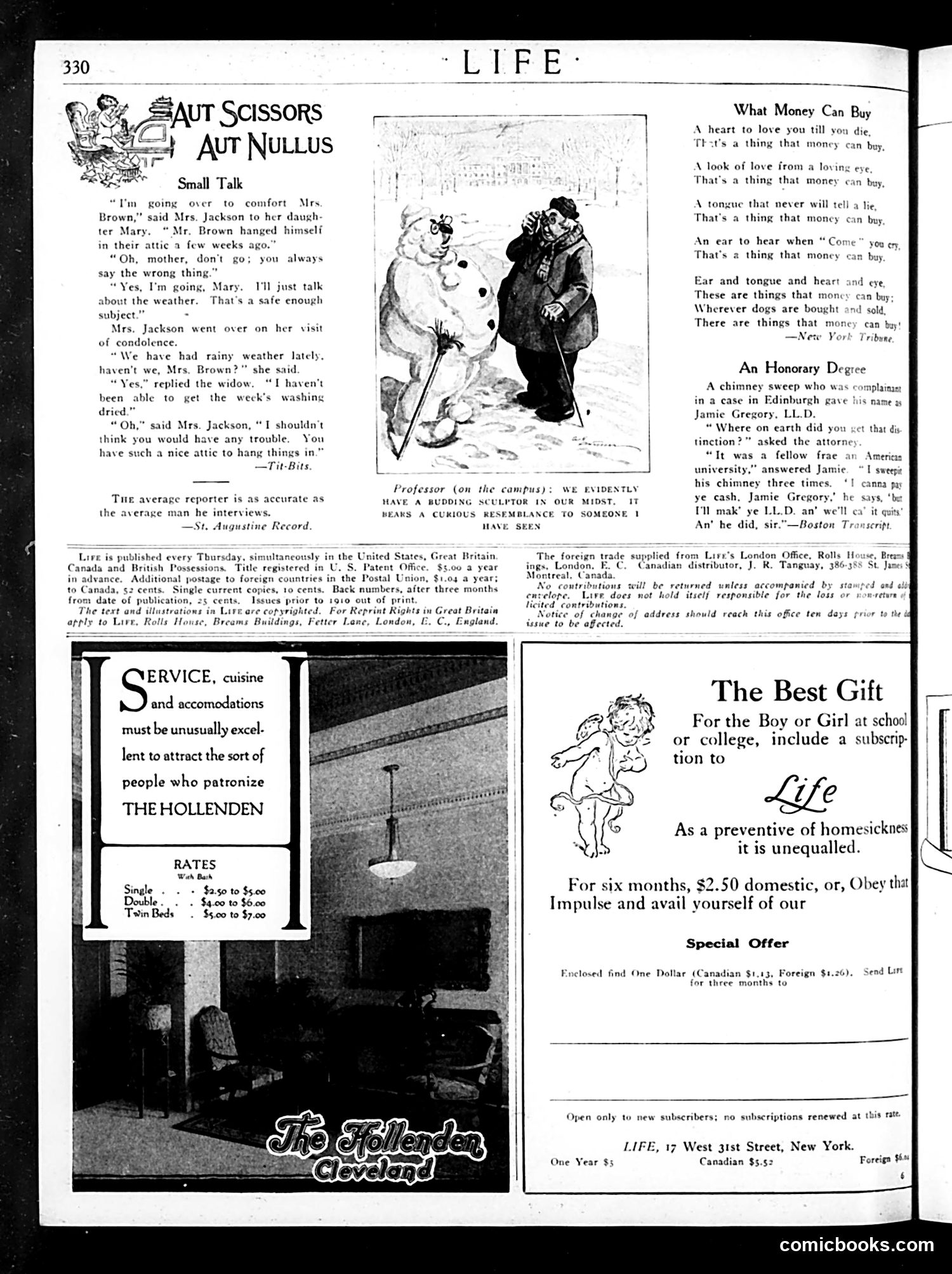
This is primarily a **humor and advertising page** from Life magazine. The main content includes: **"Small Talk" cartoon**: A dark-humor joke about social awkwardness. Mrs. Jackson visits a widow whose husband recently hanged himself in the attic. Despite promising to discuss only safe topics like weather, she catastrophically says the widow can use the attic to hang laundry—unknowingly referencing the suicide method. The satire mocks people who say tactless things while trying to comfort grieving friends. **"What Money Can Buy" poem**: A sentimental piece (credited to New York Tribune) listing things money supposedly cannot purchase—love, genuine affection, honesty—before the punchline: dogs are bought and sold, implying they possess these qualities better than humans. **Other brief humor pieces** mock inaccurate reporters and feature a Scottish chimney sweep receiving an honorary LL.D. degree as payment from an American. The page is otherwise filled with **advertisements** for The Hollenden hotel and Life magazine subscriptions, positioned as ideal gifts for schoolchildren to prevent homesickness.
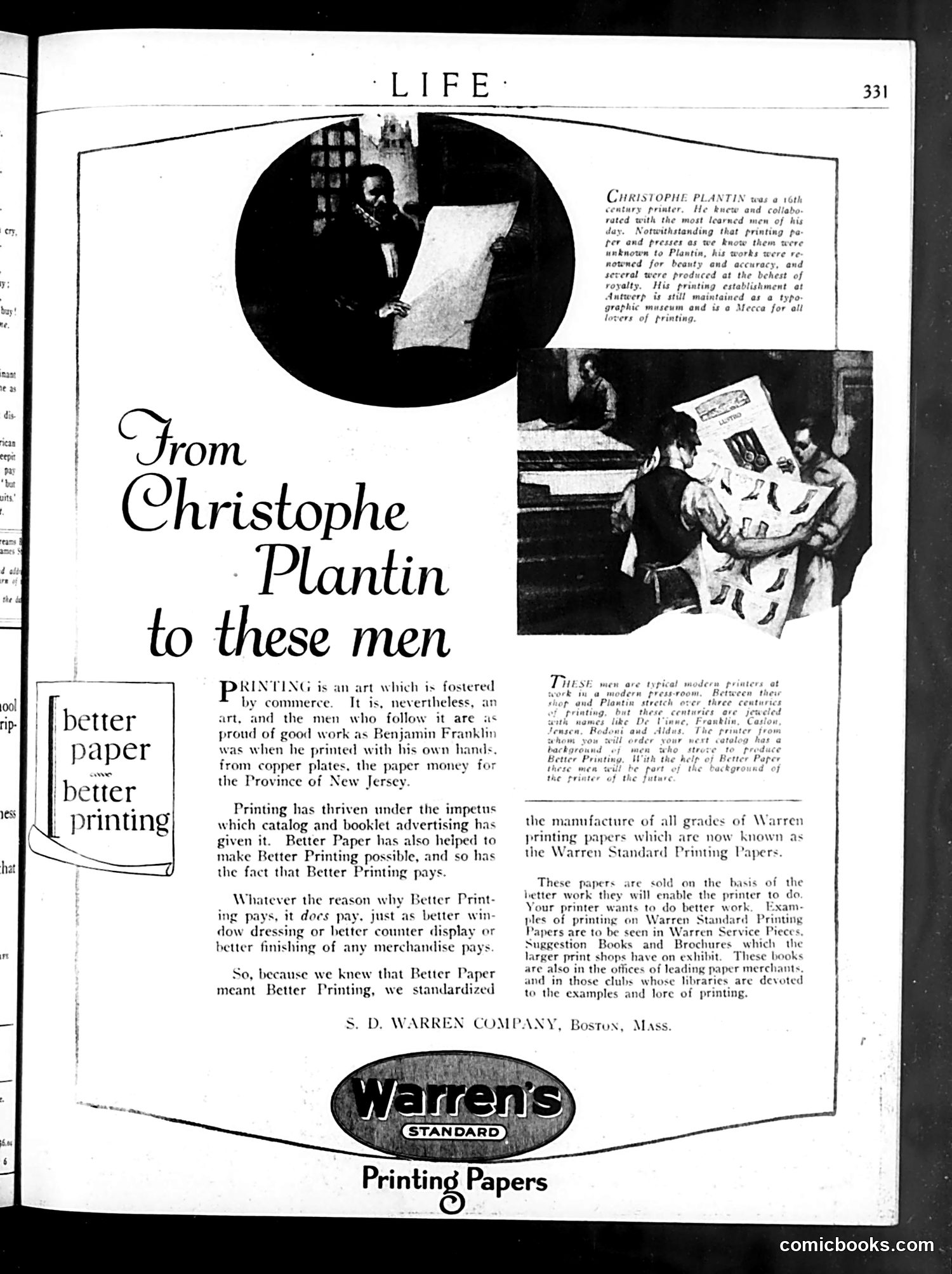
This is primarily **advertising**, not satire or political commentary. The page promotes Warren Standard Printing Papers by S.D. Warren Company of Boston. The ad uses **historical prestige** to sell paper. It invokes Christophe Plantin, a renowned 16th-century printer whose establishment still operates as a museum, and Benjamin Franklin, America's founding-era printer who printed New Jersey currency. The implicit argument: quality paper enables quality printing, just as these historical figures produced excellent work. The photographs show modern printers at work, positioning contemporary craftsmen within this honorable lineage. The ad emphasizes that "better paper" enables "better printing," and that printers take professional pride in their work—connecting consumer purchasing decisions to artisanal values. This reflects early-20th-century advertising strategy: associating commercial products with historical achievement and craft tradition to justify premium pricing and quality standards.
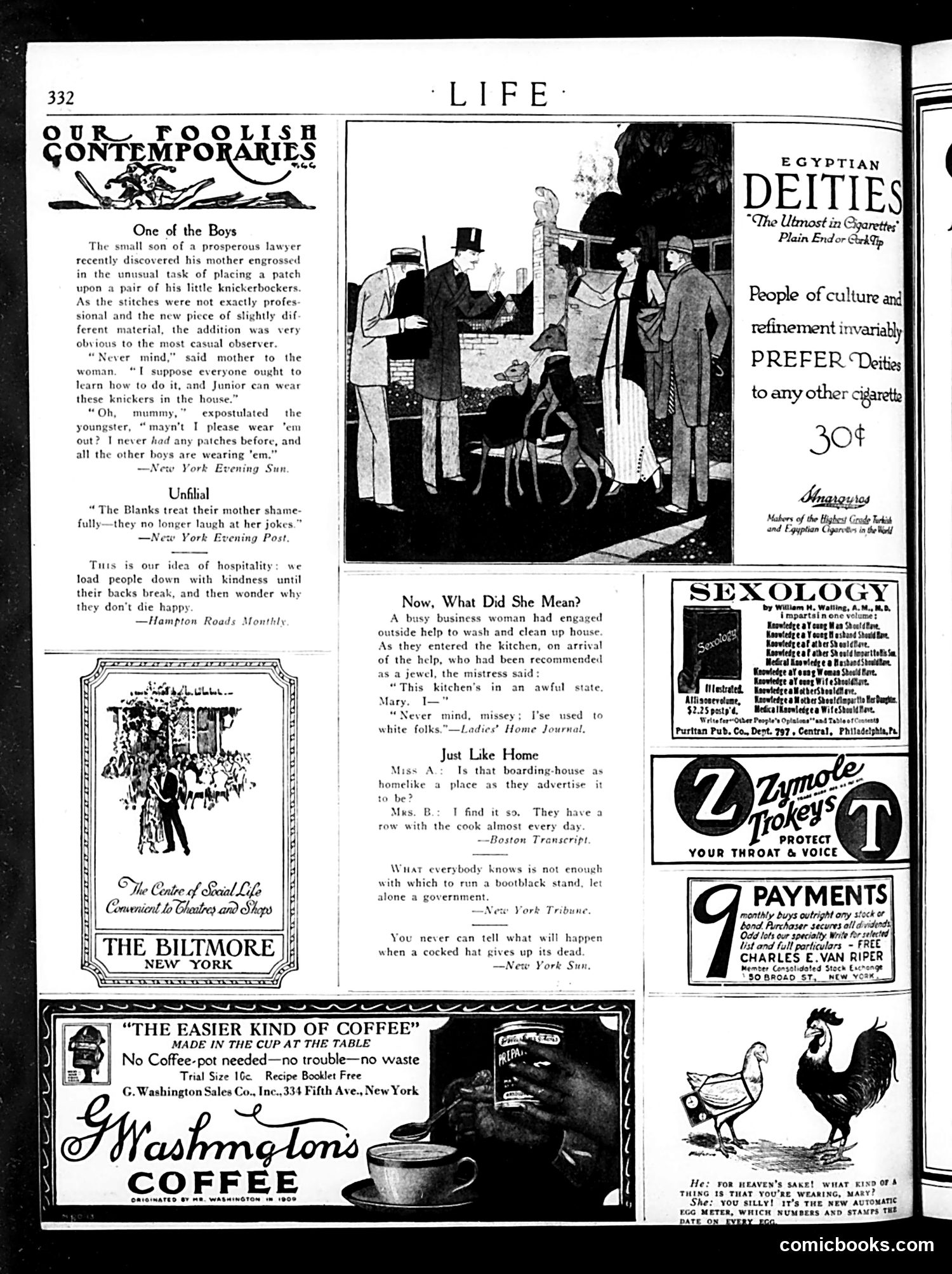
This page contains several short satirical humor pieces typical of early 20th-century American magazines: **"One of the Boys"** mocks a child's inverted class consciousness—a lawyer's son is proud to wear patched knickers because "all the other boys are wearing 'em,'" inverting the usual shame about visible mending. **"Now, What Did She Mean?"** plays on racial dialect humor (problematic by modern standards). A Black maid's response "I'se used to white folks" to the mistress saying "This kitchen's in an awful state" is meant to suggest the maid is accustomed to white people creating mess. **"Just Like Home"** jokes that a boarding house achieves "homelike" qualities through domestic discord—they argue with the cook daily, like a real home. The remaining pieces are brief one-liners and advertising. The page is predominantly composed of short jokes and commercial ads rather than a single coherent cartoon.
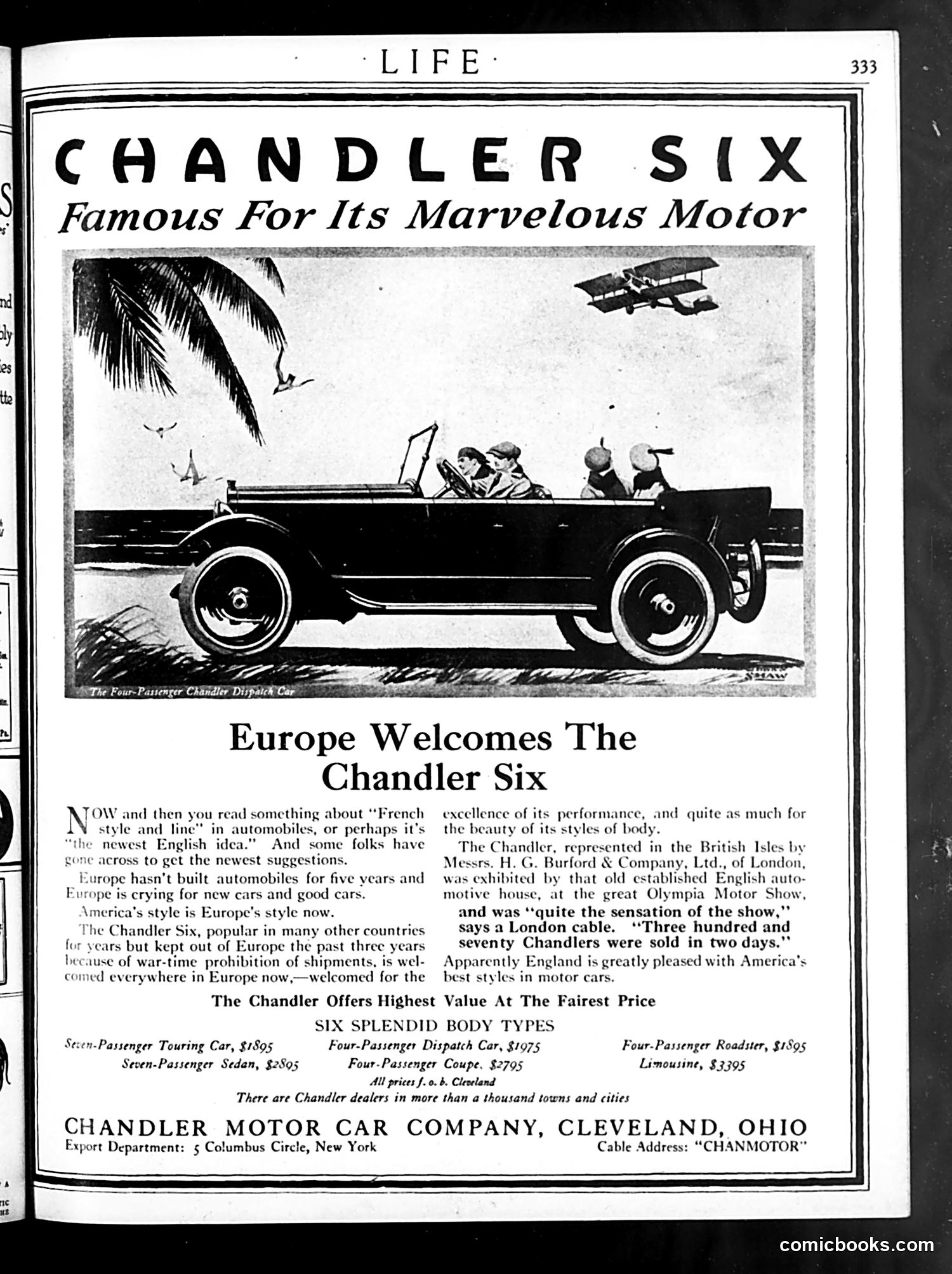
This is primarily a **automobile advertisement**, not political satire. The page promotes the Chandler Six motor car from Cleveland, Ohio. The text frames American automotive superiority in post-WWI context: Europe stopped manufacturing cars during the five-year war and now eagerly imports American vehicles. The ad emphasizes that American design—not European "French style" or "English ideas"—now sets the global standard. The illustration shows a touring car with passengers and an airplane overhead, conveying modernity and aspiration. The claim that 370 Chandlers sold in two days at London's Olympia Motor Show functions as proof of American manufacturing dominance. The satire is subtle: the ad gently mocks Americans' previous insecurity about European automotive style while celebrating America's newfound industrial and cultural leadership in the postwar period.
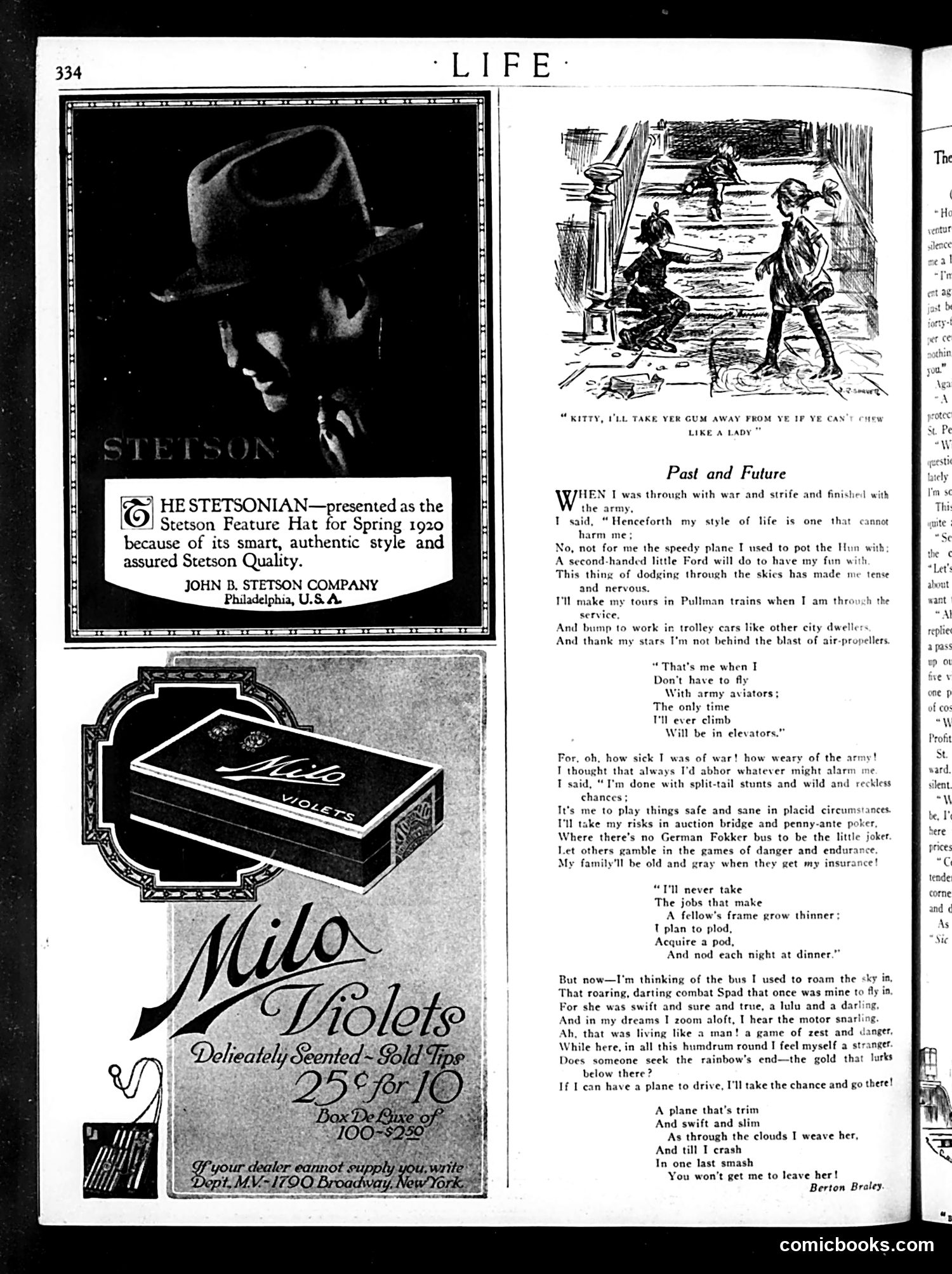
This page features a poem by Berton Braley about a demobilized WWI aviator struggling with peacetime. The soldier initially resolves to embrace safe, ordinary civilian life—trolleys, poker, insurance—after the trauma of combat flying. However, he grows restless in "humdrum" routine and fantasizes about returning to his wartime pursuit: piloting a fighter plane ("Spad"). The satire captures a genuine post-WWI anxiety: soldiers trained for danger and excitement found civilian life dull and constraining. His romanticization of aerial combat (despite earlier claims of exhaustion) reflects how wartime experiences warped veterans' sense of normalcy. The poem suggests that even those desperate to escape war's trauma couldn't fully readjust—the adrenaline and purpose of military service proved psychologically addictive compared to ordinary work and domesticity. The page also includes period advertisements (Stetson hats, Milo Violets), typical of *Life* magazine's format.
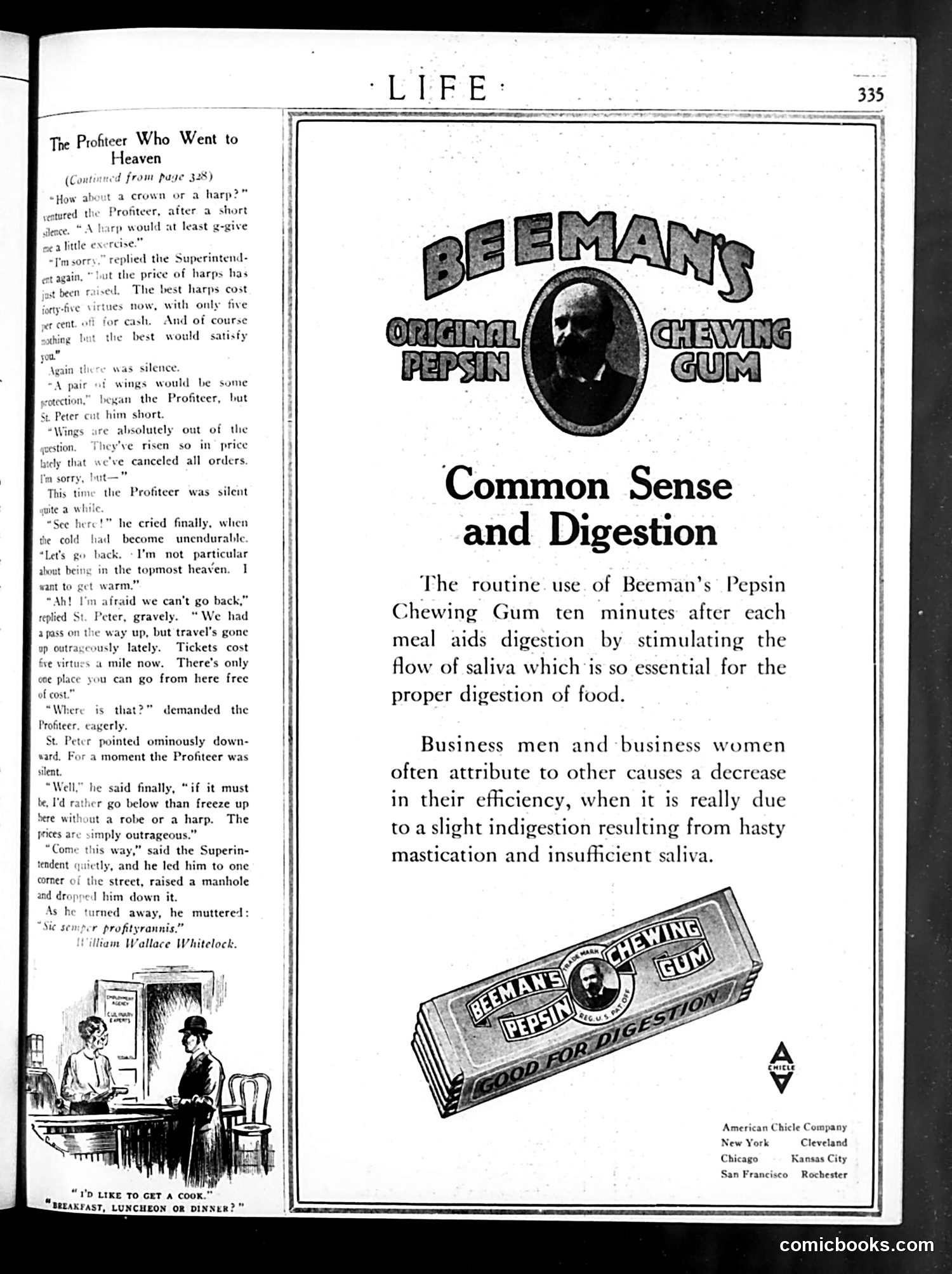
This page combines two distinct elements: a satirical story and a product advertisement. **The Story ("The Profiteer Who Went to Heaven"):** A morality tale mocking wartime profiteers—businessmen who exploited shortages to raise prices dramatically. The protagonist dies and finds even heaven's amenities (harps, wings, crowns) are now unaffordable due to inflation he caused. St. Peter ultimately sends him to hell, concluding with the Latin phrase "Sic semper profityrannis" ("Thus always to tyrants"). The satire targets greedy wartime merchants who exploited scarcity. **The Advertisement:** Beeman's Pepsin Chewing Gum occupies the right half, claiming the product aids digestion by stimulating saliva. It targets "business men and business women" whose efficiency suffers from poor digestion—an ironic placement beside a story condemning profiteers, though the ad itself makes no such critique. The juxtaposition is typical of *Life*'s satirical format: pointed social commentary paired with period advertising, creating unintended comedic contrast.
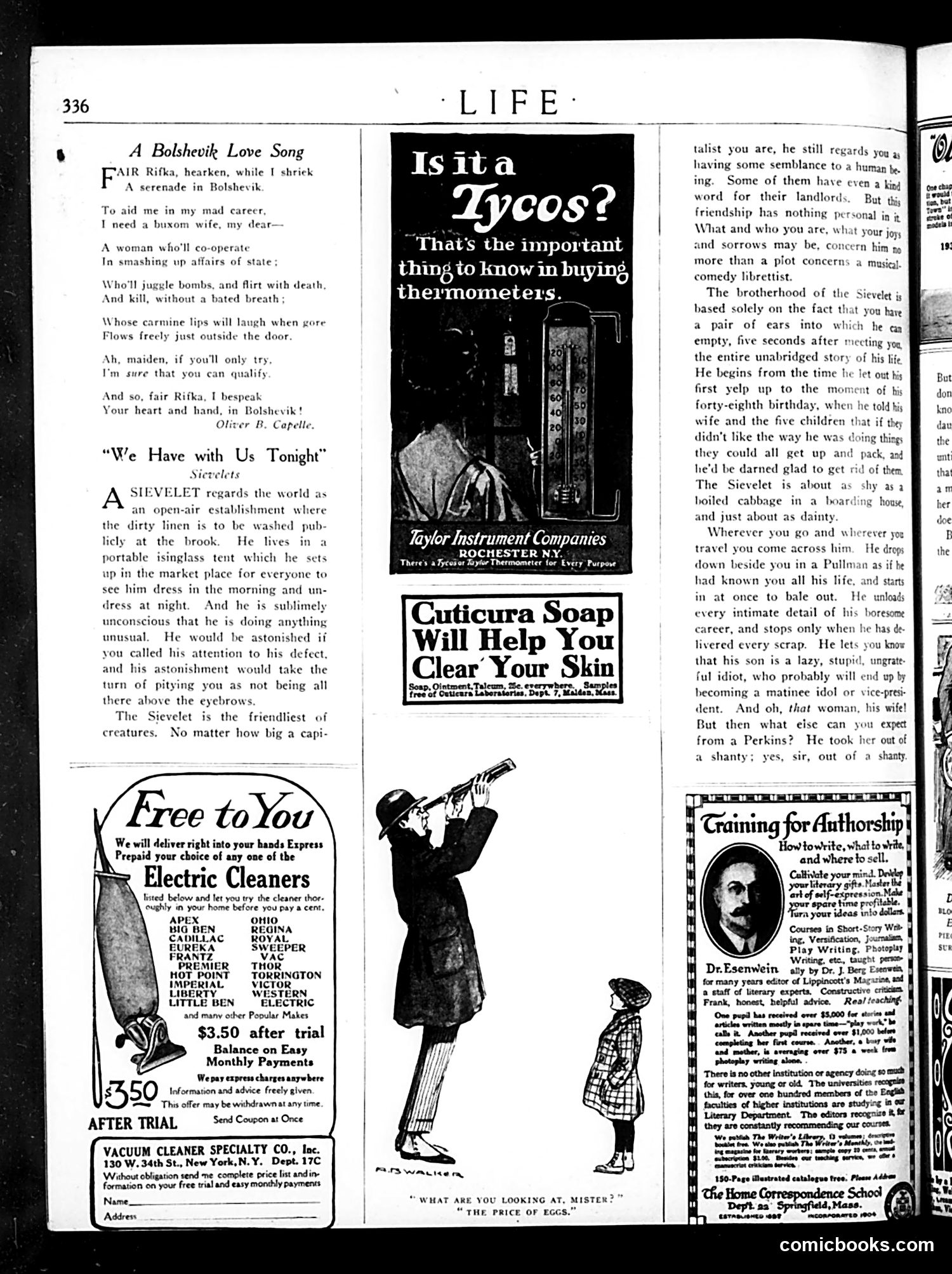
This page combines satire with period advertising. The main satirical content is **"A Bolshevik Love Song,"** which mocks Bolshevik revolutionaries (Russian communists) through crude stereotype. The poem presents a caricatured "Bolshevik" suitor seeking a violent, bomb-juggling wife—exaggerating contemporary American fears about communist ideology and revolutionary violence circa the Red Scare era. The other satirical piece, **"We Have with Us Tonight,"** describes the "Sievelet"—apparently a type of bore who monopolizes conversation and reveals intimate life details to strangers. This is observational social humor about annoying personality types. The page is otherwise dominated by **advertisements** (vacuum cleaners, soap, thermometers, authorship courses)—typical of Life's mixed editorial-advertising format. The small cartoon at bottom shows a man and boy; the caption joke "What are you looking at, mister? The price of eggs" likely references economic anxiety or inflation concerns of the period.
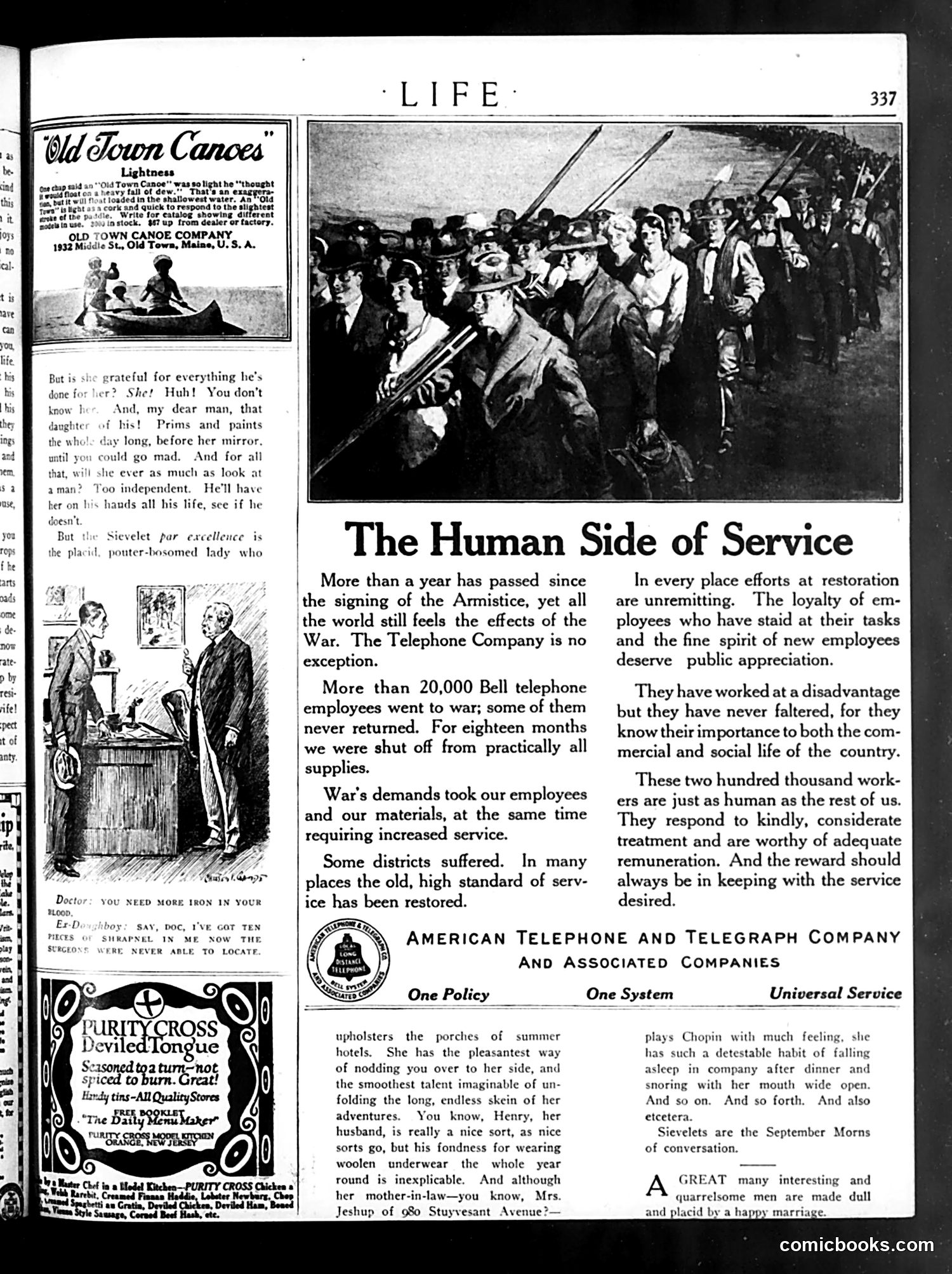
This page mixes **advertisements and editorial content** with period satirical cartoons. ## The Cartoons: The left side contains **two separate domestic humor comics**: 1. **Top cartoon**: A man complaining about his independent daughter—she spends all day primping before mirrors, shows no gratitude, and won't marry. The satire mocks both her vanity and his controlling expectations of daughters. 2. **Bottom cartoon ("Purity Cross")**: A doctor and patient exchange about shrapnel lodged in the patient's body since WWI. The humor comes from the casual acceptance of permanent war injuries as normal life. ## Main Article: "**The Human Side of Service**" is a **corporate tribute from AT&T**, acknowledging that over 20,000 telephone employees served in WWI (some never returning). It emphasizes worker loyalty despite wartime hardships and calls for "adequate remuneration"—essentially asking the public to appreciate telephone workers' sacrifices. ## Context: Written in 1919 (post-Armistice), this reflects America's transition from wartime to peacetime while grappling with returning soldiers' reintegration and labor's post-war expectations.
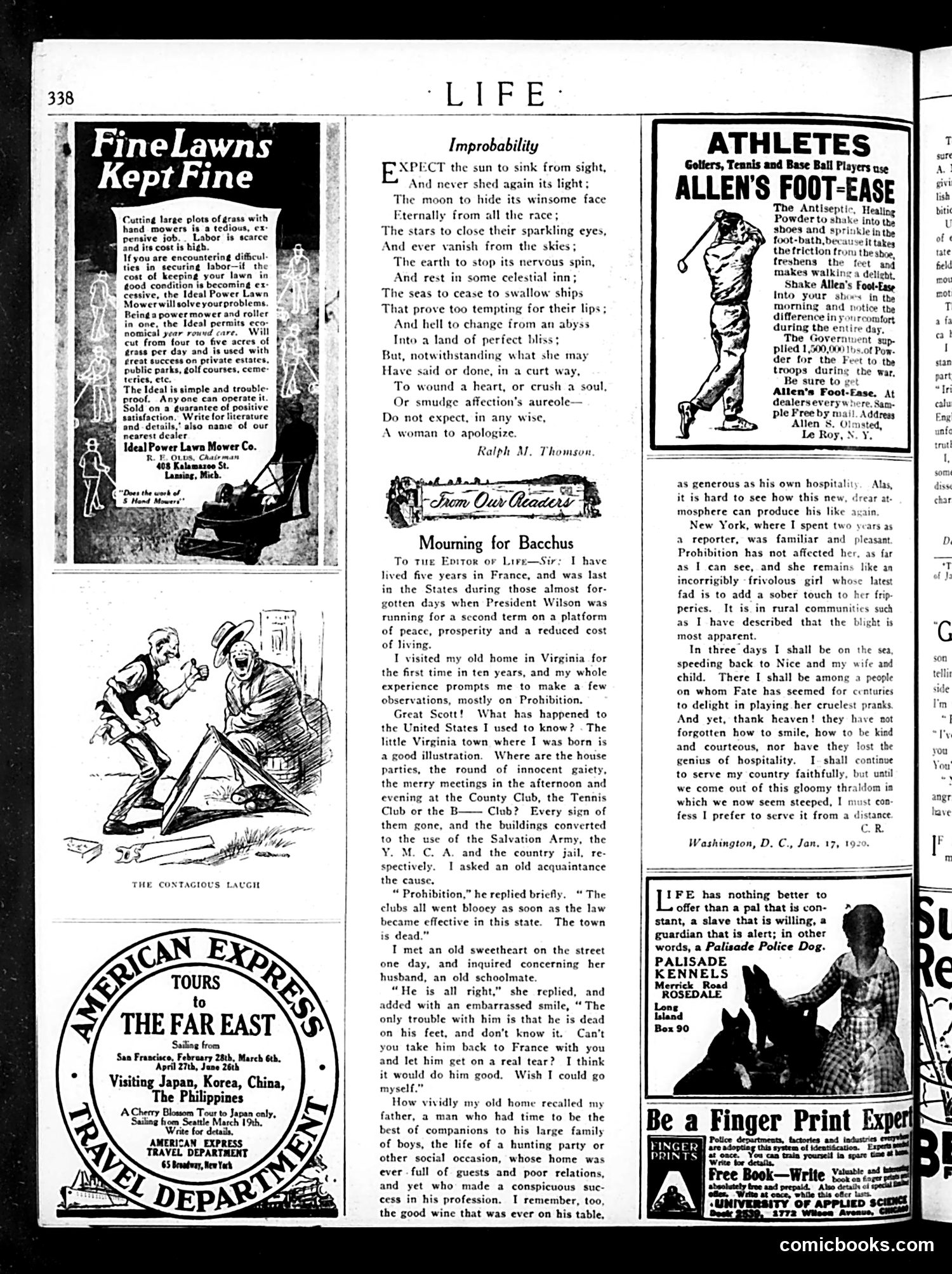
This page contains advertisements and poetry satirizing early Prohibition era America. The key content: **"Improbability" poem** by Ralph M. Thomson mocks women's refusal to apologize, using elaborate cosmic imagery (sun disappearing, earth stopping) to suggest a woman's apology is more impossible than natural laws reversing. **"Mourning for Bacchus" letter** is the page's main satire. A returning American expatriate laments Prohibition's effects on his Virginia hometown. He describes how social clubs ("the B—— Club" appears to reference a specific club) have closed or been converted to Salvation Army facilities. He contrasts this dead town with memories of his father's pre-Prohibition era—a man of professional success who hosted lavish gatherings with wine flowing freely. The satire targets Prohibition's devastating impact on American social life and hospitality traditions. "Bacchus" (Roman god of wine) references the loss of drinking culture. The piece nostalgically portrays pre-1920 America as more vibrant and convivial, implicitly criticizing the new dry law as destructive to community life. The surrounding advertisements for lawn mowers and travel tours provide commercial context typical of Life's format.
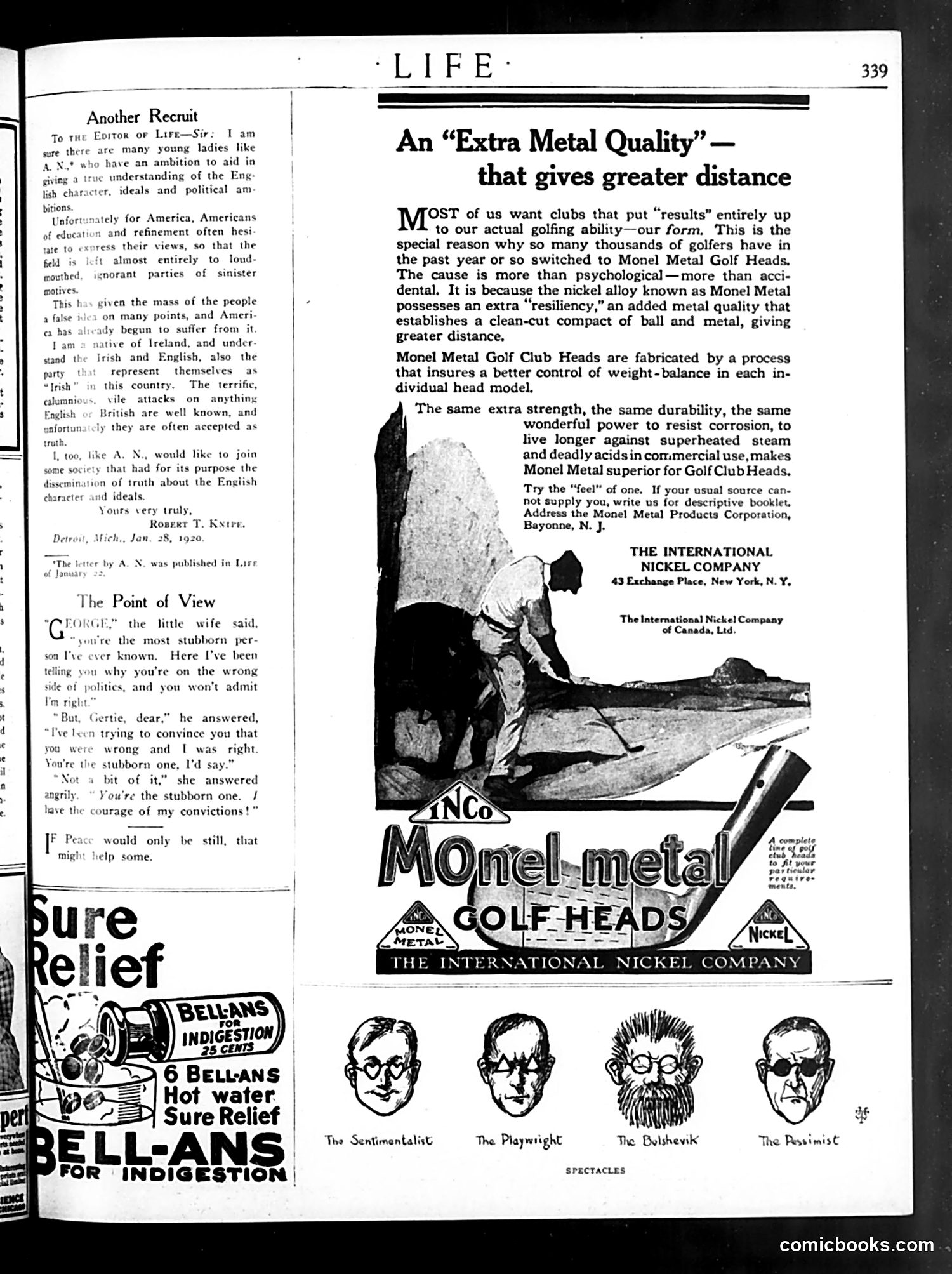
This page mixes reader letters, domestic humor, and advertising. The main content includes: **Letters Section**: Correspondents debate Irish-English character and American political attitudes, with one writer seeking a society to promote truthful understanding of English ideals. **"The Point of View" Cartoon**: A marital dispute where George and his wife argue over who's stubborn about politics. The joke's punchline—"If Peace would only be still, that might help some"—suggests both parties are equally obstinate; humor derives from the domestic argument reflecting broader political disagreements of the post-WWI era. **Advertisements**: The page is dominated by a Monel Metal Golf Heads ad (nickel alloy clubs) and a Bellans indigestion remedy ad. The bottom shows four male face caricatures labeled "Spectacles"—depicting different personality types (Sentimentalist, Playwright, Bolshevik, Pessimist), likely advertisement for eyeglass frames for different temperaments, though unclear which product. The page reflects 1920s preoccupations: politics, materialism, consumer goods, and gendered domestic comedy.
This is not a cartoon but an advertising/editorial essay promoting American capitalism and consumerism. The piece argues that living fundamentally depends on thinking and exchanging ideas. It celebrates America's "unfettered" freedom of thought and action. The key argument: advertisements are valuable—they're "thoughts" from manufacturers sharing ideas for your happiness. Rather than criticizing ads as manipulative (a common progressive concern of the era), the author frames them as voices from millions of workers in factories and studios, democratically offering improved goods. The implicit pitch: consuming advertised products represents intellectual engagement, not passive consumption. Ignoring ads is compared to isolation ("nobody to play with"). This reflects early-20th-century advertising industry ideology: rebranding sales pitches as cultural benefit and positioning consumerism as patriotic participation in American freedom.
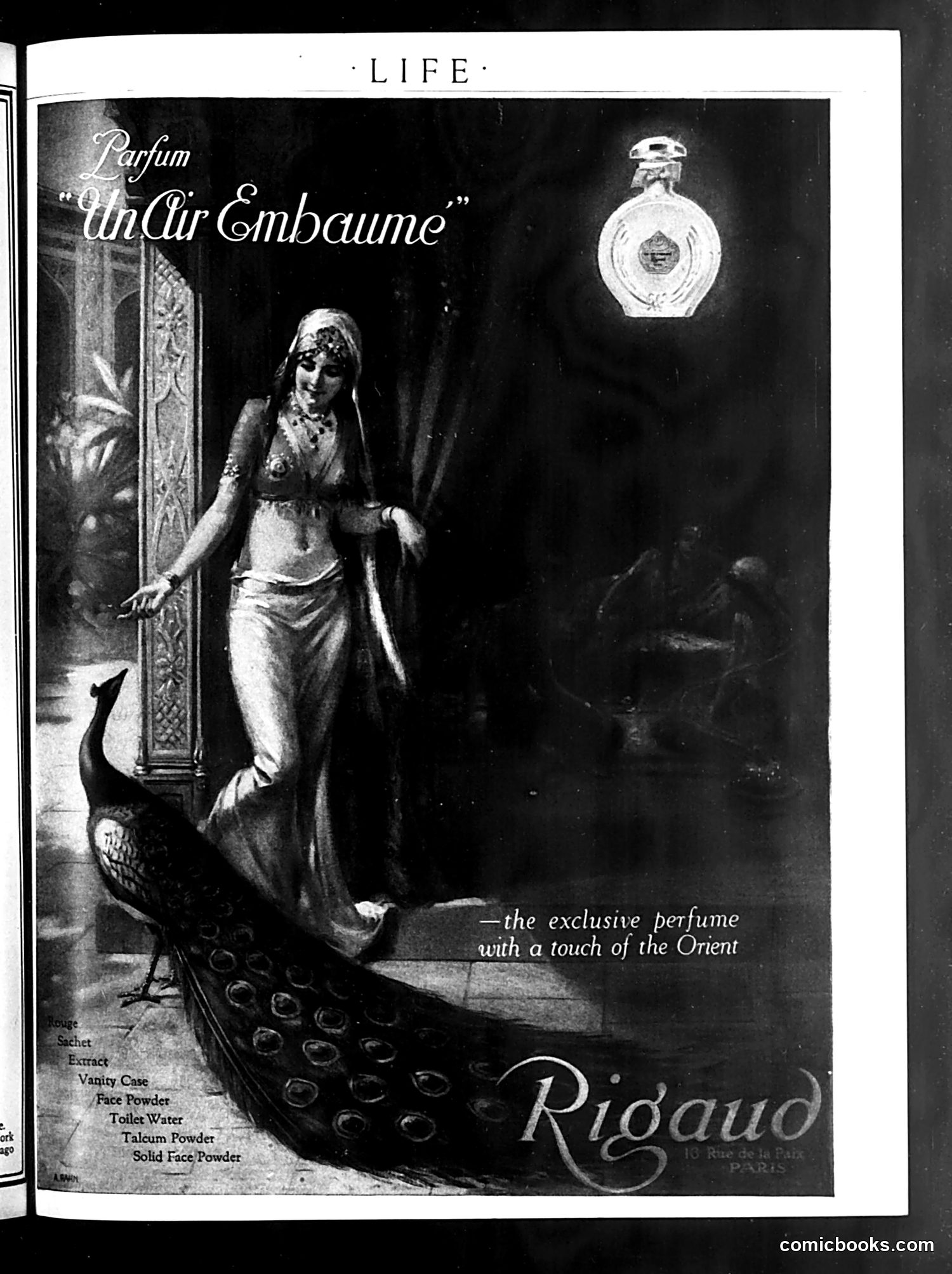
This is a **perfume advertisement**, not political satire. It promotes "Un Air Embaumé" by Rigaud, a Paris-based fragrance house. The ad features an orientalist aesthetic popular in early-20th-century luxury marketing: a woman in exotic costume with a peacock, positioned near ornamental doors suggesting an "Oriental" setting. The tagline emphasizes exclusivity and "a touch of the Orient"—reflecting the era's fascination with non-Western aesthetics as markers of luxury and sophistication. The perfume bottle appears upper right. The left sidebar lists Rigaud's product line (Rouge, Sachet, Extract, etc.), typical of comprehensive beauty-brand advertising from this period. There is no political commentary or satire present on this page.
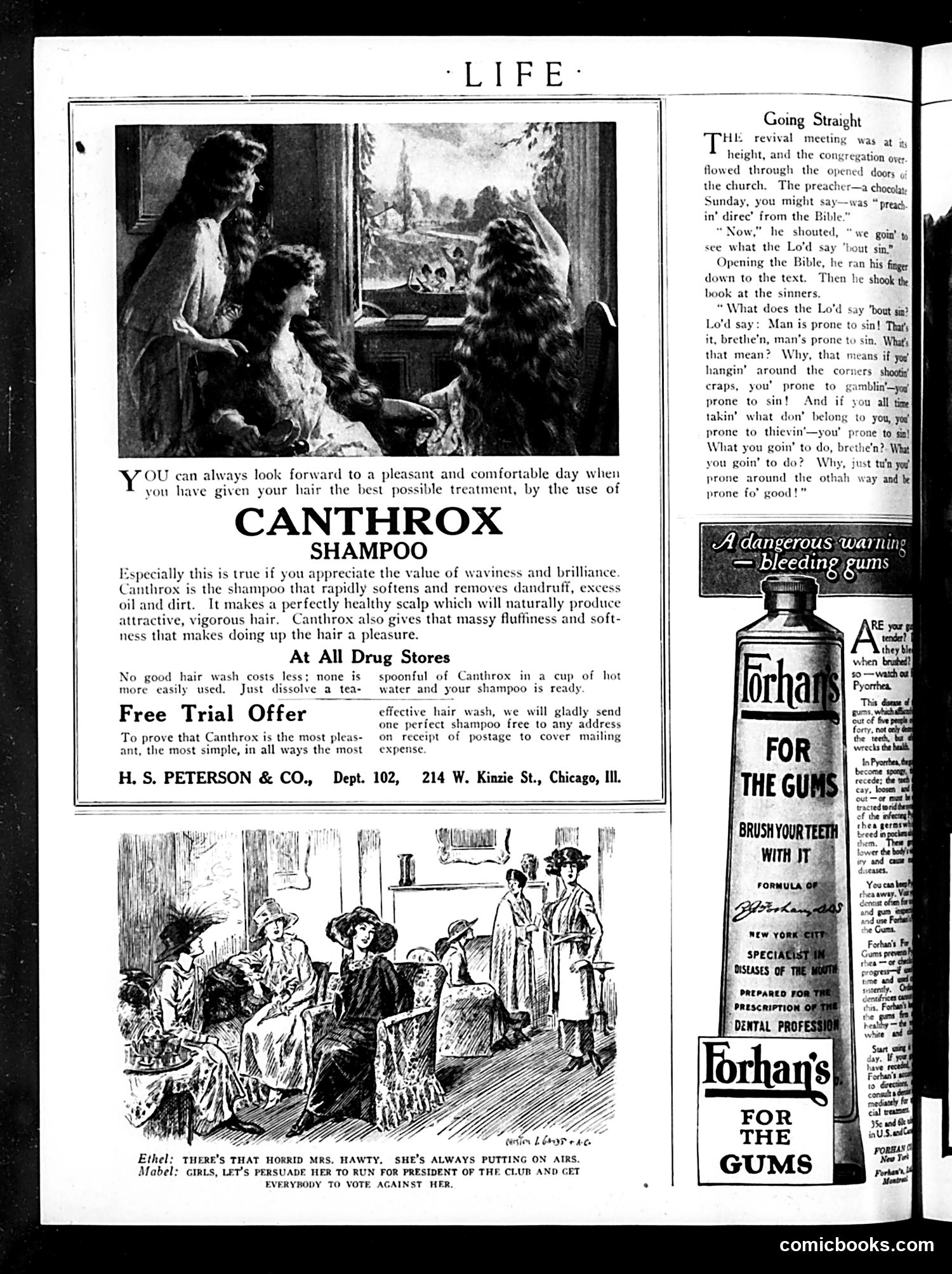
This LIFE magazine page contains mostly **advertising** (Canthrox shampoo, Forhan's toothpaste) with two separate comic items: **Top cartoon**: A domestic satire about social climbing. Two women (Ethel and Mabel) conspire to nominate their pretentious neighbor Mrs. Hawty as club president—not as honor, but as sabotage, expecting everyone will vote *against* her because of her annoying snobbish behavior. **Bottom comic**: "Going Straight" depicts a **racist caricature** of a Black preacher using exaggerated dialect, delivering a sermon about sin and moral reform. The humor relies on stereotypical speech patterns and religious earnestness played for laughs. This reflects the casual, dehumanizing racism common in early 20th-century American media. Both pieces are period-typical satirical content, though the second item exemplifies the deeply offensive racial mockery that would be unacceptable today.
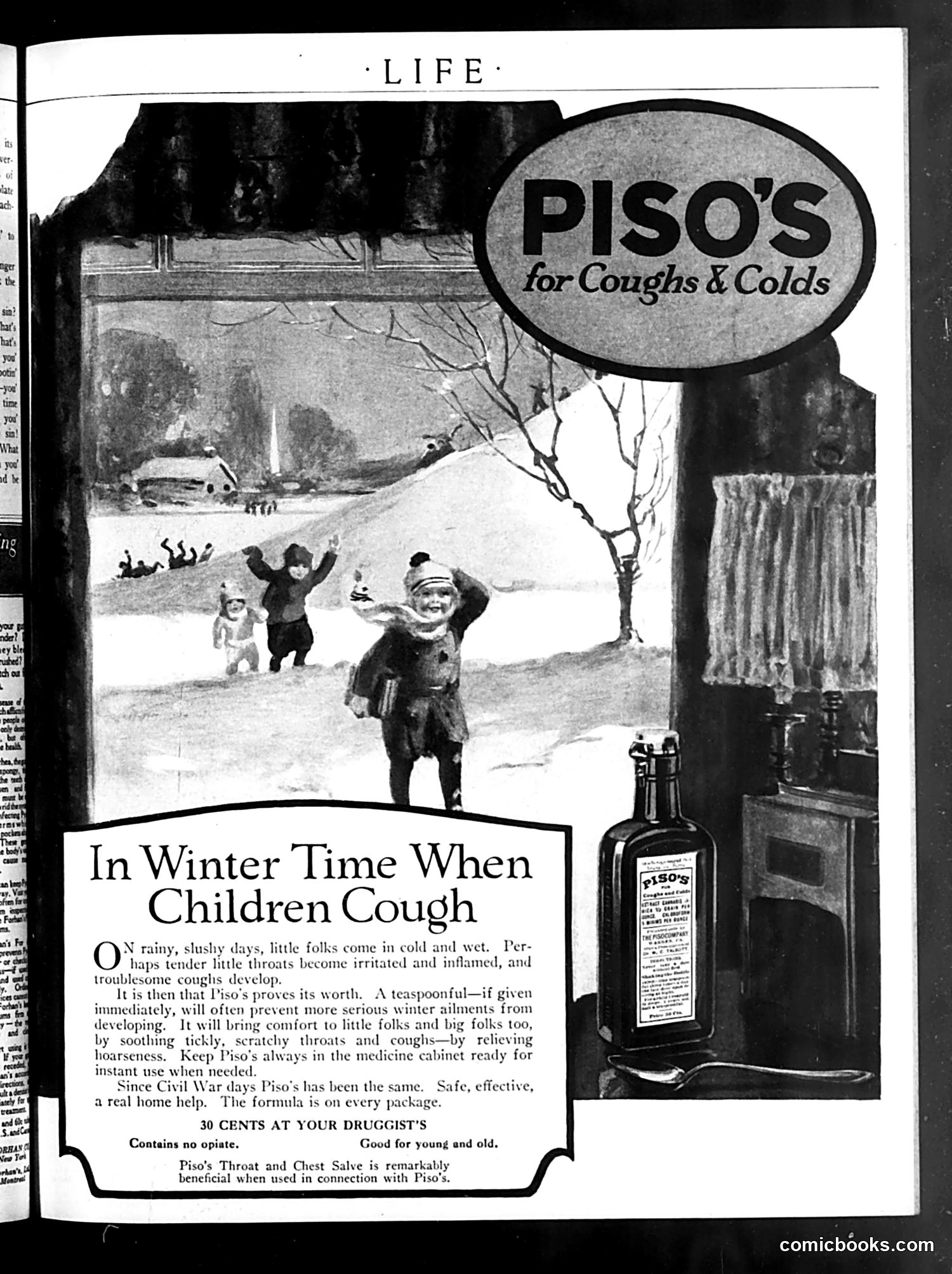
This is a **commercial advertisement**, not satire or political commentary. It promotes Piso's, a cough remedy medicine. The image shows children playing outdoors in winter snow, depicting the seasonal context when colds spread. The ad's appeal is straightforward: winter brings coughs in children; Piso's provides relief by soothing irritated throats. Key selling points emphasized: - Safe and effective ("since Civil War days") - Contains no opiates (important assurance for early 20th-century medicine) - Affordable (30 cents) - Available at drugstores The complementary product "Piso's Throat and Chest Salve" is also mentioned. For modern readers: this represents vintage patent medicine marketing—before FDA regulations required rigorous safety testing. The longevity claim and formula transparency were typical trust-building tactics of the era. This appeared in *Life* magazine during a period when such advertisements were standard editorial content.
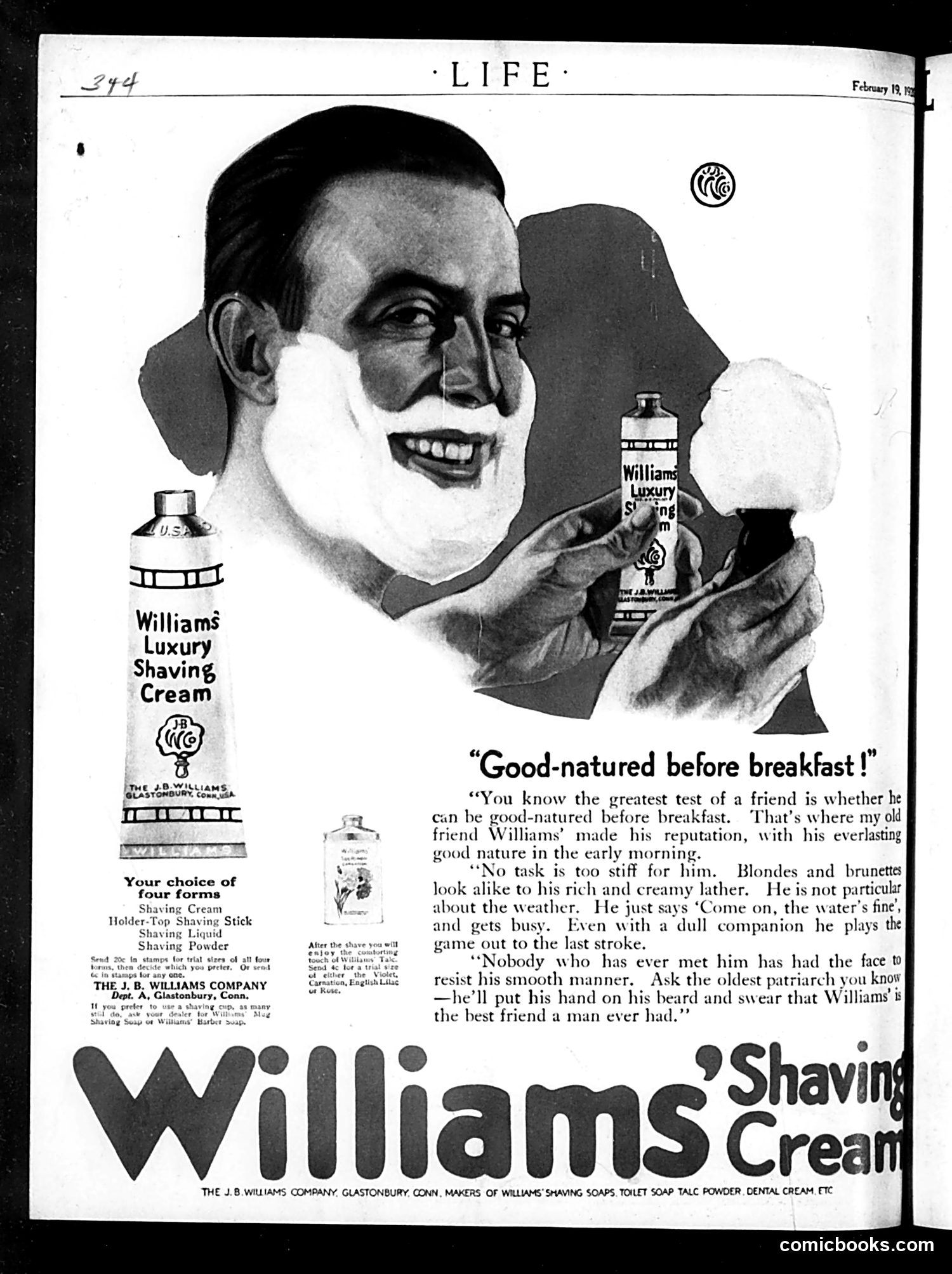
This is primarily a **product advertisement**, not political satire. It promotes Williams' Luxury Shaving Cream by depicting an idealized man with an exaggerated, cheerful expression applying the product. The ad's humor relies on a common early-20th-century marketing trope: the claim that this shaving cream transforms a man's temperament. The text humorously argues that Williams cream makes men so good-natured they're pleasant even before breakfast—traditionally portrayed as a cranky time. The caricatured face with its enormous grin and smooth complexion is meant to suggest the product's transformative qualities. The appeal is to masculine identity and social charm: a "good friend" who's always jovial and obliging. There is **no political commentary** here—it's straightforward consumer advertising using exaggeration and humor to sell grooming products, typical of early 20th-century American magazine marketing.