
Life, 1920-02-19 · page 20 of 48
Life — February 19, 1920 — page 20: what you’re looking at
What you’re looking at
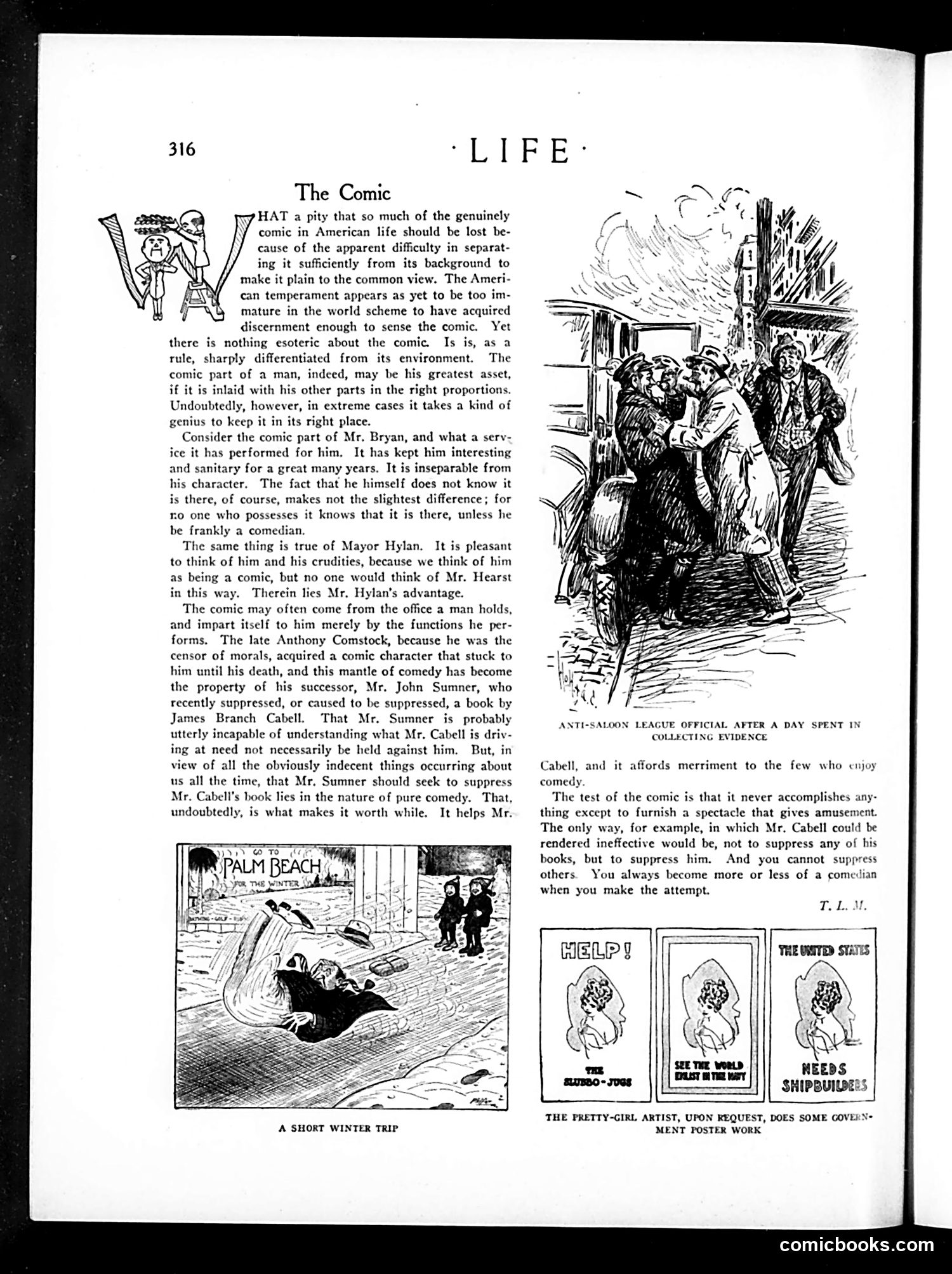
This page from *Life* magazine discusses American humor and features several satirical cartoons. The main essay argues that genuine comedy in American life often goes unrecognized because Americans lack cultural sophistication. It praises figures like William Jennings Bryan and Mayor Hylan as naturally comic—unknowingly so—without realizing it. The piece then critiques **John Sumner**, successor to moral censor Anthony Comstock, for suppressing James Branch Cabell's book. The satire: Sumner's censorship efforts are themselves absurdly comic, and the censorship actually helps Cabell by generating attention. The point is that attempts to suppress art through moral policing are inherently ridiculous. The cartoons include: an "Anti-Saloon League official" collecting evidence (likely depicting prohibition enforcement as pretextual drinking); a "Short Winter Trip" scene; and a "pretty-girl artist" doing government poster work—all mocking bureaucratic or moral authority figures.
📄 Transcribed text from this page (OCR, searchable)
Machine-transcribed from the original scan — historical spelling and the odd misread are preserved.
“LIFE: The Comic HAT a pity that so much of the genuinely comic in American life should be lost be- cause of the apparent difficulty in separat- ing it sufficiently from its background to make it plain to the common view. The Ameri- can temperament appears as yet to be too im- mature in the world scheme to have acquired discernment enough to sense the comic. Yet there is nothing esoteric about the comic. Is is, as a tule, sharply differentiated from its environment. The comic part of a man, indeed, may be his greatest asset, if it is inlaid with his other parts in the right proportions. Undoubtedly, however, in extreme cases it takes a kind of genius to keep it in its right place. Consider the comic part of Mr. Bryan, and what a serv- ice it has performed for him. It has kept him interesting and sanitary for a great many years. It is inseparable from his character. The fact that he himself does not know it is there, of course, makes not the slightest difference; for ro one who possesses it knows that it is there, unless he be frankly a comedian. The same thing is true of Mayor Hylan. It is pleasant to think of him and his crudities, because we think of him as being a comic, but no one would think of Mr. Hearst in this way. Therein lies Mr, Hylan’s advantage. The comic may often come from the office a man holds, and impart itself to him merely by the functions he per- forms, The late Anthony Comstock, because he was the censor of morals, acquired a comic character that stuck to him until his death, and this mantle of comedy has become the property of his successor, Mr. John Sumner, who recently suppressed, or caused to be suppressed, a book by James Branch Cabell. That Mr. Sumner is probably utterly incapable of understanding what Mr. Cabell is driv- ing at need not necessarily be held against him. But, in view of all the obviously indecent things occurring about us all the time, that Mr, Sumner should seek to suppress Mr. Cabell’s book lies in the nature of pure comedy. That, undoubtedly, is what makes it worth while. It helps Mr. A SHORT WINTER TRIP ANTI-SALOON LEAGUE OFFICIAL AFTER A DAY SPENT IN COLLECTING EVIDENCE Cabell, and it affords merriment to the few who enjoy comedy. The test of the comic is that it never accomplishes any- thing except to furnish a spectacle that gives amusement. The only way, for example, in which Mr. Cabell could be rendered ineffective would be, not to suppress any of his books, but to suppress him. And you cannot suppress others. You always become more or less of a comedian when you make the attempt. TL. AM, THE VINTED STATES NEEDS SHIPBUILBEES THE PRETTY-GIRL ARTIST, UPON REQUEST, DOES SOME GOVERN- MENT POSTER WORK comicbooks.com