
Life, 1920-02-19 · page 29 of 48
Life — February 19, 1920 — page 29: what you’re looking at
What you’re looking at
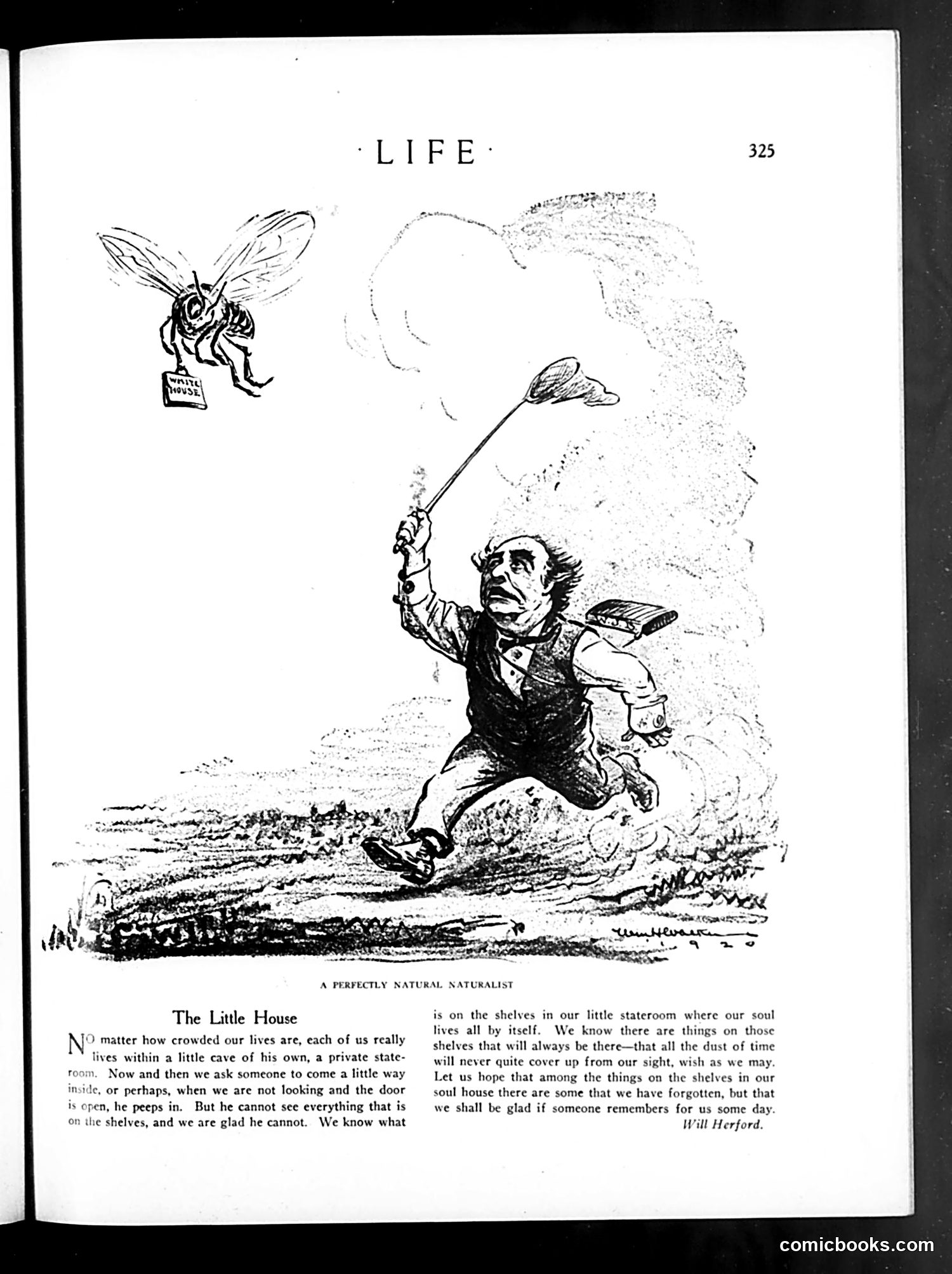
The cartoon depicts a man with a net chasing a bee labeled "LIFE," illustrating the essay "A Perfectly Natural Naturalist." The image is satirical commentary on how humans attempt to capture and control life itself—presented as an impossible, futile pursuit. The accompanying essay "The Little House" uses metaphor to discuss privacy and the inner self. It suggests each person maintains a private "stateroom" of the soul containing memories and thoughts—some shared, others deliberately hidden. The piece argues we should value forgotten memories that others might help us recover, emphasizing the interior emotional life we keep private from the world. Together, the cartoon and text suggest life cannot be pinned down or fully examined, much like the contents of one's inner house remain partially unknowable—even to ourselves.
📄 Transcribed text from this page (OCR, searchable)
Machine-transcribed from the original scan — historical spelling and the odd misread are preserved.
A PERFECTLY NATURAL NATURALIST The Little House O matter how crowded our lives are, each of us really lives within a little cave of his own, a private state- room. Now and then we ask someone to come a little way inside, or perhaps, when we are not looking and the door is open, he peeps in. But he cannot see everything that is on the shelves, and we are glad he cannot. We know what is on the shelves in our little stateroom where our soul lives all by itself. We know there are things on those shelves that will always be there—that all the dust of time will never quite cover up from our sight, wish as we may. Let us hope that among the things on the shelves in our soul house there are some that we have forgotten, but that we shall be glad if someone remembers for us some day. Will Herford. comicbooks.com