
Life, 1920-02-19 · page 30 of 48
Life — February 19, 1920 — page 30: what you’re looking at
What you’re looking at
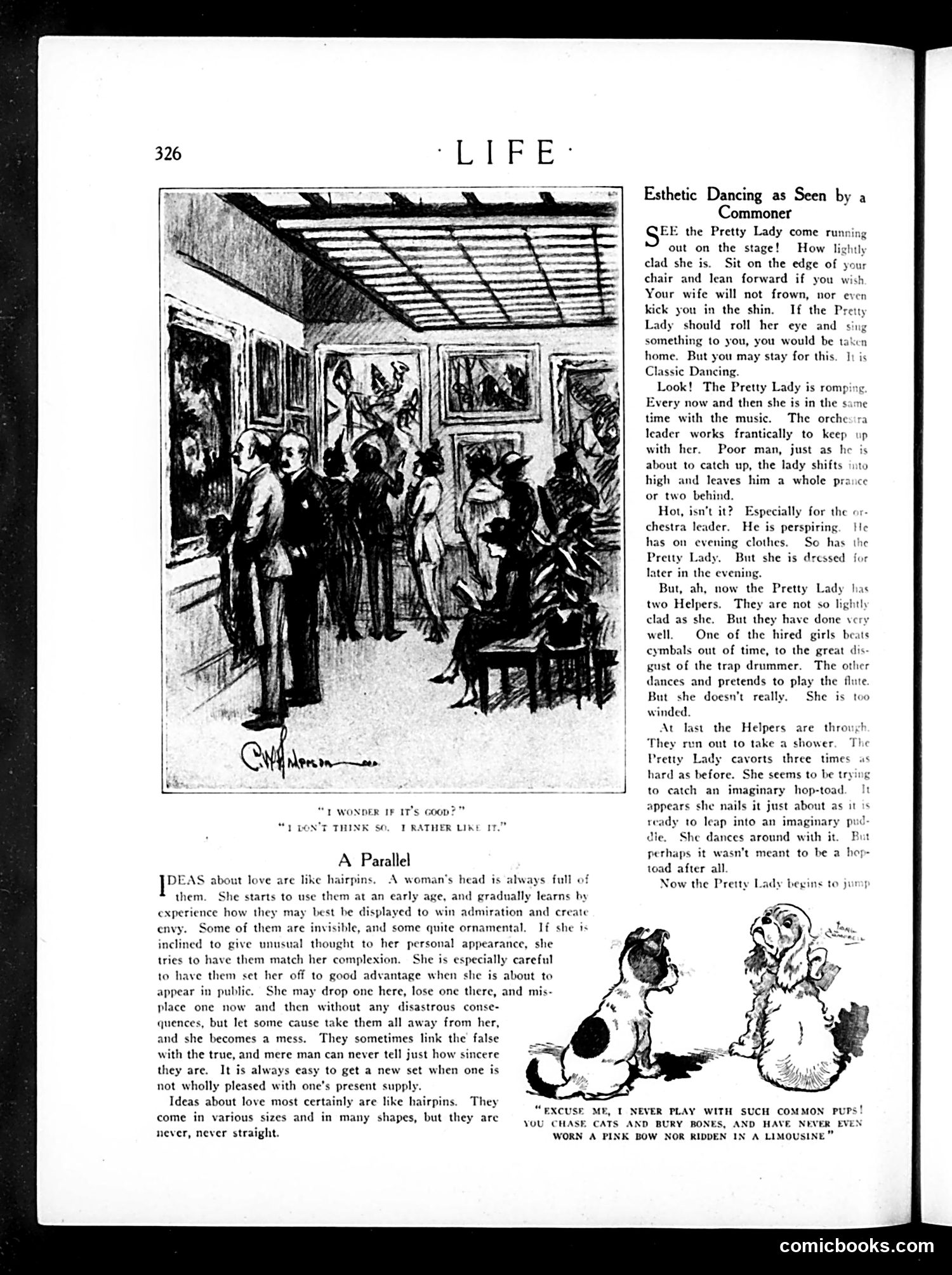
This page contains two satirical pieces mocking early 20th-century cultural pretensions. **"Aesthetic Dancing as Seen by a Commoner"** ridicules modern interpretive dance (likely referencing Isadora Duncan-style "free" dance). The narrator—positioned as an ordinary spectator—describes a scantily-clad "Pretty Lady" performer whose movements don't sync with the orchestra, leaving the exhausted conductor scrambling to follow her. The satire targets both the dancer's self-importance and the absurdity of the art form itself: she appears to be chasing an imaginary toad and pretending to play instruments she isn't actually using. The piece mocks this as pretentious nonsense dressed up as high art. **"A Parallel"** uses an extended metaphor comparing women's ideas about love to hairpins—decorative, variable, never straight, easily lost or replaced. It suggests women manipulate romantic notions for social advantage, much as they arrange hairpins for appearance. Both pieces use satirical exaggeration to critique contemporary fashions in art and gender relations, reflecting early 20th-century attitudes toward modernism and women.
📄 Transcribed text from this page (OCR, searchable)
Machine-transcribed from the original scan — historical spelling and the odd misread are preserved.
T WONDER IF IT's Goop?” “1 DON’T THINK SO, T RATHER LIKE 11,” A Parallel DEAS about love are like hairpins. A woman's head is always full of them. She starts to use them at an early age, and gradually learns by experience how they may best be displayed to win admiration and create envy. Some of them are invisible, and some quite ornamental. If she is inclined to give unusual thought to her personal appearance, she tries to have them match her complexion. She is especially careful to have them set her off to good advantage when she is about to appear in public. She may drop one here, lose one there, and mis- place one now and then without any disastrous conse- quences, but let some cause take them all away from her, and she becomes a mess. They sometimes link the false with the true, and mere man can never tell just how sincere they are. It is always easy to get a new set when one is not wholly pleased with one’s present supply. Ideas about love most certainly are like hairpins. They come in various sizes and in many shapes, but they are never, never straight. Esthetic Dancing as Seen by a Commoner SE = the Pretty Lady come running out on the stage! How lightly clad she is. Sit on the edge of your chair and lean forward if you wish Your wife will not frown, nor even kick you in the shin. If the Pret Lady should roll her eye and sing something to you, you would be taken home. But you may stay for this. 1 is Classic Dancing. Look! The Pretty Lady is rompi Every now and then she is in the s time with the music. The orche Icader works frantically to keep up with her. Poor man, just as he is about to catch up, the lady shifts into high and leaves him a whole prance or two behind. Hot, isn’t it? Especially for the or- chestra leader. He is perspiring. He has on evening clothes. So has the Pretty Lady, But she is dressed for later in the evening. But, ah, now the Pretty Lady has two Helpers. They are not so lightly clad as she. But they h; done very well. One of the hired girls bea cymbals out of time, to the great dis- gust of the trap drummer. The other dances and pretends to play the f But she doesn’t really. She is winded. At last the Helpers are through They run ont to take a shower, The Pretty Lady cavorts three times as hard as before. She seems to be try to catch an imaginary hop-toad. !t appears she nails it just about as it is ready to leap into an imaginary pud- je. She dances around with it. But perhaps it wasn’t meant to be a hep- toad after all. Now the Pretty Lady begins to jumy 1 NEVER PLAY WITH SUCH COMMON PUPS! . AND HAVE NEVER EVEN BOW NOR RIDDEN IN A LIMOUSINE” comicbooks.com