
Life, 1920-02-19 · page 26 of 48
Life — February 19, 1920 — page 26: what you’re looking at
What you’re looking at
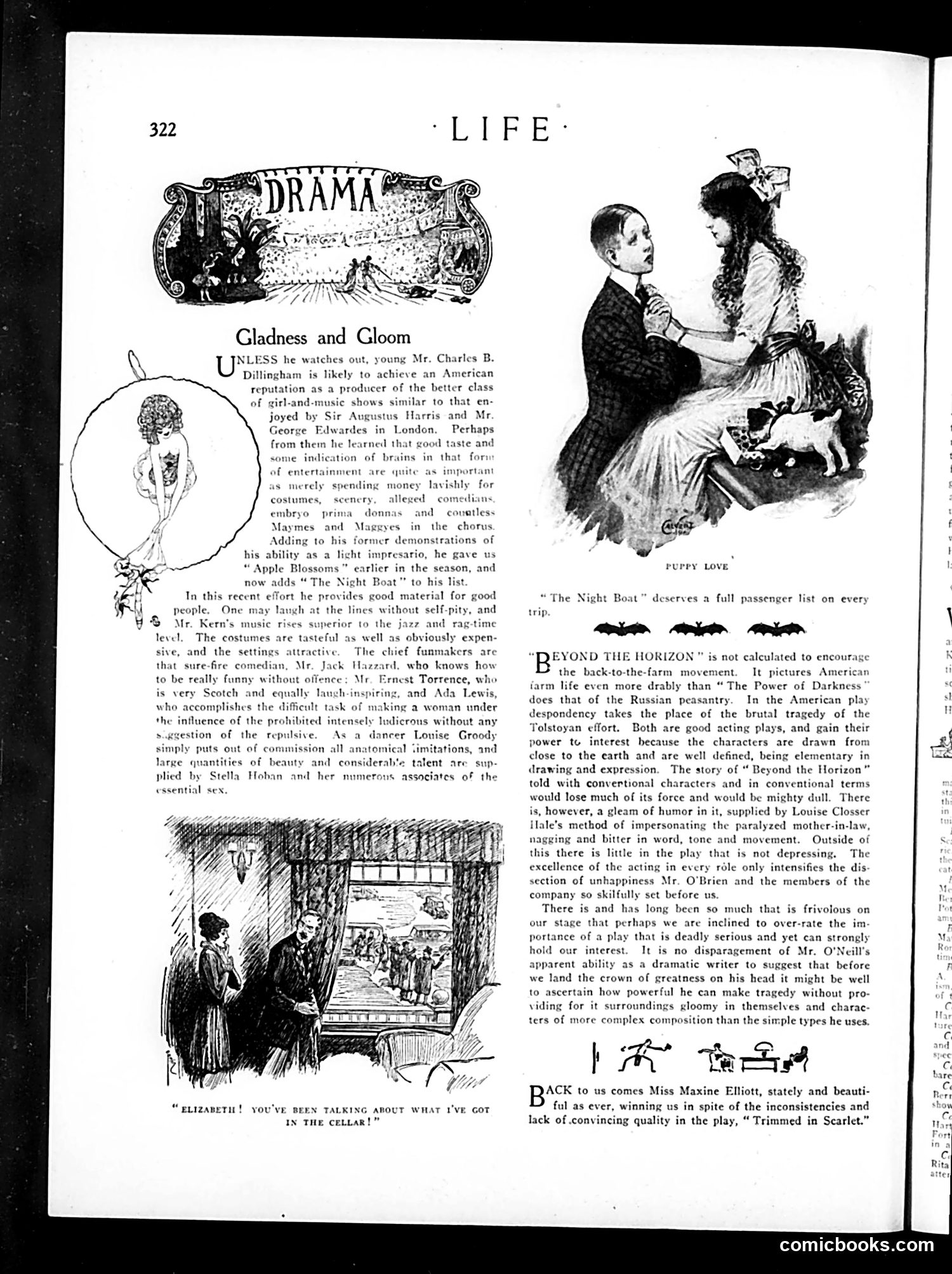
This page reviews three Broadway productions. The main cartoon depicts a cellar scene with the caption "Elizabeth! You've been talking about what I've got in the cellar!"—a joke about Prohibition (the alcohol ban in effect 1920-1933). Someone has been gossiping about hidden liquor. The reviews discuss: 1. **"The Night Boat"** by Charles B. Dillingham—a musical praised for tasteful humor, good music by Mr. Kern, and talented performers including Jack Hazzard and Ada Lewis, who plays a woman "under the influence of the prohibited" (drunk) without being offensive. 2. **"Beyond the Horizon"**—described as bleak, depicting American farm life grimly. The reviewer notes it's well-acted but questions whether its relentless depression warrants calling it great drama. 3. **"Trimmed in Scarlet"**—featuring actress Maxine Elliott, criticized for inconsistencies despite her charm. The page exemplifies how Prohibition-era theater addressed forbidden alcohol humorously while serious drama tackled rural American despair.
📄 Transcribed text from this page (OCR, searchable)
Machine-transcribed from the original scan — historical spelling and the odd misread are preserved.
Gladness and Gloom NLESS he watches out, young Mr. Charles B. Dillingham is likely to achieve an American reputation as a producer of the better class irl-and-music shows similar to that en- joyed by Sir Augustus Harris and Mr George Fdwardes in London. Perhaps from them he learned that good taste and some ind on of brains in that for lavishly for Aportant as merely spending mon costumes, scenery, alleged comedians embryo prima is and covatless Maymes and Maggyes in the chorus Adding to his f his ability as a light impresario, he gave us “Apple Blossoms” earlier in the season, and now adds “The Night Boat” to his 1 In this recent effort he provides good material for good people, One may laugh at the lines without self-pity, and Mr. Kern's music rises superior to the jazz and rag-time level. The costumes are tasteful as well as obviously expen- sive, and the settings attractive. The chief funmakers are that sure-fire comedian, Mr. Jack Hazzard, who knows how to be really funny withou nce: Mr. Ernest Torrence, who is very Scotch and equally laugh-inspiring, and Ada Lewis, who accomplishes the difficult task of making a woman under the influence of the prohibited intensely 1 hout any suggestion of the repulsive. As a dancer Louise Groody simply puts out of commission all anatomical jimitations, and large quantities of beauty and considerah'e talent are sup- plied by Stella Hoban and her numerous associates of the rmer demonstrations of essential sex, “ELIZABETH ! YOU'VE BEEN TALKING AROUT WHAT I'VE GOT IN THE CELLAR!” t Boat” ee ee ei OND THE HORIZO is not calculated to encourage the back-to-the-farm movement. It pictures American iarm life even more drably than “ The Power of Darkness does that of the Russian peasantry. In the American play despondency takes the place of the brutal tragedy of the Tolstoyan effort. Both are good acting plays, and gain their power to interest because the characters are drawn from close to the earth and are well defined, being elementary in drawing and expression. The story of “ Beyond the Horizon” told with convertional characters and in conventional terms would lose much of its force and would be mighty dull. There 3, however, a gleam of humor in it, supplied by Louise Closser ilale’s method of impersonating the paralyzed mother-in-law, nagging and bitter in word, tone and movement. Outside of this there is little in the play that is not depressing. The excellence of the acting in every réle only intensifies the dis. section of unhappiness Mr. O'Brien and the members of the company so skilfully set before us. There is and has long been so much that is frivolous on our stage that perhaps we are inclined to over-rate the im portance of a play that is deadly serious and yet can hold our interest. It is no disparagement of Mr. O'Neill's apparent ability as a dramatic writer to suggest that before we land the crown of greatness on his head it might be well to ascertain how powerful he can make tragedy without pro- viding for it surroundings gloomy in themselves and charac- ters of more complex composition than the simple types he uses. ACK to us comes Miss Maxine Elliott, stately and beauti- ful as ever, winning us in spite of the inconsistencies and lack of convincing quality in the play, “ Trimmed in Scarlet.” deserves a full passenger list on laa mae rongly comicbooks.com