
Life, 1920-02-19 · page 22 of 48
Life — February 19, 1920 — page 22: what you’re looking at
What you’re looking at
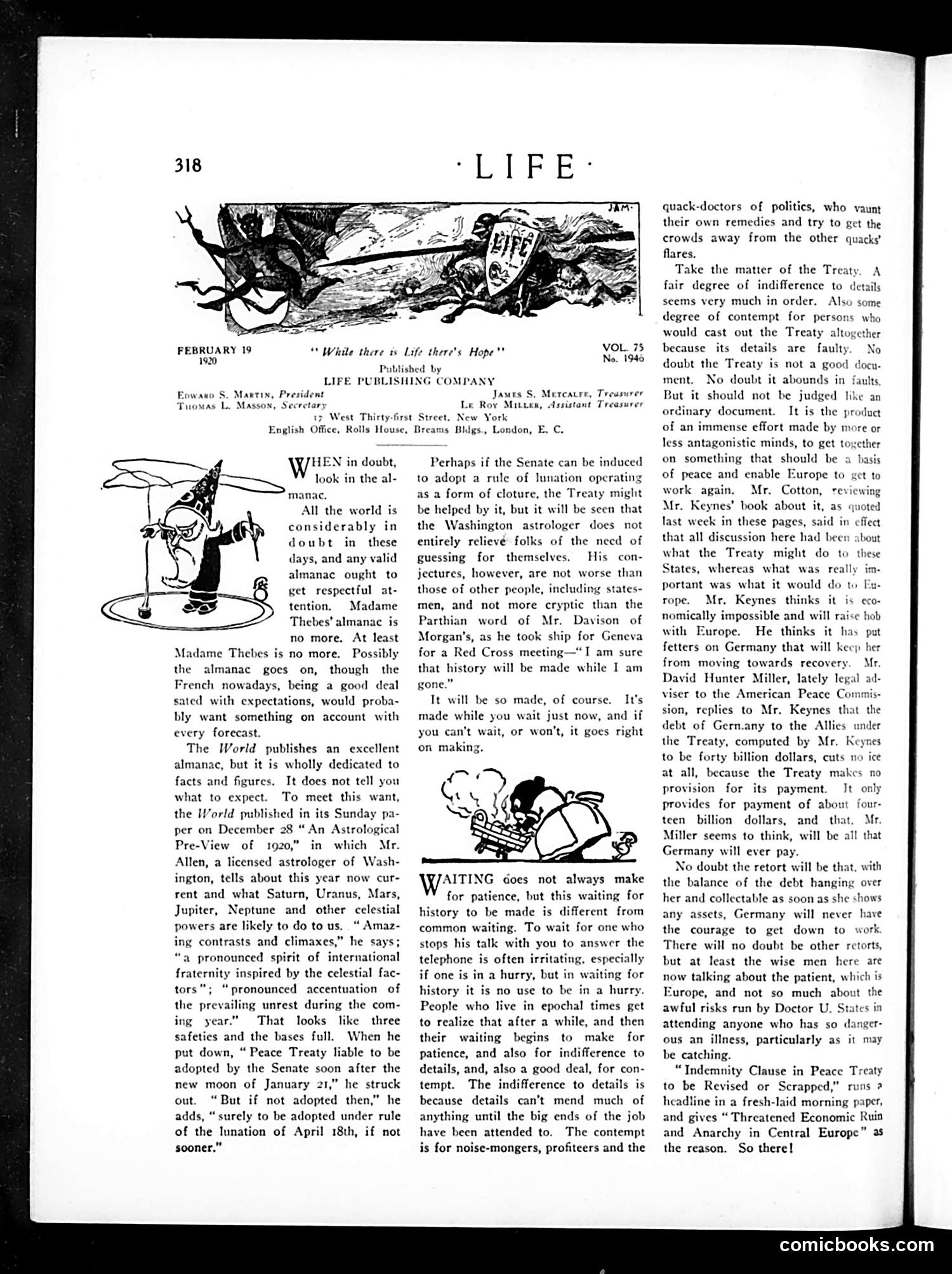
This page satirizes post-WWI political uncertainty, particularly surrounding the League of Nations Treaty. The cartoons mock reliance on astrology and fortune-telling during turbulent times. The first cartoon depicts someone consulting an almanac or fortune-teller—visual mockery of Americans seeking certainty through mystical means. The text references "Madame Thebes" (a famous French fortune-teller, now deceased) and a Washington astrologer's vague predictions about the Treaty's Senate adoption, which could occur either in January or April depending on lunar cycles. The satire suggests that political forecasters are as unreliable as fortune-tellers. The author argues the Treaty shouldn't be rejected for minor flaws, comparing criticism to expecting perfection from a document produced by "antagonistic minds" attempting compromise. The piece criticizes "quack-doctors of politics" who exploit public anxiety with alternative remedies—a pointed jab at politicians opposing the Treaty through misleading rhetoric rather than substantive debate.
📄 Transcribed text from this page (OCR, searchable)
Machine-transcribed from the original scan — historical spelling and the odd misread are preserved.
FEBRUARY 19 “* While there ts Life there's Hope" VOL. 75 No. 1946 Published by LIFE PUBLISHING COMPANY Fowano S. Martin, Pi Tuomas L. Masson, S James S. Mercatre, Tree: Le Roy Miter, Assistant Treasure 17 West Thirty-first Street, New York English Office, Rolls House, Breams Bldgs., London, E. C. HEN in doubt, look in the al- m - All the world is considerably in doubt in these days, and any valid almanac ought to get respectful at- tention. Madame Thebes’ almanac is no more. At least Madame Thebes is no more. Possibly the almanac goes on, though the French nowadays, being a good deal sated with expectations, would proba- bly want something on account with every forecast. The World publishes an excellent almanac, but it is wholly dedicated to facts and figures. It does not tell you what to expect. To meet this want, the World published in its Sunday per on December 28 “An Astrological Pre-View of 1920," in which Mr. Allen, a licensed astrologer of Wash- ington, tells about this year now cur- rent and what Saturn, Uranus, Mars, Jupiter, Neptune and other celestial powers are likely to do to us. “ Amaz- ing contrasts and climaxes,” he says; “a pronounced spirit of international fraternity inspired by the celestial fac- tors”; “pronounced accentuation of the prevailing unrest during the com- ing year.” That looks like three safeties and the bases full. When he put down, “ Peace Treaty liable to be adopted by the Senate soon after the new moon of January 21,” he struck out. “But if not adopted then,” he adds, “surely to be adopted under rule of the lunation of April 18th, if not sooner.” Perhaps if the Senate can be induced to adopt a rule of lunation operating as a form of cloture, the Treaty might be helped by it, but it will be seen that the Washington astrologer does not entirely relievé folks of the need of guessing for His jectures, however, are not worse than themselves. con- those of other people, including states- men, and not more cryptic than the Parthian word of Mr. Davison of Morgan's, as he took ship for Geneva for a Red Cross meeting—“I am sure that history will be made while I am gone.” It will be so made, of course. made while you wait just now, and if you can’t wait, or won't, it goes right on making. AITING Goes not always make for patience, but this waiting for history to be made is different from common waiting. To wait for one who stops his talk with you to answer the telephone is often irritating, especially if one is in a hurry, but in ting for history it is no use to be in a hurry. People who live in epochal times get to realize that after a while, and then their waiting begins to make for patience, and also for indifference to details, and, also a good deal, for con- tempt. The indifference to details is because details can’t mend much of anything until the big ends of the job have been attended to. The contempt is for noise-mongers, profiteers and the quack-doctors of politics, who vaunt their own remedies and try to get the crowds away from the other quacks’ flares, Take the matter of the Treaty fair degree of indifference to details seems very much in order. Also some degree of contempt for persons who would cast out the Treaty altogether because its details are faulty. No doubt the Treaty is not a good docu- ment. No doubt it abounds in faults. But it should not be judged like an ordinary document. It is the product of an immense effort made by more or less antagonistic minds, to get together on something that should be a basis of peace and enable Europe to get to work again. Mr. Cotton, reviewing Mr. Keynes’ book about it, as quoted last week in these pages, said in effect that all discussion here had been about what the Treaty might do to these States, whereas what was really in portant was what it would do to I rope. Mr, Keynes thinks it is eco- nomically impossible and will raise hob with rope. He thinks it has put fetters on Germany that will keep her from moving towards recovery. Mr. David Hunter Miller, lately legal ad- viser to the American Peace Ce sion, replies to Mr. Keynes that the debt of Gern.any to the Allies under the Treaty, computed by Mr. Keynes to be forty billion dollars, cuts no ice at all, because the Treaty makes no provision for its payment. Jt only provides for payment of about four- teen billion dollars, and that, Mr. Miller seems to think, will be all that Germany will ever pay. No doubt the retort will be that, with the balance of the debt hanging over her and collectable as soon as she shows any assets, Germany will never have the courage to get down to work. There will no doubt be other retorts, but at least the wise men here are now talking about the patient, which is Europe, and not so much about the awful risks run by Doctor U. States in attending anyone who has so danger- ous an illness, particularly as it may be catching. “Indemnity Clause in Peace Treaty to be Revised or Scrapped,” runs ? headline in a fresh-laid morning paper, and gives “ Threatened Economic Ruin and Anarchy in Central Europe” as the reason. So there! comicbooks.com