
Life, 1920-02-19 · page 32 of 48
Life — February 19, 1920 — page 32: what you’re looking at
What you’re looking at
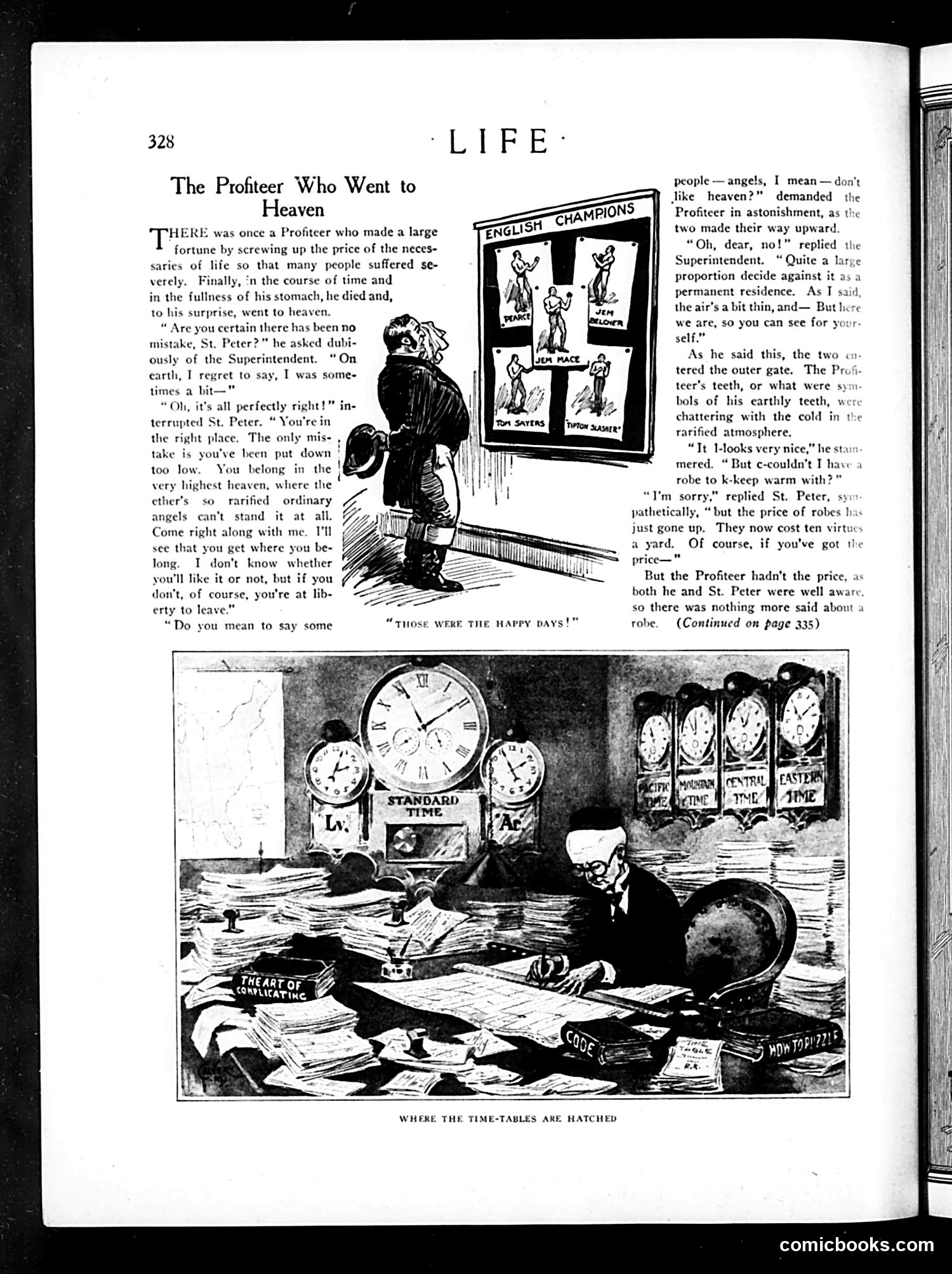
This is a satirical moral fable critiquing wartime profiteering. A wealthy businessman who made his fortune by inflating prices on necessities—causing public suffering—dies and goes to heaven. St. Peter places him in the coldest, highest heaven (where even angels avoid), then reveals the story's punchline: when the profiteer asks for a robe to stay warm, St. Peter informs him robes now cost "ten virtues a yard"—the profiteer has no virtues to pay with, having spent his earthly life pursuing profit over people. The satire works through ironic reversal: heaven uses the profiteer's own logic against him. What earned him wealth on earth (exploiting scarcity and desperation) leaves him helpless in the afterlife. The lower cartoon shows time-keeping mechanisms, likely referencing wartime efficiency or industrial production that enabled profiteering. The piece targets unscrupulous businessmen who exploited wartime shortages (likely WWI era, given Life magazine's context).
📄 Transcribed text from this page (OCR, searchable)
Machine-transcribed from the original scan — historical spelling and the odd misread are preserved.
328 The Profiteer Who Went to Heaven HERE was once a Profiteer who made a large fortune by screwing up the price of the neces- saries of life so that many people suffered se- verely. Finally, 'n the course of time and in the fullness of his stomach, he died and, to his surprise, went to heaven. “ Are you certain there has been no mistake, St. Peter?" he asked dubi- ously of the Superintendent. “On earth, I regret to say, I was some- times a bit—" “Oh, it’s all perfectly right!” in- terrupted St. Peter. “ You're in the right place. The only mis take is you've been put down ! too low. You belong in the very highest heaven, where the people — angels, I mean — don't like heaven?" demanded the Profiteer in astonishment, as the two made their way upward. “Oh, dear, no!” replied the Superintendent. “Quite a Is proportion decide against it as a permanent residence. As I said the air’s a bit thin, and— But here we are, so you can see for your- self.” As he said this, the two cn- tered the outer gate. The Pruti- teer's teeth, or what were sym bols of his earthly teeth, w chattering with the cold in the rarified atmosphere, “Tt I-looks very nice,” he stain mered. “But c-couldn’t I ha robe to k-keep warm with?” ether’s so. rarified ordinary A “I'm sorry,” replied St. Peter, sy angels can't stand it at all. 7 iN’ pathetically, “but the price of robes } Come right along with me. T'll Z Bu.) just gone up. They now cost ten virtues see that you get where you be- J \ a yard. Of course, if you've got the long. I don’t know whether cs ! = price—" you'll like it or not, but if you Z - But the Profiteer hadn't the price, «s don't, of course, you're at lib- g both he and St. Peter were well aware, erty to leave.” so there was nothing more said about a “Do you mean to say some robe. (Continued on page 335) m THEART OF 4 ORV oe 4 WHERE THE TIME-TABLES ARE HATCHED comicbooks.com