
Life, 1920-02-19 · page 23 of 48
Life — February 19, 1920 — page 23: what you’re looking at
What you’re looking at
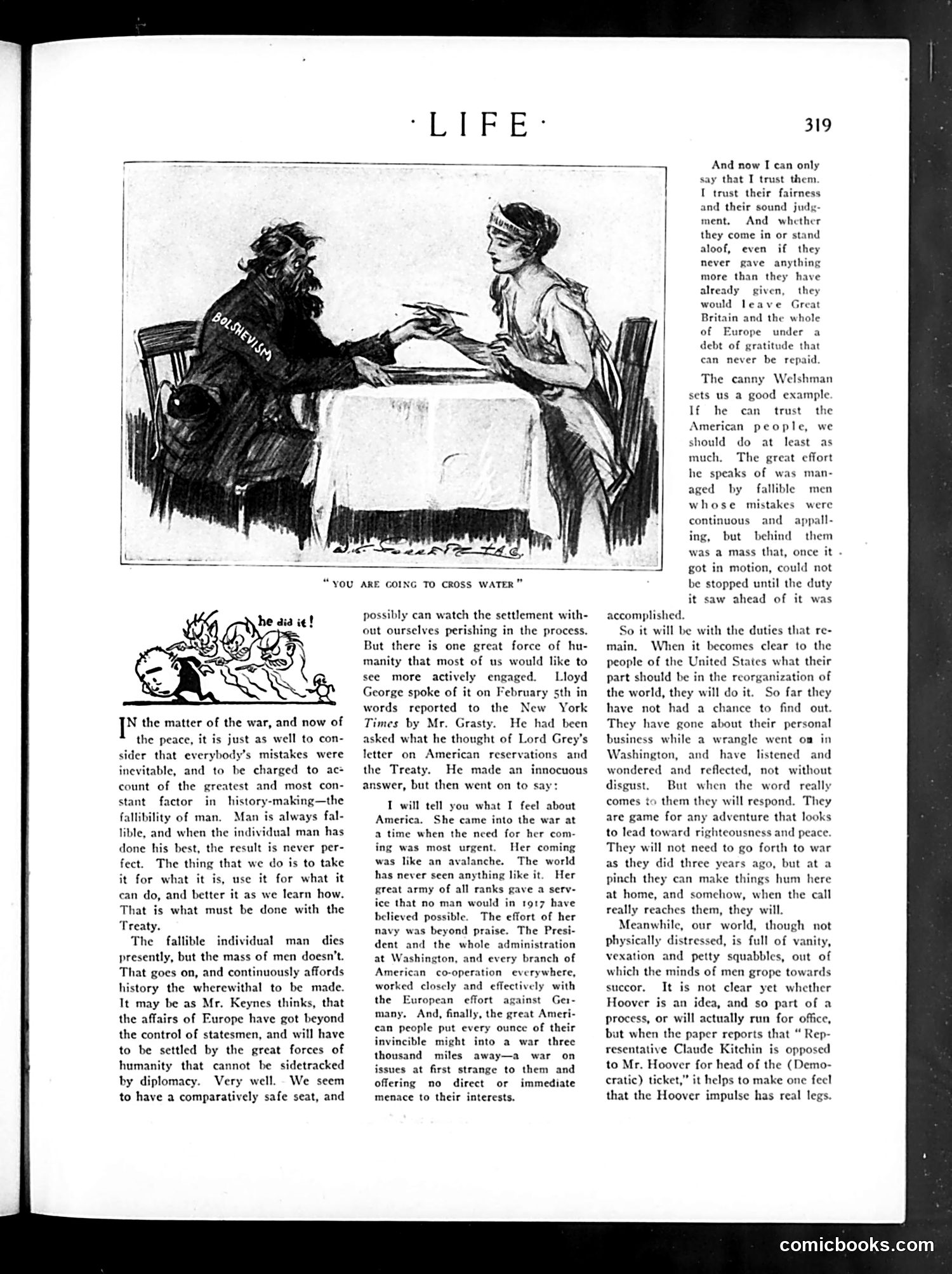
This page contains a cartoon and editorial commentary about post-World War I peace negotiations, likely from 1919. **The Cartoon**: Shows two figures at a table labeled "YOU ARE GOING TO CROSS WATER." The figure on the left appears to be labeled "BOLSHEVISM" based on visible text, facing a younger man across the table—likely representing America or an American negotiator. **The Text's Context**: The editorial discusses Lloyd George's February 5th remarks praising America's massive military and industrial contribution to WWI. It argues Americans should trust their leaders to reorganize post-war Europe, and that American public opinion will ultimately guide policy decisions. **The Satire**: The cartoon likely satirizes negotiations with Bolshevik Russia or concerning communist influence in post-war Europe. The "crossing water" reference suggests America considering direct involvement in European communist/political upheaval. The juxtaposition suggests tension between American idealism and revolutionary ideology. The page reflects American anxiety about their proper role in reshaping Europe while managing new ideological threats.
📄 Transcribed text from this page (OCR, searchable)
Machine-transcribed from the original scan — historical spelling and the odd misread are preserved.
319 And now I can only say that I trust them. I trust their fairness and their sound judg- ment, And whether they come in or stand aloof, even if they never gave anything more than they have already n, they would leave Great in and the whole under a debt of gratitude that can never be ri id. Europe The canny Welshman sets us a good example. If he can trust the American people, we should do at least as much, The great effort he speaks of was man- aged by fallible whose mistakes men were continuous appall- ing, but them was a mass that, once it - and behind “YOU ARE GOING TO CROSS WATER” N the matter of the war, and now of the peace, it is just as well to con- sider that everybody’s mistakes were inevitable, and to be charged to ac= count of the greatest and most con- stant factor in history: xing—the fallibility of man. Man is always fal- lible, and when the individual man has done his best, the result is never per- fect. The thing that we do is to take it for what it use it for what it can do, and better it as we learn how. That is what must be done with the Treaty. The fallible individual dies presently, but the mass of men doesn’t. That goes on, and continuously affords history the wherewithal to be made. It may be as Mr. Keynes thinks, that the affairs of Europe have got beyond the control of statesmen, and will have to be settled by the great forces of humanity that cannot be sidetracked by diplomacy. Very well. We seem to have a comparatively safe seat, and man possibly can watch the settlement with- out ourselves perishing in the process. But there is one great force of hu- manity that most of us would like to see more actively engaged. Lloyd George spoke of it on February sth in words reported to the New York Times by Mr. Grasty. He had been asked what he thought of Lord Grey's letter on American reservations and the Treaty. He made an innocuous answer, but then went on to say: I will tell you what I feel about America. She came into the war at a time when the need for her com- ing was most urgent. Her coming was like an avalanche. The world has never seen anything like it. Her great army of all ranks gave a serv- ice that no man would in 1917 have believed possible. The effort of her navy was beyond praise. The Presi- dent and the whole administration at Washington, and every branch of American co-operation everywhere, worked closcly and effectively with the European effort inst Ger- many. And, finally, the great Ameri- can people put every ounce of their invincible might into a war three thousand miles away—a war on issues at first strange to them and offering no direct or immediate menace to their interests. got in motion, could not be stopped until the duty it saw ahead of it was accomplished. So it will be with the duties that re- main. When it becomes clear to the people of the United States what their part should be in the reorganization of the world, they will do it. So far they have not had a chance to find out. They have gone about their personal business while a wrangle went om in Washington, and have listened and wondered and reflected, not without disgust. But when the word really comes to them they will respond. They are game for any adventure that looks to lead toward righteousness and peace. They will not need to go forth to war as they did three years ago, but at a pinch they can make things hum here at home, and somehow, when the call really reaches them, they will. Meanwhile, our world, though not physically distressed, is full of vanity, vexation and petty squabbles, out of which the minds of men grope towards succor. It is not clear yet whether Hoover is an idea, and so part of a process, or will actually run for office, but when the paper reports that “ Rep- resentative Claude Kitchin is opposed to Mr. Hoover for head of the (Demo- cratic) ticket,” it helps to make one feel that the Hoover impulse has real legs. comicbooks.com