
A complete issue · 44 pages · 1920
Life — February 12, 1920
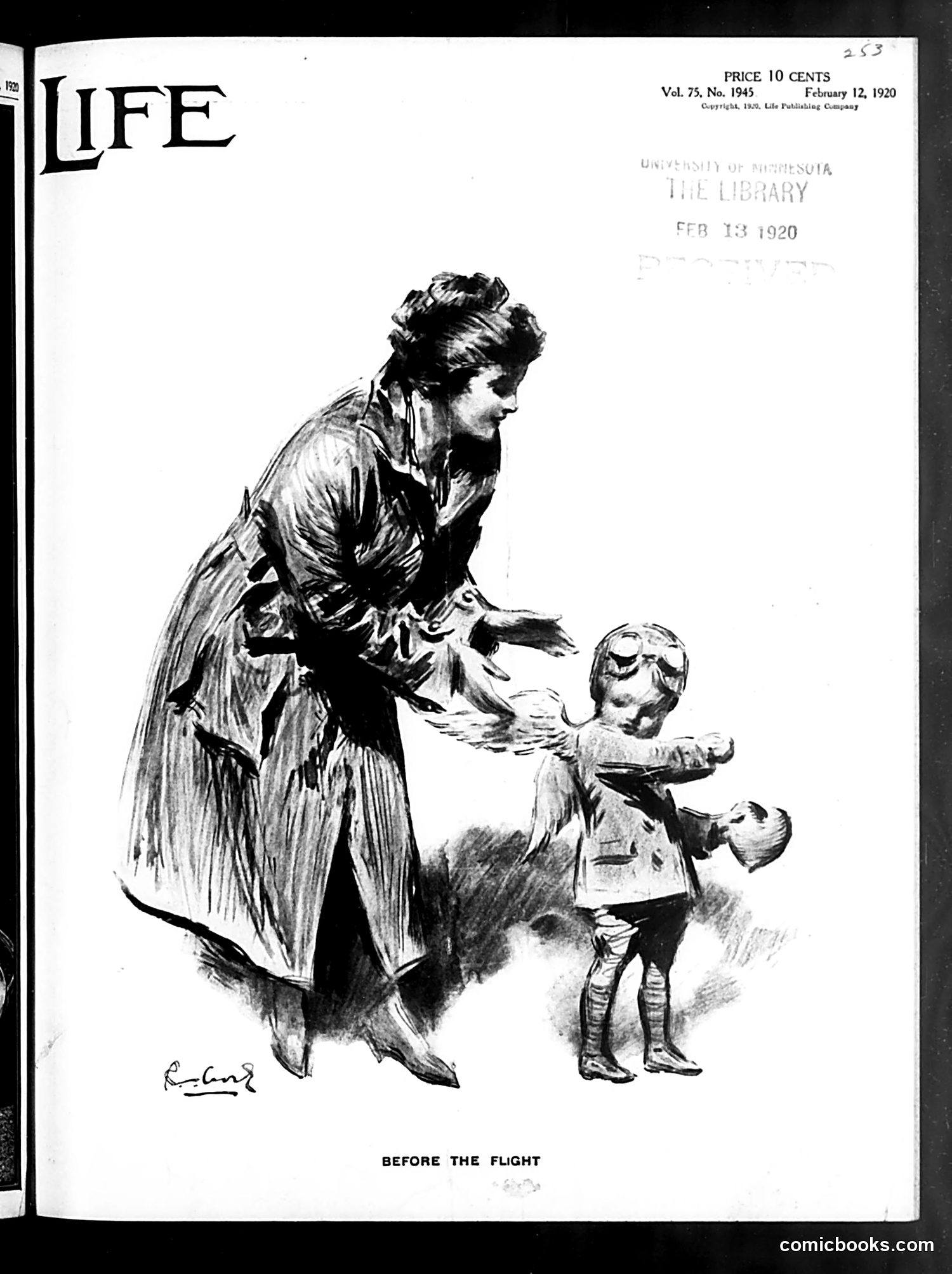
This cartoon depicts a woman in an elaborate coat bidding farewell to two small children, titled "Before the Flight." The composition suggests an emotional parting scene, though the specific historical context isn't entirely clear from the image alone. Given the 1920 date and the dramatic staging, this likely references either: - A contemporary custody dispute or family scandal covered by Life - Immigration or emigration circumstances - A theatrical or literary adaptation The woman's fashionable dress and the children's formal clothing suggest the subject involves a middle or upper-class family. The artist's signature appears at bottom left. Without additional contextual information from accompanying text or period records, the specific identities and precise satirical point remain unclear, though the emotional melodrama is clearly the intended subject of satire.

This page is **not a cartoon or satire**—it's a straightforward product advertisement for the United States Rubber Company. The ad announces a new "grainless rubber compound" for solid truck tires. The company claims that rubber's natural "grain" (similar to wood grain) causes splitting and cracking under heavy load. Their innovation eliminates this grain structure entirely, creating tires without weak points. The decorative graphic shows the company's shield logo with rolled/curled rubber imagery, emphasizing the product's durability. The tagline "United States Tires are Good Tires" concludes with claims about the company's size and reputation as "the oldest and largest rubber manufacturing company in the world." This is genuine product promotion, not satirical content.
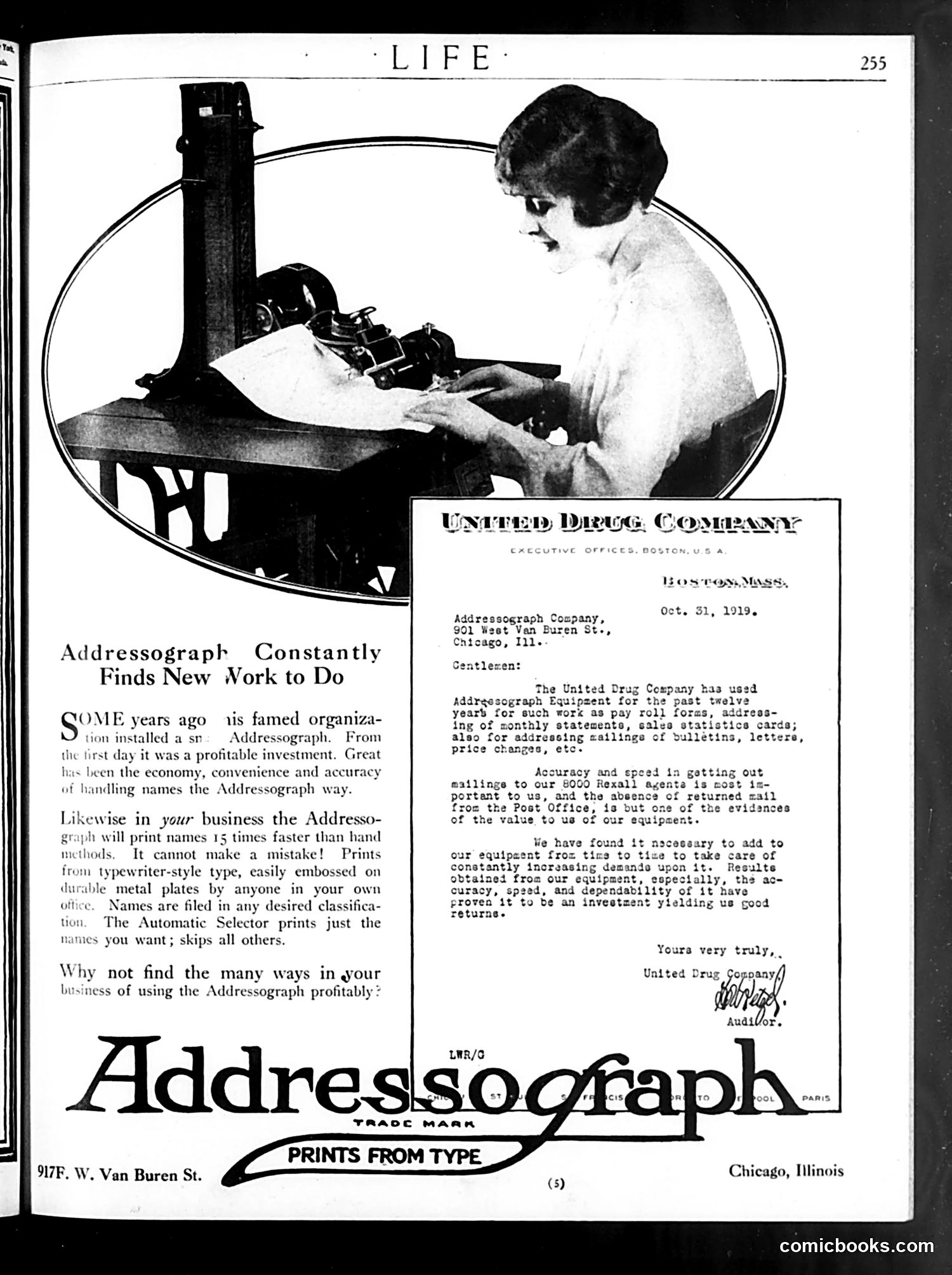
This page is **primarily advertising**, not satire or political commentary. The left side contains an advertisement for the Addressograph, a mechanical device for printing names and addresses on documents. The accompanying illustration shows a woman operating the machine at a desk. The ad emphasizes the machine's efficiency—printing names "15 times faster than hand methods"—and its business applications for mailing lists, price changes, and similar tasks. The right side reproduces a testimonial letter from the United Drug Company (dated Oct. 31, 1919) praising the Addressograph's accuracy and speed for their mailing operations. This represents typical early 20th-century magazine advertising targeting business customers, not editorial content or political commentary.
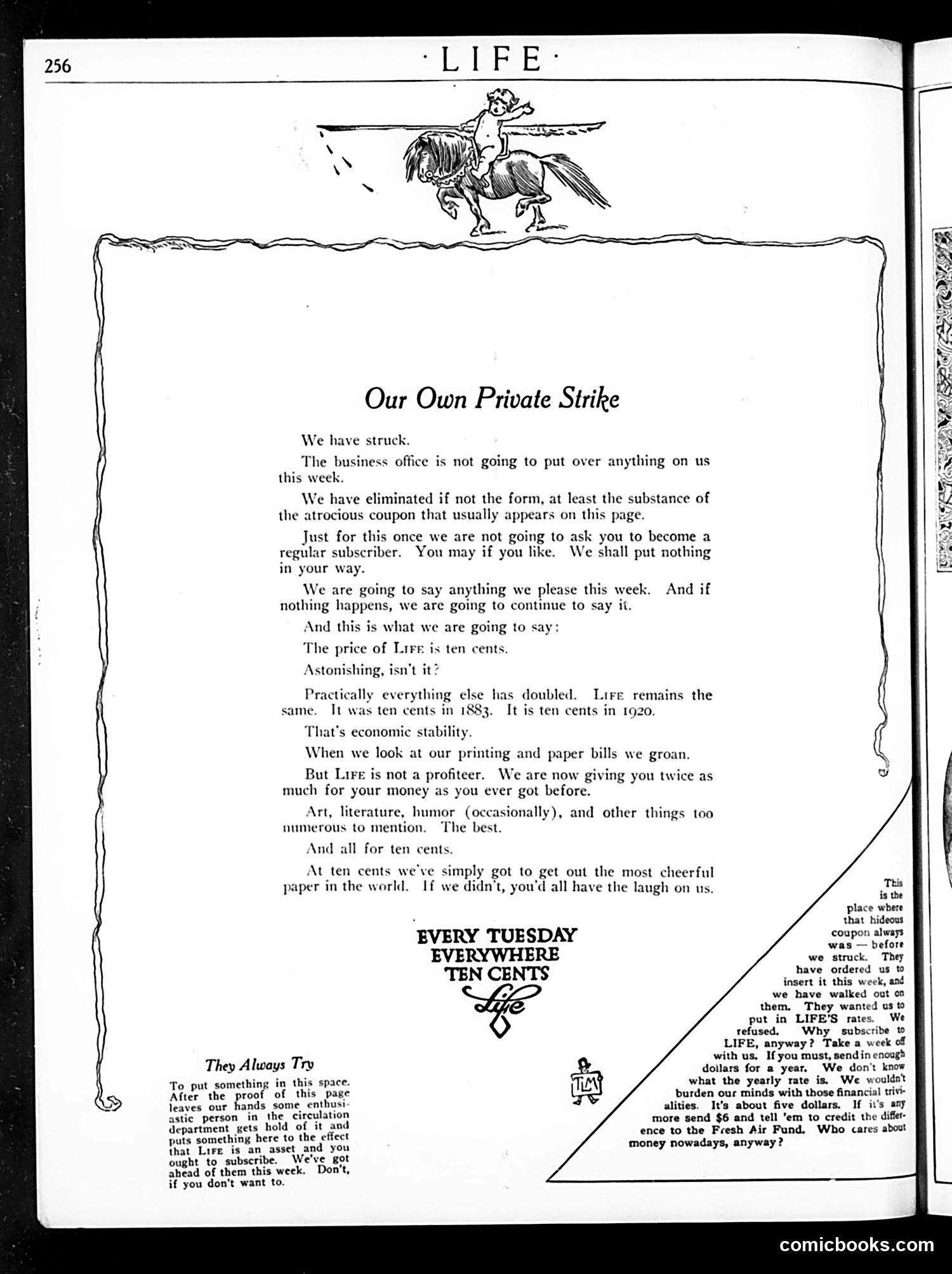
This page announces *Life* magazine's strike against its own advertisers and business practices. The publishers are refusing to run the standard coupon advertisement (a regular feature) and eliminating subscriber solicitation that week. The central claim is that *Life* has maintained its ten-cent price since 1883, while "practically everything else has doubled." They argue this represents "economic stability" and that readers get exceptional value—art, literature, and humor for a dime. The satire targets publishers who typically try to extract more revenue through coupons and subscription pushes. *Life* presents itself as the principled alternative, prioritizing content quality and price stability over profit extraction. The small illustration of a figure with wings appears decorative rather than specifically satirical.
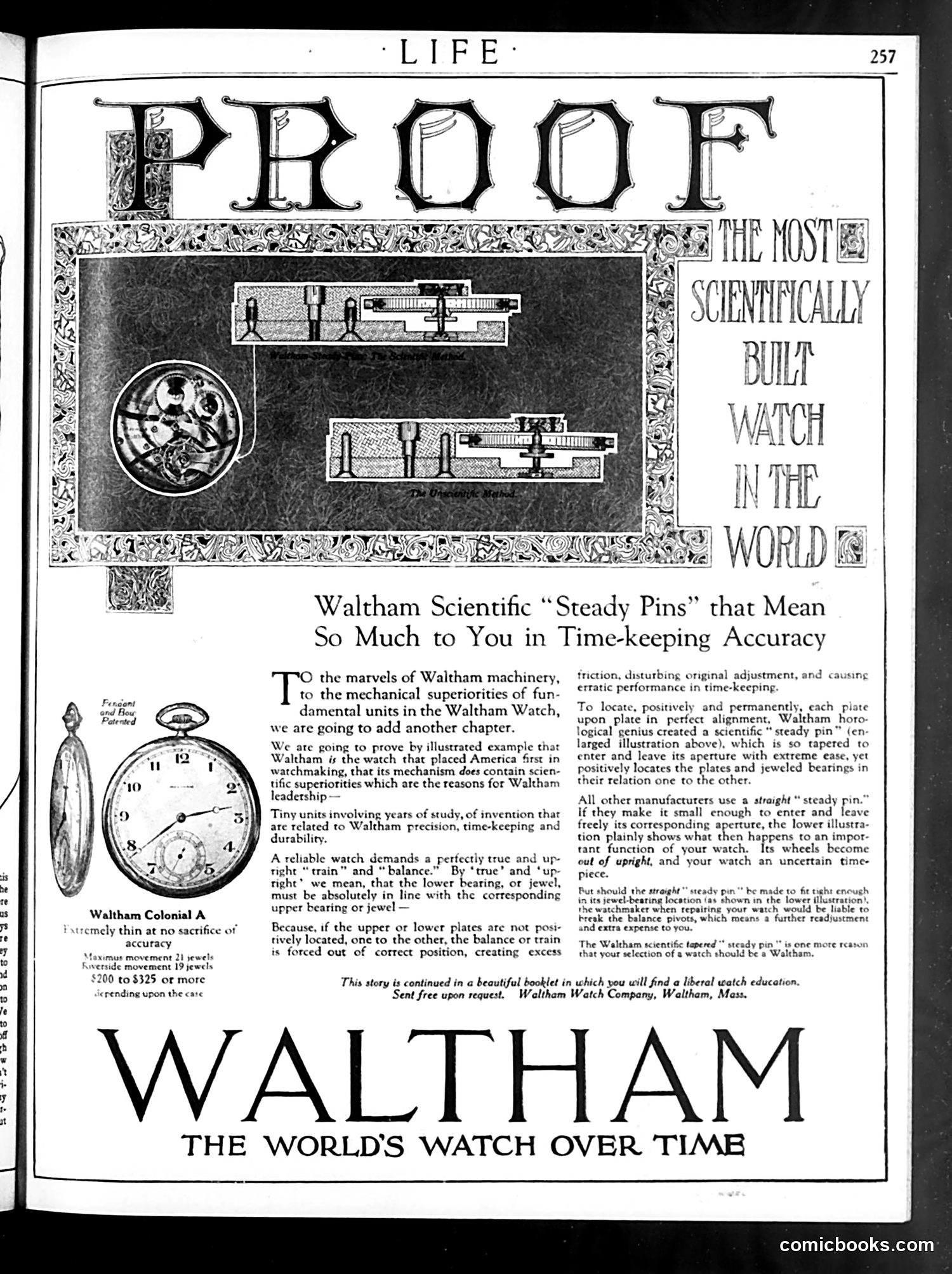
This is primarily a **Waltham Watch Company advertisement**, not political satire. The page features technical illustrations of watch mechanisms—specifically "steady pins" that improve timekeeping accuracy. The text explains how Waltham's engineering innovations (tiny mechanical components called "steady pins") maintain watch precision by keeping the balance wheel properly aligned. There's a diagram of the Waltham Colonial A pocket watch model shown on the left. The only figurative element is a classical or allegorical female figure in the decorative border, which appears to be generic ornamental design rather than political commentary. The advertisement emphasizes American industrial superiority ("placed America first in watchmaking"), which reflects early 20th-century national pride in manufacturing technology, but this is marketing messaging rather than editorial satire.
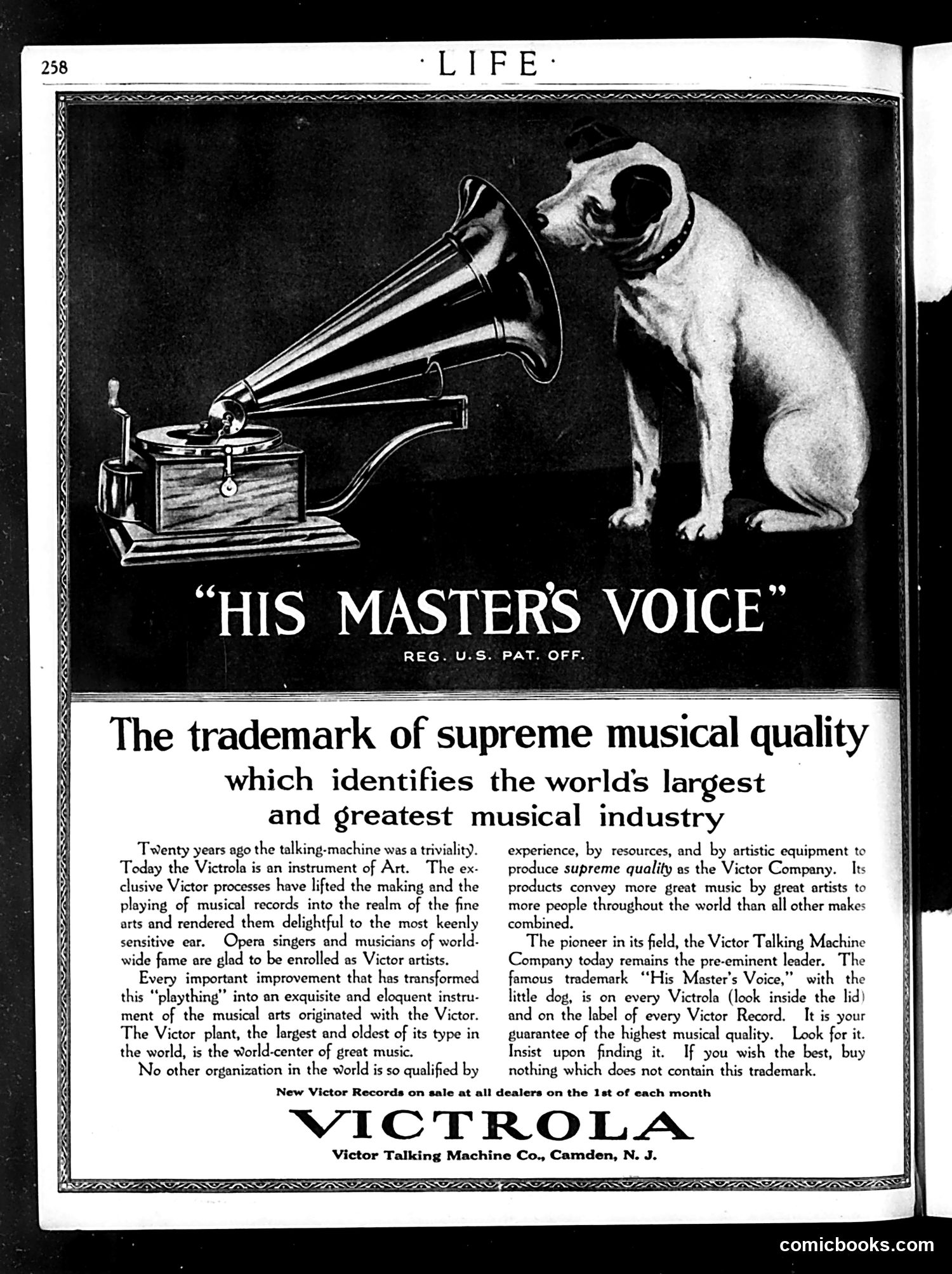
This is a **Victor Talking Machine Company advertisement**, not political satire. The page showcases the famous "His Master's Voice" trademark—a white dog (a fox terrier named Nipper) listening intently to a gramophone horn. The ad emphasizes that Victor's brand represents "supreme musical quality" and claims the company is "the world's largest and greatest musical industry." It references that twenty years prior, talking machines were considered novelties, but Victor has elevated them to fine art comparable to opera. The dog listening to the gramophone is meant to suggest that even a simple animal recognizes quality sound reproduction—a humorous way to convey the product's superiority. This iconic image became one of advertising's most recognizable symbols, still used today.
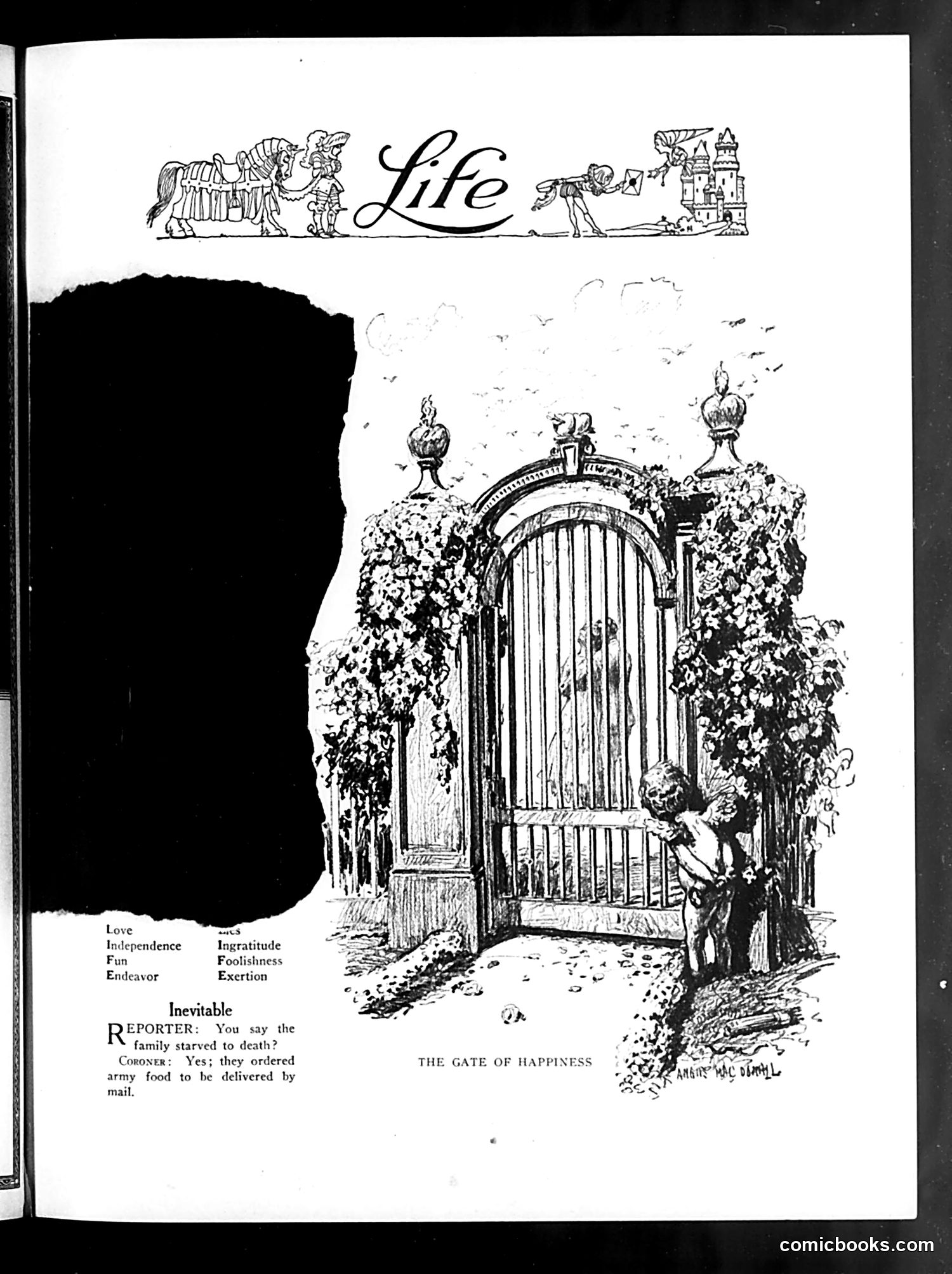
This page features "The Gate of Happiness," an illustration showing an ornate gate covered in ivy, with a figure approaching it. The accompanying joke presents a brief comedic dialogue between a Reporter and a Coroner about a family that "starved to death" because they "ordered army food to be delivered by mail." The satire appears to mock U.S. Army food service and mail delivery inefficiency—likely referencing WWI-era logistics. The joke's dark humor suggests either that Army rations were inedible or that mail delivery was so slow the food never arrived in time. The page header lists character types ("Love," "Ingratitude," "Fun," "Foolishness," etc.), suggesting this was part of a larger satirical feature about human nature and social follies typical of *Life* magazine's humor style from the early 20th century.
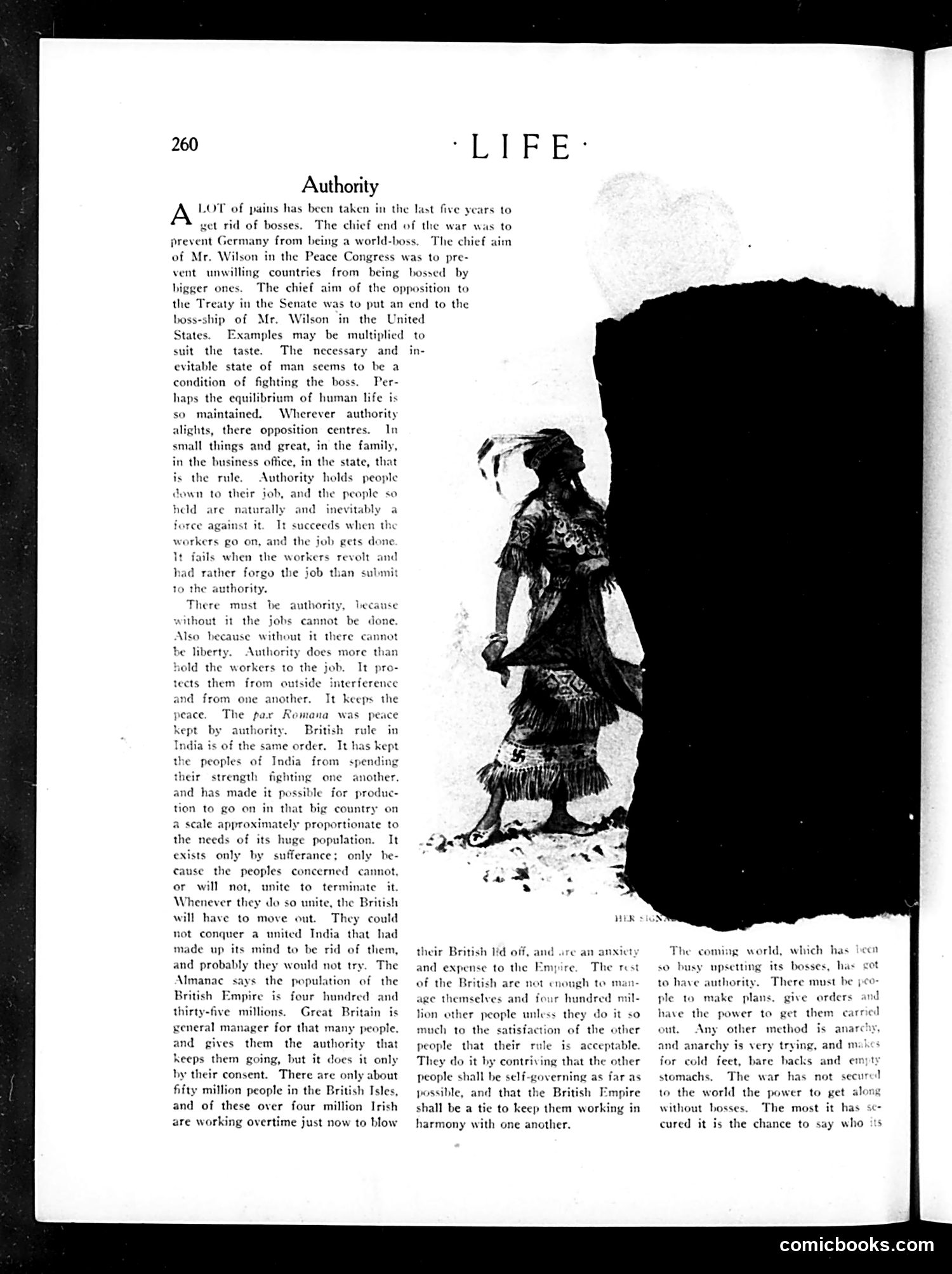
The essay argues that authority is necessary for society to function—jobs require direction, and liberty depends on order. The author defends British imperial rule, particularly in India, claiming it maintains peace among diverse populations that would otherwise fight each other. He argues the British Empire benefits India's 300+ million people, and that only about 50 million British people govern these territories. The illustration shows a figure in ornate dress (likely representing India or an Indian subject) standing passively. The essay's tone suggests this is pro-imperialist propaganda justifying colonial control as benevolent governance rather than exploitation—a common argument made during the early 20th century to defend British imperial expansion.
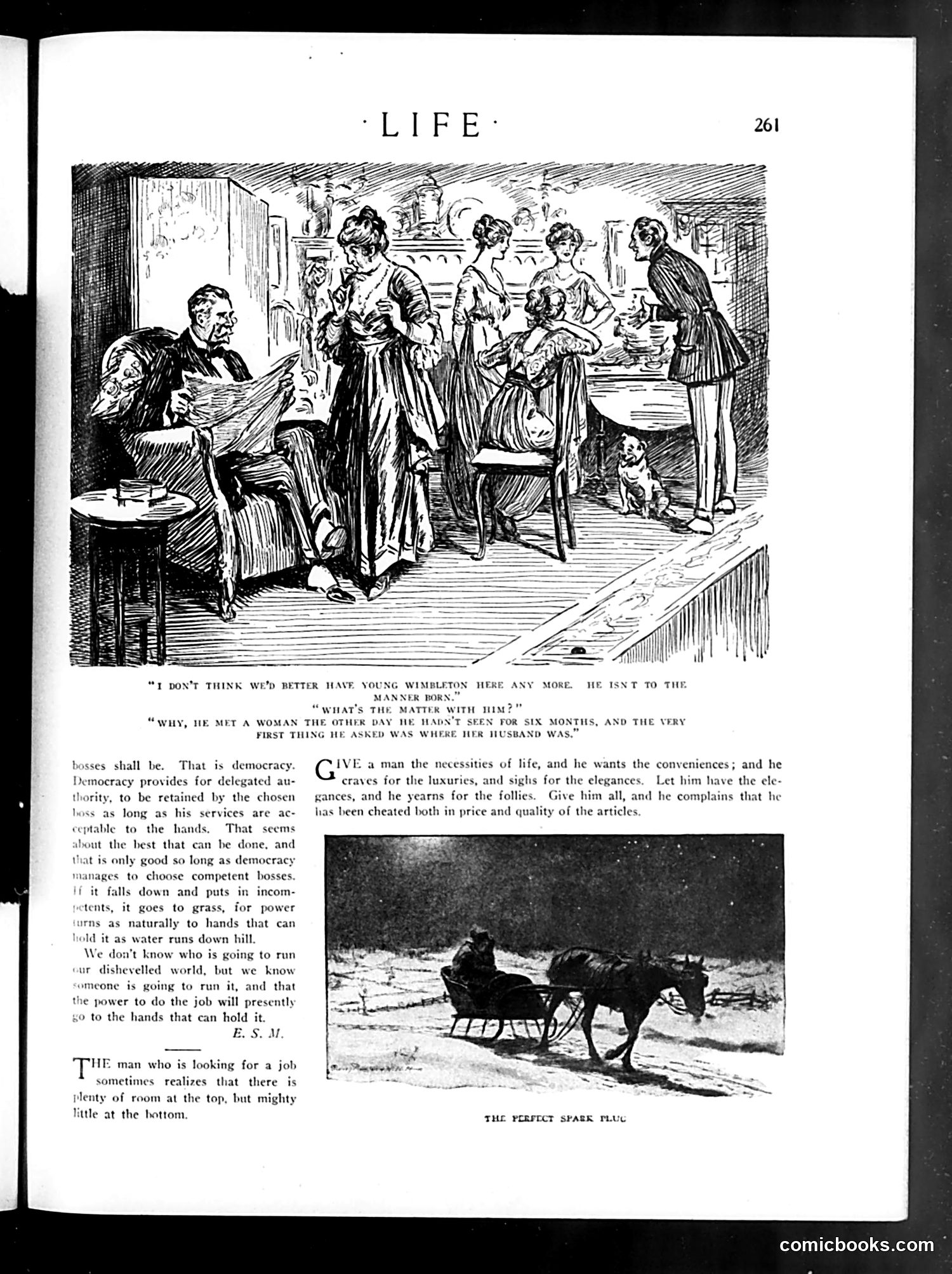
The top cartoon depicts a domestic scene where a man reads a newspaper while women gather in a parlor. The dialogue reveals gossip about "young Wimbleton," who recently met a woman and hasn't seen his husband in six months—the first thing he asked about was the husband's whereabouts. The satire targets marital infidelity and social hypocrisy. The joke's sting relies on the surprise revelation that "Wimbleton" is male, suggesting homosexual behavior. This reflects early-20th-century satirical treatment of scandalous social conduct. The accompanying text discusses democracy and job-seeking. Below is an unrelated photograph labeled "The Perfect Spark Plug," showing a horse-drawn sleigh.
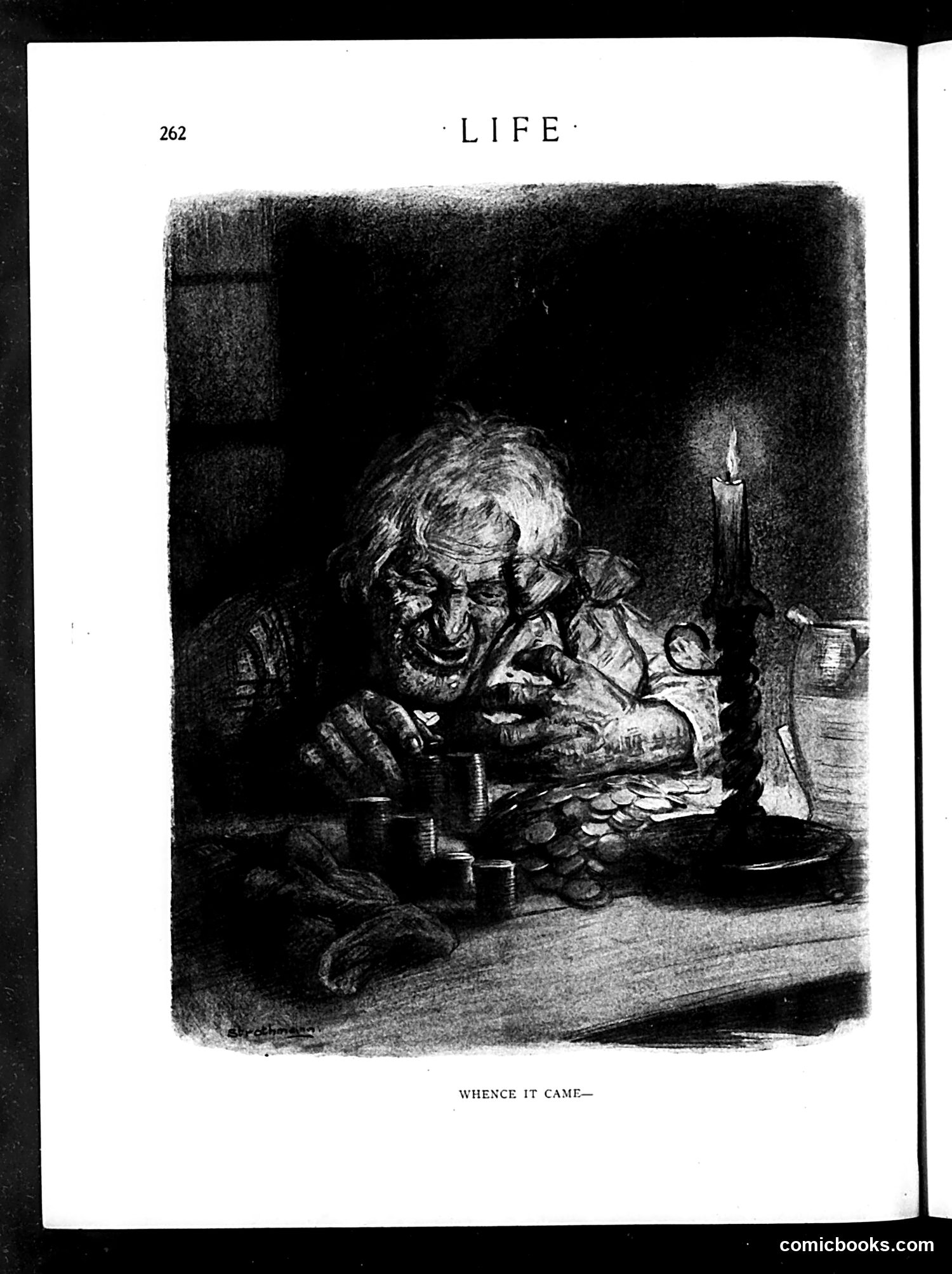
This appears to be a satirical illustration depicting a figure hunched over coins and money in a dimly lit, cramped setting—rendered in dark, expressionistic style. The figure's exaggerated facial features and posture suggest moral critique rather than celebration of wealth. The title "Whence It Came" implies commentary on the *origins* of money or wealth, likely questioning its moral sources. The candle, sparse surroundings, and furtive pose suggest ill-gotten gains or greed. This fits Life magazine's tradition of social satire, possibly critiquing materialism, corruption, or miserliness during the Gilded Age or Progressive Era. Without additional context or byline visible, the specific target remains unclear, but the image functions as a morality tale about wealth's questionable origins.
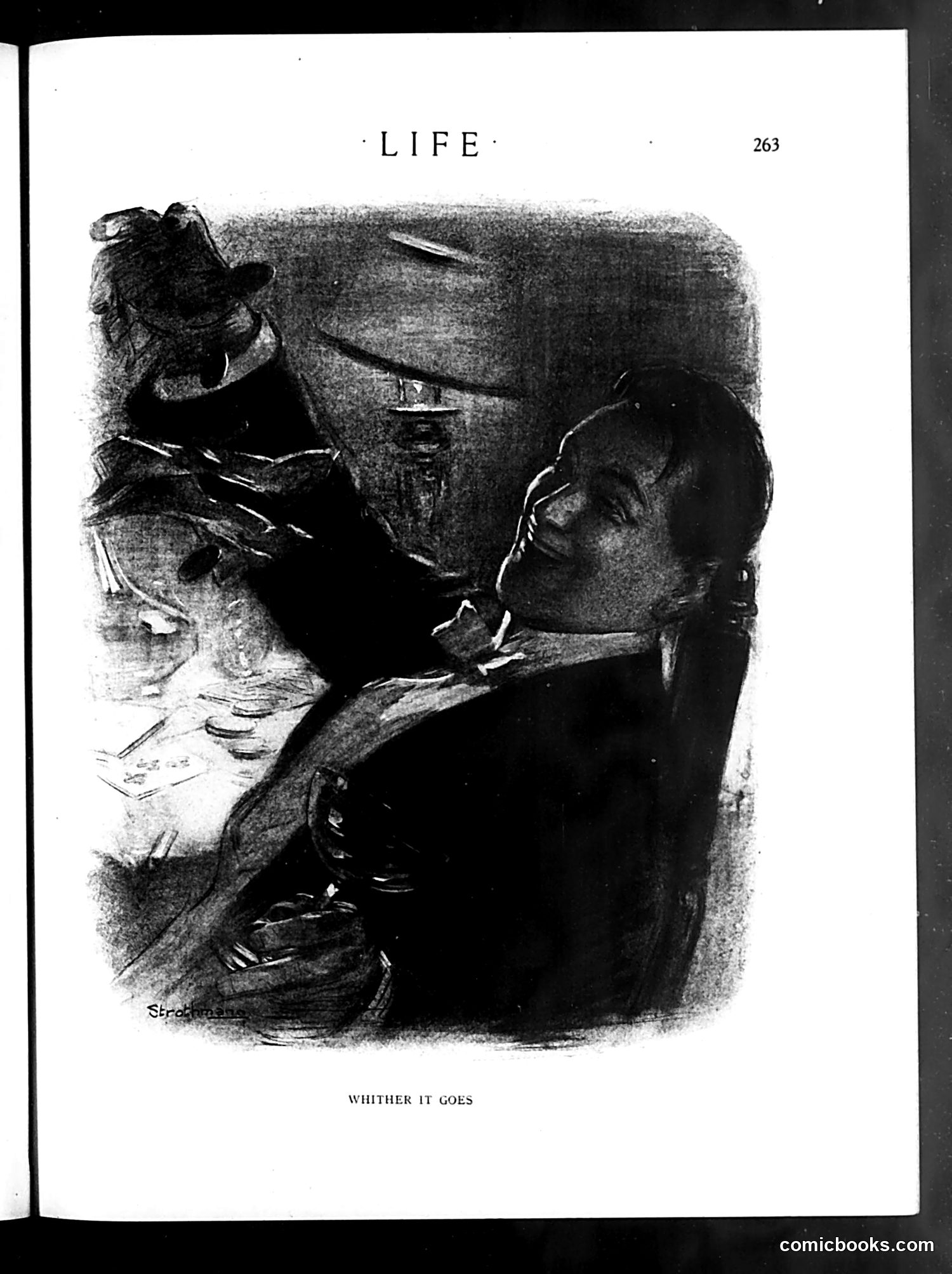
This single-panel cartoon depicts a man in formal attire examining or holding what appears to be a document or paper, with a telescope or similar instrument visible in the background. The title "Whither It Goes" suggests uncertainty about a destination or outcome. Without additional context about the publication date or specific historical event referenced, the exact political meaning is unclear. However, the formal setting and scrutiny of a document suggests commentary on governmental or bureaucratic processes—possibly about tracking money, legislation, or resources and questioning where they ultimately end up. The cartoon's satirical point likely critiques lack of transparency or accountability in some institution, though the specific target remains uncertain without more contextual information.
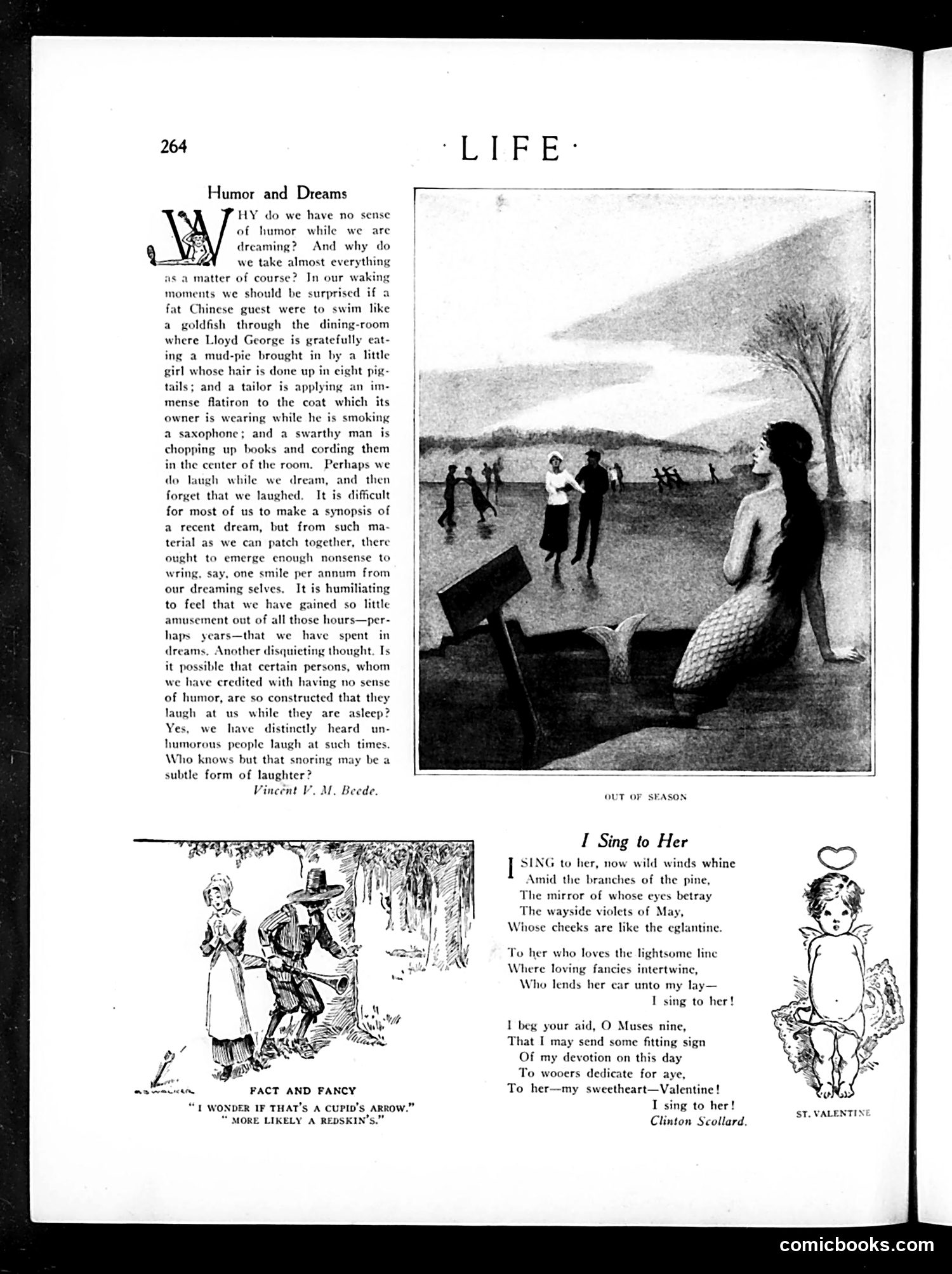
This page contains two unrelated pieces. The top essay, "Humor and Dreams" by Vincent V. M. Beede, discusses why we find humor in dreams and whether certain humorless people might laugh while sleeping. It's philosophical rather than satirical. Below is a cartoon labeled "Fact and Fancy" showing a man in period costume (possibly 18th century) with a woman, captioned: "I wonder if that's a Cupid's arrow. More likely a redskin's." The joke appears to mock romantic pretension by suggesting what looks like Cupid's arrow might actually be a Native American weapon—substituting crude reality for romantic fantasy. The page also includes a poem "I Sing to Her" by Clinton Scollard and decorative illustrations.
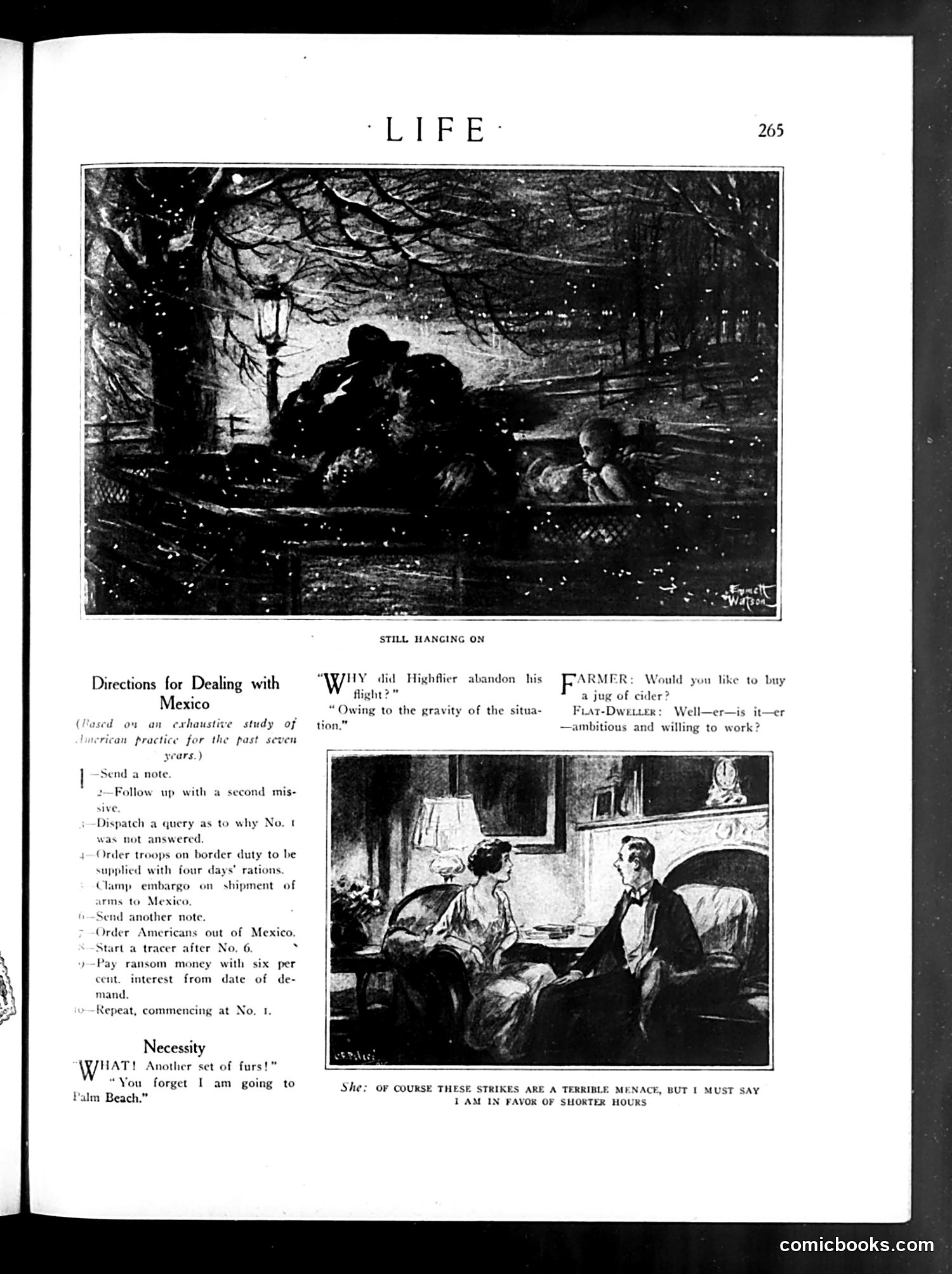
This page contains satirical commentary on U.S.-Mexico relations and labor disputes, likely from the early 20th century. **"Directions for Dealing with Mexico"** presents a numbered list mocking American diplomatic responses, suggesting bureaucratic incompetence: send notes, follow-ups, queries about unanswered notes, supply troop rations, ship arms, and repeat. The satire critiques how America handled Mexican affairs through ineffectual paperwork rather than coherent policy. **"Still Hanging On"** (top image) depicts what appears to be soldiers or fighters in difficult conditions, possibly referencing military intervention in Mexico. **"Necessity"** is a dialogue joke about forgotten beach plans. **The lower cartoon** shows a woman and man discussing labor strikes, with her noting strikes send a "terrible message" but supporting shorter hours—satirizing how even strike opponents acknowledge workers' legitimate grievances.
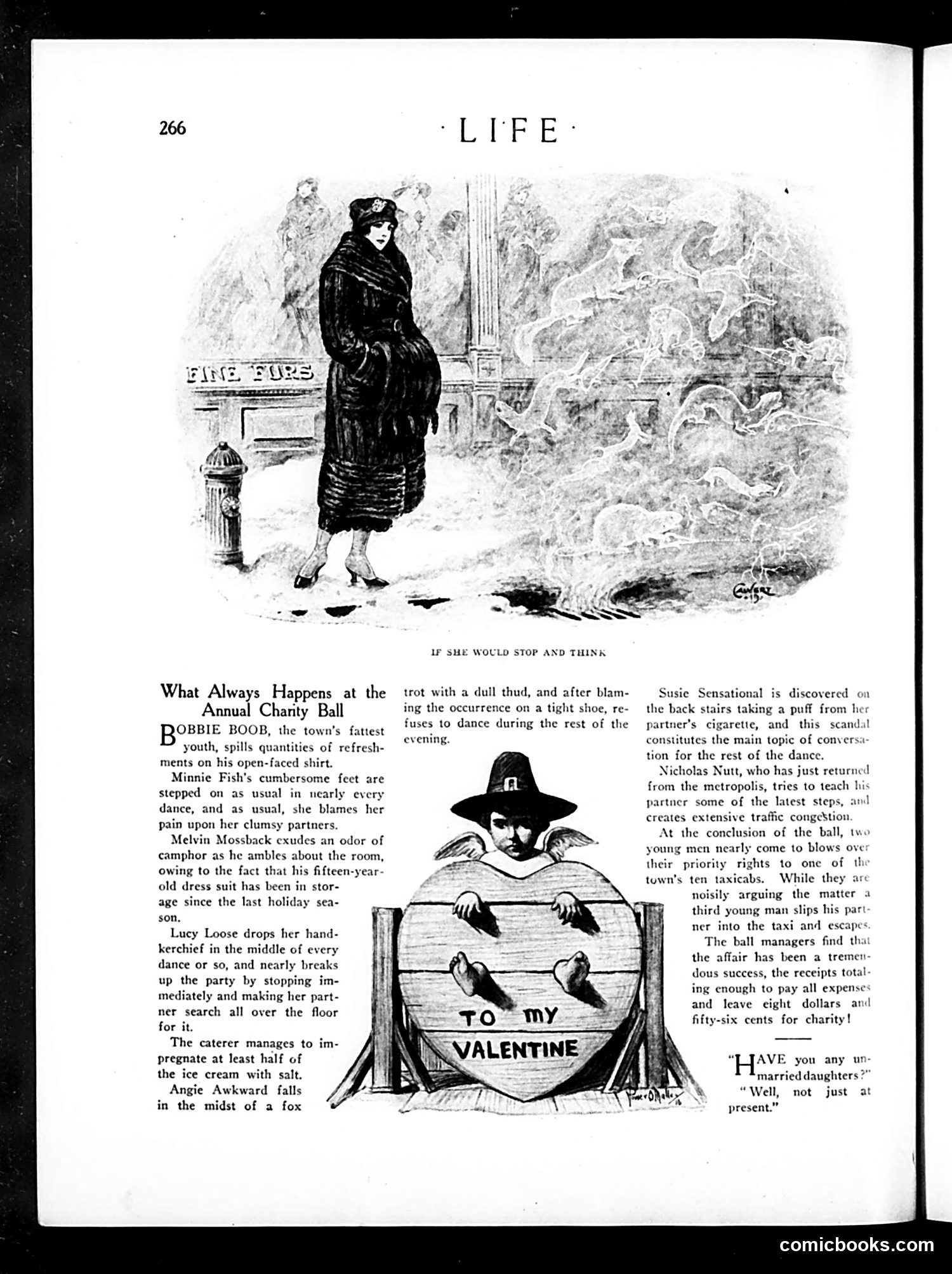
This page satirizes social mishaps at a charity ball. The main cartoon ("If She Would Stop and Think") shows a woman in fur coat standing near a fire hydrant—a visual pun suggesting she might be mistaken for a dog. The article "What Always Happens at the Annual Charity Ball" catalogs comedic incidents: Bobbie Boob's torn shirt, Minnie Flatfoot's stepped-on feet, Lucy Loose's dropped handkerchief, and Angie Awkward falling during a fox-trot. The second cartoon depicts Cupid with a heart labeled "To my VALENTINE," likely mocking sentimental expressions. The satire targets upper-class social pretensions and the inevitable embarrassments that occur despite efforts at sophistication—a common Life magazine theme mocking the wealthy.
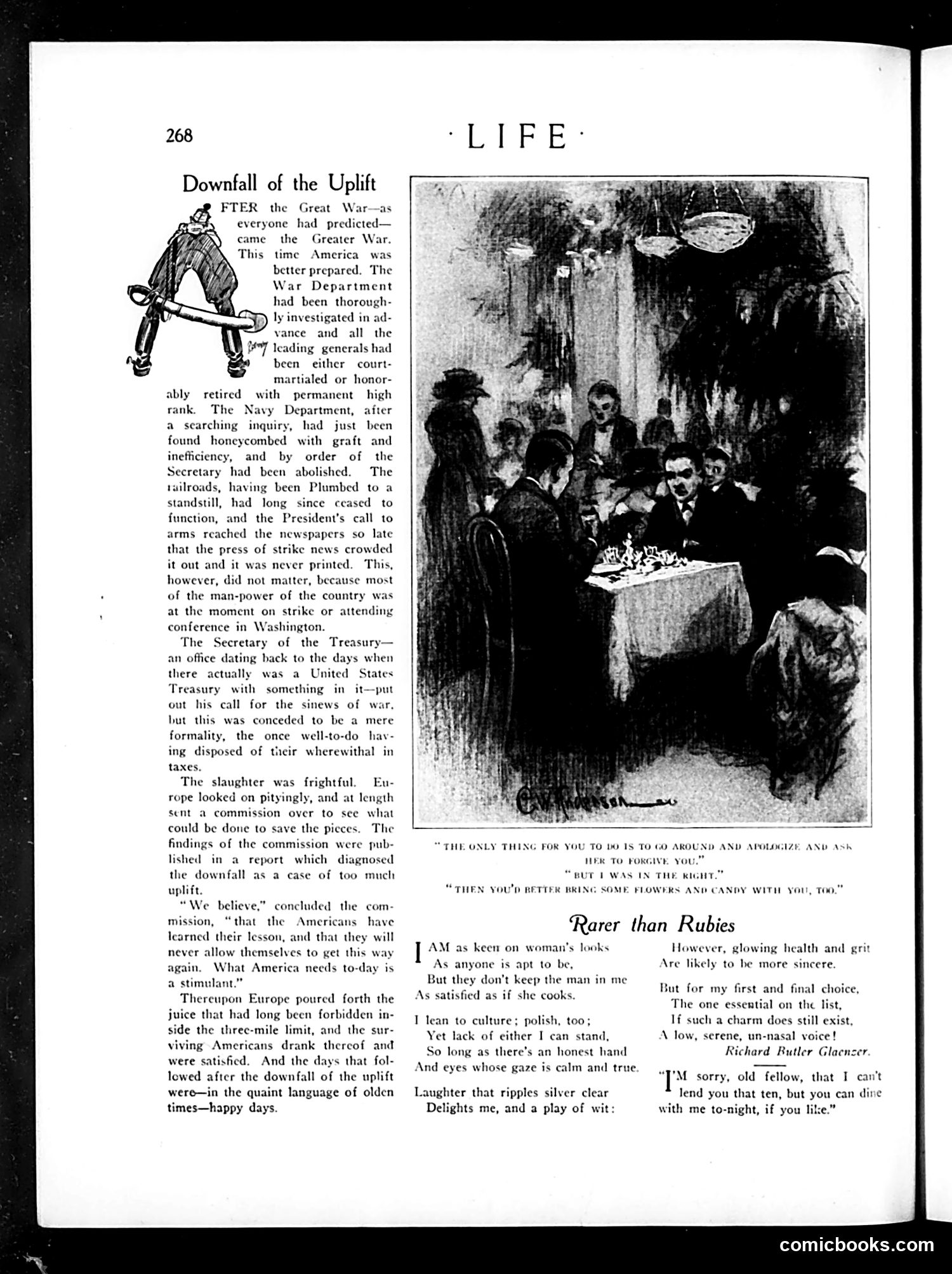
This satirical piece mocks Progressive Era "uplift" reforms and their unintended consequences. The narrative describes a dystopian post-war America where well-intentioned institutional reforms have paradoxically crippled the nation: the War Department was investigated into dysfunction, the Navy abolished for graft, railroads "plumbed to a standstill," and the military draft announcement got buried under strike news. The satire's punchline: Europe sends a commission that diagnoses America's collapse as "too much uplift"—the cure being the repeal of Prohibition, allowing alcohol back in. The joke suggests that Progressive reformism and temperance movements, however morally motivated, have actually weakened American society. The concluding sentiment—that post-Prohibition "happy days" returned—reflects the magazine's skepticism toward idealistic reform movements, positioning them as naive and counterproductive. The cartoon criticizes both bureaucratic inefficiency and moral crusades.
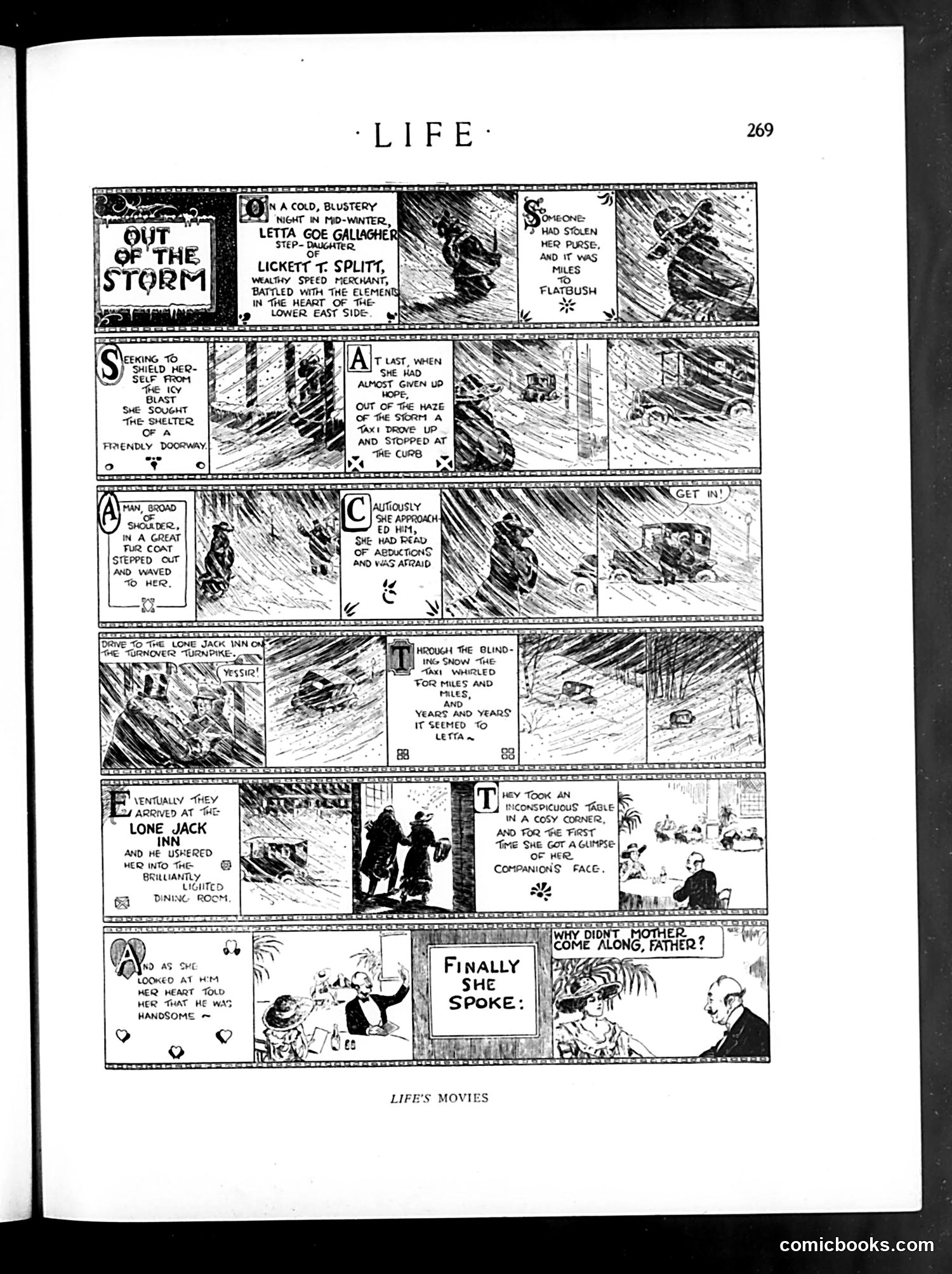
This comic strip satirizes the overwrought conventions of 1920s silent film melodrama. The narrative follows a classic formula: a young woman (Letta Gallagher) loses her purse in a blizzard, is rescued by a wealthy man (Lickett T. Splitt—a ridiculous name suggesting the character's absurdity), and they shelter together at an inn. The satire targets the genre's exaggerated emotional language ("her heart told her"), implausible coincidences, and stock situations—the storm, the mysterious stranger, romantic tension. The deliberately purple prose and overwrought panel descriptions mock how seriously these films treated their melodramatic plots. The final panel's caption "Why didn't mother come along, Father?" suggests the joke concludes with an unexpectedly mundane or anticlimactic revelation, deflating the accumulated romantic tension—the point being that these silent film plots were inherently ridiculous when examined closely.
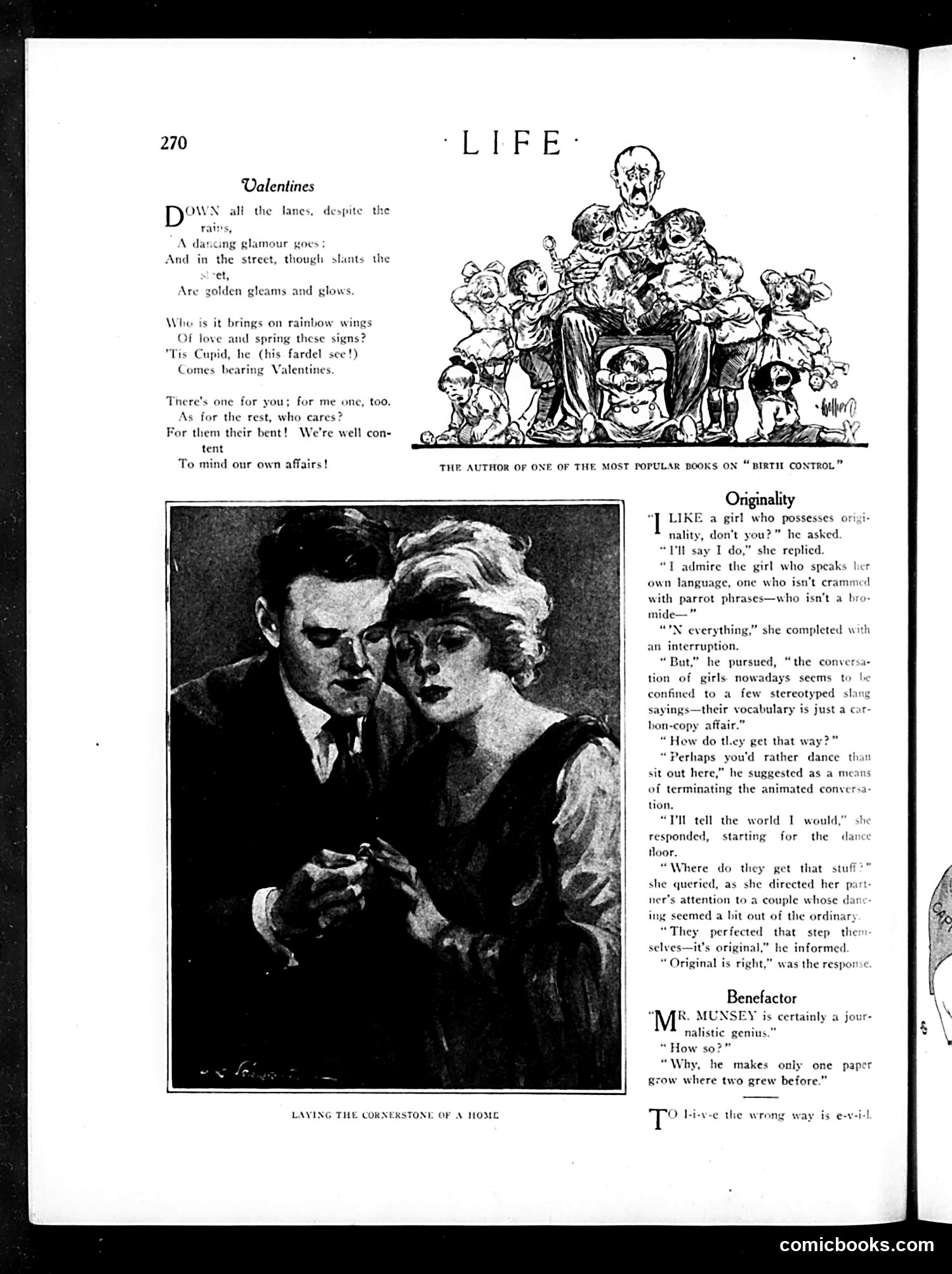
This page from Life magazine presents satirical social commentary through multiple segments: **"Valentines" Poem & Illustration**: A sentimental verse about Cupid delivering love notes, paired with a sketch showing an elderly man surrounded by many children. The caption identifies him as "the author of one of the most popular books on 'birth control'"—a dark joke suggesting ironic contradiction between his published message and his large family. **"Originality" Dialog**: Satirizes shallow modern conversation. A man criticizes girls for using clichéd "parrot phrases" and "carbon-copy" slang, yet when the woman agrees and wants to dance, he dismisses the conversation entirely—exposing his hypocrisy about valuing original thought. **"Benefactor" Quip**: A brief joke mocking newspaper magnate (likely Frank Munsey), claiming he reduces competition by consolidating papers rather than expanding the industry. The page targets early 20th-century social pretension, dating advice culture, and media consolidation.
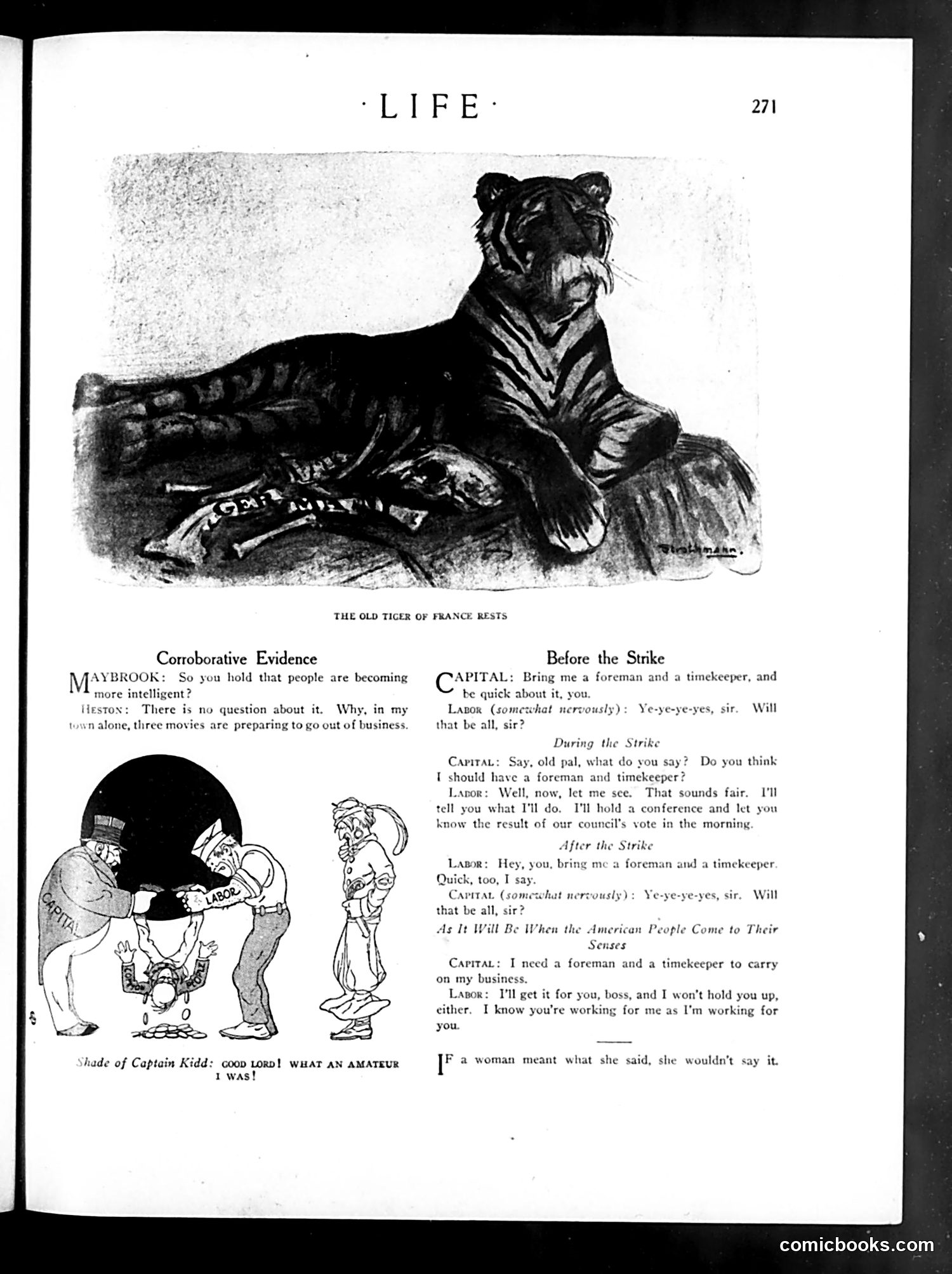
This page contains two distinct satirical pieces: **"The Old Tiger of France Rests"** shows a resting tiger, likely referencing French military power or leadership (unclear which specific figure without dates). **"Corroborative Evidence"** jokes that people growing more intelligent is proven by three movies going out of business—implying movies appeal to unintelligent audiences. **The main feature** shows a three-panel labor dispute comic. A capitalist employer initially demands workers quickly produce a foreman and timekeeper. During a strike, the empowered labor leader ("Labor") becomes demanding and bureaucratic, reversing roles. After the strike ends, the labor leader obsequiously complies with the same request, submitting to the employer again. The satire critiques labor unions: it suggests striking workers gain temporary power and arrogance, but ultimately lose leverage and revert to subservience. The final panel mockingly depicts an idealized future where capital and labor work as equals—presented as absurdly utopian. The page reflects anti-union sentiment common in early 20th-century American humor.
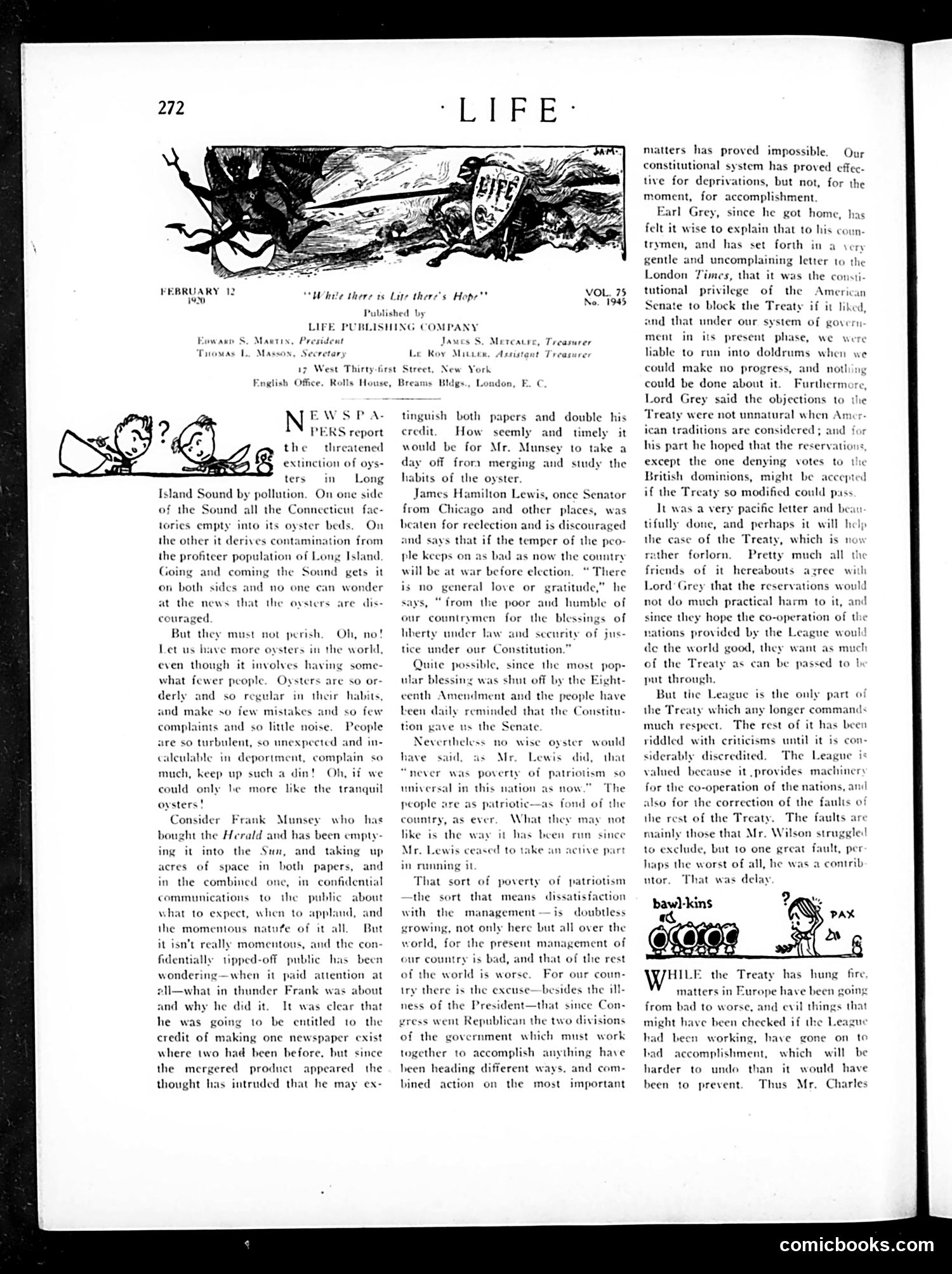
This page contains two distinct satirical pieces: **The Oyster Editorial**: The main text uses oysters as a metaphor for social order. Life sarcastically suggests oysters are preferable to people because they're orderly, quiet, and complain-free—while humans are "turbulent" and "unpredictable." This is social satire mocking those who value conformity over democratic messiness. **Frank Munsey Cartoon**: The small illustration criticizes newspaper magnate Frank Munsey, who merged the *Herald* and *Sun* newspapers. Life ridicules him for consolidating papers while neglecting to understand how systems actually work—comparing him unfavorably to an oyster's disciplined habits. **James Hamilton Lewis Reference**: The text critiques the defeated Senator Lewis, who blamed poor patriotism among Americans for national problems. Life counters that people have legitimate grievances with government management, not lack of patriotism—especially regarding Prohibition (the "Eighteenth Amendment"). The underlying theme: Government dysfunction and corporate consolidation are real problems; blaming citizens for lacking gratitude is misguided.
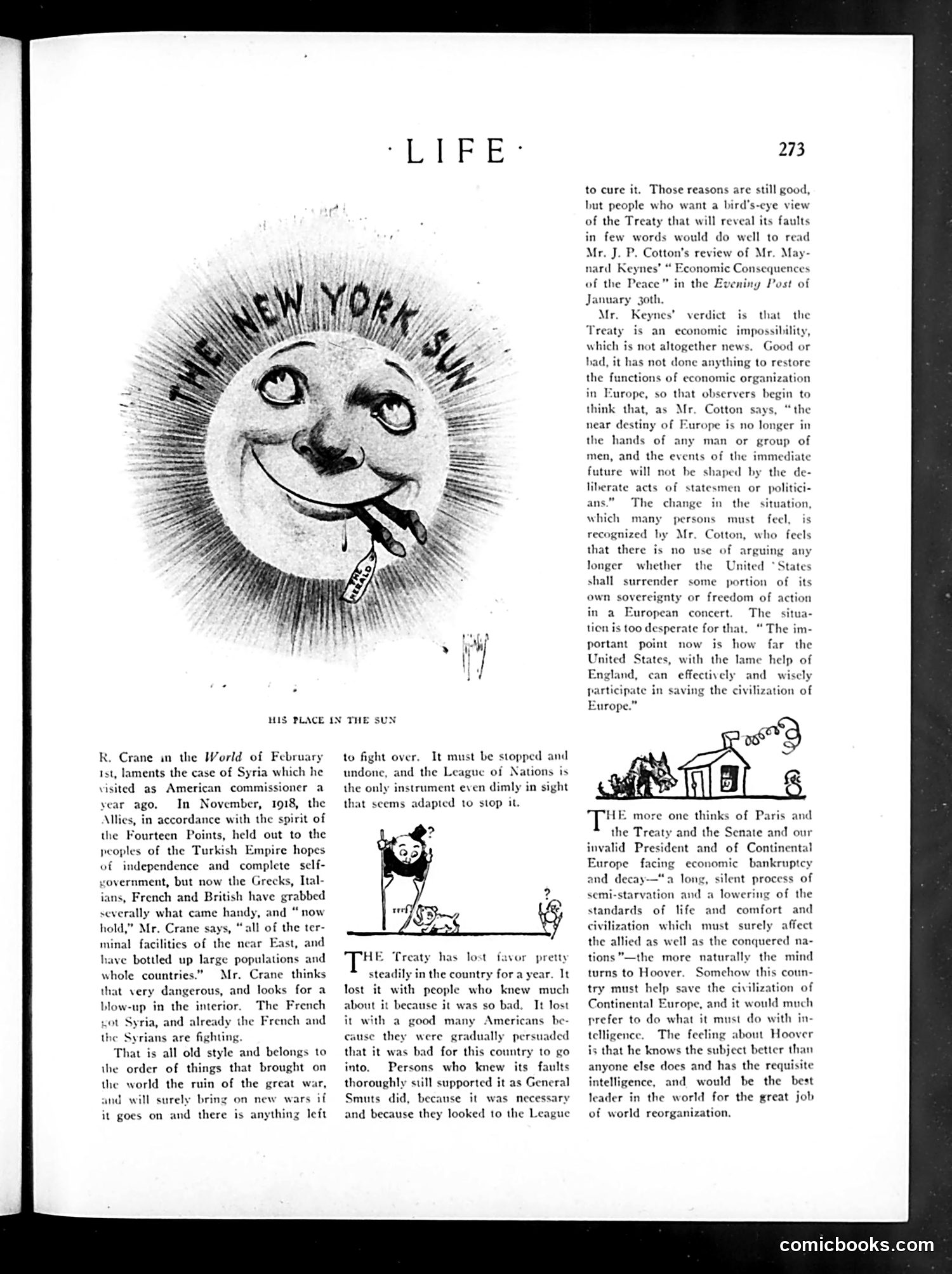
This page critiques the post-WWI Treaty of Versailles and European instability. The large cartoon "His Place in the Sun" depicts a smiling face labeled "NEW YORK SUN"—satirizing the newspaper's optimistic coverage despite dire circumstances. The text discusses R. Crane's observations about Syria and the Near East, where Allied powers (France, Britain, Greece, Italy) broke promises of self-determination made under Wilson's Fourteen Points, instead seizing territory. This "old style" imperialism risks future wars. The article argues the Treaty itself is economically catastrophic (citing economist Keynes' analysis) and has failed to restore European stability. The author suggests the situation is now beyond political negotiation—too desperate for debate over American sovereignty. The piece concludes by endorsing Herbert Hoover as the best leader to manage European reconstruction with practical intelligence, rather than relying on the "invalid President" (Wilson) or Senate squabbling. The overall message: the Treaty failed, Europe faces collapse, and only pragmatic American intervention under Hoover can prevent catastrophe.
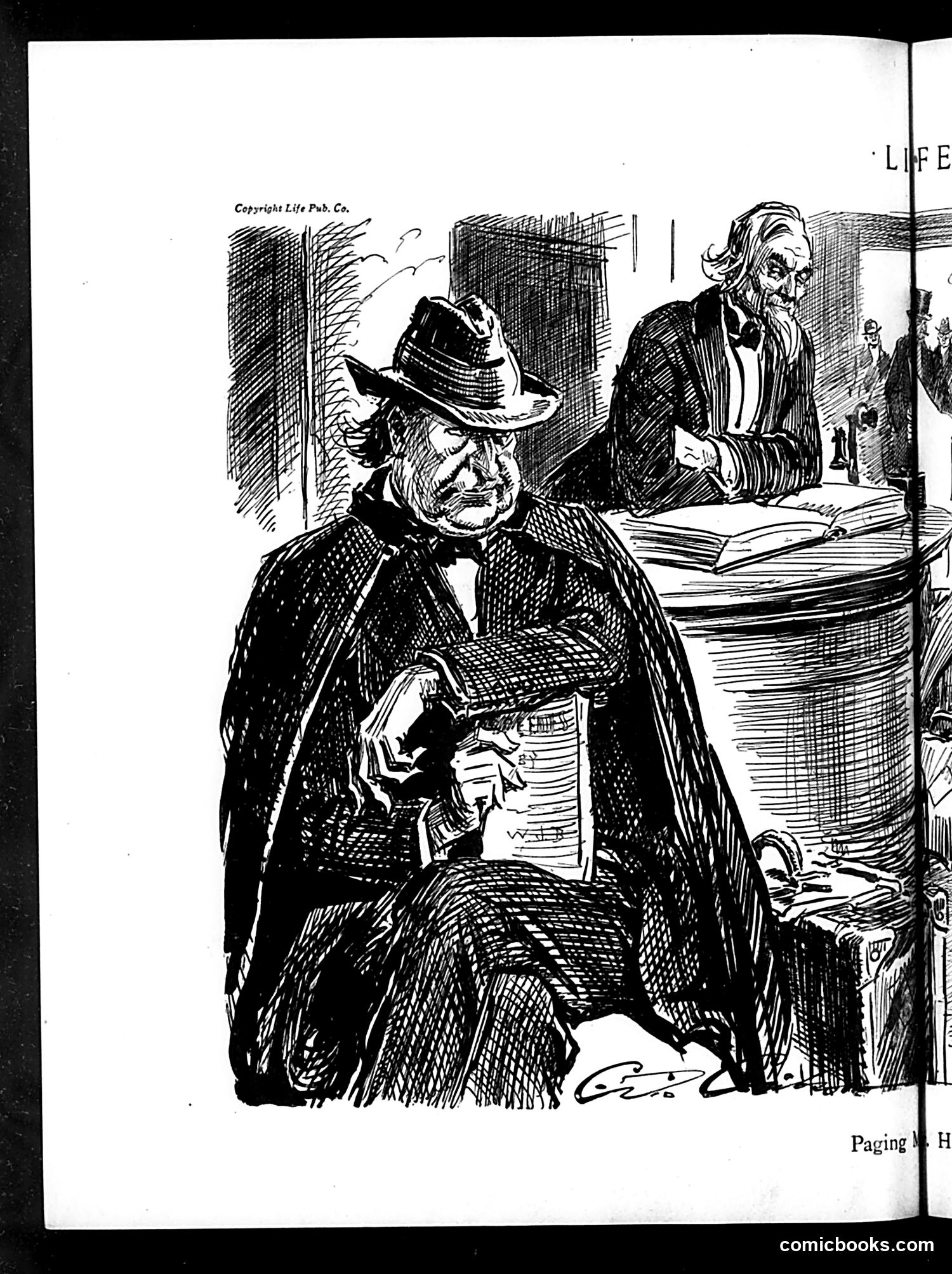
This appears to be a satirical cartoon from Life magazine depicting a scene in what looks like a legal or governmental office. The central figure is a man wearing a hat and cape, shown from behind, holding documents—likely representing a lawyer, judge, or official of some kind. Behind him are other formally dressed men, including one with a notably long beard, suggesting authority figures or colleagues. The setting with books and papers suggests bureaucratic or legal proceedings. However, without the complete OCR text or caption ("Paging" is cut off), I cannot definitively identify the specific political figure or scandal being satirized, or determine the exact joke's point. The style and composition suggest commentary on corruption, incompetence, or hypocrisy within institutional authority.
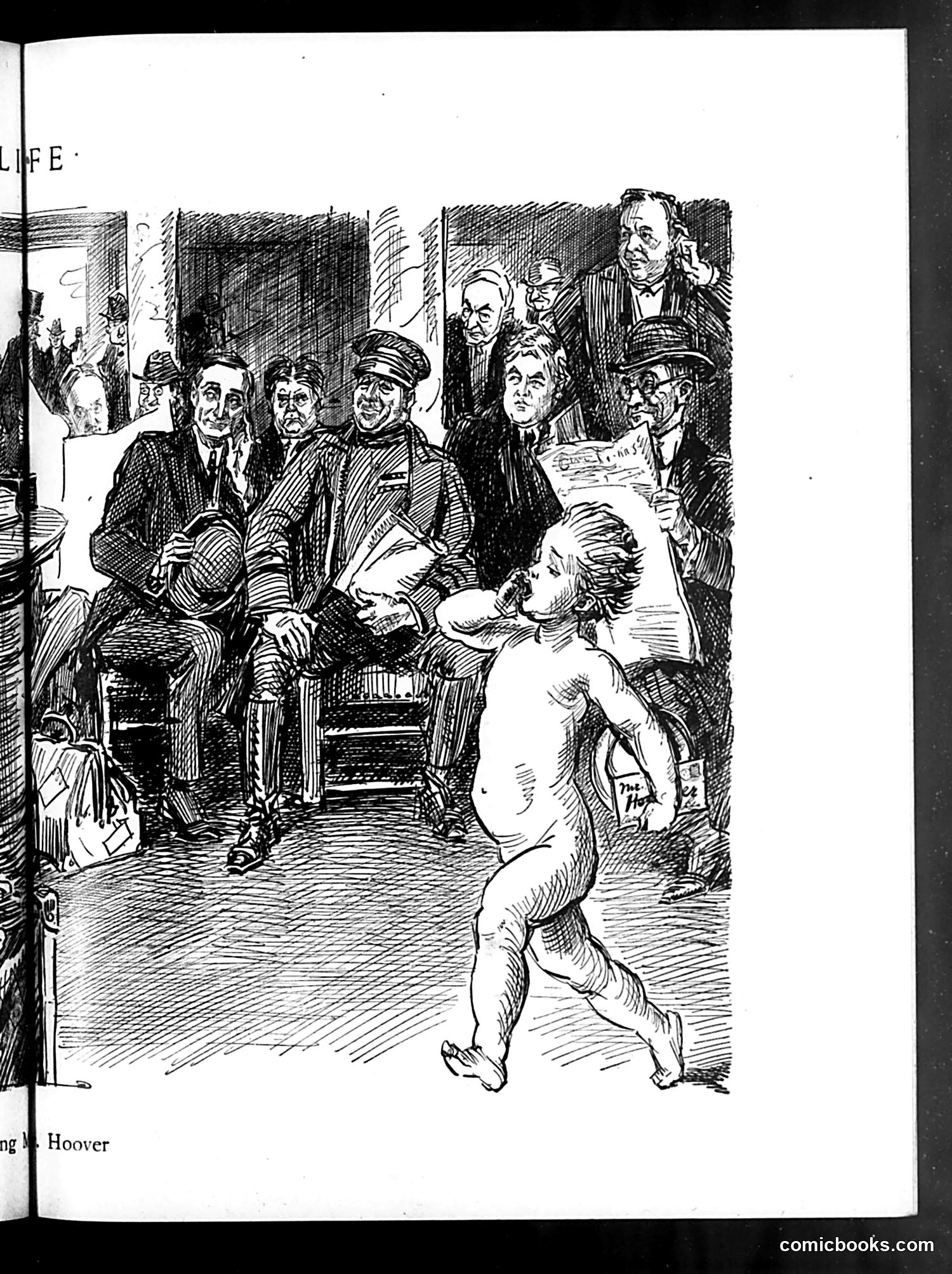
This is a satirical cartoon depicting a naked cherub or cupid figure displaying itself to an audience of well-dressed men in what appears to be a formal setting or gallery. The men's expressions range from amusement to disapproval as they observe the child figure. The satire appears to target either: - Art world pretension (mocking how the art establishment treats or accepts questionable subject matter) - Social hypocrisy regarding public decency standards - Possibly commentary on inappropriate exploitation presented under the guise of "art" The formal attire and indoor setting suggest this critiques established institutions or upper-class attitudes. Without visible caption text or clearer context from the page, the specific political or social reference remains unclear, though the satirical intent—exposing contradiction between public propriety and private acceptance—is evident.
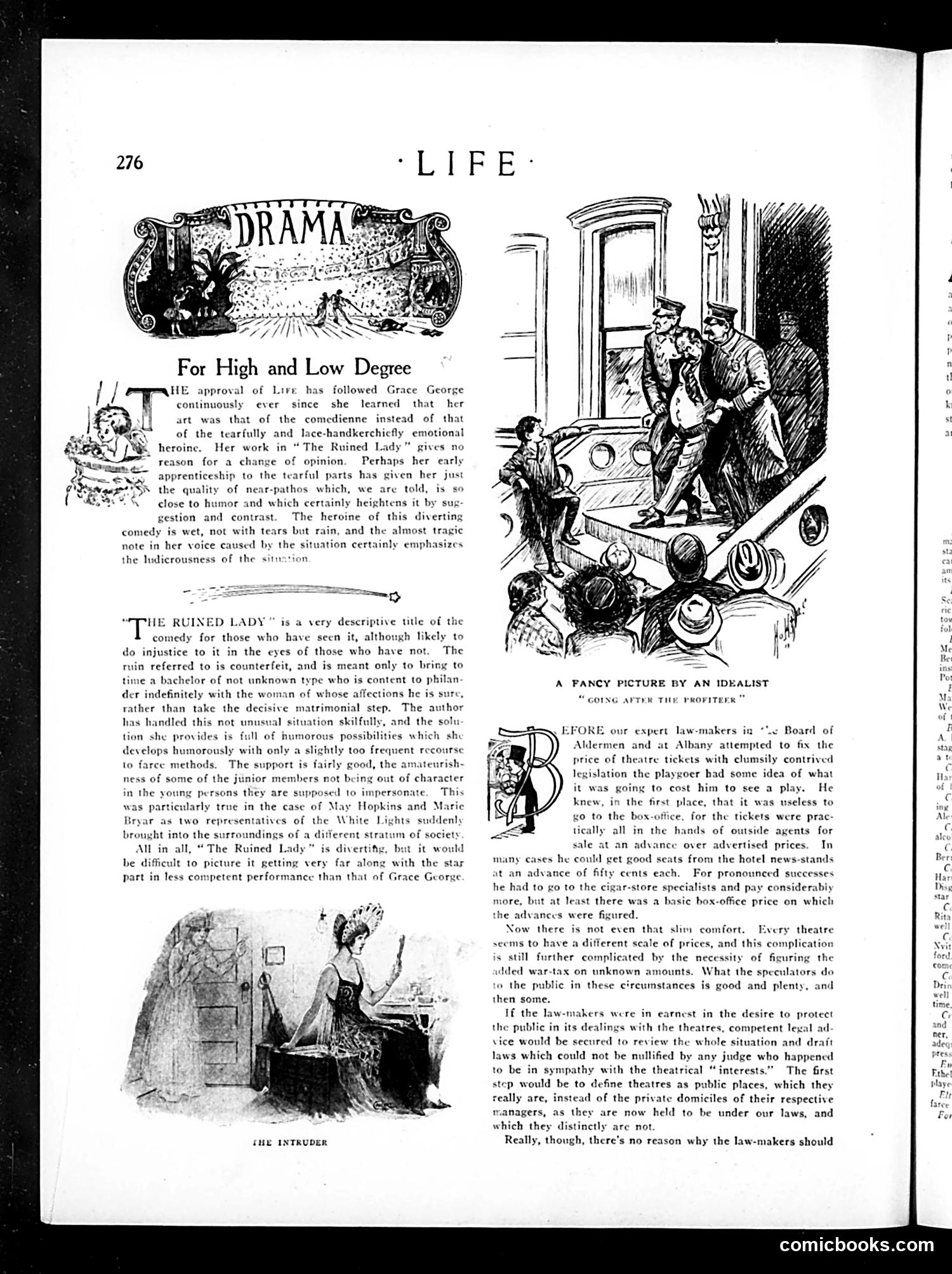
This *Life* magazine page critiques two theatrical matters: **"The Ruined Lady" Review (left):** A favorable review of Grace George's comedy performance. The play concerns a woman falsely ruined in reputation to trap a reluctant bachelor into marriage. *Life* approves George's comedic talent, noting she excels at humor rather than melodramatic tragedy. **"A Fancy Picture by an Idealist" (right):** The main satire. The illustration shows theatrical scalpers/ticket speculators being pursued. The accompanying article criticizes price-fixing legislation for theater tickets, enacted by New York's Board of Aldermen and Albany. The complaint: regulations meant to protect consumers have backfired, making prices *less* transparent and more exploitative. Previously, scalpers charged fixed markups over advertised box-office prices; now theaters use complex variable pricing plus war-taxes, allowing speculators to charge arbitrarily. The author argues lawmakers should legally define theaters as "public places" (regulated utilities) rather than private businesses to effectively control profiteering.
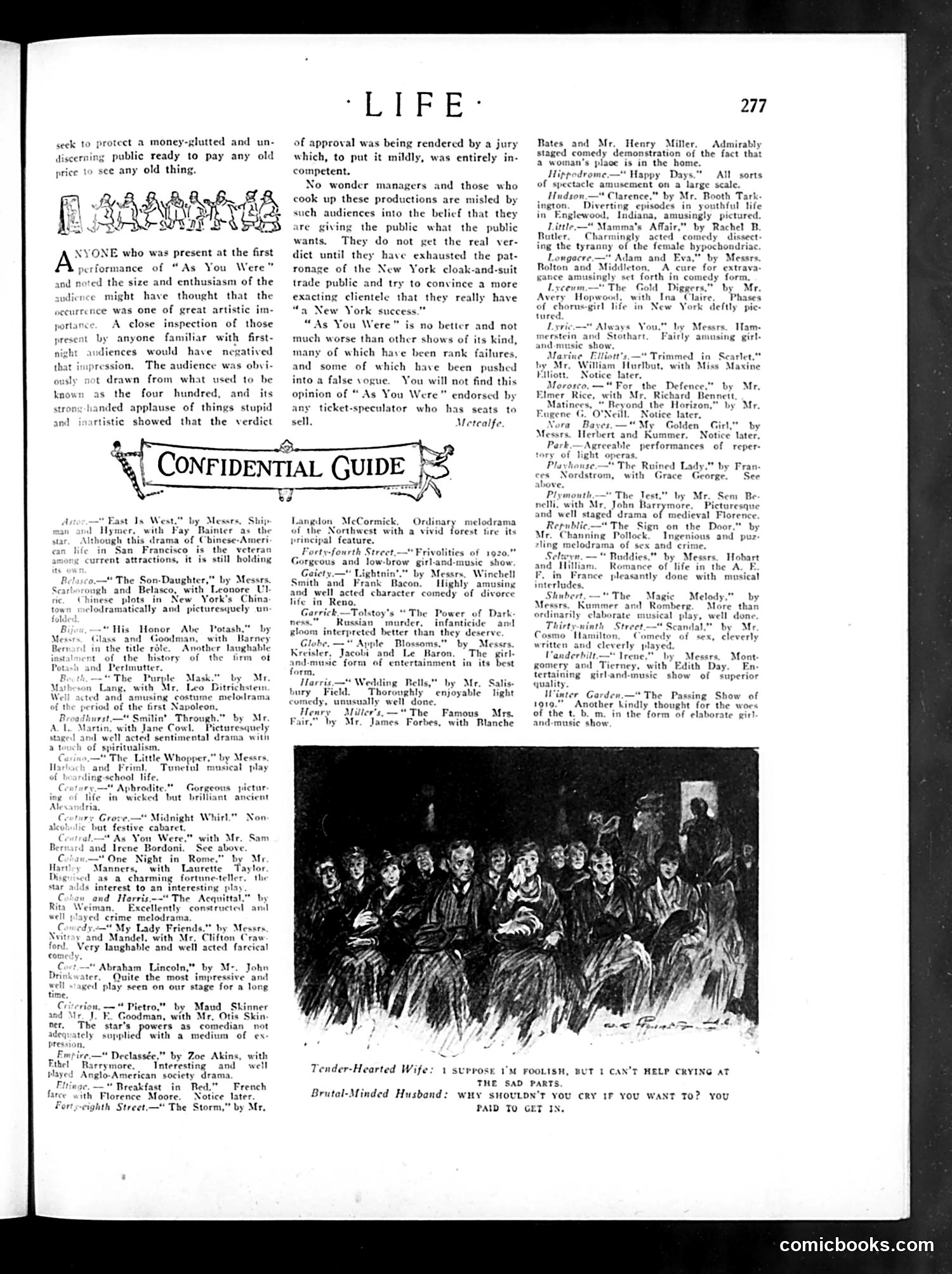
This page from *Life* magazine contains a critical theater review disguised as a "Confidential Guide" to Broadway shows. The main cartoon (bottom half) depicts an arguing couple: a tearful wife and dismissive husband in what appears to be a domestic dispute about theater attendance. The satire targets both New York theater audiences and producers. Critic Metcalfe argues that shows like "As You Were" succeed only because they appeal to the "cloak-and-suit trade public"—a derogatory reference to working-class Jewish immigrants in the garment industry. He suggests these unsophisticated audiences mislead producers into thinking mediocre productions are hits, and that real artistic merit requires "a more exacting clientele." The cartoon illustrates this class condescension: the husband (likely representing the working-class theater-goer) dismisses his wife's emotional response as foolish, embodying the reviewer's contempt for ordinary audience reactions to entertainment.
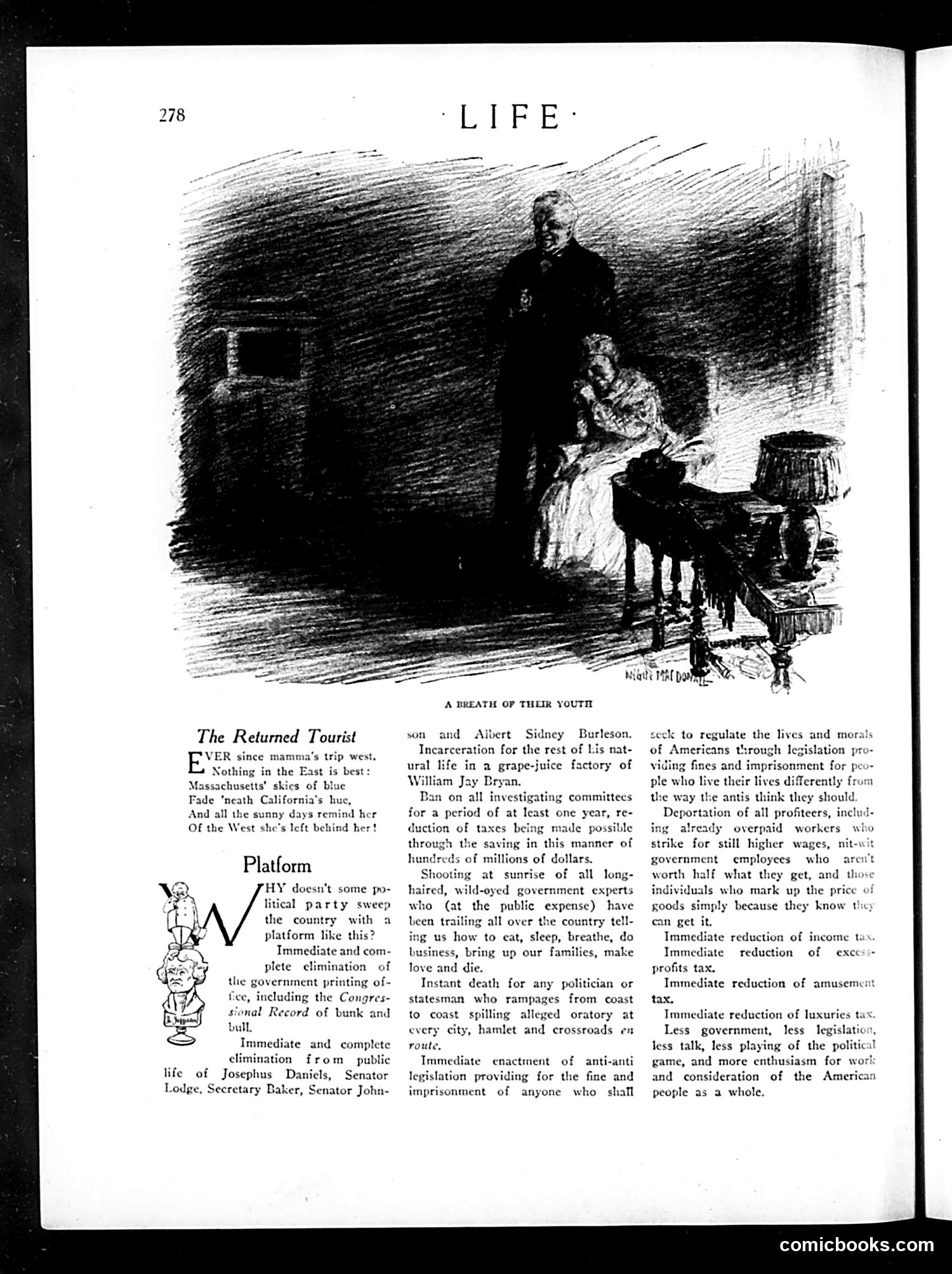
This page satirizes wartime government overreach and political incompetence during the Wilson administration (likely WWI era, given references to Secretary Baker and Josephus Daniels). **"The Returned Tourist"** is a light joke about a woman returning from California, unable to appreciate the East anymore—establishing a tone of comparing different perspectives. **"Platform"** is the main satire: a mock political platform proposing radical elimination of government waste and control. It attacks: - The Congressional Record as "bunk and bull" - Prominent officials (Daniels, Lodge, Baker, Bryan) as failures - Government "experts" dictating daily life to citizens - Politicians on speaking tours wasting public money - Excessive taxation and regulation The cartoon's central image shows a woman at a piano while a man stands—likely representing "A Breath of Their Youth," suggesting nostalgic contrast with current government intrusion into private life. The satire targets progressive-era government intervention, high wartime taxes, and what the magazine viewed as bureaucratic tyranny—appealing to readers frustrated with regulation and taxation.
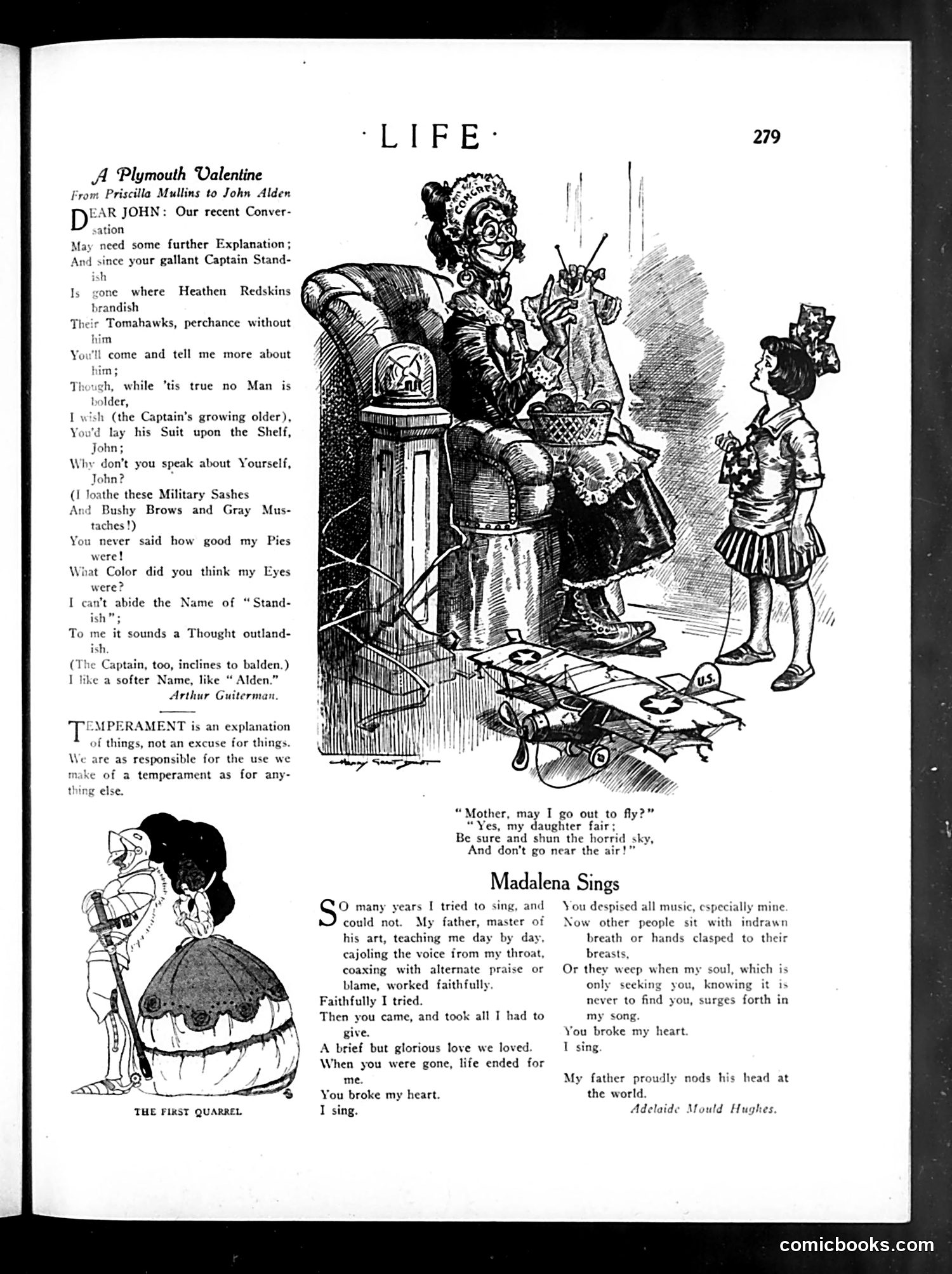
This page contains literary satire and light verse rather than political cartoons. **"A Plymouth Valentine"** humorously reimagines the Pilgrims' legend: Priscilla Mullins urges John Alden to stop courting *her* on behalf of Captain Standish and instead propose for himself. The satire mocks the famous historical anecdote by having Priscilla complain about Standish's military bearing, gray mustaches, and baldness—she prefers Alden's softer name and wants compliments about her pies and eyes. It's a tongue-in-cheek reversal of romantic protocol. **"The First Quarrel"** appears to be a humorous domestic scene (illustration shows a woman scolding a child about flying), playing on overprotective parenting. **"Madalena Sings"** is a melodramatic poem about a woman who only discovered her singing voice after a lost love broke her heart—now audiences weep at her performances, while her father takes pride in her success. These pieces represent Life's literary humor tradition: witty, romantic, and sentimental rather than hard-hitting political satire.
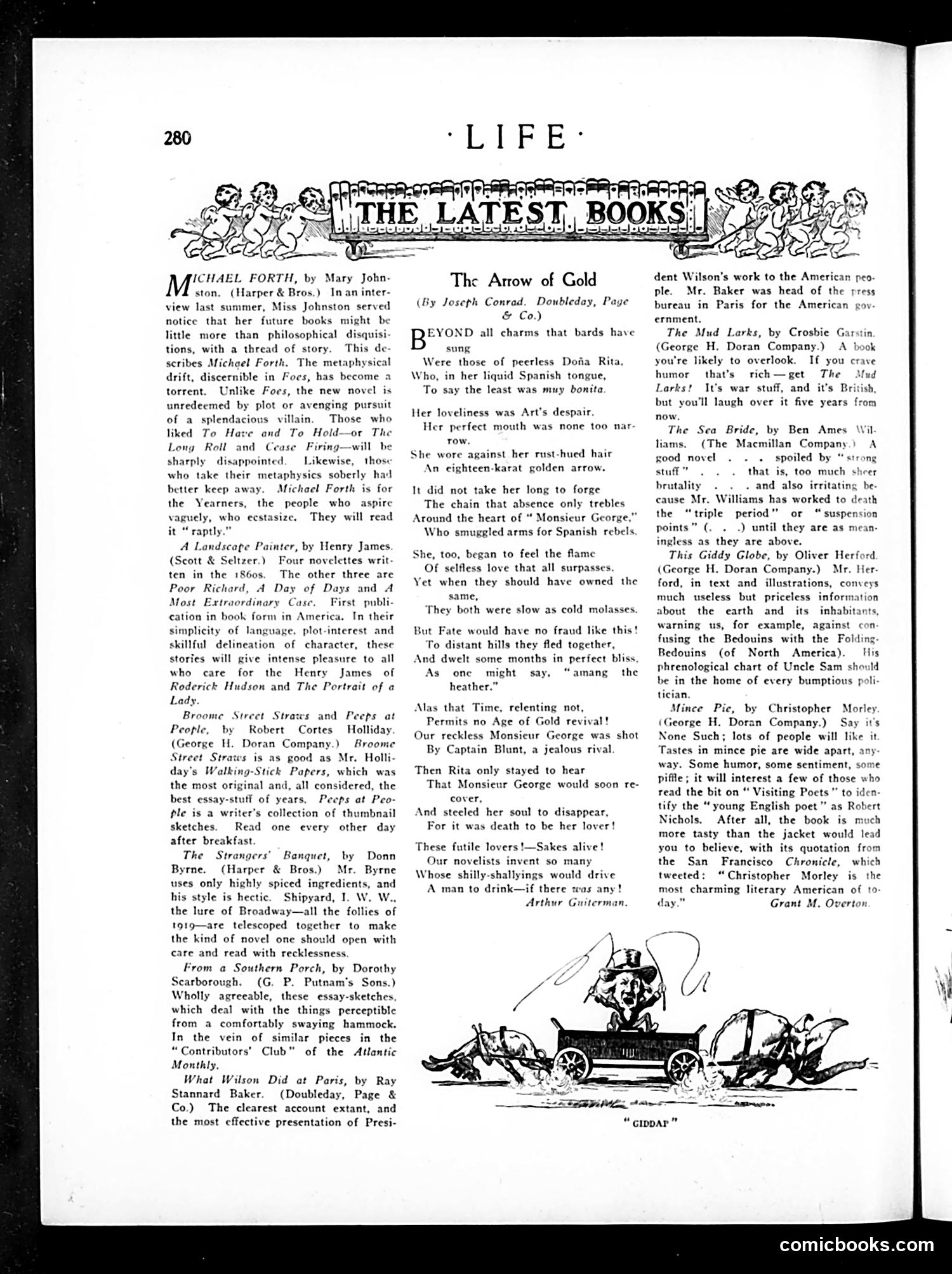
This is a book review page from Life magazine featuring literary criticism of contemporary works. The main illustration at bottom—labeled "GIDOAP"—depicts a car crash or automobile accident, likely accompanying a review (partially cut off) about a book involving transportation mishaps. The reviews themselves are straightforward literary criticism, though the tone is satirical throughout. Arthur Guiterman's verse review of Joseph Conrad's *The Arrow of Gold* mocks the novel's romantic plot—two lovers separated by circumstance and rivals—by sarcastically exaggerating their hesitation and the melodrama. His final stanza complains that novelists invented too many indecisive lovers, joking that such frustrating characters would drive readers to drink "if there was any" (likely referencing Prohibition). The reviews generally criticize contemporary authors for philosophical pretension over plot, though praising Henry James's earlier work and Dorothy Scarborough's accessible essays. The page reflects 1920s literary taste and publishing trends.
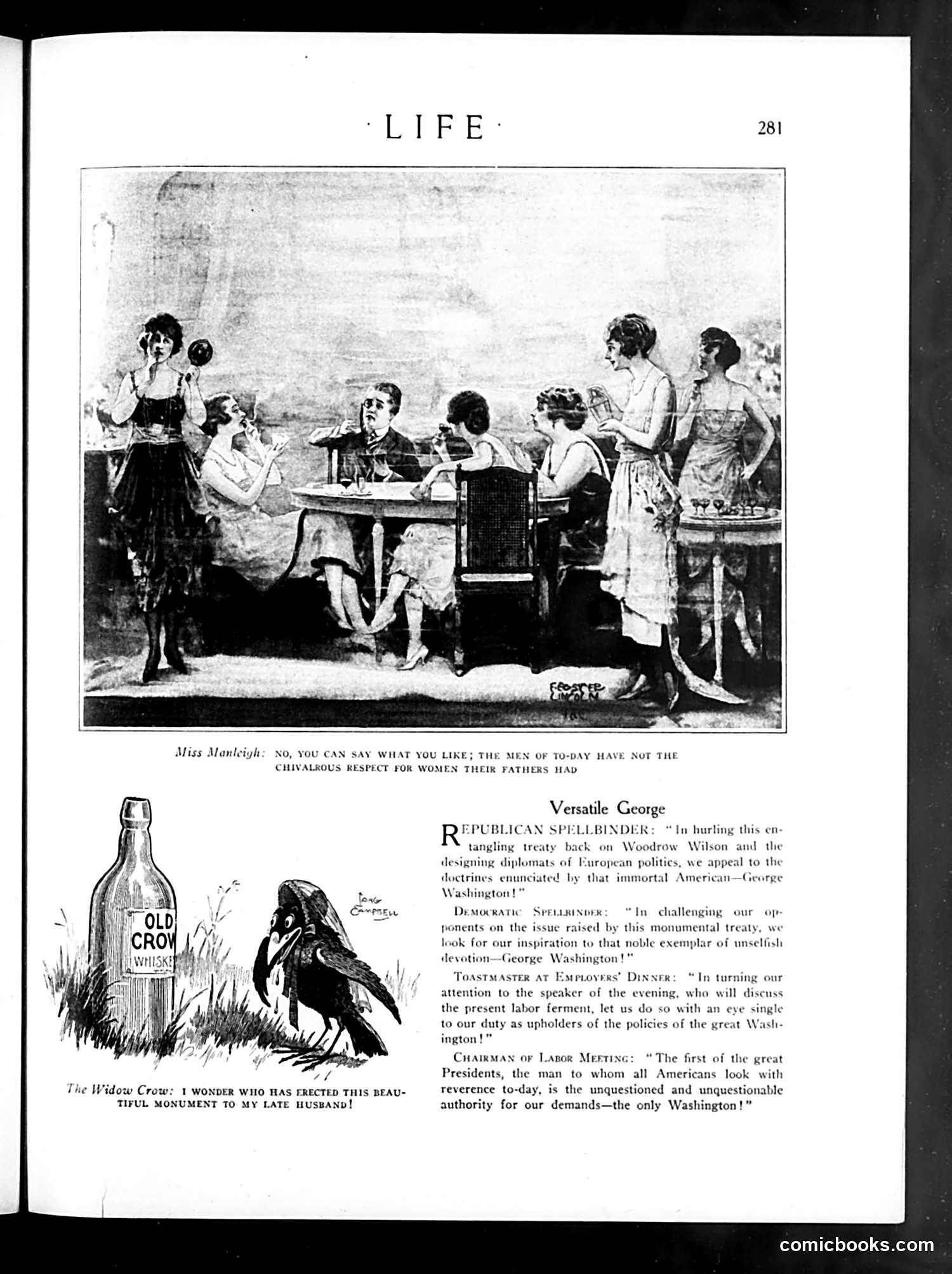
This satirical piece mocks how politicians across the political spectrum—Republicans, Democrats, business leaders, and labor organizers—all invoke George Washington to support completely opposing positions on the same issues (particularly a treaty, likely the League of Nations after WWI). The cartoon shows different speakers cynically appropriating Washington's authority: a Republican defends a treaty by citing Washington; a Democrat opposes it using the same figure. A business dinner speaker and labor meeting chairman similarly claim Washington backs their conflicting interests. The joke: Washington has become so universally revered and vaguely remembered that everyone can project their own agenda onto him. His actual positions matter less than his symbolic power. The page's title illustrations—showing a woman claiming men lack chivalry, and a widow wondering who built a monument—reinforce the theme of selective memory and self-serving interpretation of historical figures.
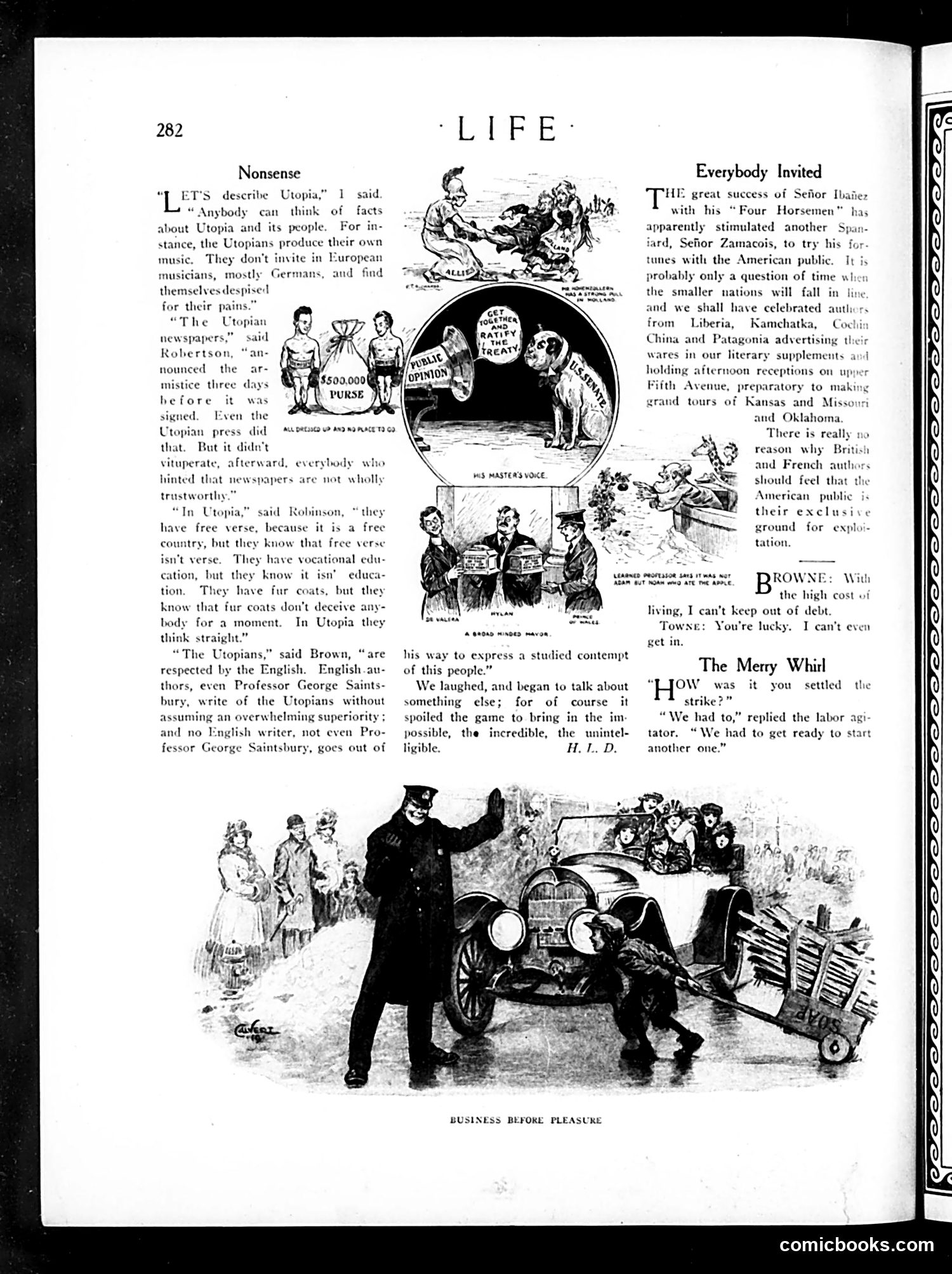
This page contains satirical commentary on early 1920s literary and labor culture. **"Nonsense"** section mocks a fictional utopia where people think clearly and avoid pretense—contrasting with reality where newspapers lie, free verse isn't verse, and fur coats deceive. The satire critiques both press dishonesty and cultural pretension. **"Everybody Invited"** responds to the American success of Spanish author Vicente Blasco Ibáñez's *The Four Horsemen of the Apocalypse*. The satire suggests this will prompt a flood of authors from minor nations (Liberia, Patagonia, etc.) to exploit American audiences with readings and tours through the Midwest—mocking American eagerness for foreign literary celebrities and the commercialization of culture. **"The Merry Whirl"** cartoon satirizes labor strikes: workers settle one strike merely to prepare for starting another, suggesting strikes had become routine industrial theater rather than meaningful protest. The overall tone is cynical about modern institutions: press reliability, cultural authenticity, and labor relations.
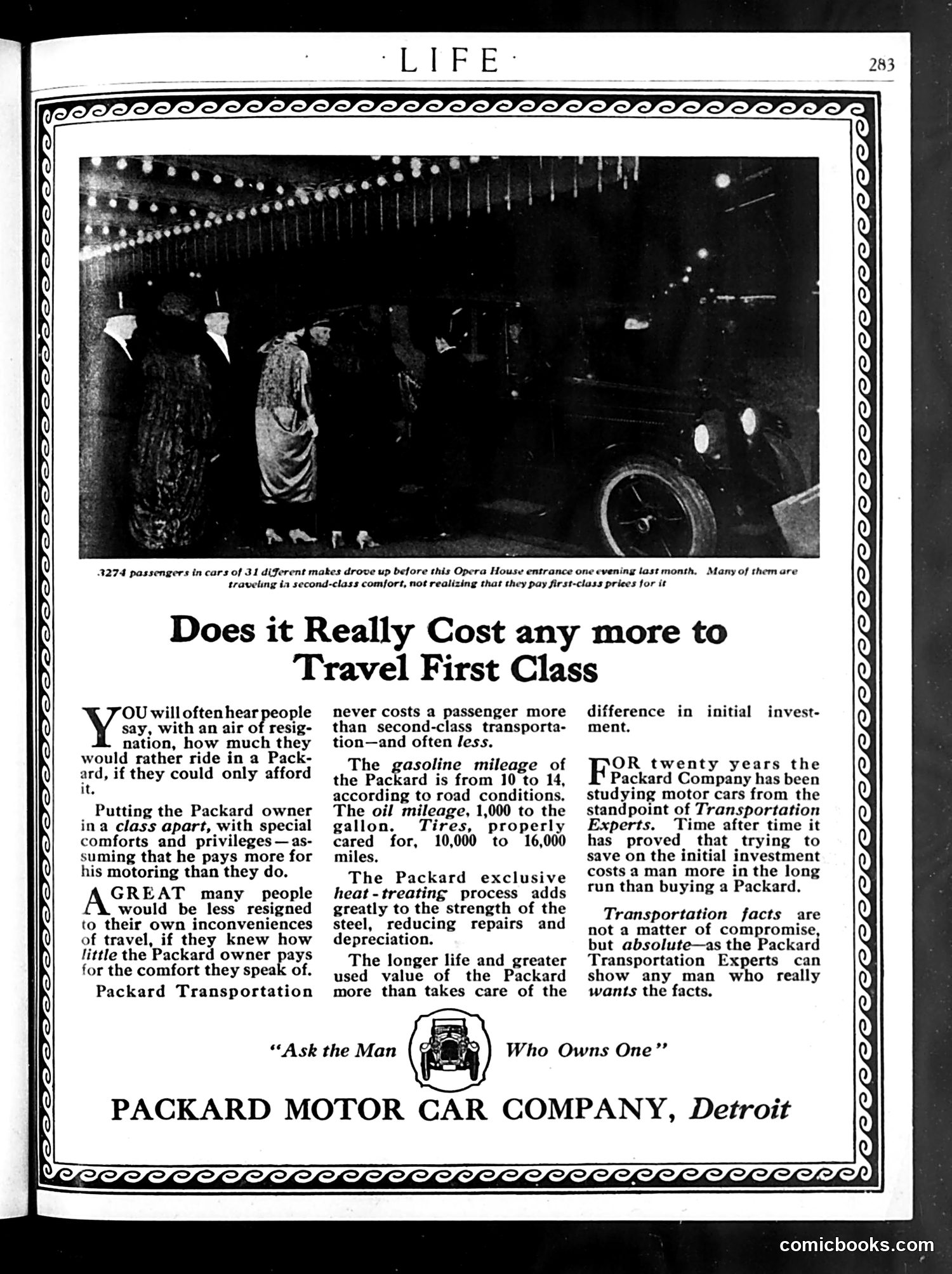
This is a **Packard automobile advertisement**, not political satire. The page uses a photograph of wealthy patrons arriving at an opera house to argue that luxury car ownership is economically rational. The opening image shows 31 different car makes delivering opera-goers, suggesting most drivers "pay first-class prices" for second-class comfort. The ad's argument: a Packard owner actually spends *less* per mile due to superior fuel efficiency, oil mileage, tire durability, and lower depreciation. The "heat-treating process" reduces repairs. The appeal targets aspirational middle-class readers who felt they "couldn't afford" a Packard. The ad reframes luxury as practical value: buying cheap costs more long-term. The tagline "Ask the Man Who Owns One" encourages peer testimonials. This reflects 1920s consumer capitalism, where advertisements positioned expensive goods as smart investments rather than indulgences—a rhetorical strategy that remains common today.
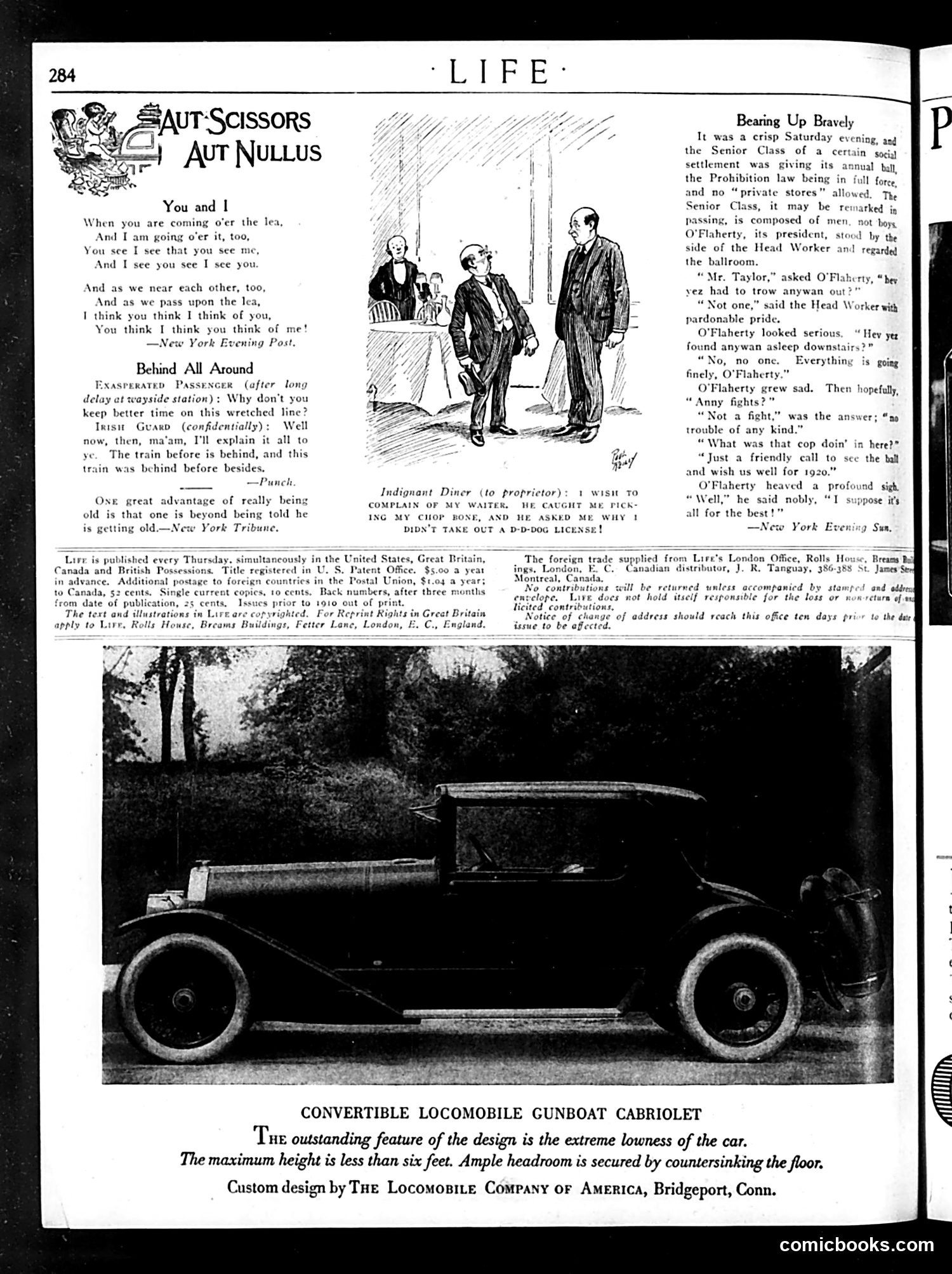
This page from Life magazine contains several short humorous pieces typical of early 20th-century American satire: **"You and I"** and **"Behind All Around"** are brief comic poems/anecdotes poking fun at everyday situations—romantic confusion and train delays with absurd explanations. **"Bearing Up Bravely"** satirizes a Prohibition-era social settlement dance. O'Flaherty, the Irish-American organizer, is disappointed that the event went *too* well—no one was drunk, ejected, or fighting. The joke hinges on the irony that under Prohibition (then in force), a "successful" party by conventional standards feels like a failure because there's no rowdy misbehavior to report. This reflects period attitudes about Irish-Americans and drinking culture stereotypes. The page is primarily **advertising** for a Locomobile automobile ("Gunboat Cabriolet"), emphasizing its unusual low design. The satire assumes readers understood Prohibition's social impact and contemporary ethnic stereotypes about Irish immigrants.
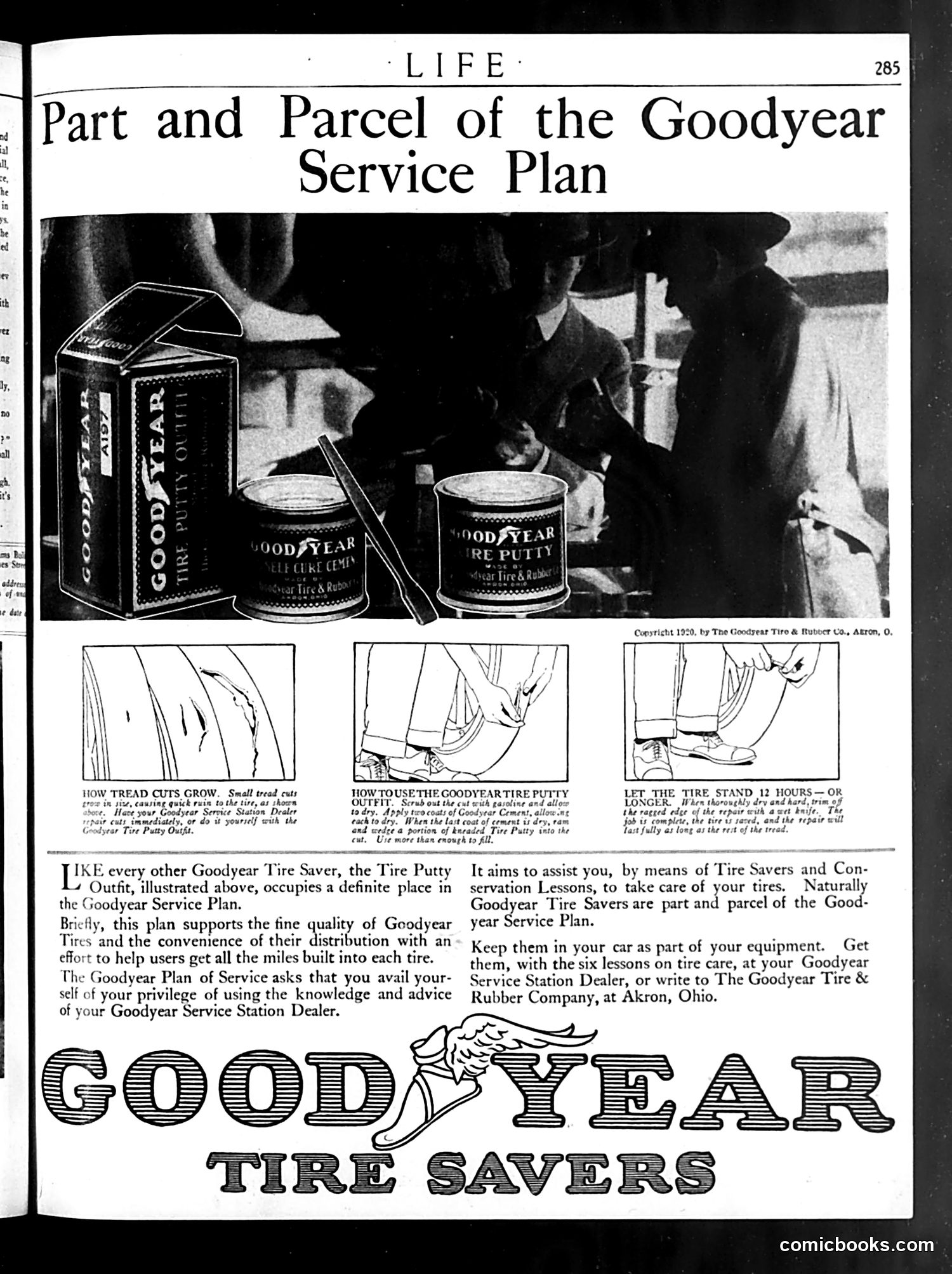
This is **not a cartoon or satire** — it's a straightforward **advertisement** for Goodyear tire maintenance products, specifically their "Tire Putty Outfit" and broader "Service Plan." The page shows: - **Product photos** (top): boxes and cans of Goodyear tire repair putty - **Instructional diagrams** (middle): three panels demonstrating how tread cuts develop and how to use the tire putty to repair them - **Promotional text** (bottom): explaining that tire savers are "part and parcel" of Goodyear's service plan, encouraging consumers to keep these products in their cars The appeal is practical and consumer-focused: small tread cuts grow into major tire damage unless fixed immediately using Goodyear products. The company positions itself as helpful by offering both the repair products and educational "lessons on tire care." This represents early-20th-century automotive consumer culture, where tire maintenance was a regular concern and manufacturers marketed preventative care products directly to car owners.
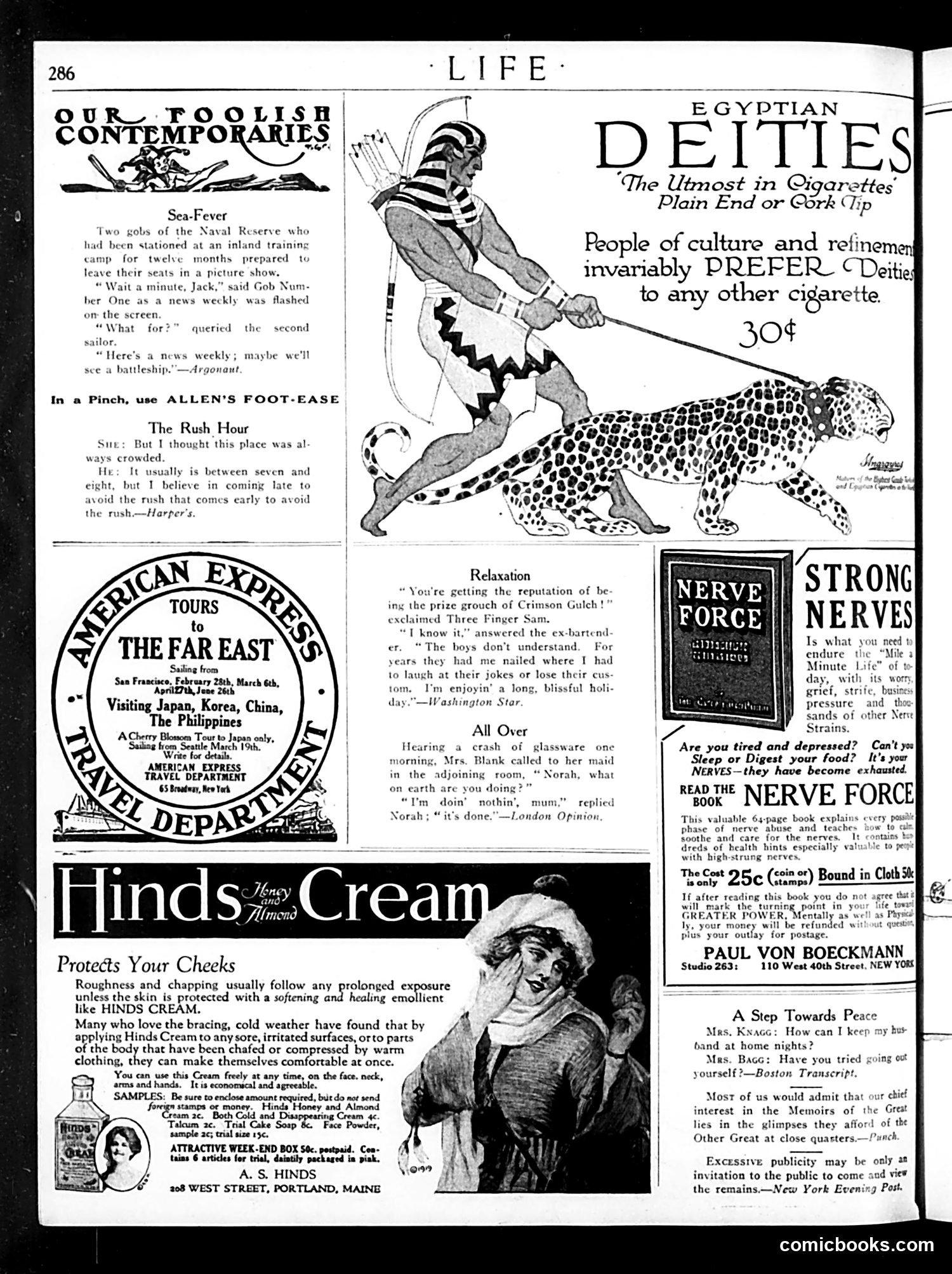
This page is primarily **advertising rather than political satire**. The dominant image shows an Egyptian pharaoh figure riding a leopard, advertising "Egyptian Deities" cigarettes at 30¢ per pack. The ad claims people "of culture and refinement" prefer this brand. The humor relies on **orientalist exoticism**—associating luxury cigarettes with ancient Egypt and suggesting sophistication through pseudo-exotic imagery. The leopard-riding pharaoh is deliberately absurd and theatrical, designed to appeal to aspirational consumers. The page also contains minor comedic anecdotes (sailors wanting to see battleships in newsreels, dating advice about avoiding rush hours) and product advertisements for foot cream and nerve tonics—typical Life magazine filler content. **This reflects early 20th-century advertising strategy**: linking consumer products to fantastical imagery and social status claims rather than practical product qualities.
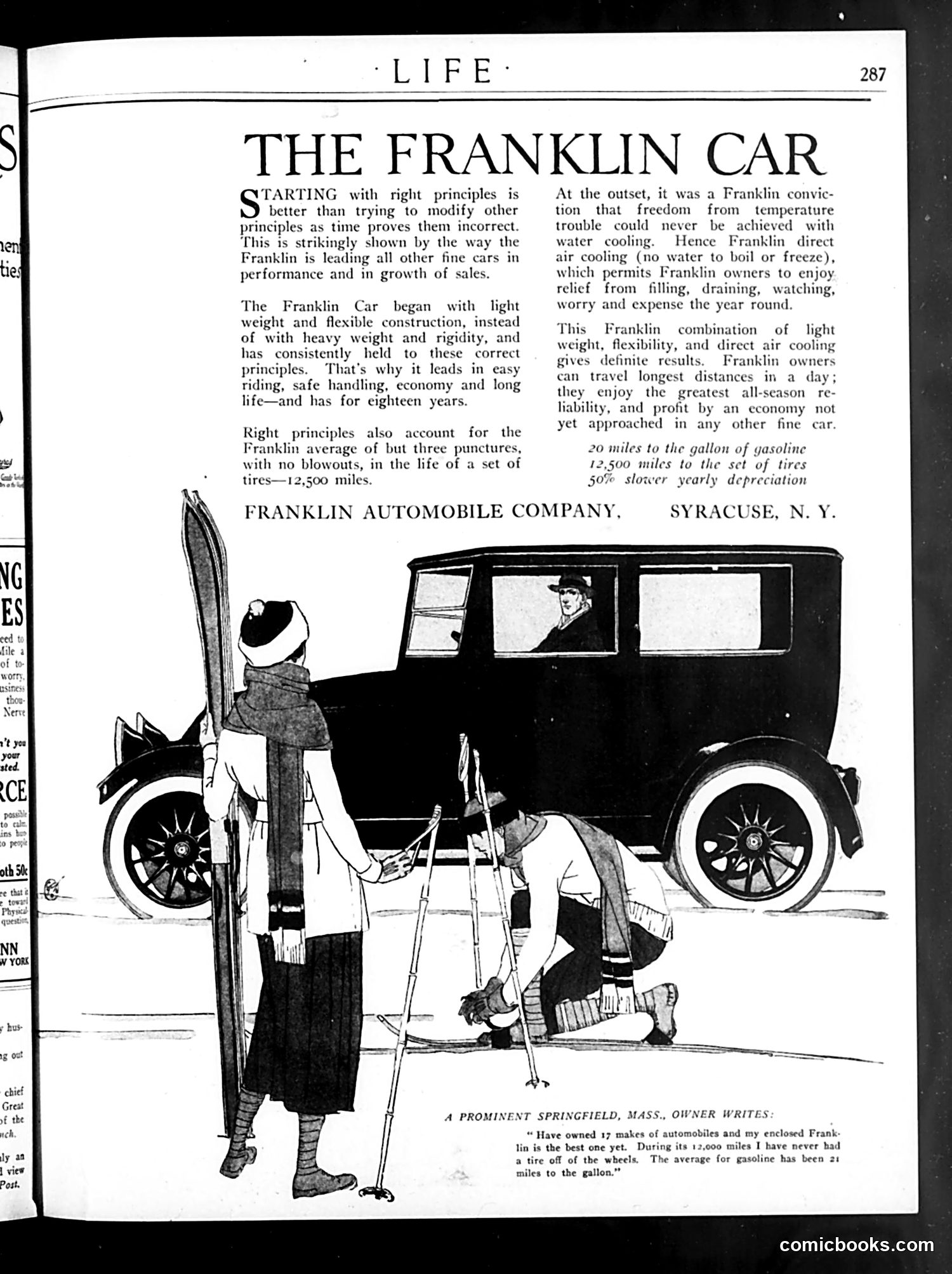
This is a **automobile advertisement**, not a political cartoon. The page promotes the Franklin automobile manufactured in Syracuse, New York. The illustration depicts two figures enjoying winter sports (skiing) beside a Franklin car, emphasizing the vehicle's reliability and low-maintenance design. The advertisement's central argument is that the Franklin's original engineering principles—light weight, flexible construction, and crucially, **air cooling instead of water cooling**—have proven superior over eighteen years. The key selling points highlighted are: exceptional fuel economy (20 miles per gallon), tire durability (12,500 miles per set), minimal depreciation, and freedom from seasonal maintenance hassles like draining coolant in winter or refilling in summer. A testimonial from a Springfield, Massachusetts owner claiming 17 previous automobiles owned but the Franklin as "the best one yet" provides social proof. The advertisement targets affluent buyers seeking practical luxury and economy combined.
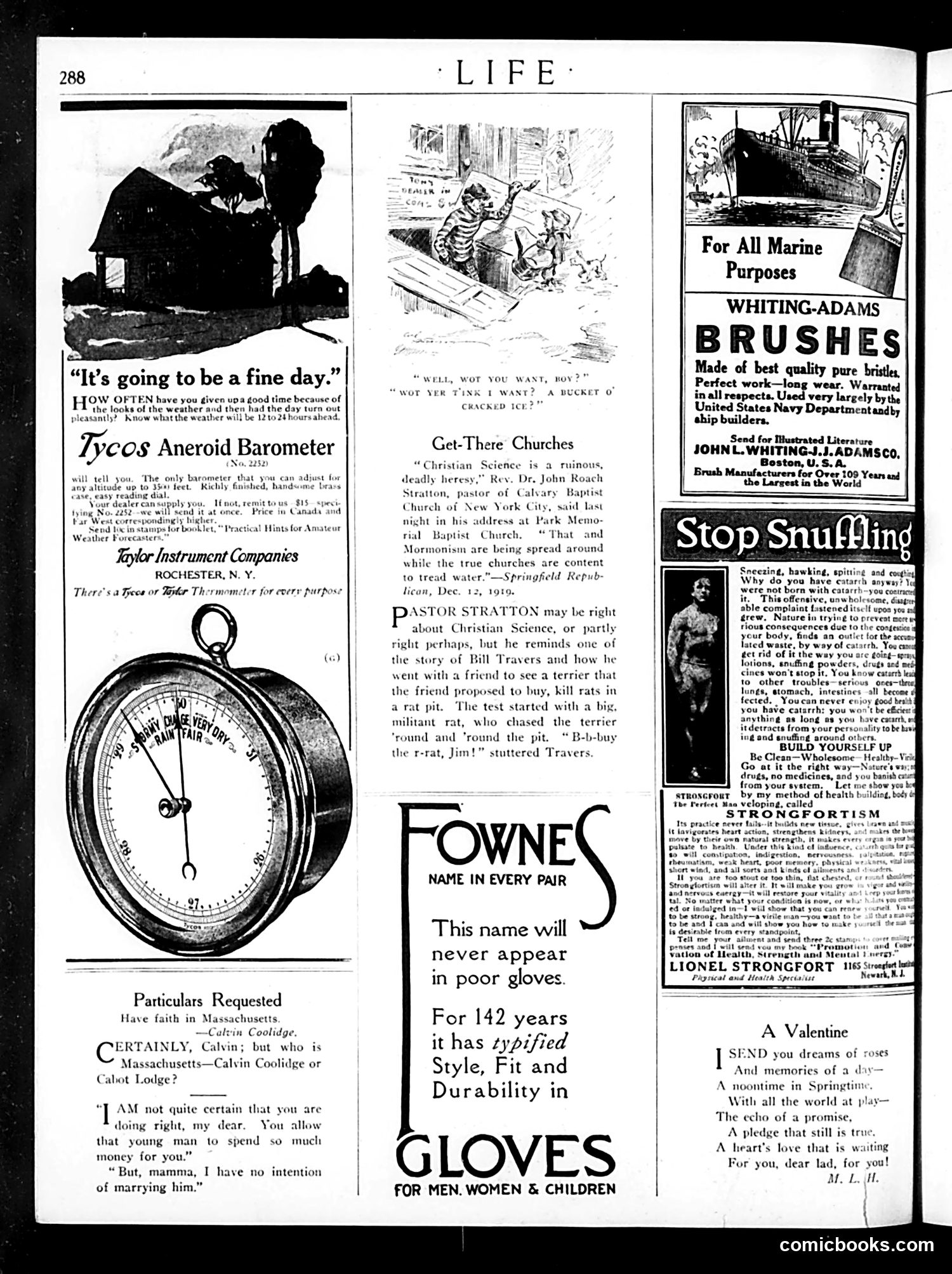
This page is primarily **advertising**, but includes several satirical pieces typical of Life's style. The main cartoon humor appears in "Particulars Requested," which mocks Massachusetts politics during the Calvin Coolidge era (Coolidge was Massachusetts governor before becoming president). The joke questions whether "Massachusetts" refers to Coolidge or Senator Henry Cabot Lodge—satirizing unclear political leadership. Below that, a brief comic anecdote about "Bill Travers" ridicules Rev. Dr. John Roach Stratton's aggressive religious criticism of Christian Science and Mormonism. The satire suggests that Stratton, like the terrier chasing the rat, is so focused on attacking competitors that he loses sight of actual effectiveness—implying his condemnation rings hollow. The remaining content consists of period advertisements for barometers, brushes, gloves, health treatments, and a sentimental Valentine poem. No political figures are caricatured visually on this page.
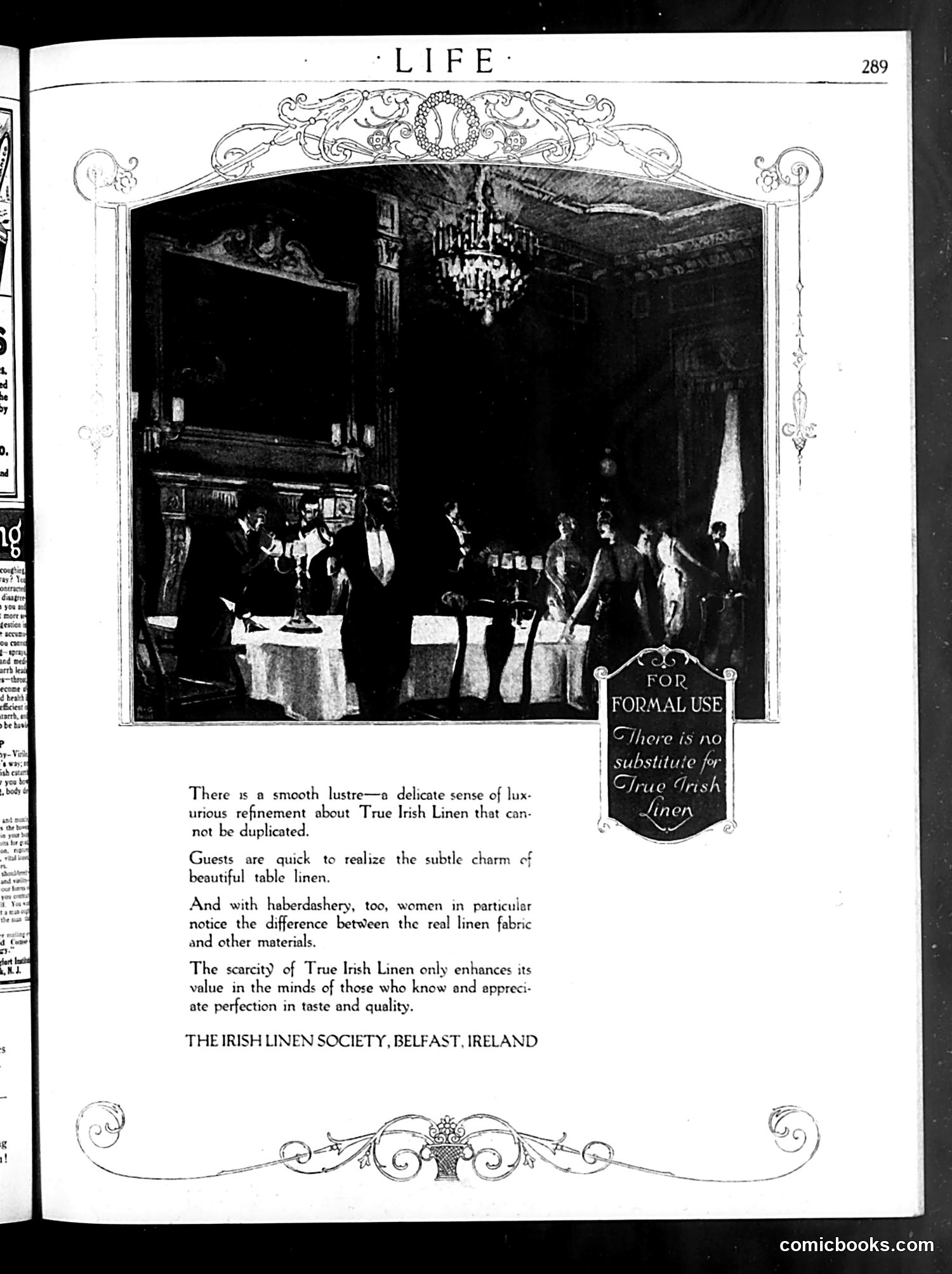
This is **an advertisement, not a political cartoon**. The page features a formal dinner scene photograph promoting True Irish Linen tablecloths and linens by the Irish Linen Society of Belfast. The "satire" or humor here is subtle and implicit in the *advertising approach* rather than explicit mockery: the ad appeals to class consciousness and snobbery, emphasizing that genuine Irish linen signals refined taste, luxury, and sophistication to guests and observers. Women are specifically targeted as judges of quality. The photograph depicts an elegant formal dinner with well-dressed guests, a chandelier, and draped tables—staging the aspirational lifestyle associated with owning "True Irish Linen." The implicit message: purchasing this product marks one's refined social status. For modern readers, this reflects pre-WWII attitudes about class, gender (women as arbiters of domestic taste), and marketing through appeals to exclusivity and refinement.
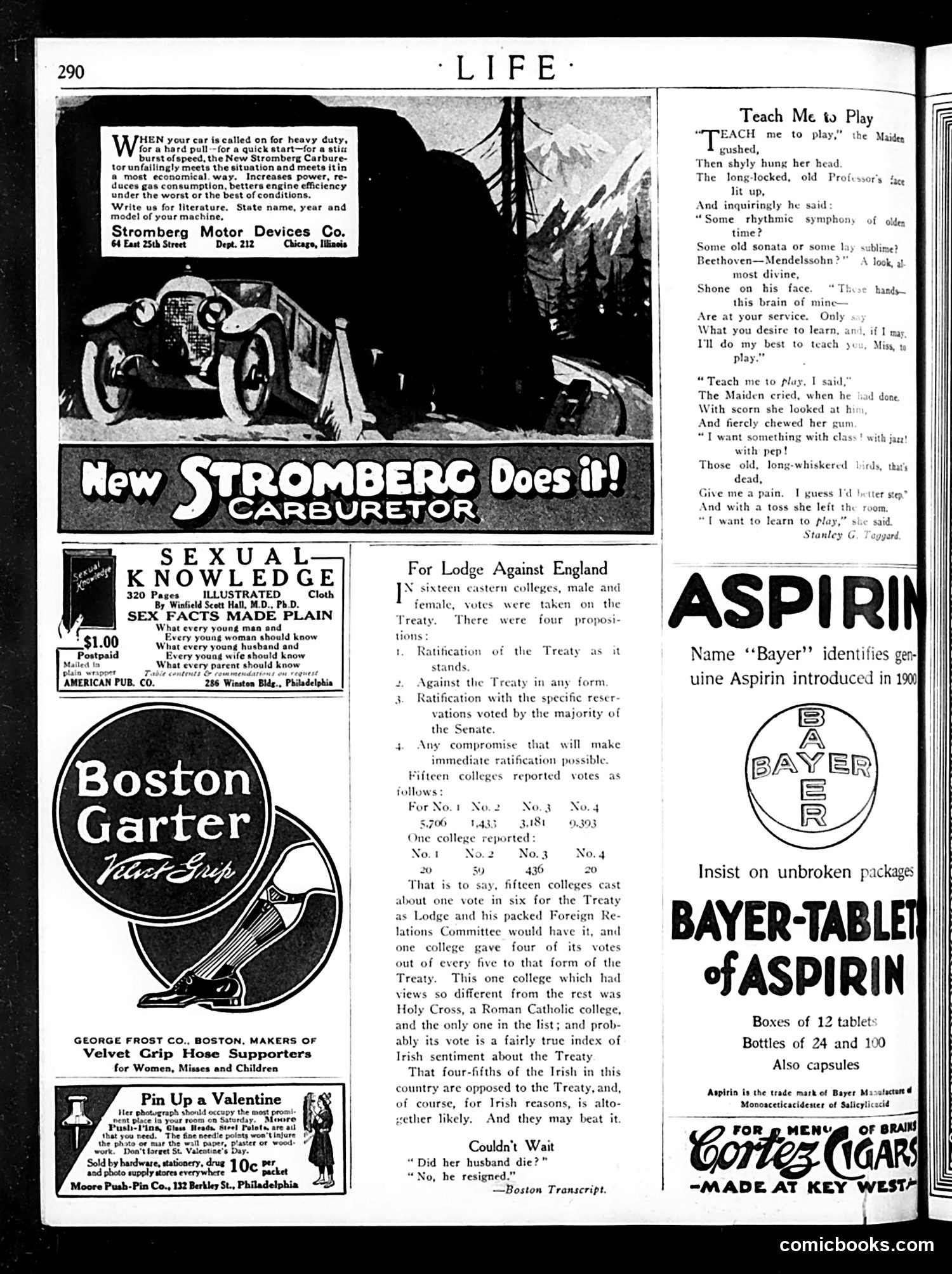
This page contains several distinct elements rather than unified political satire: **Main Content:** A poem titled "Teach Me to Play" depicts a young woman asking an elderly professor to teach her music. She initially expects classical instruction (Beethoven, Mendelssohn) but reveals her actual preference for modern jazz and popular music with "class" and "pep," rejecting "old, long-whiskered birds" (classical composers). The satire gently mocks generational musical taste differences and female modernity. **Political Article:** A substantive piece on college votes regarding the League of Nations Treaty, noting that fifteen eastern colleges cast one-sixth of their votes *for* the Treaty as presented, while Holy Cross (a Catholic college) voted four-fifths against it—attributed to Irish-American opposition to the Treaty's provisions. **Advertisements:** The page is dominated by period ads for motor carburetors, books on sexual knowledge, garters, valentines, and Bayer Aspirin—typical 1920s commercial content. The page reflects post-WWI American debates about the League of Nations and emerging modern culture clashing with tradition.
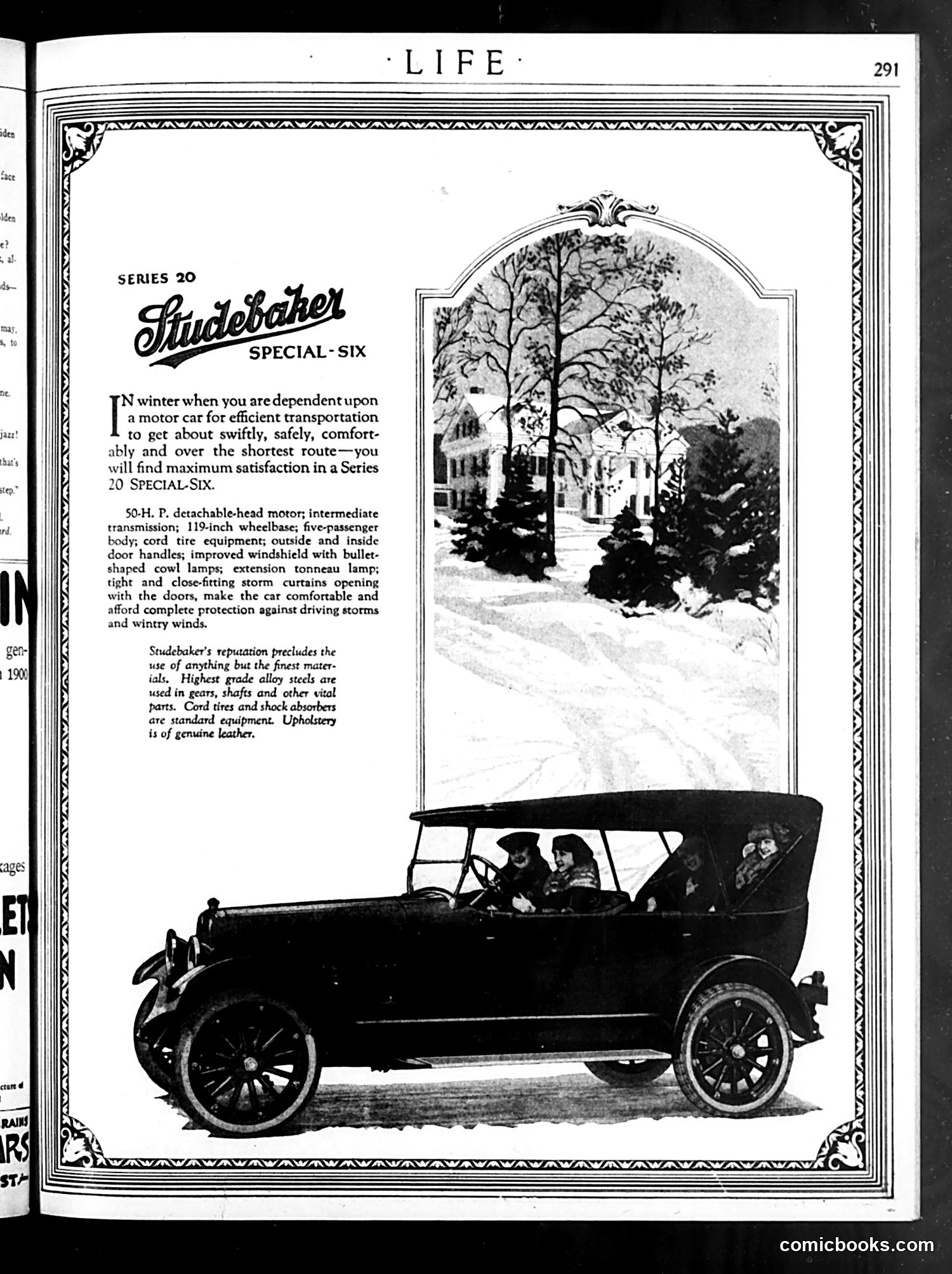
This is a **car advertisement**, not political satire. It promotes the Studebaker Series 20 Special-Six automobile, emphasizing its suitability for winter driving. The page features a winter landscape photograph (snowy scene with trees and buildings) and a side-view illustration of the dark-colored vehicle with passengers visible inside. The text highlights practical features for harsh weather: a 50-horsepower engine, intermediate transmission, improved windshield, storm curtains, and quality materials (alloy steels, cord tires, leather upholstery). The appeal is straightforward—reliability and comfort during winter travel. This represents early automotive advertising's focus on engineering specifications and weatherproofing rather than style or lifestyle marketing common in later decades.
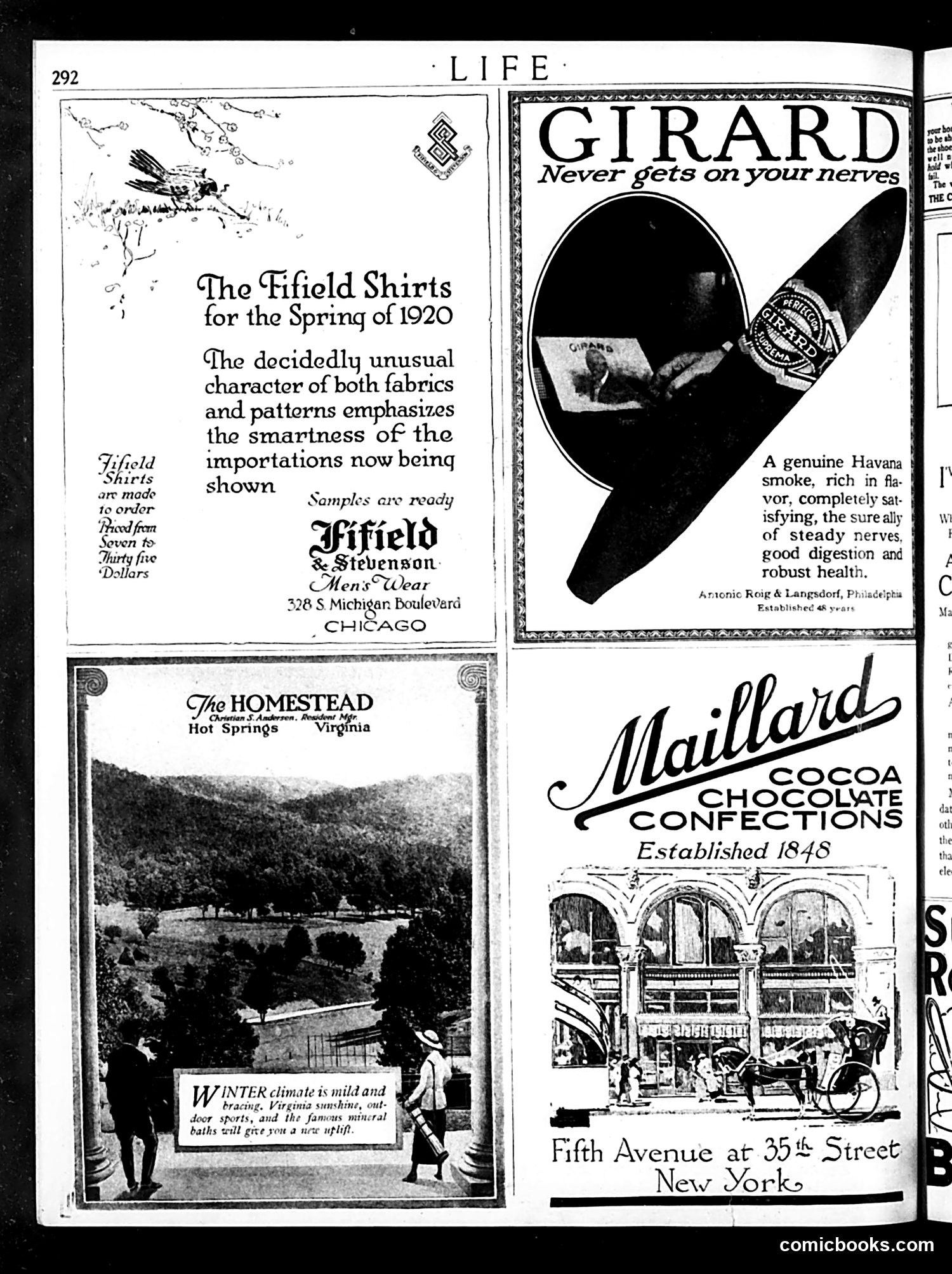
This is **primarily a page of advertisements**, not satire or political commentary. It contains four commercial ads typical of 1920: 1. **Fifield Shirts** (top left): Promoting spring 1920 menswear imported fabrics, made-to-order from Chicago. 2. **Girard Cigars** (top right): A "genuine Havana smoke" advertisement claiming the product calms nerves and aids digestion—typical health-benefit claims common in early 20th-century tobacco advertising. 3. **The Homestead** (bottom left): A resort advertisement for Hot Springs, Virginia, promoting its mild winter climate and mineral baths as therapeutic. 4. **Maillard Cocoa Chocolate** (bottom right): An established confectionery company (since 1848) advertising from their Fifth Avenue, New York storefront. The page reflects consumer culture and advertising practices of 1920, with no discernible satirical intent or political commentary.
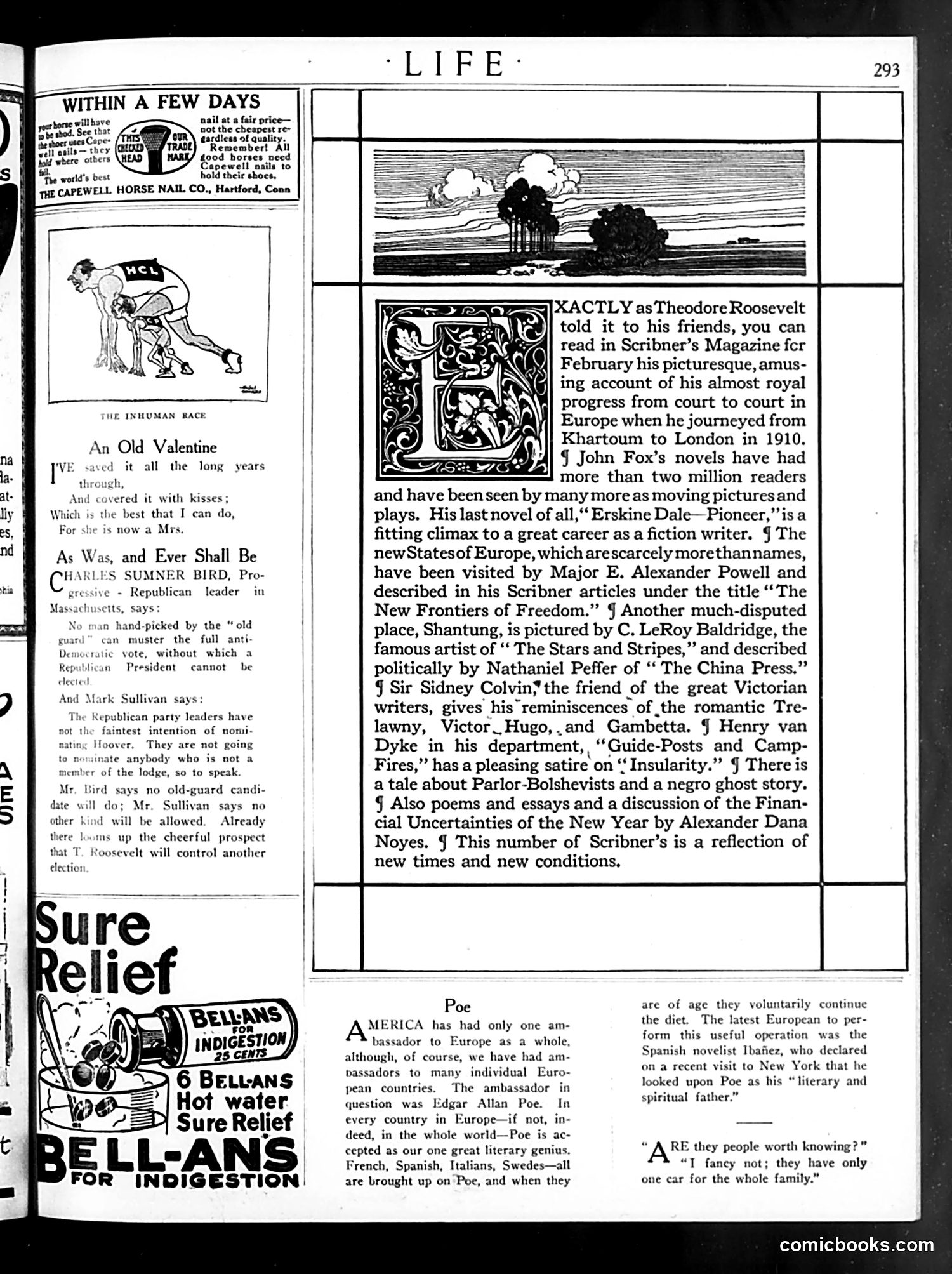
This page contains mixed content: advertisements, poetry, and editorial promotions rather than political cartoons. **"The Inhuman Race"** cartoon (top left) depicts a figure labeled "HCL" (likely representing high cost of living) racing or struggling, satirizing economic hardship—a common 1920s concern. **Political content** appears in the "Old Valentine" poem section, which references Republican Party politics. Mark Sullivan and Mr. Bird discuss whether Herbert Hoover will be nominated as a presidential candidate. The implicit joke: Republican leaders won't nominate Hoover because he's not a "member of the lodge"—suggesting party insiders control nominations regardless of merit. **The Poe section** celebrates Edgar Allan Poe as America's only universal European ambassador through literature, noting his acceptance across European nations—a cultural nationalism argument. The page primarily advertises Scribner's Magazine content and Bellans antacid, making it more advertising-driven than satirical.
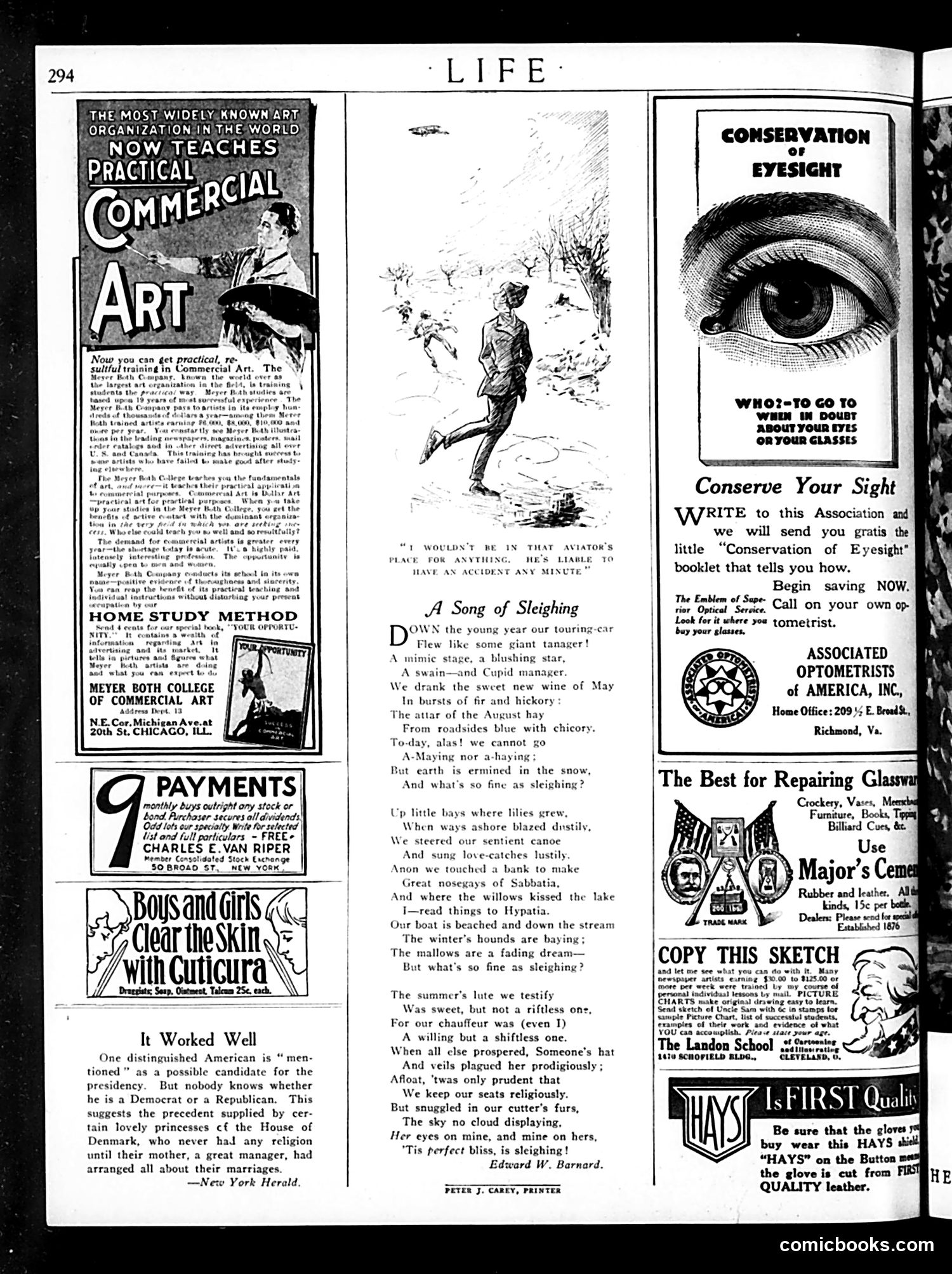
This page is primarily **advertising and light verse**, not political satire. The dominant content is **"A Song of Sleighing,"** a nostalgic poem by Edward W. Barnard contrasting romantic summer activities (touring, canoeing) with winter sleighing. The accompanying illustration shows a figure running/fleeing through snow, supporting the poem's winter theme. The cartoon caption—"I wouldn't be in that aviator's place for anything, he's liable to have an accident any minute"—appears to be simple social commentary on the perceived danger of early aviation, without identifying specific figures. The page is otherwise filled with commercial advertisements (art education, stock brokerage, eye care, cement, gloves) typical of Life's revenue model. **"It Worked Well"** is a brief editorial note comparing an unnamed American presidential prospect of ambiguous party affiliation to Danish princesses who adopted religion only for advantageous marriages—suggesting opportunism rather than principle. Nothing here requires specialized historical knowledge beyond understanding that aviation was considered hazardous in this era.
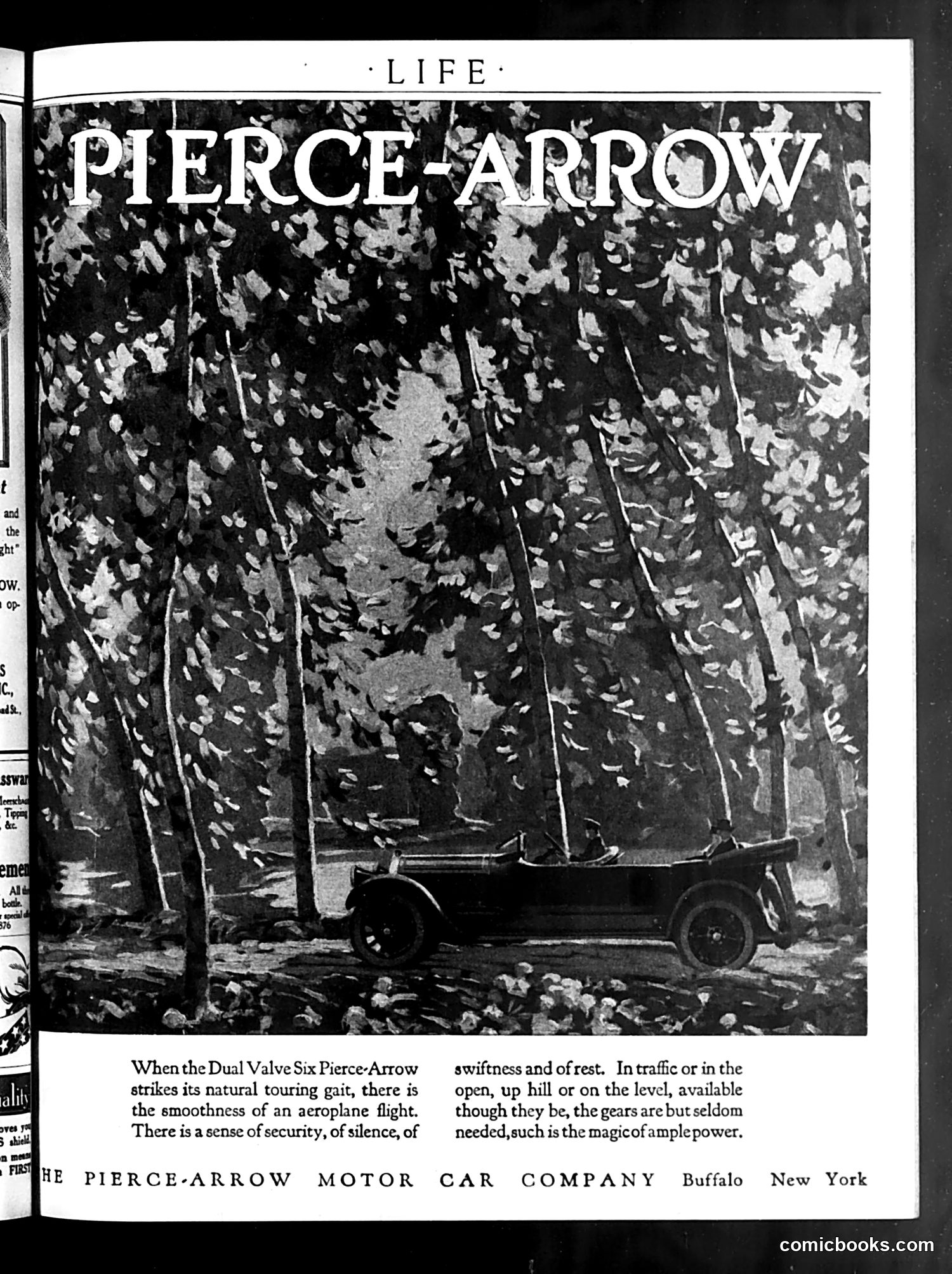
This is not political satire but rather a **full-page automobile advertisement** from Life magazine. The image shows a Pierce-Arrow motorcar driving through a forest of tall trees, emphasizing the vehicle's power and reliability. The ad's text uses luxury marketing language typical of early automotive advertising, claiming the "Dual Valve Six" engine provides "smoothness of an aeroplane flight" and "a sense of security, of silence." It boasts the car handles varied terrain—"traffic or in the open, up hill or on the level"—with sufficient power that "gears are but seldom needed." The Pierce-Arrow Motor Car Company (Buffalo, New York) positioned their vehicle as a premium, powerful automobile for affluent consumers. This represents straightforward commercial messaging rather than political commentary or satire.
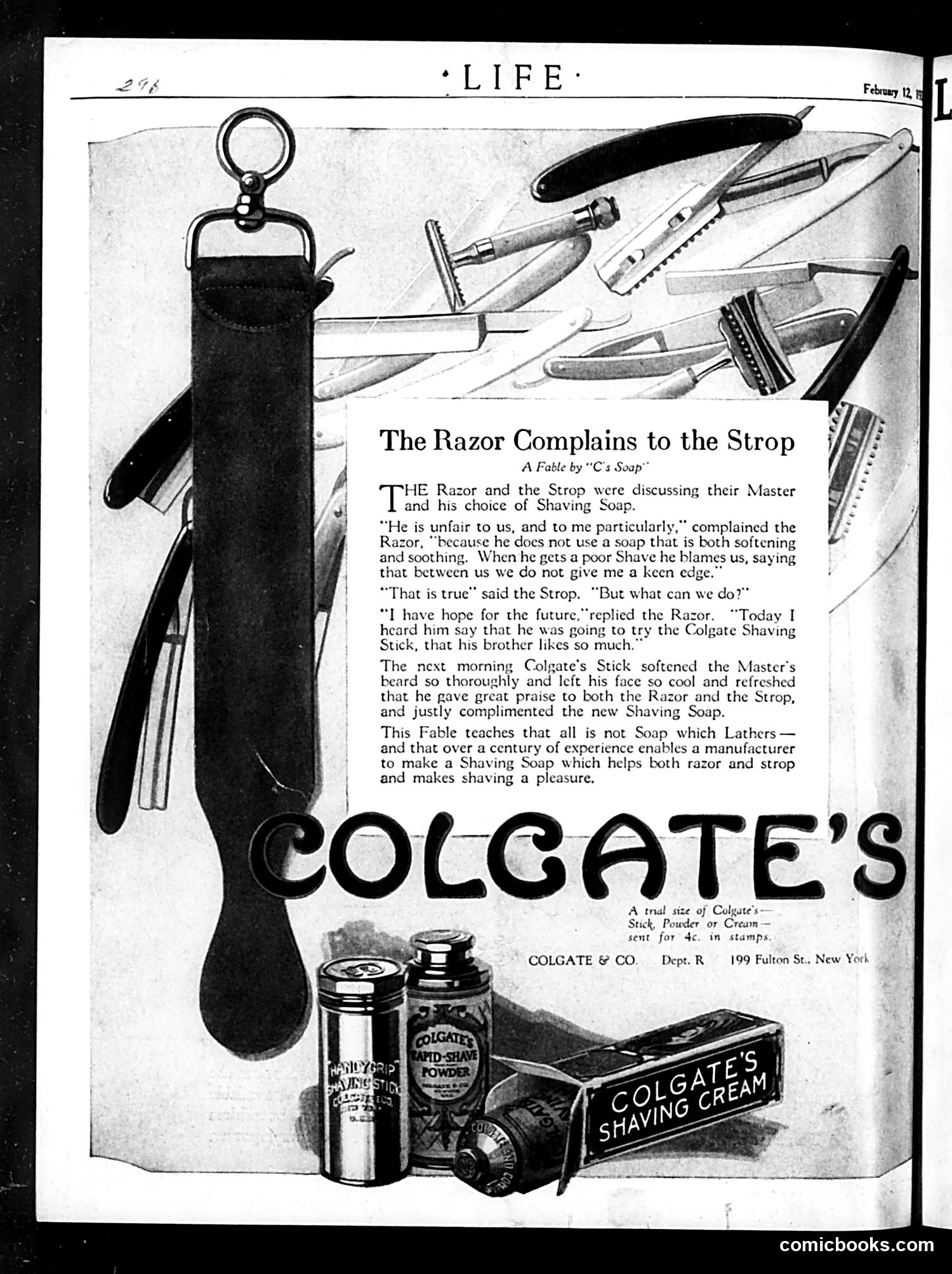
This is an **advertisement disguised as a fable**, not political satire. Colgate & Co. uses anthropomorphized shaving tools to promote their product line. **The Setup:** A razor and strop (leather sharpening strap) complain that their master blames *them* for poor shaves when the real problem is inferior soap that doesn't soften the beard properly. **The "Moral":** When the master switches to Colgate's Shaving Stick, his beard becomes soft and his face feels refreshed—suddenly the razor and strop receive praise they deserved all along. **The Satire:** The fable mockingly suggests that not all lathering soaps are equal; cheap soaps fail to deliver results, causing users to wrongly blame their tools. By contrast, Colgate's century of manufacturing experience produces superior soap that makes shaving genuinely pleasant. **Context:** This early 20th-century ad appears in *Life* magazine, treating readers as intelligent enough to appreciate humor while selling them grooming products. The final line offers a trial size for 4 cents in stamps.