
Life, 1920-02-12 · page 28 of 44
Life — February 12, 1920 — page 28: what you’re looking at
What you’re looking at
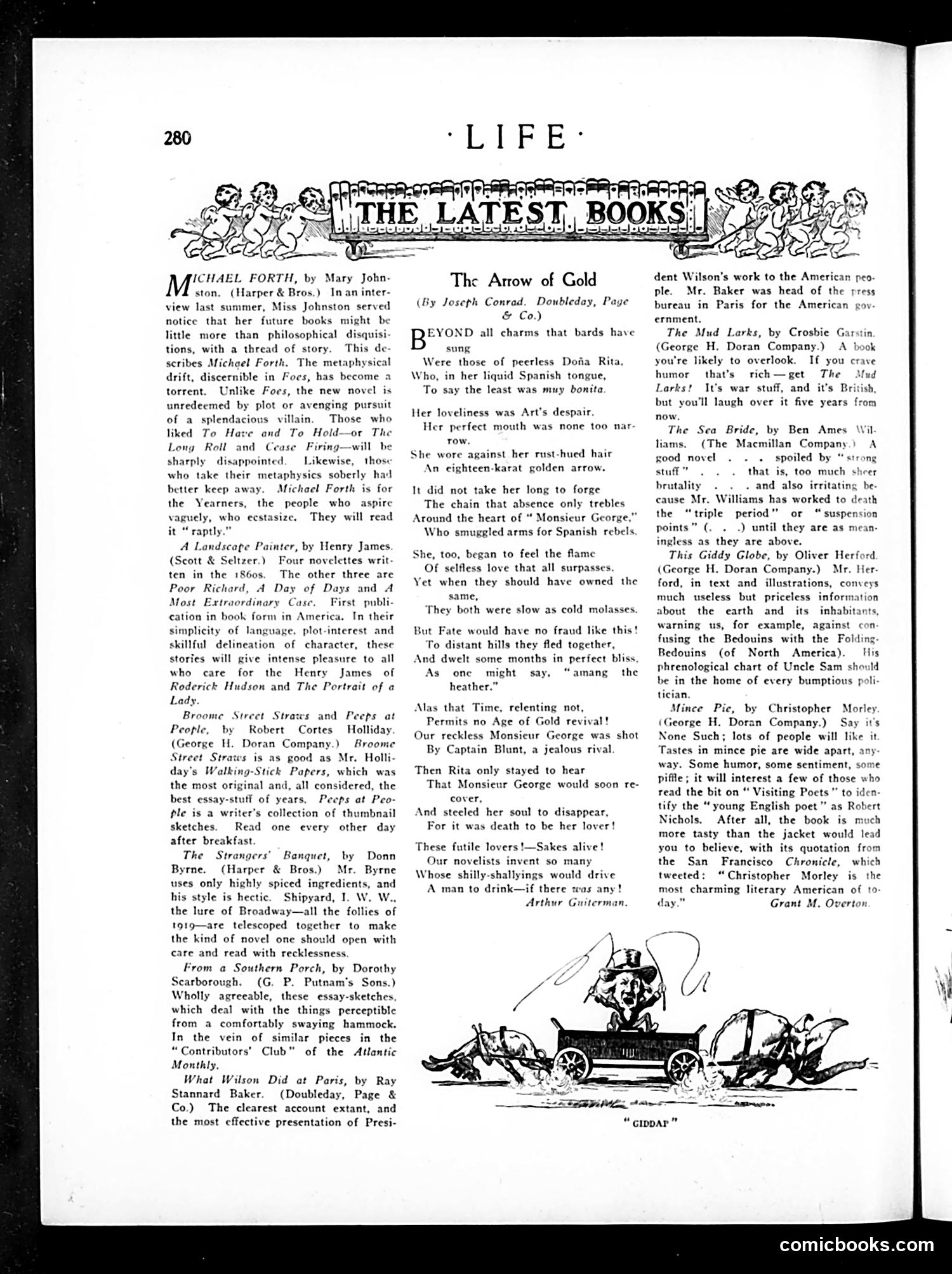
This is a book review page from Life magazine featuring literary criticism of contemporary works. The main illustration at bottom—labeled "GIDOAP"—depicts a car crash or automobile accident, likely accompanying a review (partially cut off) about a book involving transportation mishaps. The reviews themselves are straightforward literary criticism, though the tone is satirical throughout. Arthur Guiterman's verse review of Joseph Conrad's *The Arrow of Gold* mocks the novel's romantic plot—two lovers separated by circumstance and rivals—by sarcastically exaggerating their hesitation and the melodrama. His final stanza complains that novelists invented too many indecisive lovers, joking that such frustrating characters would drive readers to drink "if there was any" (likely referencing Prohibition). The reviews generally criticize contemporary authors for philosophical pretension over plot, though praising Henry James's earlier work and Dorothy Scarborough's accessible essays. The page reflects 1920s literary taste and publishing trends.
📄 Transcribed text from this page (OCR, searchable)
Machine-transcribed from the original scan — historical spelling and the odd misread are preserved.
ICHAEL FORTH, by Mary John- ston. (Harper & Bros.) In an inter- view last summer, Miss Johnston served notice that her future books might be little more than philosophical disquisi tions, with a thread of story. This de scribes Michael Forth. The metaphysical drift, discernible in Foes, has become a torrent. Unlike Foes, the new novel is unredeemed by plot or avenging pursuit of a splendacious villain. Those who liked To Have and To Hold—or The Long Roll and Cease Firing—will be sharply disappointed. Likewise, those who take their metaphysics soberly had better keep away. Michael Forth is for the Yearners, the people who aspire vaguely, who ecstasize. They will read it “ aptly.” A Landscape Painter, by Henry James. (Scott & Seltzer.) Four novelettes writ- ten in the 1860s. The other three are Poor Richard, A Day of Days and A Most Extraordinary C First publi- cation in book form in America. In their simplicity of langu plot-interest. and skillful delineation of character, these stories will give intense pleasure to all who care for the Henry James of Roderick Hudson and The Portrait of a Lady. Broome Street Straws and Peeps at People, by Robert Cortes Holliday. (George H. Doran Company.) Broome Street Straws is as good as Mr. Holli- day's Walking-Stick Papers, which was the most original and, all considered, the best essay-stuff of years, Peeps at Peo- fle is a writer's collection of thumbnail sketches. Read one every other day after breakfast The Strangers’ Banquet, by Donn Byrne. (Harper & Bros.) Mr. Byrne uses only highly spiced ingredients, and his style is hectic. Shipyard, I. W. W.. the lure of Broadway—all the follies of to19—are telescoped together to make the kind of novel one should open with care and read with recklessness. From a Southern Porch, by Dorothy Scarborough. (G. P. Putnam's Sons.) Wholly agreeable, these essay-sketches, which deal with the things perceptible from a comfortably swaying hammock. In the vein of similar pieces in the “Contributors’ Club” of the Atlantic Monthly. What Wilson Did at Paris, by Ray Stannard Baker. (Doubleday, Page & Co.) The clearest account extant, and the most effective presentation of Presi- The Arrow of Gold (By Joseph Conrad. Doubleday, Pay & Co.) EYOND all charms that bards have sung Were those of peerless Dofa Rita, Who, in her liquid Spanish tongue, To say the least was muy bonita Her loveliness was Art's despair. Her perfect mouth was none too nar- Tow. She wore against her rust-hued hair An cighteen-karat golden arrow. It did not take her long to forge The chain that absence only trebles Around the heart of “ Monsieur George,” Who smuggled arms for Spanish rebels. She, too, began to feel the flame Of selfless love that all surpasses. Yet when they should have owned the same, They both were slow as cold molasses. But Fate would have no fraud like this! To distant hills they fled together, And dwelt some months in perfect bliss, As one might say, “amang the heather.” Mas that Time, relenting not, Permits no Age of Gold revival! Our reckless Monsieur George was shot By Captain Blunt, a jealous rival Then Rita only stayed to hear That Monsieur George would soon re- cover, And steeled her soul to disappear, For it was death to be her lover! These futile lovers !—Sakes alive! Our novelists invent so many Whose shilly-shallyings would drive A man to drink—if there was any! Arthur Guiterman. dent Wilson's work to the American peo- ple. Mr. Baker was head of the press bureau in Paris for the American gov- ernment. The Mud Larks, by Crosbie Garstin, (George H. Doran Company.) A book you're likely to overlook. If you crave humor that’s rich—get The Mud Larks! It’s war stuff, and it’s British, but you'll laugh over it five years from now, The Sea Bride, by Ben Ames \Vil liams. (The Macmillan Company.) A good novel . . . spoiled by “strong stuff” that is, too much sheer brutality « and also irritating be- cause Mr, Williams has worked to death the “triple period” or “ suspension points” (. -) until they are as mean- ingless as they are above. This Giddy Globe, by Oliver Herford (George H. Doran Company.) Mr. Her- ford, in text and illustrations, conveys much useless but priceless information about the earth and its inhabitants, warning us, for example, against con fusing the Bedouins with the Folding- Bedouins (of North America). His phrenological chart of Uncle Sam should be in the home of every bumptious poli- tician, Mince Pie, by Christopher Morley ieorge H. Doran Company.) Say it’s one Such; lots of people will like it Tastes in mince pie are wide apart, any Some humor, some sentiment, some piffle; it will interest a few of those who read the bit on “ Visiting Poets” to iden- tify the “young English poet” as Robert Nichols. After all, the book is much more tasty than the jacket would lead you to believe, with its quotation from the San Francisco Chronicle, which tweeted: “Christopher Morley is the most charming literary American of to day.” Grant M. Overton “ ciwpar” comicbooks.com