
Life, 1920-02-12 · page 30 of 44
Life — February 12, 1920 — page 30: what you’re looking at
What you’re looking at
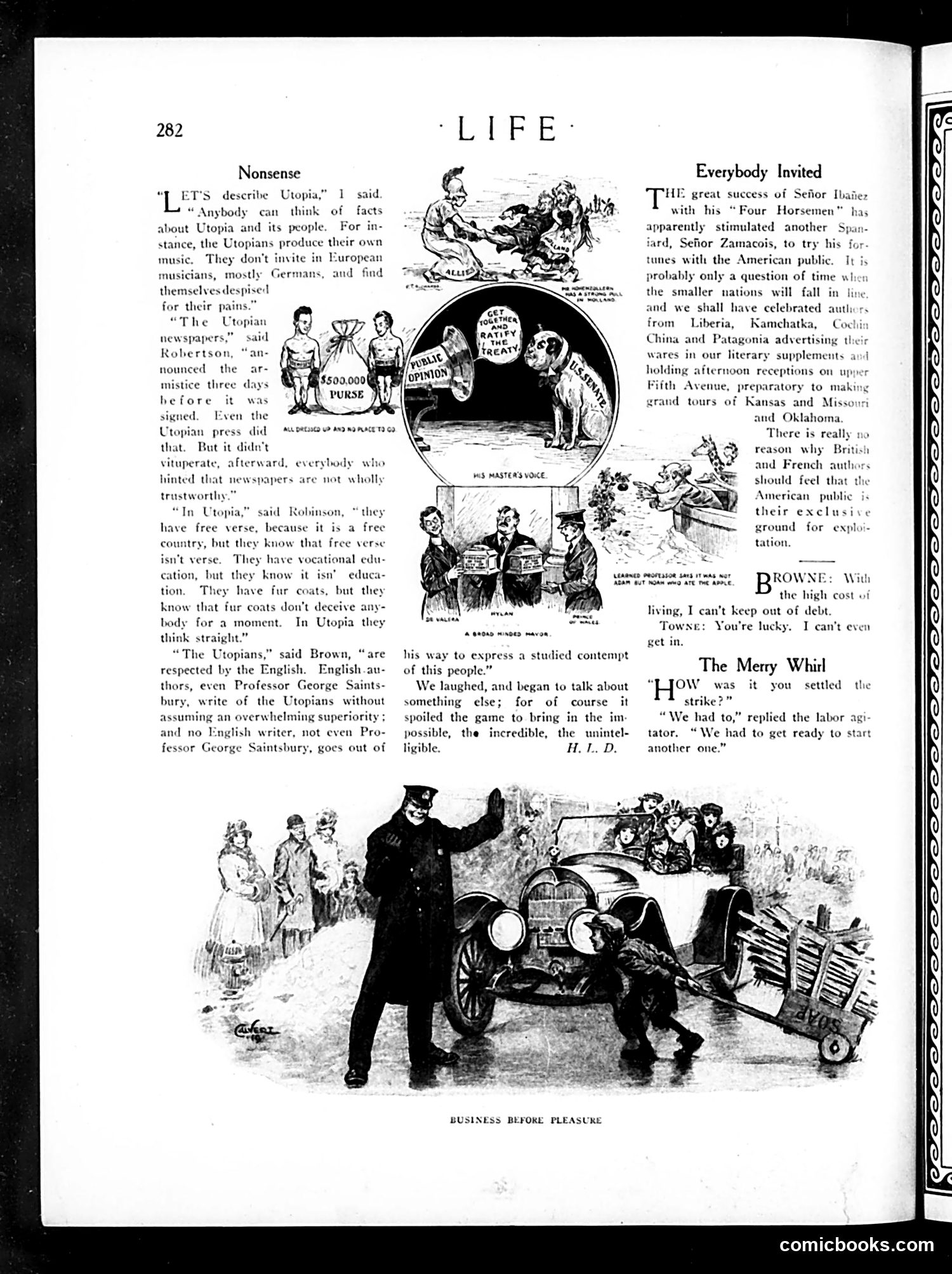
This page contains satirical commentary on early 1920s literary and labor culture. **"Nonsense"** section mocks a fictional utopia where people think clearly and avoid pretense—contrasting with reality where newspapers lie, free verse isn't verse, and fur coats deceive. The satire critiques both press dishonesty and cultural pretension. **"Everybody Invited"** responds to the American success of Spanish author Vicente Blasco Ibáñez's *The Four Horsemen of the Apocalypse*. The satire suggests this will prompt a flood of authors from minor nations (Liberia, Patagonia, etc.) to exploit American audiences with readings and tours through the Midwest—mocking American eagerness for foreign literary celebrities and the commercialization of culture. **"The Merry Whirl"** cartoon satirizes labor strikes: workers settle one strike merely to prepare for starting another, suggesting strikes had become routine industrial theater rather than meaningful protest. The overall tone is cynical about modern institutions: press reliability, cultural authenticity, and labor relations.
📄 Transcribed text from this page (OCR, searchable)
Machine-transcribed from the original scan — historical spelling and the odd misread are preserved.
282 Nonsense “T ETS “ Anybody said facts Utopia,” 1 think about Utopia and its people. stance, the Utopians produce their own describe of For in- can They don't invite in European ans, mostly Germans, and find themselves despis for their pains.” “The newspapers,” Robertson, “ Utopian said nounced the ar- mistice three days hefore it: was signed. Even the Utopian press did “setae mamanucene that. But it didn’t vituperate, afterward, everybody who hinted that newspapers are not wholly trustworthy.” “Tn Utopia,” have free verse, because it is a free country, but they know that free verse said Robinson, “they They have vocational edu- cation, but they know it isn’ tion. isn't verse. educa- They have fur coats, but they know that fur coats don’t deceive any- body for a moment. In Utopia they think straight.” “The Utopians,” said Brown, “are respected by the English. English.au- thors, even Professor George Saints- bury, write of the Utopians without ing an overwhelming superiority ; inglish writer, not even Pro- fessor George Saintsbury, goes out of his way to express a studied contempt of this people.” We laughed, and began to talk about something else; for of course it spoiled the game to bring in the im possible, the incredible, the unintel- ligible. Everybody Invited HE great success of Sefior Ibaiez with his “Four Horsemen” has apparently stimulated another iard, Sefior Zamacois, to try his tunes with the Ameri public. probably only a question of time the smaller nations will fall in and we shall have celebrated authors from Liberia, Kamehatka, Coch China and Patagonia advertising the wares in our literary supplements a holding afternoon receptions on up) Fifth Avenue, preparatory to making grand tours of Kansas and Missouri and Oklahoma. There is really 1 AY 3 a reason why Britis and French author should feel that the American public their exclusive ground for exploi- tation, ROWNE: With the high cost of I can’t keep out of debt. : You're lucky. peorUaso8 Sans HT mAs mor aT NOAM ord ATE TE APDLE living, Tow get in, T can’t even The Merry Whirl “LJOW was it settled striki “We had to,” replied the labor agi tator. “We had to get ready to start another one.” you the comicbooks.com