
Life, 1920-02-12 · page 21 of 44
Life — February 12, 1920 — page 21: what you’re looking at
What you’re looking at
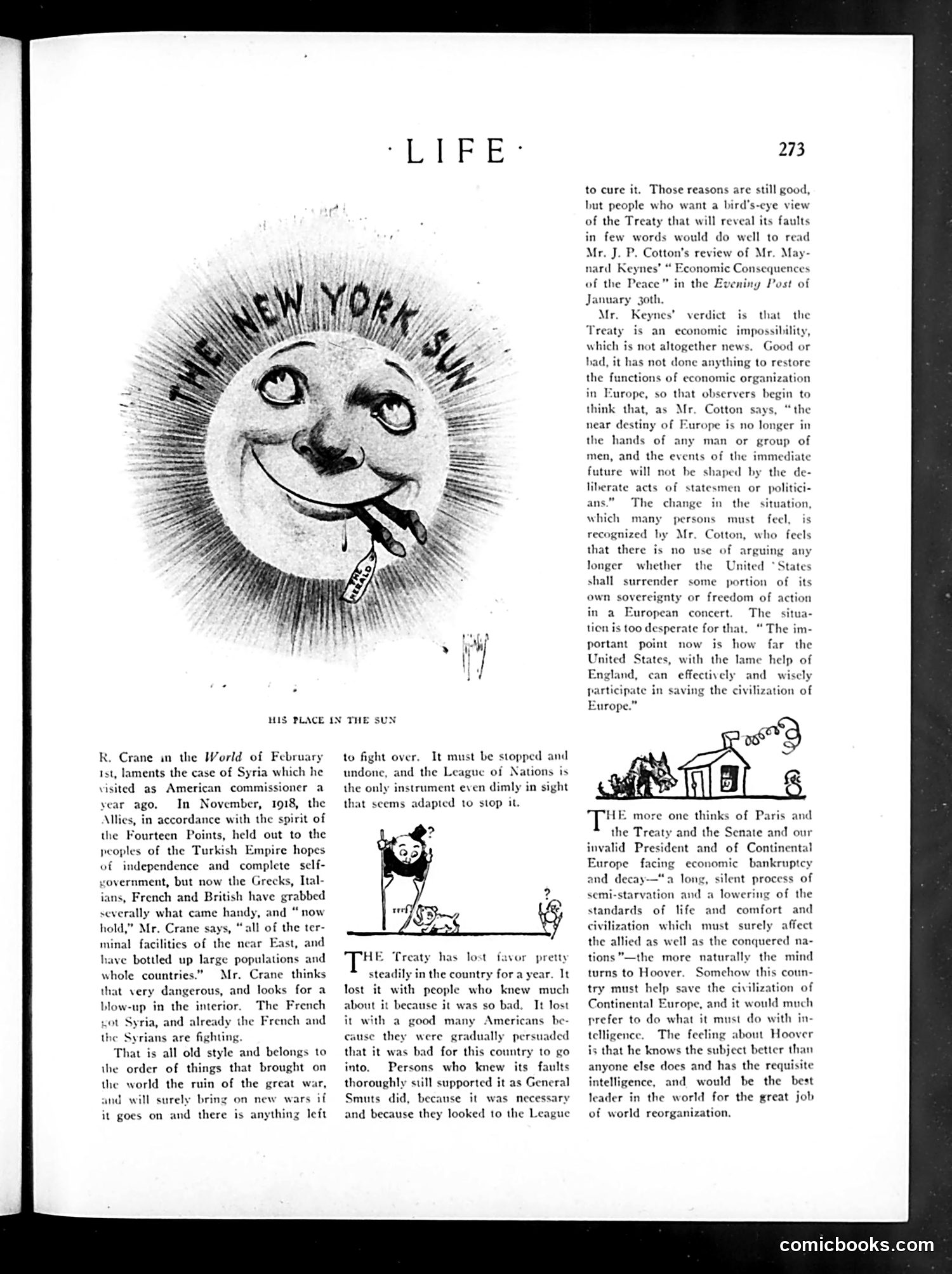
This page critiques the post-WWI Treaty of Versailles and European instability. The large cartoon "His Place in the Sun" depicts a smiling face labeled "NEW YORK SUN"—satirizing the newspaper's optimistic coverage despite dire circumstances. The text discusses R. Crane's observations about Syria and the Near East, where Allied powers (France, Britain, Greece, Italy) broke promises of self-determination made under Wilson's Fourteen Points, instead seizing territory. This "old style" imperialism risks future wars. The article argues the Treaty itself is economically catastrophic (citing economist Keynes' analysis) and has failed to restore European stability. The author suggests the situation is now beyond political negotiation—too desperate for debate over American sovereignty. The piece concludes by endorsing Herbert Hoover as the best leader to manage European reconstruction with practical intelligence, rather than relying on the "invalid President" (Wilson) or Senate squabbling. The overall message: the Treaty failed, Europe faces collapse, and only pragmatic American intervention under Hoover can prevent catastrophe.
📄 Transcribed text from this page (OCR, searchable)
Machine-transcribed from the original scan — historical spelling and the odd misread are preserved.
HIS PLACE IN THE k. Crane in the World of February ist, laments the case of Syria which he visited as American commissioner a year ago. In November, 1918, the Allies, in accordance with the spirit of the Fourteen Points, held out to the peoples of the Turkish Empire hopes of independence and complete sclf- xovernment, but now the Grecks, Ital- ns, French and British have grabbed severally what came handy, and “ now hold,” Mr. Crane says, “all of the ter- minal facilities of the near East, and have bottled up large populations and whole countries.” Mr. Crane thinks that very dangerous, and looks for a blow-up in the interior. The French yria, and already the French and yrians are fighting. That is all old style and belongs to the order of things that brought on the world the ruin of the great war, and will surely bring on new wars if it goes on and there is anything left to fight over. It must be stopped and undone, and the League of Nations is the only instrument even dimly in sight that scems adapted to stop it. HE Treaty has lost steadily in the country fora year. It lost it with people who knew much about it because it was so bad. It lost it with a good many Americans be- cause they were gradually persuaded that it was bad for this country to go into. Persons who knew its faults thoroughly still supported it as General Smuts did, because it was necessary and because they looked to the League favor pretty 273 to cure it. Those reasons are still good, but people who want a bird's-eye view of the Treaty that will reveal its faults in few words would do well to read Mr. J. P. Cotton’s review of Mr. Ma nard Keynes’ “ Economic Consequences of the Peace” in the Evening Post of January 3oth, Mr. Keynes’ that the Treaty is an economic impossibility, which is not altogether news. verdict is Good or had, it has not done anything to restore the functions of economic organization in Europe, so that observers begin to think that, as Mr. Cotton says, “the near destiny of Europe is no longer in the hands of any man or group of men, and the events of the immediate future will not be shaped by the de- liberate acts of statesmen or politici- The many ans.” change in the situation, which persons must feel, is recognized by Mr. Cotton, who feels that there is no use of arguing any longer whether the United * States shall surrender some portion of its own sovereignty or freedom of action ina ropean concert. The si tion is too desperate for that. “ The im- portant point now is how far the United States, with the lame help of and, can effectively and wisely participate in saving the civilization of Europe. HE more one thinks of Paris and the Treaty and the Senate and our invalid President and of Continental Europe facing economic bankruptcy and decay—“a long, silent process of semi-starvation and a lowering of the standards of life and comfort and civilization which must surely affect the allied as well as the conquered na- tions"—the more naturally the mind turns to Hoover. Somehow this coun- try must help save the civilization of Continental Europe, and it would much prefer to do what it must do with in- telligence. The feeling about Hoover that he knows the subject better than anyone else does and has the requisite intelligence, and would be the best leader in the world for the great job of world reorganization. comicbooks.com