
Life, 1920-02-12 · page 20 of 44
Life — February 12, 1920 — page 20: what you’re looking at
What you’re looking at
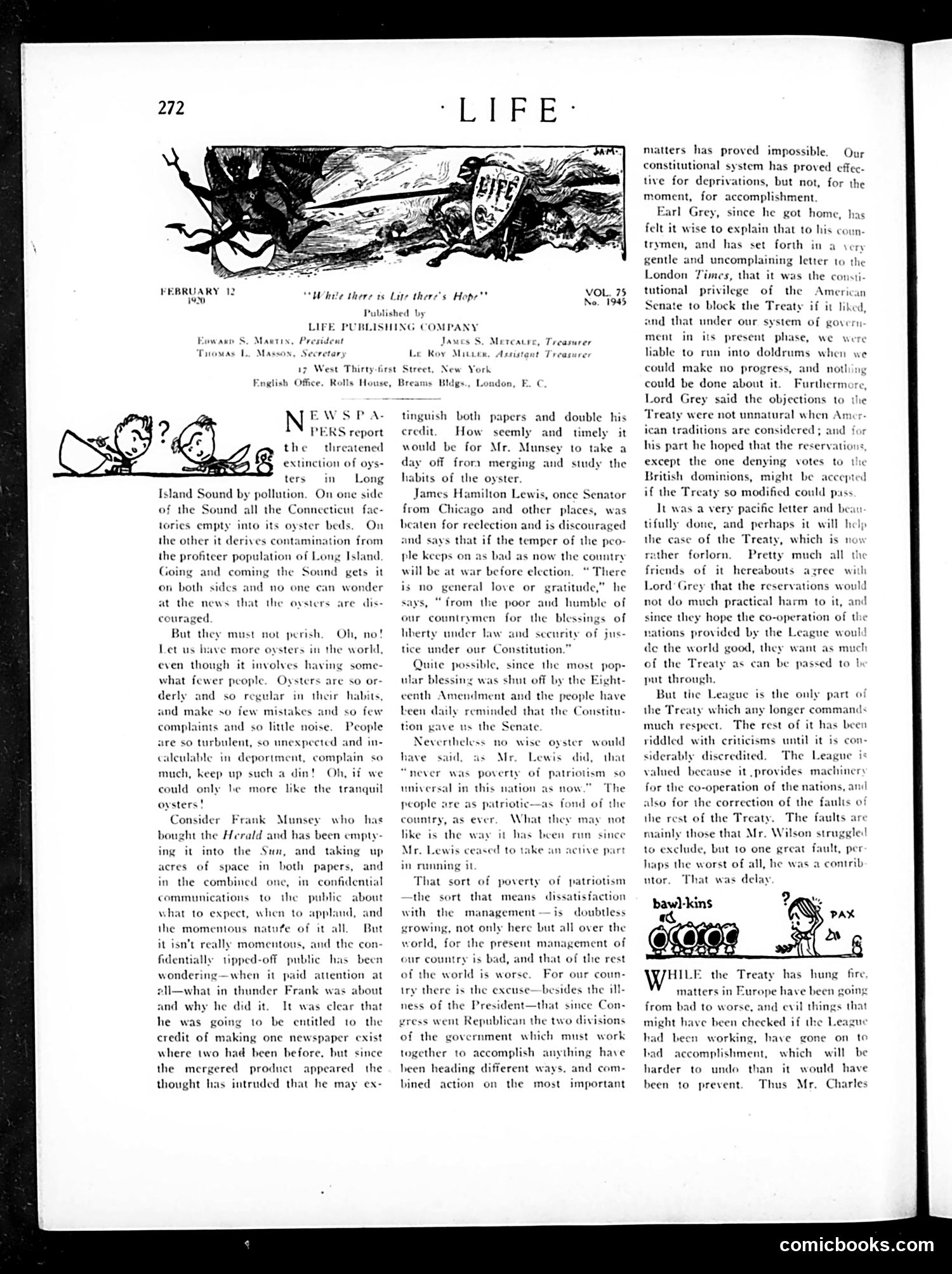
This page contains two distinct satirical pieces: **The Oyster Editorial**: The main text uses oysters as a metaphor for social order. Life sarcastically suggests oysters are preferable to people because they're orderly, quiet, and complain-free—while humans are "turbulent" and "unpredictable." This is social satire mocking those who value conformity over democratic messiness. **Frank Munsey Cartoon**: The small illustration criticizes newspaper magnate Frank Munsey, who merged the *Herald* and *Sun* newspapers. Life ridicules him for consolidating papers while neglecting to understand how systems actually work—comparing him unfavorably to an oyster's disciplined habits. **James Hamilton Lewis Reference**: The text critiques the defeated Senator Lewis, who blamed poor patriotism among Americans for national problems. Life counters that people have legitimate grievances with government management, not lack of patriotism—especially regarding Prohibition (the "Eighteenth Amendment"). The underlying theme: Government dysfunction and corporate consolidation are real problems; blaming citizens for lacking gratitude is misguided.
📄 Transcribed text from this page (OCR, searchable)
Machine-transcribed from the original scan — historical spelling and the odd misread are preserved.
FEBRUARY 12 190 “While there ts Lite there's: Hope"* VOL. 75 No. Published by LIFE PUBLISHING COMPANY Enwarn S. Matix, President Tomas LL. Masson, Secretary English Office, Rolls House, Breams Bligs., EWspP PERS report the threatened extinction of oys- ters in Long Island Sound by pollution, On one side of the Sound all the Connecticut fac- On the other it derives contamination from f Long Island. tories empty into its oyster beds. the profitcer population Going and coming the Sound gets it on both sides and no one can wonder at the news that the oysters are dis- couraged But they must not perish. Oh, no! Let us have more oysters in the world, even though it involves having some- what fewer pcople. Oysters are so or- derly and so regular in their habits, and make so few mistakes and so few complaints and so little noise. People are so turbulent, so unexpected and in- calculable in deportment, complain. so Oh, if we much, keep up such a din! could only he more like the tranquil oysters! Consider Frank Munsey who has bought the Herald and has been empty- and taking up both papers, confidential about ing it into the Sun, acres of space in and in the combined one, in communications to the public what to expect, when to appland, and But it isn’t really momentous, and the con- the momentous natufe of it all fidentially tipped-off public has been wondering—when it paid attention at ell—what in thunder Frank was about and why he did it. It was clear that he was going to be entitled to the credit of making one newspaper exist where two had been before, but since the mergered product the thought has intruded that he may ex- appeared 17 West Thirty-first Street, New Jawes S. Mereatre, T Le Koy Mitrer York London, F nd double his seemly and timely it would be for Mr. Munsey to take a tinguish both p credit. How pers day off frora merging and study the habits of the oyster. James Hamilton Lewis, once Senator from Chicago and other places, was beaten for reelection and is discouraged and says that if the temper of the pco ple keeps on as bad as now the country will be at war before election, “ There is no general love or gratitude,” he says, “from the poor and humble of our countrymen for the blessings of liberty under law and security of jus- tice under our Constitution.” Quite possible, since the most pop- ular blessing was shut off by the Eight- centh Amendment and the people have been daily reminded that the Constitu- tion gave the Senate. Nevertheless no wise oyster would said, as Mr that “never have Lewis did, Was poverty of patriotism so The people are as patriotic—as fond of the What has been universal in this nation as now.” country, as ever they may not like is the Mr. in running it That the with the management — is growing, not only here but all over the way it run since Lewis ceased to take an active part of patriotism sort of poverty sort that means dissatisfaction doubtless world, for the present management of our country is bad, and that of the rest of the world is worse. For our coun- iry there is the excuse—besides the ill- ness of the President—that since Con- gress went Republican the two divisions which work of the government must together to accomplish anything have heen heading different ways. and com- bined action on the most important matters has proved impossible. Our constitutional system has proved effec- tive for deprivations, but not, for the moment, for accomplishment Earl Grey, since he got home, has felt it wise to explain that to his coun trymen, and has set forth in a very gentle and uncomplaining letter to the London Times, that it was the consti tutional the Senate to block the Treaty privilege of American if it liked, and that under our system of govers ment in its present phase, we were liable to run into doldrums when we could make no progress, and nothing could be done about it. Furthermor Lord Grey said the objections to the Treaty were not unnatural when Amer- ican traditions a his part he hoped that the reservations ¢ considered ; and for except the one denying votes to the British dominions, might be accepted if the Treaty so modified could pass It was a very pacific letter and beau tifully done, and perhaps it will help the case of the Treaty, which is 1% rather forlorn. Pretty much all. the friends of it hereabouts with Lord’Grey that the reserv not do much practical harm to i gree ions would since they hope the co-operation of the nations provided by the League would de the world good, they want as much of the Treaty as can be passed to 1 put through. But the League is the only part o the Treaty which any longer command: much respect. The rest of it has been riddled with criticisms until it is ¢ The League ued because it provides machiner siderably discredited. for the co-operation of the nations, an also for the correction of the faulis of the rest of the Treaty, The faults a niainly those that Mr. Wilson struggle to exclude, but 10 one great fault, per haps the worst of all, he was a contrib utor, That was dela baw)-kins \WHILe the Treaty hung fire matters in Europe have been going from bad to worse, and evil things that might have been checked if the League had gone on to had will be harder to undo would have been to prevent Mr. Charles working, have been g, accomplishment, which than it Thus comicbooks.com