
Life, 1920-02-12 · page 24 of 44
Life — February 12, 1920 — page 24: what you’re looking at
What you’re looking at
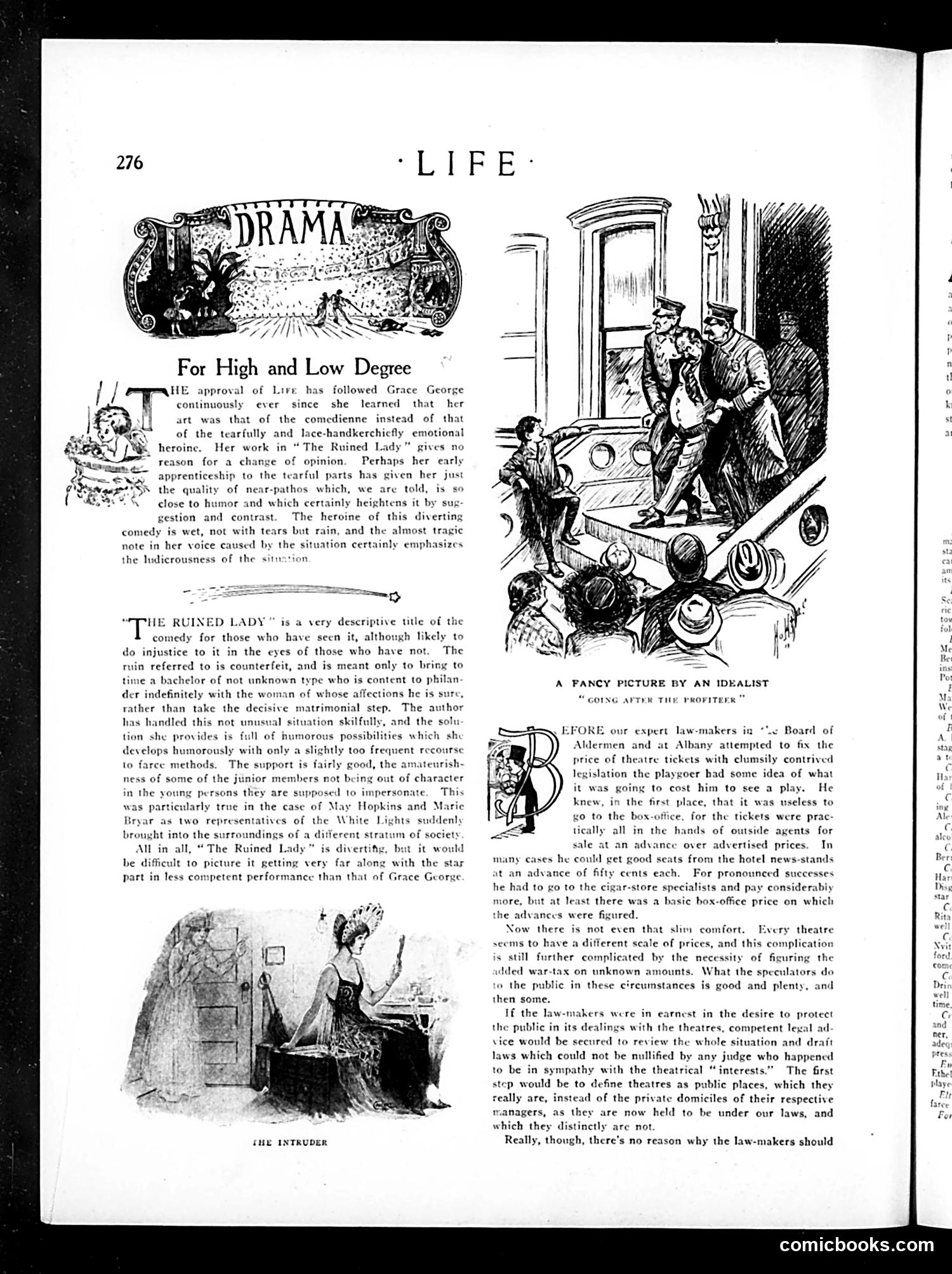
This *Life* magazine page critiques two theatrical matters: **"The Ruined Lady" Review (left):** A favorable review of Grace George's comedy performance. The play concerns a woman falsely ruined in reputation to trap a reluctant bachelor into marriage. *Life* approves George's comedic talent, noting she excels at humor rather than melodramatic tragedy. **"A Fancy Picture by an Idealist" (right):** The main satire. The illustration shows theatrical scalpers/ticket speculators being pursued. The accompanying article criticizes price-fixing legislation for theater tickets, enacted by New York's Board of Aldermen and Albany. The complaint: regulations meant to protect consumers have backfired, making prices *less* transparent and more exploitative. Previously, scalpers charged fixed markups over advertised box-office prices; now theaters use complex variable pricing plus war-taxes, allowing speculators to charge arbitrarily. The author argues lawmakers should legally define theaters as "public places" (regulated utilities) rather than private businesses to effectively control profiteering.
📄 Transcribed text from this page (OCR, searchable)
Machine-transcribed from the original scan — historical spelling and the odd misread are preserved.
For High and Low Degree HE approval of Lire has followed Grace George continuously ever since she learned that her art was that of the comedienne instead of that of the tearfully and lace-handkerchiefly emotional heroine. Her work in “The Ruined Lady” gives no reason for a change of opinion. Perhaps her early apprenticeship to the tearful parts has given her just the quality of near-pathos which, we are told, is so close to humor and which certainly heightens it t gestion and contrast. The heroine of this diverting is wet, not with tears but rain, and the almost tragic note in her voice caused by the situation certainly emphasizes the Indicrousness of the sitation ey “Te RUINED LADY " is a very descriptive title of the comedy for those who have secn it, although likely to do injustice to it in the eyes of those who have not. The ruin referred to is counterfeit, and is meant only to bring to time a bachelor of not unknown type who is content to philan der indefinitely with the woman of whose affections he is sure, rather than take the decisive matrimonial step. The author has handled this not unusual situation skilfully, and the solu tion she provides is full of humorous possibilities which sh« develops humorously with only a slightly too frequent recourse lo farce methods. The support is fairly good, the amateurish- ness of some of the junior mem ot being out of character in the young persons they are supposed to impersonat was particularly true in the case of May Hopkins and Maric Bryar as two representatives of the White Lights suddenly brought into the surroundings of a different stra i All in all, “The Ruined Lady” is diver it would be difficult to picture it getting very far g with the star part in less competent performance than that of Grace George Thy 4 iME INTRUDER A PANCY PICTURE BY AN IDEALIST * GOING AFTER THE PROFITERR . EFORE our expert law-makers in ‘".c Board of Aldermen and at Albany attempted to fix the price of theatre tickets with clumsily contrived legislation the playgoer had some idea of what it was going to cost him to see a play. He knew, in the first place, that it was useless to 0 to the box-office. for the tickets were prac- tically all in the hands of outside agents for sale at an advance over advertised prices. In many cases he could get good seats from the hotel news-stands at an advance of fifty cents each. For pronounced successes he had to go to the cigar-store specialists and pay considerabiy more, but at least there was a basic box-office price on which the advances were figured. Now there is not even that slim comfort. Every theatre seems to have rent scale of p » and this complication s still further complicated by the necessity of figuring the added war-tax on unknown amounts. What the speculators do © the public in these circumstances is good and plenty, and then some. If the law-makers were in earnest in the desire to protect the public in its dealings with the theatres, competent legal ad. vice would be secured to review the whole situation and draft laws which could not be nullified by any judge who happened to be in sympathy with the theatrical “interests.” The first step would be to define theatres as public places, which they really are, instead of the private domiciles of their respective managers, as they are now held to be under our laws, and which they distinctly are not Really, though, there’s no reason why the law-makers should comicbooks.com