
A complete issue · 37 pages · 1919
Life — December 25, 1919
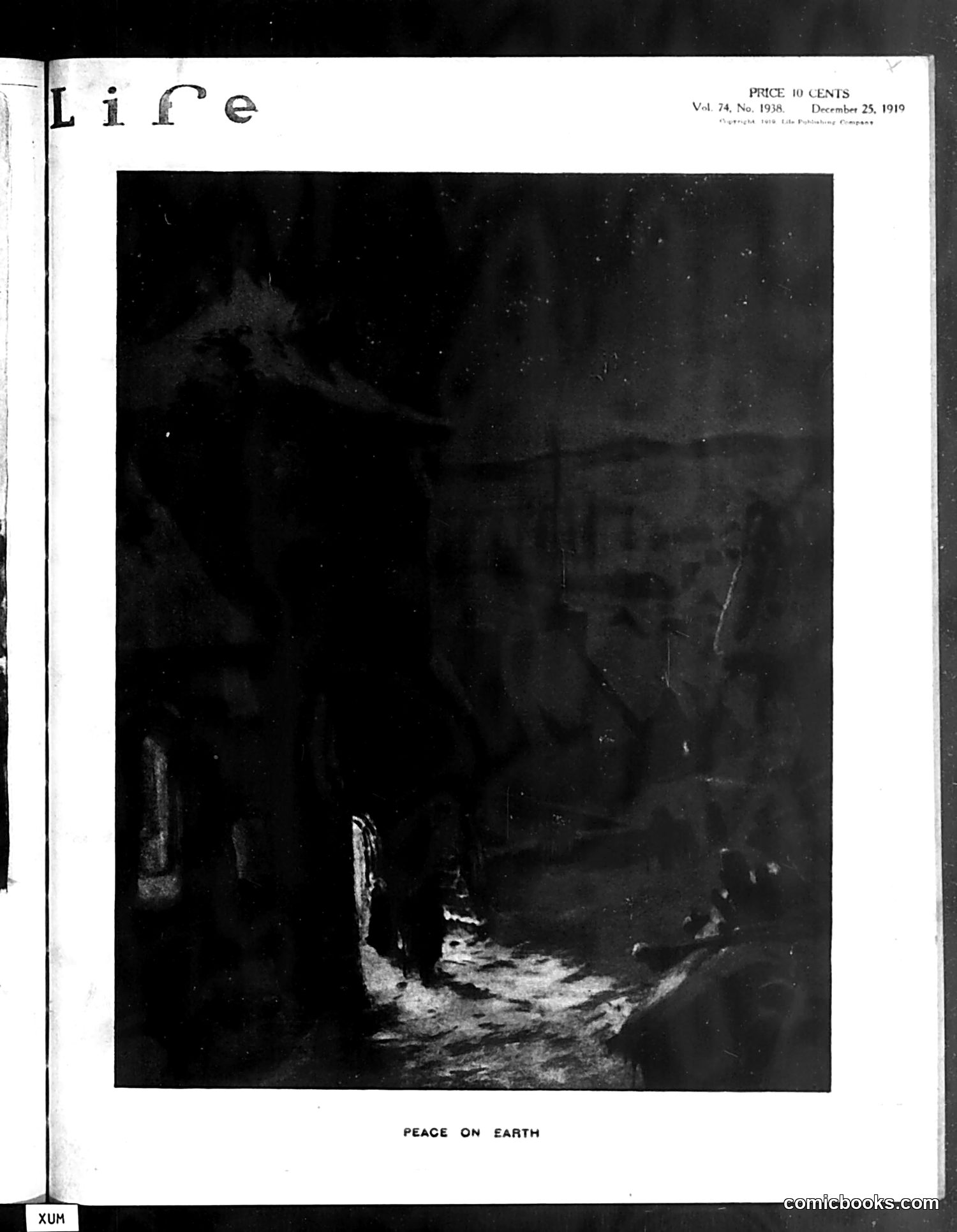
This appears to be a Christmas-themed illustration published just after World War I ended (November 1918). The image shows a dark, desolate winter landscape with bare trees and snow—a stark contrast to the hopeful caption "Peace on Earth." The juxtaposition creates ironic commentary: while the caption invokes traditional Christmas messages of peace and goodwill, the bleak, barren scene suggests the actual aftermath of WWI. The devastated landscape likely references the physical destruction across Europe from the war. Published in 1919, this reflects contemporary skepticism about whether genuine peace had truly been achieved, or whether the war's devastation would continue to haunt the world. The mood is decidedly pessimistic rather than celebratory.

This is primarily a **Piso's cough medicine advertisement**, not political satire. The page depicts a winter scene where two men are exposed to harsh snowy conditions—one carrying newspapers, another coughing into his hand—with a horse-drawn vehicle visible in the background. The advertisement's messaging is straightforward: exposure to winter weather causes coughs and sore throats, and Piso's remedy provides prompt relief. The ad emphasizes the product is "good for young and old," contains "no opiate," and costs 30 cents at druggists. This represents early 20th-century patent medicine marketing, using relatable scenarios of common winter ailments to sell a standard cure-all tonic—typical advertising strategy of the era before modern FDA regulations.
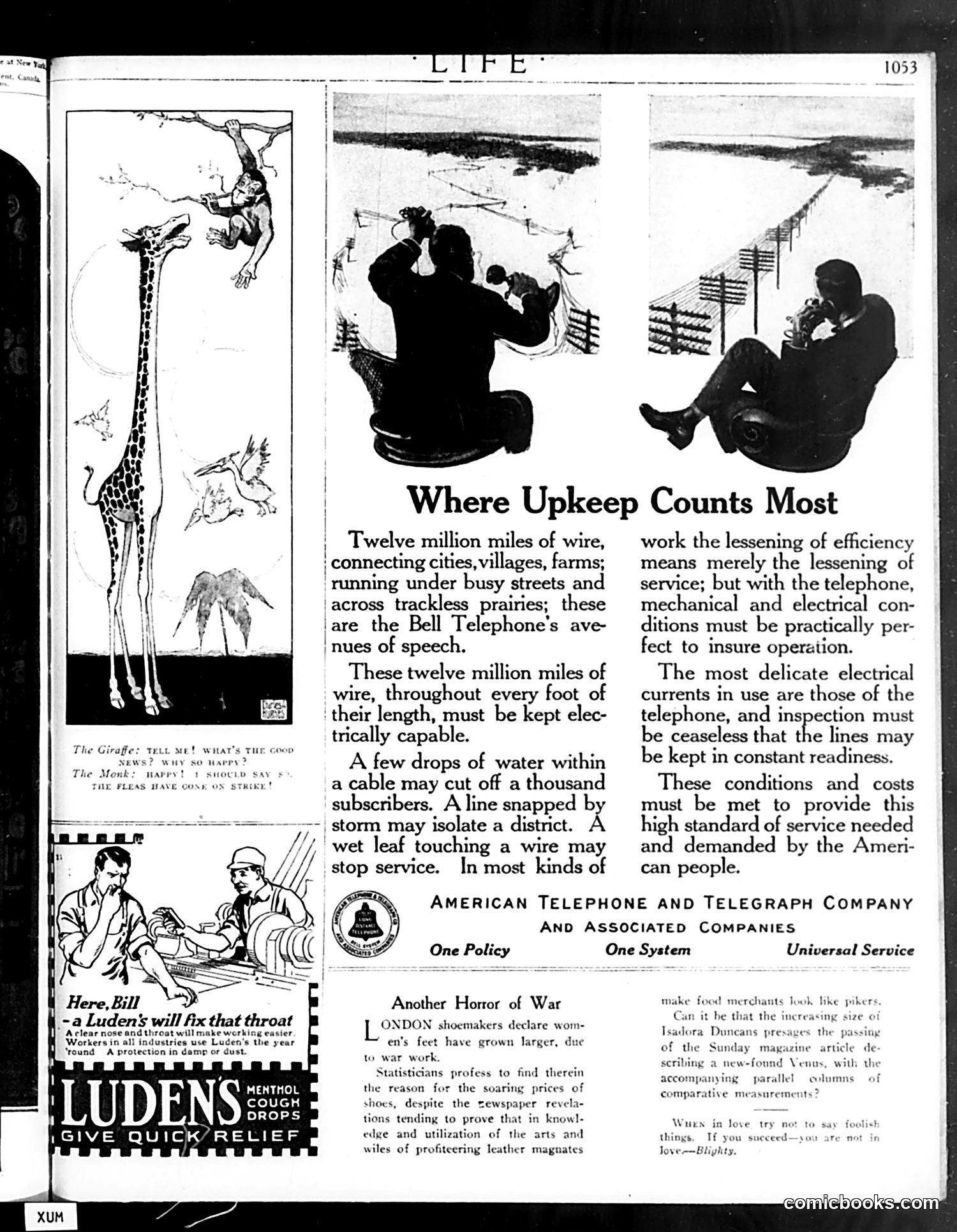
The left side features a satirical cartoon titled "The Giraffe" with dialogue between a giraffe and monkey about "good news" and happiness, with the monkey noting "the Reds have gone on strike." This appears to be Cold War-era satire mocking labor strikes, possibly suggesting strikers are communists or that their actions harm society. Below is an advertisement for Luden's Cough Drops showing workers, linking labor health to the product. The right side is primarily a Bell Telephone Company advertisement emphasizing the infrastructure maintenance required for reliable telephone service—twelve million miles of wire requiring constant upkeep and inspection. The two silhouetted figures in winter scenes illustrate the company's commitment to year-round service reliability.
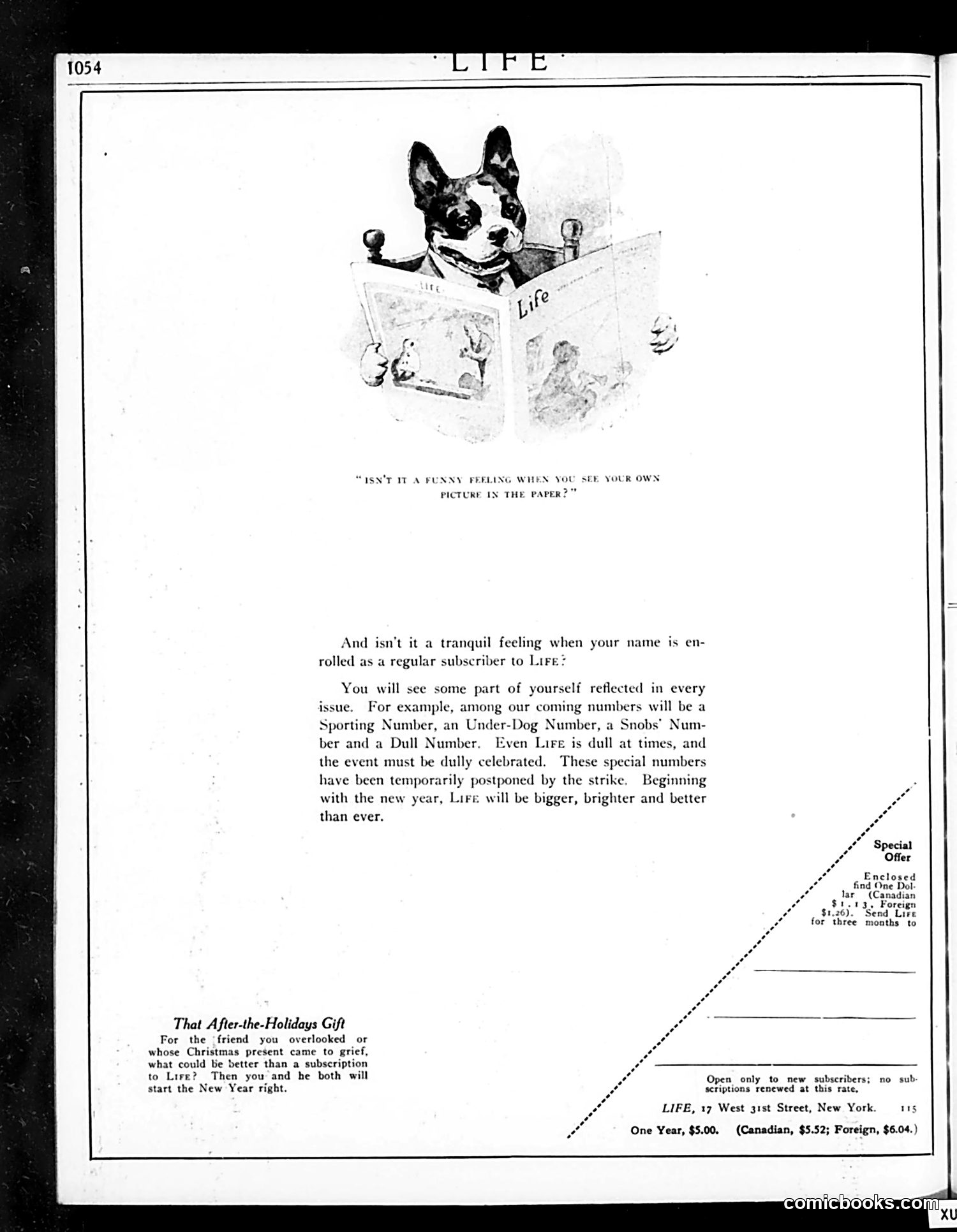
This page is primarily a **subscription advertisement for Life magazine**, not a political cartoon. The main illustration shows a Boston Terrier or similar small dog reading a copy of Life magazine, with the caption: "ISN'T IT A FUNNY FEELING WHEN YOU SEE YOUR OWN PICTURE IN THE PAPER?" The joke is straightforward: the dog is humorously depicted discovering its own image published in Life, playing on the relatable human experience of seeing oneself in print. The ad emphasizes Life's broad appeal—promising "Sporting Number, an Under-Dog Number, a Snobs' Number and a Dull Number"—suggesting there's content for every reader type. The "Special Offer" at bottom promotes subscription as an "After-the-Holidays Gift" at $5 yearly. This is largely **commercial content disguised as editorial humor**.
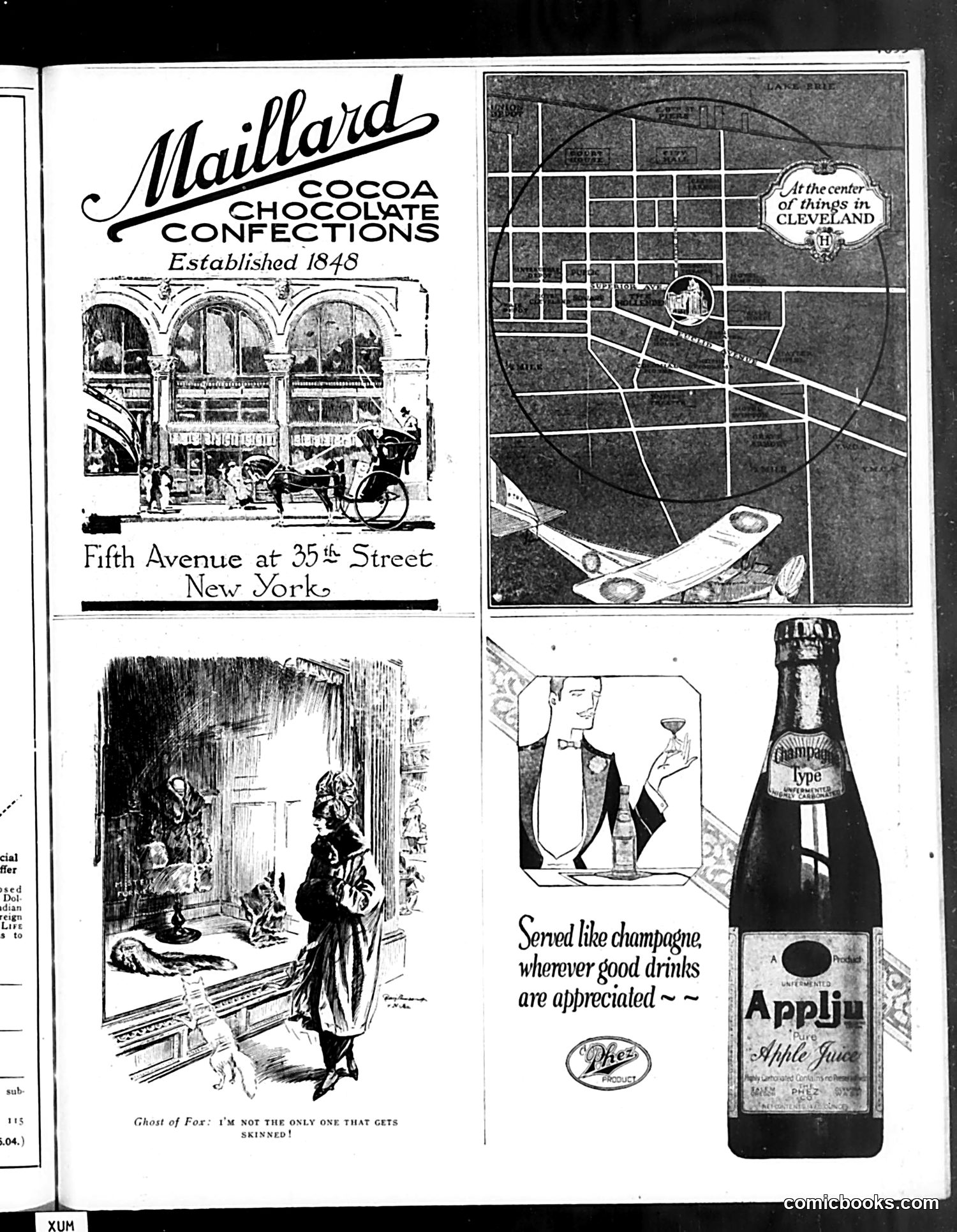
This page is primarily **advertising**, not editorial content. The top advertises **Maillard Cocoa and Chocolate Confections** (established 1848), located at Fifth Avenue and 35th Street in New York, showing their storefront. The lower left contains a cartoon labeled "Ghost of Fox: I'M NOT THE ONLY ONE THAT GETS SKINNED!" The figure appears to be a ghost, likely referencing a fox—possibly satirizing someone nicknamed "Fox" who was financially ruined or "skinned" (a period term for being cheated or losing money). The exact historical reference is unclear without additional context. The right side advertises **Applin Apple Juice**, presented as a sophisticated beverage "served like champagne wherever good drinks are appreciated." The page reflects early 20th-century advertising aesthetic and likely dates to that era.
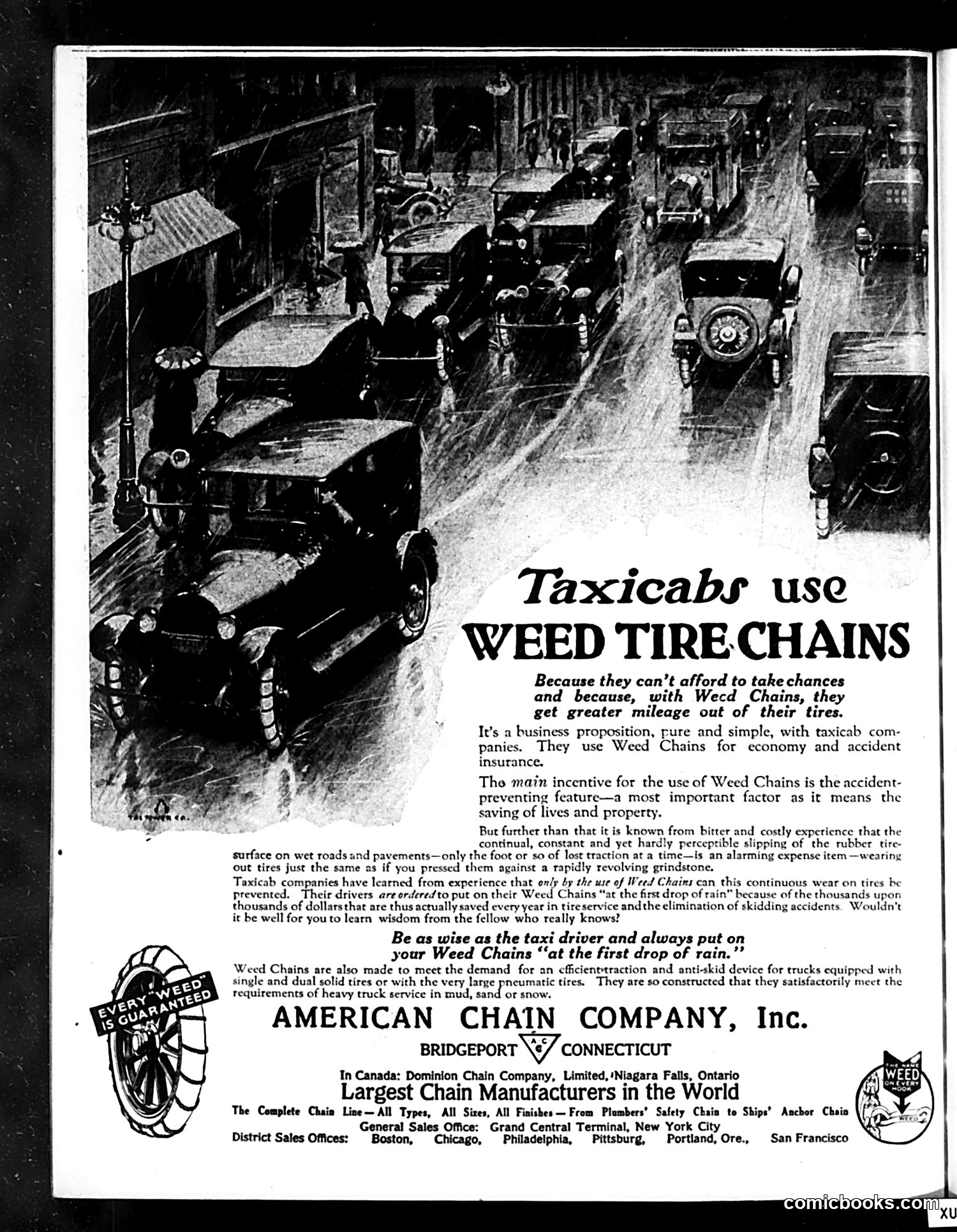
This page is **primarily an advertisement**, not editorial content or satire. It's a full-page ad for Weed Tire Chains by the American Chain Company of Bridgeport, Connecticut. The image shows a narrow, wet urban street crowded with early automobiles (likely 1920s era), demonstrating the safety hazard of slippery conditions. The advertisement argues that taxicabs use Weed Chains because they prevent accidents and extend tire life—framing chain use as both economical and a life-saving precaution. The ad emphasizes putting chains on "at the first drop of rain" and notes these chains work for various vehicle types. There is no political satire here—it's straightforward commercial messaging about automotive safety products to a contemporary audience concerned with winter driving conditions.
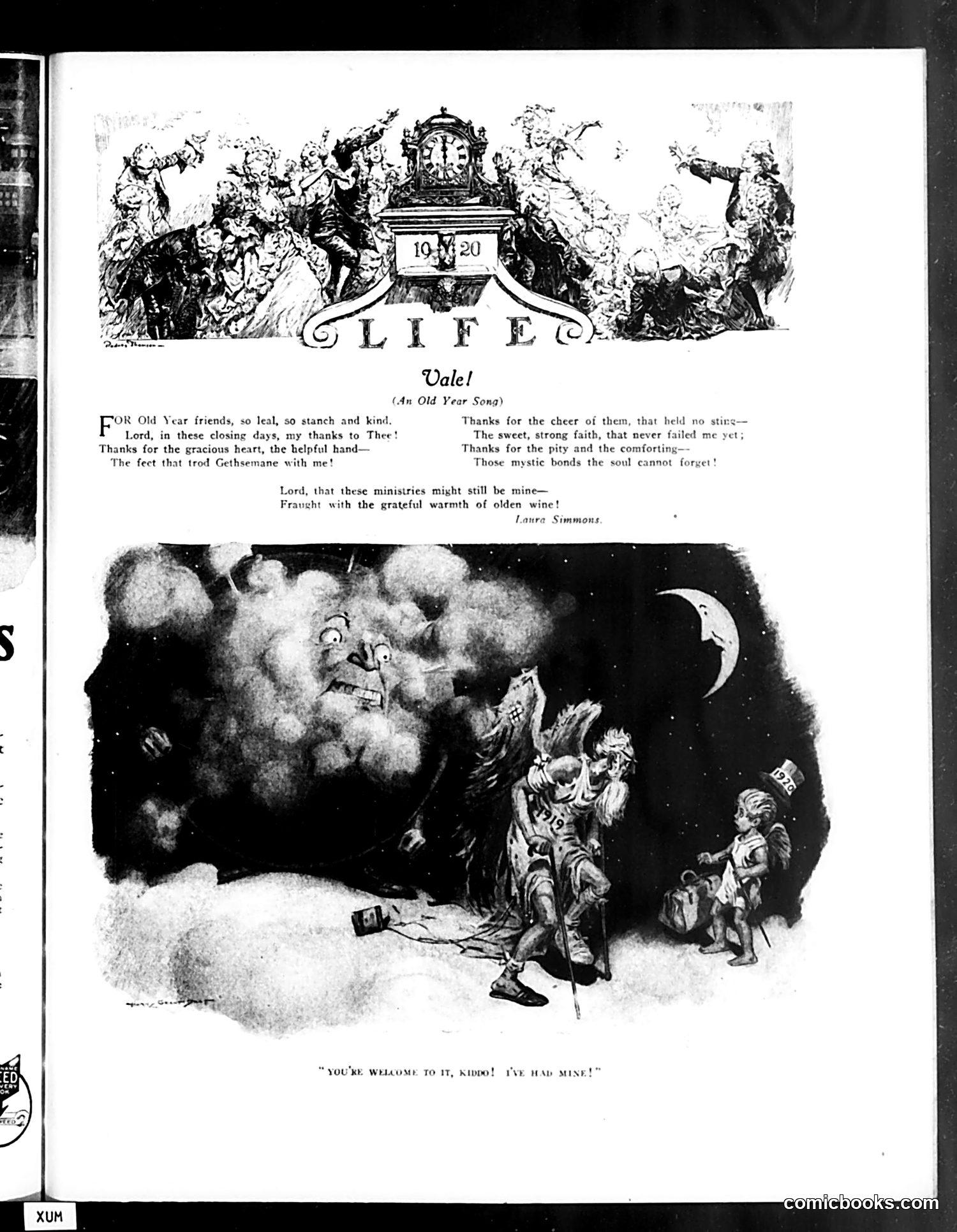
This page commemorates the passing year with "Vale!" (Latin for "farewell"). The decorative header features an ornate clock showing 1919-1920, surrounded by allegorical figures representing the year's departures and new beginnings. The poem by Laura Simmons thanks departing friends and experiences—"the gracious hearts, the helpful hand"—while acknowledging loss and spiritual bonds that "cannot forget." The illustration below depicts what appears to be **Old Year personified as a departing figure** (left, in clouds) bidding farewell to **New Year/coming year** (right, with torch and crescent moon). Child-like figures welcome the newcomer with the caption "You're welcome to it, kiddo! I've had mine!" This reflects post-WWI disillusionment—the outgoing 1919 was marked by war's aftermath, suggesting the new year holds uncertain prospects.
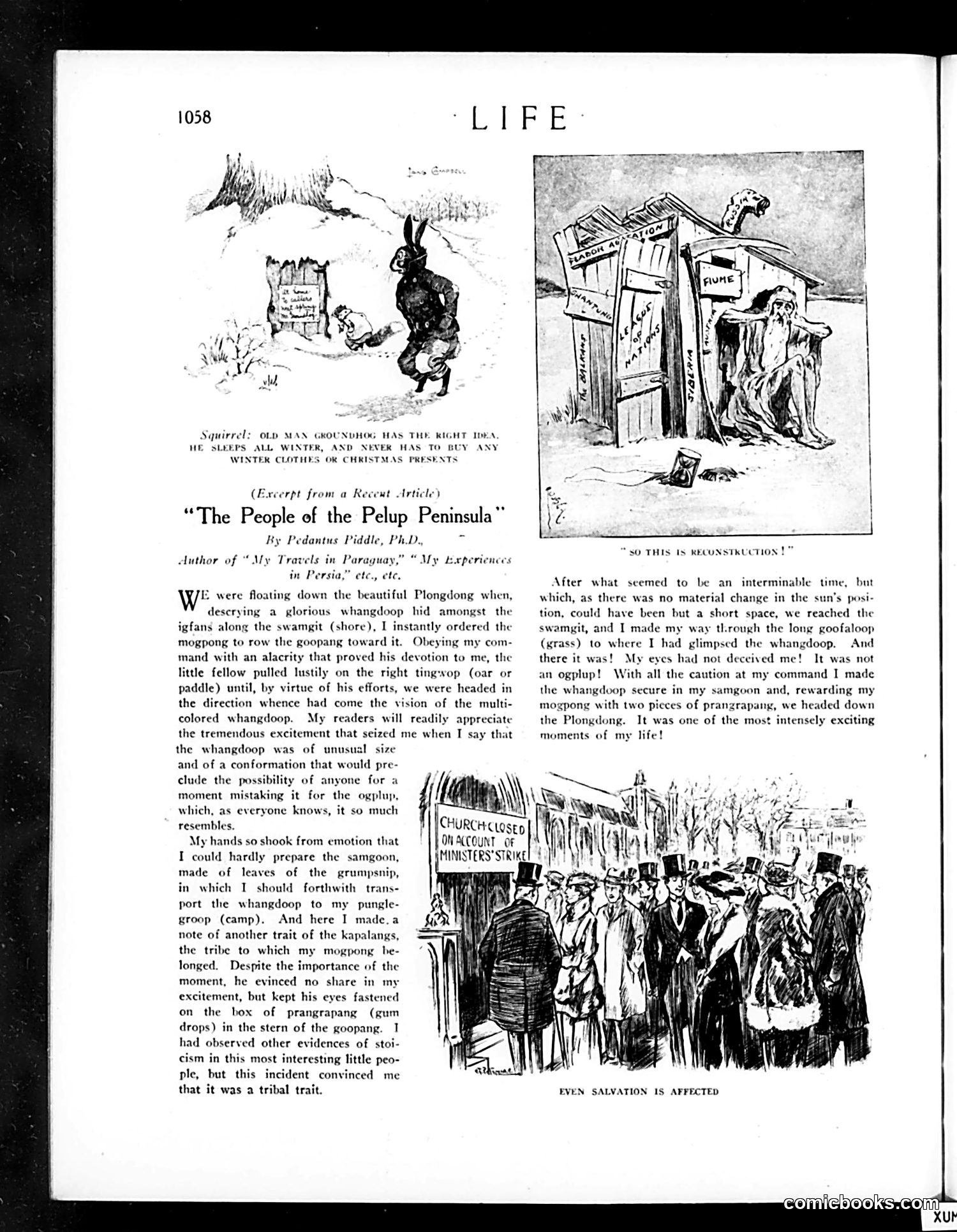
This page contains an article titled "The People of the Pelup Peninsula" by Vedantus Piddle, Ph.D., describing the author's travels in an exotic location. The three illustrations are travel sketches rather than political cartoons. The top-left cartoon shows a squirrel with a humorous caption about surviving winter without buying clothes or gifts—a gentle joke about thrift. The top-right and bottom illustrations depict scenes from the author's expedition: a dilapidated structure (captioned "So This Is Reconstruction!") and a street scene labeled "Even Salvation Is Affected." These appear to be satirical observations about conditions in the visited region, likely using travel narrative conventions common to early 20th-century Life magazine content. The references remain obscure without additional historical context about the "Pelup Peninsula."
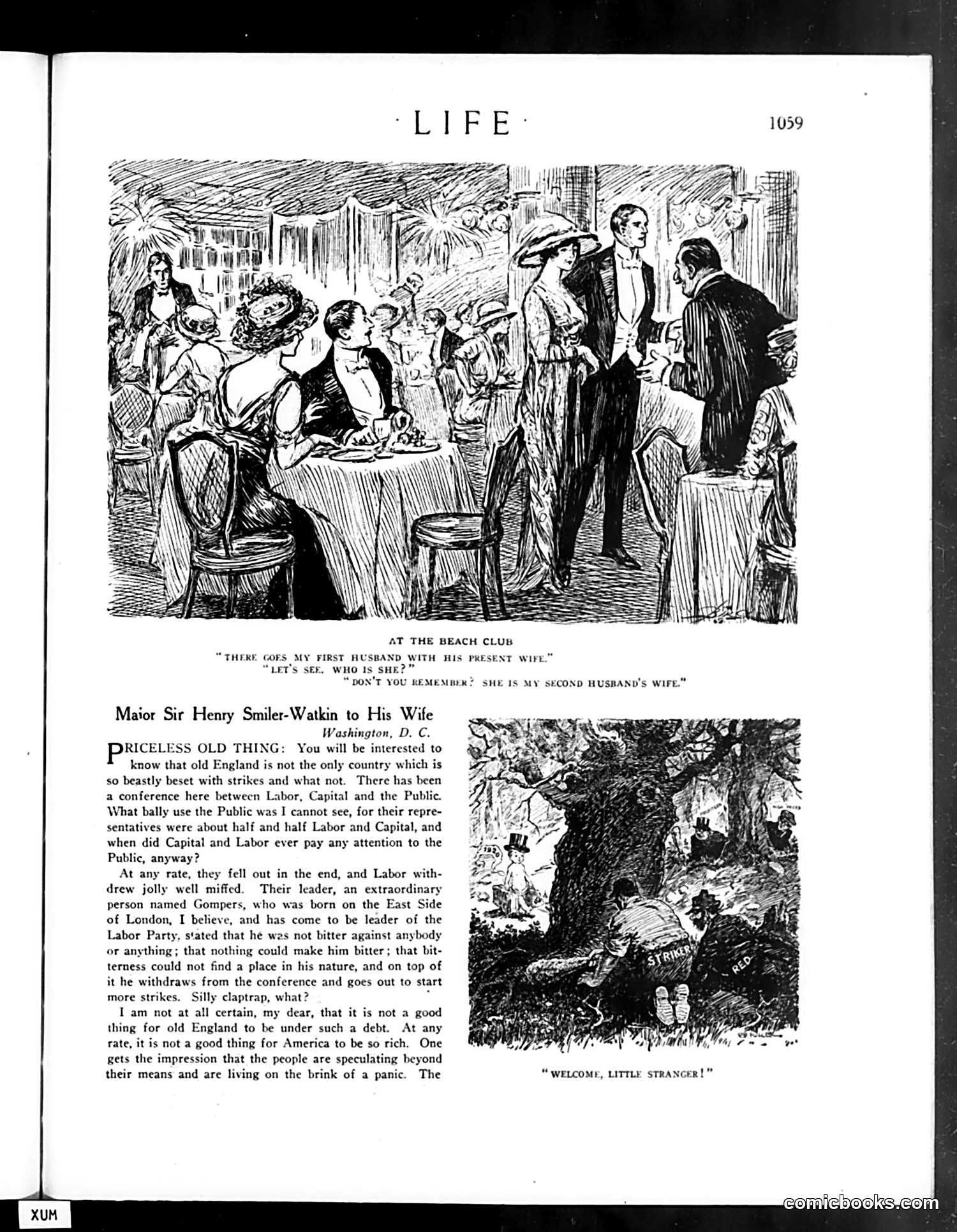
**Top Cartoon:** This is a social satire on remarriage and class consciousness. At a beach club, a woman points out her new husband to friends, noting his previous wife. The punchline—"Don't you remember? She is my second husband's wife"—is a deliberately confusing joke about marital complexity, likely mocking either the speaker's pretentiousness or the social awkwardness of remarriage among the wealthy. **Bottom Section:** A letter from "Major Sir Henry Smiler-Watkin" discusses British labor disputes. He references a conference between "Labor, Capital and the Public" where labor leader "Gompers" (likely Samuel Gompers, American labor organizer) withdrew, declaring nothing could improve conditions. The satirical point critiques labor unrest and its effects on both nations' economies during what appears to be early 20th-century industrial conflict.
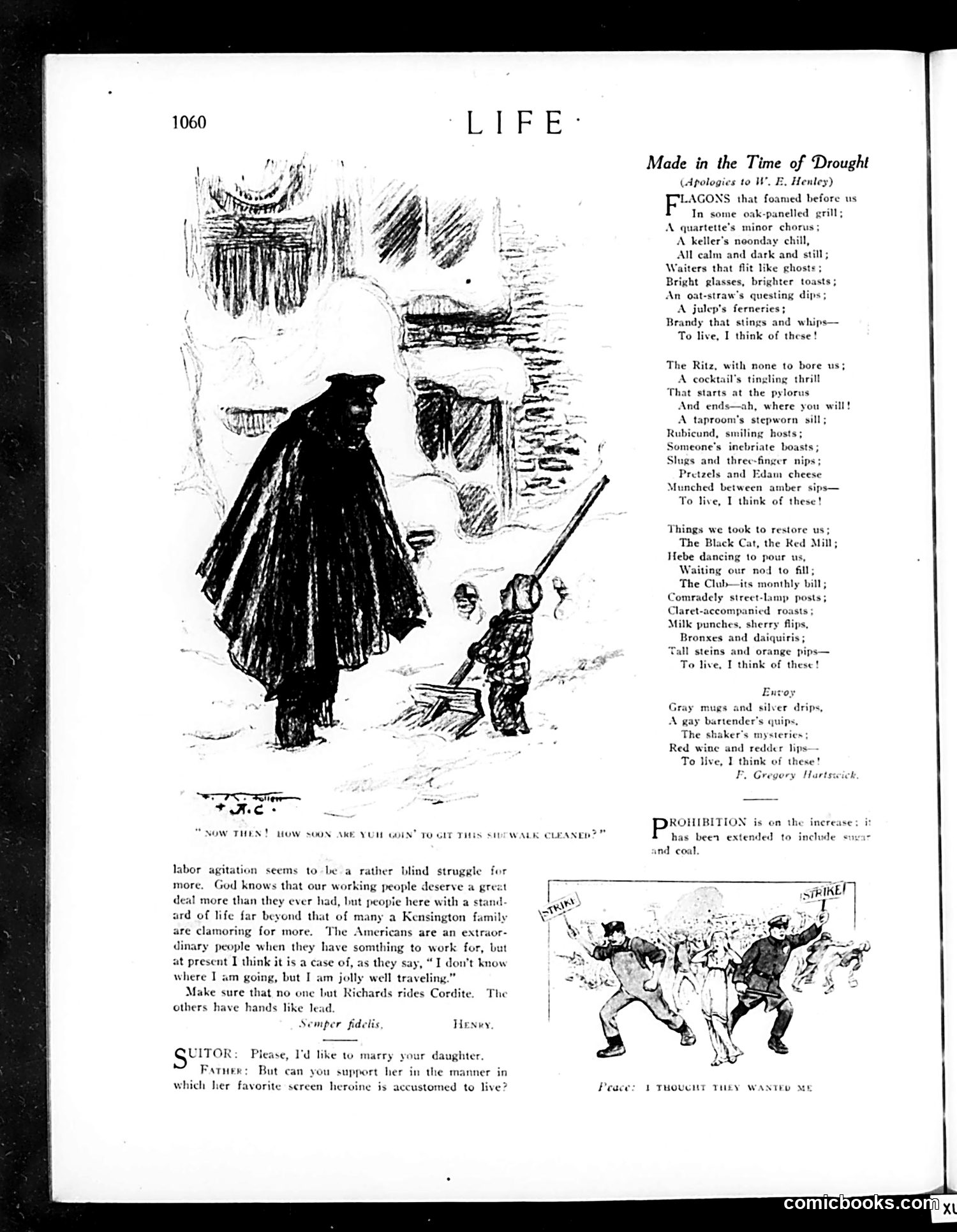
This page presents a poem by F. Gregory Hartswick lamenting what one must endure "to live" during hard times—listing deprivations like cheap lodgings, watered drinks, and modest food. The main illustration shows a street sweeper with a child, captioned "Now then! How soon are you going to get this sidewalk cleaned?"—satirizing how even the poorest workers face demands despite economic hardship. Below, a separate cartoon depicts men being ejected from what appears to be a bar or establishment, labeled "I thought they wanted me"—likely mocking contradictions in labor demand during economic downturn. The "Semper Fidelis" dialogue between a suitor and father concerns marriage affordability—the suitor cannot support a daughter in the style she expects. Overall, the page satirizes economic struggle and social anxiety during a period of financial constraint.
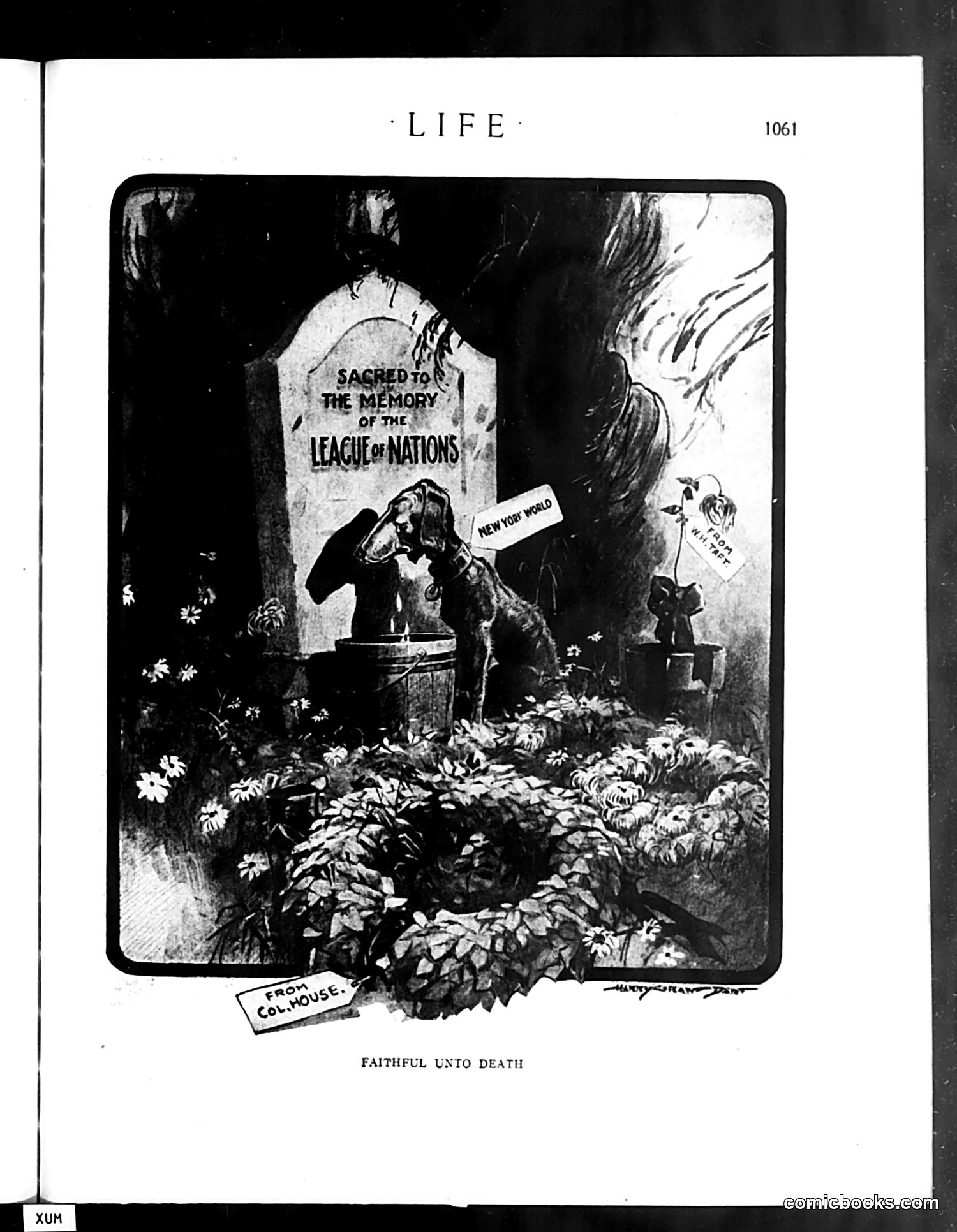
This political cartoon from *Life* magazine (page 1061) depicts a dog mourning at a monument "Sacred to the Memory of the League of Nations." The dog wears a collar labeled "New York World" and stands amid flowers in a cemetery-like setting. The satire criticizes American newspaper coverage of the League of Nations' failure or decline. The "New York World" (a major newspaper) is portrayed as a loyal but grieving observer of the League's demise. The cartoon suggests the press remained faithful to reporting on the League even as the institution itself collapsed or lost relevance—likely referencing the League's weakness in the 1930s before World War II, when American isolationism and League ineffectiveness became increasingly apparent.
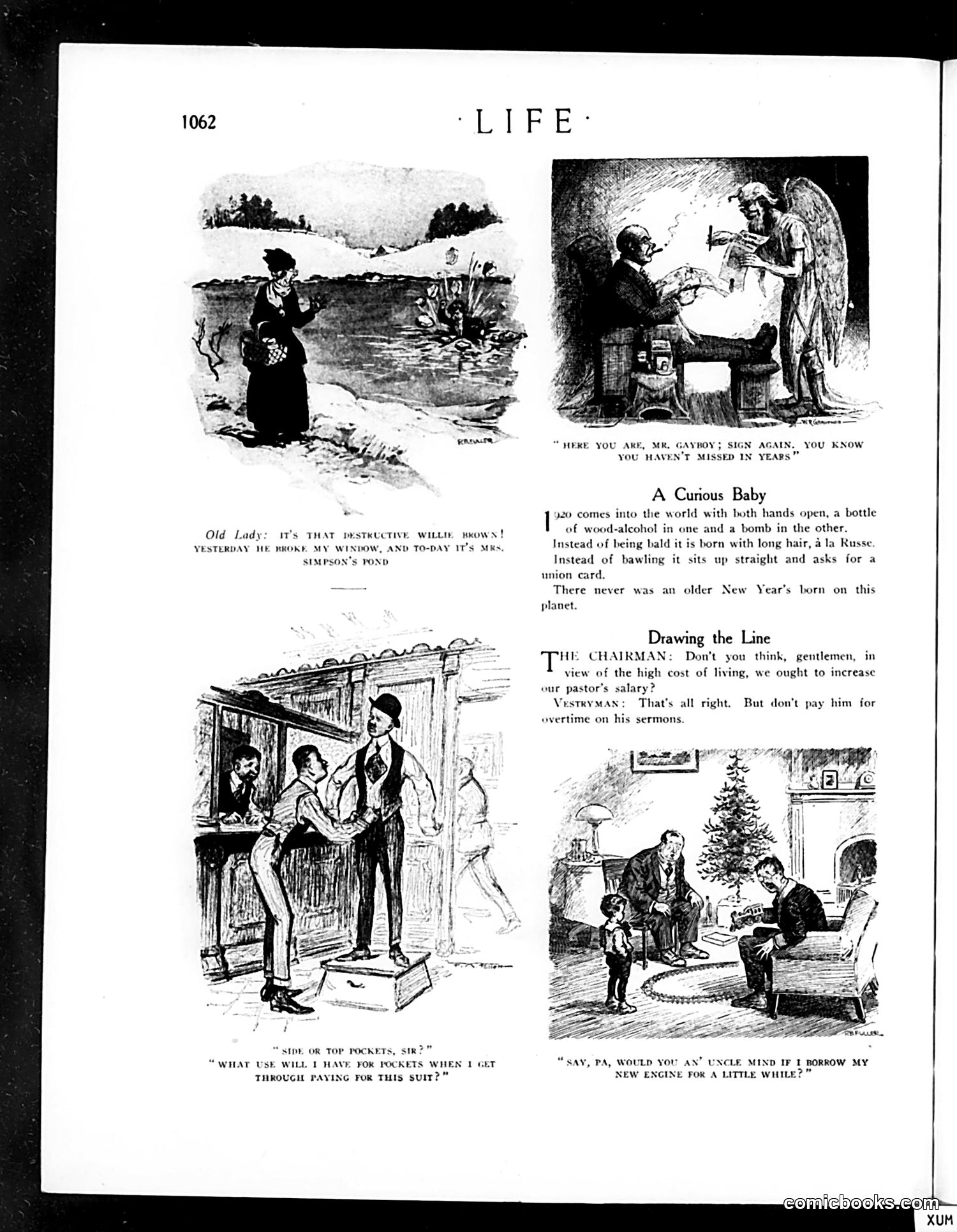
This page contains three separate humorous sketches without clear political figures or specific historical references. **"Old Lady"** (top left): A woman complains that "destructive Willie Brown" broke her window yesterday and broke it again today—the joke being the child's repeat offense and her exasperation. **"A Curious Baby"** (top right): An angel shows a man a newborn described as unusually old and demanding (wanting alcohol, a union card instead of normal infant behavior). The humor lies in satirizing cynical modern attitudes toward birth and childhood. **"Drawing the Line"** (bottom): Two sketches about financial constraints—one about a tailor's pockets becoming useless after paying for a suit, another about borrowing a toy engine. These mock working-class economic struggles and the absurdity of poverty. The page's humor is domestic and economic rather than explicitly political.
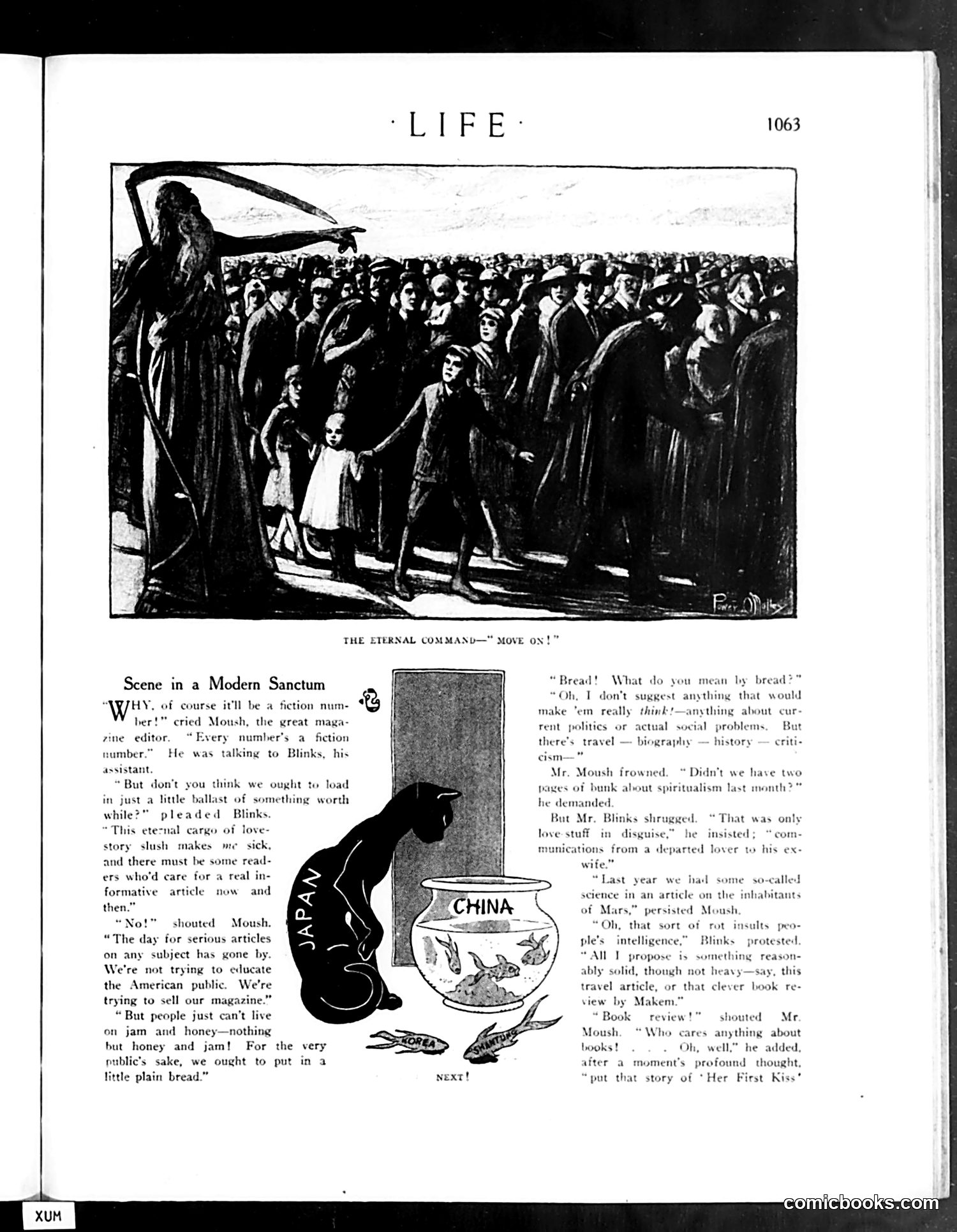
This page satirizes editorial decision-making at a modern magazine. The sketch "Scene in a Sanctum" depicts a conversation between an editor and his assistant (Blinks) about article selection. The satire mocks the tension between literary quality and commercial appeal: Blinks argues readers want "jam and honey"—escapist content—while the editor insists on substantive pieces about "current politics or actual social problems." Blinks counters that serious content like spiritualism articles and Mars science pieces bore readers, proposing instead lightweight romance stories like "Her First Kiss." The cartoon's joke: magazine editors face constant pressure to prioritize entertainment value over meaningful journalism to maintain readership and profitability. The China fishbowl illustration appears unrelated—possibly an advertisement or filler content typical of the era.
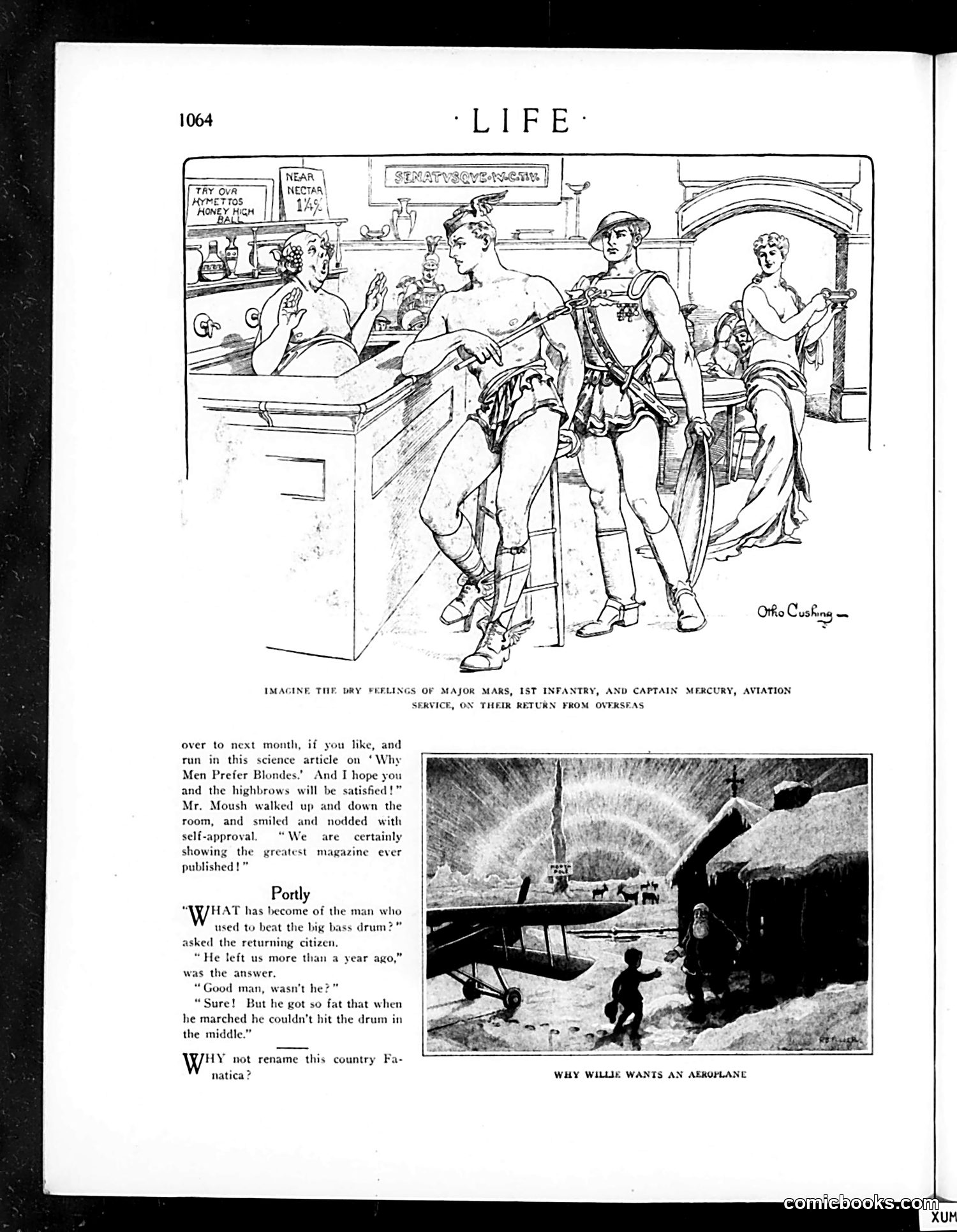
The top cartoon depicts classical/mythological figures (soldiers, sailors, and attendants) in a modern kitchen setting, captioned: "Imagine the dry feelings of Major Mars, 1st Infantry, and Captain Mercury, Aviation Service, on their return from overseas." **The joke:** The cartoon personifies classical gods (Mars=war, Mercury=travel/commerce) as military officers returning home from World War I. The humor lies in imagining these traditionally powerful deities reduced to domestic, mundane kitchen duties—a satirical comment on soldiers' anticlimatic readjustment to civilian life after combat. The lower section contains two brief humorous anecdotes about returning servicemen: one about a bass drummer who couldn't hit the drum in the middle, another questioning why the country isn't renamed "Fanatica." These mock soldiers' readjustment difficulties and post-war social oddities. The airplane photo appears illustrative rather than satirical.
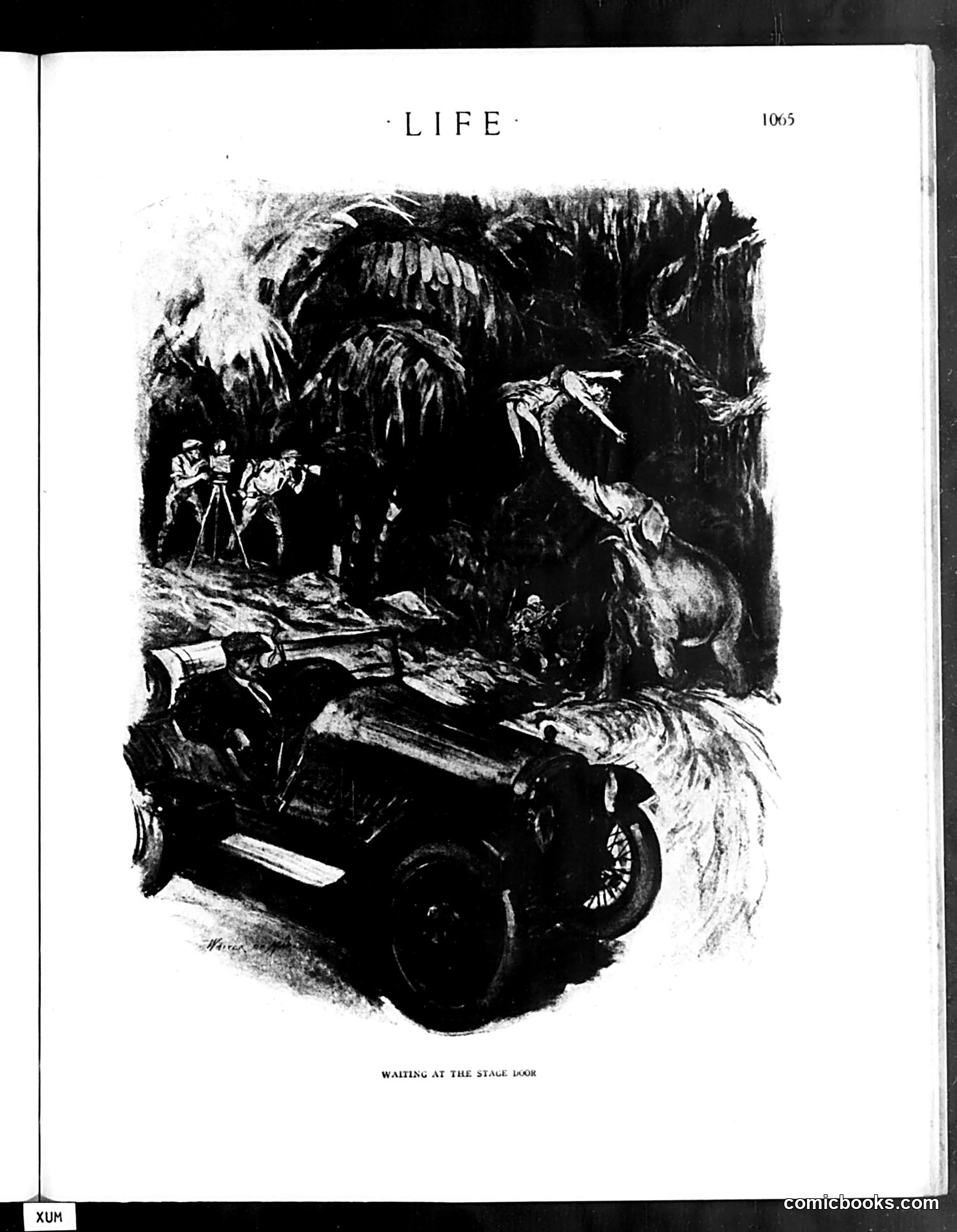
This illustration depicts an early automobile parked outside what appears to be a theater stage entrance. A man sits in the driver's seat of the car while well-dressed figures emerge from or gather near the stage door in the background, beneath drooping willow or similar foliage. The caption "Waiting at the Stage Door" suggests satirical commentary on romantic pursuit or social climbing—likely mocking wealthy men using automobiles to court actresses or performers. The car represents conspicuous consumption and modernity, while the "stage door" setting invokes the era's fascination with theater culture and the social dynamics between wealthy suitors and theatrical performers. The humor appears to target the pretensions of motorcar ownership as a courtship tool.
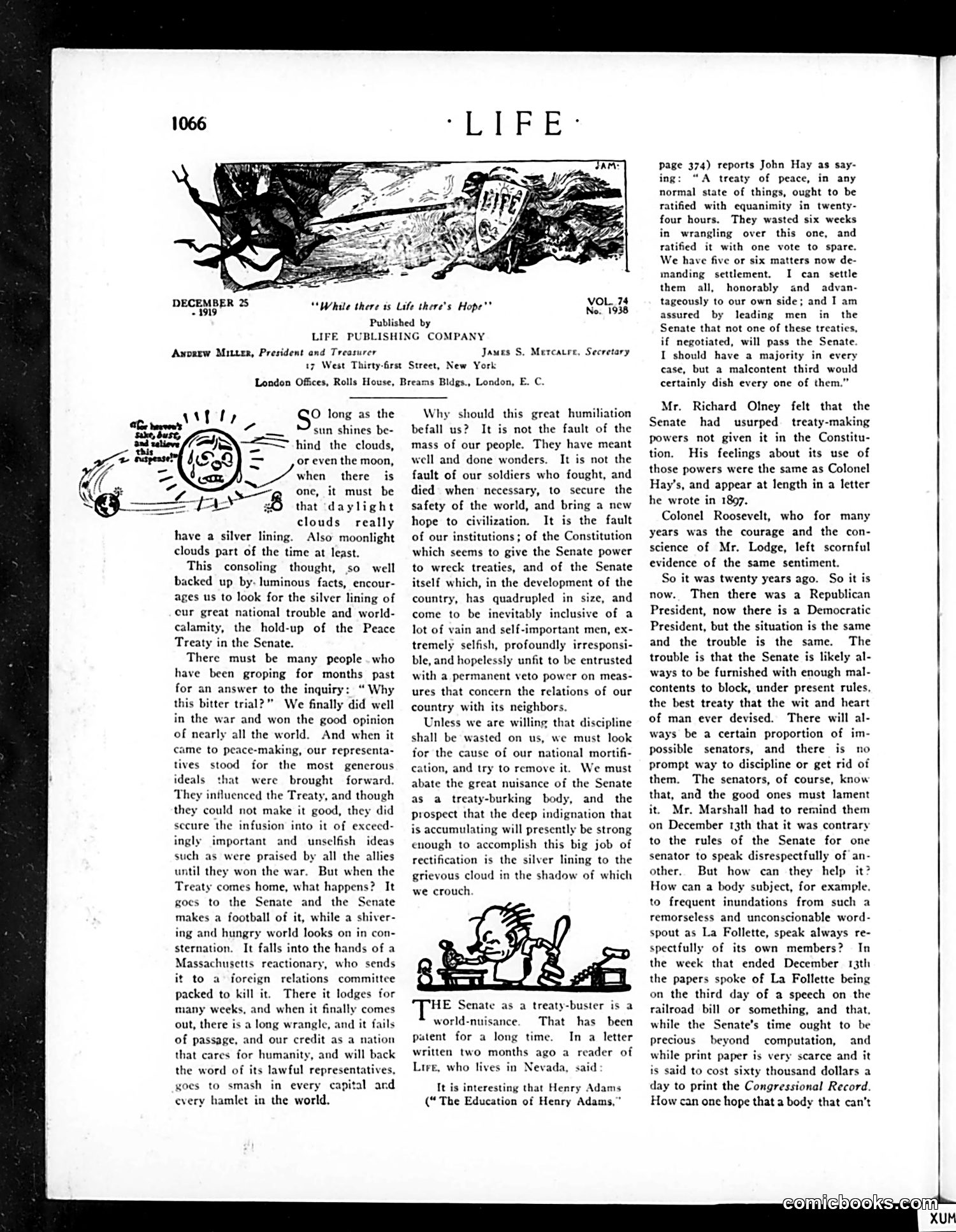
This page attacks the U.S. Senate's obstruction of the Treaty of Versailles following World War I. The editorial sardonically praises finding a "silver lining" to the national humiliation of the peace treaty's failure in the Senate. The cartoons depict the Sun (representing hope/optimism) and what appears to be a figure being crushed or defeated, visualizing America's diplomatic embarrassment. The text identifies a "Massachusetts reactionary" (likely Senator Henry Lodge) who chairs the Foreign Relations Committee and blocks treaty ratification. The author blames the Senate's constitutional veto power over treaties, arguing the institution has become filled with "vain and self-important men, extremely selfish, profoundly irresponsible." The piece advocates for reforming Senate treaty powers, calling the Senate a "world-nuisance" and "treaty-burking body." The rhetoric suggests urgent structural constitutional change is needed to prevent future diplomatic disasters. This reflects the intense post-WWI political debate over American isolationism versus international commitment.
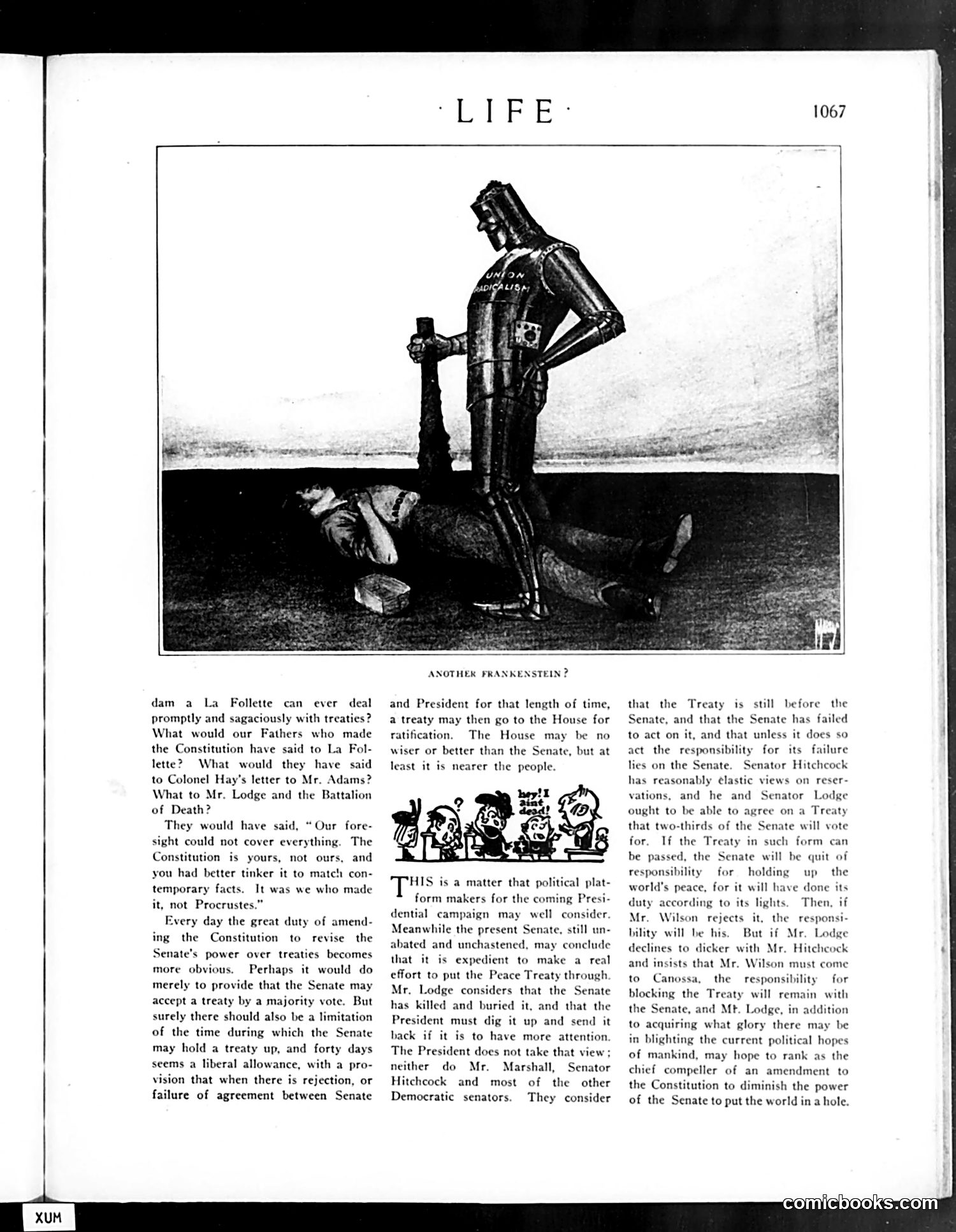
This Life magazine page satirizes the U.S. Senate's obstruction of the post-WWI Peace Treaty, likely the Treaty of Versailles around 1919-1920. **The Image:** Shows a grotesque, armor-clad figure (labeled "Another Frankenstein?") standing over a prone human, suggesting the Senate has created a monster that threatens civilization itself. **Key Figures Referenced:** - **Senator Henry Cabot Lodge**: Leading Republican opponent of the Treaty; the text criticizes his insistence that Wilson must capitulate ("come to Canossa") - **Senator Thomas Walsh (Hitchcock)**: Democratic supporter willing to compromise - **President Wilson**: Defending the Treaty - **La Follette**: Apparently referenced as an obstacle to rational treaty-making **The Satire's Point:** The Senate's power to block treaties has become destructive—a "Frankenstein" monster threatening world peace. The text proposes constitutional reform: limiting Senate treaty-blocking to 40 days, allowing House ratification as backup. Lodge is positioned as primarily responsible for keeping the world "in a hole" through partisan obstruction rather than compromise.
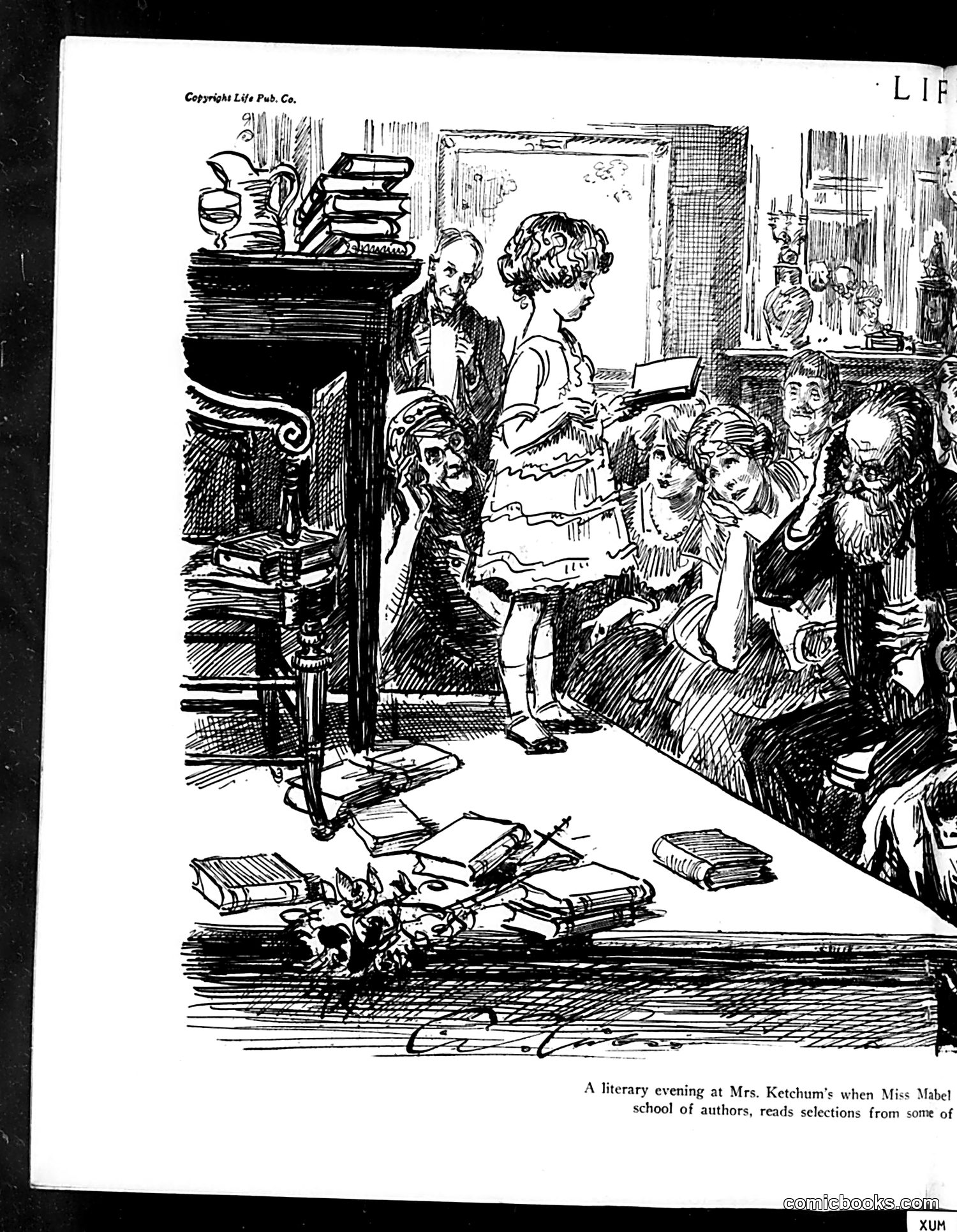
This is a satirical illustration of a pretentious literary salon. The caption indicates it depicts "a literary evening at Mrs. Ketchum's when Miss Mabel" (text cuts off) from a "school of authors" reads her work to an assembled audience. The satire appears to mock such gatherings: the gathered attendees display exaggerated, self-satisfied expressions while listening to the reading. Books are scattered on the floor, suggesting either careless intellectualism or that the literary quality doesn't warrant careful handling. The formal setting and dressed-up participants suggest aspirations to high culture, which the artist treats with gentle ridicule. The joke targets both the pretensions of amateur literary circles and, possibly, the vanity of those who attend them—a common early-20th-century *Life* magazine target of satire.
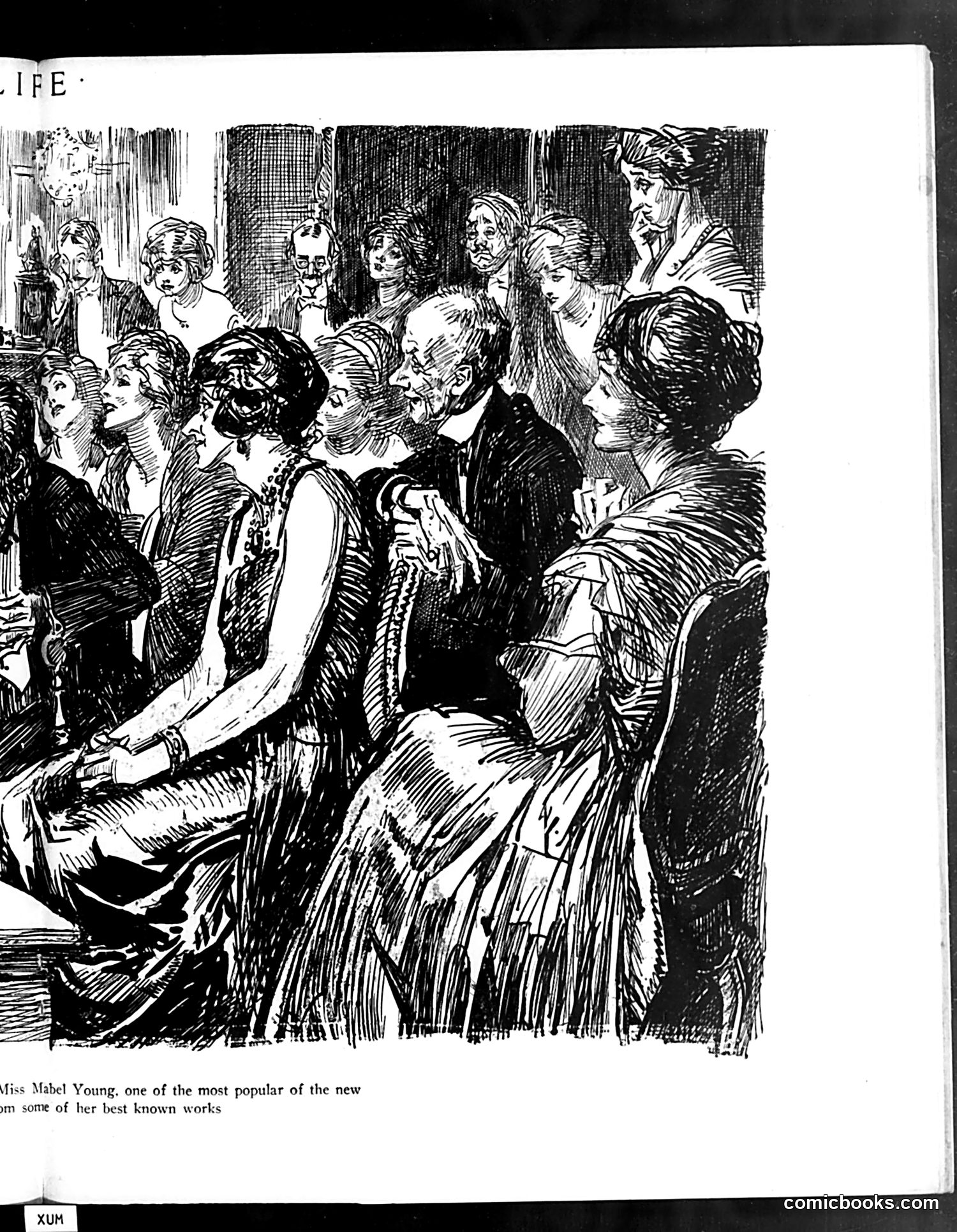
This page features an illustration of **Miss Mabel Young**, identified as "one of the most popular of the new" artists (the OCR text is fragmentary). The image depicts a crowded social gathering, likely from the early 20th century based on the clothing and hairstyles shown. The sketch shows numerous well-dressed figures at what appears to be a salon or society event, rendered in Life magazine's characteristic pen-and-ink style. Without complete caption text, the specific satirical point is unclear, but Life typically used such gatherings to comment on high society, artistic circles, or social pretension of the era. The reference to "her best known works" suggests Young was a notable illustrator or artist whose work Life's readers would recognize.
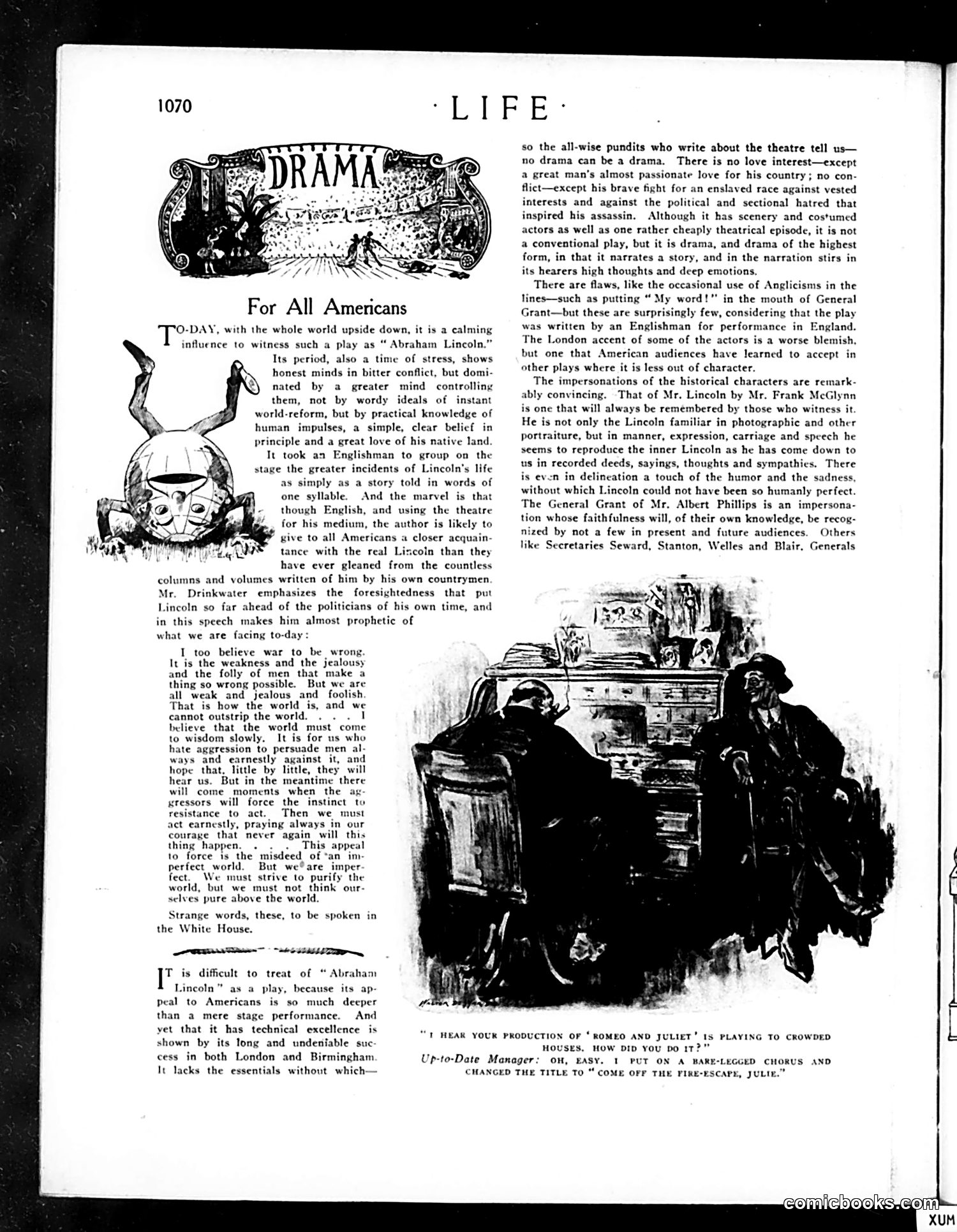
This page reviews a stage play called "Abraham Lincoln," likely John Drinkwater's 1919 production. The article praises the English-written drama for giving Americans genuine insight into Lincoln's character and wisdom—particularly his foresight about war and aggression, quoted extensively here. The critique notes an irony: an Englishman created the most authentic Lincoln portrayal for American audiences, despite minor flaws like occasional British expressions and accents. The reviewer emphasizes that the play succeeds not through conventional romance or conflict, but through its philosophical depth and historical accuracy. The illustration shows what appears to be a theatrical scene, likely depicting Lincoln or a pivotal historical moment from the production. The piece argues that this "drama of the highest form" offers Americans valuable lessons during their own turbulent era—positioning Lincoln's restraint and moral wisdom as timely guidance.
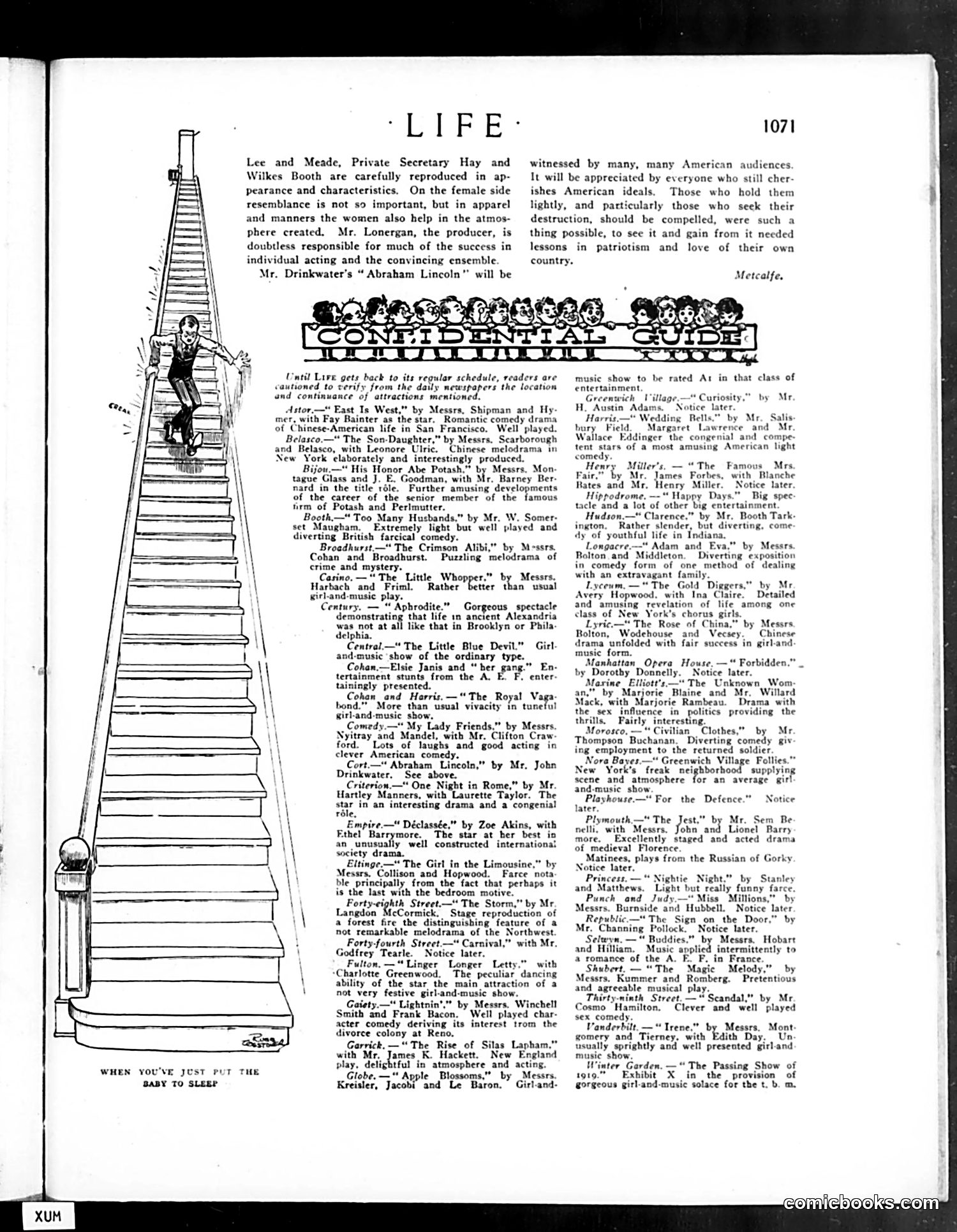
This cartoon depicts a figure climbing a tall staircase while carefully tiptoeing—illustrating the common domestic scenario of a parent trying to quietly leave a child's bedroom without waking them. The humor lies in the relatable tension: the precarious, exaggerated climb suggests the anxiety of this everyday task, where even slight noise risks failure. The accompanying theater reviews are unrelated to the cartoon. They discuss productions including a notable staging of *Abraham Lincoln* by John Drinkwater, praised for promoting "patriotism and love of their own country"—particularly resonant given the recent end of World War I (the text mentions "A.E.F. entertainment," referring to the American Expeditionary Forces). The reviews reflect post-war American theater offerings across various genres.
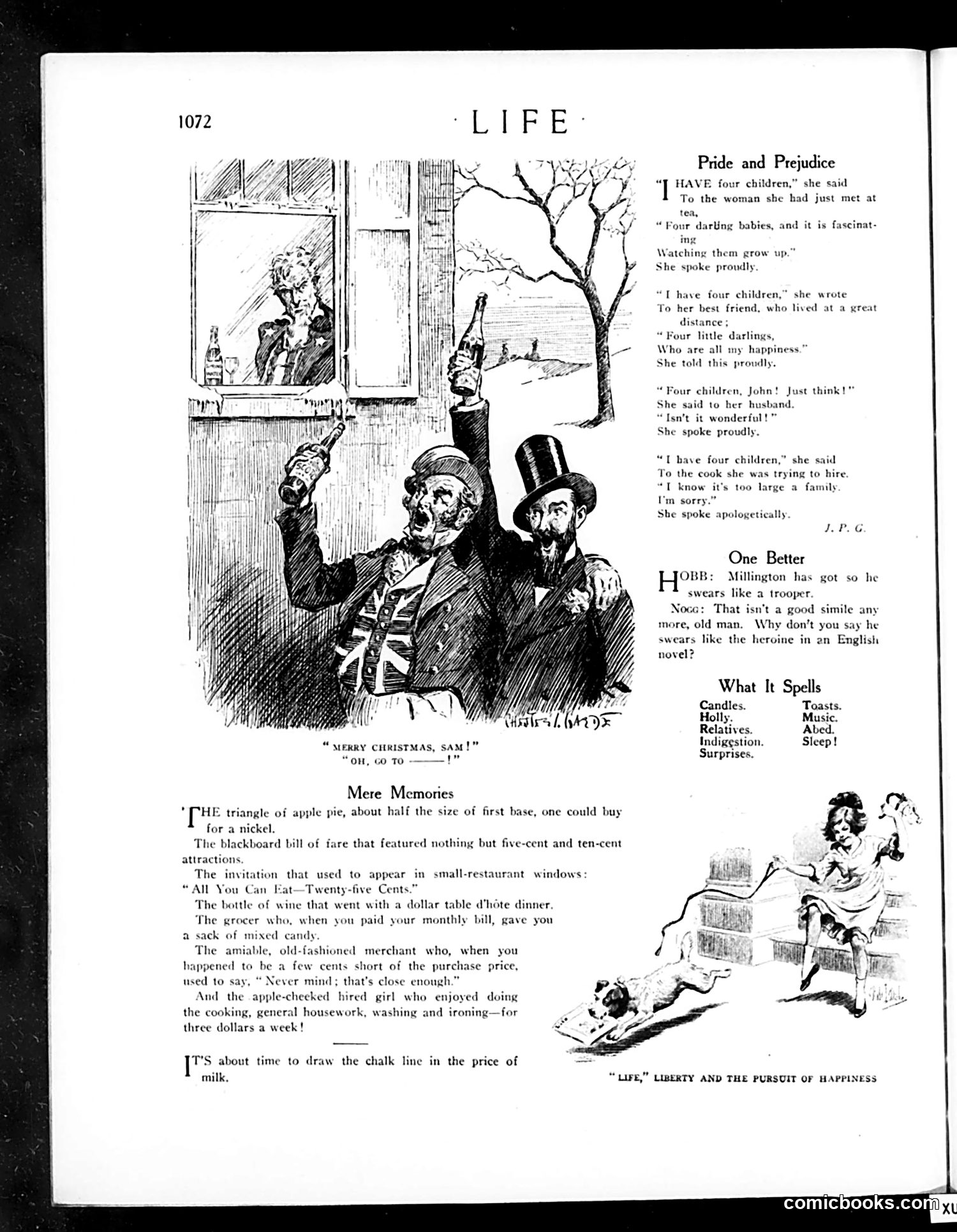
This page contains three satirical pieces typical of early 20th-century American humor: **"Pride and Prejudice"** mocks social hypocrisy through a woman's inconsistent descriptions of her four children—boasting to strangers and her husband, but apologizing to a potential hired cook, revealing she values others' opinions over honesty. **"One Better"** is a brief joke critiquing English literature: someone suggests that comparing a man's swearing to a "trooper" is outdated; instead, he swears "like the heroine in an English novel"—implying that female characters in contemporary English novels were depicted as profane or crude. **"Mere Memories"** nostalgically catalogs vanished economic practices and affordances: five-cent apple pie, cheap restaurant meals, merchants extending credit, and domestic servants earning minimal wages. The final line about milk prices suggests inflation concerns. The bottom cartoon illustrates "Liberty and the Pursuit of Happiness" through children's play, likely contrasting innocent joy with the commercial/social anxieties discussed above.
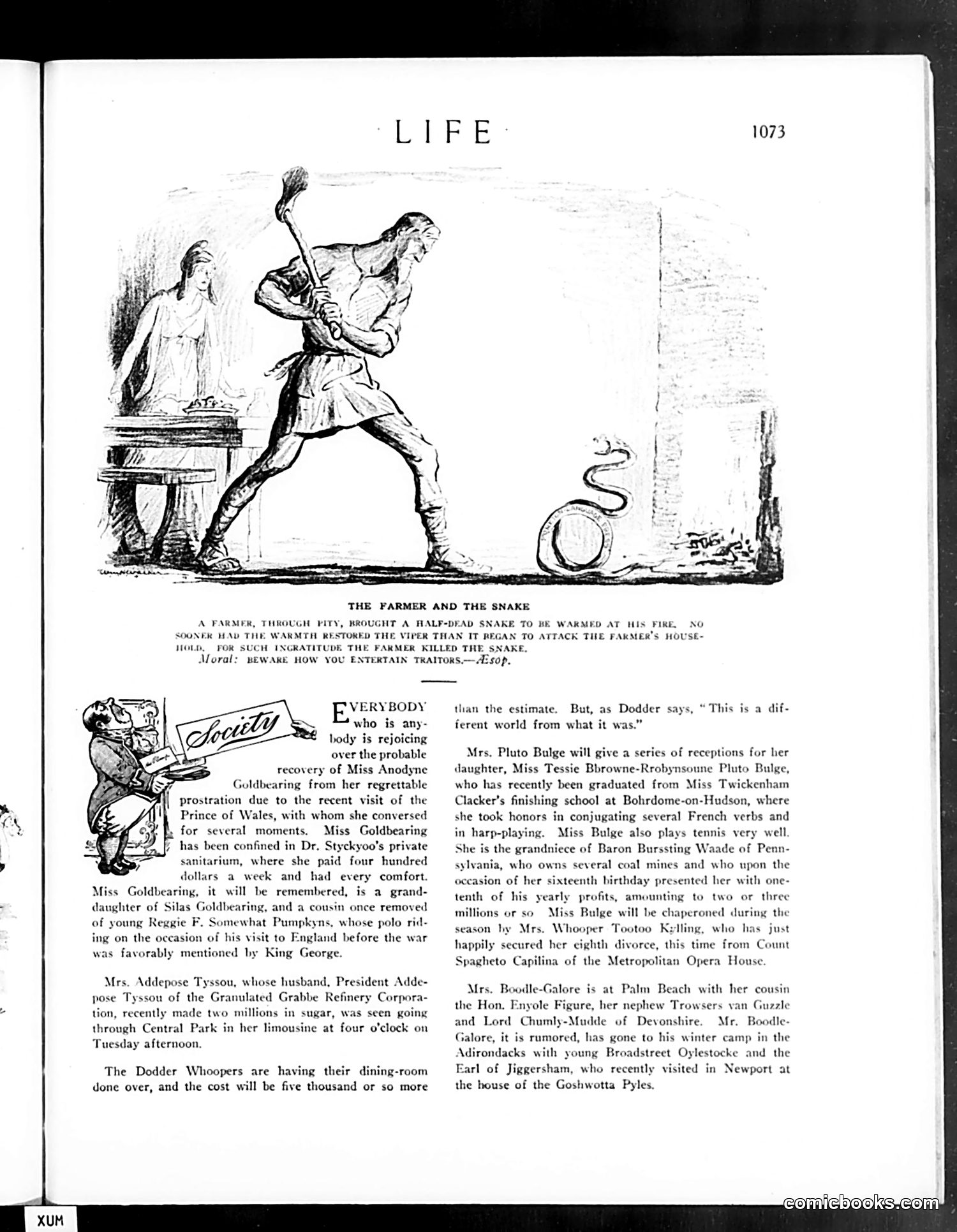
**The Main Cartoon:** "The Farmer and the Snake" illustrates Aesop's fable—a farmer warms a frozen snake by his fire, and once revived, the snake attacks him. The moral warns against entertaining "traitors," likely a political allegory about showing mercy to enemies who will inevitably betray you. The specific historical reference is unclear without dating context. **The Society Column:** The bulk of the page mocks wealthy American high society through absurdist satire. The names are obvious parodies—"Goldbearing," "Addepose Tyssou," "Dodder Whoopers"—ridiculing the nouveau riche and their ostentatious displays. References to polo, finishing schools, coal mines, and "eight divorces" exaggerate upper-class excess and frivolity. The satire suggests these people are morally hollow, their accomplishments trivial, their wealth obscene.
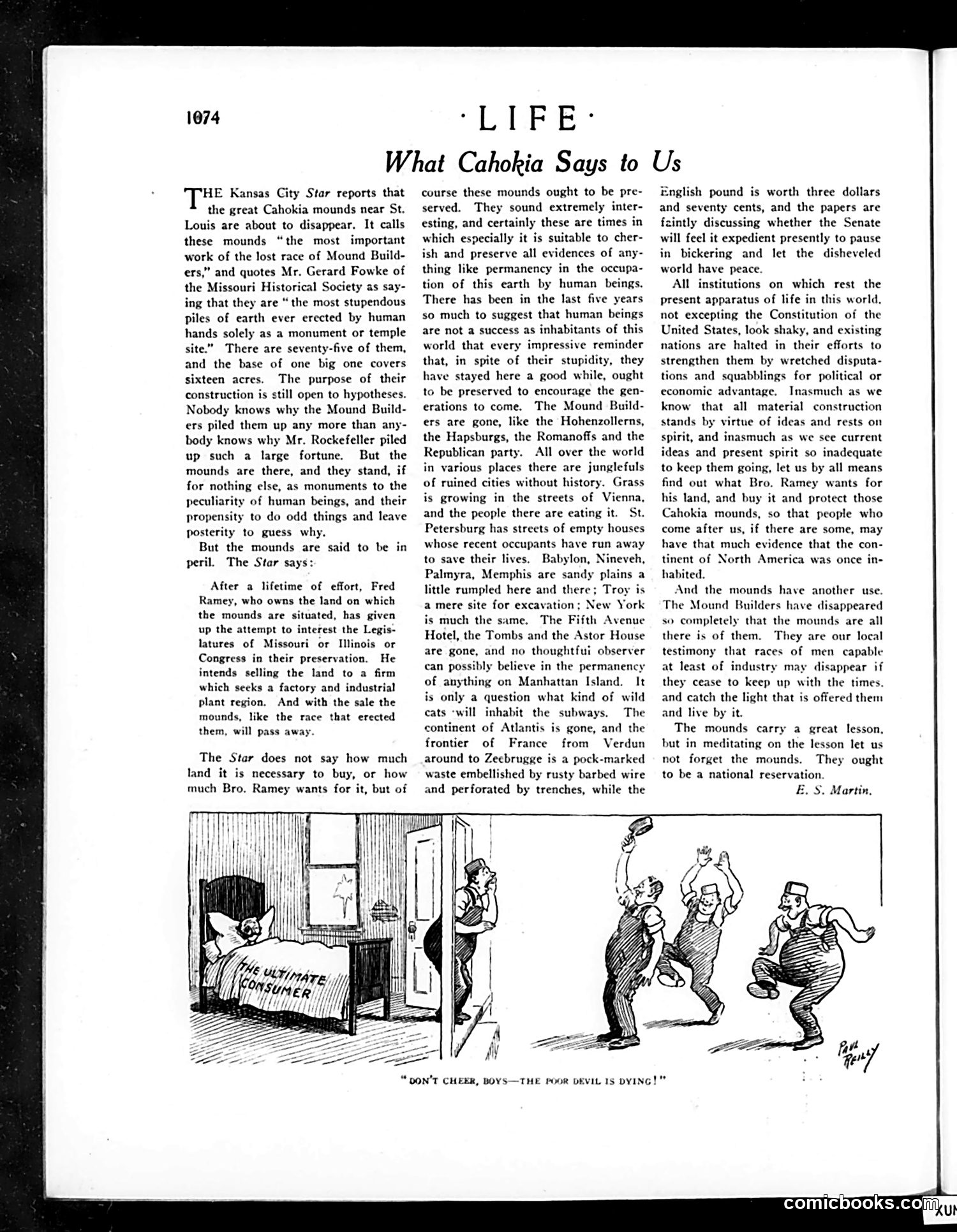
This page from Life magazine discusses the impending destruction of the Cahokia Mounds near St. Louis—ancient earthworks built by pre-Columbian peoples. The article argues these monuments should be preserved as historical testimony to human permanence. The satire is **post-World War I disillusionment**. The author sardonically catalogs civilization's collapse: Vienna's starving population, Petersburg's abandoned streets, destroyed French borders (Verdun to Zeebrugge), economic instability (British pound devaluation), and political gridlock. By comparing vanished empires (Babylon, Atlantis, Troy) to modern ruin, the piece suggests contemporary civilization is equally doomed. The implicit target: **American prosperity and complacency**. The Mounds become symbols of lost civilizations, mocking the belief that modern achievement is permanent. The veiled reference to "the Republican party" alongside fallen empires adds political critique. The cartoon (bottom) shows "The Ultimate Consumer" dying in bed while figures outside celebrate—darkly suggesting capitalism itself is expiring.
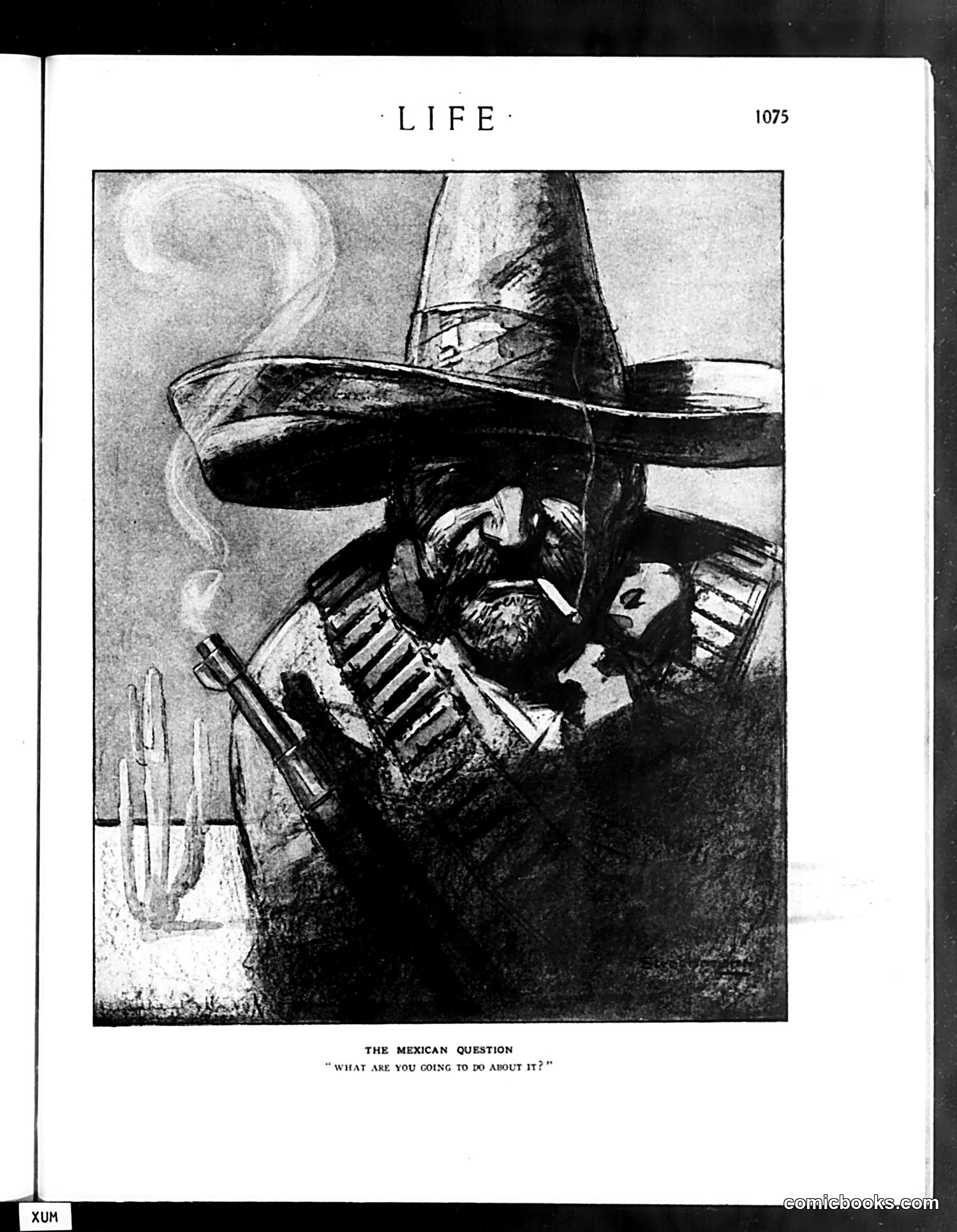
This **Life magazine** cartoon titled "The Mexican Question" depicts a heavily armed Mexican revolutionary or bandit figure—identifiable by the wide sombrero, cartridge belts, and rifle—confronting the viewer with the challenging question "What are you going to do about it?" The satire likely addresses American foreign policy concerns regarding Mexico, probably referencing revolutionary turmoil or border tensions from the early 20th century (the Mexican Revolution era, roughly 1910-1920). The cartoon presents Mexico as a threatening, armed challenge to American interests or stability. The artistic style uses caricature to emphasize the militaristic menace. The satirical point appears to be mocking American indecision or hesitation in responding to Mexican instability—posing the uncomfortable question back to American policymakers about their actual plans or resolve.
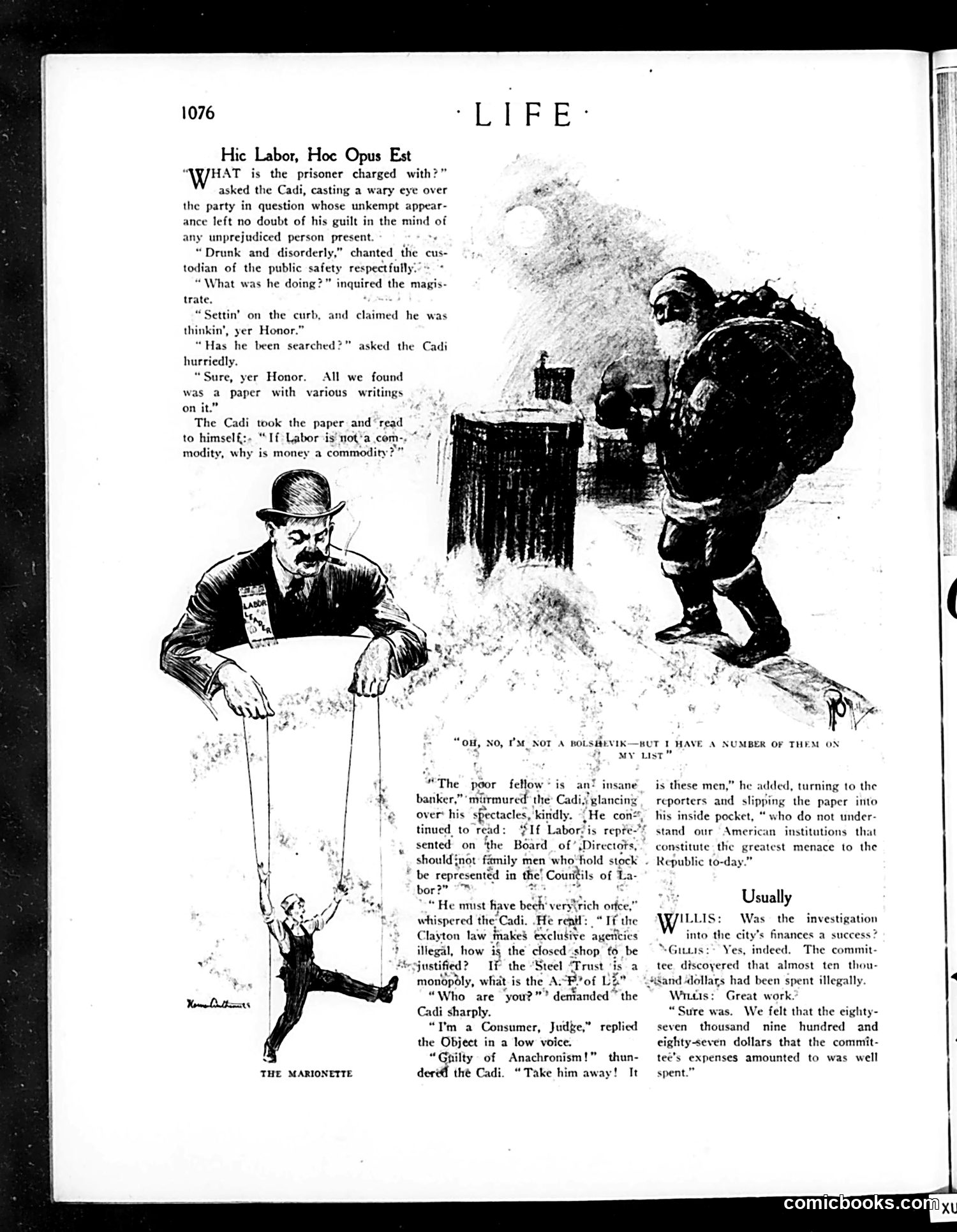
This page satirizes labor radicals and anti-capitalist thought circa the 1920s. A disheveled man is arrested for "drunk and disorderly conduct," but a judge discovers he was merely *thinking about labor philosophy*—specifically questioning whether labor deserves board representation if capital stockholders do. The cartoon's title, "The Marionette," shows the man as a puppet controlled by unseen forces. The judge dismisses him as "guilty of anachronism"—a person with outdated radical ideas—while the accompanying dialogue mocks a government investigation that spent $87,987 investigating $10,000 in illegal spending, celebrating this as "great work." The satire targets both labor activists (portrayed as dangerous subversives) and government inefficiency/corruption. The reference to "Bolshevik" reflects post-WWI American anxieties about communist infiltration. The cartoon presents radical thought itself as criminally absurd rather than engaging with its actual arguments.
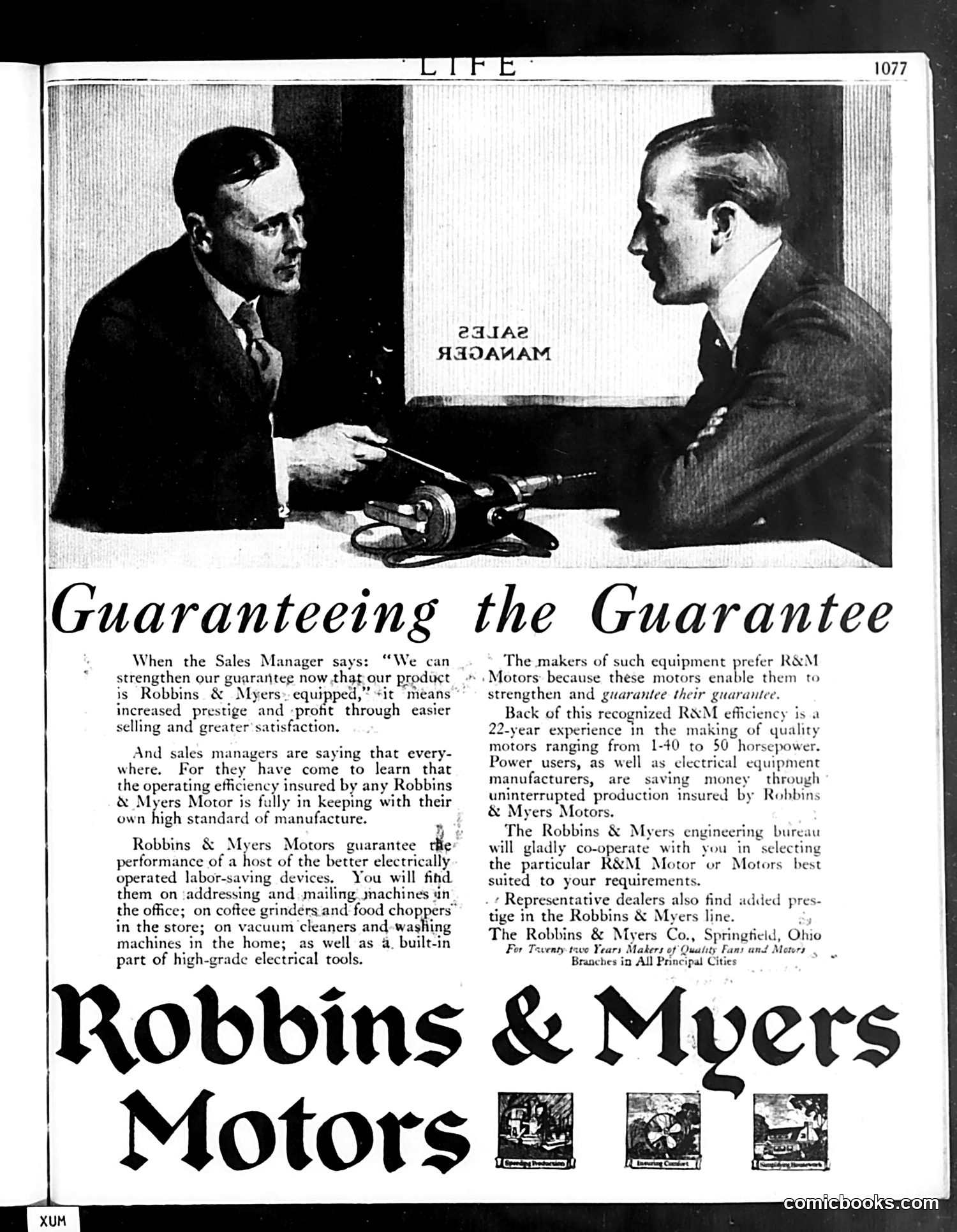
This page is **entirely an advertisement**, not satire or a political cartoon. It's a Robbins & Myers Motors company advertisement from *Life* magazine (page 1077). The image shows two businessmen in conversation, examining what appears to be a motor or mechanical device—a visual representation of a sales pitch. The headline "Guaranteeing the Guarantee" plays on a business concept: that Robbins & Myers motors are so reliable that equipment manufacturers can confidently guarantee their own products because they're using R&M motors inside. The ad emphasizes the motors' 22-year track record and their use in common household and office devices (coffee grinders, washing machines, vacuum cleaners, addressing machines). The pitch targets both manufacturers and retailers, suggesting that using R&M motors enhances a company's reputation and profit margins. There is no political commentary or satire here—it's straightforward industrial advertising from the early 20th century.
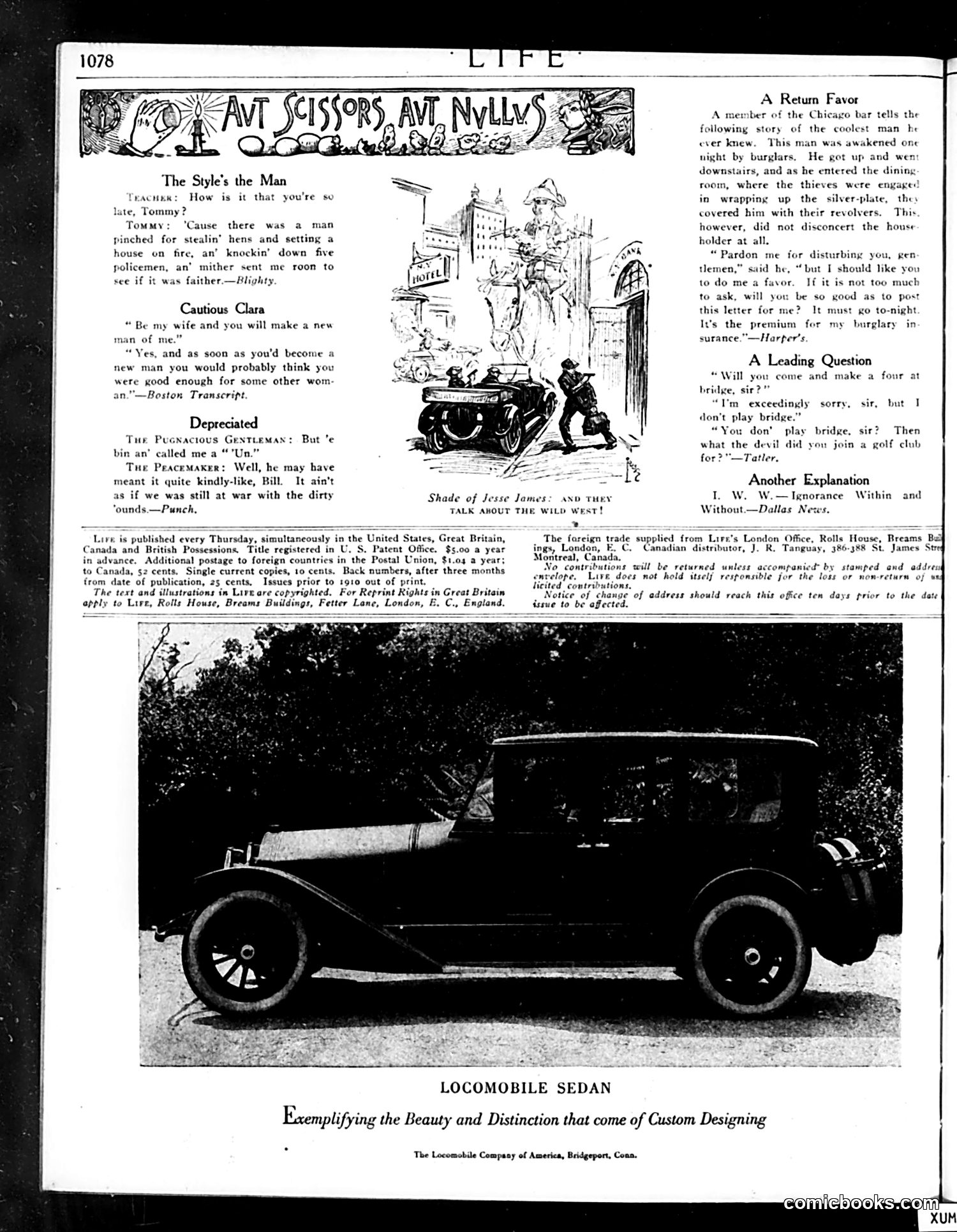
This page contains four brief satirical jokes typical of *Life* magazine's humor section, plus an advertisement. **"The Style's the Man"**: A Irish or working-class character (Tommy) explains his father's late arrival by listing serious crimes—theft, arson, assault on police—then reveals he was checking if the culprit was his father. The joke is on class stereotypes and paternal expectation. **"Cautious Clara"**: A woman rejects a suitor's promise to "become a new man," sardonically noting that once improved, he'd leave her for someone else. It's commentary on male infidelity and women's skepticism of reform promises. **"Depreciated"**: Two working-class men discuss being called "Hun" during wartime. One diplomatizes it as "kindly-like," suggesting post-WWI tension and reconciliation efforts. **"Shade of Jesse James"**: Unclear without seeing the full cartoon, but likely references the famous outlaw in an exaggerated modern crime scenario. The page also includes brief anecdotes and a Locomobile automobile advertisement. The overall tone reflects early 20th-century class-conscious, Anglo-American humor.
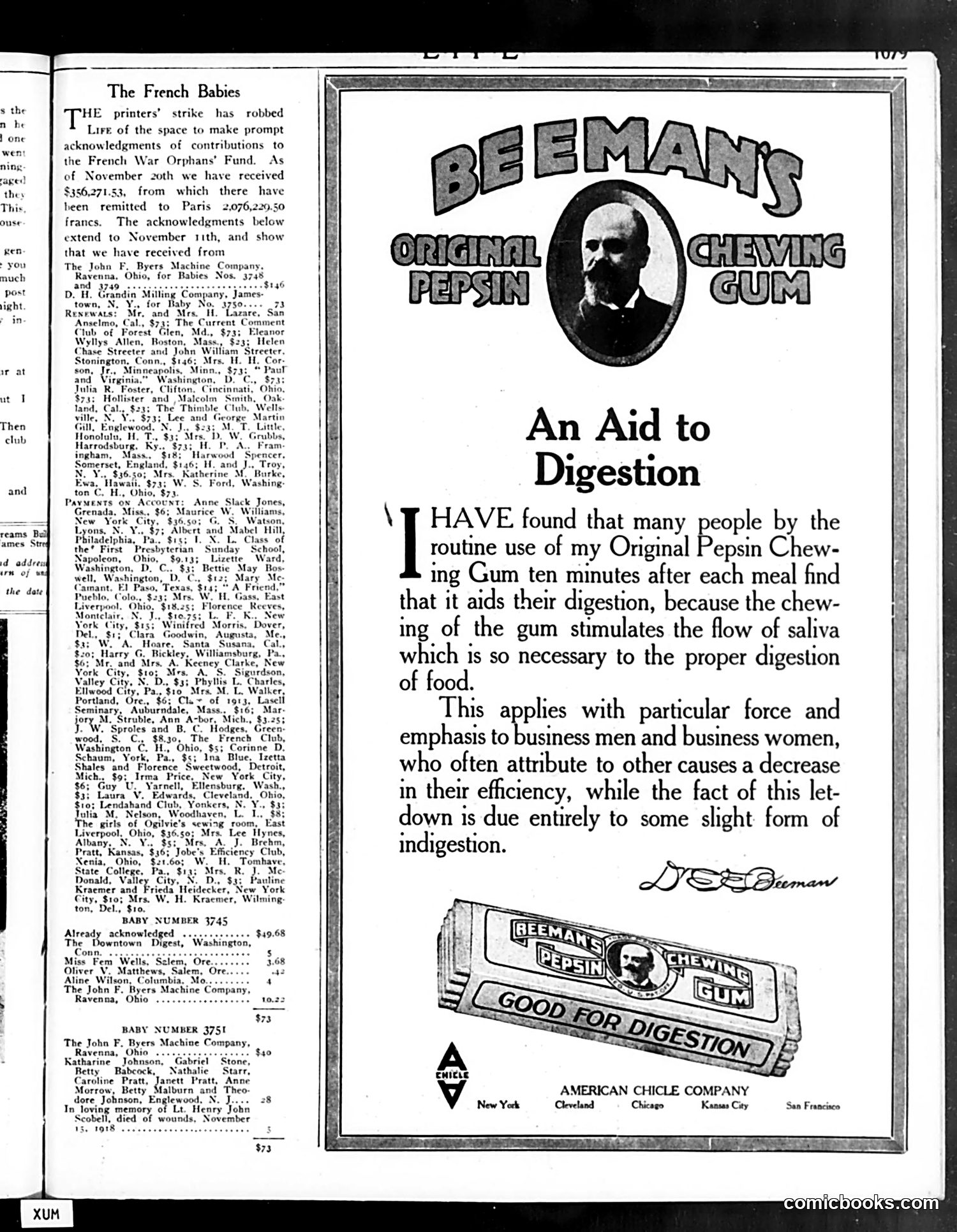
This page contains **no political cartoon or satire**. It's primarily a **charitable fundraising notice** alongside a **commercial advertisement**. The left column lists donations to the **French War Orphans' Fund** (a WWI relief effort), acknowledging contributions from individuals and organizations across America. The right side is a **vintage advertisement** for **Beeman's Pepsin Chewing Gum**, featuring a photograph of the product's namesake (likely the founder). The ad makes a health claim now considered dubious: that chewing gum after meals aids digestion by stimulating saliva flow. It specifically targets businesspeople, attributing workplace fatigue to undiagnosed indigestion rather than overwork—a humorous marketing angle by modern standards. The juxtaposition is coincidental: Life magazine mixed charitable announcements with paid advertisements to fund operations, particularly during the 1918 printers' strike mentioned in the text.
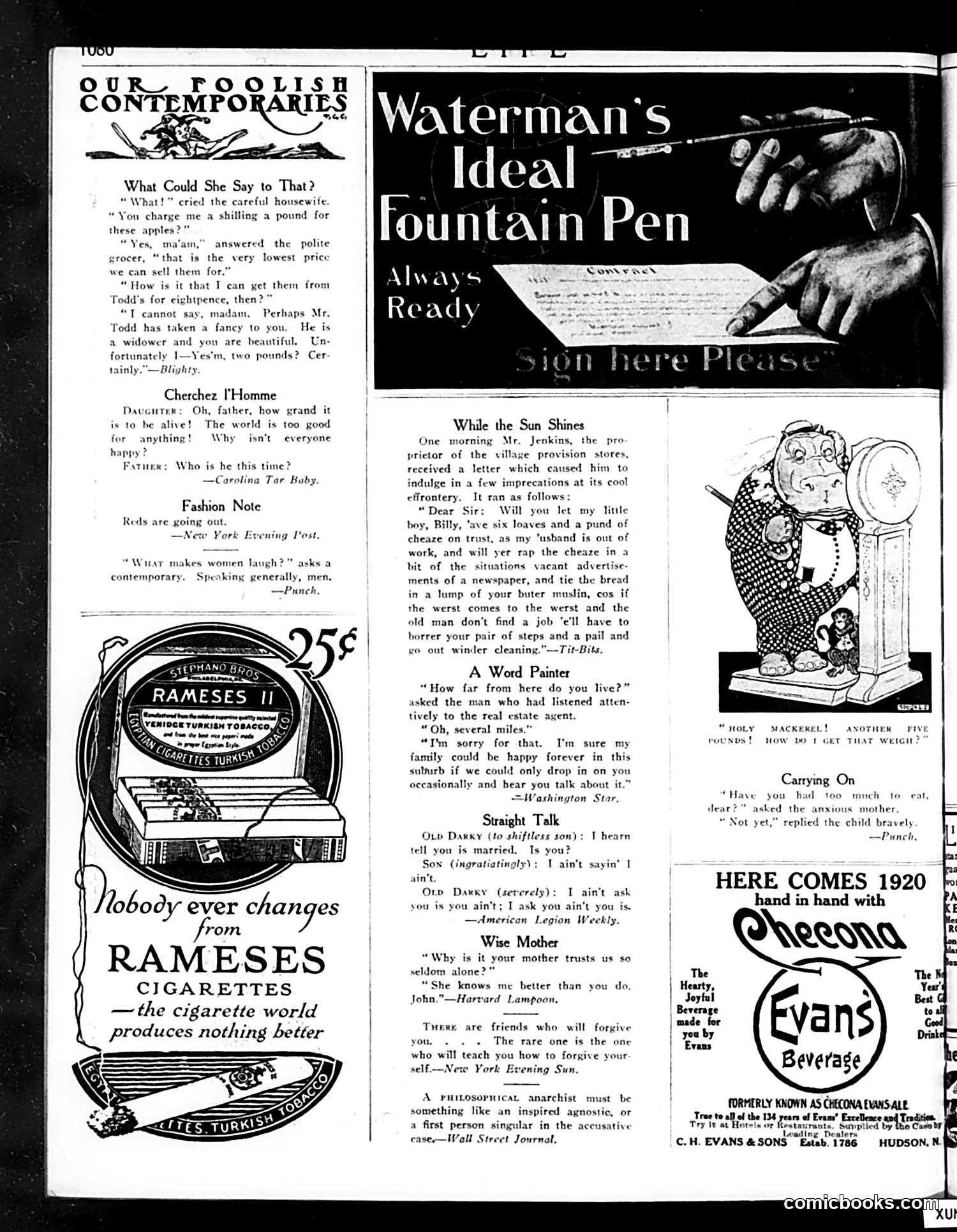
This page is primarily **advertising and humor columns**, typical of Life's satirical format. The cartoons and jokes mock everyday situations with British/American class and gender humor: **"What Could She Say to That?"** — A grocer outmaneuvers a haggling housewife by suggesting her beauty has charmed a widower competitor into lower prices, implying she'd be flattered rather than insulted. The satire targets both female vanity and working-class negotiating. **"Cherchez l'Homme"** — A father assumes his daughter's happiness must involve a romantic interest, mocking both female emotionalism and paternal cynicism. **"While the Sun Shines"** — Working-class humor: an unemployed man's wife requests credit and asks the grocer to wrap cheese in job advertisements and bread in muslin—dark comedy about Depression-era poverty and desperation. **"Straight Talk"** — Dialect humor featuring African American characters with intentionally fractured grammar, reflecting the period's casual racism. The advertisements (Waterman pens, Rameses cigarettes, Checona Evans ale) represent typical 1920s products. The overall tone is lighthearted social observation masking class and racial stereotypes common to the era.
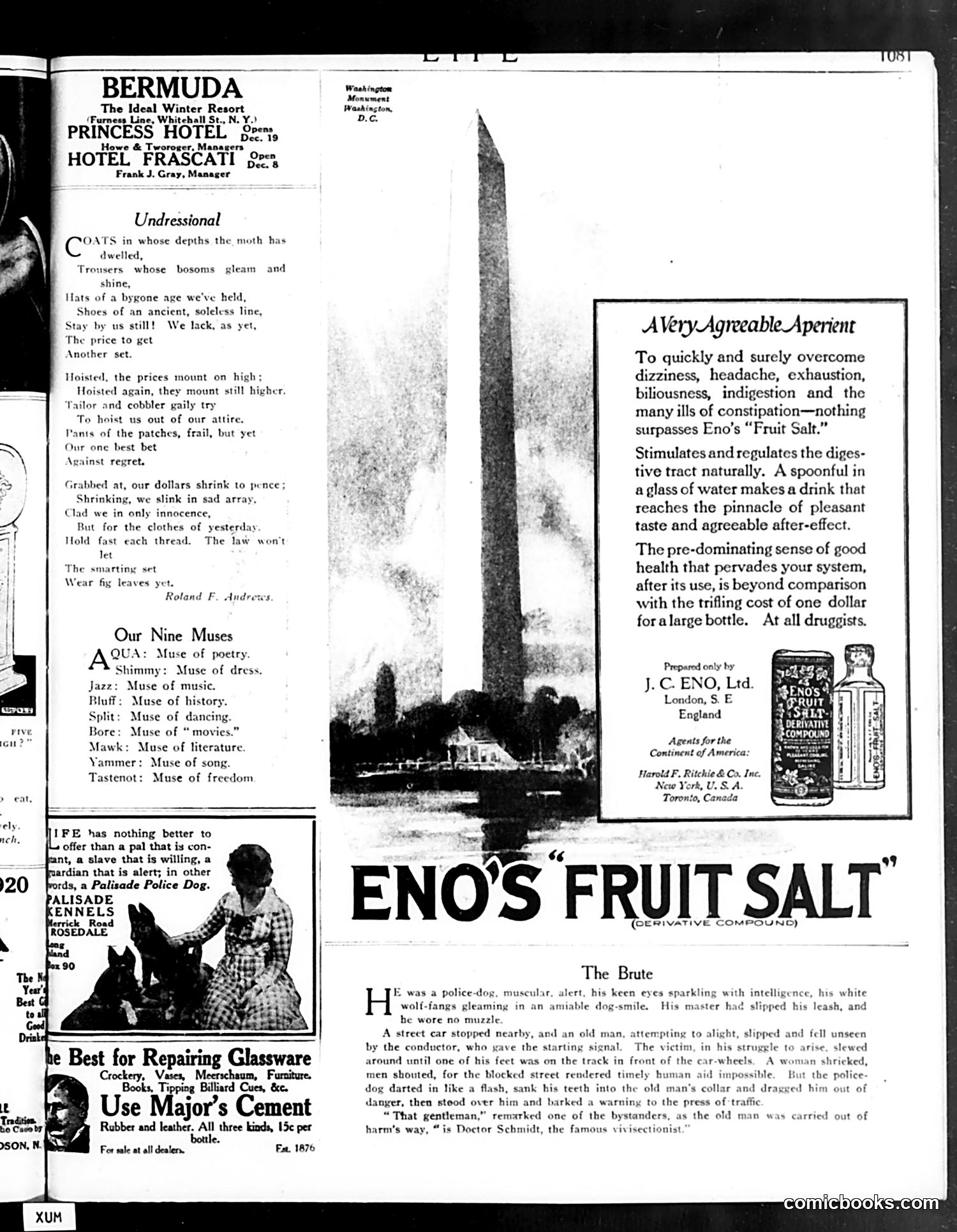
This page mixes poetry, advertisements, and a satirical short story. **"Undressional"** (by Roland F. Andrews) is a humorous poem about poverty during economic hardship—people clinging to threadbare, patched clothes because they cannot afford new ones. The satire targets both the poor's desperation and society's judgment ("if we in only innocence / But for the clothes of yesterday"). **"Our Nine Muses"** is a witty list equating modern cultural trends (jazz, shimmy dancing, movies) with classical artistic muses, mocking contemporary popular culture as shallow. **"The Brute"** is darkly ironic satire. A police dog heroically saves an accident victim from a streetcar—but the punchline reveals the victim is "Doctor Schmidt, the famous vivisectionist" (animal experimenter). The joke: the dog saved the life of someone who tortures animals like itself, inverting expected moral clarity and satirizing vivisectionists' hypocrisy. The page is otherwise filled with hotel advertisements and patent medicine promotions typical of the era.
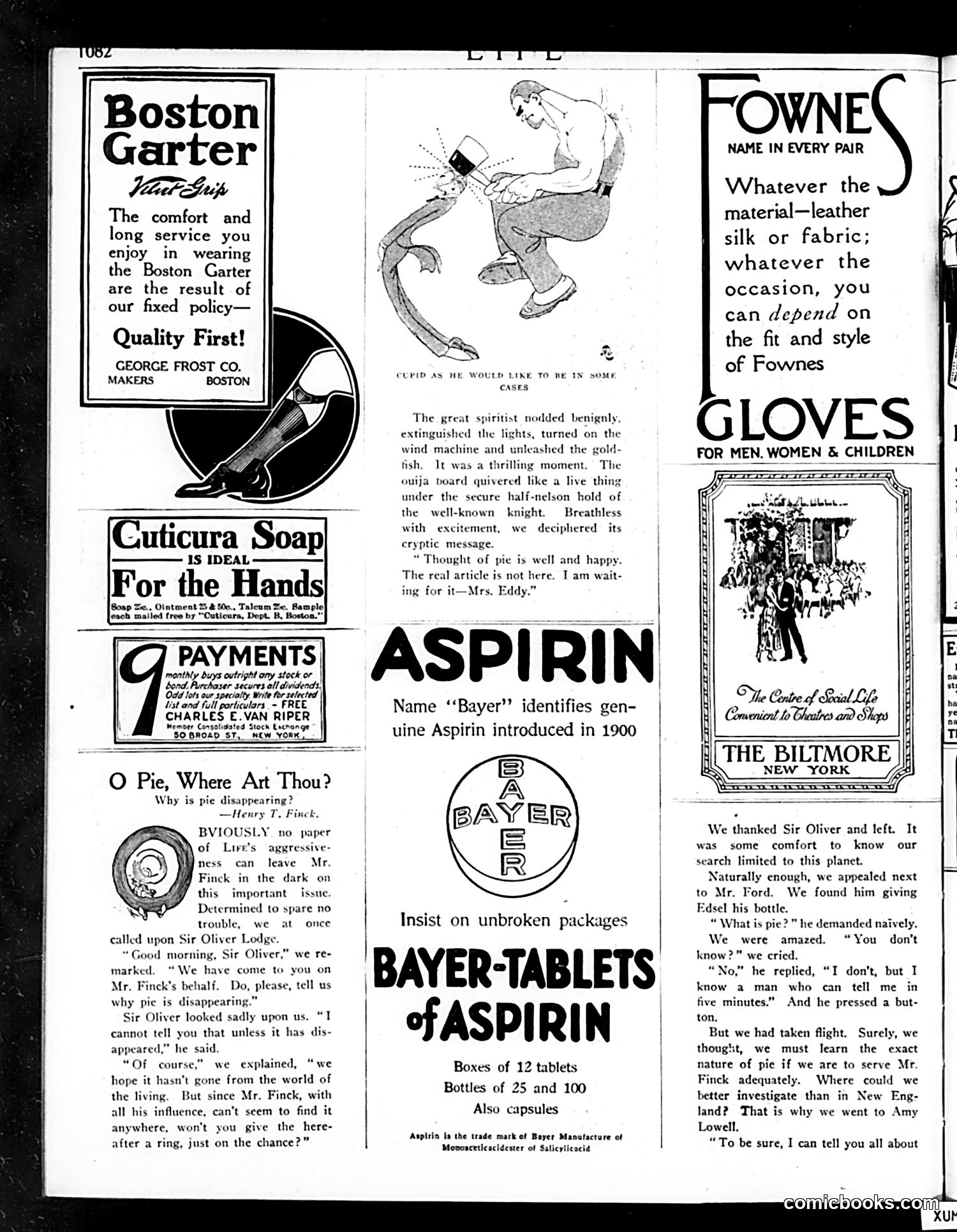
This Life magazine piece humorously investigates the disappearance of pie from American life. The writer consults three contemporary figures: **Sir Oliver Lodge**, a famous British spiritualist and physicist, who comically insists he cannot answer unless pie has actually vanished—a deadpan logical joke. **Henry Ford**, depicted as so disconnected from ordinary life that he doesn't even know what pie is, then absurdly claims he knows "a man" who can explain it in five minutes—mocking Ford's obsession with efficiency and delegation. **Amy Lowell**, a Boston poet and literary figure, presumably approached as someone who might understand pie's cultural/artistic significance. The satire targets American modernity: spiritualism's pretensions, Ford's industrial dehumanization, and intellectual elitism. The ouija board's cryptic response ("thought of pie is well and happy... I am waiting for it—Mrs. Eddy") mocks both spiritualism and Christian Science founder Mary Baker Eddy. The joke: pie's "disappearance" reflects changing American society, yet nobody in positions of influence seems to notice or care.
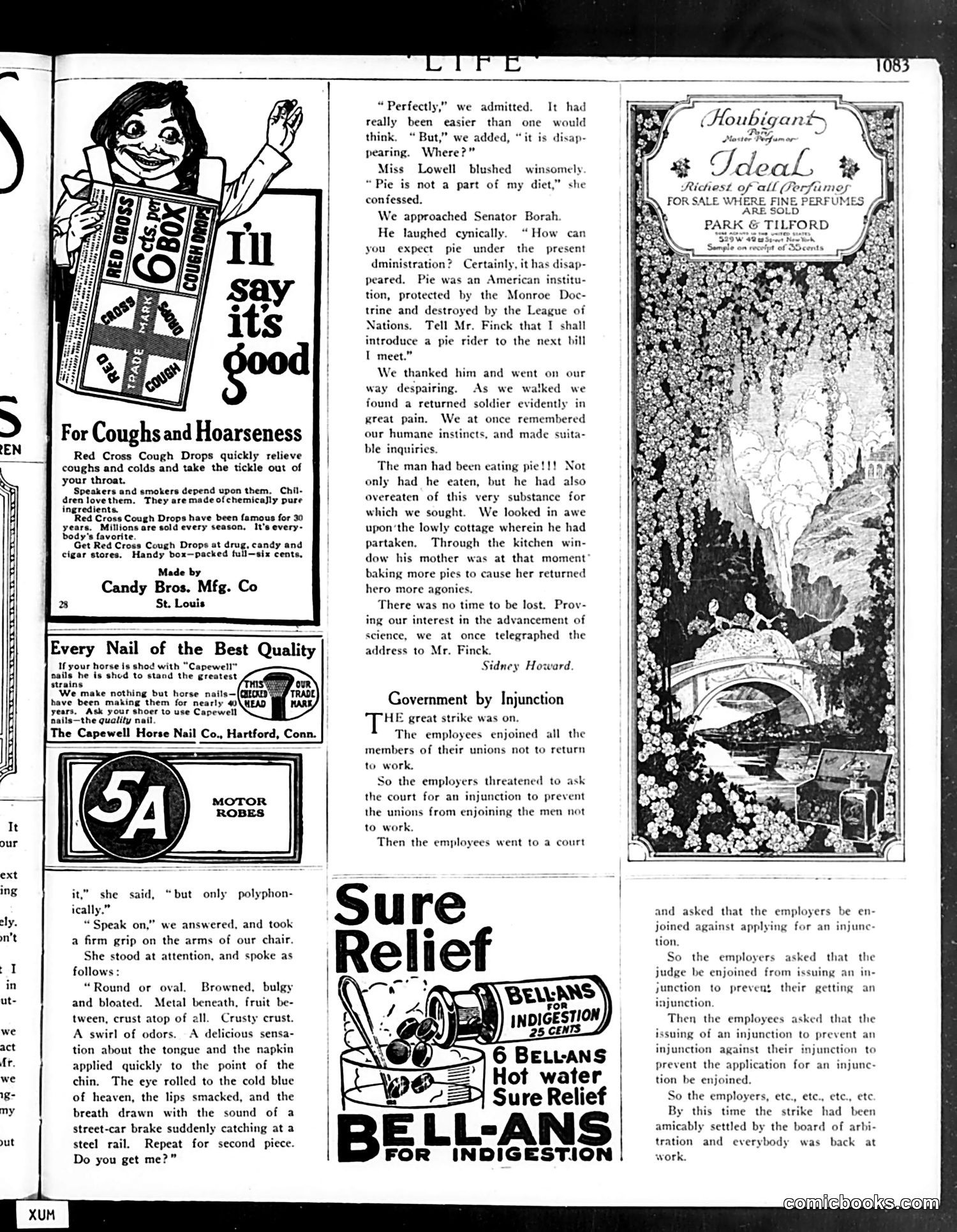
This page satirizes early 20th-century American politics and labor disputes through two main pieces: **"Government by Injunction"** mocks the legal absurdity of labor strikes. The narrative describes an escalating cycle where employers and unions file competing injunctions against each other—each side seeking court orders to prevent the other's court orders. The satire highlights how the legal system became weaponized in labor disputes, with endless procedural maneuvers replacing actual resolution. The joke's punchline is that by the time all the injunctions are filed, the strike settles anyway through arbitration, making the entire legal circus pointless. The piece references Senator Borah, a real political figure, in an earlier section about disappearing pie, likely an oblique reference to economic hardship or nostalgia for pre-war American life. The page is otherwise filled with period advertisements (cough drops, horse nails, perfume), typical of Life's advertising-heavy format. The humor relies on readers' familiarity with contemporary labor disputes and court proceedings.
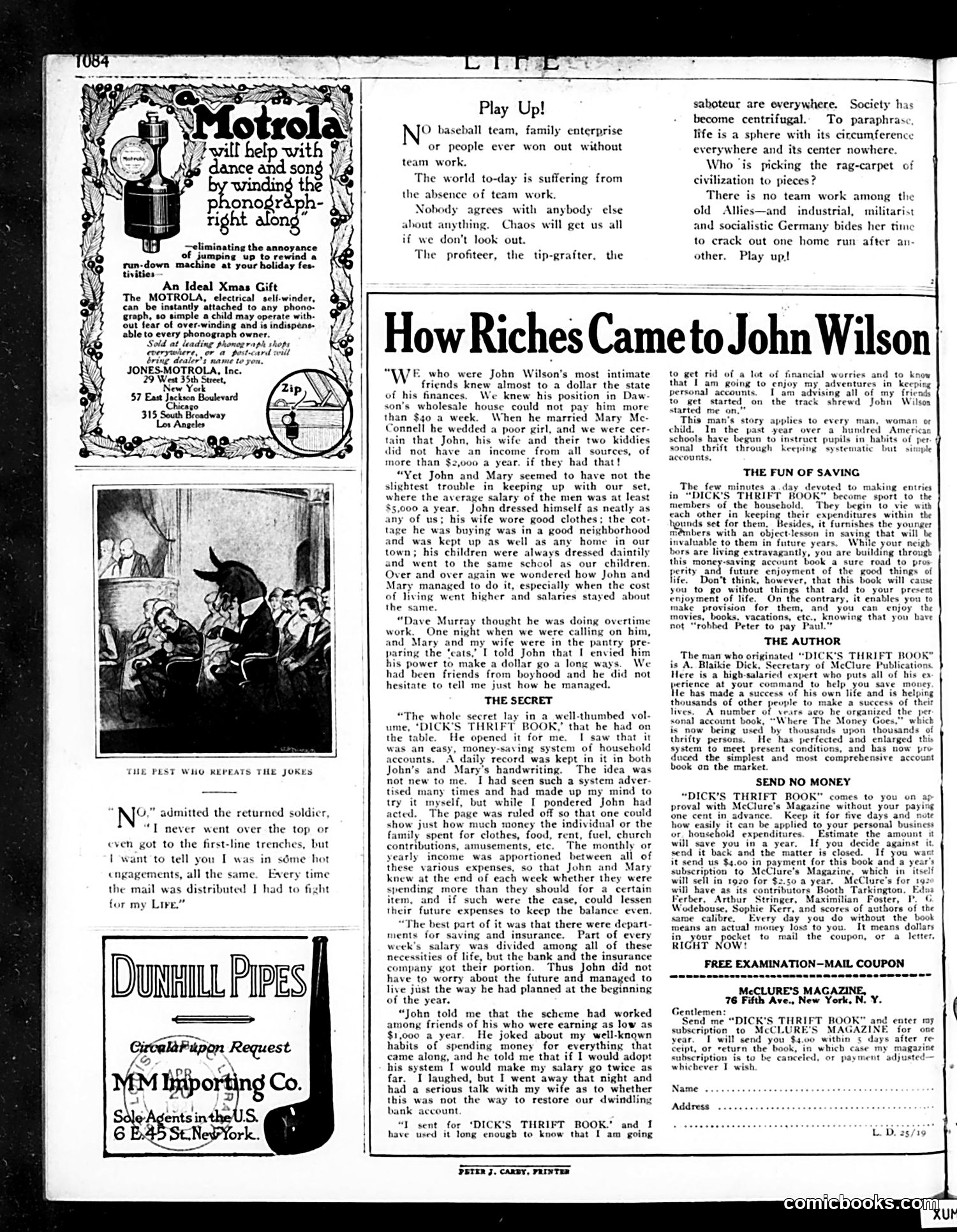
This Life magazine page contains two distinct items: **"Play Up!" Editorial**: A brief article urging post-WWI social unity and teamwork. It warns that profiteers, grafters, and saboteurs are fragmenting society, and references Germany's threat ("crack out one home run after another"), suggesting anxiety about postwar instability. **"How Riches Came to John Wilson"**: A feature story promoting *Dick's Thrift Book*, a household budget ledger. The narrative presents Wilson as a mystery—a modestly-paid wholesale worker who mysteriously keeps pace with wealthier friends. The "secret" is revealed: systematic financial record-keeping using the advertised budget book, which allows careful allocation of income across categories (food, rent, clothing, etc.). The story functions as thinly-veiled advertising, positioning the product as the path to financial respectability and middle-class status. Both pieces reflect post-WWI American concerns: social cohesion and individual economic security through systematic discipline.
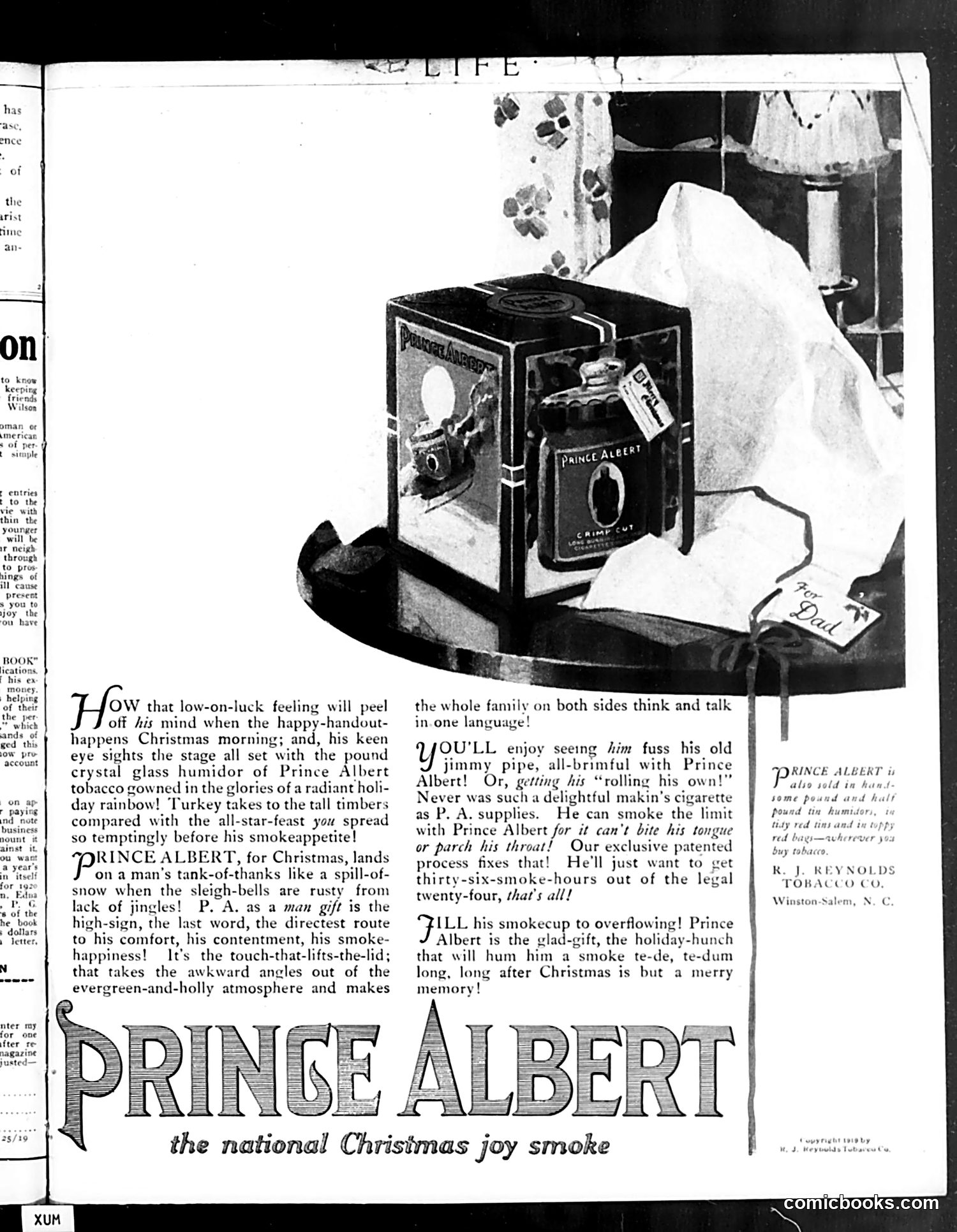
This is a full-page advertisement, not political satire. It promotes Prince Albert pipe tobacco as a Christmas gift for men. The ad uses sentimental holiday framing—depicting wrapped tobacco packages under what appears to be a Christmas tree—to market smoking as the ideal masculine gift. The copywriting employs exaggerated, flowery language ("tank-of-thanks," "smoke-happiness") typical of 1920s advertising, promising that gifting Prince Albert will create family joy and contentment. The ad emphasizes the product's appeal through appeals to male pride: watching him smoke his pipe, the gift's directness and comfort, even the "patented process" that prevents tongue-bite or throat-parch. The closing tagline calls it "the national Christmas joy smoke." This reflects the era when tobacco advertising was unrestricted and smoking was widely marketed as wholesome, masculine, and family-friendly—a stark contrast to modern health awareness.
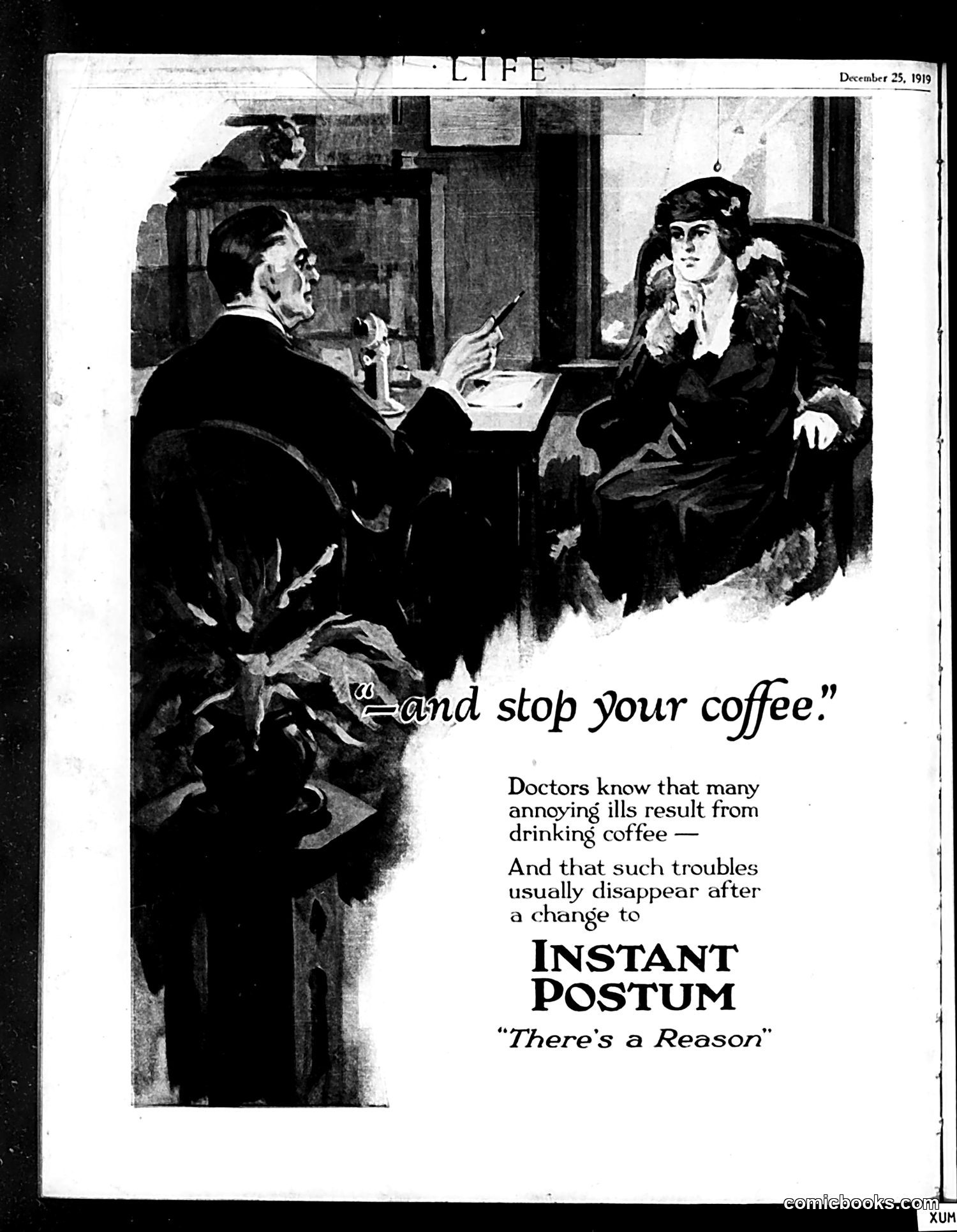
This is an advertisement for Instant Postum, a caffeine-free coffee substitute popular in the early 20th century. The image shows a doctor advising a patient to stop drinking coffee, suggesting that coffee causes "annoying ills." The ad claims these health problems disappear after switching to Postum. The satire here targets the widespread medical claims of the era: dubious health warnings were common in advertisements, with doctors' endorsements lending false authority. The "There's a Reason" tagline was Postum's actual slogan, implying scientific backing. By 1919, such ads exploited public anxieties about health while promoting a competitor product. Modern readers should note this represents early advertising's unregulated use of medical pseudo-expertise—practices now restricted by FDA regulations.

I can see this is a page from Life magazine dated 1919, but the image quality is too poor for me to reliably identify specific cartoons, figures, or text content. The page appears very dark with some faint circular shapes visible, possibly caricatures or illustrations, but I cannot make out enough detail to accurately describe who is depicted, what political or social references are being made, or what the satirical point might be. To properly explain this cartoon's meaning to a modern reader, I would need a clearer image where the illustrations and any accompanying text are legible. I cannot responsibly speculate about the content when the visual information is this obscured.