
Life, 1919-12-25 · page 16 of 37
Life — December 25, 1919 — page 16: what you’re looking at
What you’re looking at
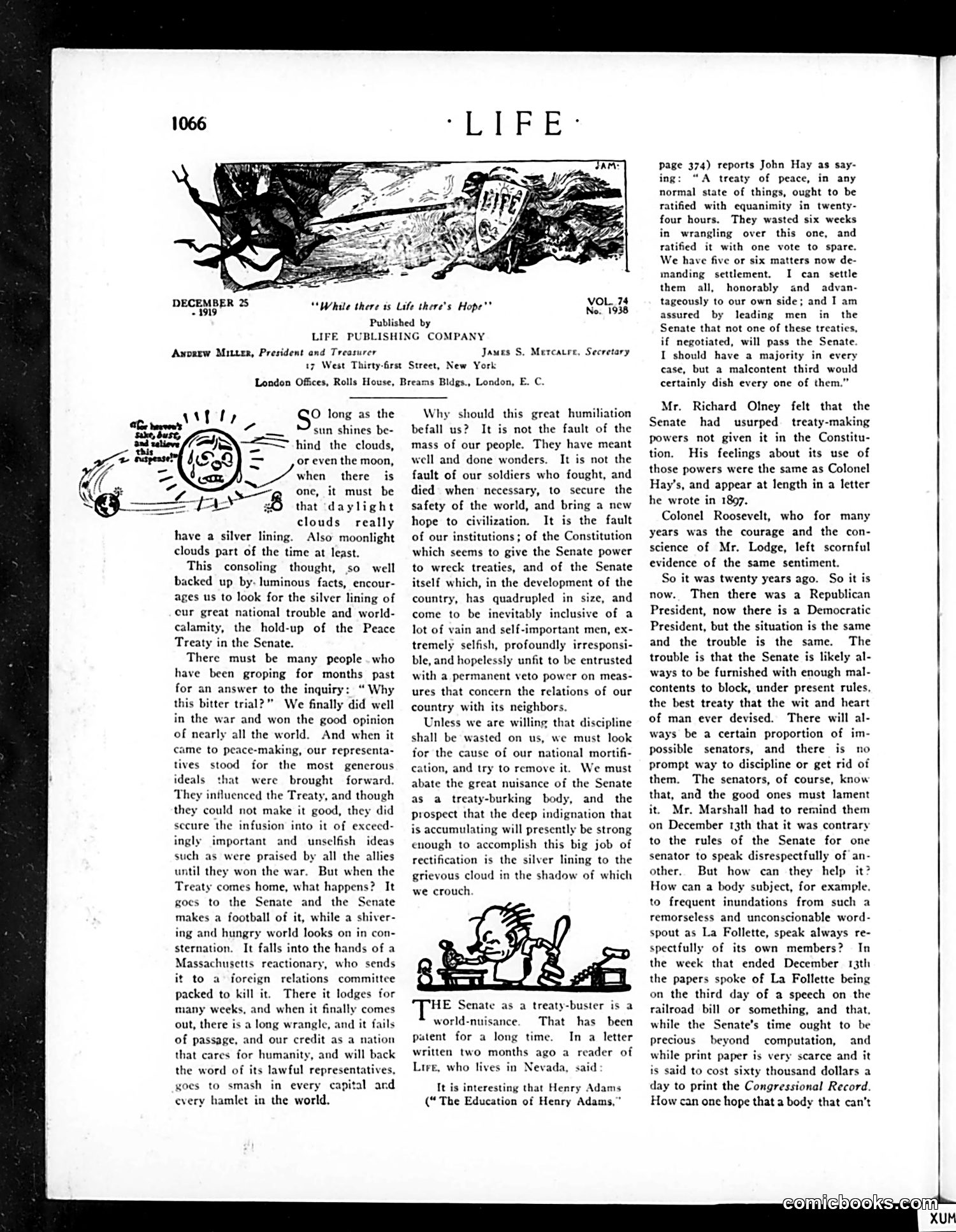
This page attacks the U.S. Senate's obstruction of the Treaty of Versailles following World War I. The editorial sardonically praises finding a "silver lining" to the national humiliation of the peace treaty's failure in the Senate. The cartoons depict the Sun (representing hope/optimism) and what appears to be a figure being crushed or defeated, visualizing America's diplomatic embarrassment. The text identifies a "Massachusetts reactionary" (likely Senator Henry Lodge) who chairs the Foreign Relations Committee and blocks treaty ratification. The author blames the Senate's constitutional veto power over treaties, arguing the institution has become filled with "vain and self-important men, extremely selfish, profoundly irresponsible." The piece advocates for reforming Senate treaty powers, calling the Senate a "world-nuisance" and "treaty-burking body." The rhetoric suggests urgent structural constitutional change is needed to prevent future diplomatic disasters. This reflects the intense post-WWI political debate over American isolationism versus international commitment.
📄 Transcribed text from this page (OCR, searchable)
Machine-transcribed from the original scan — historical spelling and the odd misread are preserved.
DECEMBER 25 199 “While there ts Life there's Hope"" No. 1938 Published by LIFE PUBLISHING COMPANY Awprew Mittrr, President and Treasurer Jaues S. Mercaure, Secretary 17 West Thirty-first Street, New York London Offices, Rolls House, Breams Bldgs., London, E. C. O long as the or even the moon, when there is one, it must be that daylight clouds really have a silver lining. Also moonlight clouds part of the time at least. This consoling thought, so well backed up by- luminous facts, encour- ages us to look for the silver lining of cur great national trouble and world- calamity, the hold-up of the Peace Treaty in the Senate. There must be many people who have been groping for months past for an answer to the inquiry: “Why this bitter trial?" We finally did well in the war and won the good opinion of nearly all the world. And when it came to peace-making, our representa- tives stood for the most generous ideals were brought forward. They influenced the Treaty, and though they could not make it good, they did secure the infusion into it of exceed- ingly important and unselfish ideas s were praised by all the allies until they won the war. But when the Treaty comes home, what happens? It gocs to the Senate and the Senate makes a football of it, while a shiver- ing and hungry world looks on in con- sternation. It falls into the hands of a Massachusetts reactionary, who sends it to a foreign relations committee packed to kill it. There it lodges for many weeks, and when it finally comes out, there is a long wrangle, and it fails of passage, and our credit as a nation that cares for humanity, and will back the word of its lawful representatives, goes to smash in every capital and every hamlet in the world. sue Why should this great humiliation befall us? It is not the fault of the mass of our people. They have meant well and done wonders. It is not the fault of our soldiers who fought, and died when necessary, to secure the safety of the world, and bring a new hope to civilization, It is the fault of our institutions; of the Constitution which seems to give the Senate power to wreck treaties, and of the Senate itself which, in the development of the country, has quadrupled in size, and come to be inevitably inclusive of a lot of vain and self-important men, ex- tremely selfish, profoundly irresponsi- ble, and hopelessly unfit to be entrusted with a permanent veto power on meas- ures that concern the relations of our country with its neighbors. Unless we are willing that discipline shall be wasted on us, we must look for the cause of our national mortifi- cation, and try to remove it. We must abate the great nuisance of the Senate as a treaty-burking body, and the prospect that the deep indignation that is accumulating will presently be strong enough to accomplish this big job of rectification is the silver lining to the grievous cloud in the shadow of which we crouch HE Senate as a treaty-buster is a world-nuisance. That has been patent for a long time. In a letter written two months ago a reader of Lire, who lives in Nevada, said It is interesting that Henry Adams (“ The Education of Henry Adams,” page 374) reports John Hay as say- ing: A treaty of peace, in any normal state of things, ought to be ratified with equanimity in twenty- four hours. They wasted six weeks in wrangling over this one, and ratified it with one vote to spare. We have five or six matters now de- manding settlement. I can settle them all, honorably and advan- tageously to our own side; and I am assured by leading men in the Senate that not one of these treaties, if negotiated, will pass the Senate. I should have a majority in every case, but a malcontent third would certainly dish every one of them.” Mr. Richard Olney felt that the Senate had usurped treaty-making powers not given it in the Constitu- tion. His feelings about its use of those powers were the same as Colonel Hay’s, and appear at length in a letter he wrote in 1897. Colonel Roosevelt, who for many years was the courage and the con- science of Mr. Lodge, left scornful evidence of the same sentiment. So it was twenty years ago. So now. Then there was a Republican President, now there is a Democratic President, but the situation is the same and the trouble is the same. The trouble is that the Senate is likely al- ways to be furnished with enough mal- contents to block, under present rules, the best treaty that the wit and heart of man ever devised. There will al- ways be a certain proportion of im- possible senators, and there is no prompt way to discipline or get rid of them. The senators, of course, know that, and the good ones must lament it. Mr. Marshall had to remind them on December 13th that it was contrary to the rules of the Senate for one senator to speak disrespectfully of an- other. But how can they help it? How can a body subject, for example. to frequent inundations from such a remorseless and unconscionable word- spout as La Follette, speak always re- spectfully of its own members? In the week that ended December 13th the papers spoke of La Follette being on the third day of a speech on the railroad bill or something, and that. while the Senate’s time ought to be precious beyond computation, and while print paper is very scarce and it is said to cost sixty thousand dollars a day to print the Congressional Record. How can one hope that a body that can’t