
Life, 1919-12-25 · page 17 of 37
Life — December 25, 1919 — page 17: what you’re looking at
What you’re looking at
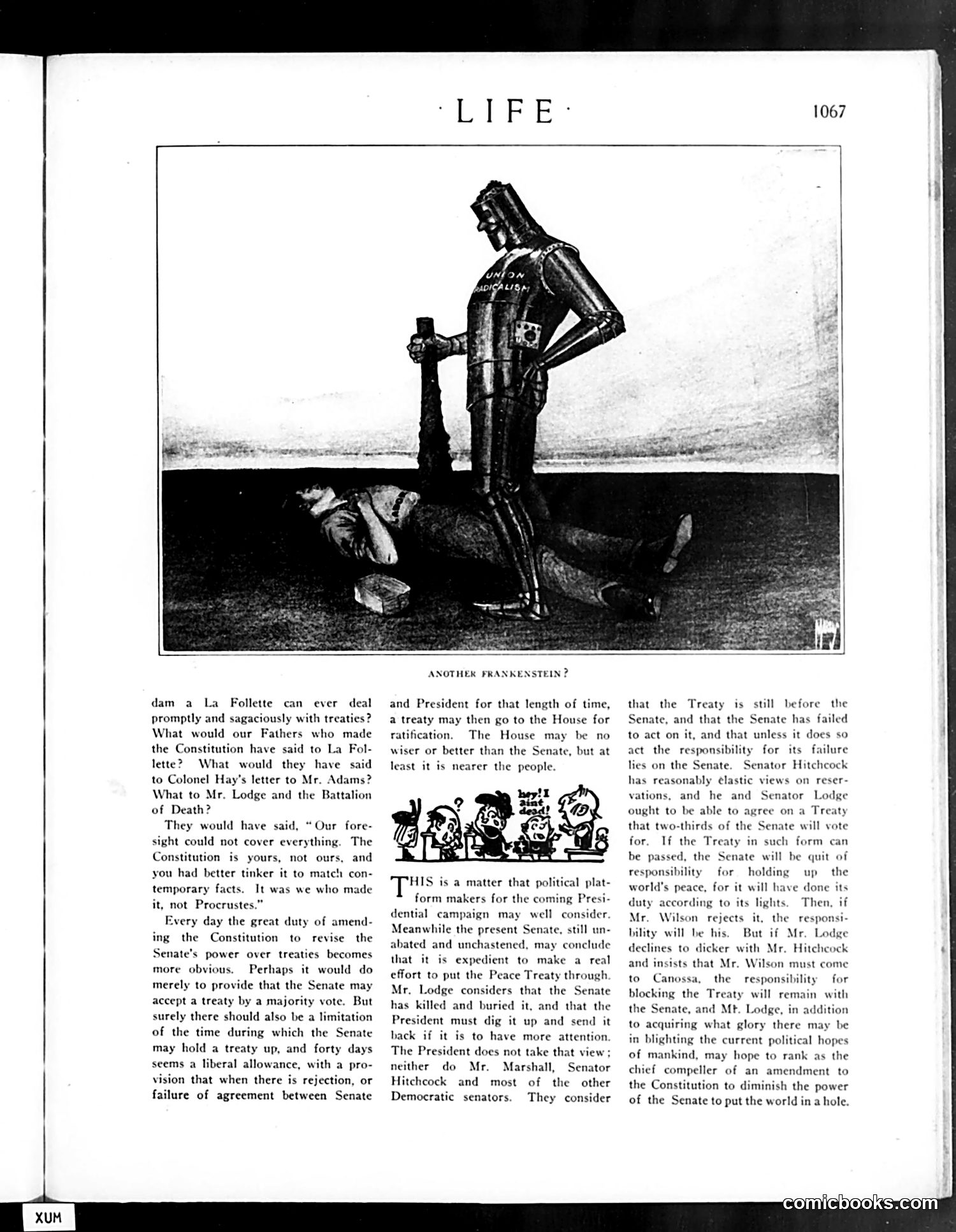
This Life magazine page satirizes the U.S. Senate's obstruction of the post-WWI Peace Treaty, likely the Treaty of Versailles around 1919-1920. **The Image:** Shows a grotesque, armor-clad figure (labeled "Another Frankenstein?") standing over a prone human, suggesting the Senate has created a monster that threatens civilization itself. **Key Figures Referenced:** - **Senator Henry Cabot Lodge**: Leading Republican opponent of the Treaty; the text criticizes his insistence that Wilson must capitulate ("come to Canossa") - **Senator Thomas Walsh (Hitchcock)**: Democratic supporter willing to compromise - **President Wilson**: Defending the Treaty - **La Follette**: Apparently referenced as an obstacle to rational treaty-making **The Satire's Point:** The Senate's power to block treaties has become destructive—a "Frankenstein" monster threatening world peace. The text proposes constitutional reform: limiting Senate treaty-blocking to 40 days, allowing House ratification as backup. Lodge is positioned as primarily responsible for keeping the world "in a hole" through partisan obstruction rather than compromise.
📄 Transcribed text from this page (OCR, searchable)
Machine-transcribed from the original scan — historical spelling and the odd misread are preserved.
dam a La Follette can ever deal promptly and sagaciously with treaties? What would our Fathers who made the Constitution have said to La Fol- lette? What would they have id to Colonel Hay’s letter to Mr. Adams? What to Mr. Lodge and the Battalion of Death? They would have said, “Our fore- sight could not cover everything. The Constitution is yours, not ours, and you had better tinker it to match con- temporary facts. It was we who made it, not Procrustes.” Every day the great duty of amend- ing the Constitution to revise the Senate's power over treaties becomes more obvious. Perhaps it would do merely to provide that the Senate may accept a treaty by a majority vote. But surely there should also be a limitation of the time during which the S nate may hold a treaty up, and forty days seems a liberal allowance, with a pro- vision that when there is rejection, or failure of agreement between Senate ANOTHER FRANKENSTEIN ? and President for that length of time, a treaty may then go to the House for ratification. The House may be no wiser or better than the Senate, but at least it is nearer the people. HIS is a matter that political plat- form makers for the coming Presi- dential campaign may well consider, Meanwhile the present Senate, still un- abated and unchastened, may conclude that it is expedient to make a real effort to put the Peace Treaty through. Mr. Lodge considers that the Senate has killed and buried it, and that the President must dig it up and send it back if it is to have more attention. The President does not take that view; neither do Mr. Marshall, Senator Hitchcock and most of the other Democratic senators. They consider that the Treaty is still before the Senate, and that the Senate has failed to act on it, and that unless it does so act the responsibility for its failure lies on the Senate. Senator Hitchcock has reasonably élastic views on reser- vations, and he and Senator Lodg' ought to be able to agree on a Treaty that two-thirds of the Senate will vote for. If the Treaty in such form can be passed, the Senate will be quit of responsibility for holding up the world’s peace, for it will have done its duty according to its lights. Then, if Mr. Wilson rejects it, the respor bility will be his. But if Mr. Lodge declines to dicker with Mr. Hitchcock and insists that Mr. Wilson must come to Canossa, the responsibility for blocking the Treaty will remain with the Senate, and Mt. Lodge, in addition to acquiring what glory there may be in lighting the current political hopes of mankind, may hope to rank as the chief compeller of an amendment to the Constitution to diminish the power of the Senate to put the world in a hole.