
Life, 1919-12-25 · page 20 of 37
Life — December 25, 1919 — page 20: what you’re looking at
What you’re looking at
This page reviews a stage play called "Abraham Lincoln," likely John Drinkwater's 1919 production. The article praises the English-written drama for giving Americans genuine insight into Lincoln's character and wisdom—particularly his foresight about war and aggression, quoted extensively here. The critique notes an irony: an Englishman created the most authentic Lincoln portrayal for American audiences, despite minor flaws like occasional British expressions and accents. The reviewer emphasizes that the play succeeds not through conventional romance or conflict, but through its philosophical depth and historical accuracy. The illustration shows what appears to be a theatrical scene, likely depicting Lincoln or a pivotal historical moment from the production. The piece argues that this "drama of the highest form" offers Americans valuable lessons during their own turbulent era—positioning Lincoln's restraint and moral wisdom as timely guidance.
📄 Transcribed text from this page (OCR, searchable)
Machine-transcribed from the original scan — historical spelling and the odd misread are preserved.
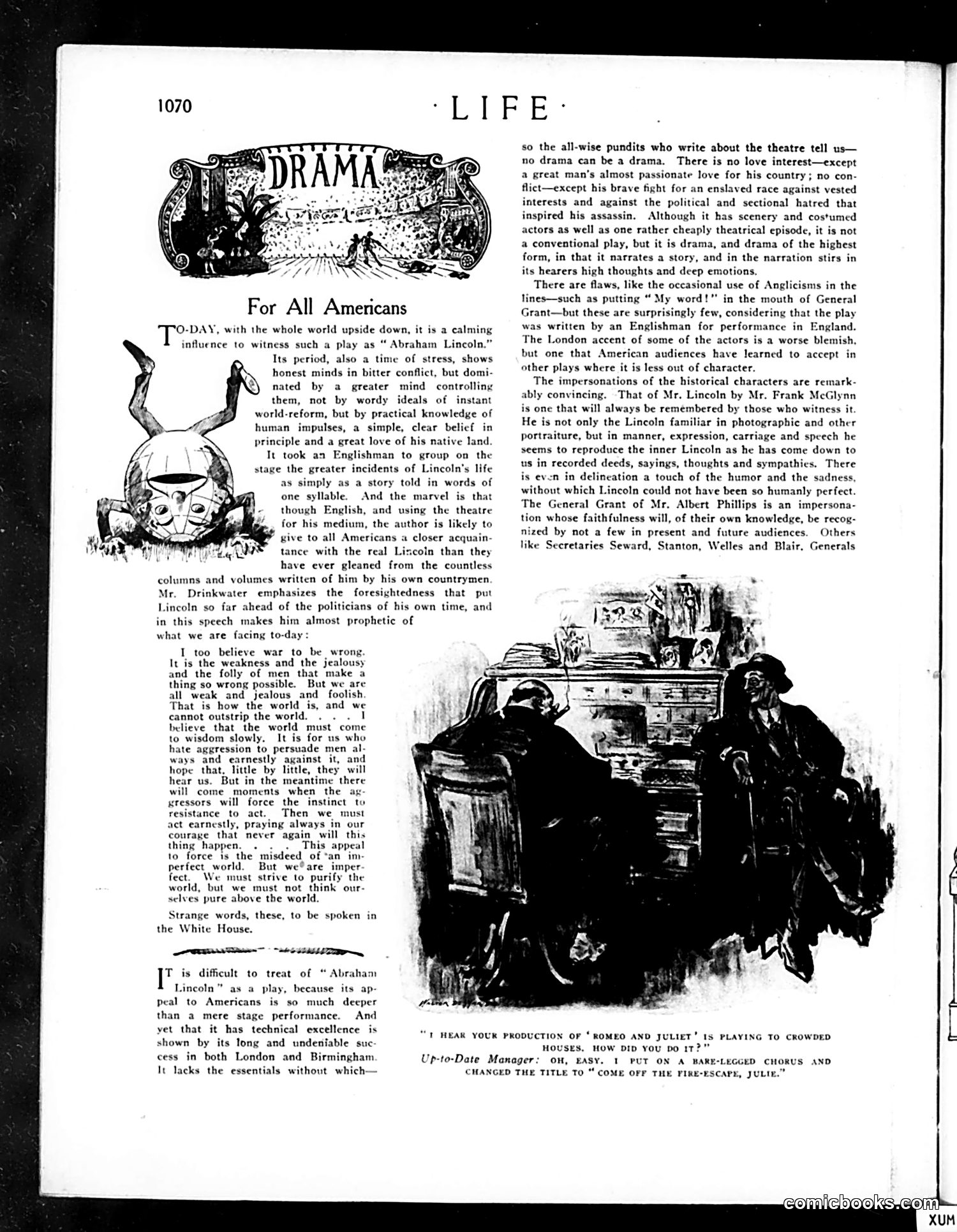
“LIFE: For All Americans ‘0-DAY, with the whole world upside down, it is a calming influence to witness such a play as “ Abraham Lincoln.” Its period, also a time of stress, shows honest minds in bitter conflict, but domi- nated by a greater mind controlling them, not by wordy ideals of instant world-reform, but by practical knowledge of human impulses, a simple, clear belief in principle and a great love of his native land. It took an Englishman to group on the stage the greater incidents of Lincoln's life as simply as a story told in words of one syllable. And the marvel is that though English, and using the theatre for his medium, the author is likely to give to all Americans a closer acquain- tance with the real Lincoln than they have ever gleaned from the countless columns and volumes written of him by his own countrymen Mr. Drinkwater emphasizes the foresightedness that put Lincoln so far ahead of the politicians of his own time, and in this speech makes him almost prophetic of what we are facing to-day: I too believe war to be wrong. It is the weakness and the jealo and the folly of men that make thing so wrong possible. But we are all weak and jealous and foolish That is how the world is, and we cannot outstrip the world. . . . I believe that the world must come to wisdom slowly. It is for us who hate aggression to persuade men al- ways and earnestly against i hope that, little by little, they hear us. But in the meantime there will come moments when the xressors will force the instinct t resistance to act. Then we must act earnestly, praying always in our courage that never again will this thing happen. . «This appea to force is the misdeed of *an ii perfect world. But we®are imper fect, We must strive to purify the world, but we must not think our- selves pure above the world. Strange words, these, to be spoken in the White House. pubiaie* ~hnceecnaséiay [ is difficult to treat of “Abraham Lincoln” as a play, because its ap peal to Americans is so much deeper than a mere stage performance. And yet that it has technical excellence is shown by its long and undeniable suc- cess in both London and Birmingham It lacks the essentials without which: so the all-wise pundits who write about the theatre tell us— no drama can be a drama. There is no love interest—except a great man’s almost passionate love for his country; no con- flict—except his brave fight for an enslaved race against vested interests and against the political and sectional hatred that inspired his assassin. Although it has scenery and costumed actors as well as one rather cheaply theatrical episode, it is not a conventional play, but it is drama, and drama of the highest form, in that it narrates a story, and in the narration stirs in its hearers high thoughts and deep emotions, There are flaws, like the occasional use of Anglicisms in the lines—such as putting “ My word!" in the mouth of General Grant—but these are surprisingly few, considering that the play was written by an Englishman for performance in England. The London accent of some of the actors is a worse blemish, but one that American audiences have learned to accept in other plays where it is less out of character. The impersonations of the historical characters are remark- ably convincing. That of Mr. Lincoln by Mr. Frank McGlynn is one that will always be remembered by those who witness it He is not only the Lincoln familiar in photographic and other portraiture, but in manner, expression, carriage and speech he seems to reproduce the inner Lincoln as he has come down to us in recorded deeds, sayings, thoughts and sympathies. There is even in delineation a touch of the humor and the sadness, without which Lincoln could not have been so humanly perfect. The General Grant of Mr. Albert Phillips is an impersona- tion whose faithfulness will, of their own knowledge, be recog- nized by not a few in present and future audiences. Others like Secretaries Seward, Stanton, Welles and Blair, Generals “1 HEAR YOUK PRODUCTION OF ‘ROMEO AND JULIET’ 1S PLAYING TO CROWDED HOUSES, HOW DID You Do IT Up-to-Date Manager: OM, EASY. 1 PUT ON A BARE-LEGGED CHORUS AND CHANGED THE TITLE To COME OFF THE FIRE-ESCAPE, JULIE.